 Ryan Delgado
 Choosing the best timer switches can turn an ordinary home into a smarter, safer, and more energy-efficient space without any complicated wiring or expensive automation hubs. Whether you want your bathroom exhaust fan to shut off automatically, your porch lights to follow the sunset, or your holiday decorations to run on a fixed schedule, a good timer switch quietly handles the job for you. This buying guide walks you through how these devices work, the different types available, and the key features to weigh before you buy, so you can pick the right model with confidence.
Instead of ranking each product one by one, we focus on the decisions that actually matter: mechanism type, wiring requirements, load compatibility, and scheduling flexibility. Along the way, we reference a curated shortlist of popular options so you can jump straight to the ones that fit your needs.

Pros
- 4 programmable on/off buttons plus 2 manual override buttons for changing plans without reprogramming the schedule
- Battery backup keeps programmed times saved through a power outage
- Rated for 120VAC, 15A general/resistive load and up to 1200W of tungsten lighting
- Compatible with LED, CFL, incandescent, halogen and select dimmable LED/CFL bulbs
- Blue LED indicators next to each button show at a glance which program is active
Cons
- Requires a neutral wire at the switch box, so it will not install in older 2-wire-only wall boxes without adding one
- Wall plate is not included, so a separate cover plate needs to be purchased to match your decor
- Screw-terminal wiring takes more time to install than a plug-in outdoor timer, and is best handled by someone comfortable working at a breaker panel
The timer offers 4 programmable on/off time slots along with 2 manual override buttons for turning the connected light or fan on or off outside the set schedule, all on a repeating 24-hour daily cycle.
- 4 programmable on/off buttons for scheduled times
- 2 manual override buttons for immediate control
- Blue LED indicators show which program is currently active
Because the schedule repeats every 24 hours without needing to be reset, it is built for a routine that stays the same day to day, such as porch lighting or an exhaust fan, rather than a schedule that changes daily.
This timer installs in place of an existing wall switch and requires a neutral wire at the box, connected using screw terminals rather than flying leads, which saves space compared with older in-wall timer designs.
- Neutral wire required at the switch box
- Screw-terminal connections for a more compact fit in standard boxes
- Wall plate not included and must be purchased separately
Because it replaces a standard switch and ties into house wiring, installation should be done with the breaker off, and anyone unsure about identifying a neutral wire should confirm compatibility before purchase or bring in an electrician.
Electrical specifications cover 120VAC 60Hz at 15A for general/resistive loads, 1200W for tungsten lighting, 1200VA for ballast loads, and up to 1/2 HP for connected motors such as exhaust fans, and the unit is UL Listed.
- Compatible with LED, CFL, incandescent and halogen bulbs
- Also works with select dimmable LED and dimmable CFL bulbs
- Battery backup preserves programmed settings through a power outage
Because the load specifications are specific to bulb and motor type, checking the connected fixture's wattage and bulb type against these limits beforehand avoids overloading the switch on a high-draw fixture.
Pros
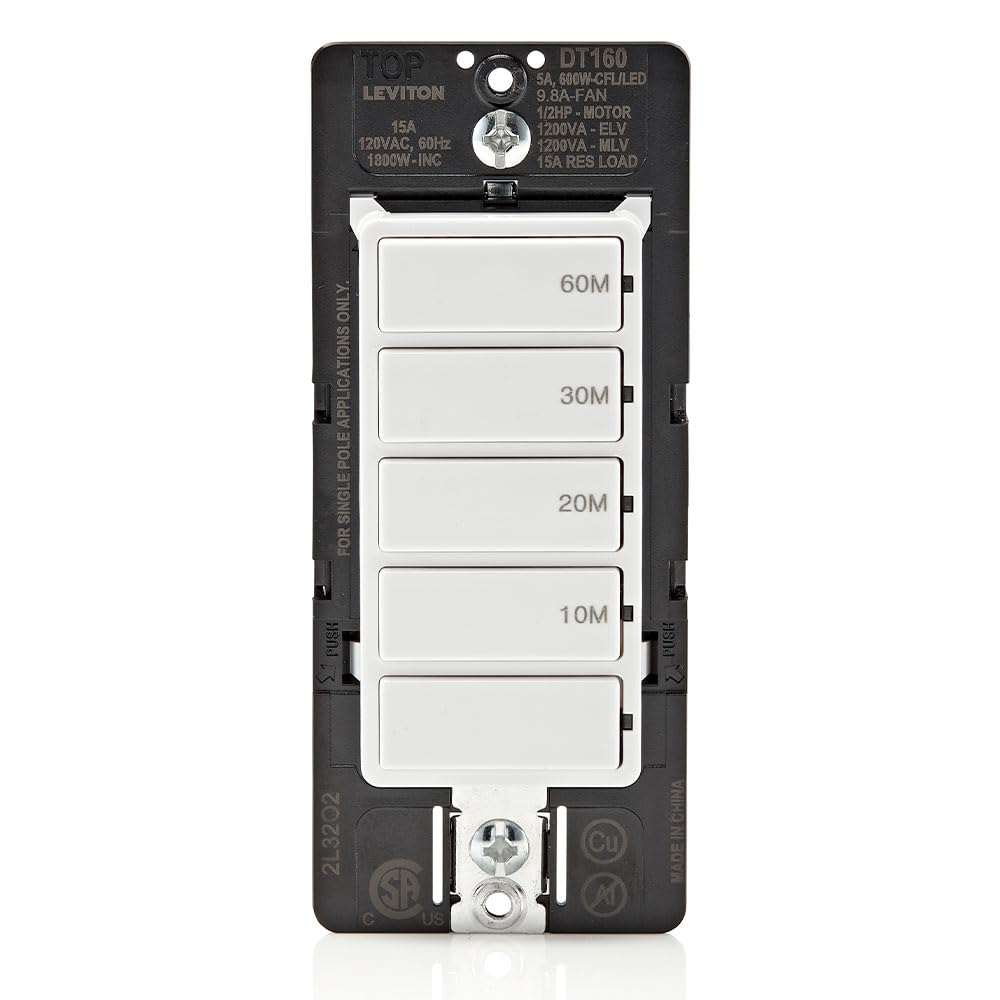
- Four preset timers, 10, 20, 30, and 60 minutes, auto-shutoff without needing to remember to switch off manually
- Green Flex Sleeve wires to ground when no neutral is present, so it installs in boxes without a neutral wire
- Rated for 1/2 HP / 9.8A fan or motor loads alongside standard lighting circuits
- Interchangeable line and load wires reduce the chance of miswiring during a DIY install
Cons
- Rated 15A resistive with specific wattage caps per load type, so mixed high-wattage circuits need checking against the spec before install
- A ground wire is required for installation, so ungrounded older wiring will not accept this switch without an upgrade first
- Faceplates in colors beyond white are sold separately as accessories, not included with the switch
The switch offers four preset countdown times, 10, 20, 30, and 60 minutes, plus a manual off button, so a fan or light left running shuts off automatically without needing to remember it. Pressing a preset button starts the countdown immediately.
- 10, 20, 30, and 60-minute preset countdown buttons
- Manual off button available separate from the timed presets
- Automatic shutoff prevents fans or lights from being left on unintentionally
Because the presets are fixed rather than a dial, setting a time is a single button press, though times between the four presets are not selectable.
The switch uses a Green Flex Sleeve that wires directly to ground when no neutral wire is present in the wallbox, or connects to a neutral if one is available after removing the sleeve. A ground wire is required either way for installation.
- Green Flex Sleeve adapts to boxes with or without a neutral wire
- Two interchangeable black wires reduce the risk of miswiring line and load
- Shallow single-pole design fits standard wallbox depth without a deeper box
Because a ground wire is mandatory, ungrounded two-wire wallboxes found in some older homes will need a grounded upgrade before this switch can be installed.
The timer is rated for 600W LED/CFL, 1800W incandescent/halogen, 1200VA magnetic or electronic low-voltage/fluorescent, and 1/2 HP (9.8A) fan or motor loads at 15A resistive, covering most bathroom fan and lighting circuits in one switch.
- 1/2 HP / 9.8A spec covers most bathroom exhaust fans and small motors
- 600W LED/CFL and 1800W incandescent/halogen limits cover common lighting loads
- Commonly used for heat lamps, towel warmers, hot tubs, saunas, and attic fans
It should not be used to control the only light source in a room, since the automatic shutoff would leave the space dark without warning.

Pros
- Five preset buttons cover 15 min, 30 min, 1 hour, and 2 hour countdowns plus a manual off
- Handles up to 1800W incandescent, 600W LED/CFL, or a 1 HP/16A fan or motor load
- Shallow housing fits standard wallboxes without extra depth for tight retrofits
- Pairs with a second DT202 unit for multi-timer control, or a DD0SR companion for 3-way wiring
Cons
- Requires a neutral wire in the wallbox, so older homes without one cannot install it
- Should not be the only light source in a room per the manufacturer, limiting where it belongs
- Faceplate colors beyond white require buying a separate DTKIT accessory kit
The DT202-1LW replaces a standard wall switch with five buttons: 15-minute, 30-minute, 1-hour, and 2-hour countdowns, plus a manual off that cancels the timer instantly. Once a preset is pressed the connected load runs for that duration and then shuts off on its own.
- Rated for 1800W incandescent/halogen, 600W LED/CFL, 1200VA magnetic or electronic low-voltage/fluorescent loads
- Handles a 1 HP or 16A fan/motor, and 20A resistive or 16A inductive loads
That range covers exhaust fans, attic fans, pool pumps, hot tub equipment, and heat lamps as well as ordinary lighting circuits, so the same switch can automate several categories of fixture rather than lighting alone. The manual-off button also means a countdown can be cut short at any point without waiting it out.
Installation follows a standard single-pole wall switch swap, but this unit needs a neutral wire present in the box, which is common in newer construction but not guaranteed in older homes. Its shallow design is meant to fit into standard wallboxes without the crowding some electronic timers cause.
- Single-pole wiring covers the most common setup
- A DD0SR switch companion adds 3-way or multi-way control from a second location
- Two DT202 units can be linked for multi-timer operation on the same circuit
The wallplate is sold separately and is compatible with Decora and Decora Plus screwless plate styles, so the finished look can be matched to existing switches in the room. Because a manufacturer caution advises against using it as a room's sole light source, pairing it with another switched fixture is worth planning for ahead of installation.
This switch is built for loads people tend to forget to turn off. Porch and landscape lighting, bathroom exhaust fans, heat lamps, pool pumps, hot tubs, saunas, and attic fans all fit within its rated capacity, and the countdown removes the need to remember a manual shutoff.
- Homeowners with an attic fan or pool pump gain an automatic cutoff without adding a smart hub
- Bathrooms benefit from a fan that runs a fixed cycle after someone leaves
- Multi-timer wiring with a second DT202 suits rooms needing independent zones
It is less suited to anyone lacking a neutral wire in their wallbox, since that is a hard requirement rather than an option, and to rooms where this switch would be the only source of light, given the manufacturer's guidance against that setup.

Pros
- Green Flex Sleeve wires to ground when no neutral wire is present, or connects to neutral if available
- Shallow design fits inside standard wallboxes without extra depth
- Interchangeable line and load wires reduce the chance of miswiring during a DIY install
- Handles 600W LED/CFL, 1800W incandescent/halogen, or 1/2 HP/9.8A fan and motor loads
- Faceplate color can be changed later using separate DTKIT faceplates
Cons
- Preset countdown times are fixed at 2, 4, 8, and 12 hours, with no custom interval in between
- A ground wire is required for installation, so older wiring without a ground path won't support it
- Single pole switch only, not built for 3-way circuits controlling a light from two locations
Installation uses Leviton's Green Flex Sleeve, which wires directly to ground when no neutral wire is present in the wallbox, or can have the sleeve removed to connect to a neutral wire where one exists. A shallow design lets the switch fit into standard wallboxes without the depth issues some timer switches run into.
- Green Flex Sleeve for no-neutral or neutral wiring
- Shallow profile fits standard wallboxes
- Interchangeable line and load wires
A ground wire is required for the install regardless of neutral wiring, so homes without a grounded circuit at the switch location cannot use this timer as-is.
Four preset buttons cover 2, 4, 8, and 12-hour countdowns, along with a manual off button for ending a cycle early. Pressing a preset starts the countdown immediately, and the switch turns the connected load off automatically once time expires, without needing to remember to switch it off manually.
- Presets: 2, 4, 8, and 12 hours
- Manual off button for early cancellation
- Automatic shutoff at the end of each countdown
Because the presets are fixed rather than freely adjustable, tasks needing an odd interval, like 6 hours, require rounding up or down to the nearest available preset.
The switch is rated for 600W of LED/CFL, 1800W of incandescent or halogen, 1200VA of magnetic or electronic low-voltage and fluorescent loads, and 1/2 HP/9.8A for fans and motors, at 15A resistive overall. That range covers most single-fixture lighting circuits as well as bathroom exhaust fans and similar small motor loads.
- 600W LED/CFL, 1800W incandescent/halogen
- 1200VA MLV/ELV/fluorescent
- 1/2 HP / 9.8A fan or motor load
Checking the connected fixture's wattage or motor draw against these limits beforehand avoids overloading the switch on a large lighting bank or a higher-draw exhaust fan.

Pros
- Single-button presets cover 1, 2, 4, or 8 hours, plus a HOLD mode for continuous on use without a timer running
- Electronic design runs silently, unlike mechanical countdown timers that tick during the countdown
- Rated for 120 VAC/60Hz circuits at up to 15A, covering typical whole house fan and lighting loads
- Compatible with incandescent, fluorescent, CFL, and LED loads, so it works across older and newer bulb types
- No programming is required; a single button press starts the countdown immediately
Cons
- Requires a neutral wire connection at the switch box, which some older homes without a neutral present will not have
- A decorator-style wall plate is not included, so a matching cover plate needs to be purchased separately
- Not intended for use with sunlamps, saunas, or other loads where incorrect timing could create a safety risk
A single button press activates one of four preset countdown times: 1, 2, 4, or 8 hours, plus a HOLD mode for continuous on use when the connected load should stay on.
- No programming is required; presets are fixed and selected with one button press
- Electronic timing eliminates the ticking sound of mechanical countdown timers, suited to bedrooms and bathrooms
- The switch is popular for whole house fans, where a fixed run time avoids leaving the fan on overnight by mistake
Once a preset finishes counting down, the connected load shuts off automatically, removing the need to remember to turn a fan or light back off manually.
The timer replaces a standard single-pole wall switch and measures 1.44"D x 4.13"W x 1.69"H to fit a standard switch box.
- Installation requires a neutral wire connection at the switch box, which is standard in newer construction but may be absent in some older homes
- It uses an SPST (single-pole, single-throw) configuration, matching common single-switch wiring setups
- A decorator-style wall plate is not included, so a separate cover plate is needed to complete the installation's finished look
Anyone unsure whether their switch box has a neutral wire present should check before purchase, since the timer will not function without one.
The switch is rated for 120 VAC/60Hz circuits at up to 15A, and works with incandescent, fluorescent, CFL, and LED loads.
- Whole house fans are a common load for this switch, letting the fan run for a fixed window before shutting off automatically
- The 15A capacity covers typical single-circuit fan and lighting loads found in residential wiring
- It is explicitly not intended for sunlamps, saunas, or other loads where incorrect timing could create a safety risk
Confirming a connected load's amperage draw against the 15A limit before installation helps avoid overloading the switch in higher-draw applications.

Pros
- 8 Pre-Set Options: Countdown timer switch offers pre-set countdown
- Energy Saving: Electric timer switch turns off the load by
- Simple Operation: The timer switch offers countdown mode and
- Wide Application: In-wall timer switch's LED indicator light stays
- Dimensions of 4.72 x 1.46 x 1.65 inches engineered for optimal spatial fitting
Cons
- Requires verifying placement clearance for 4.72 x 1.46 x 1.65 inches prior to installation
- Requires gentle maintenance routines to preserve the Copper, Metal, Polycarbonate finish
Designed with precision, the ECOELER ECOELER 4Hrs Countdown Timer Switch 1-5-10-20-30-60 Min delivers versatile performance for modern Timer Switches spaces. Technical integration focuses on functional efficiency, incorporating 8 Pre-Set Options: Countdown timer switch offers pre-set countdown options (1 min, 5 mins, 10 mins, 15mins, 30 mins, 60 mins, 2 hours, or 4 hours). Easily override any countdown with the manual on/off button for instant control. Its balanced engineering incorporates Energy Saving: Electric timer switch turns off the load by countdown time, ensuring that light/fan are never left on accidentally. Say goodbye to wasted energy and high electricity bills. Ideal for lights, ceiling fans, bathroom fans, and heaters to streamline day-to-day interactions. Measurements of 4.72 x 1.46 x 1.65 inches provide clear dimensional boundaries for precise space planning.
Evaluating build quality and structural execution reveals strong manufacturing standards across components. The physical build incorporates Simple Operation: The timer switch offers countdown mode and constant on mode. Press the selection button to choose your desired time. To enter constant on mode, hold the ON/OFF button for more than 5 seconds, providing essential protection against surface wear. High tolerance assembly prevents unexpected mechanical looseness during daily operation. Constructed using quality Copper, Metal, Polycarbonate, outer surfaces withstand routine contact without losing visual appeal. Using proper installation techniques maintains physical stability across daily activities. This balanced configuration fits smoothly into existing interior designs while maximizing efficiency.
Long-term operational satisfaction is supported by adhering to standard installation and cleaning practices. Thanks to Wide Application: In-wall timer switch's LED indicator light stays on, making it easy to locate in the dark. Ideal for use in bathrooms, closets, pantries, garages, laundry rooms, spas, enclosed patios, and more, spatial alignment and initial setup progress smoothly for homeowners. Simple preventative care maintains mechanical responsiveness and aesthetic value over extended use. Using proper installation techniques maintains physical stability across daily activities. This balanced configuration fits smoothly into existing interior designs while maximizing efficiency. Quality craftsmanship supports long term satisfaction for residential and professional settings.
Pros
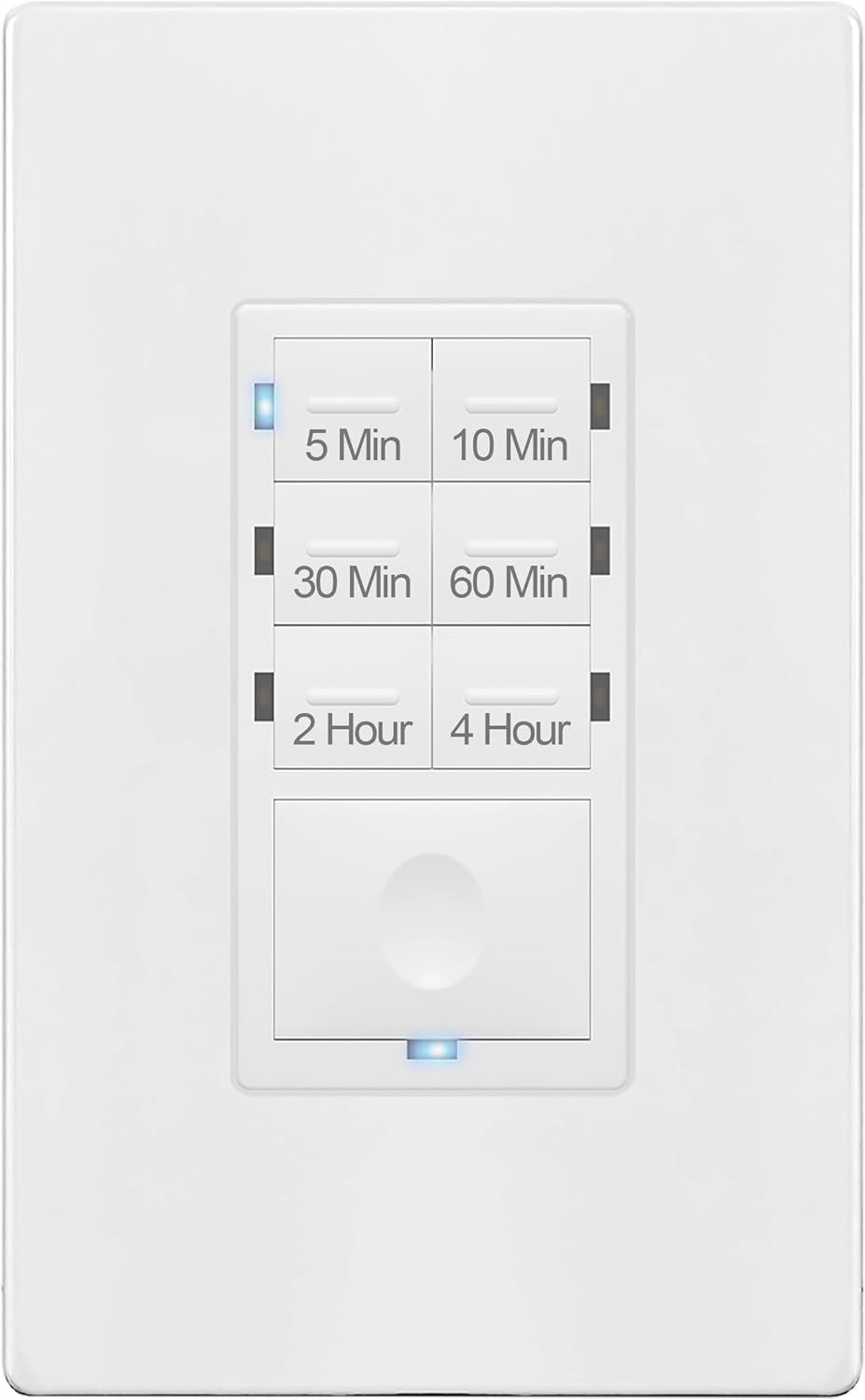
- 6 preset countdown options from 5 minutes to 4 hours, plus a manual on/off button
- UL listed and rated for 120VAC 60Hz operation with a stated 3-year warranty
- Handles incandescent loads up to 1000W, fluorescent up to 1200VA, or motor loads up to 1/2HP
- Blue LED flash confirms a successful timer setting before it counts down silently
- Screwless wall plate is included, so no separate plate purchase is needed
Cons
- Requires a neutral wire in the wall box, so older homes without one cannot install it without rewiring
- Operating range is limited to 32°F–131°F (0°C–55°C), so unconditioned spaces outside that range are not rated for it
- Single white finish only, with no color or decora-style variant listed
This switch requires a neutral wire present in the wall box, which is standard on newer construction but often missing on older single-pole switch runs. It's built to replace a standard single-pole light or fan switch, and ships with a screwless wall plate for a finished look without buying a separate cover.
- Neutral wire required for installation
- Replaces a standard single-pole switch
- Screwless wall plate included
Because the neutral wire requirement is non-negotiable, checking the wall box before ordering avoids a return or an electrician visit to add the missing wire.
Six countdown presets cover 5, 10, 30 and 60 minutes, plus 2-hour and 4-hour options, selected with a button press rather than a dial. A manual on/off button is also available for standard, non-timed operation. Two indicator modes confirm the setting: a double blue flash on success, then the LED stays lit for the full countdown before shutting off.
- Presets: 5 min, 10 min, 30 min, 60 min, 2 hr, 4 hr
- Manual on/off mode available alongside the timer
- LED indicator confirms active countdown status
All connected loads shut off automatically once the selected time expires, with no override needed to end the cycle early beyond pressing the button again.
The switch is UL listed and rated for 120VAC at 60Hz, handling incandescent loads up to 1000W, fluorescent loads up to 1200VA, or motor loads up to 1/2HP, which covers most bathroom exhaust fans, ceiling fans and light fixtures. It's rated for operation between 32°F and 131°F with humidity up to 95% non-condensing.
- Incandescent: up to 1000W
- Fluorescent: up to 1200VA
- Motor loads: up to 1/2HP
The stated 3-year warranty covers the switch itself, though the load limits mean it is not intended for higher-draw motors or industrial-grade fans beyond 1/2HP.

Pros
- Countdown timer adjusts from 5 to 60 minutes in six preset steps (5, 10, 15, 30, 45, 60), set with a rocker panel on the side
- Rated to control a 3 Amp high-efficiency exhaust fan, and compatible with up to 150W of LED lighting or 600W of incandescent/halogen load
- Double-tap switches to always-on mode, bypassing the countdown when continuous lighting or ventilation is needed
- Softly lit LED indicators show remaining time at a glance without needing to check a display
- Installs in about 15 minutes into a standard wall box, though a neutral wire is required for the switch to function
Cons
- Requires a neutral wire at the switch box, so older homes wired without one need an electrician before this switch can be installed
- Multi-location control needs a separate Maestro accessory switch (MA-AS), sold separately, added to the wiring
- Coordinating Claro wallplate is sold separately, so the switch ships without a finished cover plate
The countdown timer runs from 5 minutes up to 60 minutes across six fixed presets: 5, 10, 15, 30, 45, and 60 minutes. A single tap on the large tap switch starts the countdown at whichever preset the rocker panel is set to, while a double tap switches the load to always-on, bypassing the timer entirely.
- Six countdown presets: 5 / 10 / 15 / 30 / 45 / 60 minutes
- Single tap starts the countdown; double tap holds the load on continuously
- Rocker panel on the side sets which preset is active
- Softly lit LEDs indicate the time remaining before shutoff
That range covers both quick uses, like a bathroom exhaust fan, and longer uses, like lighting in a closet or garage while carrying items back and forth.
This switch is rated to control a 3 Amp high-efficiency exhaust fan, which covers most DC and high-efficiency bathroom fans on the market, and it also handles lighting loads up to 150W of LED bulbs or 600W of incandescent, halogen, magnetic, or electronic low-voltage lighting.
- Controls up to a 3A high-efficiency exhaust fan
- Up to 150W LED lighting load
- Up to 600W incandescent, halogen, magnetic, or electronic low-voltage lighting load
For a bathroom setup, Lutron suggests pairing this timer with a Maestro motion sensor (MS-OPS2, sold separately) so the timer runs the exhaust fan while the sensor independently handles the lighting, rather than tying both to the same switch.
Installation is designed to take about 15 minutes and works in both single-pole setups and multi-location setups, though multi-location control requires pairing with a separate Maestro accessory switch (MA-AS), sold separately. A neutral wire is required at the switch box for the timer to operate.
- Single-pole installation out of the box; multi-location needs an MA-AS accessory switch
- Neutral wire required at the switch location
- Fits a standard wall box at 1.5 x 2.2 x 4 inches
- Coordinating Claro wallplate sold separately for a finished look
Because the neutral wire requirement rules out some older two-wire switch loops, checking the existing wiring at the box before ordering avoids a return trip to the hardware store mid-installation.

Pros
- Country of Origin: CHINA
- The Package Length of the product is 6.6 inches
- The Package Width of the product is 7.87 inches
- The Package Height of the product is 12.19 inches
- Dimensions of 3 x 2 x 1 inches engineered for optimal spatial fitting
Cons
- Requires verifying placement clearance for 3 x 2 x 1 inches prior to installation
- Requires gentle maintenance routines to preserve the Plastic finish
The HoneywellAirComfort Honeywell Timer Switch with Sunrise Sunset Single or 3 Way is engineered to address the operational demands of Timer Switches environments. Practical hands-on evaluation highlights core functional attributes including Country of Origin: CHINA. Furthermore, features like The Package Length of the product is 6.6 inches ensure seamless adaptability across varied spatial layouts. Measurements of 3 x 2 x 1 inches provide clear dimensional boundaries for precise space planning. User centered design choices streamline routine interactions and enhance practical convenience. Robust physical construction provides verified peace of mind during heavy daily usage. Thoughtful spatial layout allows versatile placement across modern living environments.
High standards of material craftsmanship ensure the framework manages daily physical loads easily. Materials engineering centers on The Package Width of the product is 7.87 inches, preserving visual appeal and physical integrity over time. Thoughtful material placement preserves functional responsiveness throughout continuous service. Constructed using quality Plastic, outer surfaces withstand routine contact without losing visual appeal. User centered design choices streamline routine interactions and enhance practical convenience. Robust physical construction provides verified peace of mind during heavy daily usage. Thoughtful spatial layout allows versatile placement across modern living environments. Dependable hardware performance ensures consistent operational output throughout the year.
To optimize operational lifespan and maintain visual quality, proper setup and care routines are recommended. With user-friendly details such as The Package Height of the product is 12.19 inches, setting up the equipment requires minimal effort. Routine visual checks ensure that mounting hardware and structural screws stay properly tightened. User centered design choices streamline routine interactions and enhance practical convenience. Robust physical construction provides verified peace of mind during heavy daily usage. Thoughtful spatial layout allows versatile placement across modern living environments. Dependable hardware performance ensures consistent operational output throughout the year. Precision engineering delivers a stable foundation tailored for active household demands.

Pros
- - Experience automatic astronomic On/Off control, providing the
- SETUP WITH LARGE LCD - ASCEND's intuitive setup and large backlit
- MODERN SLEEK DESIGN - Enhance your home's aesthetics with ASCEND's
- DST WITH BATTERY BACKUP - Enjoy automatic Daylight Saving Time
- Dimensions of 1.33"D x 1.75"W x 2.75"H engineered for optimal spatial fitting
Cons
- Requires verifying placement clearance for 1.33"D x 1.75"W x 2.75"H prior to installation
- Requires gentle maintenance routines to preserve the Plastic, Steel finish
The Intermatic Intermatic ST700W Ascend 7-Day in-Wall Programmable Timer provides dependable operation suited for contemporary indoor Timer Switches configurations. Technical integration focuses on functional efficiency, incorporating - Experience automatic astronomic On/Off control, providing the most accurate lighting schedule with dusk and dawn times for enhanced energy efficiency.. Its balanced engineering incorporates SETUP WITH LARGE LCD - ASCEND's intuitive setup and large backlit LCD screen make programming up to 42 unique events effortless, empowering homeowners to automate lighting schedules easily. to streamline day-to-day interactions. Measurements of 1.33"D x 1.75"W x 2.75"H provide clear dimensional boundaries for precise space planning.
Evaluating build quality and structural execution reveals strong manufacturing standards across components. The physical build incorporates MODERN SLEEK DESIGN - Enhance your home's aesthetics with ASCEND's modern and sleek design, suitable for various lighting applications, including porches, hallways, patios, and more., providing essential protection against surface wear. High tolerance assembly prevents unexpected mechanical looseness during daily operation. Constructed using quality Plastic, Steel, outer surfaces withstand routine contact without losing visual appeal. Using proper installation techniques maintains physical stability across daily activities. This balanced configuration fits smoothly into existing interior designs while maximizing efficiency. Quality craftsmanship supports long term satisfaction for residential and professional settings.
Long-term operational satisfaction is supported by adhering to standard installation and cleaning practices. Thanks to DST WITH BATTERY BACKUP - Enjoy automatic Daylight Saving Time (DST) adjustment and non-replaceable battery backup, ensuring time and date information retention during power loss for uninterrupted functionality., spatial alignment and initial setup progress smoothly for homeowners. Simple preventative care maintains mechanical responsiveness and aesthetic value over extended use. Using proper installation techniques maintains physical stability across daily activities. This balanced configuration fits smoothly into existing interior designs while maximizing efficiency. Quality craftsmanship supports long term satisfaction for residential and professional settings.
What Is a Timer Switch and Why You Might Need One
A timer switch replaces a standard wall switch and automatically controls how long a connected device stays on. Some models simply count down and turn off after a set number of minutes, while others follow a full daily or weekly schedule. The core benefit is the same: you no longer have to remember to flip a switch off, and your lights, fans, and heaters run only when they should.
These switches are popular for a reason. They cut wasted electricity, extend the life of appliances that would otherwise run for hours, and add a layer of convenience and security. Leaving lights on a schedule while you travel, for example, makes a home look occupied. In bathrooms, a countdown timer clears humidity and then shuts the fan off on its own, protecting against mold without running all day.
Common Uses Around the Home
- Bathroom and exhaust fans: Run for a set number of minutes after a shower, then stop automatically.
- Indoor and outdoor lighting: Follow sunrise and sunset or a fixed daily schedule.
- Heaters and heat lamps: Prevent accidental all-day operation with a firm countdown limit.
- Whole-house and attic fans: Cool the home for a preset window, then shut down overnight.
- Seasonal and security lighting: Automate porch lamps and decorations for peace of mind.
The Main Types of Timer Switches
Understanding the categories is the fastest way to narrow your options. Most timer switches fall into one of three broad groups, and knowing which one suits your task saves you from buying the wrong tool.
Countdown Timer Switches
Countdown timers are the simplest and most intuitive. You press a preset button, the switch runs for that duration, and it turns off automatically. They are ideal for fans, heaters, and any load you only want on temporarily. Models like the Leviton Countdown Timer (10-60 min) and its shorter-interval sibling, the Leviton Countdown Timer (2-15 min), cover quick tasks, while the Leviton Countdown Timer (2-12 hr) handles longer runs for heaters and exhaust fans. Budget-friendly picks such as the ECOELER Countdown Timer and the ENERLITES Countdown Timer offer flexible ranges from a few minutes up to four hours.
Programmable Digital Timers
Programmable timers let you set specific on and off times across a 24-hour day or a full week. They are perfect for lighting routines that repeat, giving you granular control with multiple daily events. The myTouchSmart In-Wall Digital Timer offers programmable on/off buttons with battery backup, while the Intermatic Ascend 7-Day Timer steps things up with dozens of scheduling events and astronomic control.
Astronomic and Smart Timers
Astronomic timers track your local sunrise and sunset and adjust automatically throughout the year, so outdoor lights always follow the changing daylight. The Honeywell Sunrise Sunset Timer is built around this idea, and premium programmable models increasingly bundle astronomic features and automatic daylight-saving adjustments so you never have to reset them.
Key Features to Compare Before You Buy
Once you know the type you want, these are the specifications that separate a frustrating purchase from a switch that just works.
Neutral Wire vs. No Neutral Required
This is the single most important compatibility check. Many older homes, especially those built before the 2010s, lack a neutral wire in the switch box. Some timers demand a neutral to power their electronics, while others are designed to work without one. If you are unsure what is behind your wall plate, prioritize a no-neutral model. The Leviton countdown line, for instance, is designed to install without a neutral wire, which makes retrofits far easier. Neutral-required models like the ECOELER and ENERLITES units are excellent choices in newer homes where that wire is present.
Load Type and Rating
Timer switches are rated for specific loads, and mismatching them can cause flickering, buzzing, or premature failure. Check whether the switch supports LED bulbs, motors and fans, or resistive loads like heaters. Fan-rated models list a motor rating (often expressed in horsepower or amps), while lighting-focused switches note their wattage capacity. If you plan to control dimmable LEDs, look specifically for LED compatibility, as with the Lutron Maestro Timer, which is tuned for low-wattage LED loads and multi-location setups.
Single-Pole vs. Multi-Location
A single-pole switch controls a circuit from one location. If a light or fan is operated from two or more switches, you need a model that supports 3-way or multi-location wiring. The Lutron Maestro and Honeywell units support multi-location configurations, making them a smart pick for hallways, stairwells, and large rooms with more than one entry point.
Indoor vs. Outdoor and Environmental Rating
If you are automating porch, garden, or patio lighting, confirm the switch and any paired fixtures are suitable for the conditions. In-wall switches themselves usually sit indoors, but the loads they drive may be outdoors. The myTouchSmart digital timer, for example, is marketed for both indoor and outdoor lights and fans, which broadens where you can use it.
Presets, Hold Mode, and Manual Override
The best countdown timers include a constant-on or hold mode so you can keep the load running indefinitely when needed, then return to timed operation later. This matters in a bathroom where you occasionally want the fan running longer, or in a workshop where a heater must stay on during a long task. The Intermatic In-Wall Countdown Timer pairs simple hour presets with a hold mode for exactly this flexibility.
How to Match a Timer Switch to Your Project
With the features in mind, matching a switch to your goal becomes straightforward. Think about the task first, then the wiring, then the extras.
For Bathroom Fans
Choose a countdown timer with short-to-medium presets, ideally in the 5-to-60-minute range. No-neutral models simplify installation in older bathrooms, and a night-light indicator helps you find the switch in the dark. Short-interval countdown switches are the natural fit here.
For Everyday and Security Lighting
A programmable daily or 7-day timer gives you repeatable routines. If the lights are outdoors, an astronomic model that follows sunset removes the need to adjust the schedule as seasons change. Battery backup is a bonus so your program survives short power outages.
For Heaters and High-Draw Fans
Prioritize longer presets measured in hours and a switch rated for motor or resistive loads. Longer-run countdown timers with multi-hour options prevent devices from being left on all day while still giving you enough runtime for real tasks.
Installation and Safety Tips
Timer switches install much like a standard switch, but a few precautions keep the job safe and reliable.
- Cut the power: Always switch off the breaker before touching any wiring, and verify with a voltage tester.
- Identify your wires: Note whether you have a neutral wire available; it determines which models will work.
- Check the box depth: Some digital timers are bulkier than a basic switch and need adequate room behind the plate.
- Respect load ratings: Never exceed the amp, wattage, or horsepower limits printed on the device.
- Look for listings: Prefer UL, ETL, or FCC-listed products for tested safety and reliability.
- Call a pro when unsure: If the wiring is unfamiliar or the box is crowded, a licensed electrician is worth the cost.
Getting the Most From Your Timer Switch
After installation, spend a few minutes learning the presets and, on programmable models, setting a realistic schedule. Take advantage of battery backup by confirming the clock holds time after a brief outage. For outdoor lighting, an astronomic setting is worth enabling because it self-adjusts and you can forget about it for the rest of the year. Revisit your schedules seasonally if your model is not astronomic, especially around daylight-saving transitions.
Remember that a timer switch pays for itself over time. Fans that stop on schedule, heaters that never run forgotten, and lights that follow the day all trim energy waste and reduce wear on your equipment. That combination of savings, safety, and hands-off convenience is exactly why these devices have become a quiet staple of the modern home.
Final Thoughts
Finding the best timer switches comes down to matching the mechanism, wiring, and load rating to your specific project rather than chasing the flashiest feature list. Start by confirming whether your box has a neutral wire, then pick between a simple countdown timer, a full programmable schedule, or an astronomic model that tracks the sun. Whether you lean toward a budget countdown switch for the bathroom or a premium 7-day programmable timer for whole-home lighting, the shortlist above gives you dependable, well-reviewed starting points. Choose the switch that fits your wiring and routine, and enjoy a home that runs a little smarter on its own.