Owen Bradley
 Plenty of people buy a sofa that fits the living room perfectly, then discover it will not fit through the doorway to get there. The good news is that almost every sofa that looks too big for an opening can still be moved through it, because the measurement that matters is rarely the one people check. A couch is not a solid block: legs come off, backs unbolt, cushions lift out, and the frame is far narrower on the diagonal than it looks head on. This guide walks through the sequence professional movers use to move a sofa through door frames and stairwells that seem impossible, without gouging the walls or wrecking the upholstery.
Measure Before You Lift Anything
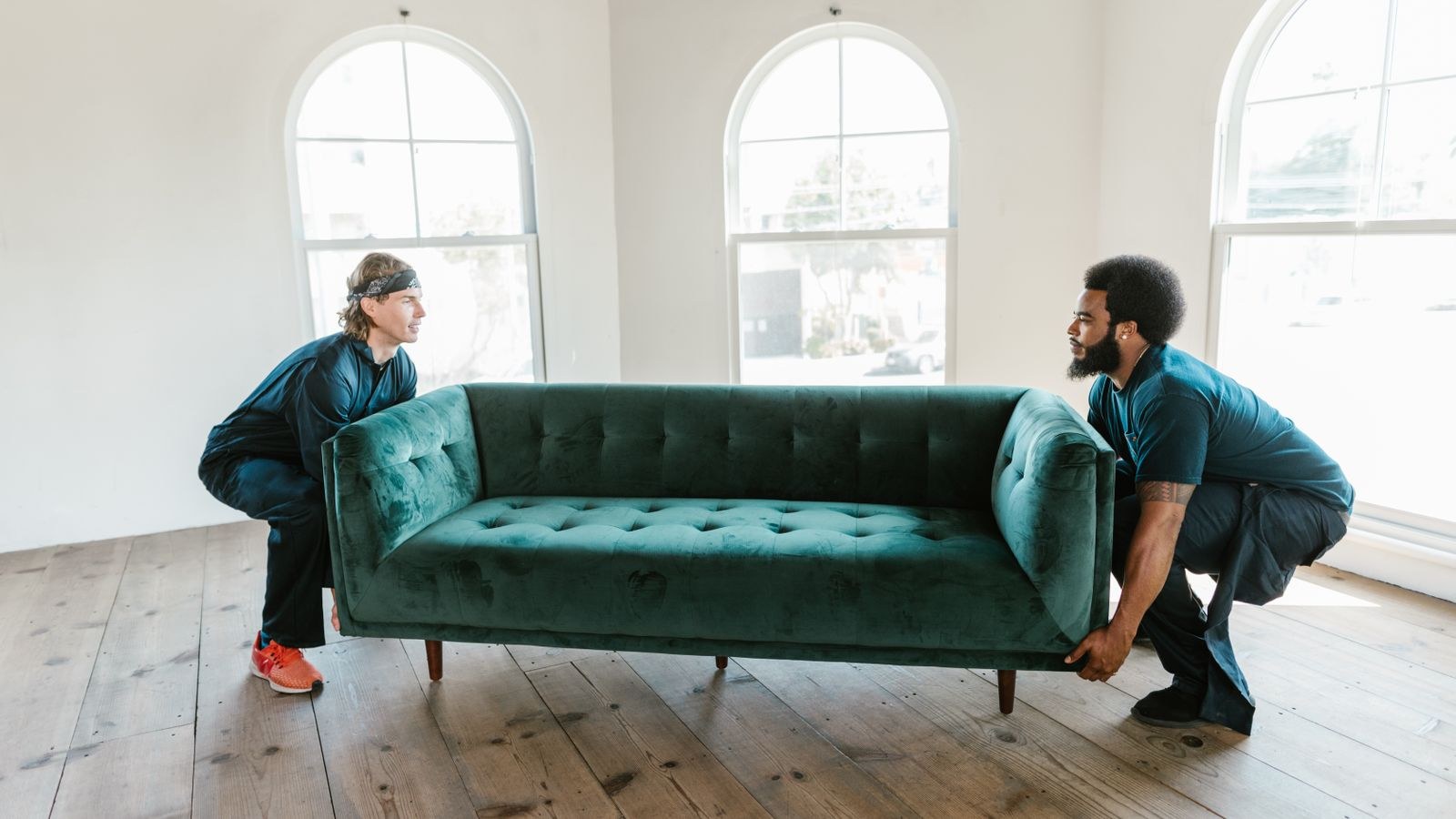
The first mistake is lifting first and measuring later. Five minutes with a tape measure tells you whether this is a simple carry, a legs-off job, or a full disassembly, and that decision changes how many people you need.
Take four numbers from the sofa: overall length, overall depth front to back, overall height including the legs, and the diagonal depth. That last one is the number nearly everyone skips and the one that decides the outcome. To find it, stand the sofa on end, run the tape from the highest point of the back down to the front edge of the base in a straight line, and record it. On most three-seaters the diagonal depth is several inches less than the height.
Then measure the opening: the clear width between the door stops with the door removed, the clear height, and the depth of the door frame itself. In a hallway, measure the wall-to-wall distance at the tightest turn. For a stairwell, measure the ceiling height above the landing and the width between the handrail and the wall, because handrails steal more clearance than people expect.
The Rule That Tells You If It Fits
Compare the sofa’s diagonal depth to the clear width of the door. If the diagonal depth is smaller, the sofa will pass through when tipped onto its end and rotated, even if the seat depth on paper is larger than the opening. If the diagonal depth is bigger, you are into removing legs, removing the back, or taking the door and its stops off. Knowing which category you are in before anyone lifts saves a lot of arguing in a hallway.
Tools and Prep You Actually Need
- Tape measure and a screwdriver or drill with Phillips and flat bits
- Socket wrench or Allen keys for bolted legs and back brackets
- Furniture blankets or old duvets, plus stretch wrap or painter’s tape
- Cardboard sheets or corner guards for door jambs and stair walls
- Furniture sliders for hard floors, or a moving strap set for stairs
- A resealable bag and a marker for hardware
- Work gloves with grip for at least two people
Clear the entire route first. Take pictures off the walls along the path, move the coffee table out, prop or remove intervening doors, and roll up loose rugs so nobody trips mid-lift. If the floor is delicate, lay cardboard down the whole run rather than in patches, because patches shift under foot.
Step by Step: Getting the Sofa Through
- Strip the sofa. Remove all seat and back cushions, throw pillows and any loose covers, and carry them through separately. This alone can cut several inches of depth and a lot of weight, and it stops fabric snagging on the frame of the door.
- Take the legs off. Tip the sofa onto its back on a blanket. Most legs either unscrew by hand, sit on a bolt plate, or are held by two screws. Removing them typically gains one to seven inches of height and lets the frame slide flat on the floor. Bag the hardware, label it, and tape it to the underside of the frame so it travels with the sofa.
- Remove the back if the design allows. Many modern sofas have a back panel held by bolts, hooks or metal clips hidden under a zippered flap or a fabric skirt at the base. Lift the flap and look. If the back detaches, the remaining piece is often shallow enough to walk straight through a standard door.
- Take the door off its hinges. Tap the hinge pins upward with a screwdriver and hammer, lift the door away, and store it flat. If it is still tight, unscrew the door stop trim from the jamb. Between the door and the stops you usually gain two to three inches of clear width, which is often exactly the margin you are missing.
- Wrap and protect. Cover the arms, back corners and any exposed feet sockets with blankets held on by stretch wrap. Tape cardboard to both sides of the door jamb and to the wall at any corner you will pivot against. Upholstery scuffs easily and painted jamb edges chip on the first bump.
- Stand it on end and hook it through. This is the move that solves most narrow doors. Tip the sofa vertically so one arm points at the ceiling. Feed the top arm and back through the opening first at an angle, then rotate the whole piece as it passes, so it corkscrews through rather than being pushed straight. One person guides the leading end from the far side, the other steers and takes weight at the trailing arm.
- Pivot, do not shove. When the sofa is halfway through, the frame becomes a lever. Rotate around the point of contact rather than forcing forward. If it stops moving, back off two inches, change the angle slightly and try again. Force is what tears fabric and cracks frames.
- Handle the stairs on the diagonal. Going up, the heavier end leads and the person below carries most of the load with the sofa tilted back so it follows the slope of the stairs. Going down, the lower person controls speed and the upper person holds it back. Keep the sofa angled so the top corner tracks along the ceiling line and pause on every landing to reset your grip.
- Reassemble in place. Set the frame roughly where it will live, then refit the back panel, screw the legs back on and drop the cushions in. Fitting legs before the sofa is in position means dragging it across a floor on hard feet, which is exactly how scratches happen.
Working a Tight Stairwell or Landing
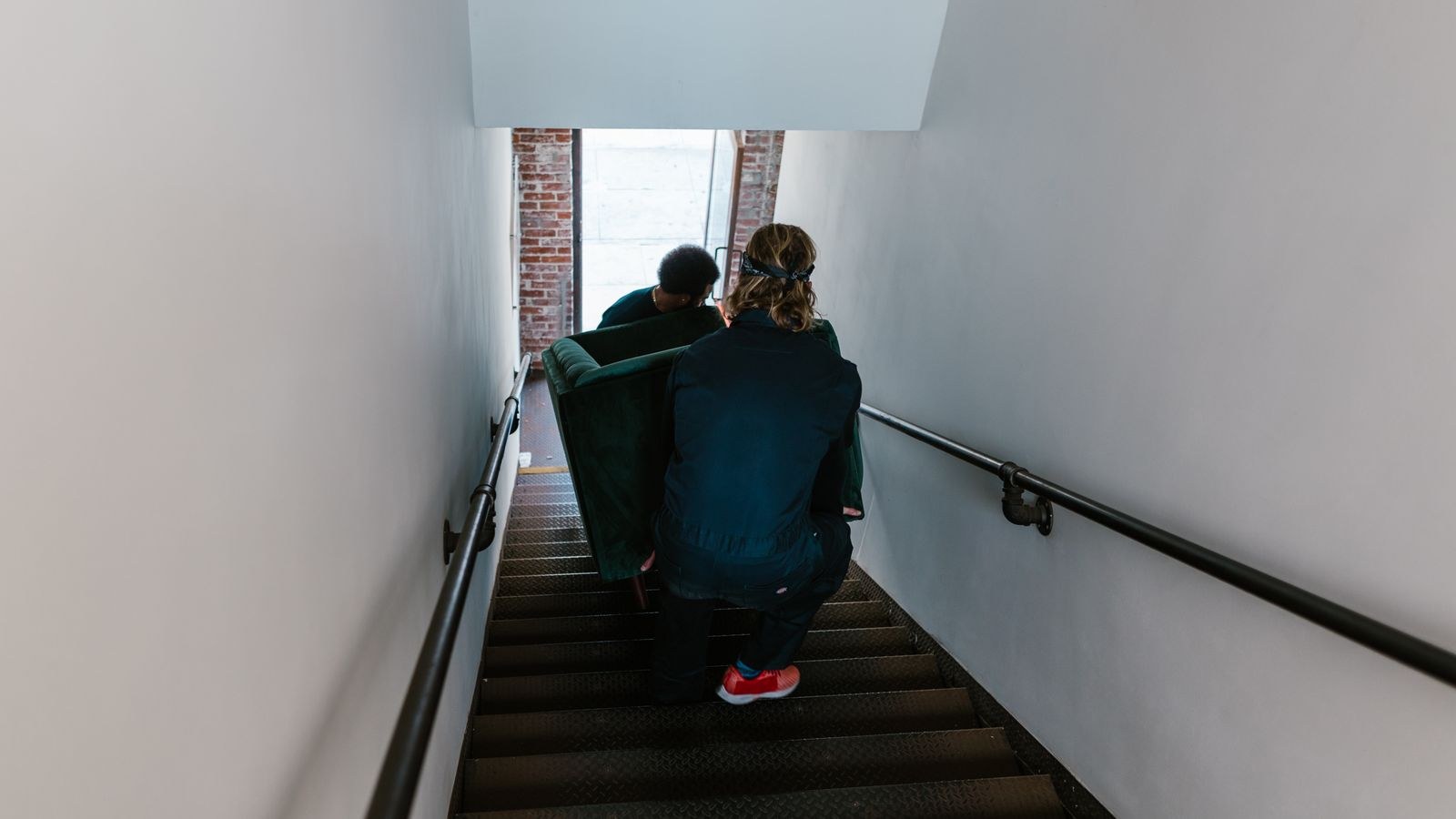
Stairs fail for a different reason than doors: it is almost never width, it is the turn at the top or bottom. A quarter-turn landing needs enough ceiling height for the sofa to swing upright while it changes direction. Measure the landing’s floor area and the height above it, then compare against the sofa’s length. If the length exceeds the diagonal from landing floor to opposite ceiling corner, the piece cannot be turned there no matter how strong the crew is, and you must disassemble or use a window.
Remove the handrail if it is screwed to brackets rather than built in; that commonly frees three to four inches on the side you need. Keep a spotter at the turn and never stand directly below a sofa being lowered.
Protecting Walls, Floors and Upholstery
Damage happens in three places: door jamb edges, wall corners at turns, and the floor under the trailing end. Cardboard taped over jamb edges and corner beads costs nothing and absorbs the knocks. On hard floors, sliders under the leading edge let one person steer instead of two people dragging. On carpet, a sheet of hardboard gives you a firm surface to slide across.
For the upholstery itself, put a blanket on first and plastic over the blanket, never plastic directly against leather. And never lift a soft-frame sofa by its arms; take the weight under the base rail.
When the Sofa Genuinely Will Not Fit
Occasionally the numbers simply say no, usually with a large fixed-frame sectional or a heavily padded roll-arm design in an older building with tight turns. At that point you have three honest options: remove a window sash and hoist it in, hire movers who own a hoisting rig, or accept that the room needs a different shape of sofa.
If you are shopping rather than moving an existing piece, buying for access is far cheaper than fighting it later. A modular sofa that ships in separate sections walks through any standard door one piece at a time and is the single best answer to a difficult staircase. For narrow hallways and period doorways, our roundup of the best narrow sofas covers slim-depth frames that clear tight openings without the tipping routine. Renters facing lifts, landings and shared stairwells should look at sofas made for apartment access, and anyone furnishing a single open space will find compact designs in our guide to the best sofas for studio apartments. For a broader look at frames, fills and construction quality across every size, start with our main couch and sofa buying guide.
Common Mistakes to Avoid
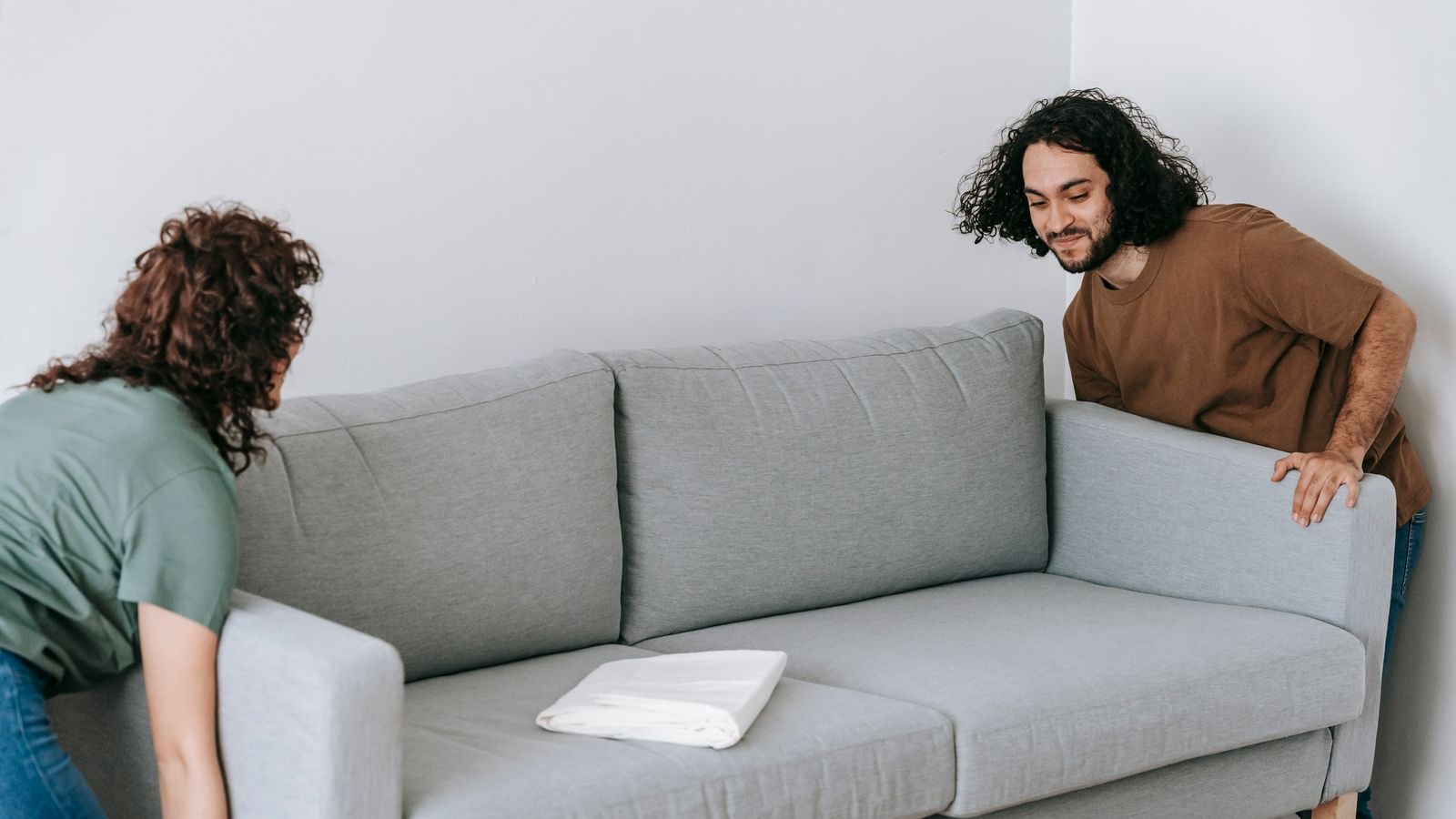
- Measuring the door width but not the diagonal depth of the sofa. The diagonal is the number that decides the job.
- Trying it with two people when the route has a turn. A third person as a spotter at the corner prevents most wall damage.
- Pushing harder when it sticks. Sticking means the angle is wrong, not that the force is insufficient.
- Leaving the door on. Ten minutes with a screwdriver buys you inches you cannot get any other way.
- Losing the hardware. Bag leg bolts and tape them to the frame immediately.
Frequently Asked Questions
Can one person move a sofa through a doorway alone?
A small two-seater with the legs off can be walked through on sliders by one determined person on a flat route. Anything larger, or any route with stairs or a turn, needs at least two people. The risk is not just to the sofa but to your back and to the door frame.
Will removing the back damage the sofa?
No, if it was designed to come apart. Bolt-on and clip-on backs are engineered for exactly this and reassemble with no loss of strength. Do not attempt it on a sofa where the back is stapled and upholstered as one continuous piece with the arms, because there is no join to undo.
What if the doorway is only an inch too narrow?
Remove the door, then remove the door stop trim from both sides of the jamb. That usually recovers more than an inch. Stripping the cushions and going through on the diagonal generally covers the rest.
How do I stop the fabric from snagging on the door frame?
Wrap the leading arm and back corners in a blanket and tape cardboard to the jamb edges. Snags almost always happen where a metal strike plate or a chipped jamb edge catches the weave as the sofa rotates past.
Final Thoughts
Getting a sofa through a narrow door is a measuring problem dressed up as a strength problem. Take the diagonal depth, compare it to the clear opening, strip the cushions, pull the legs, take the door off its hinges, then rotate rather than push. That sequence solves the overwhelming majority of doorways and landings that look hopeless at first sight. Work slowly, protect every edge the sofa will touch, and keep a spotter at each turn.