Owen Bradley
 Two systems using identical hardware can sound completely different depending on where the boxes sit. A soundbar shoved inside a cabinet loses its treble and its stereo width; a subwoofer jammed into a corner turns every action scene into a one-note rumble. Placement is free, reversible, and delivers a larger improvement than most upgrades — yet it is the step almost everyone skips. This guide covers the height, distance, and boundary rules that govern how a soundbar and subwoofer interact with a room, and gives you a repeatable method for finding the best positions in your own living space.

What You Need Before You Start
- A tape measure for seating distance and speaker height.
- A test track or film scene you know well, ideally with clear dialogue and steady bass.
- A phone SPL meter app — not laboratory accurate, but more than good enough for comparing positions.
- Isolation pads or felt feet to stop cabinet resonance.
- A helper, since moving a subwoofer while listening from the seat is the core technique.
Before touching anything, sketch the room. Mark the main listening seat, the TV wall, the doorways, and any large soft objects such as sofas, rugs, and curtains. Those soft surfaces absorb high frequencies, and hard bare walls reflect them. The layout you draw will explain most of what you hear later.
Step 1: Get the Soundbar Height and Angle Right
A soundbar wants its drivers roughly at ear height when seated, which for most sofas is 36 to 42 inches from the floor. Perfect alignment is rarely possible, so aim to be close and avoid the two failure modes: buried below the TV stand lip, or mounted so high that the sound arrives over your head.
- Centre it horizontally with the television. An offset bar pulls dialogue away from the actor’s mouth and breaks the illusion immediately.
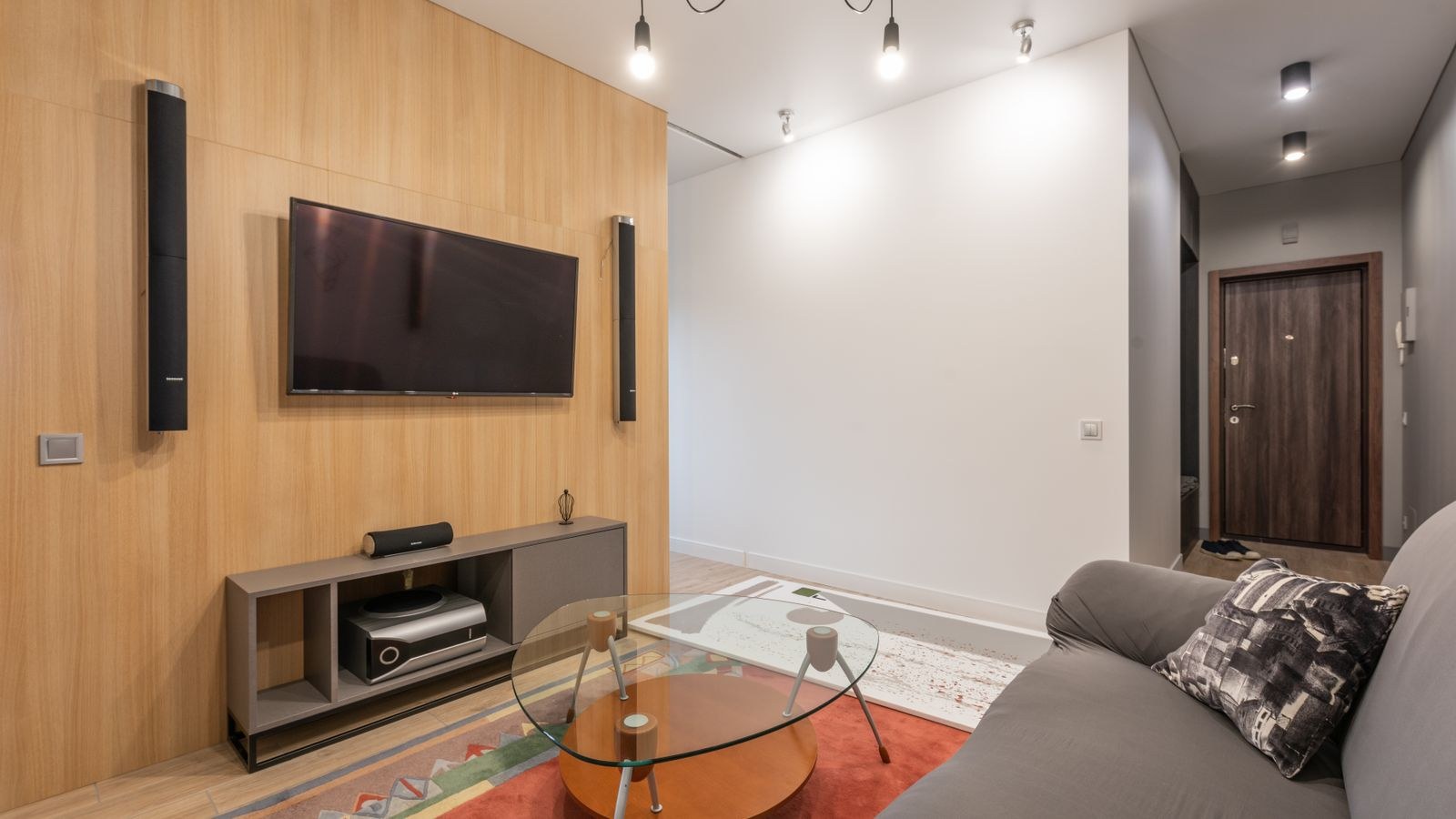
- Put it in front of the TV, not behind it. The bar’s front baffle should sit at or slightly ahead of the screen’s front edge so nothing blocks the tweeters.
- Leave the top clear. If the bar overlaps the bottom of the screen it may block the IR receiver; raise the TV or lower the bar rather than angling either one.
- If wall mounting, keep it within about 12 inches of the screen and tilt it downward slightly when the mount sits above ear level.
- Never enclose it in a cabinet. A closed shelf traps and colours the sound. If the bar must live in furniture, use an open-fronted shelf with several inches of clearance above.
Wall Proximity and Bass Reinforcement
Placing a soundbar tight against the wall adds low-frequency energy through boundary reinforcement, which can help a thin-sounding bar or make an already-warm one boomy. Pull it forward two to four inches and listen again. Many bars include a wall-mount EQ mode that compensates automatically — switch it on when mounted and off when it sits on furniture.
Step 2: Give Virtual Surround a Chance to Work
Bars that advertise virtual surround or upfiring Atmos channels bounce sound off the side walls and ceiling. Those reflections only exist if the surfaces exist. For side-wall bounce, the bar wants roughly symmetrical walls within about ten feet on each side, without a large open archway on one side. For ceiling bounce, you want a flat ceiling between eight and twelve feet high, made of drywall rather than exposed beams, acoustic tile, or a sharp vault.
If your room fails those conditions, virtual modes will sound diffuse rather than immersive, and you are better off switching them off and running the bar in a clean stereo or movie mode. Rooms that genuinely defeat virtual processing are the ones where discrete rear speakers earn their keep — the same logic behind most best home theater speakers recommendations for irregular spaces.
Step 3: Find the Right Subwoofer Position With the Crawl
Bass frequencies are long enough to interact strongly with room dimensions, creating peaks where bass booms and nulls where it disappears entirely. Rather than guess, use the subwoofer crawl — a decades-old trick that works reliably in ordinary rooms.
- Temporarily place the subwoofer on your main listening seat, roughly at ear height if you can prop it safely.
- Play a track with continuous, repeating bass — a steady bassline works better than film effects.
- Set the volume loud enough to hear clearly from floor level, then crawl slowly around the perimeter of the room with your ear near the floor.
- Note where the bass sounds loudest and most even, not just loudest. You are listening for tight, defined notes rather than a single overwhelming boom.
- Move the subwoofer to that spot and return to your seat. The bass you heard while crawling is what you will now hear seated, because sound paths work equally in both directions.
Test two or three candidate spots this way. Small shifts of six to twelve inches often change the result noticeably, so refine after you have chosen a general area.

Step 4: Understand What Corners Actually Do
A corner is the loudest possible place for a subwoofer because it reinforces bass off three surfaces at once. That extra output is real, and for a small or underpowered sub it can be welcome. The cost is evenness: corners excite every room mode strongly, so certain notes bloom while others vanish, and bass tends to sound slow and one-note.
The practical compromise is to place the sub along a wall but off-centre, typically a quarter to a third of the way along its length, and pulled six to twelve inches out from the wall. That keeps useful reinforcement while avoiding the worst mode stacking. If you must use a corner, expect to reduce the subwoofer level by several decibels afterwards.
Front Versus Side Placement
Placing the sub on the same wall as the TV keeps low bass visually and acoustically tied to the action, which matters most if your crossover sits high, around 100 Hz or above. A side-wall position is often flatter in response but can make bass feel detached at higher crossovers. Set the crossover to 80 Hz where possible; below that frequency, direction is far harder to localise and side placement becomes free of penalty.
Step 5: Set Level, Crossover, and Phase
Placement gets you most of the way; three controls finish the job.
- Crossover — start at 80 Hz. Raise it toward 100 to 120 Hz only if the soundbar is very small and sounds thin in the upper bass.
- Level — turn the sub up until it is clearly audible, then back it down until it stops calling attention to itself. Good bass is felt in the room, not heard as a separate box.
- Phase — play steady bass and flip the phase switch between 0 and 180 degrees. Keep whichever setting sounds louder and fuller from the seat; the wrong choice causes cancellation right where the bar and sub overlap.
Recheck level after phase, since a correct phase setting usually increases output and may push the sub too hot. Two or three passes through these three controls is normal.
Placement Mistakes That Cost the Most
Putting the subwoofer inside a cabinet or under the sofa traps output and adds cabinet buzz. Give it open air on at least three sides. Blocking a rear-firing port against a wall is another frequent error; ported subs need at least eight to twelve inches of clearance behind them. Setting the sub on a suspended wooden floor without isolation transmits vibration into the structure, which neighbours notice more than you do — isolation feet or a dense pad solve it cheaply.
On the soundbar side, the biggest mistakes are recessing it into furniture, mounting it far above ear height without tilt, and leaving room-correction or wall-mode EQ set for a position the bar no longer occupies. Also avoid placing large decorative objects directly in front of either unit; a vase or picture frame in the sound path audibly dulls the treble.
Matching Placement to Room Size and Seating
Small rooms under roughly 150 square feet have strong, closely spaced modes, so subwoofer position matters more there than in a large open plan. In small spaces, avoid corners entirely and try a side wall near the midpoint of the room’s length. Compact systems designed for these spaces, like the models covered among the best speakers for small rooms, are usually easier to place than large floorstanding designs.
Seating position matters just as much. Sitting directly against a rear wall usually puts you in a bass peak; moving the sofa even eight inches forward often smooths it. Avoid sitting at exactly the midpoint of the room’s length, which is where the strongest null typically forms. If dialogue is your weak point rather than bass, the fix is usually the centre channel or the bar’s voice mode rather than furniture, and systems noted among the best speakers with clear vocals illustrate what to listen for.
Frequently Asked Questions
Can the subwoofer go behind the sofa?
Yes, and in some rooms it measures better there. The risk is a very strong seat-level peak because you are close to the driver. Reduce the level and confirm the bass still sounds even across all seats before committing.
Does the subwoofer need to be near the soundbar?
No. At an 80 Hz crossover, low bass is largely non-directional, so the sub can sit anywhere it measures well. Only when the crossover is set high, above 100 Hz, does keeping it near the front stage start to matter.
Should the soundbar sit on the TV stand or on the wall?
Whichever puts it closer to ear height without blocking the screen. Furniture placement is simpler and usually adequate; wall mounting wins when the TV is high or the stand is deep enough to recess the bar.
Will two subwoofers help?
Often significantly. A second sub averages out room modes and delivers noticeably more even bass across multiple seats. Pairs are a common recommendation among the best speakers with subwoofer configurations for wide seating layouts.
Final Thoughts
Good placement follows a short sequence: get the soundbar centred and near ear height with nothing enclosing it, then crawl the room to find where bass is even rather than merely loud, then dial in crossover, level, and phase from the listening seat. Prefer an off-centre wall position over a corner, give ports room to breathe, and recheck settings any time furniture moves. It costs nothing but an afternoon, and once you hear how much cleaner dialogue and bass become you will treat placement as the first step of every system you set up in 2026, not the last. Options among the best soundbar speakers only reach their potential once the room is on their side.
Once you dial in the physical placement, run through a few bass-heavy scenes to evaluate how cleanly the low end integrates with the soundbar. If low frequencies still feel muddy or lack punch despite optimal positioning, checking a comprehensive Subwoofer Verdict can help you decide whether your room simply needs different hardware. Taking time to test thoroughly ensures you get the tightest performance possible out of your current setup before investing in new gear.