Owen Bradley
 Low ceilings are the single most common reason people give up on ceiling fans. At 8 feet or below, a standard fan on a downrod either fails safety clearances or hangs so low that tall people duck instinctively every time they cross the room. Low-profile fans, also called hugger or flush-mount fans, solve the headroom problem by mounting the motor directly against the ceiling. They also introduce their own compromises, mostly around airflow, and the trick to buying well is knowing which of those compromises are inherent and which are just the result of a cheap design.
What Counts as Low Profile
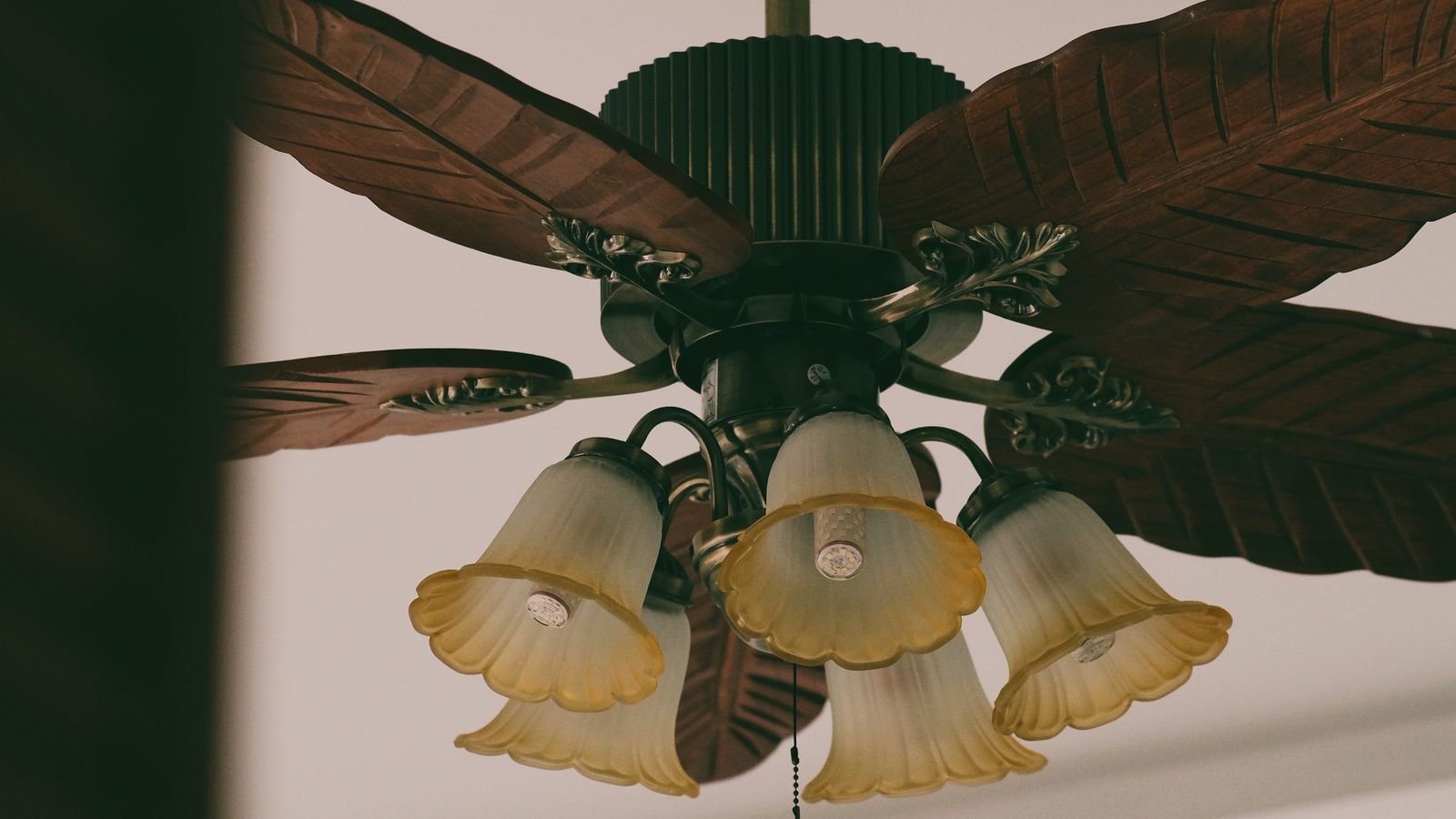
A low-profile fan mounts flush to the ceiling with no downrod, so the whole assembly typically occupies between 7 and 12 inches from ceiling to the bottom of the fixture. A standard fan with even the shortest downrod usually occupies 12 to 16 inches, and more once you add a light kit.
The relevant threshold is the safety clearance for blades, which should be a minimum of 7 feet above the finished floor. On an 8 foot ceiling, that leaves you 12 inches of total budget for the entire fixture. On a 7 foot 6 inch ceiling, you have almost nothing to spare and a hugger becomes mandatory.
Terminology is inconsistent across manufacturers. Hugger, flush mount, low profile and close-to-ceiling generally mean the same thing, while low-clearance sometimes describes a short downrod rather than a true flush mount. Always shop by the published overall height in inches rather than the marketing label. Options across the category are compared in our best low profile ceiling fans guide.
The Airflow Trade-Off Explained
A ceiling fan works by drawing air down from above the blades and pushing it toward the floor. It needs a gap between blades and ceiling to breathe. When that gap shrinks, the fan starves for intake air and moves less air for the same rotational speed.
The recommended minimum is roughly 8 to 10 inches of clearance between the blade plane and the ceiling. Many hugger fans come in below this, which is why their CFM figures often trail comparable downrod fans by twenty percent or more.
This does not make low-profile fans useless. It means you should compensate by choosing a larger blade span than you would with a downrod fan, by prioritising models that publish honest CFM figures, and by looking for designs that engineer some intake clearance into the housing rather than pressing the blades right against the ceiling. A 52 inch hugger will comfortably outperform a 42 inch downrod fan in the same room.
Measuring Your Ceiling Properly
- Measure floor to ceiling at the exact spot the fan will hang, not at the wall. Ceilings are rarely perfectly level.
- Subtract 7 feet as the minimum blade height. What remains is your total fixture height budget.
- Check the fixture’s published overall height from ceiling to the lowest point, including any light kit.
- Account for obstructions: door swings, wardrobe doors, a raised bed platform, or a loft ladder path.
- Check horizontal clearance too: blade tips should be at least 18 to 24 inches from any wall, and clear of sloped ceiling sections.
If your budget after subtracting 7 feet is under 10 inches, you need a genuine ultra-low profile model, and your choice of light kits will be limited to slim integrated arrays.
Sizing for the Room
Because low-profile fans lose some efficiency to restricted intake, size up rather than down.
- Up to 75 square feet: 29 to 36 inches. Small bedrooms, laundry rooms, walk-in closets.
- 75 to 150 square feet: 42 to 44 inches. Typical secondary bedrooms and home offices.
- 150 to 250 square feet: 48 to 52 inches. Main bedrooms and small living rooms.
- 250 to 400 square feet: 54 to 56 inches, or two smaller fans in a long room.
Room shape matters as much as area. A long narrow room is better served by two modest fans spaced along its length than by one large fan in the middle, which leaves the ends still. Guidance for tighter spaces is in the best ceiling fans for small room comparison.
Motor Choice Matters More at Low Clearance
With a hugger fan the motor sits closer to your head and closer to the ceiling structure, so both its noise and its vibration are more noticeable. That makes motor quality a higher priority here than on a fan hanging on a long downrod.
DC motors are the better choice for a low ceiling for three reasons. They hum less, which matters when the motor is 7 and a half feet from your ears. They offer six or more speed steps rather than three, so you can dial in gentle air movement without the draught that a large fan close overhead can otherwise produce. And they run cooler and lighter, which reduces the load on the mounting.
Noise is also amplified because a flush-mounted motor couples directly into the ceiling structure with no downrod to decouple it. That makes the rubber isolators in the mounting bracket essential rather than optional. The best DC ceiling fans guide covers motor differences, and the best and quietest ceiling fans comparison covers what makes a fan sound quiet in practice.

Light Kits on a Tight Budget of Inches
Adding light to a flush-mount fan is where the inches run out fastest. Your realistic options:
- Slim integrated LED: an array behind a shallow frosted lens built into the motor housing. Adds perhaps an inch or two. Almost always the right choice on a low ceiling.
- Low-profile bowl shade: a shallow diffuser. Adds 3 to 5 inches, which many low ceilings cannot spare.
- Uplight: a ceiling-bounced light that adds no drop at all and produces soft glare-free ambient light. Excellent in bedrooms, though rare on hugger models because the housing is against the ceiling.
- No light kit: a genuinely good option if you have other lighting. It buys back every inch and the fan runs quieter without a rattling shade.
Avoid hanging shades and exposed decorative bulbs entirely on a low ceiling. They eat headroom and, being close and bright, they produce noticeable strobing as the blades pass. Combined fixture guidance is in the best ceiling fans with lights guide.
Installation Notes Specific to Flush Mounts
Flush-mount installation is fiddlier than downrod installation because there is no gap to work in. Plan for it.
- Use a fan-rated brace box. Non-negotiable. A hugger transmits vibration straight into the ceiling with no downrod to absorb it.
- Manage the wiring. There is very little space in the canopy. Fold conductors neatly and avoid pinching them against the bracket, which is a common cause of later rattles.
- Fit the isolation grommets. Every rubber bushing supplied is there to stop structural hum.
- Do not force the canopy tight against a textured ceiling. Uneven contact concentrates vibration at one point.
- Balance after installation. Wobble is more audible in a flush mount, and the supplied balancing kit fixes most of it.
Most flush-mount fans are best assembled as much as possible on the floor, since working overhead with almost no clearance is where wiring gets pinched.
Sloped Ceilings and Other Edge Cases
A flush mount generally will not work on a sloped ceiling, because the fan needs to hang vertically while the mounting plane is angled. Most huggers tolerate only a very shallow slope, if any. On a pitched ceiling you need a downrod with an angled mount, which reintroduces the headroom you were trying to save. If the room has a low sloped ceiling, look for a model explicitly rated for slope with a short rod rather than a true hugger.
Damp locations are the other edge case. Covered porches and bathrooms need at least a damp rating, and anywhere subject to direct moisture needs a wet rating. Standard indoor fans corrode quickly in those environments regardless of how well they are mounted.
Budget Tiers
- Entry level: a basic AC hugger with pull chains and a simple light. Fits under a low ceiling and moves some air, but expect modest CFM and audible hum at low speed.
- Mid range: a larger-span hugger with a better AC or entry DC motor, a remote and a slim integrated dimmable light. The sensible choice for a bedroom on an 8 foot ceiling.
- Premium: a DC flush mount with shaped blades, six or more speeds, a high-CRI dimmable light and a housing engineered to preserve intake clearance. Quiet, efficient and closest to matching downrod performance.
Bedroom priorities differ from living room priorities, and the best ceiling fans for bedroom guide covers how to weigh airflow against quiet operation.
Frequently Asked Questions
Do low-profile fans move less air than standard fans?
Generally yes, because restricted clearance above the blades limits intake. Compensate by choosing a larger blade span than you would otherwise.
What is the minimum ceiling height for a ceiling fan?
Blades should sit at least 7 feet above the floor, which typically means 7 feet 6 inches to 8 feet of ceiling height for a flush-mount fan.
Can I install a hugger fan on a sloped ceiling?
Usually not. Flush mounts tolerate very little slope. A sloped ceiling needs a downrod with an angled mounting bracket.
Is a light kit worth the lost height?
Only a slim integrated LED. If you have other lighting in the room, skipping the light kit buys back useful headroom and reduces rattles.
Why does my flush-mount fan hum more than my old downrod fan?
Because the motor couples directly into the ceiling with no downrod to isolate it. Check that all supplied rubber bushings are fitted and the box is fan-rated.
Final Thoughts
Low-profile ceiling fans are a genuine solution rather than a compromise, provided you buy with the constraints in mind. Measure the ceiling at the mounting point, subtract 7 feet, and shop only fixtures that fit the remaining budget. Then size the blade span generously to recover the airflow that restricted clearance costs you, choose a DC motor so the fan stays quiet close overhead, keep the light kit slim, and mount everything on a properly braced fan-rated box. A well-chosen hugger will keep a low-ceilinged room comfortable all the way through 2026.