
 Hannah Lindqvist
 Shopping for the best routers under $100 can feel confusing once you start comparing wifi standards, mesh systems, and dense spec sheets. The good news is that you don’t need to spend $300 to get fast, reliable wifi for a home full of streaming devices, laptops, and smart gadgets. This guide breaks down what actually matters in a budget router, then walks through 10 picks suited to different homes and needs. You’ll find options for small apartments, larger houses, gaming setups, and smart home networks. Use the quick answer below for a fast recommendation, or keep reading for the full comparison.
Quick answer: For most shoppers in 2026, our top pick among the best routers under $100 is the TP-Link Deco M5 — our #1 rated choice thanks to whole-home mesh coverage and a strong track record of reviews. See the full ranked comparison, alternatives, and buying advice below.

Pros
- One unit is quoted at up to 2,000 sq ft of coverage, enough for most two-bedroom flats on a single node
- AC1300 dual-band splits 400 Mbps on 2.4 GHz and 867 Mbps on 5 GHz across simultaneous clients
- Extra nodes join under the same network name and password, so devices roam room to room without reconnecting
- The bundled security suite adds antivirus, per-profile parental controls and QoS from the app rather than a browser page
- Multi-voltage 100-240V input means it travels abroad with only a plug adapter
Cons
- Wi-Fi 5 class hardware, so Wi-Fi 6 clients gain no OFDMA or 1024-QAM benefit
- Supplied as a single unit, so true mesh coverage means adding further nodes later
- No dedicated backhaul radio, so satellite nodes share the 5 GHz band with clients and lose throughput on distant hops
A single node is quoted at up to 2,000 sq ft, a figure measured in open space. In a real home with brick walls, foil-backed insulation or a concrete stair core, plan on considerably less from one unit.
- Combined speed is 1300 Mbps - 400 Mbps on 2.4 GHz plus 867 Mbps on 5 GHz - which comfortably carries 4K streams and video calls on a typical broadband line.
- Beamforming steers signal toward active devices instead of broadcasting evenly in all directions.
- A quad-core processor keeps routing overheads low when twenty or thirty devices are connected.
Where one node is not enough, adding a second creates a mesh hop. Because there is no separate backhaul radio, that hop shares the 5 GHz band with your devices, so place nodes within clear reach of each other rather than at maximum distance.
Pros
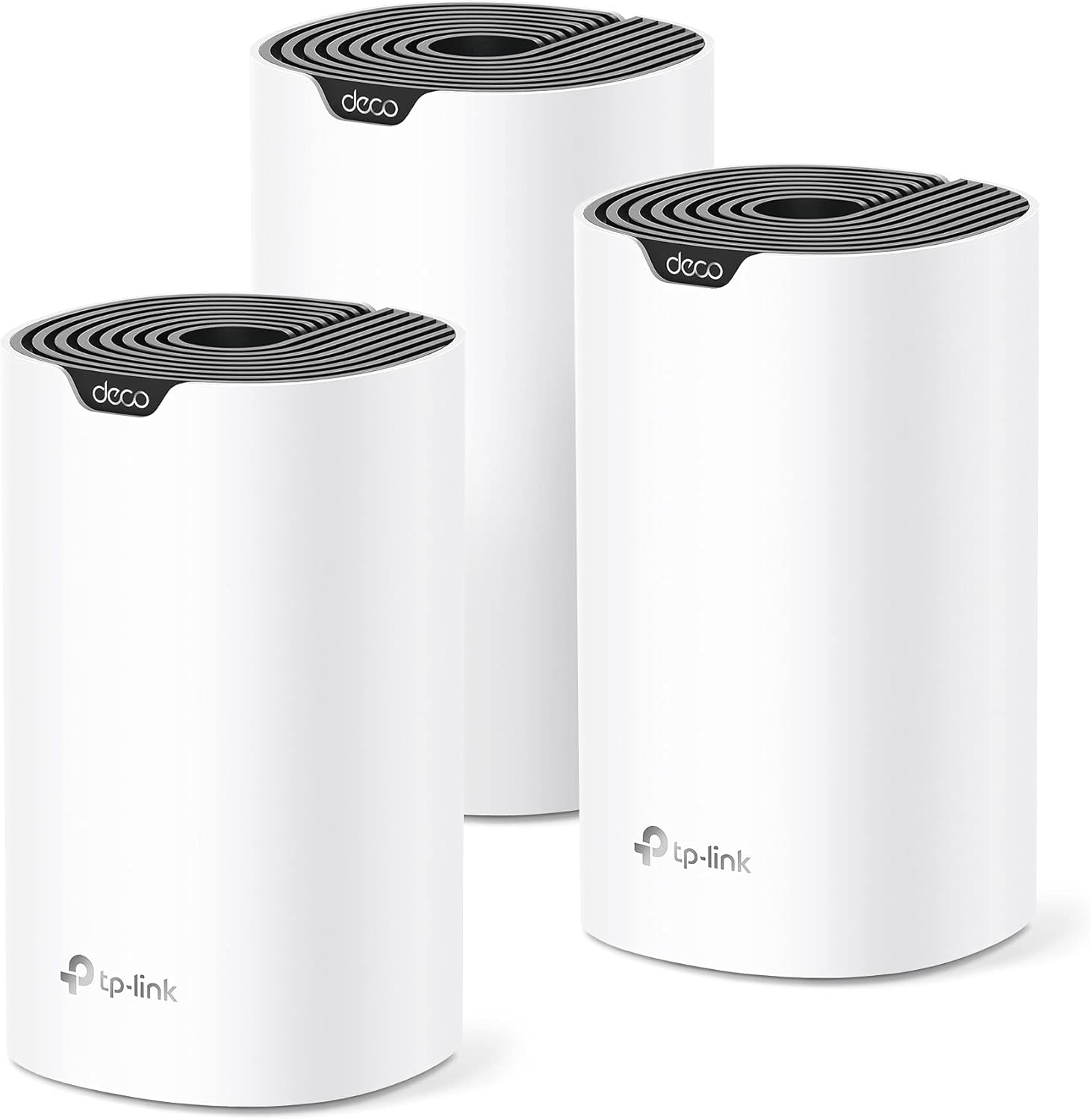
- Three units combine to blanket homes up to 5,500 square feet under a single network name
- AC1900 3x3 dual-band radios support up to 100 connected devices
- Each unit carries 2 Gigabit Ethernet ports, 6 across the pack, and any one can act as the router
- Wired Ethernet backhaul is supported, so a Cat 5e run between floors frees the radios for clients
- Per-person profiles cap online time and block sites by category
Cons
- Wi-Fi 5 hardware, so Wi-Fi 6 phones and laptops gain none of the OFDMA benefits
- Two Ethernet ports per unit, and the main node loses one to the modem, leaving a single free socket there
- No USB port, so a shared drive or printer has to hang off something else

Pros
- Covers up to 1,500 sq ft from a single unit, roughly a 22 ft radius in open floor plans
- Supports internet plans up to 900 Mbps, which matches most gigabit-tier home connections
- Wi-Fi 6 radio handles 75 or more connected devices at once, useful once smart bulbs and sensors multiply
- Built-in Zigbee hub links compatible bulbs, plugs and locks without a separate bridge box
- Cross-compatible with the wider hardware family, so extra nodes can join the same network later
Cons
- Coverage from one unit stops at about 1,500 sq ft, so a two-storey or long narrow home will need extra nodes
- Just two auto-sensing Ethernet ports, and one is taken by the modem uplink, leaving a single wired client before you need a switch
- Advanced security filtering, ad blocking and parental controls require a separate eero Plus subscription
Pros
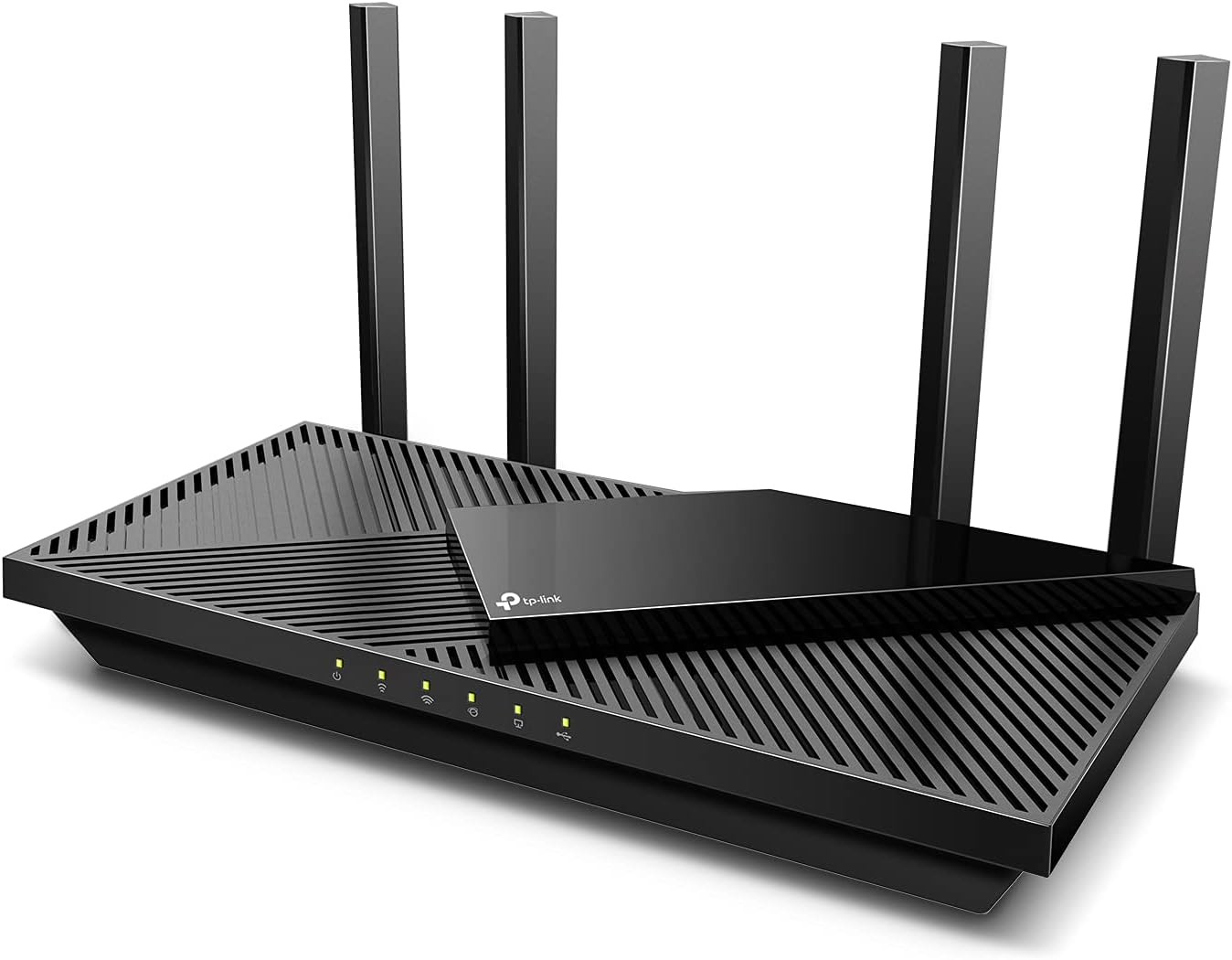
- AX3000 splits 2402 Mbps on 5 GHz and 574 Mbps on 2.4 GHz, with OFDMA and MU-MIMO dividing airtime between clients
- Four high-gain external antennas plus beamforming steer signal towards devices in back bedrooms
- USB 3.0 port shares a drive or printer across the whole network
- Built-in VPN server and VPN client, so you can reach home files remotely or route outbound traffic through a provider
- An enlarged heatsink and reworked case shed heat, which matters in a cupboard or an unventilated shelf
Cons
- Dual-band only, so mesh traffic shares the same 5 GHz band as your devices instead of a dedicated backhaul
- Gigabit WAN and LAN ports cap it below multi-gigabit internet plans
- Only the basic HomeShield tier is included, and the deeper network protections need a separate plan
The headline split is 2402 Mbps on 5 GHz and 574 Mbps on 2.4 GHz, a sensible balance for a three or four bedroom home.
- OFDMA lets several devices share a single transmission slot rather than queueing, which is what trims latency and jitter when a household streams, calls and games at once
- MU-MIMO serves multiple clients in parallel instead of round-robin
- Four high-gain antennas with beamforming concentrate signal towards each device rather than radiating evenly into the garden
- Target Wake Time lets phones and sensors sleep between transmissions, which shows up as longer battery life on those devices
The 2.4 GHz band remains the one that reaches through brick and up a floor, so keep smart plugs and doorbells there and reserve 5 GHz for laptops and TVs.
Pros
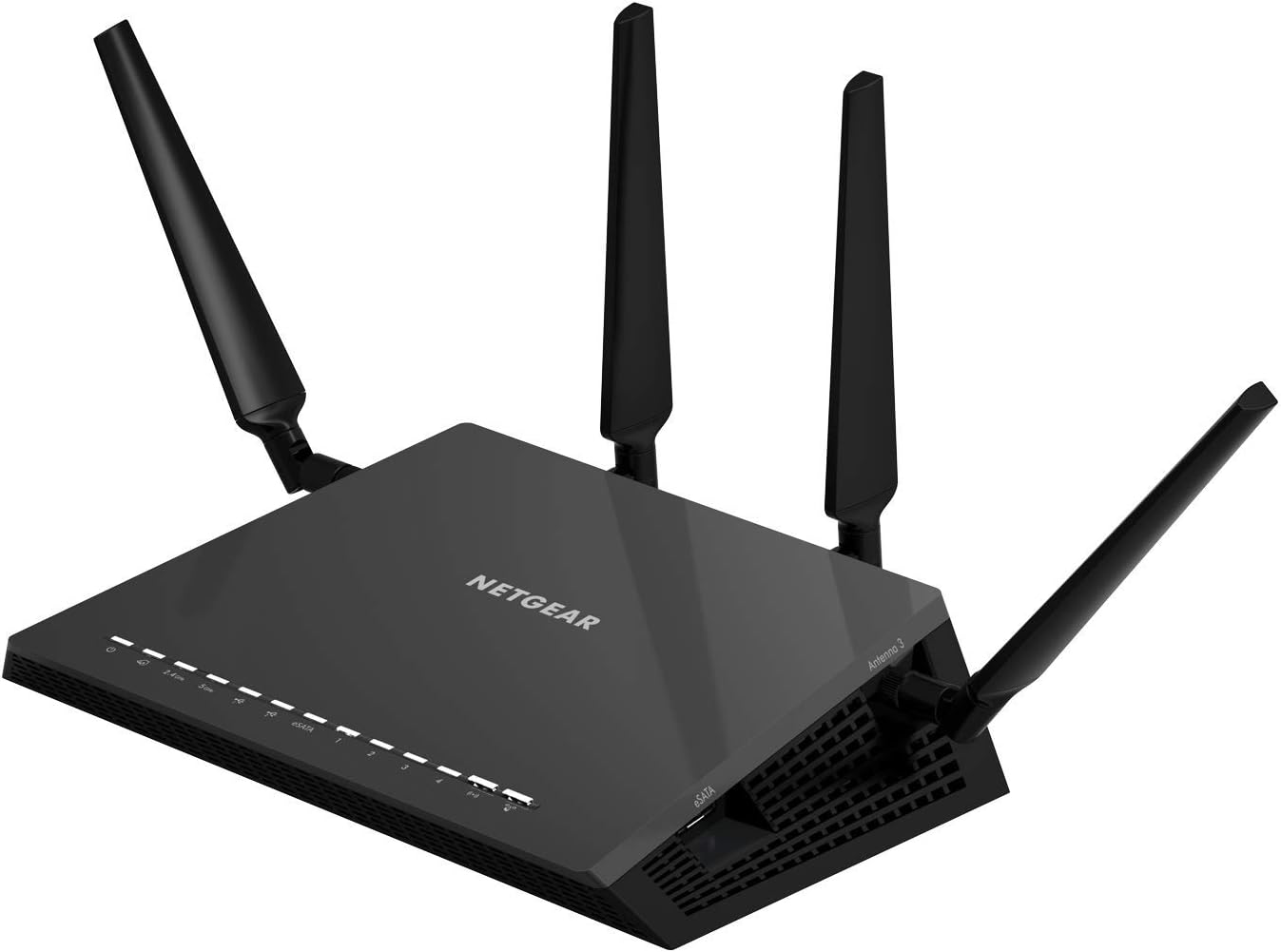
- Rated for up to 2,500 sq ft coverage and 45 connected devices, suited to larger homes with many smart devices
- 4 x 1-gigabit Ethernet ports let you hardwire a console, PC and streaming box without a separate switch
- 1.7GHz dual-core processor with 4 amplified antennas and beamforming targets a stronger signal to more rooms
- Built-in USB 3.0 x2 and eSATA ports let you share a drive or printer across the network without a separate NAS
Cons
- AC2600 wifi (802.11ac) rather than WiFi 6, so it lags newer routers on multi-device efficiency in dense households
- No dedicated multi-gig WAN port, capping wired internet input at 1 Gbps even if your ISP plan is faster
- eSATA port is a legacy connector many newer drives and enclosures no longer include
The Nighthawk X4S is built for larger homes with many connected devices, rated for up to 2,500 sq ft of coverage.
- AC2600 combined speed: up to 800 Mbps (2.4GHz) + 1733 Mbps (5GHz)
- Recommended for up to 45 connected devices
- 4x4 antenna configuration on both bands with beamforming
- 1.7GHz dual-core processor with MU-MIMO support
The dual-core processor and four amplified antennas work together with beamforming to focus signal toward connected devices rather than broadcasting evenly in every direction, which helps in homes with multiple floors or thick walls. Dynamic QoS prioritizes bandwidth for streaming and gaming automatically, so a video call in one room does not stall a 4K stream in another during peak household use.

Pros
- WiFi 6 (802.11ax) delivers up to 5.4 Gbps combined dual-band speed, about 4x the network capacity of WiFi 5 routers
- Rated for 2,500 sq ft coverage and up to 25 connected devices across its 6 WiFi streams
- 4 x 1-gigabit Ethernet ports handle wired consoles and PCs alongside the wireless network
- Armor security suite and parental controls include a 30-day trial layered on top of the 1-year hardware warranty
Cons
- Only a single USB 3.0 port for shared storage, versus the dual USB plus eSATA on higher-tier models
- WAN input is capped at 1 Gbps, so it cannot pass through multi-gig fiber plans above that speed
- Advanced security features shift to a paid subscription once the 30-day trial period ends

Pros
- Rated up to 5400 Mbps combined throughput on WiFi 6 with 160MHz channel support
- 1.5GHz tri-core processor handles simultaneous device traffic without a separate mesh node
- One of the 4 Gigabit LAN ports is hardwired to auto-prioritize gaming traffic
- AiMesh compatibility lets you add another ASUS router later to erase dead zones instead of replacing the whole setup
- Includes lifetime AiProtection Pro network security powered by Trend Micro, no separate subscription needed for that layer
Cons
- Wired ports are standard Gigabit Ethernet, not multi-gig, so pairing with a 2.5Gbps+ ISP plan requires an additional switch to use the full line speed
- Instant Guard VPN and AiProtection Pro run through the ASUS Router app, so setup outside the app is not offered
- Dual-band only (2.4GHz/5GHz), with no dedicated 6GHz WiFi 6E band for the newest client devices
The RT-AX82U is built on WiFi 6 (802.11ax) with 160MHz channel support, rated for combined dual-band speeds up to 5400 Mbps. A 1.5GHz tri-core processor manages the radios and handles multiple simultaneous device connections without the router becoming the bottleneck.
- Dual-band 2.4GHz and 5GHz radios, no 6GHz WiFi 6E band
- 160MHz channels for higher peak throughput on supported client devices
- AiMesh support extends coverage by adding compatible ASUS routers as nodes
Actual throughput and range depend on building materials, interference, and how many devices are connected at once, so real-world speeds will sit below the rated maximum.
Pros
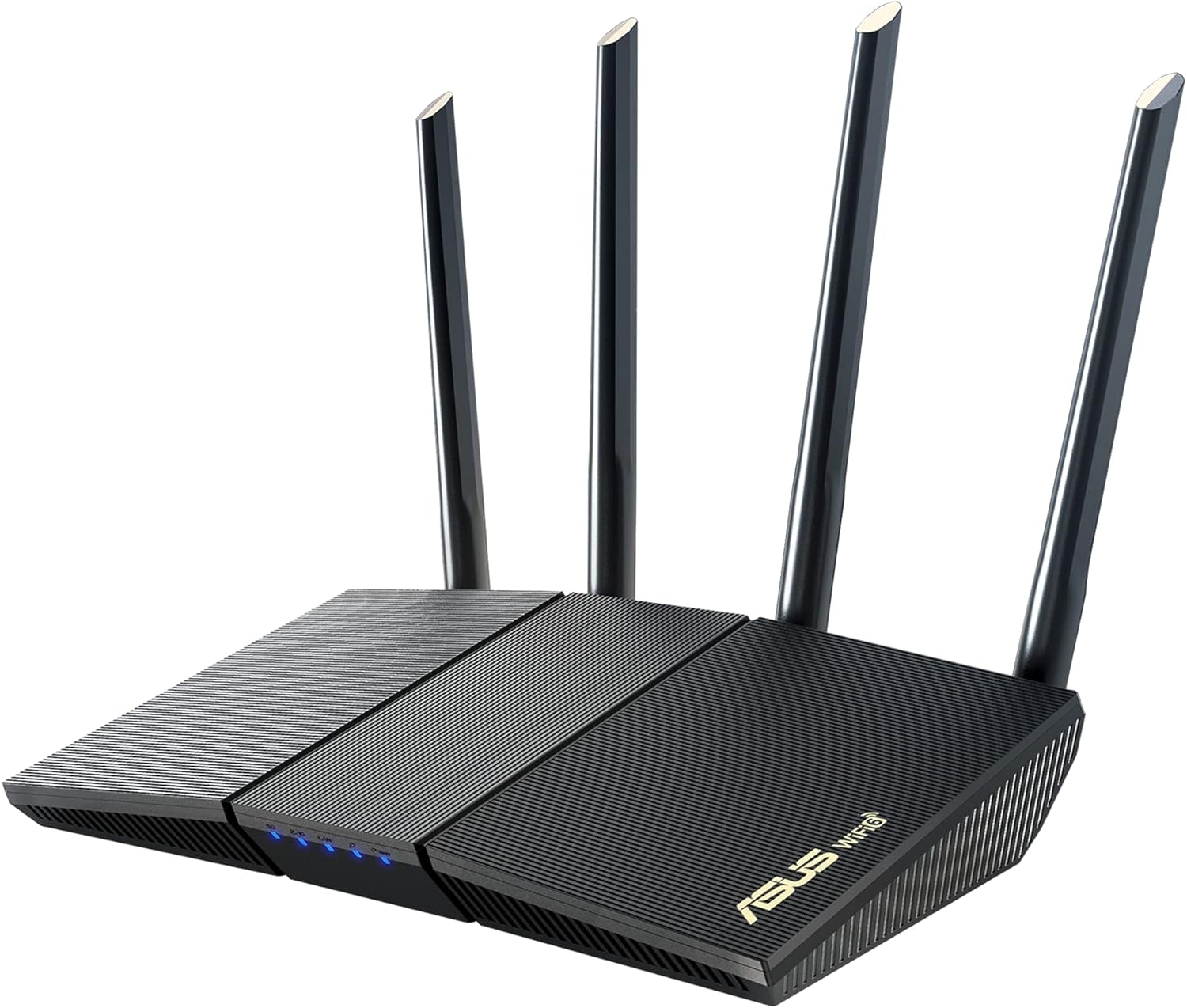
- Trend Micro powered network protection runs with no ongoing subscription attached
- Four external antennas on a 2x2 dual-band radio using 1024-QAM and 80 MHz channels
- AiMesh support, so a second compatible unit extends one network name rather than adding a second SSID
- Instant Guard opens a one-click encrypted tunnel home from a laptop on public Wi-Fi
Cons
- 2x2 radios cap the 5 GHz band near 1201 Mbps, so a multi-gig line cannot be fully used
- No USB port, so a shared drive or printer cannot be attached to the router itself
- Dual-core processor and no 160 MHz channel support, which limits top single-client speed

Pros
- Combined throughput up to 2882 Mbps on 5GHz plus 688 Mbps on 2.4GHz across dual bands using Wi-Fi 7's Multi-Link Operation
- Two 2.5 Gbps ports (one WAN/LAN switchable) plus three 1 Gbps LAN ports break past the single-gigabit bottleneck of older routers
- 2.0GHz quad-core processor and 4 internal antennas with beamforming target coverage up to 2,000 sq. ft. for up to 60 connected devices
- EasyMesh compatibility lets it pair with additional routers or extenders to expand coverage without replacing the whole system
- USB 3.0 port adds local network storage or printer sharing that many entry routers skip entirely
Cons
- Dual-band only, so it does not include the 6GHz band found on tri-band Wi-Fi 7 routers, reducing available spectrum in congested networks
- 2,000 sq. ft. coverage figure is on the smaller end for whole-home Wi-Fi 7 systems, so larger homes may need an EasyMesh extender
- HomeShield's advanced security and parental control features typically require an ongoing subscription beyond the basic free tier
The Archer BE230 is a dual-band BE3600-class Wi-Fi 7 router with combined speeds up to 2882 Mbps on 5GHz and 688 Mbps on 2.4GHz, using 4-stream Multi-Link Operation to keep connections stable as devices roam between bands. Four internal antennas with beamforming push signal toward hard-to-reach corners, with coverage figures up to 2,000 sq. ft. and support for up to 60 connected devices at once.
- Combined throughput up to 2882 Mbps (5GHz) and 688 Mbps (2.4GHz)
- 4-stream Multi-Link Operation for Wi-Fi 7 devices
- Coverage figures up to 2,000 sq. ft. for up to 60 devices
- 4K-QAM modulation for added data capacity per stream
Because this is a dual-band model, it skips the 6GHz band found on tri-band Wi-Fi 7 routers, which matters most in dense apartment buildings with heavy 5GHz interference from neighboring networks.

Pros
- Works as a standalone tri-band router first, so a single unit replaces an existing router and extender without committing to a full mesh
- Tri-band total of 5,400 Mbps split as 2402 Mbps on 6GHz, 2402 Mbps on 5GHz and 574 Mbps on 2.4GHz
- Rated for 200 connected devices, ample headroom for a smart home on one node
- Cross-compatible with every other Deco model, so a second unit added later can be a different model rather than an identical one
Cons
- 2,900 sq ft is a single-node open-space figure - internal walls and floors reduce it sharply, and one unit cannot fill a multi-storey house
- With only one node there is no mesh backhaul to run, so the dedicated 6GHz band sits underused until you buy a second Deco
- The listing states no Ethernet port count or speed for this model; the 2.5 Gbps port belongs to the Pro version and is absent here
TP-Link lists this as working with all major providers - Comcast, Charter, AT&T, Verizon, Xfinity, Spectrum, RCN, Cox, CenturyLink and Frontier among them - with the standard caveat that most require a separate modem. This is a router replacement, not a modem replacement.
The 6GHz band deserves thought before you buy. By default it is reserved as the mesh backhaul between nodes - but with a single unit there are no nodes to link, so that capacity does nothing until you switch it into WiFi network mode in the app. Do that and your 6E-capable phones and laptops can use 2402 Mbps of clean spectrum with no legacy device interference.
The catch: 6GHz has shorter range than 5GHz, so it works within a room or two of the unit rather than across the house.
What to Look for in a Budget Router
Not every router under $100 is built the same way. Before you compare prices, it helps to understand the handful of specs that actually affect your day-to-day wifi experience. Focus on these areas first, then narrow down by use case below.
Wifi Standards: Wifi 5, Wifi 6, and Wifi 6E Explained
Wifi 6 is the current mainstream standard, and it handles crowded networks far better than older Wifi 5 hardware. It uses a technology called OFDMA, which lets a router talk to multiple devices at once instead of one at a time. If your budget allows it, a Wifi 6 router future-proofs your network for a few more years. Wifi 6E adds a new 6GHz band that’s almost always free of interference from neighboring networks, which is especially useful in apartment buildings.
Coverage, Range, and Number of Connected Devices
Check the square footage rating on the box, then be realistic about your home’s layout. Thick walls, multiple floors, and metal appliances all cut down real-world range. A router rated for 2,000 sq. ft. in an open floor plan might only cover 1,200 sq. ft. in a home with lots of interior walls. If you regularly connect 15 or more devices, look for a router with a strong CPU and MU-MIMO support so performance doesn’t drop when everyone’s online at once.
Mesh System vs. Single-Unit Router
A single-unit router is simpler and usually cheaper, but it struggles in homes larger than about 1,500 sq. ft. A mesh system spreads two or three small units around your home so every room gets a strong signal. Mesh kits used to cost well over $150, but budget mesh routers under $100 now exist and cover many mid-size homes without dead zones. If you already know your home has weak wifi in a back bedroom or garage, mesh is usually worth the tradeoff over a single router.
Security and Built-In Protection Worth Having
Most routers in this price range now include some form of built-in network security, but the depth varies a lot. Some brands bundle a subscription-free firewall and basic intrusion detection, while others push you toward a paid app after the first year. If you have kids or smart home devices with weak default passwords, look for a model with free parental controls and automatic firmware updates baked in. That lowers the chance of an outdated router becoming the weak point in your home network.
Best Routers Under $100: Top Picks by Use Case
Rather than ranking every option the same way, it’s more useful to match a router to how you actually use your home network. Here are our top picks for common situations.
Best for Small Apartments and Single-Floor Homes
The Amazon eero 6 is a compact single-pack mesh unit built for smaller spaces. It covers roughly 1,500 sq. ft. on its own and connects through a simple app-based setup that takes a few minutes. It’s a good fit if you live in an apartment or condo and want reliable coverage without extra hardware cluttering a shelf. For a wider comparison of mesh options across price points, see our guide to best mesh routers.
Best for Larger Homes on a Tight Budget
If you have a bigger house and can’t fit a mesh kit into your budget, the Netgear Nighthawk X4S is worth a look. It’s rated for up to 2,500 sq. ft. and 45 connected devices, which is unusually high for this price range. The four gigabit ports also make it a solid choice if you have wired devices like a desktop PC or a NAS box. Just know that a single router still has to punch through every wall in the house, so results vary by layout.
Best for Gaming Under $100
Gamers care about consistent latency more than raw top speed, and the TP-Link Archer AX55 handles that well for the price. It supports Wifi 6, OFDMA, and basic VPN client and server functions, which matters if you play on a private network for certain titles. It won’t match a pricier gaming router’s dedicated traffic-prioritization dashboard, but it comfortably keeps ping steady during typical evening household usage. For dedicated gaming-first picks with more aggressive traffic prioritization, browse our best routers for gaming roundup.
Best for Smart Home and Multiple Devices
Smart bulbs, cameras, thermostats, and voice assistants add up fast, and a weak router will choke once you pass 20-plus devices. The Asus RT-AX1800S includes built-in parental controls and network security tools without a subscription fee, plus AiMesh support if you want to add a second unit later. That expandability is a real advantage over routers that only work as a single fixed unit.
Best Wifi 6E and Wifi 7 Value Picks
If you want newer wifi technology without paying flagship prices, two options stand out. The TP-Link Archer BE230 is an early Wifi 7 router at a genuinely affordable price, with 2.5G ports for a fast wired connection to a modem or NAS. The TP-Link Deco XE75 brings Wifi 6E mesh coverage across roughly 2,900 sq. ft., which is a lot of ground for two units. Neither is the fastest hardware on the market, but both give you a meaningful upgrade path over Wifi 5 gear.
Common Mistakes to Avoid When Buying a Router Under $100
The biggest mistake is buying based on advertised speed alone. Marketing numbers like AX5400 describe combined theoretical speeds across bands, not what any single device will actually see. Your internet plan’s speed matters more than the router’s rated maximum in most homes.
Another common error is ignoring firmware update history. A router that stopped getting security patches two years ago is a bigger risk than a slightly slower model that’s still supported. Check the brand’s update page before buying, especially for older models still sold at a discount.
A lot of buyers also unbox a new router, plug it in, and expect old settings to carry over automatically. Most budget routers ship reset to factory defaults and need a few minutes in the companion app to configure your wifi name, password, and any parental controls. Skipping this step is often why people report weaker performance than expected.
Finally, don’t assume more antennas automatically mean better coverage. Placement matters more, since a router tucked in a closet or behind a TV loses range regardless of its spec sheet. Set it up in a central, open location for the best real-world results.
Router Under $100 FAQ
Can a router under $100 handle a gigabit internet plan?
Yes, most Wifi 6 routers in this price range support gigabit wired speeds. Wireless speeds to individual devices will usually be lower, since that’s limited by the device’s own wifi chip and distance from the router.
Is mesh wifi worth it for a small home?
Not always. If your home is under 1,200 sq. ft. with a simple layout, a single router is often enough and easier to manage. Mesh becomes more valuable once you have multiple floors or persistent dead zones.
How often should I replace my router?
Most routers are worth replacing every four to five years, or sooner if firmware updates have stopped. Wifi standards also shift enough in that time that a refresh often improves both speed and security.
Do budget routers support a VPN?
Many do, at least as a VPN client for basic privacy on outbound traffic. If built-in VPN support is a priority, compare options in our best routers with VPN guide before deciding.
Do I need a separate modem and router?
In most areas, yes. Your internet provider supplies the modem, or a combo unit, while the router you buy handles wifi distribution inside your home. Check with your provider about compatibility before buying, since some cable plans require a modem from an approved list.
Picking the right router under $100 comes down to matching coverage and features to your actual home, not chasing the highest number on the box. Start with the quick answer above if you want a dependable default, or use the use-case picks to match your specific setup. If you later move into a larger home or add more devices, our guide to routers under $150 covers the next tier up.


