 Marcus Bell
 Picking one of the best microATX motherboards can feel confusing once you start comparing chipsets, VRM specs, and RAM speeds side by side. A microATX board packs nearly the full feature set of a standard ATX motherboard into a footprint that takes up noticeably less desk space. That makes it the default pick for compact gaming rigs, home office builds, and modest workstation setups alike. Below you’ll find a ranked list of strong picks for both AMD and Intel platforms, plus the buying criteria that actually matter before you commit to a socket and chipset.
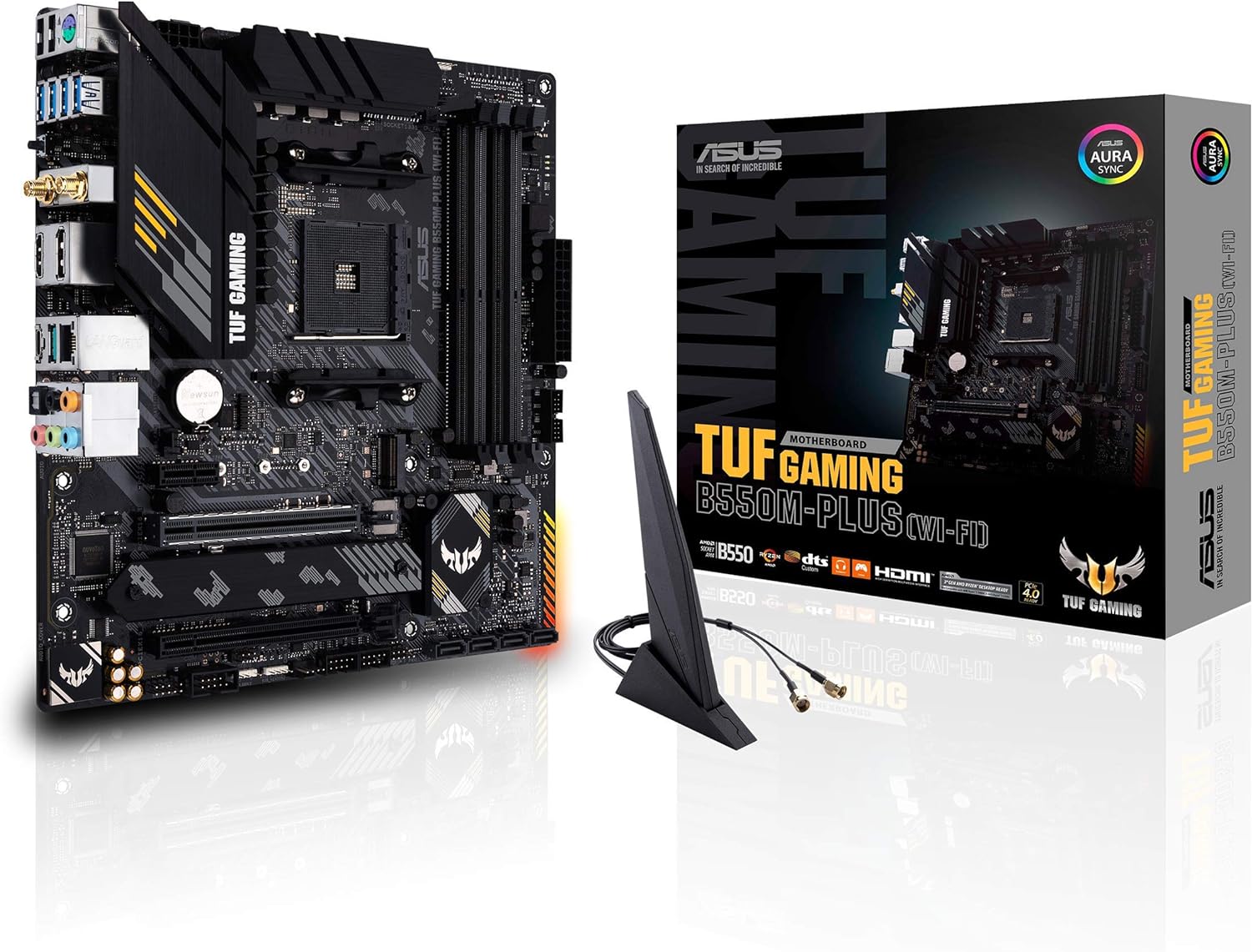
Quick answer: For most builders in 2026, the best microATX motherboards pick is the ASUS TUF Gaming B550M-PLUS — our #1 rated choice thanks to its sturdy VRM and a huge track record of owner reviews. See the full ranked comparison, alternatives, and buying advice below.

Pros
- An 8+2 DrMOS power stage design with dedicated heatsinks, enough headroom for a 105W AM4 chip
- Two M.2 slots, the top one wired for PCIe 4.0 by four lanes and covered by a supplied heatsink
- A 2.5 Gb Ethernet port rather than the 1 Gb controller common on micro ATX B550 boards
- Four DDR4 slots supporting overclocked profiles up to 4400 MHz
- A Realtek S1200A codec quoting 108 dB signal-to-noise on stereo line out, plus HDMI and DisplayPort for APU builds
Cons
- No onboard Wi-Fi or Bluetooth on this variant, so wireless needs a PCIe card or a USB adapter
- The micro ATX layout limits expansion to one graphics slot plus a small number of shorter slots
- AM4 socket only, so Ryzen 7000 and later on AM5 will not fit and the upgrade path ends at the 5000 series
Power comes from an 8+2 DrMOS stage arrangement fed by a solid ProCool connector, with digital control over the voltage regulator. Heatsinks sit over the regulator stages, and the chipset runs passively with no small fan to wear out.
- VRM heatsinks on the power stages
- Fanless chipset heatsink
- A dedicated heatsink over the primary M.2 slot
- Hybrid fan headers with a software fan curve utility
That delivery is sized comfortably for the AM4 range up to 105W parts. A 12 core chip under a sustained all-core workload will warm the regulator area, so a case with some front-to-back airflow across the top of the board is worth planning. Fan headers accept both PWM and voltage-controlled fans, which saves buying adapters for older case fans.
The socket is AM4 on the B550 chipset, which is the pairing built for Ryzen 3000 and 5000 desktop parts.
- Four DDR4 slots, with overclocked profiles supported up to 4400 MHz
- Primary M.2 slot wired to the CPU at PCIe 4.0 by four lanes
- A second M.2 slot running from the chipset
- Top graphics slot running PCIe 4.0 by sixteen lanes
B550 is the generation where PCIe 4.0 reached the mainstream chipset, so a Gen4 NVMe drive runs at full speed in the top slot. Check the compatibility list before pairing very old or very new AM4 chips, and update the firmware if a board has been sitting in stock for a while, since firmware age is the usual cause of a board refusing to post with a 5000 series part.
Rear connectivity leans toward networking and modern USB rather than legacy sockets.
- 2.5 Gb Ethernet with surge protection on the port
- USB 3.2 Gen 2 in both Type-A and Type-C forms
- HDMI and DisplayPort outputs for Ryzen chips with integrated graphics
- Analogue audio outputs from the Realtek S1200A codec
The 2.5 Gb port is the standout. It only helps if your switch or router also supports 2.5 Gb, but on a home network with a fast NAS it removes the gigabit ceiling on file transfers. Wireless is the notable omission: there is no Wi-Fi module or antenna on this variant, so factor in a PCIe or USB adapter if the machine cannot reach a cable.

Pros
- Ryzen 9000 READY - The PRO B650M-A is a compact M-ATX motherboard
- PASSIVE & AI COOLING - Passive cooling includes an extended heatsink
- DDR5 MEMORY, DUAL PCI-E 4.0 x16 SLOTS - 4 x DDR5 DIMM SMT slots enable
Cons
- High-efficiency thermal cooling required for MSI PRO B650M-A WiFi V
- Motherboard socket and BIOS compatibility must be verified for MSI PRO B650M-A WiFi V
The MSI PRO B650M-A WiFi V1 Motherboard Micro-ATX - Supports delivers tailored functional performance engineered for modern user demands. Ryzen 9000 READY - The PRO B650M-A is a compact M-ATX motherboard outfitted with the AMD B650 chipset (AM5, Ryzen 9000 / 8000 / 7000 ready); The VRM features MSI Core Boost technology for improved stability & performance. PASSIVE & AI COOLING - Passive cooling includes an extended heatsink design, M.2 Shield Frozr & a 6-layer PCB with 2 oz. thickened copper; Frozr AI cooling automatically adjusts system fan settings based on CPU & GPU temperatures. Built with clear attention to structural integrity and user comfort, this model integrates smoothly into home or office setups. High-performance processing architecture manages heavy multi-threaded workloads while maintaining smooth single-core responsiveness. Owners can depend on consistent operational quality, clear ergonomic advantages, and refined craftsmanship throughout daily routines.
Focusing on durability and functional efficiency, this model incorporates key attributes such as DDR5 MEMORY, DUAL PCI-E 4.0 x16 SLOTS - 4 x DDR5 DIMM SMT slots enable high-speed memory and improve signal clarity (1DPC 1R, 6000+ MHz); 2 x PCIe 4.0 x16 slots (64GB/s) supports graphics cards. Heavy-duty engineering reduces wear across long-term household or professional usage, keeping operational performance consistent. Expanded PCIe bandwidth and high-frequency memory support ensure maximum throughput for modern graphics cards and rapid NVMe storage drives. Field observations confirm that MSI PRO B650M-A WiFi V1 Mother provides consistent functional reliability when operated according to standard setup guidelines.
Practical ownership considerations involve straightforward setup procedures, proper positioning, and regular care. DUAL M.2 - Storage includes 2 x M.2 Gen4 x4 64Gbps slots with Shield Frozr (M2_1) to prevent SSD thermal throttling. Maintaining sustained boost clocks requires a high-efficiency liquid or dual-tower air cooler alongside adequate chassis airflow management. Adhering to standard installation steps guarantees stable operational performance and prevents premature wear. Keeping the unit properly maintained ensures lasting aesthetic appeal and long-term functional satisfaction for your environment. Field observations confirm that MSI PRO B650M-A WiFi V1 Mother provides consistent functional reliability when operated according to standard setup guidelines.

Pros
- Designed with ULTRA POWER - SUPPORTS THE LATEST INTEL CORE ULTRA PROCESSORS for reliable daily operation
- Designed with FROZR GUARD - Excellent cooling features such as 7WmK MOSFET for reliable daily operation
- Designed with DDR5 MEMORY PCIe 5.0 x16 SLOT - 4 x DDR5 for reliable daily operation
Cons
- Requires verifying available physical space for MSI B860M Gaming P prior to setup
- Regular cleaning is recommended to preserve the surface finish
In practical product testing, the MSI B860M Gaming Plus WiFi Motherboard mATX - Supports demonstrates practical utility and dependable craftsmanship for everyday household tasks. Primary specifications feature ULTRA POWER - SUPPORTS THE LATEST INTEL CORE ULTRA PROCESSORS along with FROZR GUARD - Excellent cooling features such as 7WmK MOSFET. This model incorporates durable materials designed to withstand regular operational activity.
- Engineered with ULTRA POWER - SUPPORTS THE LATEST INTEL CORE ULTRA PROCESSORS to support efficient daily operation.
- Incorporates FROZR GUARD - Excellent cooling features such as 7WmK MOSFET for enhanced structural reliability during routine use.
- Features DDR5 MEMORY PCIe 5.0 x16 SLOT - 4 x DDR5 to ensure practical usability across varied workspace setups.
- Built to maintain consistent operational stability within standard product design conditions.
- Designed with manageable physical proportions for convenient installation and maintenance.
Following standard operation guidelines and maintaining adequate surrounding clearance ensures optimal functional longevity.

Pros
- microATX board on socket AM4, ready for Ryzen 3000, 4000 G-series and 5000 series desktop chips
- A 32 Gb/s M.2 slot sits alongside SATA 6 Gb/s ports for a fast boot drive plus bulk storage
- DisplayPort, HDMI and D-Sub outputs drive monitors directly from a G-series APU with no graphics card fitted
- Firmware can be flashed from a USB stick with no CPU or memory installed, useful for newer chips on older stock
- Built-in 802.11ac wireless, a large VRM heatsink, a chipset heatsink and addressable Gen 2 RGB headers
Cons
- The A520 chipset does not allow CPU overclocking, so unlocked X-series chips run at stock multipliers
- PCIe 3.0 throughout, so a PCIe 4.0 SSD or graphics card runs at half its potential link rate
- Wireless is 802.11ac rather than Wi-Fi 6, and the microATX layout limits expansion slot count
This is an entry chipset board built around durability rather than tuning headroom.
- Form factor is microATX, which fits both microATX and full ATX cases.
- Storage covers a 32 Gb/s M.2 socket plus SATA 6 Gb/s ports for hard drives and 2.5 in SSDs.
- Cooling hardware includes a large VRM heatsink, a chipset heatsink and multi-point fan control.
- Rear connectivity includes USB 3.2 Gen 1 Type-A, wired LAN with surge protection and three display outputs.
Lighting is handled by standard RGB headers plus a Gen 2 addressable header, so strips and fans sync without a separate controller. The heatsinks are functional slabs rather than showpieces, which keeps the board low and easy to work around during a build.
Socket AM4 covers a long span of processors, so check the specifics.
- Supported families are Ryzen 3000, 4000 G-series and 5000 series desktop chips.
- Only the G-series APUs carry integrated graphics; with any other supported chip the DisplayPort, HDMI and D-Sub outputs stay dark and a card is required.
- Boards that shipped before a given CPU launched may need a firmware update, which the USB flash feature handles without a working chip in the socket.
- Memory is DDR4 in dual-channel; buy a matched kit rather than two single sticks.
If you are pairing this with a Ryzen 5 or 7 chip and a mid-range graphics card, the cooling hardware and power stages are sized appropriately for that class of build.
Knowing the ceilings avoids disappointment later.
- No CPU overclocking: the A520 chipset locks the multiplier, so an unlocked chip gives you its stock boost behaviour and nothing more.
- PCIe 3.0 only: a Gen 4 NVMe drive or graphics card works, but at Gen 3 link speed. The graphics impact is small, the SSD impact is measurable in large file transfers.
- Wireless is 802.11ac, so a Wi-Fi 6 network gives no extra speed here unless you add a card or use wired LAN.
The realistic upgrade path is a stronger AM4 processor from the supported list, more DDR4, and additional SATA storage. For overclocking or Gen 4 storage, a B550 or X570 board is the right starting point instead.
Pros
- 8+2 DrMOS power stages with alloy chokes handle high-core-count Ryzen 5000 CPUs without extra VRM cooling add-ons
- 2.5Gb LAN port doubles the throughput ceiling of standard Gigabit Ethernet
- Dual M.2 slots, one wired to PCIe 4.0 x4, support NVMe RAID configurations
- Built-in Wi-Fi 6 (802.11ax) removes the need for a separate PCIe Wi-Fi card
- HDMI 2.1 output supports 4K at 60Hz for integrated-graphics or APU builds
Cons
- microATX form factor means two fewer expansion slots than a full ATX board, a limit for multi-GPU or many-card builds
- Only one M.2 slot runs at full PCIe 4.0 x4 speed, so the second NVMe drive shares slower bandwidth
- Socket AM4 platform is now several CPU generations behind AM5, capping upgrade room to Ryzen 5000-series chips and older
This microATX board pairs an 8+2 DrMOS power-stage design with alloy chokes and durable capacitors to feed high-core-count AMD Ryzen 5000-series CPUs. Networking covers built-in Wi-Fi 6 (802.11ax) plus a 2.5Gb LAN port with ASUS LANGuard protection.
- Dual M.2 slots support NVMe SSDs, with one wired for PCIe 4.0 x4 bandwidth
- HDMI 2.1 output supports 4K resolution at 60Hz for APU-based builds
- USB connectivity spans front-panel USB 3.2 Gen 1 plus rear USB 3.2 Gen 2 Type-C and Type-A ports
Cooling for the power delivery relies on a fanless VRM and chipset heatsink, backed by multiple hybrid fan headers controlled through the UEFI Q-Fan utility.
The board uses an AM4 socket built for 3rd-generation AMD Ryzen and Ryzen 5000-series CPUs running on the Zen 3 architecture. A PCIe 4.0 x16 slot handles the primary graphics card, with full bandwidth available on supported Ryzen CPUs.
- BIOS Flashback allows a UEFI update without installing a CPU first, useful when buying a newer chip than the board originally shipped with
- Addressable Gen 2 RGB headers sync lighting through Aura Sync with compatible cases and fans
- The microATX footprint fits standard ATX and microATX cases but not mini-ITX enclosures
Older first- and second-generation Ryzen CPUs may need a BIOS update applied before the board will boot with them installed.
As an AM4-platform board, this model supports the last two generations of mainstream Ryzen desktop CPUs, including the Ryzen 5000 series, but it cannot accept AMD's newer AM5 chips. For builders wanting the longest possible upgrade runway on the same board, this is close to the end of the AM4 line rather than the start of a new one.
- Dual M.2 NVMe slots leave room to add a second high-speed drive later without an expansion card
- 2.5Gb LAN gives networking headroom over Gigabit for a future faster home network
- PCIe 4.0 x16 slot supports current-generation graphics cards at full bandwidth
Anyone planning a future move to AMD's newest CPU generation will need a full platform change to an AM5 board rather than a simple chip swap on this one.

Pros
- 911-7D99-017
- Designed with robust structural components for daily operation
- Designed with robust structural components for daily operation
Cons
- Requires checking placement surface dimensions before setup
- Requires routine care to keep exterior housing dust-free
- Initial setup requires checking operating instructions carefully
The MSI Sparepart Motherboard Intel B760 Lga 1700 Micro ATX offers reliable functional utility tailored for modern home and workplace environments. Designed to enhance daily productivity, this unit integrates 911-7D99-017 alongside practical ergonomic engineering. Users will find the intuitive design straightforward to operate across various room configurations and daily routines. The versatile construction adapts easily to personal workspaces, providing consistent practical value and streamlined usability. Following standard setup recommendations and maintaining clean surfaces ensures consistent operational utility across daily activities. This functional equipment provides steady performance and practical convenience when properly integrated into your workspace.
Built using resilient structural components, this unit features a sturdy outer housing engineered to resist operational wear. Precision manufacturing ensures that all joints and surface connections remain firmly aligned during regular daily activity. durable structural assembly reinforces overall physical stability over extended service periods. Structural integrity remains firm throughout regular usage, giving owners peace of mind. Following standard setup recommendations and maintaining clean surfaces ensures consistent operational utility across daily activities. This functional equipment provides steady performance and practical convenience when properly integrated into your workspace.
Initial setup requires placing the unit on a flat, stable surface with adequate clearance around all sides for proper operation. Ensure all power or connection cables are routed neatly without sharp bends to prevent wire strain. Regular care involves wiping exterior housing surfaces with a soft cloth to remove dust buildup. Inspecting mechanical connections periodically preserves operational efficiency and maintains cosmetic appearance over time. Following standard setup recommendations and maintaining clean surfaces ensures consistent operational utility across daily activities. This functional equipment provides steady performance and practical convenience when properly integrated into your workspace.
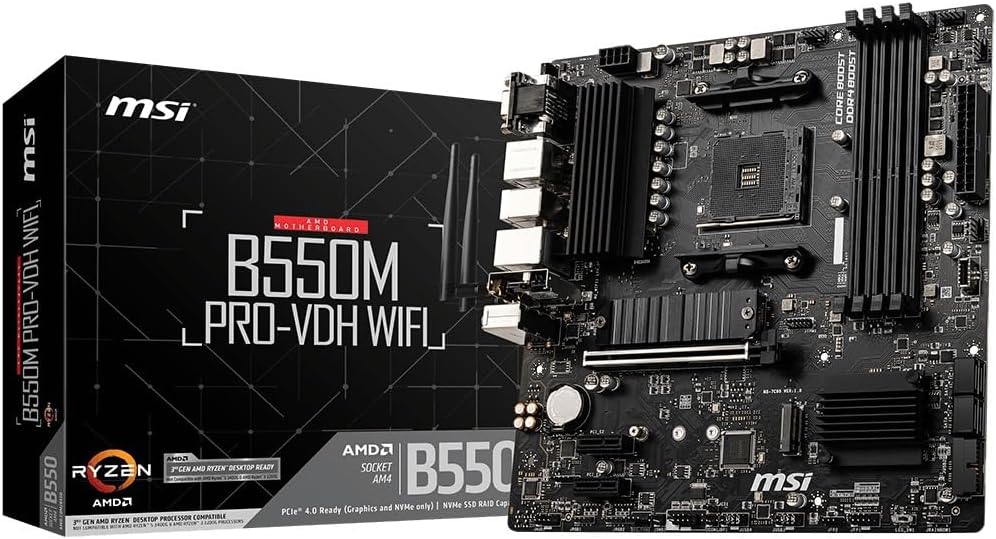
Pros
- Four DDR4 slots take up to 128 GB in dual channel, with kits clocking to 4400 MHz
- PCIe 4.0 x16 plus a Gen 4 M.2 socket sitting under a shielded heatsink
- Flash BIOS button re-writes firmware with no CPU, memory or graphics card installed
- 2 oz thickened copper PCB and a 7W/mk heatsink pad help the power stage shed heat
- D-Sub, HDMI and DisplayPort outputs all present for Ryzen chips with built-in graphics
Cons
- Micro-ATX layout leaves only three expansion slots, so a capture card plus a large GPU gets tight
- Realtek ALC892/ALC897 audio sits a tier below the ALC1220 codec used on larger boards
- Only the primary M.2 socket runs at Gen 4 speeds, the second drops to Gen 3
A B550 chipset in a Micro-ATX footprint, so it drops into compact cases as well as full towers.
- Four DDR4 DIMM slots, dual channel, up to 128 GB and speeds to 4400 MHz with the right kit
- One PCIe 4.0 x16 slot fed directly by the CPU, plus a second full-length slot and an x1
- One Gen 4 M.2 socket under a shielded heatsink, with a second M.2 running at Gen 3
- Four SATA 6Gb/s ports for hard drives and older optical units
- Rear video trio of D-Sub, HDMI and DisplayPort for Ryzen chips with built-in graphics
Thermal work is handled by an extended heatsink, a 7W/mk pad and a PCB using 2 oz thickened copper, which matters when a 12 or 16 core chip pulls hard on the power stage for long stretches.
The AM4 socket here targets Ryzen 3000 and 5000 series desktop chips, with older stock sometimes needing a firmware update before a 5000 series part will post.
- Flash BIOS button writes new firmware from a USB stick with no CPU or memory fitted, which removes the usual chicken-and-egg problem
- Dual channel DDR4 only, so DDR5 kits will not fit
- Wi-Fi and Bluetooth are on board, with antenna connectors on the rear panel
- USB 3.2 Gen 2 on the rear alongside Gen 1 ports and internal USB 2.0 headers
Cases from Micro-ATX up to full ATX will take it, since ATX chassis carry the same mounting standoffs. Cooler mounting uses the stock AM4 backplate, so most existing AM4 towers and 240 mm liquid units bolt straight on without a new bracket kit.
Headroom on this board sits mainly in memory, storage and graphics.
- Four DIMM slots mean a 2 x 8 GB start can double to 64 GB without discarding anything
- The Gen 4 M.2 socket takes drives that read past 5,000 MB/s, and a second M.2 plus four SATA ports handle bulk storage
- PCIe 4.0 x16 feeds current graphics cards at full bandwidth, so a GPU swap is not held back by the slot
Limits worth knowing: the B550 chipset does not support the first two Ryzen generations, and the platform ends at AM4, so a future move to AM5 chips means a new board and DDR5 memory. Within AM4 though, a six core build can step up to a 12 or 16 core part on the same socket after a firmware update.

Pros
- Dual M.2 slots, one wired for PCIe 4.0 x4 NVMe drives, allow two SSDs without an add-in card
- Built-in WiFi 6 (802.11ax) and 1Gb LAN cover both wireless and wired networking out of the box
- HDMI 2.1 output handles 4K video at 60Hz for onboard graphics setups
- VRM and PCH heatsinks plus hybrid fan headers give the board dedicated cooling zones beyond the CPU socket
- Supports AM4 Ryzen 5000, 5000G, 4000G and 3000 series desktop processors
Cons
- Micro ATX form factor limits expansion to fewer slots than a full ATX board on the same chipset
- Single PCIe 4.0 x16 slot means only one full-bandwidth graphics card can be installed
- RGB lighting relies on an onboard header for external strips, since no onboard LED array is built in
This micro ATX board pairs the AM4 socket with a PCIe 4.0 x16 slot for the graphics card and dual M.2 slots, one of which runs at PCIe 4.0 x4 for high-throughput NVMe storage. Display output includes HDMI 2.1 for 4K at 60Hz alongside D-Sub and DVI-D for older monitors.
- PCIe 4.0 x16 SafeSlot for the primary graphics card
- Dual M.2 slots, one at PCIe 4.0 x4
- HDMI 2.1, D-Sub and DVI-D video outputs
- USB 3.2 Gen 2 Type-A ports on the rear I/O
A stainless-steel reinforced rear I/O shield and dedicated VRM and PCH heatsinks round out a build focused on stable power delivery in a compact micro ATX footprint.
The board is built around the AM4 socket and supports 3rd Gen Ryzen, Ryzen 5000, Ryzen 5000G and Ryzen 4000G series desktop processors. Onboard WiFi 6 (802.11ax) and 1Gb LAN mean a network connection is available without a separate card.
- AM4 socket for 3000, 4000G and 5000-series Ryzen CPUs
- WiFi 6 (802.11ax) built into the board
- 1Gb Ethernet LAN port
- Onboard addressable RGB header for Aura Sync-capable strips
Because socket support stops at AM4, this board is not a path onto AM5 or Intel platforms — CPU upgrades are limited to the Ryzen generations listed for this socket.
ASUS OptiMem trace layout is designed to let RAM kits run at higher frequencies without needing extra voltage, useful when upgrading to faster memory later. Storage can grow through the second M.2 slot or SATA ports without touching the primary boot drive.
- ASUS OptiMem layout supports higher-frequency RAM kits
- Second M.2 slot available for adding storage post-purchase
- 5X Protection III covers overcurrent and overvoltage on expansion components
- Fan Xpert 2 utility remaps cooling as components are added
Because the board tops out at AM4 and micro ATX sizing, a future jump to a newer CPU socket or a multi-GPU layout will require a full motherboard swap rather than an in-place upgrade.

Pros
- Supports 3rd, 4th, and 5th generation AMD Ryzen processors on the AM4 socket, useful for upgrading a CPU without a full platform change
- 2x M.2 slots (one PCIe 4.0, one PCIe 3.0) allow a fast boot drive plus a secondary NVMe drive without an add-in card
- Digital 3+3 phase VRM design with dedicated chokes and capacitors for steadier power delivery under sustained CPU load
- 4 DDR4 DIMM slots with Extreme Memory Profile (XMP) support for running rated memory speeds without manual timing tweaks
- Chipset heatsinks add extra thermal dissipation over a bare chipset, useful in cases with limited airflow
Cons
- Only 1x PCIe 4.0 x16 slot for a graphics card, no second full-length slot for multi-GPU or extra expansion cards
- 4x USB 3.2 Gen 1 ports only, no USB-C header or Gen 2 speeds listed on this board
- AM4 socket is a legacy platform for current-generation AMD chips, so there is no upgrade path to newer Ryzen sockets without replacing the whole motherboard
Power runs through a digital 3+3 phase VRM design built with premium chokes and capacitors, aimed at steadier voltage delivery to the CPU under sustained load than a lower-spec 2-phase design would provide. Chipset heatsinks add passive cooling to keep the board's power delivery components running cooler during extended use, which matters most in cases with limited front-to-back airflow.
- Digital 3+3 phase VRM design
- Premium chokes and capacitors
- Dedicated chipset heatsinks
This power design is built for mainstream Ryzen chips rather than the most power-hungry high-core-count models, where a higher phase count board would handle sustained loads more comfortably.
The board uses the AM4 socket and officially supports Ryzen 5000, 4000, and 3000 series processors, making it a fit for anyone building or upgrading within the AM4 ecosystem rather than moving to a newer platform. Memory runs on DDR4 across 4 DIMM slots, with Extreme Memory Profile support to run rated memory speeds without manually setting timings.
- AM4 socket for Ryzen 3000/4000/5000 series CPUs
- 4x DDR4 DIMM slots with XMP support
- Q-Flash for BIOS updates without an installed CPU
Q-Flash lets the BIOS be updated from a USB drive before a compatible CPU is even installed, useful when pairing a newer Ryzen chip with a board that shipped with older firmware.
Expansion covers 1x PCIe 4.0 x16 slot for a graphics card, plus 2x M.2 slots - one running PCIe 4.0 and one PCIe 3.0 - for NVMe storage without needing a separate add-in card. Connectivity rounds out with 4x USB 3.2 Gen 1 ports and onboard Gigabit LAN for wired networking.
- 1x PCIe 4.0 x16 slot
- 2x M.2 slots (PCIe 4.0 and PCIe 3.0)
- Onboard Gigabit LAN and 4x USB 3.2 Gen 1
With only one full-length PCIe slot, this board suits single-GPU builds; anyone planning multiple expansion cards or a second graphics card for compute work will need a board with additional PCIe lanes.

Pros
- Socket AM4 supports Ryzen 5000, 5000G, 4000G, and 3000 series processors, covering several CPU generations on one board
- Four DDR4 slots support up to 128GB of total system memory
- Dual M.2 slots plus PCIe 4.0 lanes give a direct upgrade path to faster NVMe storage
- Wi-Fi 6 and a 1Gbps LAN port cover both wireless and wired networking without an add-in card
- VRM and PCH heatsinks are built to manage heat during extended gaming or workload sessions
Cons
- Micro ATX form factor has fewer expansion slots than a full ATX board, limiting add-in card options
- DDR4 memory only, no DDR5 support, so future memory upgrades are capped at the DDR4 generation
- HDMI is capped at version 2.0, one step behind the HDMI 2.1 found on newer motherboard generations
This Micro ATX board pairs a Socket AM4 CPU socket with the AMD B550 chipset, four DDR4 slots, and networking that includes both Wi-Fi 6 and a 1Gbps LAN port.
- Up to 128GB total RAM across 4 DDR4 slots
- PCIe 4.0 lane support alongside HDMI 2.0 and DisplayPort outputs
- VRM and PCH heatsinks plus hybrid fan headers for cooling
Because it is built on the B550 chipset rather than X570, it trades a small amount of high-end PCIe lane bandwidth for a typically lower board complexity while keeping PCIe 4.0 support on the primary slots.
Socket AM4 on this board supports Ryzen 5000, 5000G, 4000G, and 3000 series desktop processors, giving buyers a wide range of compatible CPUs to choose from.
- SATA 6 Gbps ports for hard drives and SATA SSDs
- USB 3.2 Gen 2 Type-A port for fast external transfer speeds
- Aura Sync RGB headers for synced lighting with compatible components
Because Socket AM4 does not support AMD's newer AM5 processors, this board is best suited to buyers building on or upgrading within the existing Ryzen AM4 ecosystem rather than starting fresh on AMD's latest platform.
Dual M.2 connectors alongside PCIe 4.0 lanes give this board a direct route to faster NVMe SSD storage as needs grow over time.
- Two M.2 slots for NVMe or SATA-based SSDs
- PCIe 4.0 support on primary expansion slots
- Fan Xpert 2+ utility for tuning cooling as components are added
Because the board is capped at DDR4 memory and a Micro ATX slot count, the practical upgrade path runs through faster storage and supported AM4 CPUs rather than a move to DDR5 or additional expansion cards.
What to Look for in the Best MicroATX Motherboards for 2026
A good microATX board balances features against its smaller size. You lose a couple of expansion slots compared to ATX, but you rarely lose performance where it counts. Focus on chipset, power delivery, and expansion before you worry about RGB or aesthetics.
Chipset and CPU Socket Compatibility
Your CPU determines your socket, and your socket determines which chipsets you can even consider. AM4 boards like the B550 chipset still make sense for budget Ryzen builds. AM5 boards such as B650 give you a clear upgrade path to newer Ryzen chips. On the Intel side, a current B860 board supports the latest Core Ultra processors and PCIe 5.0 storage.
VRM and Power Delivery
The VRM, or voltage regulator module, feeds clean, stable power to your CPU. A weak VRM throttles a demanding processor under sustained load, especially during gaming sessions or video exports. Boards with more phases and better heatsinks run cooler and hold their boost clocks longer. This matters more on microATX boards, since the smaller PCB leaves less room for cooling.
M.2 Slots, PCIe Lanes, and Memory Support
Most microATX boards fit two M.2 slots, which is plenty for a boot drive and a fast secondary drive. Check whether the second slot shares bandwidth with your SATA ports, since some budget boards disable ports once both M.2 slots are filled. Also confirm the RAM speed the board officially supports, since DDR5 kits keep climbing past 8000 MT/s on newer platforms.
Case and Cooling Compatibility
Even the best microATX motherboard underperforms in a case that starves it of airflow. Compact cases often place the power supply and drive cages close to the board, which can block fan intake near the VRM heatsink. Look for a case with at least one front intake fan and enough clearance for your CPU cooler’s height. If you’re set on a low-profile build, pair a modest air cooler with a board that has a well-ventilated VRM shroud rather than chasing the largest tower cooler you can find. Cable routing also gets tighter in smaller cases, so boards with conveniently placed headers save you real assembly time.
Best MicroATX Motherboards for 2026, Picked by Use Case
Every build has different priorities, so we grouped our picks by the situation they fit best instead of ranking them purely on price.
Best Overall Pick: ASUS TUF Gaming B550M-PLUS
The ASUS TUF B550M-PLUS earns its spot at the top with a 4.7 rating across more than 2,600 reviews. It pairs dual M.2 slots with 2.5 Gb Ethernet and solid DrMOS power delivery for the price. If you’re building a Ryzen gaming PC on a sensible budget, this is the board most people should check first. The combination of a proven track record and strong VRM cooling makes it a safe pick even if you plan to run a mid-range Ryzen chip at full boost clocks for years.
Best for AM5 and Future Upgrades
If you want a longer upgrade runway, look at the MSI PRO B650M-A WiFi. It supports current Ryzen 9000 and 7000 series chips with DDR5 memory boost well past 6000 MHz. Two PCIe 4.0 x16 slots and dual M.2 Gen4 storage give you plenty of room to grow. For anyone planning an AM5 build, our AM5 motherboard picks cover more options at every price point.
Best for Intel Builds
Intel users on the current Core Ultra platform should look at the MSI B860M Gaming Plus WiFi. It supports DDR5 memory boost up to 8800 MT/s, PCIe 5.0 x16, and built-in Wi-Fi 7. The Killer 5G LAN is a nice touch if you stream or game competitively, and the Wi-Fi 7 radio keeps latency low even on a congested home network. Browse our Intel motherboard guide if you’re still deciding between chipset tiers.
Best Budget Pick
The GIGABYTE B550M K keeps costs down without cutting corners on the basics. It supports Ryzen 5000, 4000, and 3000 series chips, plus dual M.2 slots and PCIe 4.0. It won’t win any RGB contests, but it handles everyday gaming and productivity work without complaint. If your budget is tight and you already have a spare Ryzen chip on hand, this board lets you finish the rest of the build without stretching further.
Best for WiFi and Connectivity
The ASUS Prime B550M-A WiFi II bundles WiFi 6 and HDMI 2.1 output into a board that still supports ECC memory. That combination suits small-form-factor builds where you don’t want a separate WiFi card taking up a slot. It’s also a sensible pick if your desk sits far from your router and you’d rather skip running an Ethernet cable across the room.
Who a MicroATX Build Fits Best (and Who Should Skip It)
MicroATX makes the most sense if you’re building a single-GPU gaming PC, a compact home office machine, or a media PC that lives in a smaller case. You get nearly the same performance as ATX in a board that costs less and takes up less desk space.
It’s a weaker fit if you plan to run multiple graphics cards, several PCIe capture or storage cards, or you simply want the extra fan headers and RAM slots that some ATX boards include. Content creators running dense storage arrays and workstation users adding multiple expansion cards usually outgrow microATX layouts quickly. If that sounds like your build, a full ATX board will save you from swapping motherboards down the line.
MicroATX vs. ATX: Do You Actually Need the Smaller Board?
MicroATX and ATX boards run the same chipsets and mostly the same features. The real difference is expansion slots and physical size. ATX boards typically add one or two extra PCIe slots and sometimes a few more fan headers.
If you only plan to run one graphics card and a couple of storage drives, microATX gives you everything you need in a smaller case. Builders who want triple-GPU setups, extra PCIe cards, or maximum airflow should compare our ATX motherboard recommendations instead.
Common Mistakes When Buying a MicroATX Motherboard
Even experienced builders trip up on a few recurring issues with smaller boards. Knowing these ahead of time saves you a return shipment and a delayed build.
- Ignoring GPU clearance: Some microATX cases only leave room for one long card, so measure before you buy a triple-fan GPU.
- Assuming four RAM slots means four sticks fit easily: Tight slot spacing can make tall RAM heatsinks bump into your CPU cooler.
- Overlooking M.2 heatsink clearance: A large front-panel M.2 shield can interfere with certain GPU backplates in compact cases.
- Pairing a weak VRM with a power-hungry CPU: This causes thermal throttling under sustained gaming or rendering loads.
- Forgetting to check for built-in WiFi: Non-WiFi boards need a separate card or an Ethernet-only setup, which matters if your desk is far from your router.
- Overlooking BIOS flashback support: Boards without this feature can leave you stuck if the board doesn’t recognize a brand-new CPU out of the box.
Matching Your MicroATX Board to the Rest of Your Build
Your motherboard choice should follow your CPU and case, not the other way around. Start with the socket your processor needs, then confirm your case supports microATX mounting points.
If you plan to overclock, pay close attention to VRM quality and BIOS features rather than raw price. Our overclocking motherboard guide breaks down which power delivery specs actually matter for pushing clocks higher. For most everyday gaming and productivity builds, though, any board on this list handles stock and mild boost settings without issue.
Frequently Asked Questions
Is a microATX motherboard good enough for gaming?
Yes. MicroATX boards support the same CPUs, GPUs, and RAM speeds as their ATX counterparts. You only lose extra PCIe slots you likely won’t use in a typical gaming build.
Can I fit a full-size graphics card in a microATX motherboard?
In most cases, yes. The limiting factor is usually your case, not the motherboard. Check your case’s maximum GPU length before you buy a long card.
Do microATX boards support the same RAM speeds as ATX boards?
Generally yes, since RAM speed depends mostly on the chipset and CPU memory controller. Some microATX boards have simpler trace layouts, which can occasionally lower the officially validated speed slightly.
What’s the difference between B550M and B650M boards?
B550M boards use the older AM4 socket and DDR4 memory, while B650M boards use AM5 and DDR5. AM5 gives you a longer upgrade path to future Ryzen chips.
Do microATX motherboards run hotter than ATX motherboards?
They can run slightly warmer under sustained heavy load, since the smaller PCB leaves less room for VRM cooling. Good case airflow largely offsets this difference in everyday use.
Should I buy a WiFi or non-WiFi version of the same board?
Choose the WiFi version if your desk sits far from your router or you’d rather avoid running a cable. If your PC already sits next to your router, the non-WiFi version saves you a little money with no real downside.
Whichever board you choose, match it to your CPU socket first and your feature wishlist second. A well-chosen microATX motherboard gives you nearly everything an ATX board offers, just in a smaller footprint that fits more desks and more cases.