 Marcus Bell
 Choosing the best motherboards for overclocking comes down to more than a flashy heatsink or RGB header. A weak VRM throttles your CPU the moment you push past stock clocks, and the wrong chipset can lock multiplier adjustments entirely. This guide walks through what actually matters for a stable overclock, then covers 10 boards worth shortlisting for 2026 across AM4, AM5, and Intel platforms so you can match one to your build and budget.
Quick answer: For most people shopping in 2026, the best motherboards for overclocking comes down to one board: the Asus ROG Strix B550-F Gaming WiFi II, our #1 rated choice for stable, budget-friendly overclocking on AM4. See the full ranked comparison, alternatives, and buying advice below.

Pros
- 12+2 teamed power stages with alloy chokes and a ProCool connector hold steady under a 16-core AM4 chip
- On-board Wi-Fi 6E pairs with Intel 2.5 Gb Ethernet, so both wireless and wired clear gigabit
- Dual M.2 slots with the primary wired PCIe 4.0 x4 for 7,000 MB/s class drives
- BIOS Flashback rewrites firmware from a USB stick with no CPU or memory installed
- HDMI 2.1 and DisplayPort 1.2 outputs drive a display straight from a G-series APU with no graphics card fitted
Cons
- AM4 is a closed socket, so any future CPU jump means replacing the board as well
- The chipset only feeds PCIe 3.0, so the second M.2 and the lower slots run at half the bandwidth of the primary pair
- No rear Thunderbolt or USB4 port on the back panel
This is a full ATX board built around the AMD B550 chipset and the AM4 socket.
- The VRM uses 12+2 teamed power stages with alloy chokes and durable capacitors, which is generous headroom for a 105W part and leaves room for a manual overclock.
- A ProCool solid-pin power connector replaces the usual hollow-pin header, cutting contact resistance where the 8-pin EPS lead meets the board.
- Heatsinks cover the VRM and both M.2 positions, with no fan on the chipset.
- An addressable Gen 2 RGB header plus Aura Sync ties case lighting to the board.
Layout follows the usual pattern with the primary M.2 sitting between the socket and the top graphics slot, so drives there run warmer than the lower position under sustained writes.
The AM4 socket accepts Ryzen 3000 and 5000 series desktop chips plus 4000 and 5000 G-series APUs. Older 2000 series parts are not supported by B550 boards.
- Fit a G-series APU and the HDMI 2.1 and DisplayPort 1.2 outputs work directly, so the machine can be built and tested before a graphics card arrives.
- Bluetooth v5.2 and Wi-Fi 6E come from the on-board module, with the antenna screwing onto the rear panel.
- As a standard ATX board it needs a case with nine mounting standoffs; microATX chassis will not take it.
If the CPU you have chosen is newer than the board revision on the shelf, use BIOS Flashback first. It updates firmware with no processor installed, which avoids the classic dead-on-arrival boot loop.
Upgrade headroom on this platform splits cleanly in two.
- Storage and graphics stay open. The primary M.2 and the top x16 slot both run PCIe 4.0 from the CPU, so a current graphics card and a fast NVMe drive are fully fed.
- The CPU path is finite. AM4 ended with the Ryzen 5000 series, so the ceiling is fixed - a 5800X3D or 5950X is as far as it goes, and anything beyond that means a new board, memory and processor together.
Networking ages well here: 2.5 Gb Ethernet and Wi-Fi 6E both outlast the socket. The sensible way to read this board is as the final stop on a mature platform - excellent if you already own AM4 memory and a chip, less appealing as the base for a machine you plan to grow for another five years.

Pros
- Dual-channel DDR4 support up to 128 GB, with speeds to 4400 MHz when overclocked
- PCIe 4.0 x16 graphics slot plus a Gen4 x4 M.2 under a shielded heatsink
- Wi-Fi 6E and Bluetooth 5.2 onboard, leaving expansion slots free
- HDMI and DisplayPort outputs drive monitors directly from a G-series APU
- 2 oz thickened copper PCB with 7 W/mK thermal pads on the power stages
Cons
- Not compatible with the Ryzen 5 3400G or Ryzen 3 3200G
- DDR4 and AM4 only, so a move to a newer socket means a new board and memory
- Older Ryzen 3000 chips may need a BIOS update before the board will post
A micro-ATX B550 board for AM4 processors, with dual-channel DDR4 support up to 128 GB and speeds to 4400 MHz under overclocking. Storage spreads across SATA 6 Gb/s ports and a Gen4 x4 M.2 slot sitting under a shielded heatsink.
- PCIe 4.0 x16 for the graphics slot
- Gen4 x4 M.2 with a shield-style heatsink
- Wi-Fi 6E and Bluetooth 5.2 onboard
- USB 3.2 Gen 2 plus HDMI and DisplayPort
Construction details matter under sustained load: a 2 oz thickened copper PCB, digital PWM control and 7 W/mK thermal pads across the power stages keep VRM temperatures in check during long renders or overnight compiles.
The socket accepts Ryzen 5000 and 3000 series desktop chips plus Ryzen 4000 G-series parts. Two are specifically excluded: the Ryzen 5 3400G and Ryzen 3 3200G will not run here, so confirm the exact model number before pairing anything older.
- Socket AM4 with DDR4 memory only
- Ryzen 5 3400G and Ryzen 3 3200G unsupported
- Onboard video needs a processor with graphics
- Older chips may require a BIOS update first
Memory runs dual channel, so populate the slots in matched pairs for full bandwidth. The HDMI and DisplayPort outputs are only live when a processor with built-in graphics is fitted; a chip without them still needs a discrete card.
B550 sits in the middle of the AM4 stack: PCIe 4.0 on the graphics slot and the primary M.2, with DDR4 memory throughout. That covers a Gen4 SSD and a current graphics card without stepping up to a higher tier chipset.
- Room to move up to an 8-core AM4 processor
- SATA drives and a second M.2 for storage growth
- No DDR5 or PCIe 5.0 route from AM4
- Wireless built in, so no slot lost to a network card
The ceiling is the socket itself. Once AM4 parts run out, the next step means a new board and new memory together, so treat this as a platform to fill out rather than one to keep climbing.

Pros
- Four M.2 slots alongside four SATA 6Gb/s ports, so a large NVMe array and older mechanical drives can coexist
- PCIe 5.0 x16 and DDR5 across four DIMM slots, ready for 12th, 13th and 14th Gen Core processors out of the box
- A 16+1 DrMOS power stage with ProCool sockets and Digi+ VRM, backed by VRM, PCH and M.2 heatsinks for sustained loads
- Intel 2.5Gb LAN with LANGuard surge protection, plus a front-panel USB 3.2 Gen 2 Type-C header and a Gen 2x2 Type-C port
- A Thunderbolt 4 header for adding USB4 connectivity later via an expansion card
Cons
- The listing contradicts itself on wireless: the title claims WiFi 6E with Bluetooth 5.3 while the feature list specifies the WiFi 6 AX201 module, so assume WiFi 6 with no 6GHz band
- DDR5 only, so an existing DDR4 kit cannot carry over and new memory has to be budgeted alongside the board
- Thunderbolt 4 is a header rather than a rear port, requiring a separate add-in card, and LGA1700 ended with 14th Gen so there is no future CPU generation for this socket
This is a full ATX Z790 board aimed at the middle of the enthusiast range rather than the top.
- Socket and chipset: LGA1700, Intel Z790
- Memory: four DDR5 DIMM slots
- Graphics: PCIe 5.0 x16
- Storage: four M.2 slots and four SATA 6Gb/s ports
- Power delivery: 16+1 DrMOS with Digi+ VRM and ProCool sockets
- Networking: Intel 2.5Gb LAN plus onboard wireless
Cooling is handled passively throughout: a VRM heatsink, a fanless PCH heatsink and an M.2 heatsink, with hybrid fan headers and Fan Xpert 4 for control. The absence of a chipset fan matters for noise, as it removes the small high-pitched fan that plagued earlier chipsets.
Aura RGB lighting and headers are included for anyone building around a lit case.
The socket accepts 12th, 13th and 14th Gen Intel Core processors, and the listing states it is Windows 11 ready out of the box. Even so, a board that has sat in stock may need a BIOS update before it recognises a 14th Gen chip, so check the shipped revision if you are pairing it with the newest CPU you can find for the socket.
Memory is the firm constraint. This board is DDR5 only. A DDR4 kit from a previous build will not fit, and four slots means you should buy a matched two-module kit first and leave room to expand rather than filling all four at once, which typically forces lower speeds.
Check the wireless spec against your needs before ordering: the title advertises WiFi 6E and Bluetooth 5.3 while the feature list names the WiFi 6 AX201 adapter. Those are different capabilities, and the conservative reading is WiFi 6 without the 6GHz band.
Storage is where this board earns its money. Four M.2 slots plus four SATA ports is more NVMe capacity than most builders will ever fill, and it means a system can grow for years without a drive swap. Bear in mind that populating the lower M.2 slots on Z790 boards usually shares bandwidth with SATA ports or the second PCIe slot, so read the manual's lane table before planning a full load.
The PCIe 5.0 x16 slot leaves room for a future graphics card generation, and the Thunderbolt 4 header lets you add USB4 ports through an add-in card rather than replacing the board.
The one thing that will not grow is the CPU. LGA1700 ended with 14th Gen, so the ceiling for this board is already known. Buy it to build a machine that lasts on its current chip, not as a platform you will upgrade twice.

Pros
- Three PCIe Gen3 x4 M.2 slots, each with its own thermal guard, so boot, game and scratch drives all sit on board
- 12+1 phase digital VRM with DrMOS, enough for a sustained all-core overclock on an 8-core chip
- ALC1220-VB codec with WIMA capacitors, quoted at 114 dB SNR on the rear output and 110 dB at the front
- Front-panel USB 3.1 Gen 1 Type-C header for a modern case front panel
- Direct-touch heat pipe links the VRM heatsinks, with Smart Fan 5 hybrid headers and a fan-stop mode
Cons
- LGA1151 is a closed socket, taking only 8th and 9th generation Core processors with no path to newer chips
- Onboard wireless is 802.11ac 2x2 and wired networking stops at Gigabit, with no 2.5 G port
- The M.2 slots are PCIe Gen3 x4, so a Gen4 drive fitted there runs at Gen3 speeds
This is an Intel Z390 board on the LGA1151 socket, built for 8th and 9th generation Core processors — the i5-9600K and i9-9900K era.
- Power delivery is a 12+1 phase digital VRM with DrMOS, which is what allows a sustained all-core overclock rather than a brief boost that falls back.
- A direct-touch heat pipe links the VRM heatsinks, moving heat away from the hottest stages beside the socket.
- Memory is dual-channel non-ECC unbuffered DDR4 across four DIMM slots, with Intel Optane memory support listed.
- Smart Fan 5 exposes multiple temperature sensors and hybrid headers that switch between PWM and voltage control, including a fan-stop mode at low load.
The board is a full ATX 305 by 244 mm footprint with an integrated rear I/O shield, so there is no loose plate to fit during the build.
Storage is the standout feature: three M.2 PCIe Gen3 x4 slots, each with its own thermal guard, which was unusual for this era and lets a boot drive, a game drive and a scratch drive all live on the board.
- Audio uses the ALC1220-VB codec with WIMA capacitors, quoted at 114 dB SNR on the rear output and 110 dB at the front.
- USB DAC-UP 2 offers adjustable voltage on selected ports to steady the supply to an external headphone amplifier.
- Wired networking is Intel Gigabit LAN paired with cFosSpeed traffic shaping software.
- Wireless comes from an onboard Intel CNVi 802.11ac 2x2 wave 2 module.
- A front USB 3.1 Gen 1 Type-C header feeds a modern case front panel.
RGB Fusion drives the onboard zones plus both addressable and standard LED strip headers.
Anyone considering this board is building or refreshing an older machine, so the ceilings matter more than the feature list.
- LGA1151 is a closed socket: 9th generation Core is the end of the line, with no route to newer Intel processors on this board.
- Wireless is 802.11ac, a full generation behind Wi-Fi 6, and wired networking stops at Gigabit with no 2.5 G port.
- The M.2 slots are PCIe Gen3 x4, so a Gen4 drive will work but run at Gen3 speeds.
- Documented driver support targets Windows 10 64-bit.
Inside those limits it remains capable: three heatsinked M.2 slots, a strong VRM and good onboard audio make it a sensible base for a second machine, a home server, or a hand-me-down gaming PC still running an i7-9700K.

Pros
- Triple M.2 slots include one PCIe 5.0 and two PCIe 4.0 lanes, covering a fast boot drive plus two additional NVMe drives without add-in cards
- 12+2+2 phase digital VRM design is built to handle sustained power delivery for higher core-count Ryzen 7000/8000/9000 processors
- WiFi 6E and Gigabit Ethernet are both built in, so there's no need for a separate network card for high-throughput wireless
- Four DDR5 DIMM slots support both AMD EXPO and Intel XMP memory profiles for one-click overclocked memory speeds
- Advanced thermal guards cover both the VRM and M.2 slots, aimed at maintaining stable performance under sustained loads
Cons
- Supports AM5 socket CPUs only, so existing AM4 processors from prior Ryzen generations are not compatible with this board
- USB 3.2 Gen2x2 Type-C is a single port, not multiple, limiting how many top-speed peripherals can connect directly
- No specifics are listed on rear I/O USB port count beyond the Type-C connection, so buyers needing many rear USB-A ports should check the full port layout first
This ATX motherboard uses the AM5 socket (LGA 1718) and supports DDR5 memory across 4 DIMM slots with both AMD EXPO and Intel XMP profile support for simplified memory overclocking. Power delivery runs through a 12+2+2 phase digital VRM design, built for stable sustained performance under higher core-count Ryzen processors.
- AM5 socket, ATX form factor
- 4x DDR5 DIMM slots
- 12+2+2 phase digital VRM
- USB 3.2 Gen2x2 Type-C port
Advanced thermal guard covers both the VRM section and the M.2 slots, aimed at keeping voltage regulation and SSD performance stable during extended heavy workloads rather than throttling under sustained use.
The board supports AMD Ryzen 9000, Ryzen 8000, and Ryzen 7000 series processors on the AM5 socket, so it doesn't accept older AM4-generation Ryzen chips. Triple M.2 slots split across one PCIe 5.0 lane and two PCIe 4.0 lanes allow a fast primary boot drive plus two secondary NVMe drives without needing a separate expansion card.
- AM5 socket: Ryzen 7000/8000/9000 series
- 1x PCIe 5.0 M.2 slot + 2x PCIe 4.0 M.2 slots
- WiFi 6E and Realtek Gigabit LAN built in
Because it's AM5-only, anyone upgrading from an older AM4 system will need a new compatible Ryzen CPU alongside this board, not just a motherboard swap; the socket change means the CPU and board upgrade together.
Smart Fan 6 gives granular control over multiple case and CPU fan headers for temperature-based speed curves, and Q-Flash allows BIOS updates without needing a CPU or memory installed first. The triple M.2 layout leaves room to add storage over time without maxing out slots on day one.
- Smart Fan 6 multi-header fan control
- Q-Flash BIOS updates without a CPU installed
- 3 total M.2 slots for staged storage upgrades
Reaching the full PCIe 5.0 bandwidth on the primary M.2 slot depends on pairing it with a PCIe 5.0-rated SSD; installing a PCIe 4.0 or older drive in that slot will run at the drive's own lower ceiling rather than the slot's maximum.
Pros
- AMD AM4 socket Ready for 2nd, 3rd Gen AMD Ryzen processors and 3rd Gen
- Comprehensive thermal design Passive chipset heatsink, M.2 aluminum
- Robust power delivery Designed power solution 14 plus2 TI power stages
- High-performance connectivity On-board Wi-Fi 6 (802.11ax) with MU-MIMO
- DIY Friendly Design Pre-mounted I O shield, ASUS SafeSlot, BIOS
Cons
- Requires checking placement surface dimensions before setup
- Requires routine care to keep exterior housing dust-free
- Initial setup requires checking operating instructions carefully
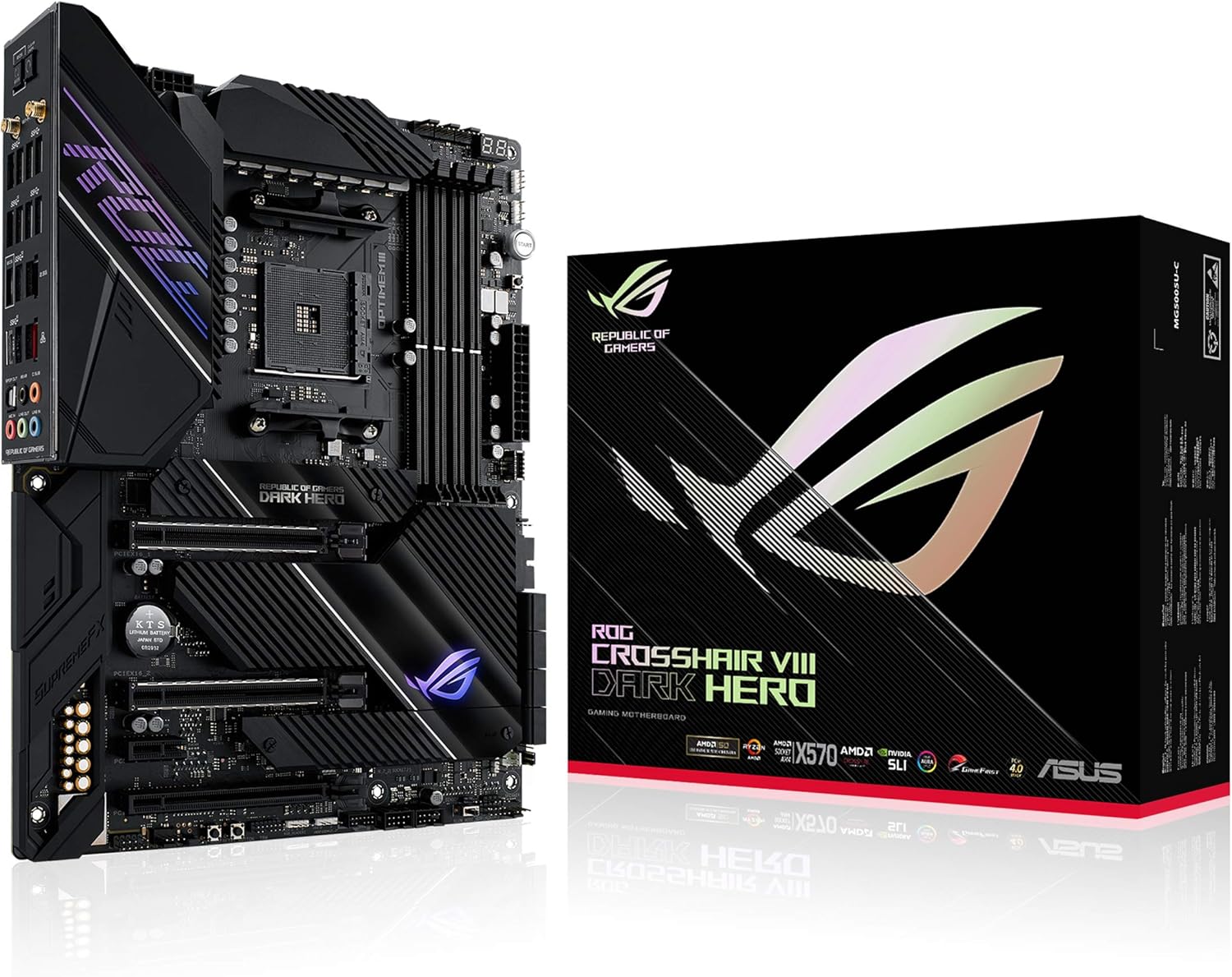
The ASUS ROG Crosshair VIII Dark Hero AMD AM4 X570S Zen 3 offers reliable functional utility tailored for modern home and workplace environments. Designed to enhance daily productivity, this unit integrates AMD AM4 socket Ready for 2nd, 3rd Gen AMD Ryzen processors and 3rd Gen alongside Comprehensive thermal design Passive chipset heatsink, M.2 aluminum. Users will find the intuitive design straightforward to operate across various room configurations and daily routines. The versatile construction adapts easily to personal workspaces, providing consistent practical value and streamlined usability. Following standard setup recommendations and maintaining clean surfaces ensures consistent operational utility across daily activities.
Built using resilient structural components, this unit features a sturdy outer housing engineered to resist operational wear. Precision manufacturing ensures that all joints and surface connections remain firmly aligned during regular daily activity. Robust power delivery Designed power solution 14 plus2 TI power stages reinforces overall physical stability over extended service periods. Structural integrity remains firm throughout regular usage, giving owners peace of mind. Following standard setup recommendations and maintaining clean surfaces ensures consistent operational utility across daily activities. This functional equipment provides steady performance and practical convenience when properly integrated into your workspace.
Initial setup requires placing the unit on a flat, stable surface with adequate clearance around all sides for proper operation. Ensure all power or connection cables are routed neatly without sharp bends to prevent wire strain. Regular care involves wiping exterior housing surfaces with a soft cloth to remove dust buildup. Inspecting mechanical connections periodically preserves operational efficiency and maintains cosmetic appearance over time. Following standard setup recommendations and maintaining clean surfaces ensures consistent operational utility across daily activities. This functional equipment provides steady performance and practical convenience when properly integrated into your workspace.

Pros
- Supports 3rd, 4th, and 5th generation AMD Ryzen processors on the AM4 socket, useful for upgrading a CPU without a full platform change
- 2x M.2 slots (one PCIe 4.0, one PCIe 3.0) allow a fast boot drive plus a secondary NVMe drive without an add-in card
- Digital 3+3 phase VRM design with dedicated chokes and capacitors for steadier power delivery under sustained CPU load
- 4 DDR4 DIMM slots with Extreme Memory Profile (XMP) support for running rated memory speeds without manual timing tweaks
- Chipset heatsinks add extra thermal dissipation over a bare chipset, useful in cases with limited airflow
Cons
- Only 1x PCIe 4.0 x16 slot for a graphics card, no second full-length slot for multi-GPU or extra expansion cards
- 4x USB 3.2 Gen 1 ports only, no USB-C header or Gen 2 speeds listed on this board
- AM4 socket is a legacy platform for current-generation AMD chips, so there is no upgrade path to newer Ryzen sockets without replacing the whole motherboard
Power runs through a digital 3+3 phase VRM design built with premium chokes and capacitors, aimed at steadier voltage delivery to the CPU under sustained load than a lower-spec 2-phase design would provide. Chipset heatsinks add passive cooling to keep the board's power delivery components running cooler during extended use, which matters most in cases with limited front-to-back airflow.
- Digital 3+3 phase VRM design
- Premium chokes and capacitors
- Dedicated chipset heatsinks
This power design is built for mainstream Ryzen chips rather than the most power-hungry high-core-count models, where a higher phase count board would handle sustained loads more comfortably.
The board uses the AM4 socket and officially supports Ryzen 5000, 4000, and 3000 series processors, making it a fit for anyone building or upgrading within the AM4 ecosystem rather than moving to a newer platform. Memory runs on DDR4 across 4 DIMM slots, with Extreme Memory Profile support to run rated memory speeds without manually setting timings.
- AM4 socket for Ryzen 3000/4000/5000 series CPUs
- 4x DDR4 DIMM slots with XMP support
- Q-Flash for BIOS updates without an installed CPU
Q-Flash lets the BIOS be updated from a USB drive before a compatible CPU is even installed, useful when pairing a newer Ryzen chip with a board that shipped with older firmware.
Expansion covers 1x PCIe 4.0 x16 slot for a graphics card, plus 2x M.2 slots - one running PCIe 4.0 and one PCIe 3.0 - for NVMe storage without needing a separate add-in card. Connectivity rounds out with 4x USB 3.2 Gen 1 ports and onboard Gigabit LAN for wired networking.
- 1x PCIe 4.0 x16 slot
- 2x M.2 slots (PCIe 4.0 and PCIe 3.0)
- Onboard Gigabit LAN and 4x USB 3.2 Gen 1
With only one full-length PCIe slot, this board suits single-GPU builds; anyone planning multiple expansion cards or a second graphics card for compute work will need a board with additional PCIe lanes.

Pros
- 16+2+2 power stage design rated for 90A per stage, backed by dual ProCool II connectors for stable power delivery
- Supports AMD Ryzen 7000, 8000, and 9000 series desktop processors on the AM5 socket
- Four M.2 slots plus PCIe 5.0 support give room for multiple fast NVMe drives
- Built-in WiFi 7 and USB4 cover next-generation wireless and high-speed peripheral connections without add-in cards
- Q-Release Slim mechanism lets the GPU be removed without pressing a hard-to-reach latch
Cons
- ATX form factor needs a full-size case, not a compact micro-ATX or Mini-ITX build
- AI Overclocking and AI Networking features require ASUS software installed on the system to configure
- White PCB colour scheme may clash with builds using black or coloured components
The X870-A Gaming WiFi uses a 16+2+2 power stage design rated for 90A per stage, paired with dual ProCool II power connectors, high-quality alloy chokes, and durable capacitors. That combination is built to keep voltage steady under sustained load from multi-core AM5 processors.
- Four M.2 slots support PCIe 5.0 NVMe storage for fast boot and game-load times
- Built-in WiFi 7 and USB4 cover current wireless and peripheral standards without extra expansion cards
- DDR5 memory support pairs with AEMP for simplified memory overclocking profiles
The white PCB is a design choice worth noting for anyone matching component colour schemes.
This board uses the AM5 socket, supporting AMD Ryzen 7000, 8000, and 9000 series desktop processors, so it covers several processor generations on one platform without a socket change. It ships in a standard ATX form factor, requiring a full-size case rather than a compact micro-ATX build.
- Dynamic OC Switcher and Core Flex features are configured through ASUS software after installation
- Q-Release Slim lets the graphics card be unlatched and removed without reaching behind it
- AI Cooling II and AI Networking tools require the companion ASUS utility installed on the system
Confirm case clearance for a full ATX board before finalizing a build around this motherboard.
Because the AM5 socket spans multiple Ryzen generations, this board leaves room to upgrade the processor later without replacing the motherboard, as long as future chips stay within the AM5 platform. Four M.2 slots and PCIe 5.0 support also leave headroom for faster storage as drives improve.
- DDR5 support lines up with where memory standards are headed, rather than locking into the outgoing DDR4 standard
- WiFi 7 and USB4 are current-generation standards likely to stay relevant through the life of a build
- 16+2+2 power stages provide margin for higher-power processors released later in the AM5 lifecycle
A solid base for builders wanting to upgrade the CPU over time without a full platform change.

Pros
- 14+2+1 80A DrMOS power stages on an 8-layer PCB give this board a robust power delivery setup for higher-end AM5 CPUs
- Three M.2 slots, one on PCIe 5.0 and two on PCIe 4.0, all equipped with heatsinks for sustained SSD performance
- WiFi 7 and 2.5Gb Ethernet cover both wireless and wired networking well above the older WiFi 5/1Gb standard still common on entry-level boards
- Supports AMD Ryzen 9000, 8000 and 7000 series desktop processors on the same AM5 socket
- USB Type-C ports at both 10Gbps and 20Gbps, plus a Thunderbolt (USB4) header, give a wide range of high-speed peripheral options
Cons
- 4 DIMM slots support DDR5 only, so anyone with existing DDR4 memory cannot reuse it on this board
- ATX form factor takes up standard full-size case space, ruling it out for small form factor or mini-ITX builds
- Bluetooth is capped at v5.4, which is current but not the newest revision available on some competing boards
The B850-PLUS WiFi packs a full feature set onto an ATX-sized 8-layer PCB.
- Power delivery: 14+2+1 80A DrMOS stages with 8+8 pin ProCool connectors, alloy chokes, and durable capacitors
- Memory: 4 DIMM slots for DDR5
- Storage: 3x M.2 slots (1x PCIe 5.0, 2x PCIe 4.0), all with heatsinks
- Expansion: PCIe 5.0 x16 slot with SafeSlot reinforcement
- Networking: WiFi 7, Bluetooth 5.4, 2.5Gb Ethernet
- USB: 10Gbps and 20Gbps Type-C ports, plus a Thunderbolt (USB4) header
The 14+2+1 power stage count and 8-layer PCB point to a board built to handle higher-wattage AM5 CPUs under sustained load, not just entry-level chips, while the triple M.2 setup with full heatsink coverage keeps fast NVMe drives from throttling under heavy read/write use.
This board is built around AMD's current AM5 socket and DDR5 memory standard.
- Socket: AM5, supporting AMD Ryzen 9000, 8000, and 7000 series desktop processors
- Memory: DDR5 only — existing DDR4 modules are not compatible with this board
- Form factor: full ATX, sized for standard mid-tower and full-tower cases
- BIOS Flashback allows a BIOS update without installing a CPU first, useful when using a newer processor than the board originally shipped support for
Because the board supports three full Ryzen generations on one socket, it's built with some future-proofing in mind for AMD's AM5 platform, though buyers should confirm their specific CPU is on the board's supported list, since BIOS updates are sometimes required for newer chip releases.
The AM5 platform and expansion layout here leave real room to grow a build over time.
- Three Ryzen generations (7000/8000/9000 series) share the AM5 socket, so a CPU upgrade later doesn't necessarily require a new motherboard
- Three M.2 slots allow adding NVMe storage over time rather than committing to one drive at purchase
- PCIe 5.0 x16 slot supports the newest graphics cards without the bandwidth bottleneck older PCIe standards would introduce
The trade-off is on the memory side — since DDR5 is required, anyone upgrading from an older DDR4 system needs to plan for new RAM alongside the board itself, rather than carrying over existing memory. That's a one-time cost to unlock the rest of the platform's upgrade runway.

Pros
- 14 Duet Rail 80A SPS VRM power design supports the full AMD Ryzen 9000/8000/7000 lineup on the AM5 socket
- 4x M.2 slots include 2 Gen5 x4 (128Gbps) plus Gen4 x4 and Gen4 x2 slots, covering four drives without an add-in card
- DDR5 memory support reaches overclocked speeds of 8400+ MT/s across 4 DIMM slots
- WiFi 7 with Bluetooth 5.4 and 5Gbps wired LAN cover both wireless and wired networking without a separate card
- 2oz thickened copper PCB and PCIe Steel Armor II reinforce the board and primary graphics slot for heavier components
Cons
- PCIe 5.0 x16 speeds and DDR5 8400+ MT/s overclocking both require a compatible CPU and correctly configured BIOS settings to reach top speeds
- Dual 8-pin CPU power connectors mean the power supply and cabling need to support that configuration, not all older PSUs will
- ATX form factor needs a full-size case, ruling out compact mini-ITX or micro-ATX builds
The board runs a 14 Duet Rail Power System rated at 80A per phase (SPS) for the AM5 socket, built to feed AMD Ryzen 9000/8000/7000 processors under sustained load.
- FROZR GUARD cooling includes 7W/mK MOSFET thermal pads, extra choke thermal pads, and an extended heatsink across the VRM area
- EZ M.2 Shield Frozr II covers the primary M.2 slot to help prevent thermal throttling on fast Gen5 drives
- A combo-fan header supporting both pump and system fans (3A rated) adds flexibility for liquid cooling setups
Dual 8-pin CPU power connectors feed the VRM directly, a setup aimed at higher-core-count Ryzen chips under full load.
The AM5 socket supports the full AMD Ryzen 9000, 8000, and 7000 series processor lineup on this B850 chipset board.
- 4 DDR5 DIMM slots support overclocked memory speeds up to 8400+ MT/s at 1DPC 1R configuration
- A single PCIe 5.0 x16 slot (128GB/s) with Steel Armor II reinforcement supports current and upcoming graphics cards
- Rear I/O includes USB 20G Type-C and 7.1-channel USB audio with Audio Boost 5, plus S/PDIF output for external DACs
Reaching the board's maximum rated memory and PCIe speeds depends on both the installed CPU generation and BIOS settings being configured for the intended overclock.
Storage expansion covers 4 M.2 slots: two Gen5 x4 slots at 128Gbps, one Gen4 x4 slot at 64Gbps, and one Gen4 x2 slot at 32Gbps.
- EZ M.2 Clip II tool-free latches speed up drive installation and swaps without a screwdriver
- WiFi 7 and Bluetooth 5.4 cover wireless upgrades without needing a separate PCIe WiFi card
- 5Gbps Realtek LAN gives a wired upgrade path over standard 1Gbps ports for high-throughput local networking
Because the board already includes 4 M.2 slots and PCIe 5.0 support, most storage and connectivity upgrades can be handled without needing additional expansion cards down the line.
What Makes a Motherboard Great for Overclocking?
An overclocking-friendly board starts with power delivery. Look at the number of power stages and their amperage rating, since more stages spread heat and current across the board instead of stressing a handful of components. You also want a chipset that actually unlocks the features you need — budget chipsets often disable memory overclocking or multiplier control even on an otherwise capable board.
Cooling matters just as much as raw power. VRM heatsinks with real surface area and contact with a heat pipe keep voltage regulation stable during long gaming or rendering sessions. A board that throttles after twenty minutes under load isn’t actually overclocking-ready, no matter how many phases the spec sheet lists.
Key Buying Criteria Before You Choose
Before you compare specific models, run through these four checkpoints. They matter more than aesthetics or bundled software, and they explain most of the price gap between entry boards and enthusiast ones.
VRM Power Stages and Cooling
Count the power stages and check whether the manufacturer lists SPS (smart power stage) or DrMOS components — both handle heat better than older discrete designs. A board with 14+ stages and a finned heatsink will hold clocks steady far longer than a 6-phase budget option, especially with power-hungry chips.
Chipset and CPU Socket Compatibility
Match the socket to your CPU first, then check the chipset tier. On AM4, boards like the B550 support PCIe 4.0 and full overclocking, while on AM5 you’ll want B650 or X870 for headroom. If you’re building around a newer AMD chip, our AM5 motherboard picks cover chipset differences in more depth.
Memory Support for DDR5 Overclocking
Newer boards list a QVL (qualified vendor list) and a max supported memory speed — both hints at how well the memory controller and traces are tuned. Pushing past rated speeds also depends heavily on the memory kit itself, so it’s worth pairing your board with modules from our best RAM for overclocking guide rather than assuming any DDR5 kit will hit its rated XMP profile.
BIOS Features and Board Layout
A well-organized BIOS with granular voltage offsets, LLC (load-line calibration) presets, and saved profiles makes tuning far less tedious. Physical layout counts too — clearance around the CPU socket for larger air coolers, and M.2 slots that don’t sit directly under a hot GPU, both affect real-world thermals once you start pushing voltage.
Best Motherboards for Overclocking by Use Case
Not every overclocker needs the same board. Here’s how the lineup breaks down by platform, budget, and how far you plan to push your chip.
Best for AM4 Ryzen Rebuilds
The Asus ROG Strix B550-F Gaming WiFi II pairs a sturdy VRM with PCIe 4.0 and WiFi 6E, making it a strong fit if you’re upgrading an existing AM4 rig with a 5000-series Ryzen chip. Reviewers consistently mention stable all-core clocks without needing an aftermarket VRM fan, which is unusual at this price point.
Best for Intel 12th–14th Gen Overclocking
If you’re on Intel, the ASUS TUF Gaming Z790-Plus WiFi brings a 16+1 DrMOS design and PCIe 5.0 support, which gives K-series chips plenty of headroom for all-core tuning. The 4x M.2 slots also mean you won’t run out of fast storage as your build grows.
Best Budget-Friendly AM5 Board
For newer AMD builds without the flagship price tag, the GIGABYTE B650 Eagle AX supports DDR5 and triple M.2 storage while keeping costs reasonable. It’s a sensible starting point if you want AM5’s platform longevity without paying for features you won’t use.
Best for Extreme Overclockers
Enthusiasts chasing every last megahertz should look at the ASUS ROG Crosshair VIII Dark Hero. Its 14+2 Ti power stages and dedicated PCH heatsink are built for sustained high-voltage tuning, and the price reflects that — it’s not the right pick if you just want a mild all-core bump for daily use.
Best Value Pick Under $100
The GIGABYTE B550M K is a compact micro-ATX option that still supports PCIe 4.0 and basic overclocking on Ryzen 5000 chips. It’s a reasonable choice if your case is small and you don’t need multiple M.2 drives or elaborate RGB lighting.
Best Modern AM5 Flagship
For a future-facing build, the ASUS ROG Strix X870-A Gaming WiFi pairs 16+2+2 power stages with WiFi 7 and PCIe 5.0, giving newer Ryzen chips serious thermal and electrical headroom. It’s a strong match if you’re also shopping for a build focused on frame rates — see our best motherboards for gaming roundup for how it stacks up outside of overclocking specifically.
How to Validate a Stable Overclock After You Buy
Picking the right board is only half the job — you still need to confirm the overclock actually holds under real load. Run a stress test like Prime95 or OCCT for at least 30-60 minutes while watching VRM and CPU package temperatures in HWiNFO or a similar monitoring tool. If temperatures climb past your motherboard’s throttle point or the system crashes before the test finishes, back off the voltage or clock speed a notch rather than assuming the board is at fault.
It’s also worth running a memory stability test, such as TM5 or MemTest86, after tuning DDR4 or DDR5 timings. Memory instability often shows up as random reboots days later rather than an immediate crash, so a few hours of testing upfront saves troubleshooting time down the road. Save a BIOS profile once you find a stable configuration so you’re not re-tuning everything after a power outage or BIOS update.
Common Mistakes When Buying an Overclocking Motherboard
A few recurring mistakes show up again and again in build forums and return reasons. Avoid these before you check out.
- Buying a board with a great chipset but a weak VRM, then wondering why clocks drop under sustained load.
- Ignoring PSU headroom — a strong overclock draws meaningfully more power, so pairing your board with an undersized unit undercuts the whole build. Our best PSUs for overclocking guide covers wattage headroom in more detail.
- Assuming any DDR5 kit will hit its rated speed on any board — motherboard memory traces and BIOS maturity both matter.
- Skipping BIOS updates before tuning, which can leave stability fixes and better memory training on the table.
- Choosing a smaller form factor without checking VRM cooling clearance, then finding thermal throttling in a cramped case.
- Overlooking case airflow entirely — even a strong VRM heatsink needs moving air nearby to shed heat effectively during long sessions.
Who Should (and Shouldn’t) Buy an Overclocking-Focused Board
If you plan to run your CPU at stock settings with maybe a light PBO bump, you likely don’t need a flagship board — a mid-range option with a solid VRM covers that use case comfortably. Extreme overclockers pushing sustained high voltages, or anyone building a workstation that runs demanding loads for hours at a time, will get real value from the higher-tier boards on this list, since the extra power stages translate directly into cooler, more stable operation.
Budget builders should still prioritize VRM quality over extra M.2 slots or RGB lighting, since power delivery is what actually limits your overclocking ceiling. On the other hand, if you mostly game at stock settings and rarely touch the BIOS, spending extra on a flagship board mainly buys you future-proofing rather than day-one performance — that money is often better spent on a faster GPU or additional memory instead.
Frequently Asked Questions
Do I need an expensive motherboard to overclock safely?
Not necessarily. A mid-range board with a well-cooled VRM, like the B550-F Gaming WiFi II, handles moderate overclocks safely and holds temperatures well below throttle points. Extreme, sustained high-voltage tuning is where flagship boards start to matter more, mainly because of their extra power stages and heavier heatsinks.
Does motherboard choice affect memory overclocking?
Yes. Trace layout, BIOS maturity, and the memory controller’s tolerance all affect how close you get to your kit’s rated speed, which is why pairing a good board with a kit from our RAM guide matters as much as the CPU itself.
Can I overclock on a locked chipset?
Generally no — entry-level chipsets from both Intel and AMD often disable multiplier and voltage adjustments entirely, regardless of how the board is built. Check the chipset tier before you buy rather than assuming a premium-looking board unlocks tuning.
How many power stages should I look for?
For moderate overclocking, 10-12 well-cooled stages are usually enough for most builds. Sustained high-voltage tuning benefits from 14 or more stages paired with a substantial heatsink and good case airflow.
Is WiFi or extra M.2 slots worth paying for?
Only if you’ll actually use them day to day. They don’t affect overclocking headroom directly, so prioritize VRM quality first and treat connectivity extras as a secondary, nice-to-have factor.
Should I overclock a used or older motherboard?
It depends on its history. A board that’s been run at high voltages for years may have degraded capacitors or power stages, so buying new gives you more predictable headroom for sustained tuning.
Your ideal board depends on which chip you’re running and how far you plan to push it. Match the platform first, check the VRM before anything else, and pair your pick with adequate cooling and a PSU that has real headroom. Do that, and any of the boards above will hold a stable overclock for years of use.