 Hannah Lindqvist
Buffering during a movie, lag spikes mid-game, and video calls that freeze at the worst moment usually trace back to one culprit: the router. If everyone in your house is streaming, gaming, and working online at the same time, a weak router becomes the bottleneck no faster internet plan can fix. This guide covers the best high performance routers for 2026, what the spec sheet numbers actually mean, and how to match a router to your home size and internet speed instead of guessing.
Quick answer: For most households in 2026, the best high performance routers pick is the GL.iNet GL-MT6000 Flint 2 — our #1 rated choice thanks to its dual 2.5G ports, strong throughput, and a large base of verified owners. See the full ranked comparison, alternatives, and buying advice below.

Pros
- ***Please update the firmware upon initial setup of the router, as


Pros
- 4804 Mbps available on 5 GHz thanks to a four-stream HE160 radio, alongside 574 Mbps on 2.4 GHz
- Six external antennas driven by high-power front-end modules push usable signal into far bedrooms and kitchens
- OFDMA and MU-MIMO together quadruple average throughput when dozens of devices are active at once
- A USB 3.0 port turns an external drive into shared media storage or a private cloud without extra hardware
- OneMesh support lets a compatible extender join as one roaming network rather than appearing as a second name
Cons
- All WAN and LAN ports are Gigabit, so a 2 Gbps fibre plan cannot be used anywhere near its full speed
- The included security suite covers basic scanning and parental controls, with the advanced tier behind a subscription
- Rated for 0 to 40 degrees Celsius operation, so an unventilated cupboard in summer can push it beyond spec
The AX5400 figure breaks down as 4804 Mbps on 5 GHz plus 574 Mbps on 2.4 GHz. The 5 GHz side uses a four-transmit, four-receive arrangement with 160 MHz channel width, which is what produces the high number.
- Six antennas plus beamforming concentrate signal towards each connected device
- High-power front-end modules boost transmit strength within regulatory limits
- OFDMA lets one transmission carry data for several devices at once
- MU-MIMO serves multiple clients simultaneously rather than in sequence
- A large vented top surface, 167 square centimetres of it, keeps the radios from throttling
Real-world coverage in a three-bedroom house is typically strong throughout, with 2.4 GHz reaching a garage or garden. The 160 MHz channels that produce the headline speed are also the ones most likely to clash with radar detection outdoors, so speeds vary by location.

Pros
- 2.5G Multi-Gigabit Port: Breakthrough gigabit speeds and enter the multi-gig era of wired connection
- TP-Link HomeShield - TP-Link's premium security service keeps your home network safe with cutting-ed
Cons
- Aura RGB lighting feature adds to power consumption during operation

Pros
- Four Gigabit LAN ports plus a Gigabit WAN, so a console, TV and desktop can all run wired at once
- 1201 Mbps on the 5 GHz 802.11ax band with OFDMA and MU-MIMO for crowded device counts
- Dual-core 900 MHz processor keeps routing steady when a dozen devices stream simultaneously
- Four external high-gain antennas with beamforming, pivoting for a shelf or wall position
- OneMesh support lets a compatible extender join as one roaming network name rather than a second SSID
Cons
- The 2.4 GHz band runs 802.11n at 300 Mbps rather than 802.11ax, so Wi-Fi 6 gains apply on 5 GHz only
- No USB port, which rules out shared network storage or a connected printer
- No modem inside, so most ISP connections still need the provider box in front of it
Combined figures are 1201 Mbps on 5 GHz using 802.11ax plus 300 Mbps on 2.4 GHz using 802.11n, an AX1500 class device. Four external high-gain antennas with beamforming steer signal toward connected clients rather than radiating evenly in all directions.
- OFDMA lets several devices share one transmission slot, where Wi-Fi 6 helps most in a busy house
- MU-MIMO serves multiple clients at once instead of taking turns
- 1024-QAM raises the data carried per symbol for newer clients
- Dual-core 900 MHz processor keeps routing steady with many sessions open
- OneMesh support extends coverage under a single network name
Read those numbers as ceilings under ideal conditions. A phone two internal walls away will see a fraction of them, which is normal at this class and why spending ten minutes on antenna aiming pays off.
Pros
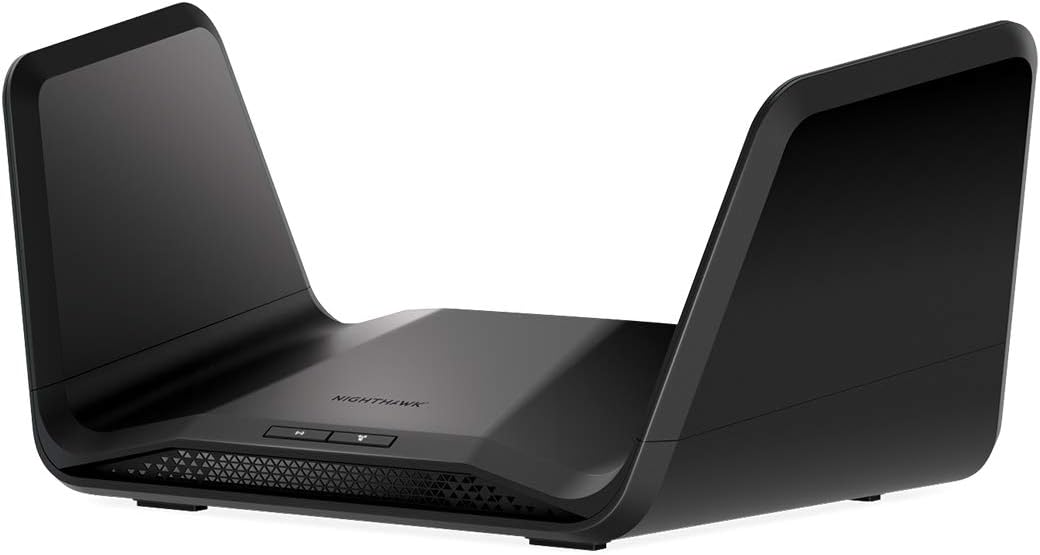
- AX6600 tri-band spec adds an extra 4.8 Gbps band, useful for splitting heavy 4K streaming and gaming across separate channels
- 8 WiFi streams and a quad-core 1.5GHz processor keep up to 40 connected devices from bottlenecking each other
- 4 x 1 Gig Ethernet ports plus 1 USB 3.0 port cover wired consoles, NAS drives and storage without a switch
- 160MHz channel support doubles per-channel speed versus 80MHz routers, on compatible client devices
- Rated for coverage up to 2,500 sq. ft., enough for most single-family homes
Cons
- Requires a separate modem, since this is a router only and will not work as a standalone gateway
- NETGEAR Armor's advanced security tools are a 30-day trial, after which continued use needs a paid subscription
- Sold for use in the U.S. only, so firmware and channel support are not configured for other regions
The RAX70 is built around AX6600 tri-band WiFi 6, splitting traffic across three bands for a combined 6.6 Gbps of link capacity. NETGEAR rates coverage at up to 2,500 sq. ft. and up to 40 connected devices.
- 8 WiFi streams reduce congestion when many devices are active simultaneously
- 160MHz channel support roughly doubles per-channel speed over 80MHz on compatible clients
- A quad-core 1.5GHz processor handles routing for multiple 4K streams and video calls at once
Actual coverage depends on home layout and wall materials, so larger or multi-floor homes may still see weaker signal in far rooms without a mesh extender.

Pros
- Total bandwidth of 6.5 Gbps across 2.4GHz and 5GHz bands with 6 spatial streams
- Two 2.5 Gbps ports (WAN/LAN and LAN) plus three 1 Gbps LAN ports
- Rated coverage up to 2,400 sq ft and 90 simultaneously connected devices
- USB 3.0 port for network-attached storage or printer sharing
- WPA3 encryption plus a separate managed network for IoT devices
Cons
- Dual-band design only, with no dedicated 6GHz band despite the Wi-Fi 7 label
- Full 5764 Mbps and 6.5 Gbps figures are only reached with Wi-Fi 7 client devices; older phones and laptops connect at lower legacy speeds
- Deeper security scanning and remote management run through the cloud-connected Tether app rather than working fully offline
This dual-band Wi-Fi 7 router combines a 5764 Mbps 5GHz band with a 688 Mbps 2.4GHz band for 6.5 Gbps of combined bandwidth across 6 spatial streams.
- Rated coverage of up to 2,400 sq ft with 6 external antennas and beamforming
- Supports up to 90 simultaneously connected devices
- Multi-Link Operation combines both bands for lower latency on supported clients
Because this is a dual-band design rather than tri-band, there is no dedicated 6GHz lane; devices without Wi-Fi 7 support fall back to standard 5GHz or 2.4GHz speeds rather than the peak combined figure. For a typical single-floor or small two-floor home, the antenna layout and beamforming keep signal consistent across rooms, though a very large multi-floor house may still benefit from a mesh add-on at the edges of the stated coverage area.

Pros
- Five 2.5G Ethernet ports, so wired clients and a NAS are not limited to gigabit
- WireGuard and OpenVPN throughput quoted up to 680 Mbps on the same hardware
- Tri-band Wi-Fi 7 including the 6 GHz band, with Multi-Link Operation across bands
- AdGuard Home built in for DNS-level ad and tracker filtering across every device
- Rated for more than one hundred connected clients, with plugin support on the stock firmware
Cons
- Wi-Fi 7 and 6 GHz gains require clients that support them, so older phones stay on 5 GHz
- The OpenWrt-based interface exposes far more settings than a typical consumer router, which takes time to learn
- No cellular modem or SIM slot, so it depends entirely on a wired broadband line
Three radios total BE9300 across 2.4 GHz, 5 GHz and the newer 6 GHz band opened up by Wi-Fi 7.
- Multi-Link Operation lets a capable client use two bands at once
- 4K-QAM packs more bits into each symbol than 1024-QAM Wi-Fi 6
- Enhanced OFDMA and multiple resource units cut latency in crowded rooms
- Rated for more than one hundred connected devices
The 6 GHz band is clean and fast but short-ranged, so treat it as a same-room band for a desktop, headset or laptop while 5 GHz does the whole-home work. MLO matters most for gaming, because a dropped packet on one band can be covered by the other rather than causing a visible stall. Older devices connect normally at their own standard.

Pros
- Covers up to 2,500 square feet and supports up to 80 connected devices simultaneously per the maker's figures
- WiFi 7 dual-band radios reach combined speeds up to 6.5Gbps (BE6500 class), about 2.4 times faster than a WiFi 6 router by the same spec sheet
- 2.5 Gig WAN port supports multi-gig internet plans beyond what a standard 1 Gig port allows
- LAN side includes 1x 2.5 Gig port plus 3x 1 Gig ports for wired devices needing higher throughput
- NETGEAR Armor adds an automatic security shield across all connected devices on the network
Cons
- This is a router only, with no built-in modem, so a separate cable or fiber modem is required to actually reach the internet
- Reaching the full 2.5Gbps WAN speed requires an internet plan and modem that also support 2.5Gbps, so a slower plan or older modem caps throughput well below the router's ceiling
- Coverage of 2,500 sq ft and 80 devices is the entry point in NETGEAR's WiFi 7 Nighthawk line, with larger homes needing a higher model in the same series for more coverage or device capacity

Pros
- Tri-band radios at 2402 Mbps on 6GHz, 2402 Mbps on 5GHz and 574 Mbps on 2.4GHz
- 2.5 Gbps port usable as either WAN or LAN, for multi-gig service or a wired NAS
- 1.0 GHz dual-core CPU with 512 MB of memory and six high-gain antennas with beamforming
- 160MHz channels on the 6GHz band, clear of legacy device traffic and neighbouring overlap
- Runs OpenVPN, PPTP and L2TP as both server and client, with WPA3 and a 2-year warranty
Cons
- Only Wi-Fi 6E clients can use the 6GHz band, and 6GHz signal attenuates faster through walls than 5GHz
- A separate modem is still required for most cable and DSL services
- Just one 2.5 Gbps port, so a second multi-gig wired device drops back to Gigabit
Three radios rather than two: 2402 Mbps on 6GHz, 2402 Mbps on 5GHz and 574 Mbps on 2.4GHz, making up the 5400 Mbps combined headline. The 6GHz band is the reason to buy a 6E unit at all, because it carries no legacy traffic from older devices and has room for 160MHz channels without overlapping the neighbours.
Six high-gain antennas with beamforming shape signal toward connected devices, and OFDMA plus true tri-band working raises capacity roughly fourfold against a comparable dual-band unit when many devices are active at the same time.
Behind the radios sit a 1.0 GHz dual-core CPU and 512 MB of memory, which is what stops throughput collapsing when dozens of clients, QoS rules and a VPN tunnel are all live at once. The housing is shaped for heat dissipation rather than stacking.
It works with any provider that hands off an Ethernet connection, including AT&T, Verizon, Xfinity, Spectrum, RCN, Cox, CenturyLink and Frontier. As with any standalone router, a separate modem is still needed for most cable and DSL services, so this replaces the router half of an existing gateway rather than the whole box.
On the client side, only Wi-Fi 6E devices can use the 6GHz band. Recent flagship phones, current laptops and newer 6E adapters qualify; anything older sits on 5GHz or 2.4GHz and sees no benefit from the third radio at all. Worth knowing too: 6GHz attenuates faster through walls than 5GHz, so the fastest band is also the shortest ranged.
OneMesh support lets a compatible extender join as a single roaming network name rather than appearing as a second SSID.
What “High Performance” Actually Means in a Router
Router marketing throws around a lot of jargon, so it helps to know what you’re actually paying for. Speed, coverage, and stability all come from a handful of underlying technologies working together.
The wireless standard is the biggest factor. WiFi 6 handles crowded networks well thanks to a technique called OFDMA, which splits a single data transmission so multiple devices get served at once instead of waiting in line. WiFi 6E adds a wide-open 6GHz band with far less interference from neighboring networks. WiFi 7 pushes throughput even higher and adds multi-link operation, letting a device use more than one band at the same time.
Tri-band routers, like several picks in this guide, add a second 5GHz (or 6GHz) band purely for device traffic, which keeps your laptop from fighting your smart TV for airtime. That separation is a real-world reason your connection feels smoother during a busy evening.
Two other terms worth knowing are MU-MIMO and beamforming. MU-MIMO lets a router talk to several devices at nearly the same instant instead of serving them one at a time, which matters a lot once you have a dozen smart home gadgets online. Beamforming focuses the wireless signal toward each connected device rather than broadcasting it evenly in every direction, which extends usable range without adding more hardware.
Matching Router Speed to Your Internet Plan
A high performance router only helps if it can actually keep up with what you’re paying your ISP for. Before you buy, check your current plan speed and think about whether you’re likely to upgrade in the next couple of years.
If you pay for 300-500 Mbps, a solid WiFi 6 router with Gigabit ports already gives you plenty of headroom. Once you’re on a 1 Gbps plan or higher, though, a Gigabit WAN port becomes the bottleneck, and you’ll want a router with at least a 2.5G port to actually see those speeds on your devices. Buying more router than your internet plan can use isn’t wasted money forever, since it future-proofs you for the next plan upgrade, but it won’t speed up your connection today.
Key Specs to Compare Before You Buy a High-Performance Router
Once you understand the terminology, four categories decide whether a router earns its “high performance” label.
Wireless Standard: WiFi 6, 6E, or 7
WiFi 6 routers, like the TP-Link Archer AX73, remain a smart choice if your devices are a few years old, since most phones and laptops sold recently already support it. WiFi 6E and WiFi 7 models make more sense if you’re already running a gigabit-plus internet plan and own newer devices that can use the extra 6GHz bandwidth.
Port Speed and Multi-Gig WAN
If your internet plan runs faster than 1,000 Mbps, check the WAN port speed before anything else. A router with only a Gigabit WAN port caps your whole network at roughly 940 Mbps, no matter how fast your wireless radios are. Look for a 2.5G or 10G WAN port if you’re on a multi-gig fiber plan.
Coverage Area and Device Capacity
Manufacturers list square footage and device counts under ideal lab conditions, so treat those numbers as a ceiling rather than a guarantee. A router rated for 2,500 sq. ft. in an open floor plan may only cover 1,500 sq. ft. in a home with plaster walls and multiple floors. If your home is large or oddly shaped, pairing your router with a mesh router system often solves dead zones more reliably than a single powerful unit.
Security, VPN, and Parental Controls
WPA3 encryption should be non-negotiable at this point, and built-in VPN client or server support matters if you work remotely or want to route traffic through a privacy service. Firmware that supports OpenVPN or WireGuard, like the GL.iNet models here, gives you more control than routers locked to a single app ecosystem.
Best High Performance Routers for 2026, By Use Case
Rather than ranking these by spec sheet alone, it helps to match a router to how you actually use your network.
Best for Serious Gamers
Low, consistent latency matters more than raw bandwidth if you play competitively online. The GL.iNet GL-BE9300 Flint 3 is a tri-band WiFi 7 router built around 6GHz connectivity and a quad-core processor, which keeps ping spikes down even while someone else streams 4K video in another room. If gaming performance is your top priority, our dedicated guide to the best routers for gaming digs deeper into latency-focused features.
Best for Large or Multi-Story Homes
Square footage claims only tell part of the story once walls and floors get involved. The NETGEAR Nighthawk RS200 covers up to 2,500 sq. ft. and supports 80 connected devices with a 2.5G internet port, which makes it a solid single-unit option for a mid-size house with a few dead spots. If you routinely need whole-home coverage across multiple floors, a mesh setup will usually outperform any single router, however powerful.
Best Value Without Sacrificing Speed
You don’t need to spend top dollar to get dependable WiFi 6 performance. The TP-Link Archer AX73 delivers dual-band AX5400 speeds and long-range coverage at a price that leaves room in your budget for a mesh satellite later if you need one. It’s a practical pick for apartments and small to mid-size homes that don’t need multi-gig ports.
Best for Multi-Gig Fiber Plans
If your ISP sells plans above 1 Gbps, your router needs a WAN port that can keep up. The TP-Link Archer AX80 pairs AX6000 wireless speeds with a 2.5 Gbps WAN/LAN port, so you’re not leaving bandwidth on the table. It also supports OneMesh, letting you extend coverage later without replacing the router.
Best for Privacy and VPN Users
Some households want more control over their traffic than a typical consumer router allows. The TP-Link Archer AXE75 supports WPA3 security and a 2.5Gbps WAN port for gaming and streaming, and its firmware plays well with third-party VPN configurations. For a deeper comparison of routers built specifically around VPN support, see our guide to the best routers with VPN built in.
Common Mistakes to Avoid When Buying a High-Performance Router
A few recurring mistakes cause most of the buyer’s remorse we see with router purchases.
- Buying a WiFi 6E or WiFi 7 router without owning any devices that support those bands, which wastes money on capability you can’t use yet.
- Ignoring the WAN port speed and pairing a fast wireless router with a slow wired connection to your modem.
- Assuming coverage ratings apply to your specific home layout instead of the open, obstruction-free space manufacturers test in.
- Skipping firmware updates after setup, which leaves known security vulnerabilities unpatched for months.
- Choosing a router based on maximum device count alone instead of checking real-world throughput reviews for your use case.
Placement and Setup Tips to Get Full Performance
Even the best hardware underperforms if it’s tucked in a closet. Place your router in a central, open location, ideally elevated off the floor, and away from thick walls, mirrors, and large appliances that block signal.
Keep the router away from microwaves and cordless phones, which can interfere with the 2.4GHz band. Update the firmware right after setup, then check again every few months, since manufacturers regularly patch both security holes and performance bugs.
If you’re upgrading from an older router, don’t assume you need a full wireless router replacement. Sometimes a firmware update or better channel selection solves the slowdown without new hardware.
Frequently Asked Questions
What is considered a high performance router?
A high performance router combines a modern wireless standard (WiFi 6, 6E, or 7), fast wired ports that match or exceed your internet plan, and enough processing power to handle many connected devices without slowing down.
Do I need WiFi 7 for high performance internet?
Not necessarily. WiFi 6 already handles most home networks well, and WiFi 7 mainly benefits households with multi-gig internet plans and newer WiFi 7-compatible devices.
How much coverage does a high performance router provide?
Manufacturer coverage ratings assume an open floor plan with few obstructions, so real-world coverage in a typical home is often 20-30% smaller than the advertised square footage.
Is a single router or a mesh system better for large homes?
A single high performance router can work well in homes under roughly 2,000 sq. ft., but larger or multi-story homes usually see fewer dead zones with a mesh system instead.
How often should I replace my router?
Most routers stay capable for four to six years, but it’s worth upgrading sooner if your internet plan speed now exceeds your router’s WAN port rating or your devices support a newer WiFi standard.