 Hannah Lindqvist
Flipping a wall switch is second nature, but it isn’t always convenient. Maybe the switch is on the wrong side of the room, maybe your bedroom lamp has no wall control at all, or maybe you just want to shut off every light in the house from one spot. This is exactly where the best remote light switches earn their place. With a small handheld remote or a smart controller, you can turn lights, fans, and small appliances on or off without touching a single physical switch.
This guide walks you through what to look for, the main types available, and how to match the right remote light switch to your home. Instead of rating each product one by one, we focus on helping you choose confidently. Below you’ll find a curated shortlist of popular options to explore.

Pros
- Single keychain remote switches 3 outlets independently or together, each rated to 15A/1875W for lamps through heavy-duty appliances
- 200-foot RF range is rated to pass through interior walls and doors, useful for controlling devices from another room
- Compact 5.3 x 2.95 x 1.8-inch body occupies only one wall socket, leaving nearby outlets free
- ETL and FCC listed with fire-resistant casing, and the system is expandable with additional treewell remote and receiver kits
Cons
- Remote relies on a CR2032 coin battery, so it needs periodic battery swaps rather than being rechargeable
- Suitable for single-pole installation only, which limits which existing outlets it can replace
- RF pairing is proprietary to the treewell ecosystem, so it does not integrate with third-party smart home apps

Pros
- 200-foot RF range works through walls, doors, and windows without needing line of sight to the outlet
- Rated for 15A/1875W, enough for lamps and most small household appliances plugged into a single outlet
- ETL and FCC listed, with a fire-resistant polycarbonate casing around the outlet
- Detachable remote doubles as a handheld unit or a wall-mounted switch using the included buckle mount
- Additional treewell switch and receiver kits pair with the same system to control more outlets
Cons
- 15A/1875W limit means it isn't sized for large appliances like space heaters or window air conditioners that draw more current
- Takes up one full wall outlet space, leaving only the adjacent socket free on a two-gang outlet
- RF range can shrink through thick masonry or multiple walls, below the stated 200-foot open-air figure

Pros
- 200-foot remote range penetrates walls, doors, and windows with reliable signal transmission
- 10A/1200W capacity accommodates lights, fans, and other electrical appliances safely
- Programmable and expandable design allows connecting multiple switches to single receiver
- No in-wall rewiring required saves installation time and maintains existing infrastructure
- Dual-use magnetic switch works as wall-mounted or portable handheld remote control
Cons
- RF signal can experience interference from dense walls and metal structures
- Requires separate receiver installation in existing switch box or junction

Pros
- Add/Relocate Wall Switch without Rewiring - Plug and play! Remotely
- Dual-Use Detachable Magnetic Switch - The sleek Decorator Rocker
- 200 FT Longer Remote Range - Strong RF signal of this remote light
- Space Saving & Certified Safe - Compact Design, fits well in tight
- Built with high grade Polycarbonate for lasting wear resistance
Pros
- 1875W maximum load capacity for large appliances
- 100-foot wireless range through walls and doors
- Quality construction
Cons
- 100-foot range subject to walls reducing effectiveness
- Cannot handle high-amperage devices above 1875W

Pros
- Includes (1) caseta lutron smart switch for Caséta smart lighting, (1) Pico
Cons
- Weight capacity not specified for heavy-duty scenarios
- Assembly or installation time depends on room setup

Pros
- STRONG SIGNAL:Our RF receivers and transmitters work through doors
- : With the option to pair multiple BN-Link remote outlets together,
- Dimensions of 3.5 x 2 x 1 inches engineered for optimal spatial fitting
Cons
- Requires verifying placement clearance for 3.5 x 2 x 1 inches prior to installation
Pros
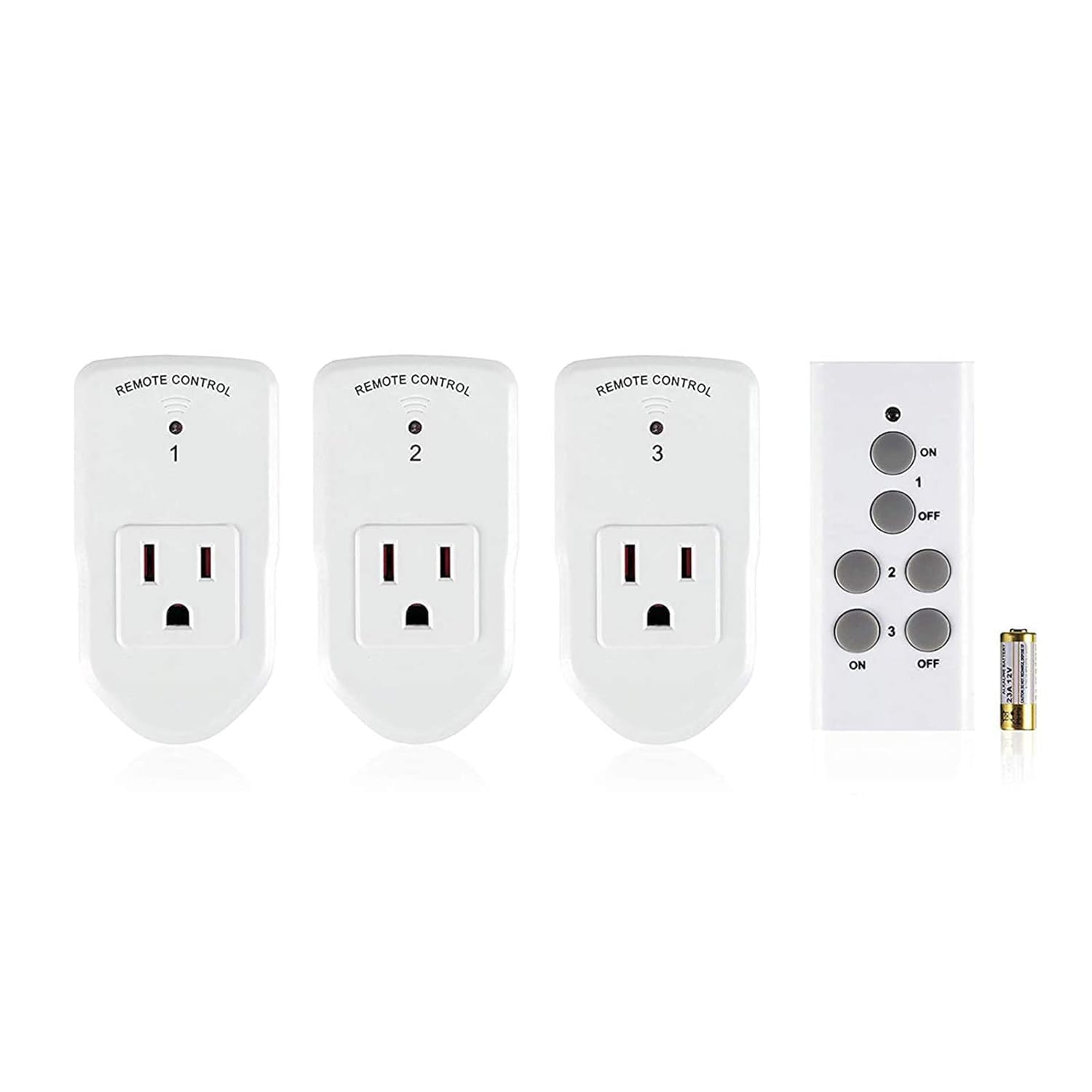
- Each outlet handles 120V at 10A for up to 1200W, enough for a fan heater or a bank of lamps
- RF signal reaches about 100 ft in line of sight and passes through interior doors and plasterboard walls
- Learning code pairing lets several remotes drive one outlet, so everyone in the house can use it
- Outlets stay off after a power cut rather than snapping appliances back on with nobody in the room
- Each module is 3.5 by 2 by 1 inches and the 12V 23A remote cell is included in the box
Cons
- RF only, with no Wi-Fi, no app, no scheduling and no voice assistant support
- Explicitly not compatible with shop vacuums, whose start-up surge exceeds the 10A limit
- No timer function on the outlets, so every switch on and off is a manual button press
The electrical ceiling is the number that decides whether an appliance is suitable: 120V, 10A and 1200W per outlet.
- Lamps, LED string lights, fans, radios, audio systems and phone chargers sit comfortably inside that limit
- Space heaters and window air conditioners need checking against the nameplate figure first, because many draw close to or above 1200W
- Shop vacuums are called out as incompatible, since their motor inrush current spikes far beyond the steady-state figure
- ETL and FCC certification cover the safety and radio-emission testing
The no-restore-after-outage behaviour is a safety feature worth understanding. If the power blinks, every outlet comes back off, which protects unattended appliances but also means a lamp will not resume on its own without a button press.

Pros
- Dimensions of 4.72 x 2.95 x 3.15 inches engineered for optimal spatial fitting
Cons
- Requires verifying placement clearance for 4.72 x 2.95 x 3.15 inches prior to installation

Pros
- Cycles between 4 preset light scenes with a single button press, without opening an app
- Battery life rated at a minimum of 3 years before a replacement is needed
- Magnetic backing lets it stick to metal surfaces like a fridge, in addition to the included wall adhesive
- Matter support extends connection options for linking to a broader smart home setup beyond the manufacturer's own app
Cons
- Requires a separately sold Hue Bridge; it will not control lights standalone over Bluetooth alone in this configuration
- Wireless design means no wired power option, so it relies entirely on the internal battery
- Sold in white only, with no colorway to match darker switch plates or trim
Why Choose a Remote Light Switch?
Remote light switches solve everyday frustrations that traditional wiring can’t. They add convenience, improve accessibility, and can even boost home security. Because most models are wireless and plug-and-play, you get the benefits without hiring an electrician or tearing into your walls.
- Convenience: Control lamps and lights from your couch, bed, or doorway.
- Accessibility: Ideal for seniors or anyone with limited mobility who shouldn’t reach behind furniture.
- Security: Turn lights on and off remotely so your home looks occupied while you’re away.
- Flexibility: Add switching to outlets and fixtures that never had a convenient control.
If any of these match your situation, a remote switch is one of the cheapest, fastest home upgrades you can make. Options like the 200FT Long Range Remote Outlet show how affordable the entry point can be.
Types of Remote Light Switches
Not all remote switches work the same way. Understanding the categories helps you avoid buying something that won’t fit your setup.
RF Plug-In Remote Outlets
These are the most common and beginner-friendly. You plug a receiver into a wall outlet, plug your lamp or appliance into the receiver, and control power with a small RF remote. There’s no wiring, no app, and no hub required. Radio frequency (RF) signals also pass through walls, so you can control lights from another room. The Mini Wireless Wall Switch and the Decorator Rocker Remote Outlet are good examples of this compact, no-fuss style.
Wireless Wall-Mounted Switches
These mimic a real wall switch but stick on with adhesive instead of screws and wires. They pair with a receiver that controls your fixture, giving you a permanent-looking control point anywhere. A Wireless Light Switch and Receiver Kit is perfect when you want a wall control for a ceiling light or fan without in-wall wiring. The DEWENWILS Wireless Wall Switch follows the same approach with a proven track record.
Multi-Outlet Remote Systems
If you want to control several lamps or a string of holiday lights at once, look for kits with multiple receivers and one or two remotes. These are popular for Christmas lights, entertainment centers, and hard-to-reach outlets. The BN-LINK Wireless Remote Outlet and the multi-pack BN-LINK Remote Outlet Set are designed for exactly this kind of whole-room control.
Smart Home Remote Switches
Smart options connect to an app, voice assistant, or lighting ecosystem. They cost more and may require a hub, but they unlock scheduling, dimming, and automation. The Lutron Claro Smart Switch and the Philips Hue Smart Dimmer are strong picks if you’re building toward a fuller smart-home setup rather than just simple on/off control.
Key Features to Compare Before You Buy
Once you know the type you want, these are the specifications that separate a switch that delights from one that disappoints.
Wireless Range
Range determines how far you can be and still control your lights. Basic units cover around 100 feet, while long-range models reach roughly 200 feet. If you plan to control outdoor lights or reach across a large home, prioritize longer range. Real-world distance drops when signals pass through multiple walls, so buy more range than you think you need.
Power Rating (Watts and Amps)
Every switch has a maximum load. Many remote outlets handle 15A/1875W, which is plenty for lamps, LED fixtures, and most household devices. Others cap around 1200W/10A. Check the wattage of what you’re plugging in – space heaters and high-draw appliances can exceed the limit, so match the rating carefully for safety.
Installation Method
Plug-in receivers require zero tools. Adhesive wall switches only need a clean surface. Hardwired smart switches may need a neutral wire and some electrical comfort. Be honest about your DIY skills. If wiring makes you nervous, stick to plug-in or peel-and-stick options.
Number of Outlets and Remotes
Decide how many devices you want to control and whether family members need their own remotes. Single-outlet kits are cheapest, but a multi-outlet system with an all on/off button can be far more convenient for whole-room lighting.
Safety Certifications
Look for ETL and FCC listings. These indicate the product has been tested for electrical safety and won’t cause radio interference. Since these devices handle mains power, certification is not a detail to skip.
How to Match a Remote Switch to Your Needs
The right choice depends on your goal. Use these quick scenarios to narrow things down.
- Just want to turn a lamp on from bed: A single plug-in RF outlet like the Mini Wireless Wall Switch is all you need.
- Need a wall switch where none exists: Choose an adhesive kit such as the Wireless Switch and Receiver Kit.
- Controlling multiple holiday or accent lights: A multi-outlet set like the BN-LINK Remote Outlet Set saves time.
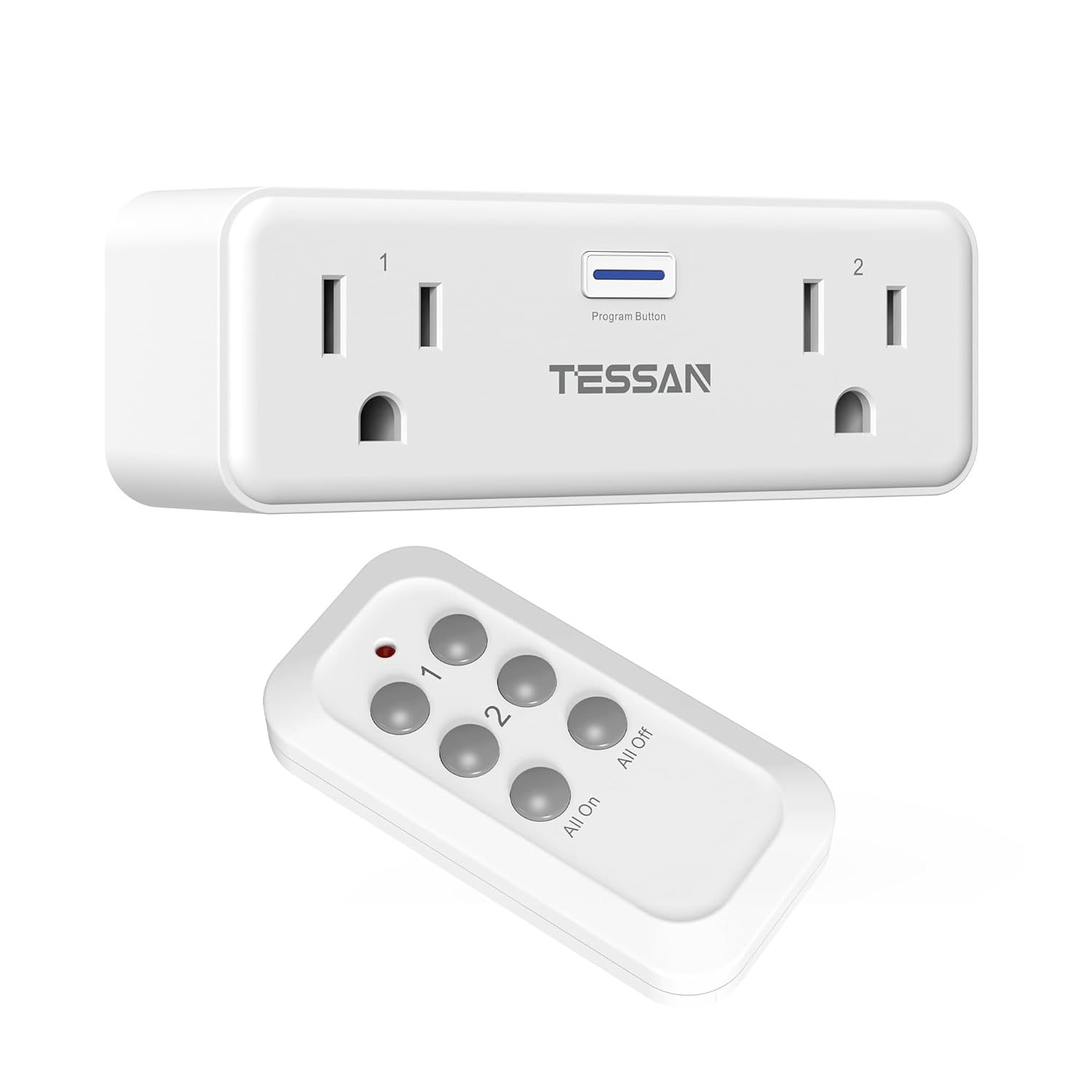
- Want two switched sockets in one: The TESSAN Remote Outlet Plug covers a pair of devices at once.
- Building a smart home: Go with the Lutron Claro or Philips Hue Dimmer for app and voice control.
Installation and Setup Tips
Most remote light switches are ready in minutes, but a few habits make the process smoother.
- Test before mounting: Pair the remote and confirm it works before you stick anything to the wall.
- Mind the load: Add up the wattage of connected devices and stay under the switch’s rating.
- Program extra remotes early: Many kits let you add remotes or expand receivers, so set up the full system at once.
- Keep receivers accessible: If a unit ever loses pairing, you’ll want to reach the reset button easily.
- Label your remotes: In multi-room homes, a small label prevents confusion about which remote controls what.
For a dependable, no-frills starting point, the Decorator Rocker Remote Outlet installs in seconds and requires no configuration at all.
Budget Versus Premium: What Are You Really Paying For?
Remote light switches span a wide price range, and understanding the difference helps you avoid overspending or under-buying. At the budget end, simple plug-in RF outlets deliver reliable on/off control for just a few dollars each. They skip apps and automation, but for most people that simplicity is a feature, not a limitation.
Mid-range options add longer range, higher wattage ceilings, multiple sockets, or expandable receivers. If you’re outfitting a whole room or want an all on/off command, spending a little more here pays off. The 200FT Long Range Remote Outlet is a good example of extra range without a big jump in price.
Premium smart switches command the highest prices because they do far more than toggle power. Dimming, scheduling, scene control, and voice-assistant integration are standard. If you value automation and plan to grow your system over time, models like the Lutron Claro Smart Switch justify the cost. But if you only need to flip a lamp from across the room, that money is better saved.
Reliability and Long-Term Use
A remote switch is only useful if it responds every time. Reliability comes down to signal strength, build quality, and how the receiver handles power. Well-reviewed models with tens of thousands of ratings, such as the BN-LINK Wireless Remote Outlet, tend to prove themselves over years of daily use.
Keep a few maintenance habits in mind. Replace remote batteries before they die completely, since a weak battery shortens range. If a receiver stops responding, a quick re-pair usually fixes it. And avoid stacking receivers behind large metal appliances, which can block the signal. With minimal care, a quality remote switch will run quietly in the background for a long time.
Common Questions About Remote Light Switches
Do remote light switches work through walls?
Yes. RF-based models send signals that pass through typical interior walls, which is why they’re rated by distance. The more walls and metal between the remote and receiver, the shorter the effective range becomes.
Do I need Wi-Fi or a hub?
Not for basic RF switches – they work entirely offline with their own remote. Only smart models that offer app or voice control need Wi-Fi, and some ecosystems require a dedicated bridge or hub.
Can one remote control several outlets?
Many kits include a remote with multiple buttons plus an all on/off control, letting one remote manage several receivers. Multi-outlet bundles are the easiest way to achieve this.
Are they safe to leave plugged in?
Certified units carrying ETL and FCC listings are designed for continuous use. Just respect the wattage limit and avoid connecting high-draw appliances beyond the rated load.
Final Thoughts
The best remote light switches turn an everyday annoyance into effortless convenience. Whether you want a single plug-in outlet for a bedside lamp, a wall-style switch for a fixture that never had one, or a full smart-home controller, there’s an affordable option that fits. Focus on range, power rating, installation method, and safety certifications, and you’ll land on a switch that simply works.
Start with your primary goal, pick the matching type, and let a small remote do the walking for you. Any of the options highlighted above make a solid first step toward smarter, more convenient lighting control at home.