
 Daniel Okafor
 If you stream from home, your desk affects more than comfort — it shapes your camera angle, your cable routing, and how clean your background looks. Choosing the best desks for streaming means finding one with room for a monitor array, a webcam, a mic arm, and a capture card, without turning your setup into a tangle of cords. The right desk gives your gear space to breathe and keeps your on-camera look tidy. Below, we break down what actually matters when shopping for a streaming desk and match specific picks to real setups, from small bedroom corners to full multi-monitor battle stations.
Quick answer: For most home streamers in 2026, the best desks for streaming pick is the Veken 63″ Standing Desk — our #1 rated choice. See the full ranked comparison, alternatives, and buying advice below.
Pros
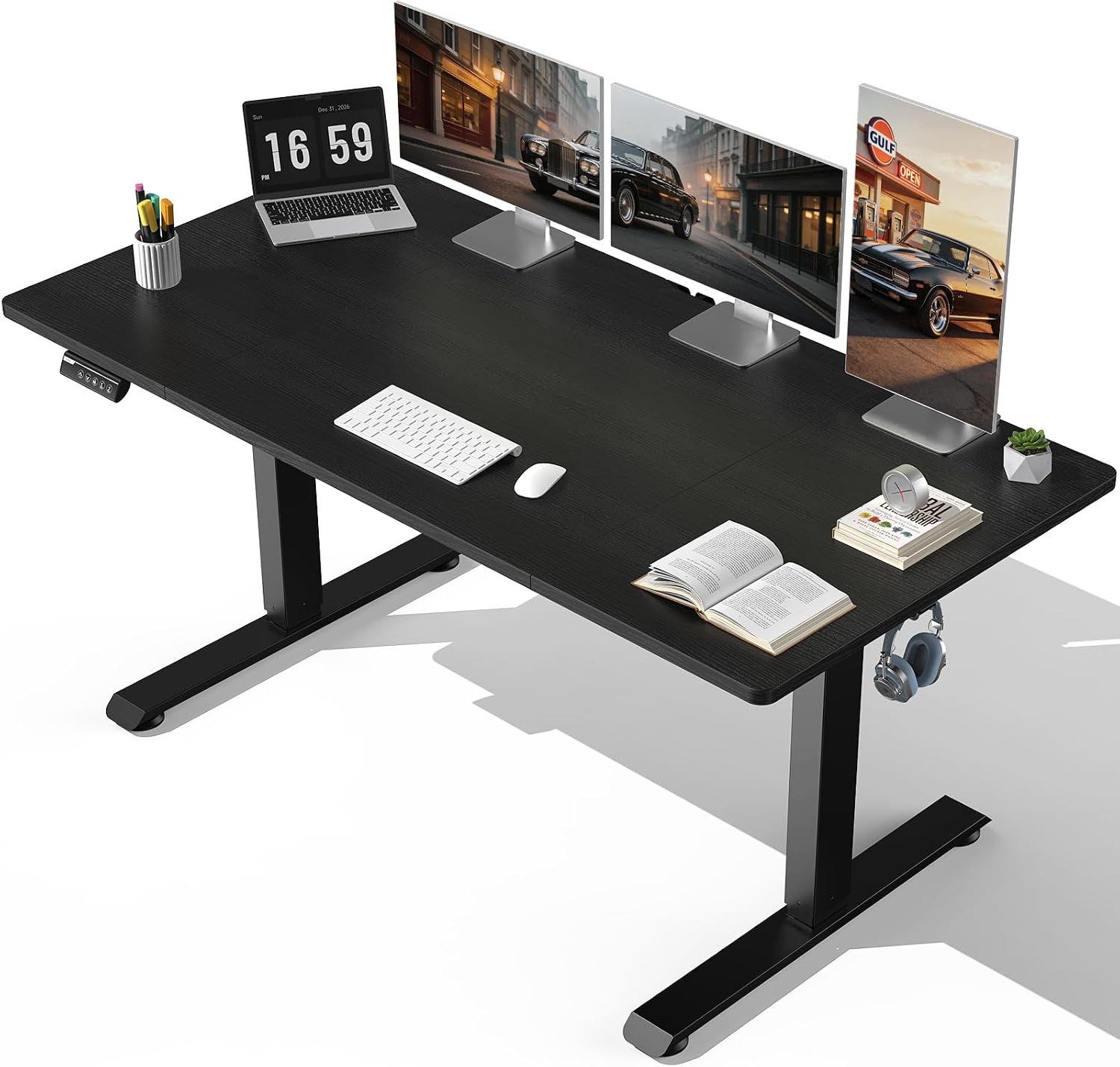
- Generous 63x28 inch desktop surface accommodates multi-monitor setups
- Motorized height adjustment transitions quietly between sit and stand modes
- Programmable memory settings save preferred standing heights for quick recall
- Heavy-duty steel T-legs provide physical stability under full load
- Integrated cable tray keeps power cords organized underneath desk
Cons
- Assembling the large steel frame requires space and two-person effort
- Motorized lift requires an accessible wall power socket nearby for operation
The Veken 63" x 28" large standing desk provides an expansive, ergonomic workspace designed for home office professionals, gamers, and multi-monitor power users. Featuring a large 63-inch wide by 28-inch deep desktop surface, it easily accommodates dual monitors, laptops, desktop speakers, and writing accessories without feeling cramped. Transitioning between sitting and standing postures throughout the workday promotes blood circulation, reduces lower back strain, and boosts energy levels. This height-adjustable desk serves as a versatile workstation centerpiece for home offices, conference rooms, or creative studio spaces during long computer tasks.
Powered by a smooth electric motor system, the standing desk adjusts height quietly between sitting and standing positions at the touch of a button. The digital control panel features customizable memory presets, allowing users to save and recall their preferred sitting and standing heights instantly without manual adjustments. Advanced anti-collision sensors detect obstacles when raising or lowering the desk, automatically stopping motion to prevent damage to surrounding furniture. The heavy-duty T-style steel leg frame ensures rock-solid stability even when elevated to maximum height for standing work and typing tasks.
Setting up the electric standing desk involves connecting the steel leg frame, crossbeams, motor drive shaft, and desktop panels using the supplied hardware kit. An under-desk wire basket manages power strips, monitor cables, and charger cords, maintaining a tidy workstation aesthetic. Hanging hooks attached to desk sides provide convenient storage for headphones and bags. Place the desk on level flooring near power outlets, ensuring sufficient cable slack for smooth height adjustments throughout your workday and computer tasks across every season of remote work.

Pros
- Workstation surface measures 53 inches wide by 18.9 inches deep at 29.8 inches tall, rated to hold up to 300 pounds
- Built-in power strip adds 3 AC outlets and 2 USB ports directly on the desk for centralized charging
- RGB LED strip offers 10 color presets, 8 brightness levels and 10 dynamic modes with a memory function
- X-shaped steel frame construction adds stability for dual-monitor or multi-display setups
- Reversible left/right side modules let the L-shape orientation match either side of a room
Cons
- Assembly takes an estimated 50 to 70 minutes even with included tools and labeled parts, and is easier with two people when flipping the desk upright
- LED lighting and power outlets add electrical components to a furniture piece, meaning more parts that could eventually need troubleshooting versus a plain desk
- Corner L-shape footprint needs more floor space than a straight desk, so it will not fit tight rooms as easily
The main workstation area measures 53 inches wide by 18.9 inches deep at a 29.8-inch working height, rated to support up to 300 pounds across the desktop. Built-in power comes from 3 AC outlets and 2 USB ports mounted on the desk itself, along with cable management channels to keep cords off the floor during long sessions.
- Dual open shelves, a CPU stand, an accessory hook and a tool bag are included for onboard storage
- RGB LED strip supports 10 color presets, 8 brightness grades and 10 dynamic lighting modes with a memory function
- X-shaped steel frame is designed to add stability under the weight of dual monitors and a desktop tower
The overall L-shape footprint spans 53.15 x 39.37 inches at the base, so it needs a corner or wall space to match.
Assembly is estimated at 50 to 70 minutes using the included tools and hardware, with labeled parts and step-by-step instructions provided. One person can complete the build alone, though the maker notes two people make it faster, particularly when flipping the desk upright partway through assembly.
- Side modules are interchangeable, so the L-shape can be built with the extension on the left or right
- Adjustable foot pads help level the desk on uneven flooring after assembly
- Included accessory hook and tool bag attach during the build rather than as separate add-ons
Because the frame is alloy steel rather than particleboard, expect more weight to handle during assembly compared with lighter all-wood desks.
The corner L-shape and RGB lighting are aimed squarely at gaming setups and dual-monitor workstations, though the desk also suits remote workers and students who want built-in storage and power without adding a separate power strip. Reversible side placement means it can be configured for either side of a room depending on layout.
- 300-pound capacity supports dual monitors, a desktop tower and peripherals together
- Built-in outlets reduce the need for a separate surge protector on the desk surface
- Storage shelves and hooks keep headsets, controllers and cables organized without extra furniture
The L-shape's larger footprint suits dedicated gaming or home office rooms more than small apartments short on floor space.

Pros
- Electric lift adjusts smoothly from 27.95 to 45.67 inches to cover sitting and standing heights
- 3 programmable memory buttons recall preferred heights instantly
- Frame is tested for 50,000 lift cycles at up to 220 lbs (100 kg) of loaded weight
- 1-inch-thick desktop resists flex under monitors and heavier equipment
- Motor runs below 45dB, quiet enough for shared home office spaces
Cons
- 60 x 28-inch top is fixed in size, so it will not suit a corner or L-shaped office layout
- Requires a nearby power outlet for the electric lift motor to function
- Cable management is built in but still needs manual routing during setup
The desk lifts electrically between 27.95 and 45.67 inches, covering both seated and standing positions on the same frame. Maximum loaded capacity is rated to 220 lbs (100 kg), supported by a 2.5mm steel base and a reinforced double-beam frame.
The desktop itself is 1 inch thick across a 60 x 28-inch surface, sized to hold multiple monitors and other equipment without visible flex. DeskShow states the lifting mechanism has been tested through 50,000 lift cycles, aimed at withstanding years of daily height changes.
- 3 programmable memory buttons store preferred sit and stand heights
- Motor runs at under 45dB during height changes
- Cable management channel keeps cords routed along the frame
Programming a height involves adjusting the desk to the desired position and holding the corresponding memory button, after which that height can be recalled with a single press. The quiet motor is built to avoid disrupting calls or shared home office spaces during adjustment.
Buttons sit within reach while seated, so a height change can be triggered without standing up or leaning across the desktop to reach a separate control panel.
This desk suits anyone alternating between sitting and standing through a workday, particularly with multiple monitors or heavier equipment given its rated 220 lb capacity. The fixed 60 x 28-inch top works for a single dedicated workstation rather than a shared or sectional office layout.
An outlet is required near the desk for the electric lift motor to run, since there is no manual crank or battery-powered alternative included.
The double-beam steel frame and 1-inch desktop are built to keep the surface stable while standing and typing, rather than flexing under repeated height changes.

Pros
- 300 lb weight capacity metal frame handles dual towers and monitors
- 55" x 21.6" desktop, large enough for two full computer setups side by side
- Two open storage shelves plus a top hutch keep consoles and speakers off the desktop
- RGB LED strip syncs to music with an adjustable-sensitivity mic, over 60,000 colours via app
- Built-in CPU holder and monitor stand free up desk surface for keyboard and mouse
Cons
- 78.8" width needs a dedicated wall run, not suited to small bedrooms
- LED strip depends on a companion app and Bluetooth pairing, no physical remote mentioned
- Metal frame with hutch and shelves means a longer bolt-together assembly than a basic table
This desk measures 78.8"W x 21.6"D x 60"H, giving it enough footprint for a triple-monitor arrangement or two workstations sharing the surface. The metal frame is rated to hold 300 pounds, which covers a full tower PC, two monitors on stands, and typical desktop accessories without flexing.
- Desktop area: 55"L x 21.6"W for keyboard, mouse and paperwork
- Two lower storage shelves for CPU towers, consoles or speakers
- Top hutch shelf for books, figures or plants
- Built-in monitor stand raises screens above desk clutter
The dimensions suit a dedicated office or gaming room rather than a shared or compact bedroom corner.
The desk ships as a flat-pack metal frame with a hutch, two storage shelves, a CPU holder and a monitor stand, all needing bolt-together assembly. Expect more hardware and panel alignment than a simple two-leg table because of the added shelving structure.
- LED light strip attaches along the frame and pairs with a mobile app
- Music-sync mode uses a built-in microphone with adjustable sensitivity
- App control offers over 60,000 colours and 29 flashing modes
- A timer function can schedule the lighting on or off
Because the RGB system relies on an app and Bluetooth connection, users without a smartphone on hand will only get static lighting from the physical controls.
This desk fits gamers and remote workers who want a single station that also stores hardware. The 300 lb capacity and dual shelving make it practical for anyone running two PCs, streaming equipment, or console peripherals that would otherwise clutter the floor.
- Suited to dedicated gaming rooms or home offices with wall space for a 78.8" run
- Good for users who want LED ambiance synced to games or music
- Storage shelves help households consolidating a PC and console setup on one desk
It is less practical for small apartments or shared bedrooms where a 78.8" wide footprint will not fit comfortably against available wall space.

Pros
- Electric height range of 28.3 to 46.5 inches across 3 memory presets, covering both seated and standing positions without manual cranking
- Built-in 3 outlets and 2 USB ports let you charge devices at the desk instead of running an extension cord
- U-shaped 55.1-inch top plus a full-size monitor stand holds 2 monitors while leaving desktop space clear
- Steel frame rated to 154 lbs, enough for dual monitors, a laptop dock and desk accessories together
- LED strip offers 10 colours and 10 lighting modes built into the frame, no separate light bar needed
Cons
- Footprint of 29.1 x 55.1 inches with a U-shaped corner needs more floor space than a straight desk of the same width
- 154 lb capacity is lower than some steel-frame standing desks rated past 200 lbs, so heavy dual-monitor arm setups should check total load
- Only offered in white in this listing, with no alternate finish
The desktop measures 29.1"D x 55.1"W, finished with a U-shaped corner extension that adds side workspace beyond a standard rectangular top. Height adjusts electrically from 28.3" to 46.5", covering seated and standing positions for most adult heights.
- 3 preset memory buttons recall favourite heights without re-adjusting each time
- Steel frame construction supports up to 154 lbs of desktop load
- Monitor stand section accommodates 2 monitors side by side
- 3 power outlets and 2 USB ports are built into the frame
The U-shape trades a larger footprint for additional side surface, so measuring available floor space before assembly is worthwhile, particularly in home offices where the desk sits in a corner.
The desk ships with labeled parts and step-by-step instructions covering frame assembly, tabletop attachment and cable routing for the LED strip and outlets.
- Frame legs and crossbars connect first, forming the electric lift base
- Tabletop and monitor stand attach on top of the assembled frame
- LED strip and outlet wiring route through the frame before the control panel is mounted
Because the U-shape and monitor stand add extra panels compared with a single flat desktop, assembly runs longer than a basic two-leg standing desk, and having a second person on hand for the tabletop step makes alignment easier. A hex key set and all screws are included, so no separate tools are required.
The combined U-shape, monitor stand and lift range fit users who run a multi-monitor setup or split time between sitting and standing during the workday.
- Home office workers who want side storage plus a raised monitor shelf
- Gamers running dual monitors with peripherals spread across the extra corner space
- Anyone alternating between seated and standing postures during long work sessions
The 154 lb capacity comfortably covers 2 monitors, a laptop and typical desk accessories, though setups adding heavy monitor arms or multiple peripherals should total their equipment weight against that limit first. The larger U-shaped footprint suits a dedicated office corner more than a small shared workspace.

Pros
- Reversible frame converts between a 67-inch corner desk and a 94.5-inch straight desk, so the same unit adapts to different room layouts
- Built-in charging station adds 4 AC outlets and 2 USB ports for up to 6 devices without an extra power strip
- Top hutch, pegboard, and 2-tier storage shelves keep monitors, files, and accessories off the main desktop
- Keyboard tray sits below desk height, freeing the desktop surface for a mouse, notebook, or second monitor
- Frame is rated to hold 2 desktop computers and 1 notebook computer plus up to 3 monitors
Cons
- Engineered wood construction is lighter-duty than a solid wood or steel-frame desk, so very heavy CPU towers need to sit on the included stand rather than directly on the surface
- Reversible top hutch has to be manually repositioned to the opposite side, adding an extra assembly step versus a fixed hutch
- LED lighting strip and charging station both depend on the desk being plugged into a wall outlet, so it offers no backup power if power is cut
The desk measures 19.7"D x 67"W x 57"H in its L-shaped corner configuration, and the frame reverses to a 94.5-inch straight desk when the top hutch is moved to the opposite side. The extended length is built to hold up to 3 monitors across the surface alongside a CPU stand and two-tier storage shelves.
- 67-inch corner layout tucks into a room corner for a compact home office footprint
- 94.5-inch straight layout suits two people working side by side without interference
- Frame supports 2 desktop computers and 1 notebook computer at once
Because the same hardware converts between both layouts, the desk can move with a room redesign or a switch from single-person to shared use without buying a second piece of furniture.
Assembly follows a panel-and-bracket build typical of engineered wood desks, with the top hutch, pegboard, keyboard tray, and storage shelves attached after the main frame is assembled. The built-in charging station wires directly into the frame, adding 4 AC outlets and 2 USB ports controlled by a single on-off switch.
- Top hutch can be mounted on either side to match the reversible corner or straight layout
- Keyboard tray slides in below the main desktop, separate from the monitor shelf
- Storage bag and pegboard hooks attach to the frame for hanging headphones or small tools
Because the hutch position is not fixed at the factory, switching the desk from corner to straight layout means unbolting and remounting that one section rather than a full rebuild.
The combination of desk length, monitor capacity, and built-in power makes this a fit for home offices running multiple screens or a dual desktop and notebook setup. The reversible frame also suits shared spaces where two people need separate work zones on one footprint.
- Gamers or streamers running 2-3 monitors plus a desktop tower and notebook
- Home offices needing a corner desk that can later convert to a straight two-person layout
- Anyone wanting built-in charging for phones, headsets, or peripherals without a separate power strip
It suits engineered-wood tolerant setups rather than rooms needing a heavy-duty steel-frame desk for extremely heavy tower cases or industrial monitor arms.

Pros
- Alloy steel R-frame carries a stated 150 lb across the 47-inch top, enough for a mid-tower plus two 24-inch panels
- Four leg pads screw down individually, so the frame stops rocking on carpet or uneven floorboards
- Two grommet holes and a clip-on cable box drop power leads straight to the floor
- Cup holder and headphone hook hang off the frame edge, keeping the shallow 23.45-inch depth clear
- Carbon fibre textured laminate hides fingerprints far better than a gloss black surface
Cons
- Fixed 29.55-inch height with no sit-stand adjustment beyond the levelling pads
- 23.45-inch depth is shallow, so a deep monitor stand pushes the screen close to your face
- MDF core beneath the laminate swells permanently if a spill is left standing
The surface measures 47 inches wide by 23.45 inches deep and sits at a fixed 29.55 inches high, which lines up with standard task chairs rather than drafting stools. The steel frame is quoted at a 150 lb load, so a mid-tower, two 24-inch panels and a laptop dock stay comfortably inside the limit.
- The curved front edge pulls the keyboard zone closer to the body than a straight-edged slab
- 23.45 inches of depth suits a single monitor arm better than a wide twin-screen stand
- The levelling pads take up a few millimetres of floor variation each
Measure the alcove first. The frame is rigid, so nothing can be trimmed down to fit a tight recess.
Everything arrives in one flat carton: the R-shaped steel legs, the laminated top, the cross-brace, the cup holder, the headphone hook and all fixings. Build it on the floor with the top face down on the packaging so the laminate does not pick up scuffs.
- Start every leg bolt by hand and leave them loose until the cross-brace is seated, then tighten in sequence
- Decide whether the hook and cup holder sit on the left or right before you close up the fixings
- Wind the four pads out until the frame stops rocking, checking with a spirit level on the top
One person can manage the build, though a second pair of hands makes flipping the finished desk far less awkward.
A 47-inch width targets a single-screen or compact twin-screen station rather than a triple-monitor wall. It handles a console setup, a laptop plus an external panel, or a tower parked on the floor underneath.
- Students and teens working in a bedroom corner where a 63-inch top simply will not fit
- Anyone who wants a drinks holder and headset hook built in rather than clamped on afterwards
- Renters who need furniture that breaks back down into a flat carton on moving day
It suits standing work poorly, since the height cannot change, and it is the wrong choice for stacking heavy studio speakers and a laser printer together. Treat the 150 lb figure as a working ceiling, not a target.

Pros
- 54 x 19.7 in top holds a monitor, laptop, lamp and a mug with legroom left over
- Steel tube frame with reinforcement struts bolted beneath the particleboard top
- Five finishes listed: grey, black, white, rustic brown and a rustic brown and black mix
- Maker states the build finishes in under 40 minutes with the supplied tools and picture guide
- 29.5 in height clears the arms of most standard task chairs
Cons
- No stated weight limit, so loading it with heavy all-in-one machines is guesswork
- No grommets or cable tray, so leads hang loose behind the rear legs
- Fixed height with an open frame that carries no drawer, shelf or storage option
The surface measures 54 in wide by 19.7 in deep, standing 29.5 in tall, which is the standard writing height that task chairs are designed around.
- That width takes a 27-inch monitor plus a laptop beside it, or two smaller screens without crowding.
- The 19.7 in depth is shallow, so a monitor arm clamped to the rear edge frees far more usable space than a stand.
- Steel tubes run the full perimeter, with reinforcement struts under the top to stop flex in the middle of the span.
- The open underside means uninterrupted legroom across the whole 54 in.
The trade for that legroom is the absence of any drawer or pedestal, so plan on a separate under-desk unit if you need to store paperwork close by.
Huuger states the desk goes together in under 40 minutes, and the structure supports that: it is a top, a steel frame and a set of struts rather than a cabinet.
- Tools and hardware are supplied, and the guide is illustrated rather than written, so no parts list decoding is needed.
- Lay the top face-down on the carton to protect the finish while you bolt the frame in place.
- Leave every bolt finger-tight until the whole frame is located, then tighten in sequence to keep the desk square.
- Level the desk against the floor before loading it, since a rocking frame will loosen fixings over time.
Wipe the particleboard with a barely damp cloth only. Sealed laminate resists marks well, but standing moisture at the edges is what damages any board top.
The plain rectangular form and the five-colour range make this a desk that adapts to the room rather than dominating it.
- Rustic brown and grey read as warm and neutral in a bedroom or living room corner.
- Black and the brown-black mix suit a gaming setup where the tower and peripherals are already dark.
- White works in a study or a child's room where the aim is to keep the space feeling open.
- At 54 in wide it lines up against most standard wall runs without eating a whole side of a small room.
Best suited to single-monitor or laptop-first work. If you plan on three screens and a tower sitting on top of the desk, look for a deeper surface with a published load limit instead.

Pros
- Main top measures 48 by 19.7 inches at 30 inches high, inside an overall 48 by 31.5 inch corner footprint
- Stated 100 pound load across the desk surfaces
- 3 AC outlets and 2 USB charging ports built into the frame, so a phone and headset charge at desk level
- LED strip offers 10 static colours, 6 brightness steps, 10 dynamic modes and a memory function that recalls the last setting
- Reversible build puts the return on the left or right, with monitor stand, PC tower stand, hook and side storage bag all included
Cons
- 100 pound total capacity is modest once a full tower, two monitors and peripherals are loaded onto it
- Main top depth of 19.7 inches is tight for a large curved ultrawide on its stock stand
- The L shape needs a genuine corner measuring at least 48 by 31.5 inches, since the return does not detach
There are two sets of numbers worth keeping apart here.
- The main desk surface is 48 inches wide, 19.7 inches deep and 30 inches high, standard desk height for a task chair
- The overall corner envelope is 48 by 31.5 inches, rising to 34.6 inches at the shelf structure
- Stated load capacity is 100 pounds across the surfaces
The maker describes the 48 inch top as holding three monitors and a laptop, though the 19.7 inch depth means shallow-stand monitors or a mount is the sensible route for anything above 24 inches. Measure both wall lengths before ordering, and allow separately for chair clearance and the depth of your PC tower. In a small bedroom the corner is usually available and it is the chair swing that runs short.
The desk arrives with labelled parts and printed instructions, and the build rewards a bit of preparation.
- Check every part against the list before starting, so a missing fixing is found at the beginning rather than an hour in
- Sort the hardware into groups by step, since several similar-length bolts are used
- Have a second person for the larger panels, which is where a solo build gets awkward
The layout is reversible, so the return and the storage column can go on the left or the right. Decide which side before assembly by looking at where your wall socket sits and which way the room door opens, because changing your mind afterwards means partly dismantling the desk. Included in the build are a raised monitor stand, an under-desk PC tower stand, open shelves, a side storage bag and a hook.
Two features aimed squarely at a PC setup are built into the frame rather than added on.
- 3 AC outlets and 2 USB charging ports at desk level, which covers a monitor, a lamp, a phone and a headset without a floor extension lead
- An LED strip with 10 static colours, 6 brightness grades and 10 dynamic modes, plus a memory function that returns to your last setting after switch-off
Dropping the brightness a couple of steps and leaving a static colour behind the monitor reduces the contrast between a bright screen and a dark room, which is easier on the eyes during long evening sessions than the animated modes. Keep total draw on the built-in outlets sensible, since it is designed for desk devices rather than heaters or high-draw appliances.

Pros
- 53.15 in wide by 18.9 in deep top standing 29.8 in tall, sized to fill a room corner without blocking a doorway
- Three mains outlets and two USB charging ports built into the frame, fed by one wall plug
- Hutch mounts on the left or the right, so the same desk fits either corner of a room
- LED strip carries 10 static colours, 8 brightness grades and 10 dynamic modes with memory
- Alloy steel frame on adjustable foot pads levels out on uneven floorboards
Cons
- 18.9 in depth is shallow for a 27-inch monitor plus keyboard once the hutch takes the back edge
- Fixed 29.8 in height with no sit-stand adjustment
- Storage is open shelves, a hook and a fabric bag, with no drawers or lockable space
The desk measures 53.15 in wide by 18.9 in deep, standing 29.8 in to the main work surface with the two-tier hutch above that. The L shape is reversible, so the upper storage rack fixes to the left or the right and the same unit works in either corner of a room.
- 18.9 in of depth suits a single monitor or a laptop plus notes, while deeper screens will overhang
- Adjustable foot pads take up the slack on uneven floorboards so the top does not rock
- An alloy steel frame carries the load rather than the board top alone
Measure the diagonal path through doorways before assembly day. Corner desks are awkward to move once built, and this one is far easier to carry in as a flat-pack carton.
This arrives flat-packed with the frame sections, two shelves, the CPU stand, the hook and the fabric storage bag. The upper rack can be built in two arrangements, so read the step order before driving any bolts, because swapping sides later means part-dismantling the hutch.
- Leave every bolt finger-tight until the frame is square, then tighten in sequence so the top does not sit proud
- The mains lead from the built-in outlet block needs a route to the wall, so decide which side the plug exits before pushing the desk into the corner
- The headphone hook and storage bag mount to either side, and both can be left off entirely
Allow an evening for a first build. A second person mainly helps with lifting the top onto the frame.
The frame carries 3 mains outlets and 2 USB charging ports fed by a single power cord, which is the difference between one plug behind the desk and a nest of extension leads. A phone, a monitor and a lamp can all live on the desk itself.
- The LED strip offers 10 static colours, 8 brightness grades and 10 dynamic modes, with memory so it returns to the last setting
- Lower brightness at night reduces the contrast between a bright screen and a dark room
- Controls sit inline on the strip lead rather than in an app, so there is nothing to pair
Total draw across the outlets still counts against that one wall socket, so keep heaters and kettles off the desk block.
What to Look For in a Desk for Streaming
Before comparing specific models, it helps to know which features actually matter for streaming. Your desk needs to support monitors, lighting, and a mic without feeling cramped. Here are the details worth checking before you buy.
Desk Size and Monitor Space
Most streamers run at least two monitors: one for the game or content, one for chat and OBS. That means you want at least 48 inches of width, and 55-63 inches gives you real breathing room. A deeper top, around 24-28 inches, also gives your webcam and mic arm somewhere to sit without crowding your keyboard.
Sit-Stand vs Fixed Height
Electric standing desks like the SIAGO Electric Standing Desk let you switch positions during long streams, which helps with back fatigue on marathon sessions. Fixed-height gaming desks cost less and are usually sturdier under heavy monitor arms. If you stream for hours several nights a week, the adjustability is worth the extra cost. For more sit-stand options beyond streaming-specific models, see our full guide to the best standing desks.
Cable Management and Power
Streaming setups run a lot of cables: capture card, mic, lights, extra monitors, and a PC. Desks with built-in outlets, like the OffiGo U-Shaped Standing Desk, cut down on power strip clutter under your desk. Look for grommet holes or a rear channel so cords stay out of camera view.
Build Quality and Weight Capacity
Desk stability matters as much as size once you start mounting gear. A wobbly desktop makes for shaky camera shots and rattling monitor arms during tense moments. Look for a steel frame, crossbar supports, and a listed weight capacity of at least 150 pounds if you plan to run dual monitor arms, a PC tower, and a full lighting rig.
Laminate and MDF tops are common at this price range and hold up fine for daily home use. Just avoid glossy, high-gloss finishes near your key light, since they bounce reflections straight into frame.
Best Desks for Streaming by Setup Type
Not every streamer needs the same desk. Here’s how to match a pick to your actual setup and viewing angle.
Best for Multi-Monitor Streaming Setups
If your desk needs to hold three or more monitors plus a full PC tower, size becomes the priority. The SEDETA 79″ Gaming Desk pairs a hutch and shelving with a huge surface, so your monitors, lights, and speakers all get a spot. It suits streamers running a wide multi-screen bar across their background.
Best Standing Desk for Long Sessions
For streamers who sit too long and feel it in their back, an electric sit-stand frame changes the game. The Veken 63″ Standing Desk covered above handles this well, and the SIAGO model above is a solid second option with a thicker, extra-deep top. Both let you stand up mid-stream without losing your camera framing.
Best Budget Pick
You don’t need to spend much to get a usable streaming desk. The BestOffice 47″ Gaming Desk comes in under $60 and still includes a cup holder and headphone hook, both handy during long sessions. It’s a fair trade-off: less desktop space, but enough for a single-monitor streamer on a tight budget.
Best for Small Rooms or Corners
If your streaming setup lives in a bedroom corner, an L-shaped desk uses the space better than a straight one. The ODK 48″ L-Shaped Desk is reversible, so it fits either side of a room, and its built-in shelves keep gear off the floor. It’s a smart pick when square footage is tight.
Who Should (and Shouldn’t) Buy an Electric Standing Desk
Electric standing desks are worth the extra cost if you stream for two hours or more at a stretch, or if back and hip stiffness already bother you during long sessions. Raising the desk mid-stream without breaking your camera framing pays off fast once you notice the difference.
They’re not for everyone, though. If you stream from a gaming chair with a headrest and rarely stand, a fixed-height desk saves money you can put toward a better mic or capture card instead. Heavier electric frames can also wobble slightly at full height with a loaded monitor arm, so check the weight rating before you commit.
L-Shaped vs Straight Desks for Streaming
L-shaped desks give you a second surface for a capture setup, extra monitor, or light stand, without stretching along one long wall. Straight desks fit flat walls more easily and usually cost less at the same width. If your room has a corner to spare, the L-shape often wins for streaming because it separates your gaming zone from your stream gear.
Reversible L-shaped models, like the ODK 53″ L-Shaped Gaming Desk, let you flip the layout depending on which wall you’re working with. That flexibility matters if you rent or expect to rearrange your room later.
Common Mistakes When Buying a Streaming Desk
A few buying mistakes show up again and again with streaming setups. Knowing them ahead of time can save you a return shipment.
- Buying too narrow a desk, then running out of room once a mic arm and light are added.
- Skipping weight capacity checks before mounting a triple-monitor arm or heavy ring light.
- Ignoring desk height, which matters more once you add a wrist rest or raised monitor arm.
- Choosing a glossy top that reflects RGB lighting straight into your webcam.
- Forgetting cable routing until after the desk is already against the wall.
Most of these are easy to avoid if you plan your layout before checkout. Measure your gear, not just your desk.
Setting Up Your Streaming Desk for Best Results
Once your desk arrives, a little setup work makes a big difference on camera. Start by placing your main monitor at eye level, then build outward from there.
Desk placement matters as much as the desk itself. Put your setup perpendicular to a window rather than facing it, so daylight doesn’t wash out your webcam or create harsh backlighting. A plain wall behind you reads cleaner on camera than a hallway or open room.
Keep your lighting and camera on one side of the desk so cables don’t cross your keyboard tray. If you’re chasing a more stable connection, our guide to the best routers for streaming covers what to pair with your new setup. Check the weight rating too, since a monitor arm added later needs a sturdy frame underneath it.
For a gaming-first layout instead of a pure streaming one, our guide to the best desks for gaming covers frame stability and monitor arm compatibility in more depth. And if you split time between competitive gaming and streaming, our roundup of gaming desks built for streaming narrows the list further.
How We Compared These Picks
Each desk above was compared on size, weight capacity, price, and how well it fits a real streaming setup rather than a generic office desk. We weighted rating and review counts too, since a desk with thousands of reviews and a 4.6 average has proven itself under daily use.
We also considered layout: L-shaped and hutch desks scored higher for streamers running multiple monitors and lighting, while compact straight desks scored better for single-monitor, space-limited setups. None of the picks above need a specialized frame or professional installation, since most home streamers want something they can build in an afternoon.
FAQ: Desks for Streaming
What size desk do I need for streaming?
Most streamers do well with 48-63 inches of width. That gives room for two or three monitors plus a mic arm and lighting without crowding your keyboard.
Is a standing desk worth it for streaming?
Yes, if you stream for long stretches. Switching between sitting and standing reduces back strain during multi-hour sessions, and it doesn’t require reframing your camera each time.
Do I need an L-shaped desk for streaming?
Not always. An L-shape helps if you’re tight on space or want a separate zone for stream gear, but a wide straight desk works fine for simpler single-monitor setups.
How much weight can a gaming desk hold?
It varies by model, but several of the desks above support 150-220 pounds. Always check the listed capacity before adding a heavy monitor arm or multiple screens.
What should I avoid when buying a streaming desk?
Skip glossy tops that reflect light into your camera, and avoid desks without cable management if you run several devices. Also confirm width before you buy, since return shipping on large desks gets expensive.






