 Daniel Okafor
A monitor arm transforms a battlestation, but it only works on a desk built to grip one. The best gaming desks you can attach monitors to share a few traits: a thick, flat rear edge, honest weight capacity, and clearance for a C-clamp. Get those wrong and your arm sags, wobbles, or refuses to bite the surface. This guide ranks 10 desks that welcome clamp-on and VESA arms, from budget L-shaped corners to a full electric standing model. You will see who each desk suits, where it falls short, and how to pair one with your screens. Let us open with the fast answer.
Quick answer: For most gamers in 2026, the best gaming desks you can attach monitors to is the EUREKA ERGONOMIC Captain 60-inch — our #1 rated choice. See the full ranked comparison, alternatives and buying advice below.

Pros
- 60 LARGE GAMING DESKTOP Captain GIP-P60 gaming desk is a extraordinary
- STURDY AND STABLE STRUCTURE Captain GIP-P60 gaming desk s support
- EXCLUSIVELY AND FULLY COVERED MOUSE PAD FOR FREE Captain GIP-P60 gaming
- EUREKA GAMING OFFERS YOU FREE ACCESSORY OPTIONS All come together with
- CUSTOMER SERVICE We hold our products to a high standard and hope you
Cons
- Requires checking room layout clearance for 27.56"D x 60"W x 30.12"H dimensions
- Requires periodic vacuuming and fabric care for Carbon Fiber

Pros
- Reversible frame converts between a 67-inch corner desk and a 94.5-inch straight desk, so the same unit adapts to different room layouts
- Built-in charging station adds 4 AC outlets and 2 USB ports for up to 6 devices without an extra power strip
- Top hutch, pegboard, and 2-tier storage shelves keep monitors, files, and accessories off the main desktop
- Keyboard tray sits below desk height, freeing the desktop surface for a mouse, notebook, or second monitor
- Frame is rated to hold 2 desktop computers and 1 notebook computer plus up to 3 monitors
Cons
- Engineered wood construction is lighter-duty than a solid wood or steel-frame desk, so very heavy CPU towers need to sit on the included stand rather than directly on the surface
- LED lighting strip and charging station both depend on the desk being plugged into a wall outlet, so it offers no backup power if power is cut
The desk measures 19.7"D x 67"W x 57"H in its L-shaped corner configuration, and the frame reverses to a 94.5-inch straight desk when the top hutch is moved to the opposite side. The extended length is built to hold up to 3 monitors across the surface alongside a CPU stand and two-tier storage shelves.
- 67-inch corner layout tucks into a room corner for a compact home office footprint
- 94.5-inch straight layout suits two people working side by side without interference
- Frame supports 2 desktop computers and 1 notebook computer at once
Because the same hardware converts between both layouts, the desk can move with a room redesign or a switch from single-person to shared use without buying a second piece of furniture.

Pros
- Desktop spans 55.1 inches wide by 23.6 inches deep, with a 360-pound weight capacity on the metal frame
- Supports a dual-table assembly configuration for combining two units into a larger workspace
- Engineered wood top pairs with a sturdy metal frame rather than an all-wood or all-metal build
- Multiple assembly layouts let the same parts form different desk configurations
- Offered in multiple color choices to fit different room styles
Cons
- No built-in cable management, power outlets or drawers are mentioned, so accessories need to be added separately
- Standing desk height adjustment is not offered; the 29.7-inch height is fixed
The desktop measures 55.1 inches wide, 23.6 inches deep and stands 29.7 inches tall, built on a metal frame rated to hold up to 360 pounds. That combination of width and depth gives room for a monitor, keyboard, paperwork and a printer without the desk feeling cramped.
- 360-pound capacity covers dual-monitor setups, a desktop tower and typical office equipment together
- Fixed 29.7-inch height is not adjustable, so it suits users comfortable with standard desk height rather than sit-stand use
- Rustic brown finish pairs an engineered wood top with a metal frame for an industrial look
At just under 4.6 feet wide, this fits typical home office or bedroom corners without needing a full wall run.
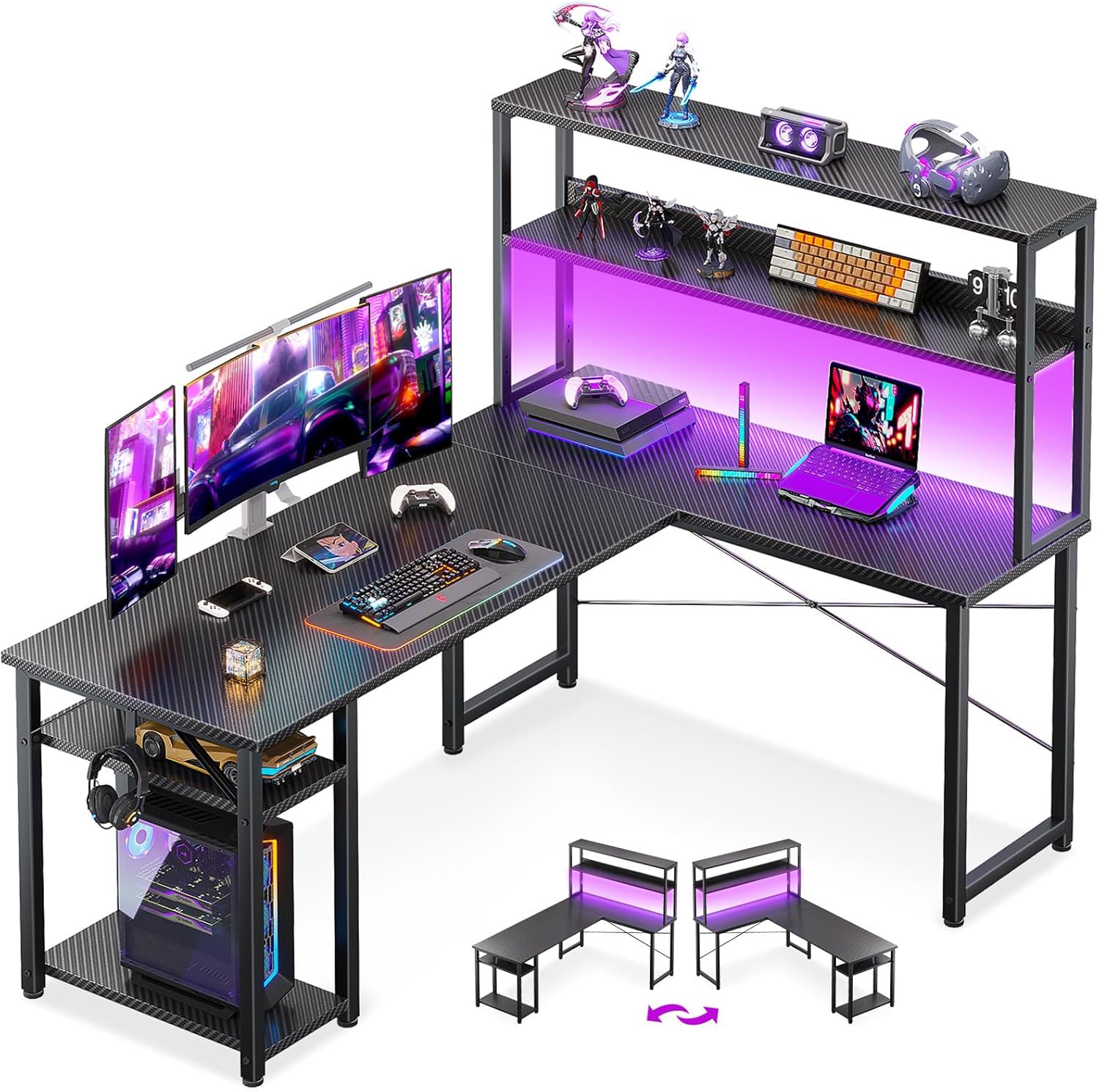
Pros
- Dimensions of 39.37"D x 53.15"W x 29.9"H engineered for optimal spatial fitting
Cons
- Requires verifying placement clearance for 39.37"D x 53.15"W x 29.9"H prior to installation

Pros
- Workstation surface measures 53 inches wide by 18.9 inches deep at 29.8 inches tall, rated to hold up to 300 pounds
- Built-in power strip adds 3 AC outlets and 2 USB ports directly on the desk for centralized charging
- RGB LED strip offers 10 color presets, 8 brightness levels and 10 dynamic modes with a memory function
- X-shaped steel frame construction adds stability for dual-monitor or multi-display setups
- Reversible left/right side modules let the L-shape orientation match either side of a room
Cons
- Assembly takes an estimated 50 to 70 minutes even with included tools and labeled parts, and is easier with two people when flipping the desk upright
- Corner L-shape footprint needs more floor space than a straight desk, so it will not fit tight rooms as easily
The main workstation area measures 53 inches wide by 18.9 inches deep at a 29.8-inch working height, rated to support up to 300 pounds across the desktop. Built-in power comes from 3 AC outlets and 2 USB ports mounted on the desk itself, along with cable management channels to keep cords off the floor during long sessions.
- Dual open shelves, a CPU stand, an accessory hook and a tool bag are included for onboard storage
- RGB LED strip supports 10 color presets, 8 brightness grades and 10 dynamic lighting modes with a memory function
- X-shaped steel frame is designed to add stability under the weight of dual monitors and a desktop tower
The overall L-shape footprint spans 53.15 x 39.37 inches at the base, so it needs a corner or wall space to match.

Pros
- 70.8-inch width with a 55 x 21.6-inch desktop area holds two full computer setups side by side
- 3-tier storage shelves separate a CPU tower, speakers, and console gear instead of piling them on the desktop
- Built-in RGB LED strip offers over 60,000 colors and 29 modes, including music-reactive sync via a built-in microphone
- Integrated 2-outlet, 2-USB charging station powers up to 4 devices without a separate power strip
- Cup holder and headphone hook keep drinks and headsets off the desk surface during long sessions
Cons
- Weight capacity of 55 lbs on the desktop limits how much monitor and accessory weight can sit on top at once
- RGB lighting requires an app connection to access the full 29 modes, adding a setup step beyond plug-and-play
- 70.8-inch width needs a dedicated wall run, too large for narrow bedrooms or shared desk corners
The desktop spans 70.8 inches wide by 21.6 inches deep, with a listed weight capacity of 55 lbs across the main surface. Three tiered storage shelves sit to the side, sized to hold a CPU tower, speakers, or console hardware separately from the desktop workspace, and the layout is wide enough to fit two complete computer setups.
A built-in monitor shelf raises screens above the main desktop, following ergonomic eye-level positioning without requiring a separate monitor riser purchased on top of the desk itself.

Pros
- Gaming Desk with LED Lights Patent Pending. 20 colors, 22 modes, 5
- Charging Made Easy With 4 standard plug outlets and 2 USB ports on the
- Monitor Stand Headphone Hook Apart from adding more storage space, this
- Sturdy and Solid Construction Crafted from heavy-duty power-coated
- Easy to Assemble Assembling this l shape desk with storage maybe not be
Cons
- Requires checking room layout clearance for 50.4"D x 18.9"W x 29.2"H dimensions

Pros
- Dimensions of 37"D x 71"W x 28.3"H engineered for optimal spatial fitting
Cons
- Requires verifying placement clearance for 37"D x 71"W x 28.3"H prior to installation
- Load weight limits should not exceed 220 Pounds during active operations

Pros
- Physical footprint measures 47.2"D x 18.9"W x 35.5"H for spatial placement
Cons
- Spacious wall or desk clearance needed for Furologee 47 Gaming De
- Careful cable routing recommended for Furologee 47 Gaming De wall mounting

Pros
- Dimensions of 17"D x 50.4"W x 27.5"H engineered for optimal spatial fitting
Cons
- Requires verifying placement clearance for 17"D x 50.4"W x 27.5"H prior to installation
- Load weight limits should not exceed 220 Pounds during active operations
What makes the best gaming desks you can attach monitors to
Not every desk can host a clamp-on arm or a heavy VESA stand. The right one has a rear edge you can reach behind and grab. It also has a top that resists flex when a 15-pound screen leans over it.
Three specs decide compatibility. Edge thickness must fit your clamp’s jaw, usually between 0.4 and 2.4 inches. The surface should be flat with no lip, drawer, or apron blocking the back. And the frame needs enough weight capacity for the desk plus your gear.
Desktop thickness and a flat rear edge
Most monitor arms clamp to an edge under 2 inches thick. A 1-inch tabletop, like the one on the FEZIBO standing desk, sits comfortably in that range. Avoid tops with a bullnose lip, since the clamp cannot seat flush against a curve.
Weight capacity and anti-wobble bracing
A single ultrawide arm can cantilever real force onto one corner. Look for steel legs, cross bracing, or adjustable feet. Polygon and diagonal leg designs resist the side-to-side sway that ruins aiming.
Cable routing for a clean mount
Arms lift screens up, so cables now dangle in view. Desks with grommets, trays, or a rear channel hide that mess. If tidy wiring matters to you, study our roundup of the best desks for gaming that can hide cords before you commit.
Our top picks by use case
Every desk below earns strong ratings, but they serve different rooms and budgets. Match the scenario to your own before you buy.
Best overall: EUREKA ERGONOMIC Captain 60-inch
The EUREKA Captain pairs a 60-inch top with polygon legs that stay planted under a loaded arm. With a 4.7 rating across 2465 reviews, it is a proven, sturdy base. The flat rear edge takes a C-clamp without fuss.
It is not the cheapest option, and it lacks built-in outlets. Gamers who want power strips baked in should look further down. Everyone chasing rock-solid stability starts here.
Best budget L-shape: Homall 51-inch corner
The Homall L-shaped desk costs and carries a huge 9950-review history. Its included riser lifts one screen while the corner frees floor space. That 4.6 rating is the only one below 4.7 here, but the value is hard to argue with.
The particleboard top flexes more than steel-framed rivals. Mount lighter monitors near a leg for support. It is a great first desk for tighter budgets.
Best for corners: ODK 53-inch with hutch
The ODK 53-inch L-desk tucks a hutch, headphone hook, and storage shelves into a corner. The reversible layout suits either wall. Clamp an arm to the long rear edge and route cables behind the shelves.
The upper hutch can crowd tall arms, so measure your clearance. For dual-screen corner rigs, weigh it against the picks in our guide to the best gaming desks for dual monitors. Space-starved players will love it.
Best with power built in: ODK 53-inch LED
The ODK LED desk folds power outlets, LED lighting, and an iron hook into a reversible L. That means fewer wall runs when your monitor arm raises the screens. Storage shelves and a bag keep peripherals close.
The outlets sit on the shelf tower, not the main top, so plan your reach. It rewards gamers who hate cable spaghetti.
Best large single-tier: SEDETA 70.8-inch
The SEDETA 70.8-inch desk gives triple-monitor room on one flat plane. It ships with LED lights, outlets, a cup holder, and a monitor stand. The wide rear edge invites two or three arms side by side.
It is long, so confirm your wall can host 70.8 inches. Multi-screen builders should also skim the best gaming desks for multiple monitors for wider comparisons. This is the pick for sprawling setups.
Best standing desk: FEZIBO 71 x 37-inch electric
The FEZIBO electric standing desk adds motorized height memory to a 1-inch, 3-piece top. Dual-beam framing keeps a heavy arm steady as the desk rises. Integrated cable management channels the extra slack.
It is the priciest option here, and only 203 reviews back it so far. But the 4.7 rating and thick clamp-friendly edge justify the spend. Choose it if you alternate sitting and standing.
Best carbon-fiber style: Huuger L-shaped
The Huuger L-desk wraps a carbon-fiber-look surface around outlets, LED lights, monitor shelves, and hooks. The corner layout and rear edge handle clamp arms well. It reads sportier than plain black tops.
The textured finish shows dust faster. Keep a cloth nearby. Style-focused gamers on a budget get a lot here.
Best compact desk: Furologee 47-inch
The Furologee 47-inch desk squeezes a USB-C port, LED lights, outlets, two fabric drawers, and a monitor stand into. Its narrow footprint suits dorms and bedrooms. An arm on the back edge reclaims the shallow depth.
Only 13 reviews exist so far, so it is newer and less battle-tested. The spec sheet still impresses at this price. Small rooms benefit most.
Buying guide: sizes, specs, and compatibility
Once you know the use case, confirm the desk physically fits your arm and your screens. A few measurements save a painful return.
Match desk depth to your arm reach
Deeper tops push monitors farther back, easing eye strain. Aim for at least 24 inches of depth for a single large screen. L-shaped corners like the SEDETA reversible model give more depth at the join, which helps ultrawides sit correctly.
Confirm clamp clearance behind the desk
The clamp needs open space under the rear edge. Storage bags, back panels, and shelf towers can block it. Test-fit before you drill grommets, since a hutch can steal the very inches your arm requires.
Plan for two or three screens
Dual and triple rigs demand a wider, stiffer top. A 60 to 71-inch surface spreads the load and stops center sag. For mounted triple-screen builds specifically, compare the frames in our best desks for 3 monitor mounted gaming guide.
Weigh included risers against arms
Some desks, like the SEDETA 70.8-inch and Homall, bundle a riser or stand. Those lift screens without clamping. If you already own an arm, a bundled riser just adds weight you may not use, so pick the layout you truly need.
Common mistakes to avoid
These errors trip up first-time arm buyers. Sidestep them and your mount stays rigid for years.
- Ignoring edge thickness. A clamp jaw that maxes at 2 inches will not grip a 2.5-inch top. Measure first.
- Mounting over an unsupported center. Thin particleboard bows mid-span. Clamp near a leg or brace.
- Forgetting cable slack. Raising a screen needs longer cables. Buy extra length before install.
- Overloading one corner. Check the desk’s weight capacity, then add your monitor and arm weight together.
- Skipping the grommet. Routing cables through a grommet keeps the clamp area clean and the look tidy.
Frequently asked questions
Can every gaming desk take a monitor arm?
No. The desk needs a flat, accessible rear edge within your clamp’s thickness range. Tops with a raised lip, a back panel, or a shelf tower right behind the surface can block the clamp. Always check the edge before buying an arm.
How thick should the desktop be for a clamp?
Most clamp-on arms fit edges between 0.4 and 2.4 inches. A 1-inch top, such as the FEZIBO standing desk, sits safely in that window. If your top is thinner, many arms include a spacer to fill the gap.
Do I need a grommet hole to mount a monitor?
Not for a clamp-style arm, which grips the edge. A grommet mount is a different option that bolts through a drilled hole. Grommets do help you route cables cleanly, so they are handy either way.
Which desk is best for two monitors?
A wide, stiff top handles dual screens best. The SEDETA 70.8-inch and EUREKA 60-inch both offer room and stability for side-by-side arms. For a full breakdown, see our dedicated dual-monitor desk roundup linked above.
Are budget desks strong enough for a heavy arm?
Often yes, if you mount smartly. Clamp near a leg where the top flexes least, and stick to lighter or single monitors. The Homall and Furologee both work on a budget when you respect their weight limits.
The bottom line
The right desk is the one whose edge, depth, and bracing match your screens and your room. The EUREKA Captain 60-inch stays our top all-round pick for its stability and long review record. Pick the Homall or Furologee to save money, or the FEZIBO to stand and game. Measure your clamp, confirm the edge, and mount with confidence.