Owen Bradley
 Solar LED lighting has quietly crossed the line from novelty to genuinely practical. Panels have improved, lithium batteries hold far more charge than the old nickel cells, and LEDs draw so little power that a modest panel can run a useful light all night. The result is outdoor lighting you can install anywhere the sun reaches, with no trenching, no conduit, no electrician and no running meter. The catch is that quality varies enormously, and the specifications that matter are usually the ones cheap products hide. This guide covers how solar lighting actually works, what to look for, where it succeeds, and where you are still better off running a wire.
How Solar Lighting Works
Every solar light contains four components: a photovoltaic panel that converts daylight to electricity, a rechargeable battery that stores it, an LED that consumes it, and a small controller with a light sensor that decides when to switch on. Understanding that chain explains almost every complaint people have about solar lights.
If a light dims early, the battery is undersized, degraded, or was not fully charged. If it does not come on at all, the panel is shaded, dirty, or the sensor is being fooled by nearby artificial light. If it is dim from the start, the LED is underpowered relative to the claim. Every failure traces back to one link in that chain, which makes diagnosis straightforward once you know what to look at.
What to Look For When Buying
Battery Type and Capacity
The single most important specification, and the one most often omitted. Lithium iron phosphate and lithium-ion batteries substantially outperform the older NiMH cells still used in budget lights — more capacity, better cold tolerance, far more charge cycles. Look for a stated capacity in milliamp-hours; higher means longer runtime, and anything that refuses to publish the number is usually hiding a small one. Replaceability is worth checking too, since the battery is what fails first and a light with a swappable cell has several times the useful life of a sealed one.
Panel Type and Size
Monocrystalline panels are more efficient than polycrystalline, which matters enormously when the panel is only a few inches square. Panel area is the ceiling on how much energy the light can gather in a day — a large battery behind a tiny panel will never charge fully in winter. Separate panels connected by a cable are a significant advantage, because they let you mount the light in shade and the panel in full sun.
Actual Lumen Output
Solar lighting is the worst offender in the industry for inflated brightness claims. Treat any unsubstantiated figure skeptically. Realistically, path markers deliver 5 to 20 lumens, accent and step lights 20 to 60, wall and security floods 200 to 1000 or more. Products claiming several thousand lumens from a small panel are describing a peak the light cannot sustain for more than a few minutes.
Runtime and Modes
Look for stated hours at a given brightness, and prefer lights with multiple modes. A light that runs dim continuously and jumps to full brightness on motion delivers far more useful hours than one running flat out until the battery dies at 1 a.m.
Weather Rating
IP65 is a reasonable minimum for anything exposed. IP67 is better for lights near sprinklers or in areas that flood. Check the cold-weather rating as well, since battery performance drops sharply near freezing and some units simply stop working.
Our roundup of the best solar LED lights compares these specifications across path, wall and flood formats.
Types of Solar Outdoor Lighting
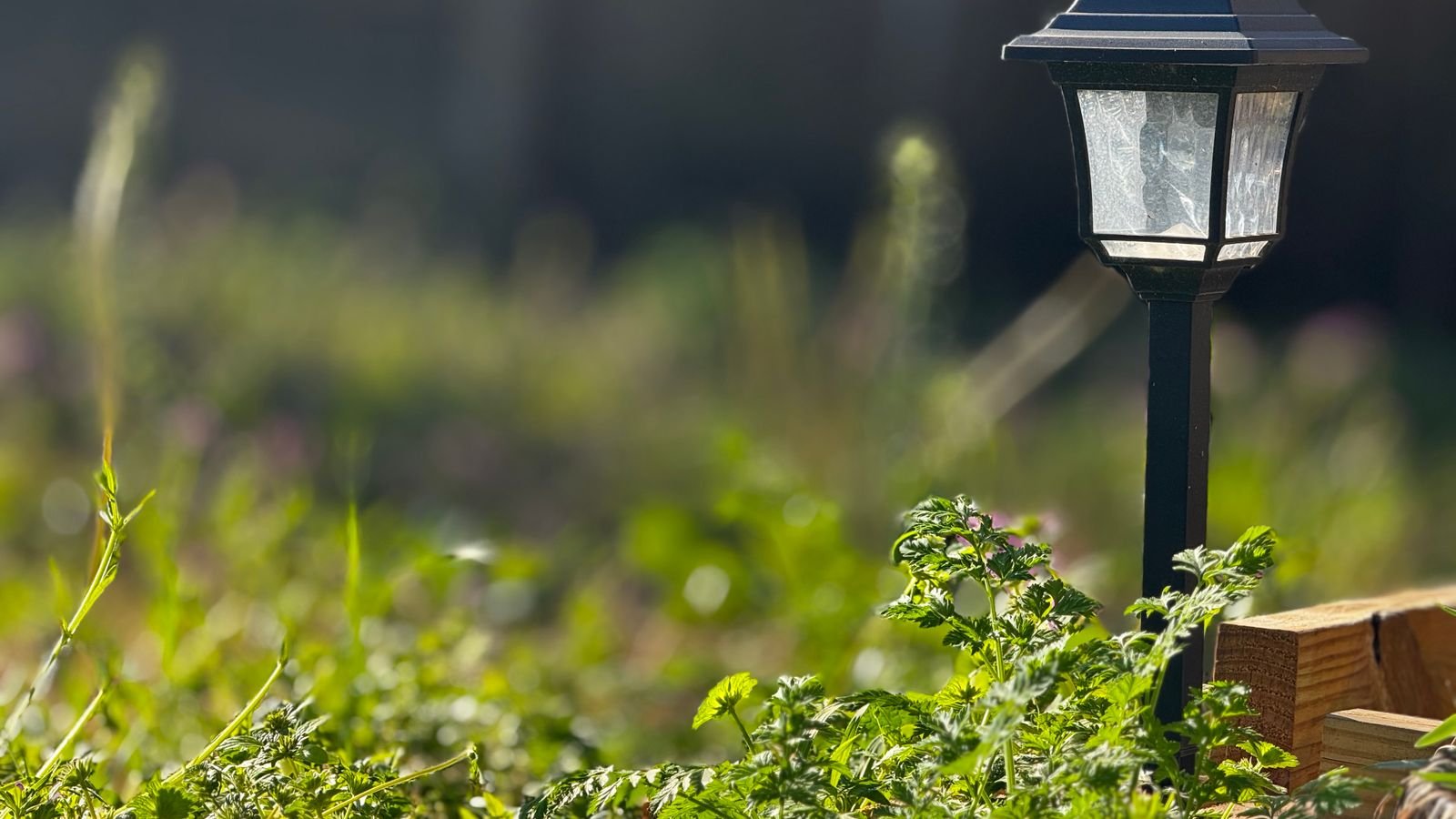
- Path and stake lights. Pushed into soil along walkways and beds. Low output by design — they mark a route rather than illuminating it. Buy for consistency of color and build quality rather than brightness.
- Wall and fence lights. Mounted on vertical surfaces, casting light down or in both directions. Good for defining boundaries, steps and entryways.
- Security floods. The highest-output category, almost always motion activated, usually with a separate panel on a cable. The most genuinely useful solar format for many homes.
- String and festoon lights. Decorative, low draw, long runtime. Excellent value because the demands on the battery are so modest, and a natural companion to the waterproof LED strip lights used on covered patios.
- Spotlights. Adjustable heads for uplighting trees, walls and architectural features. Effective when aimed carefully and disappointing when scattered randomly. Where a mains supply is available nearby, the LED flood light bulbs comparison shows what wired output looks like by contrast.
- Deck and step lights. Flush or surface mounted with very low output, purely for safe footing.
For decorative garden runs specifically, the outdoor solar LED strip lights comparison covers the flexible formats that suit fences, railings and pergolas rather than stakes.
Placement: Where Most Installations Go Wrong
- Give the panel unobstructed midday sun. Six to eight hours of direct exposure is the target. Two hours of weak morning light will not charge anything properly.
- Watch for seasonal shade. A spot that is sunny in June may be shaded by a low winter sun or by leaves that have not yet appeared. Check across the year.
- Angle the panel toward the sun. Tilting a panel toward the equator meaningfully increases daily charge compared with a flat mounting.
- Keep the sensor away from artificial light. A porch light, street lamp or window glow near the sensor can keep the unit convinced it is still daytime.
- Use separate-panel models in shaded spots. Mount the light where you need illumination and the panel on a sunny roof or fence, connected by cable. This solves the most common placement problem entirely.
- Avoid mounting behind glass. Windows block a significant portion of usable solar energy.
Where Solar Excels and Where It Does Not
Solar is the clear winner for sheds and outbuildings with no power, long driveways and fence lines, gardens far from the house, rented properties where permanent wiring is not an option, temporary and seasonal lighting, and any location where trenching a cable would be expensive or disruptive.
Wired lighting remains better where you need reliable high output every night regardless of weather, where the location gets less than about four hours of direct sun, in regions with long dark winters, for lighting that must never fail for safety reasons, and anywhere you want precise dimming and integration with a smart home system. A realistic approach uses both: wired lighting near the house where it matters most, solar for the perimeter and outlying areas.
Maintenance
Solar lights need slightly more attention than wired ones, but very little of it.
- Clean panels every few months. Dust, pollen and water spots substantially reduce charging. A damp cloth is enough. This is the single highest-value maintenance action.
- Clear vegetation. Plants grow. A panel that was in full sun in spring may be under a shrub by August.
- Replace batteries every one to three years. Runtime declining is a battery symptom, not a panel failure. Replacing a cell costs a fraction of a new fixture.
- Wipe lenses. Cloudy diffusers cut output noticeably.
- Check seals annually. Water ingress is the leading cause of outright failure. Reseal or replace gaskets if you see condensation inside.
- Store or protect over harsh winters if the light will not be used, since cold storage at low charge damages batteries.
Common Mistakes to Avoid
- Believing the lumen claims. Assume the real figure is a fraction of what a budget listing advertises.
- Installing in partial shade. The most common reason solar lights disappoint.
- Buying sealed-battery units. When the cell dies, the whole light is waste.
- Expecting solar to replace security lighting entirely. Use it as a supplement in areas without power, not as the primary system on a critical entrance.
- Ignoring the first charge. Most units need a full day or two in direct sun before their first night, and many are shipped with a protective tab still in place.
- Mixing brands along one path. Different color temperatures and heights along a single walkway look accidental.
- Never cleaning the panel. A season of grime can halve charging capacity.
Frequently Asked Questions
How long do solar LED lights last at night?
A well-charged quality unit typically runs 6 to 10 hours at moderate output, and longer in a dim-until-motion mode. Runtime falls in winter with shorter days and colder batteries, and declines steadily as the battery ages.
Do solar lights work in winter or on cloudy days?
Yes, but with reduced output. Panels still generate on overcast days at a fraction of clear-sky rates. Winter combines short days, low sun angles and cold batteries, so expect noticeably shorter runtimes and choose oversized panels and batteries if winter performance matters.
Can I replace the battery in a solar light?
In better-designed units, yes — and you should, roughly every one to three years. Many inexpensive lights are sealed, which is a strong argument for spending a little more up front on a serviceable design.
Why did my solar light stop working?
Check in this order: a dirty or shaded panel, a protective film or pull tab still fitted, a degraded battery, a sensor confused by nearby artificial light, and finally water ingress. The first three account for the large majority of failures.
Are solar security floodlights bright enough?
Good ones are, particularly in motion-activated mode where the battery discharges in short bursts. Look for a separate panel on a cable, a stated lumen figure in the several-hundred range, and lithium battery chemistry.
Final Thoughts
Solar LED lighting rewards buyers who look past the headline brightness claim and read the four specifications that actually determine performance: battery chemistry and capacity, panel type and area, honest lumen output, and weather rating. Place the panel where it genuinely gets six or more hours of direct sun, favor models with a separate panel on a cable and a replaceable battery, and wipe the panels a few times a year. Use solar for the perimeter, the garden, the shed and the fence line, and keep wired lighting for the entrances where failure is not acceptable. Approached that way in 2026, solar lighting is not a compromise — it is simply the sensible way to light everywhere a cable would be a nuisance.