
 Priya Raghavan
 Best Routers for Port Forwarding: A Complete Buying Guide
If you host game servers, run a home security camera system, use remote desktop, or self-host any kind of service, you already know how important port forwarding is. Choosing one of the best routers for port forwarding can be the difference between a smooth, reliable connection and hours of frustrating troubleshooting. The right hardware gives you a clean interface, stable NAT handling, and the advanced controls power users need to open, map, and secure specific ports without headaches.
This guide walks you through what actually matters when shopping for a port forwarding router, which features to prioritize, and how to match a model to your needs. Instead of reviewing each product one by one, we focus on helping you make a confident buying decision so you end up with a router that fits your setup for years to come.
Below is a curated shortlist of popular, well-supported routers that handle port forwarding reliably. Use it as a quick reference while you read through the rest of this guide.

Pros
- 867 Mbps on the 5 GHz band plus 300 Mbps on 2.4 GHz, enough headroom to hold a 4K stream and a video call at once
- Four Gigabit LAN ports and a Gigabit WAN port, so a console, desktop and NAS can drop off the airwaves entirely
- WPA3 security support, a protocol many older 802.11ac units never received in firmware
- Four external antennas with beamforming that aim signal at active clients instead of radiating evenly in every direction
- Access Point mode turns it into a wireless arm of an existing gateway, avoiding a double NAT setup
Cons
- 802.11ac generation only, so Wi-Fi 6 and Wi-Fi 6E clients gain nothing over older speeds
- No USB port, so attached storage or a shared printer needs separate hardware
- Requires a separate modem for most home internet services, and none is supplied in the box
The AC1200 label splits into 300 Mbps on 2.4 GHz and 867 Mbps on 5 GHz, so no single device ever sees 1200 Mbps at once. In daily use the 5 GHz band carries 4K video and game traffic while 2.4 GHz handles smart plugs, printers and anything sitting far from the unit behind masonry.
- Four fixed external antennas with beamforming steer signal toward active clients rather than spraying it evenly
- MU-MIMO on the 5 GHz band serves several compatible clients in parallel instead of one after another
- A two-bedroom apartment or a compact two-storey house sits within comfortable reach; long single-level layouts do better with a OneMesh extender added
Wired traffic is the quiet strength here. Four Gigabit LAN ports let heavy devices bypass Wi-Fi completely and leave the airtime free for phones and tablets.
Setup runs through the free Tether app on Android or iOS, or through a browser if you prefer a desktop. The order is short: run the supplied Ethernet cable from your modem into the WAN port, power the unit, then follow the prompts to name the network and set a password.
- WPA3 sits in the wireless security menu, a step above the WPA2-only firmware found on many older dual-band units
- Access Point mode converts it into a wireless extension of an existing gateway, which sidesteps double NAT headaches with port forwarding
- Guest network, parental controls and firmware updates all live in the same app rather than a separate web console
Allow around ten minutes start to finish. The antennas are fixed rather than detachable, so there is no assembly beyond angling them upright.
This is a router on its own, not a modem-router combination. It expects an existing cable, DSL or fibre modem to feed the WAN port, which is how most home services are wired. Providers such as Xfinity, Spectrum, Cox, Verizon, CenturyLink and Frontier all work, because the unit simply accepts an Ethernet handoff from their equipment.
- If your provider supplies a gateway that already routes traffic, either bridge that gateway or run this unit in Access Point mode
- Fibre customers keep the existing ONT in place and connect it to the WAN port
- With no USB port on board, network storage and printer sharing need a separate device on the LAN
Adding a OneMesh-compatible extender later keeps one network name across the whole house, instead of forcing phones to hop manually onto a second SSID.

Pros
- Covers up to 2,000 sq ft from a single unit, roughly a 25-foot radius
- Two auto-sensing 2.5 GbE ports support internet plans up to 2.5 Gbps
- Supports 120+ connected devices on one network
- Backward compatible with all previous generations of the same mesh system for gradual expansion
- Backed by a 3-year warranty on the router hardware
Cons
- This listing is a 1-pack, so covering more than 2,000 sq ft means buying additional eero units to extend the mesh
- Full Wi-Fi 7 speed benefits only apply to client devices that also support the 802.11be standard
- Advanced network features and remote management depend on the eero app rather than a local web-based admin panel
A single eero 7 unit is rated to cover up to 2,000 sq ft, roughly a 25-foot radius, with wireless speeds up to 1.8 Gbps over Wi-Fi 7. Two auto-sensing 2.5 GbE ports support wired connections and internet plans up to 2.5 Gbps.
- Up to 2,000 sq ft coverage per unit
- Wireless speeds up to 1.8 Gbps
- Two 2.5 GbE auto-sensing ports
Multi-link operation (MLO), a Wi-Fi 7 feature, lets compatible devices connect across multiple bands at once for more stable throughput during high-demand tasks.
Setup runs through the eero app, guiding the router through network naming, password creation, and initial configuration without requiring a separate desktop client. A single eero 7 can act as the main gateway, replacing an existing router directly.
- App-guided setup process
- Can act as a standalone gateway or extend an existing eero network
- Backward compatible with all previous eero hardware generations
Because backward compatibility carries across generations, an existing eero mesh network can add this unit as a node without replacing units already installed.
The router's 2.5 GbE WAN port supports internet plans up to 2.5 Gbps, above the 1 Gbps ceiling that standard router ports impose, making it suited to fiber or cable plans rated for multi-gig speeds.
- 2.5 GbE WAN support for plans up to 2.5 Gbps
- Supports 120+ simultaneously connected devices
- Compatible with eero Built-in on select Amazon Echo devices
Households on internet plans below 1 Gbps will not see the full benefit of the 2.5 Gbps WAN capability, though the router still operates normally at lower plan speeds.

Pros
- Dual-band Wi-Fi 7 delivers up to 2882 Mbps on 5GHz and 688 Mbps on 2.4GHz across 4 streams with Multi-Link Operation
- Rated to cover up to 2,500 sq. ft and 150 connected devices from a single 1-pack unit
- Two 2.5 Gbps WAN/LAN ports per unit support multi-gig internet plans and high-throughput wired devices
- 4 high-gain antennas and 4 high-power front-end modules per node extend range for remote work and gaming setups
- 128MB of flash storage and 512MB of memory run the mesh system's firmware and connected-device management
Cons
- Full 3.6 Gbps combined speed and Wi-Fi 7 features require client devices that also support Wi-Fi 7, such as recent flagship phones
- 2,500 sq. ft of coverage is based on the single 1-pack unit; larger homes will need to add extra Deco units for full-house coverage
- Advanced HomeShield security features may require an ongoing subscription beyond the basic protections built into the router
A single 1-pack Deco 7 BE23 unit is rated to cover up to 2,500 sq. ft and connect up to 150 devices without a major drop in performance. Dual-band Wi-Fi 7 with 4-stream support delivers up to 2882 Mbps on the 5GHz band and 688 Mbps on 2.4GHz, aided by Multi-Link Operation and 4K-QAM.
- Coverage up to 2,500 sq. ft per 1-pack unit
- Supports up to 150 connected devices
- Combined throughput up to 3.6 Gbps across bands
4 high-gain antennas and 4 high-power front-end modules per node are built to extend signal reach into rooms further from the main unit, useful for remote workers and gamers needing a stable connection throughout the home.
Each unit includes two 2.5 Gbps WAN/LAN ports, supporting wired backhaul between mesh nodes or a direct multi-gig modem connection for gigabit-plus internet plans. The system also supports simultaneous wireless and wired backhaul, using Wi-Fi 7 MLO to keep the mesh connection stable even if a wired link is not available at every node.
- 2x 2.5 Gbps WAN/LAN ports per unit
- Wired or wireless backhaul between mesh nodes
- Managed through the Deco app
The Deco app handles setup, AI-driven mesh roaming, and day-to-day management, while a 12VDC/1.5A external power adapter runs each unit, and the system supports AP mode for use behind an existing router.
The Deco 7 BE23 works as a smart hub compatible with Alexa and Google Assistant voice commands, and supports IPv6, guest networks, port forwarding, dynamic DNS, and VPN client and server functions. TP-Link is a signatory of CISA's Secure-by-Design pledge, and the router includes a built-in SPI firewall along with IP and MAC address filtering.
- Compatible with Alexa and Google Assistant
- Supports IPv6, VPN client/server, and port forwarding
- SPI firewall and MAC filtering built in
This router works as a standalone connection to most residential ISP modems, supporting standard Ethernet handoff, though extremely specialized ISP-provided routers with proprietary authentication may need to be set to bridge mode first.

Pros
- Up to 1200 Mbps on 5 GHz plus 574 Mbps on 2.4 GHz for 1.8 Gbps of combined bandwidth
- Four high-gain external antennas with beamforming to focus signal toward distant devices
- OFDMA scheduling keeps dozens of smart-home devices from congesting the available airtime
- Joins an EasyMesh network, so a compatible extender shares one network name across a house
- Built-in OpenVPN and PPTP server plus a 2-year warranty on the hardware
Cons
- Dual-band only - there is no 6 GHz radio, so Wi-Fi 6E and 7 clients gain nothing extra
- WAN and LAN ports top out at gigabit, which bottlenecks any internet plan faster than 1 Gbps
- A separate modem is still required for most internet services, since none is built in
Bandwidth splits into up to 1200 Mbps on 5 GHz and up to 574 Mbps on 2.4 GHz, which is where the AX1800 label comes from. Those are link speeds shared across connected devices, not a guaranteed per-device figure.
- 5 GHz carries the fast traffic - 4K streaming, gaming, large downloads - over shorter distances.
- 2.4 GHz travels further through walls and is where most smart plugs, cameras and sensors live.
- Four high-gain antennas plus beamforming aim signal at devices rather than radiating evenly.
OFDMA lets the router talk to several devices within the same transmission slot, which is the practical Wi-Fi 6 gain in a busy household: fewer stalls when a dozen devices all want airtime at once.
Initial setup runs through a phone app that walks through connection type, network name and password, so no browser configuration page is needed to get online.
- Parental controls allow per-profile time limits and content filtering.
- Guest networks can be raised on both bands to keep visitors off the main network.
- Quality-of-service settings prioritise a chosen device, useful when one machine handles video calls.
The router can also act as an OpenVPN or PPTP server, letting a laptop away from home reach the home network. It joins an EasyMesh setup with compatible units, so coverage can be extended later without replacing it. Note that the more advanced security and parental control features move to a paid tier once the included trial ends.
Wiring is conventional: a gigabit WAN port for the modem and four gigabit LAN ports for wired devices such as a desktop, console, NAS or television.
- Every port is gigabit, so a plan above 1 Gbps cannot be delivered in full through this router.
- Plans up to about 940 Mbps are matched comfortably.
- A modem or ONT from the internet service is still needed - this is a router, not a combined unit.
It works with the major cable, fibre and DSL services in the same way any standalone router does, since the connection type is set in software during setup. If the existing service supplies a combined modem-router, that unit usually has to be switched to bridge mode before this one takes over routing.

Pros
- Four Gigabit LAN ports plus a Gigabit WAN, so a console, TV and desktop can all run wired at once
- 1201 Mbps on the 5 GHz 802.11ax band with OFDMA and MU-MIMO for crowded device counts
- Dual-core 900 MHz processor keeps routing steady when a dozen devices stream simultaneously
- Four external high-gain antennas with beamforming, pivoting for a shelf or wall position
- OneMesh support lets a compatible extender join as one roaming network name rather than a second SSID
Cons
- The 2.4 GHz band runs 802.11n at 300 Mbps rather than 802.11ax, so Wi-Fi 6 gains apply on 5 GHz only
- No USB port, which rules out shared network storage or a connected printer
- No modem inside, so most ISP connections still need the provider box in front of it
Combined figures are 1201 Mbps on 5 GHz using 802.11ax plus 300 Mbps on 2.4 GHz using 802.11n, an AX1500 class device. Four external high-gain antennas with beamforming steer signal toward connected clients rather than radiating evenly in all directions.
- OFDMA lets several devices share one transmission slot, where Wi-Fi 6 helps most in a busy house
- MU-MIMO serves multiple clients at once instead of taking turns
- 1024-QAM raises the data carried per symbol for newer clients
- Dual-core 900 MHz processor keeps routing steady with many sessions open
- OneMesh support extends coverage under a single network name
Read those numbers as ceilings under ideal conditions. A phone two internal walls away will see a fraction of them, which is normal at this class and why spending ten minutes on antenna aiming pays off.
Setup runs through the Tether app or a browser page and takes a few minutes end to end.
- Connect the ISP modem to the Gigabit WAN port
- Join the default network printed on the label, then follow the wizard to set a name and passphrase
- Plug wired devices into any of the four Gigabit LAN ports
- Position it high, central and clear of metal, with the four antennas at a mix of vertical and 45 degrees
Parental controls, guest networks and Alexa voice commands are configured in the same app afterwards. Firmware updates are prompted rather than silent, so check for one shortly after setup. Placement changes results more than any setting here, since a router in a cupboard or behind a TV loses more signal than any feature can recover.
This is a router, not a modem. On most connections the provider box stays in place and this plugs into it.
- Works with Verizon, Xfinity, Spectrum, Cox, CenturyLink, Frontier, RCN and other major providers
- A separate modem is required for cable, DSL and fibre services that do not hand off Ethernet directly
- Backward compatible with 802.11a, b, g, n and ac clients, so older laptops and smart plugs still join
- WAN throughput tops out at 1 Gbps, matching the port speed
There is no USB socket, so network storage and printer sharing are off the table. Wi-Fi 6 gains apply on the 5 GHz band alone, since the 2.4 GHz radio runs 802.11n. Older smart home devices that insist on 2.4 GHz will connect happily but see no benefit from the newer standard.

Pros
- Five gigabit ports split as 1 fixed WAN, 2 configurable WAN/LAN and 2 fixed LAN
- A USB port accepts a 4G or 3G modem as a backup uplink when the main line drops
- Handles up to 20 LAN-to-LAN IPsec tunnels plus 16 each of OpenVPN, L2TP and PPTP
- Omada SDN management through a hardware, software or cloud controller
- SPI firewall with DoS defence and filtering by IP, MAC and URL
Cons
- No wireless radio at all, so access points have to be bought and cabled separately
- OpenVPN configuration requires an Omada SDN controller rather than being available from the standalone interface
- Five ports with no power over Ethernet output, so anything beyond a handful of wired devices needs a separate switch
Five gigabit Ethernet ports are split as one fixed WAN, two that can be configured as either WAN or LAN, and two fixed LAN. Running two or three WAN connections at once allows load balancing across separate lines, or automatic failover when the primary line drops.
- A USB port accepts a 4G or 3G modem as a further backup uplink.
- Bandwidth control and session limits stop one machine flooding the connection.
- Input accepts 100 to 240 V, so it works on either mains standard.
There is no wireless radio in this box at all. It is a gateway, and Wi-Fi has to come from separate access points cabled to the LAN side. Five ports also means a switch is needed for anything beyond a handful of wired devices at the site.
Tunnel capacity is what separates this from a home router: up to 20 LAN-to-LAN IPsec tunnels, plus 16 each of OpenVPN, L2TP and PPTP connections. That is enough to link several branch sites and still leave headroom for remote workers dialling in.
- An SPI firewall with DoS defence handles the standard flood and malformed packet attacks.
- Filtering by IP, MAC and URL, together with access control lists, sets who can reach what.
- Application layer gateway support covers FTP, H.323, PPTP, SIP and IPsec pass-through for VoIP and legacy software.
One caveat to plan around: OpenVPN configuration requires an Omada SDN controller rather than being available from the standalone interface. IPsec, L2TP and PPTP can be set up without one, so pick the tunnel type according to how you intend to manage the device.
The gateway can run standalone through its own web interface, or be adopted into the Omada software-defined networking platform alongside access points and switches. Adoption gives one dashboard for the whole site instead of logging into each device separately.
- Three controller choices: a hardware controller appliance, software running on a PC or server, or a cloud-based controller.
- Cloud access allows configuration and monitoring from outside the site.
- One-click automatic IPsec setup between Omada sites removes most of the manual tunnel configuration.
For a single-site installation the standalone interface is enough on its own. For anyone managing several locations, or handing a network over to someone else to support, the controller model is the main reason to choose this gateway over a consumer router, since configuration and firmware can be pushed centrally.
Pros
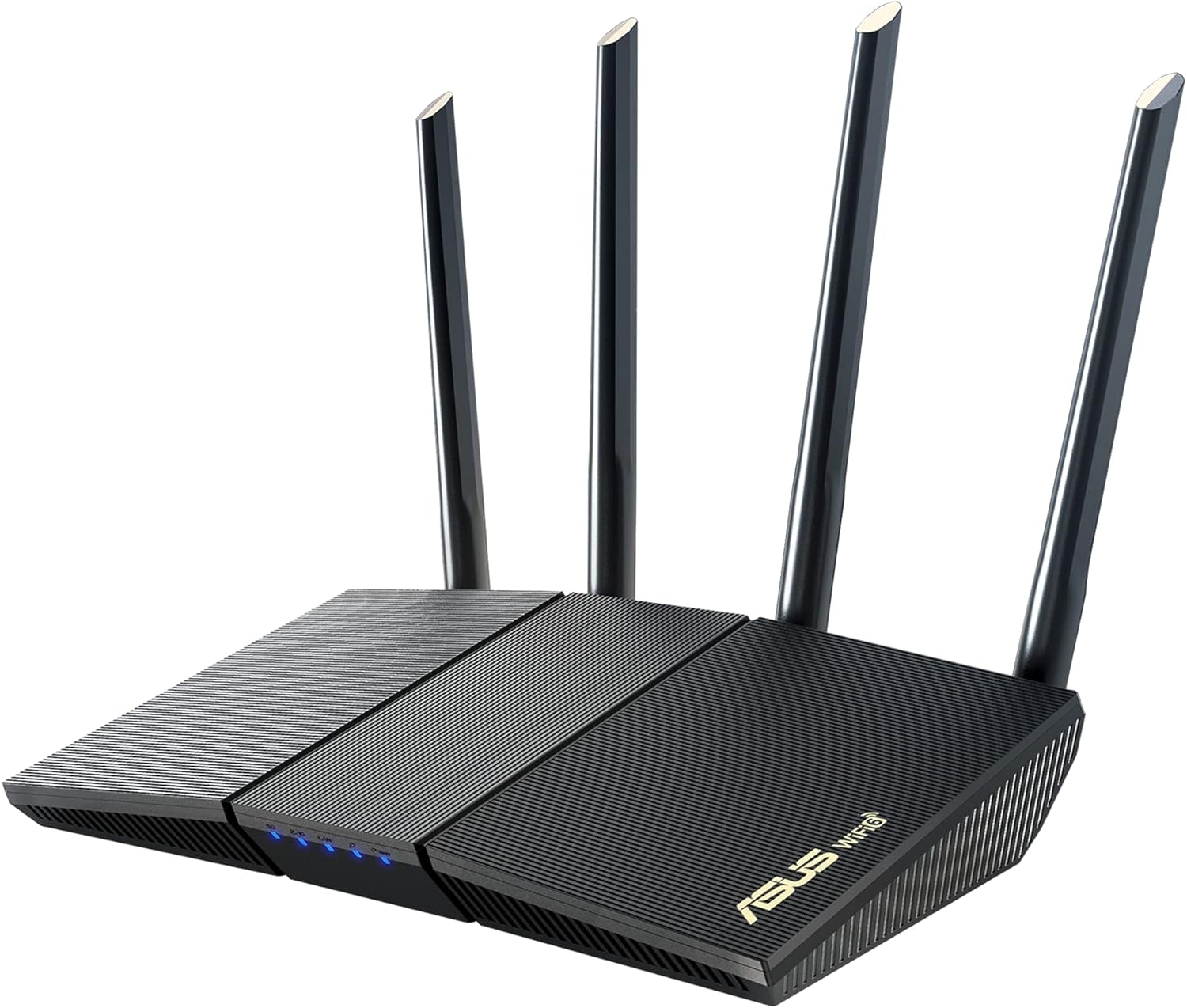
- Five gigabit ports, one WAN and four LAN, instead of the 100 Mbps ports common on entry Wi-Fi 6 units
- Trend Micro powered network protection runs with no ongoing subscription attached
- Four external antennas on a 2x2 dual-band radio using 1024-QAM and 80 MHz channels
- AiMesh support, so a second compatible unit extends one network name rather than adding a second SSID
- Instant Guard opens a one-click encrypted tunnel home from a laptop on public Wi-Fi
Cons
- 2x2 radios cap the 5 GHz band near 1201 Mbps, so a multi-gig line cannot be fully used
- No USB port, so a shared drive or printer cannot be attached to the router itself
- Dual-core processor and no 160 MHz channel support, which limits top single-client speed
This is a 2x2 dual-band 802.11ax unit: roughly 1201 Mbps on 5 GHz and 574 Mbps on 2.4 GHz, radiated from four external antennas.
- 1024-QAM packs more data into each transmission than 256-QAM Wi-Fi 5 gear
- OFDMA splits one channel between several small transmissions instead of queueing them
- MU-MIMO serves two streams at once to capable clients
- Target Wake Time lets phones and sensors sleep between check-ins
The practical gain over an older AC1750 unit is not headline speed to a single laptop, it is behaviour when fifteen devices are awake. OFDMA cuts the airtime each small packet consumes, so a video call holds steady while a console downloads. Coverage depends heavily on wall construction: plasterboard and timber are kind, dense masonry is not.
The router app walks through the first boot: plug the WAN port into your modem, scan the label, name the network and set an admin password.
- Trend Micro powered filtering blocks known malicious sites with no ongoing fee
- Parental controls schedule access per device
- Built-in VPN server covering WireGuard and OpenVPN protocols
- Instant Guard builds an encrypted tunnel home from a laptop abroad
Change two settings straight away. Turn on automatic firmware updates, since router security depends on them, and give the 2.4 GHz and 5 GHz bands the same network name so devices roam between them without manual selection. If you later add a second compatible unit, AiMesh pairing is handled from the same app in a few taps.
The unit is a router, not a modem, so it connects to whatever your provider supplies.
- Works behind cable, fibre ONT, DSL and satellite terminals with an Ethernet handoff
- One gigabit WAN plus four gigabit LAN ports
- Power input 110 to 240 V, output 12 V at 1.5 A maximum
- PPPoE, dynamic and static WAN modes all supported
If your provider supplies a combined modem-router, put that box into bridge or modem mode first, because leaving two routers in series creates double NAT and breaks console networking and port forwarding. There is no USB socket, so shared storage needs its own network connection. For lines up to about 900 Mbps the gigabit WAN is the correct match; anything faster wants multi-gig hardware.

Pros
- Combined throughput up to 2882 Mbps on 5GHz plus 688 Mbps on 2.4GHz across dual bands using Wi-Fi 7's Multi-Link Operation
- Two 2.5 Gbps ports (one WAN/LAN switchable) plus three 1 Gbps LAN ports break past the single-gigabit bottleneck of older routers
- 2.0GHz quad-core processor and 4 internal antennas with beamforming target coverage up to 2,000 sq. ft. for up to 60 connected devices
- EasyMesh compatibility lets it pair with additional routers or extenders to expand coverage without replacing the whole system
- USB 3.0 port adds local network storage or printer sharing that many entry routers skip entirely
Cons
- Dual-band only, so it does not include the 6GHz band found on tri-band Wi-Fi 7 routers, reducing available spectrum in congested networks
- 2,000 sq. ft. coverage figure is on the smaller end for whole-home Wi-Fi 7 systems, so larger homes may need an EasyMesh extender
- HomeShield's advanced security and parental control features typically require an ongoing subscription beyond the basic free tier
The Archer BE230 is a dual-band BE3600-class Wi-Fi 7 router with combined speeds up to 2882 Mbps on 5GHz and 688 Mbps on 2.4GHz, using 4-stream Multi-Link Operation to keep connections stable as devices roam between bands. Four internal antennas with beamforming push signal toward hard-to-reach corners, with coverage figures up to 2,000 sq. ft. and support for up to 60 connected devices at once.
- Combined throughput up to 2882 Mbps (5GHz) and 688 Mbps (2.4GHz)
- 4-stream Multi-Link Operation for Wi-Fi 7 devices
- Coverage figures up to 2,000 sq. ft. for up to 60 devices
- 4K-QAM modulation for added data capacity per stream
Because this is a dual-band model, it skips the 6GHz band found on tri-band Wi-Fi 7 routers, which matters most in dense apartment buildings with heavy 5GHz interference from neighboring networks.
Physical connectivity runs through one 2.5G WAN/LAN switchable port, a second dedicated 2.5 Gbps LAN port, and three additional 1 Gbps LAN ports, so multi-gig internet plans and wired devices are not bottlenecked by a single gigabit port the way many entry-tier routers are. A USB 3.0 port adds local file sharing or printer connectivity without extra hardware.
- One 2.5G WAN/LAN switchable port plus a second 2.5 Gbps LAN port
- Three additional 1 Gbps LAN ports
- USB 3.0 port for shared storage or printers
- EasyMesh support to add extenders or additional routers later
The 2.0GHz quad-core processor is built to manage this port and antenna load without introducing lag, and EasyMesh compatibility means the network can grow into a mesh system later instead of requiring a full router swap.
The Archer BE230 works with any cable or fiber internet service since it is a standalone router rather than a modem-router combo, so it slots in behind whatever modem your provider supplies. It includes built-in VPN client and server support alongside HomeShield network security tools and Private IoT network separation for keeping smart home devices off the main network.
- Works with any standard cable or fiber modem, ISP-agnostic
- Built-in VPN client and server functionality
- Private IoT network separates smart home devices from primary devices
Advanced HomeShield features such as extended parental controls and deeper security scanning commonly sit behind an ongoing subscription, so check which protections are included at no extra cost versus which require a paid tier before relying on them.

Pros
- Total bandwidth of 6.5 Gbps across 2.4GHz and 5GHz bands with 6 spatial streams
- Two 2.5 Gbps ports (WAN/LAN and LAN) plus three 1 Gbps LAN ports
- Rated coverage up to 2,400 sq ft and 90 simultaneously connected devices
- USB 3.0 port for network-attached storage or printer sharing
- WPA3 encryption plus a separate managed network for IoT devices
Cons
- Dual-band design only, with no dedicated 6GHz band despite the Wi-Fi 7 label
- Full 5764 Mbps and 6.5 Gbps figures are only reached with Wi-Fi 7 client devices; older phones and laptops connect at lower legacy speeds
- Deeper security scanning and remote management run through the cloud-connected Tether app rather than working fully offline
This dual-band Wi-Fi 7 router combines a 5764 Mbps 5GHz band with a 688 Mbps 2.4GHz band for 6.5 Gbps of combined bandwidth across 6 spatial streams.
- Rated coverage of up to 2,400 sq ft with 6 external antennas and beamforming
- Supports up to 90 simultaneously connected devices
- Multi-Link Operation combines both bands for lower latency on supported clients
Because this is a dual-band design rather than tri-band, there is no dedicated 6GHz lane; devices without Wi-Fi 7 support fall back to standard 5GHz or 2.4GHz speeds rather than the peak combined figure. For a typical single-floor or small two-floor home, the antenna layout and beamforming keep signal consistent across rooms, though a very large multi-floor house may still benefit from a mesh add-on at the edges of the stated coverage area.
Setup runs through the Tether app, which walks through connecting the WAN port to a modem and configuring the wireless network name and password in a few steps.
- 1x 2.5 Gbps WAN/LAN port, 1x 2.5 Gbps LAN port, and 3x 1 Gbps LAN ports
- 1x USB 3.0 port for a shared drive or printer
- Powered by an included 12V 2.5A adapter
The unit measures 10.6 x 6 x 1.9 inches and stands vertically, so placement needs a bit of clearance around the antennas rather than lying flat under other equipment. Guest networks, port forwarding, and a separate IoT network are all configurable from the same app, and firmware updates are pushed automatically once cloud services are enabled during setup.
The 2.5 Gbps WAN port supports multi-gig internet plans when paired with a compatible modem, while standard gigabit or slower ISP connections still work through the same port without any adapter needed.
- Supports IPv4 and IPv6, PPPoE, and dynamic or static IP connection types common across ISPs
- WPA3 encryption plus a separate network for IoT devices through HomeShield
- Compatible with Alexa and Google Assistant for voice-based network commands
Because the 2.5 Gbps WAN port only reaches its full speed with a matching multi-gig plan, anyone on a standard gigabit or lower connection will see their own connection's ceiling rather than the port's ceiling. HomeShield's deeper security scanning and parental controls are managed through the cloud-connected Tether app rather than a fully local dashboard.

Pros
- Tri-band radios at 2402 Mbps on 6GHz, 2402 Mbps on 5GHz and 574 Mbps on 2.4GHz
- 2.5 Gbps port usable as either WAN or LAN, for multi-gig service or a wired NAS
- 1.0 GHz dual-core CPU with 512 MB of memory and six high-gain antennas with beamforming
- 160MHz channels on the 6GHz band, clear of legacy device traffic and neighbouring overlap
- Runs OpenVPN, PPTP and L2TP as both server and client, with WPA3 and a 2-year warranty
Cons
- Only Wi-Fi 6E clients can use the 6GHz band, and 6GHz signal attenuates faster through walls than 5GHz
- A separate modem is still required for most cable and DSL services
- Just one 2.5 Gbps port, so a second multi-gig wired device drops back to Gigabit
Three radios rather than two: 2402 Mbps on 6GHz, 2402 Mbps on 5GHz and 574 Mbps on 2.4GHz, making up the 5400 Mbps combined headline. The 6GHz band is the reason to buy a 6E unit at all, because it carries no legacy traffic from older devices and has room for 160MHz channels without overlapping the neighbours.
Six high-gain antennas with beamforming shape signal toward connected devices, and OFDMA plus true tri-band working raises capacity roughly fourfold against a comparable dual-band unit when many devices are active at the same time.
Behind the radios sit a 1.0 GHz dual-core CPU and 512 MB of memory, which is what stops throughput collapsing when dozens of clients, QoS rules and a VPN tunnel are all live at once. The housing is shaped for heat dissipation rather than stacking.
The standout wired feature is the 2.5 Gbps port, which can face either direction. Used as WAN it lets a multi-gig cable or fibre service exceed the old Gigabit ceiling; used as LAN it gives one machine, typically a NAS or a workstation, a 2.5 Gbps link to the rest of the network.
Setup runs through the Tether app, which handles connection type, network naming and firmware. Do the firmware update first, before anything else gets configured.
VPN support is unusually complete for a home unit. It runs as both a server and a client, covering OpenVPN, PPTP and L2TP, so you can either reach your home network from outside or push household traffic out through a provider. Security is WPA3, and the unit carries a 2-year warranty.
It works with any provider that hands off an Ethernet connection, including AT&T, Verizon, Xfinity, Spectrum, RCN, Cox, CenturyLink and Frontier. As with any standalone router, a separate modem is still needed for most cable and DSL services, so this replaces the router half of an existing gateway rather than the whole box.
On the client side, only Wi-Fi 6E devices can use the 6GHz band. Recent flagship phones, current laptops and newer 6E adapters qualify; anything older sits on 5GHz or 2.4GHz and sees no benefit from the third radio at all. Worth knowing too: 6GHz attenuates faster through walls than 5GHz, so the fastest band is also the shortest ranged.
OneMesh support lets a compatible extender join as a single roaming network name rather than appearing as a second SSID.
Why Port Forwarding Depends on Your Router
Port forwarding is a feature of your router’s Network Address Translation (NAT) system. When traffic from the internet reaches your public IP address, the router decides which device on your local network should receive it. By creating a port forwarding rule, you tell the router to send any request arriving on a specific port straight to a chosen device, such as a gaming console, an NAS, or a security recorder.
Because this all happens inside the router’s firmware, the quality of that firmware matters enormously. A cheap or poorly designed router may hide port forwarding behind confusing menus, limit how many rules you can create, or drop your rules after a firmware update. The best routers for port forwarding make the process straightforward, keep your rules stable, and add security tools that reduce the risk of exposing your network.
NAT Type and Open Ports
Gamers in particular care about NAT type. An “Open” or “Type 1” NAT usually means better matchmaking, fewer connection drops, and smoother voice chat. Routers with clear port forwarding controls, UPnP options, and DMZ settings make it easier to achieve an open NAT. If online gaming is your priority, look for a model with a dedicated gaming or QoS section alongside its port forwarding menu.
Key Features to Look For
Not every router treats port forwarding equally. Before you buy, weigh these features against how you plan to use your network.
An Intuitive Firmware Interface
The single most important factor is a clean, logical admin interface. You want to be able to log in, find the port forwarding or virtual server section quickly, and add a rule in a few clicks. TP-Link, ASUS, and eero all offer polished dashboards, though they differ in depth. If you value simplicity and a guided app experience, mesh systems like the Amazon eero 7 keep things beginner friendly. If you prefer granular control, a traditional router interface such as the one on the TP-Link Archer AXE75 gives you more knobs to turn.
Wi-Fi Standard and Speed
Your router’s Wi-Fi generation affects overall performance, even if port forwarding itself is not bandwidth heavy. Wi-Fi 6 models like the TP-Link Archer AX21 and the TP-Link Archer AX10 hit a sweet spot of price and speed for most homes. If you want the latest technology, Wi-Fi 7 options such as the TP-Link Deco 7 BE23, the TP-Link Archer BE230, and the TP-Link Archer BE400 add features like MLO and faster wired backhaul that future-proof your setup.
Multi-Gig and Gigabit Ports
Wired stability matters for anything you forward ports to. Look for gigabit LAN ports at minimum, and 2.5G ports if you have a fast internet plan or a high-traffic server. Several newer models pair 2.5G WAN and LAN ports with USB connectivity, which is ideal for hosting an NAS or a media server behind a forwarded port.
Built-in VPN and Firewall Tools
Opening ports increases your exposure to the internet, so security features are essential. A capable firewall, a built-in VPN server, and options like WPA3 encryption help protect the devices you make reachable. Routers such as the ASUS RT-AX1800S ship with subscription-free network security, while a dedicated wired VPN router like the TP-Link ER605 is built for users who run business-grade firewall and load-balancing setups.
Matching a Router to Your Use Case
The best routers for port forwarding are not one-size-fits-all. Here is how to narrow the field based on what you actually do.
Budget-Conscious Home Users
If you just need to forward a few ports for a game console or a smart home hub, you do not need to overspend. An affordable dual-band router like the TP-Link Archer A6 handles basic port forwarding well and covers a typical home. Stepping up slightly, the TP-Link Archer AX10 adds Wi-Fi 6 and four gigabit LAN ports for wired reliability at a modest price.
Gamers and Streamers
For low-latency gaming and streaming, prioritize QoS controls, an open NAT, and strong wired ports. The TP-Link Archer AXE75 brings tri-band Wi-Fi 6E and a 2.5G WAN port that suit competitive play, while the TP-Link Archer AX21 is a proven, budget-friendly Wi-Fi 6 pick that makes opening ports for consoles simple.
Whole-Home Coverage Seekers
If dead zones are your main problem, a mesh system may serve you better than a single router. Modern mesh kits still support port forwarding through their companion apps. The Amazon eero 7 offers app-guided setup and wide coverage, and the TP-Link Deco 7 BE23 combines Wi-Fi 7 mesh coverage with 2.5G ports for wired backhaul.
Power Users and Home Labs
Self-hosters, remote workers, and anyone running multiple services will appreciate deeper control. Wi-Fi 7 routers like the TP-Link Archer BE400 and the TP-Link Archer BE230 pair quad-core processors with USB 3.0 and multi-gig ports, giving you the horsepower to forward many ports at once. For a pure wired, security-first build, the TP-Link ER605 VPN router is purpose-built for advanced firewall rules and multi-WAN setups.
How to Set Up Port Forwarding the Right Way
Once you have chosen your router, setting up port forwarding follows a consistent pattern regardless of brand. A little preparation keeps your rules stable and secure.
Step 1: Assign a Static Local IP
Before creating a rule, give the target device a fixed local IP address, either manually or through a DHCP reservation in your router. If the device’s IP changes, your port forwarding rule will point to nothing. Most of the routers above let you reserve an IP in a couple of clicks.
Step 2: Create the Forwarding Rule
Log in to the router’s admin panel or app, open the port forwarding or virtual server section, and enter the external port, internal port, protocol (TCP, UDP, or both), and the device’s local IP. Save the rule and reboot if the router asks you to. On app-driven systems like the Amazon eero 7, this lives under the device or advanced settings menu.
Step 3: Test and Secure
Use an online port checker to confirm the port is open, then lock things down. Disable UPnP if you are forwarding ports manually, use strong admin passwords, keep firmware updated, and enable the router’s firewall and WPA3 where available. Security-focused models such as the ASUS RT-AX1800S make it easy to layer protection on top of your open ports.
Common Mistakes to Avoid
Even with the best routers for port forwarding, a few missteps trip people up. Avoid forwarding a broad range of ports when you only need one or two, since every open port is a potential entry point. Do not forget to set a static IP, or your rules will silently break. And resist leaving default admin credentials in place, especially once your network is reachable from the internet.
Another frequent issue is double NAT, which happens when your ISP modem and your own router both perform NAT. If port forwarding refuses to work, check whether your modem is in bridge mode or whether you need to forward ports on both devices. Routers with clear status dashboards make this easy to diagnose.
Final Thoughts
The best routers for port forwarding combine an approachable interface, stable NAT handling, solid wired ports, and strong security so you can open exactly the ports you need without exposing your whole network. Budget shoppers can start with a reliable dual-band model, gamers benefit from tri-band and multi-gig options, coverage seekers gain from mesh Wi-Fi 7 kits, and power users get the most from high-performance routers or a dedicated VPN gateway.
Think about how many services you plan to host, how much coverage you need, and how much control you want over your firewall. Match those answers to one of the models above, and you will have a router that makes port forwarding simple, dependable, and secure for the long haul. Whichever option you choose, take a few minutes to configure static IPs and security settings, and your forwarded ports will keep working smoothly day after day.





Comments are closed.
No reviews yet. Be the first to share your experience!