
 Daniel Okafor
 Best Routers for Lots of Devices: How to Choose in 2026
Modern homes are crowded with connected gadgets. Between phones, laptops, smart TVs, security cameras, thermostats, speakers, game consoles, and a growing pile of smart plugs, the average household can easily juggle 40, 60, or even 100 active connections at once. When you are shopping for the best routers for lots of devices, raw speed is only part of the story. What really matters is how gracefully a router handles many clients talking to it at the same time without slowing everyone down.
This guide walks you through the features that actually determine whether a router can keep a busy, device-heavy home running smoothly. Instead of ranking each model one by one, we focus on how to choose – the specs to prioritize, the mistakes to avoid, and which types of hardware fit different home sizes and budgets. Use the shortlist below as a reference point while you read.

Pros
- Covers up to 2,000 sq ft from a single unit, roughly a 25-foot radius
- Two auto-sensing 2.5 GbE ports support internet plans up to 2.5 Gbps
- Supports 120+ connected devices on one network
- Backward compatible with all previous generations of the same mesh system for gradual expansion
- Backed by a 3-year warranty on the router hardware
Cons
- This listing is a 1-pack, so covering more than 2,000 sq ft means buying additional eero units to extend the mesh
- Full Wi-Fi 7 speed benefits only apply to client devices that also support the 802.11be standard
- Advanced network features and remote management depend on the eero app rather than a local web-based admin panel
A single eero 7 unit is rated to cover up to 2,000 sq ft, roughly a 25-foot radius, with wireless speeds up to 1.8 Gbps over Wi-Fi 7. Two auto-sensing 2.5 GbE ports support wired connections and internet plans up to 2.5 Gbps.
- Up to 2,000 sq ft coverage per unit
- Wireless speeds up to 1.8 Gbps
- Two 2.5 GbE auto-sensing ports
Multi-link operation (MLO), a Wi-Fi 7 feature, lets compatible devices connect across multiple bands at once for more stable throughput during high-demand tasks.
Setup runs through the eero app, guiding the router through network naming, password creation, and initial configuration without requiring a separate desktop client. A single eero 7 can act as the main gateway, replacing an existing router directly.
- App-guided setup process
- Can act as a standalone gateway or extend an existing eero network
- Backward compatible with all previous eero hardware generations
Because backward compatibility carries across generations, an existing eero mesh network can add this unit as a node without replacing units already installed.
The router's 2.5 GbE WAN port supports internet plans up to 2.5 Gbps, above the 1 Gbps ceiling that standard router ports impose, making it suited to fiber or cable plans rated for multi-gig speeds.
- 2.5 GbE WAN support for plans up to 2.5 Gbps
- Supports 120+ simultaneously connected devices
- Compatible with eero Built-in on select Amazon Echo devices
Households on internet plans below 1 Gbps will not see the full benefit of the 2.5 Gbps WAN capability, though the router still operates normally at lower plan speeds.

Pros
- Up to 1200 Mbps on 5 GHz plus 574 Mbps on 2.4 GHz for 1.8 Gbps of combined bandwidth
- Four high-gain external antennas with beamforming to focus signal toward distant devices
- OFDMA scheduling keeps dozens of smart-home devices from congesting the available airtime
- Joins an EasyMesh network, so a compatible extender shares one network name across a house
- Built-in OpenVPN and PPTP server plus a 2-year warranty on the hardware
Cons
- Dual-band only - there is no 6 GHz radio, so Wi-Fi 6E and 7 clients gain nothing extra
- WAN and LAN ports top out at gigabit, which bottlenecks any internet plan faster than 1 Gbps
- A separate modem is still required for most internet services, since none is built in
Bandwidth splits into up to 1200 Mbps on 5 GHz and up to 574 Mbps on 2.4 GHz, which is where the AX1800 label comes from. Those are link speeds shared across connected devices, not a guaranteed per-device figure.
- 5 GHz carries the fast traffic - 4K streaming, gaming, large downloads - over shorter distances.
- 2.4 GHz travels further through walls and is where most smart plugs, cameras and sensors live.
- Four high-gain antennas plus beamforming aim signal at devices rather than radiating evenly.
OFDMA lets the router talk to several devices within the same transmission slot, which is the practical Wi-Fi 6 gain in a busy household: fewer stalls when a dozen devices all want airtime at once.
Initial setup runs through a phone app that walks through connection type, network name and password, so no browser configuration page is needed to get online.
- Parental controls allow per-profile time limits and content filtering.
- Guest networks can be raised on both bands to keep visitors off the main network.
- Quality-of-service settings prioritise a chosen device, useful when one machine handles video calls.
The router can also act as an OpenVPN or PPTP server, letting a laptop away from home reach the home network. It joins an EasyMesh setup with compatible units, so coverage can be extended later without replacing it. Note that the more advanced security and parental control features move to a paid tier once the included trial ends.
Wiring is conventional: a gigabit WAN port for the modem and four gigabit LAN ports for wired devices such as a desktop, console, NAS or television.
- Every port is gigabit, so a plan above 1 Gbps cannot be delivered in full through this router.
- Plans up to about 940 Mbps are matched comfortably.
- A modem or ONT from the internet service is still needed - this is a router, not a combined unit.
It works with the major cable, fibre and DSL services in the same way any standalone router does, since the connection type is set in software during setup. If the existing service supplies a combined modem-router, that unit usually has to be switched to bridge mode before this one takes over routing.

Pros
- Three units cover up to 6,500 square feet and support up to 150 simultaneously connected devices
- AX3000 splits as 2402 Mbps on 5 GHz with HE160 support plus 574 Mbps on 2.4 GHz
- Nine Gigabit Ethernet ports in total, three per unit, and any unit can serve as the main router
- Wired Ethernet backhaul is supported, which frees the 5 GHz band from carrying node-to-node traffic
- Backed by a 2-year warranty with 24/7 support, a year longer than most networking brands offer
Cons
- The WAN port is Gigabit, so a 2 Gbps or faster fibre plan cannot be used at its full speed
- Dual-band only, with no dedicated backhaul radio, so wireless backhaul shares 5 GHz with your devices
- Full HomeShield parental controls and security features move to a paid subscription after the free tier
The rated figure is 6,500 square feet from three units, which is a manufacturer's best case on an open floor plan. In a real house with brick walls and a chimney breast, plan on a unit per floor plus one for whichever corner currently drops out.
- Three units suits a typical three-storey house or a large single-level spread
- Up to 150 devices supported, which covers a household full of smart plugs, cameras and phones
- AI-driven mesh learns the environment and steers clients between units
- More units can be added later, and all Deco models work together on one network
Placement beats specification here. Each node needs a solid link back to the next, so putting the second unit halfway to the dead zone rather than inside it is what actually fixes coverage.
Setup runs entirely through the Deco app, with visual guidance at each step. The realistic time from box to working network is fifteen to twenty minutes for the whole three-unit set.
- Connect the first unit to your existing modem by Ethernet and power it on
- The app finds it over Bluetooth and walks through naming the network and setting a password
- Additional units are added one at a time and adopt the same network name automatically
- Existing router should be put into modem or bridge mode to avoid double NAT
- Remote management works from the app when you are away from home
If your ISP supplied a combined modem and router, leaving it in router mode creates a double NAT that breaks port forwarding and some games. Switching it to bridge mode is the step most worth doing properly.
This replaces the router but not the modem. Cable, fibre and DSL connections all need the ISP's modem or ONT in front of it, connected to one Ethernet port on the main unit.
- Best suited to broadband plans up to 1 Gbps, which the Gigabit WAN port matches exactly
- Plans above 1 Gbps will be capped, since there is no multi-gig port on this model
- Ethernet backhaul between units is supported wherever you have existing wall cabling
- Powerline or MoCA adapters can carry backhaul where running cable is impractical
- Each unit's spare Gigabit ports can serve a TV, console or desktop directly
The wired backhaul option is the single biggest performance upgrade available here, and it costs nothing if the cabling already exists.

Pros
- Wifi 6 support with 160 MHz channel bandwidth on the 5GHz band for higher throughput per device
- Rated to cover up to 1,500 sq. ft. from a single unit, expandable by adding more units to the same mesh
- Connects 75+ devices simultaneously, useful for homes with many smart home gadgets
- TrueMesh routing automatically reroutes traffic around congestion to reduce drop-offs
- Built-in smart home hub supports Thread and Zigbee devices without a separate bridge
Cons
- Advanced security and network management features require a separate ongoing subscription
- Single-unit coverage tops out at 1,500 sq. ft., so larger homes need additional units purchased separately
- Setup and management run only through the companion app; there is no traditional web-based admin panel
A single unit is rated to cover up to 1,500 sq. ft. and supports internet plans up to a gigabit. The 160 MHz channel on the 5GHz Wifi 6 band raises available bandwidth per device, useful when several people are streaming, on video calls, or gaming at once.
- Connects 75+ devices to a single network simultaneously
- TrueMesh technology reroutes traffic automatically to reduce drop-offs and dead spots
- Expandable by adding more units to extend the same mesh network
- Works as a standalone gateway replacing an existing router
Because coverage is mesh-based, placing additional units roughly halfway between the router and the weakest signal area extends the 1,500 sq. ft. footprint further than a single traditional router could reach.
Setup runs entirely through the companion app, which walks through connecting the unit to a modem and joining it to the home network within a few minutes. There is no separate web browser admin page, so ongoing management, guest network creation, and device pausing all happen from the phone app.
- App-guided setup with step-by-step prompts
- Remote network management from outside the home over a data connection
- Automatic firmware updates applied in the background
- Built-in Thread and Zigbee hub for compatible smart home devices
Households that prefer a traditional browser-based router interface with manual firmware control should note this model is app-first by design, trading some manual configuration depth for a simpler day-to-day setup process.
This router supports internet plans up to a gigabit and works with most cable, fiber, or DSL modems that output a standard Ethernet connection. It replaces an existing router outright rather than working alongside one, so an existing router should be set to bridge mode or removed before setup.
- Compatible with internet plans up to 1 Gbps
- Works with existing units to extend a current mesh network
- Wifi 6 (802.11ax) standard for improved multi-device performance
- Built-in smart home hub adds Thread/Zigbee support to the same network
Homes on internet plans above a gigabit will not see the extra throughput reflected through this router, since its rated ceiling stops at gigabit speeds regardless of the incoming plan.

Pros
- Four Gigabit LAN ports plus a Gigabit WAN, so a console, TV and desktop can all run wired at once
- 1201 Mbps on the 5 GHz 802.11ax band with OFDMA and MU-MIMO for crowded device counts
- Dual-core 900 MHz processor keeps routing steady when a dozen devices stream simultaneously
- Four external high-gain antennas with beamforming, pivoting for a shelf or wall position
- OneMesh support lets a compatible extender join as one roaming network name rather than a second SSID
Cons
- The 2.4 GHz band runs 802.11n at 300 Mbps rather than 802.11ax, so Wi-Fi 6 gains apply on 5 GHz only
- No USB port, which rules out shared network storage or a connected printer
- No modem inside, so most ISP connections still need the provider box in front of it
Combined figures are 1201 Mbps on 5 GHz using 802.11ax plus 300 Mbps on 2.4 GHz using 802.11n, an AX1500 class device. Four external high-gain antennas with beamforming steer signal toward connected clients rather than radiating evenly in all directions.
- OFDMA lets several devices share one transmission slot, where Wi-Fi 6 helps most in a busy house
- MU-MIMO serves multiple clients at once instead of taking turns
- 1024-QAM raises the data carried per symbol for newer clients
- Dual-core 900 MHz processor keeps routing steady with many sessions open
- OneMesh support extends coverage under a single network name
Read those numbers as ceilings under ideal conditions. A phone two internal walls away will see a fraction of them, which is normal at this class and why spending ten minutes on antenna aiming pays off.
Setup runs through the Tether app or a browser page and takes a few minutes end to end.
- Connect the ISP modem to the Gigabit WAN port
- Join the default network printed on the label, then follow the wizard to set a name and passphrase
- Plug wired devices into any of the four Gigabit LAN ports
- Position it high, central and clear of metal, with the four antennas at a mix of vertical and 45 degrees
Parental controls, guest networks and Alexa voice commands are configured in the same app afterwards. Firmware updates are prompted rather than silent, so check for one shortly after setup. Placement changes results more than any setting here, since a router in a cupboard or behind a TV loses more signal than any feature can recover.
This is a router, not a modem. On most connections the provider box stays in place and this plugs into it.
- Works with Verizon, Xfinity, Spectrum, Cox, CenturyLink, Frontier, RCN and other major providers
- A separate modem is required for cable, DSL and fibre services that do not hand off Ethernet directly
- Backward compatible with 802.11a, b, g, n and ac clients, so older laptops and smart plugs still join
- WAN throughput tops out at 1 Gbps, matching the port speed
There is no USB socket, so network storage and printer sharing are off the table. Wi-Fi 6 gains apply on the 5 GHz band alone, since the 2.4 GHz radio runs 802.11n. Older smart home devices that insist on 2.4 GHz will connect happily but see no benefit from the newer standard.
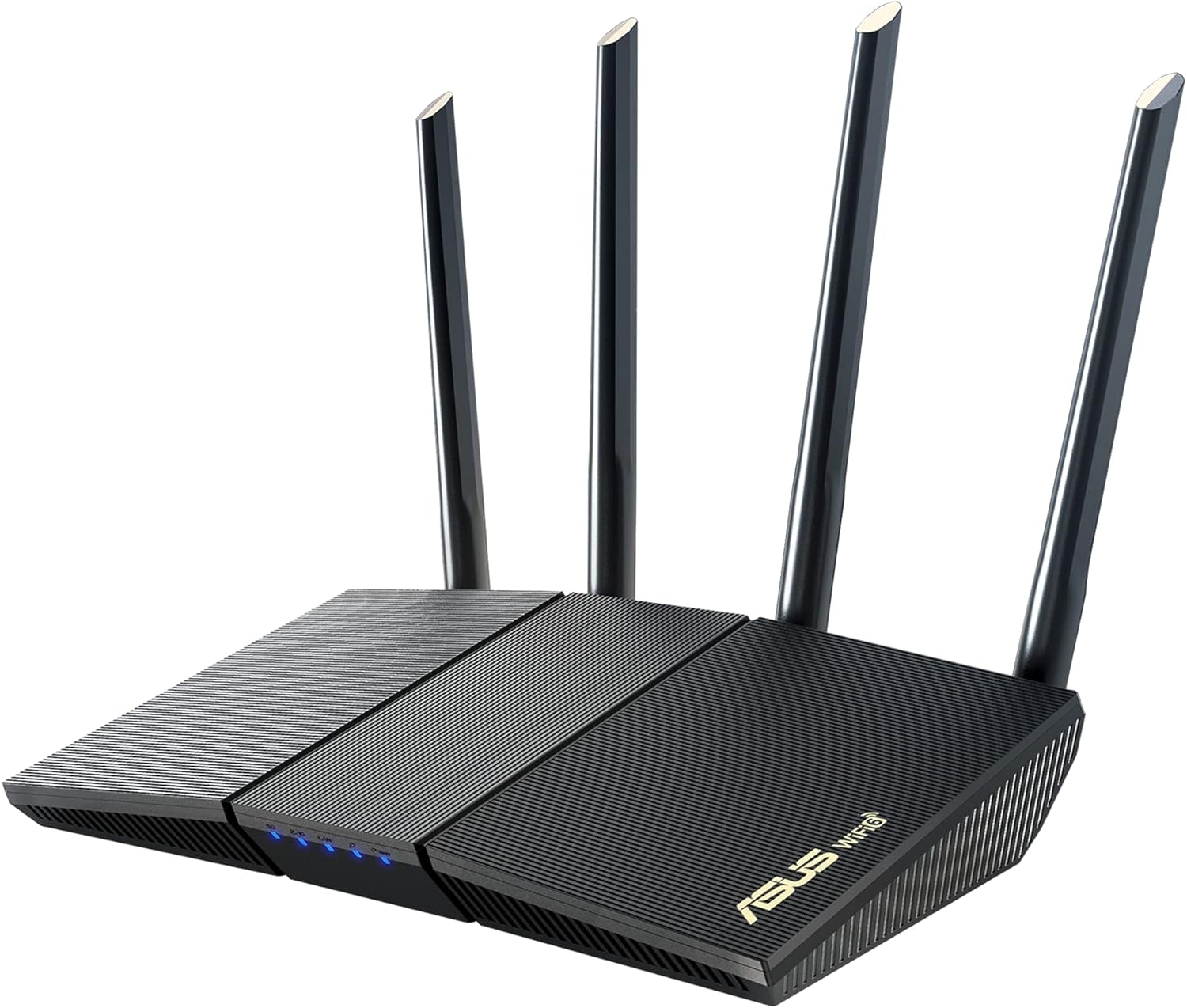
Pros
- Five gigabit ports, one WAN and four LAN, instead of the 100 Mbps ports common on entry Wi-Fi 6 units
- Trend Micro powered network protection runs with no ongoing subscription attached
- Four external antennas on a 2x2 dual-band radio using 1024-QAM and 80 MHz channels
- AiMesh support, so a second compatible unit extends one network name rather than adding a second SSID
- Instant Guard opens a one-click encrypted tunnel home from a laptop on public Wi-Fi
Cons
- 2x2 radios cap the 5 GHz band near 1201 Mbps, so a multi-gig line cannot be fully used
- No USB port, so a shared drive or printer cannot be attached to the router itself
- Dual-core processor and no 160 MHz channel support, which limits top single-client speed
This is a 2x2 dual-band 802.11ax unit: roughly 1201 Mbps on 5 GHz and 574 Mbps on 2.4 GHz, radiated from four external antennas.
- 1024-QAM packs more data into each transmission than 256-QAM Wi-Fi 5 gear
- OFDMA splits one channel between several small transmissions instead of queueing them
- MU-MIMO serves two streams at once to capable clients
- Target Wake Time lets phones and sensors sleep between check-ins
The practical gain over an older AC1750 unit is not headline speed to a single laptop, it is behaviour when fifteen devices are awake. OFDMA cuts the airtime each small packet consumes, so a video call holds steady while a console downloads. Coverage depends heavily on wall construction: plasterboard and timber are kind, dense masonry is not.
The router app walks through the first boot: plug the WAN port into your modem, scan the label, name the network and set an admin password.
- Trend Micro powered filtering blocks known malicious sites with no ongoing fee
- Parental controls schedule access per device
- Built-in VPN server covering WireGuard and OpenVPN protocols
- Instant Guard builds an encrypted tunnel home from a laptop abroad
Change two settings straight away. Turn on automatic firmware updates, since router security depends on them, and give the 2.4 GHz and 5 GHz bands the same network name so devices roam between them without manual selection. If you later add a second compatible unit, AiMesh pairing is handled from the same app in a few taps.
The unit is a router, not a modem, so it connects to whatever your provider supplies.
- Works behind cable, fibre ONT, DSL and satellite terminals with an Ethernet handoff
- One gigabit WAN plus four gigabit LAN ports
- Power input 110 to 240 V, output 12 V at 1.5 A maximum
- PPPoE, dynamic and static WAN modes all supported
If your provider supplies a combined modem-router, put that box into bridge or modem mode first, because leaving two routers in series creates double NAT and breaks console networking and port forwarding. There is no USB socket, so shared storage needs its own network connection. For lines up to about 900 Mbps the gigabit WAN is the correct match; anything faster wants multi-gig hardware.

Pros
- Combined throughput up to 2882 Mbps on 5GHz plus 688 Mbps on 2.4GHz across dual bands using Wi-Fi 7's Multi-Link Operation
- Two 2.5 Gbps ports (one WAN/LAN switchable) plus three 1 Gbps LAN ports break past the single-gigabit bottleneck of older routers
- 2.0GHz quad-core processor and 4 internal antennas with beamforming target coverage up to 2,000 sq. ft. for up to 60 connected devices
- EasyMesh compatibility lets it pair with additional routers or extenders to expand coverage without replacing the whole system
- USB 3.0 port adds local network storage or printer sharing that many entry routers skip entirely
Cons
- Dual-band only, so it does not include the 6GHz band found on tri-band Wi-Fi 7 routers, reducing available spectrum in congested networks
- 2,000 sq. ft. coverage figure is on the smaller end for whole-home Wi-Fi 7 systems, so larger homes may need an EasyMesh extender
- HomeShield's advanced security and parental control features typically require an ongoing subscription beyond the basic free tier
The Archer BE230 is a dual-band BE3600-class Wi-Fi 7 router with combined speeds up to 2882 Mbps on 5GHz and 688 Mbps on 2.4GHz, using 4-stream Multi-Link Operation to keep connections stable as devices roam between bands. Four internal antennas with beamforming push signal toward hard-to-reach corners, with coverage figures up to 2,000 sq. ft. and support for up to 60 connected devices at once.
- Combined throughput up to 2882 Mbps (5GHz) and 688 Mbps (2.4GHz)
- 4-stream Multi-Link Operation for Wi-Fi 7 devices
- Coverage figures up to 2,000 sq. ft. for up to 60 devices
- 4K-QAM modulation for added data capacity per stream
Because this is a dual-band model, it skips the 6GHz band found on tri-band Wi-Fi 7 routers, which matters most in dense apartment buildings with heavy 5GHz interference from neighboring networks.
Physical connectivity runs through one 2.5G WAN/LAN switchable port, a second dedicated 2.5 Gbps LAN port, and three additional 1 Gbps LAN ports, so multi-gig internet plans and wired devices are not bottlenecked by a single gigabit port the way many entry-tier routers are. A USB 3.0 port adds local file sharing or printer connectivity without extra hardware.
- One 2.5G WAN/LAN switchable port plus a second 2.5 Gbps LAN port
- Three additional 1 Gbps LAN ports
- USB 3.0 port for shared storage or printers
- EasyMesh support to add extenders or additional routers later
The 2.0GHz quad-core processor is built to manage this port and antenna load without introducing lag, and EasyMesh compatibility means the network can grow into a mesh system later instead of requiring a full router swap.
The Archer BE230 works with any cable or fiber internet service since it is a standalone router rather than a modem-router combo, so it slots in behind whatever modem your provider supplies. It includes built-in VPN client and server support alongside HomeShield network security tools and Private IoT network separation for keeping smart home devices off the main network.
- Works with any standard cable or fiber modem, ISP-agnostic
- Built-in VPN client and server functionality
- Private IoT network separates smart home devices from primary devices
Advanced HomeShield features such as extended parental controls and deeper security scanning commonly sit behind an ongoing subscription, so check which protections are included at no extra cost versus which require a paid tier before relying on them.

Pros
- Covers up to 2,500 square feet and supports up to 80 connected devices simultaneously per the maker's figures
- WiFi 7 dual-band radios reach combined speeds up to 6.5Gbps (BE6500 class), about 2.4 times faster than a WiFi 6 router by the same spec sheet
- 2.5 Gig WAN port supports multi-gig internet plans beyond what a standard 1 Gig port allows
- LAN side includes 1x 2.5 Gig port plus 3x 1 Gig ports for wired devices needing higher throughput
- NETGEAR Armor adds an automatic security shield across all connected devices on the network
Cons
- This is a router only, with no built-in modem, so a separate cable or fiber modem is required to actually reach the internet
- Reaching the full 2.5Gbps WAN speed requires an internet plan and modem that also support 2.5Gbps, so a slower plan or older modem caps throughput well below the router's ceiling
- Coverage of 2,500 sq ft and 80 devices is the entry point in NETGEAR's WiFi 7 Nighthawk line, with larger homes needing a higher model in the same series for more coverage or device capacity
The RS200 is a dual-band WiFi 7 router figured in the BE6500 class, reaching combined wireless speeds of up to 6.5Gbps across its bands, a figure the maker positions as roughly 2.4 times faster than a comparable WiFi 6 router. Coverage is specified at up to 2,500 square feet with support for as many as 80 connected devices at once, figures that sit at the entry point of NETGEAR's current WiFi 7 Nighthawk lineup.
Wired connectivity includes a 2.5 Gig internet (WAN) port for multi-gig internet plans, plus 1x 2.5 Gig and 3x 1 Gig LAN ports for wired devices such as a desktop PC, a NAS or a games console needing a stable, high-throughput connection.
- WiFi class: WiFi 7, BE6500 (up to 6.5Gbps)
- Coverage: up to 2,500 sq. ft.
- Device capacity: up to 80
- WAN port: 2.5 Gig
This listing is for the router only; it does not include a built-in cable modem, so a separate modem with coax input is required to connect to a cable internet service, or an ONT for fiber service. It is compatible with any internet service provider, since the router itself just needs a wired connection from a modem into its WAN port.
To reach the router's full 2.5Gbps WAN speed, both the internet plan and the modem feeding it need to support that same 2.5Gbps figure; a standard 1 Gig plan or an older modem will cap throughput at that lower ceiling regardless of the router's own capability. NETGEAR Armor runs in the background once set up, adding automatic monitoring across every device connected to the network.
- Modem: not included, required separately
- WAN speed ceiling depends on modem and ISP plan
- Security: NETGEAR Armor included
This router suits households in roughly a 2,500 square foot home running up to about 80 devices between phones, laptops, smart home gadgets, and streaming devices, wanting a step into WiFi 7 without the coverage of a larger mesh system. Gamers and anyone doing frequent 4K streaming or video conferencing benefit from the added bandwidth WiFi 7 provides across multiple devices at once.
Larger homes beyond 2,500 square feet, or households needing to connect more than 80 devices, are better matched to a higher model in the same Nighthawk WiFi 7 range built for greater coverage and device capacity. Anyone without a modem already in place will need to plan for that as a separate purchase alongside this router.

Pros
- Tri-band radios at 2402 Mbps on 6GHz, 2402 Mbps on 5GHz and 574 Mbps on 2.4GHz
- 2.5 Gbps port usable as either WAN or LAN, for multi-gig service or a wired NAS
- 1.0 GHz dual-core CPU with 512 MB of memory and six high-gain antennas with beamforming
- 160MHz channels on the 6GHz band, clear of legacy device traffic and neighbouring overlap
- Runs OpenVPN, PPTP and L2TP as both server and client, with WPA3 and a 2-year warranty
Cons
- Only Wi-Fi 6E clients can use the 6GHz band, and 6GHz signal attenuates faster through walls than 5GHz
- A separate modem is still required for most cable and DSL services
- Just one 2.5 Gbps port, so a second multi-gig wired device drops back to Gigabit
Three radios rather than two: 2402 Mbps on 6GHz, 2402 Mbps on 5GHz and 574 Mbps on 2.4GHz, making up the 5400 Mbps combined headline. The 6GHz band is the reason to buy a 6E unit at all, because it carries no legacy traffic from older devices and has room for 160MHz channels without overlapping the neighbours.
Six high-gain antennas with beamforming shape signal toward connected devices, and OFDMA plus true tri-band working raises capacity roughly fourfold against a comparable dual-band unit when many devices are active at the same time.
Behind the radios sit a 1.0 GHz dual-core CPU and 512 MB of memory, which is what stops throughput collapsing when dozens of clients, QoS rules and a VPN tunnel are all live at once. The housing is shaped for heat dissipation rather than stacking.
The standout wired feature is the 2.5 Gbps port, which can face either direction. Used as WAN it lets a multi-gig cable or fibre service exceed the old Gigabit ceiling; used as LAN it gives one machine, typically a NAS or a workstation, a 2.5 Gbps link to the rest of the network.
Setup runs through the Tether app, which handles connection type, network naming and firmware. Do the firmware update first, before anything else gets configured.
VPN support is unusually complete for a home unit. It runs as both a server and a client, covering OpenVPN, PPTP and L2TP, so you can either reach your home network from outside or push household traffic out through a provider. Security is WPA3, and the unit carries a 2-year warranty.
It works with any provider that hands off an Ethernet connection, including AT&T, Verizon, Xfinity, Spectrum, RCN, Cox, CenturyLink and Frontier. As with any standalone router, a separate modem is still needed for most cable and DSL services, so this replaces the router half of an existing gateway rather than the whole box.
On the client side, only Wi-Fi 6E devices can use the 6GHz band. Recent flagship phones, current laptops and newer 6E adapters qualify; anything older sits on 5GHz or 2.4GHz and sees no benefit from the third radio at all. Worth knowing too: 6GHz attenuates faster through walls than 5GHz, so the fastest band is also the shortest ranged.
OneMesh support lets a compatible extender join as a single roaming network name rather than appearing as a second SSID.

Pros
- WiFi 7 delivers 9.7 Gbps speeds across three bands
- Manufacturer warranty covers defects for peace of mind
- Responsive customer support assists with questions
Cons
- Wired connection only restricts placement options
- Requires some setup knowledge for initial configuration
This WiFi 7 router delivers ultra-fast wireless and wired connectivity across large coverage areas with consistent signal strength. The multi-gigabit ports support serious bandwidth demands for 4K video streaming, gaming, video conferencing, and smart home operations.
- WiFi 7 technology delivers 9.7 to 18 Gbps total speeds across three bands
- Covers 2,600+ square feet with consistent, strong signal throughout
- 10 Gigabit WAN/LAN port enables ultra-fast wired internet connections
- 2.5 Gigabit LAN ports future-proof your wired networking infrastructure
- Beamforming technology focuses WiFi signal strength toward connected devices
Stream 4K video to multiple TVs simultaneously, game without lag on multiple devices, and handle video calls smoothly, even when numerous devices demand bandwidth at the same time throughout your home.
Installation and initial configuration are straightforward for most users, with clear instructions and all required components included. The product is compatible with mainstream systems and platforms used in modern homes and offices today.
- Standard setup process takes 15-30 minutes without requiring special tools
- All required hardware, cables, and accessories included in the box
- Compatible with major operating systems and platforms available today
- Mobile app or web interface guides you through initial setup steps
- Detailed user manual and video tutorials available for reference anytime
Whether you consider yourself tech-savvy or prefer step-by-step guidance, the setup path is straightforward and well-documented, getting you productive use quickly without frustration or confusion.
This product comes with a manufacturer warranty that covers manufacturing defects, backed by responsive customer support. The thoughtful design suggests durability that extends well beyond the minimum warranty coverage period.
- Manufacturer warranty covers defects during the stated coverage period
- Customer support team responds promptly to usage and setup questions
- Replacement parts remain available for components subject to wear over time
- Design avoids planned obsolescence of major components and functionality
- User community documentation and forums support long-term ownership
Invest with confidence knowing that support resources are available when needed, and the quality construction and engineering suggest years of reliable, trouble-free service ahead.
Why Device Count Matters More Than Speed
It is tempting to buy the router with the biggest headline number, but a home with dozens of devices has a different bottleneck than a home streaming a single 4K movie. The challenge is concurrency: many small requests arriving from many directions at once. An older router can advertise fast top speeds yet still choke when 50 clients demand attention simultaneously, because it processes those requests inefficiently.
The technologies that solve this problem are baked into modern Wi-Fi standards. If your current router is more than a few years old, upgrading to Wi-Fi 6, 6E, or Wi-Fi 7 hardware such as the eero 7 or the TP-Link Archer AX21 is usually the single biggest improvement you can make for a crowded network.
Key Technologies That Handle Many Connections
- OFDMA – lets the router serve multiple devices within a single transmission, which is ideal for lots of low-bandwidth smart-home gadgets.
- MU-MIMO – allows the router to talk to several devices at once instead of taking turns, reducing lag when the network is busy.
- MLO (Multi-Link Operation) – a Wi-Fi 7 feature that lets a device use more than one band at the same time for lower latency and better reliability.
- Beamforming – focuses the signal toward each connected device rather than broadcasting equally in all directions.
A budget-friendly Wi-Fi 6 unit like the TP-Link Archer AX10 already includes OFDMA and MU-MIMO, which is why even affordable modern routers dramatically outperform older models in device-heavy homes.
Single Router vs Mesh System
One of the first decisions is whether you need a single powerful router or a mesh system made of multiple units. The right answer depends on your home layout more than your device count alone.
When a Single Router Is Enough
If you live in an apartment or a smaller single-floor home, a strong standalone router can comfortably handle many devices from one central location. Units like the ASUS RT-AX1800S or the TP-Link Archer BE230 deliver plenty of capacity for a busy household without the added cost of extra nodes. Place a single router centrally, elevated, and away from thick walls or metal appliances for the best coverage.
When Mesh Wins
Larger homes, multi-story houses, and layouts with tricky dead zones benefit from mesh. A mesh system spreads several access points around the house so devices always connect to a nearby node instead of straining to reach one distant router. A three-piece kit such as the TP-Link Deco X55 can blanket a large footprint, while the eero 6+ is a simple, app-driven option for people who want easy setup. Mesh also keeps your device load balanced across nodes, which helps when connections are concentrated in certain rooms.
Coverage Area and Home Size
Coverage ratings give you a rough sense of how much ground a router can cover, but treat them as optimistic estimates. Walls, floors, and interference all reduce real-world range. As a starting point, match the rated coverage to your square footage and then add a buffer.
- Small home or apartment (under 1,500 sq. ft.) – a single mainstream router handles this easily.
- Medium home (1,500 to 2,500 sq. ft.) – a high-capacity router such as the NETGEAR Nighthawk RS200 or a two-piece mesh kit works well.
- Large or multi-story home (over 2,500 sq. ft.) – a three-piece mesh system is the safest choice.
Remember that a device far from the router pulls down performance for everyone by consuming more airtime. Good coverage is therefore not just about eliminating dead zones – it directly improves capacity for the whole network.
Understanding Bands: Dual, Tri, and Wi-Fi 7
The number of radio bands a router offers affects how well it distributes many devices. Dual-band routers use 2.4 GHz and 5 GHz, while tri-band models add either a second 5 GHz band or a 6 GHz band for extra headroom.
For a home with lots of devices, more bands mean more lanes on the highway. Smart-home gadgets and older phones sit happily on 2.4 GHz, while laptops, TVs, and consoles get the faster, less congested 5 GHz or 6 GHz lanes. A tri-band Wi-Fi 6E router like the TP-Link Archer AXE75 opens up the clean 6 GHz band, which is excellent for high-demand devices in a busy environment.
Wi-Fi 7 pushes this further with wider channels and MLO. If you want a future-proof pick that can carry heavy simultaneous traffic, a tri-band Wi-Fi 7 router such as the TP-Link Archer BE600 is built to handle very high device counts and multi-gig internet plans.
Ports, Processors, and Under-the-Hood Specs
Wireless specs get the spotlight, but the hardware inside a router determines how well it copes under pressure. When many devices connect at once, the router’s processor and memory do a lot of work managing traffic.
Look for a Capable Processor
A dual-core or quad-core CPU keeps the router responsive when it is juggling dozens of connections, running security features, and managing parental controls at the same time. Routers marketed for heavy use, including several TP-Link and NETGEAR models above, highlight their processors for exactly this reason.
Wired Ports Still Matter
Even in a wireless-first home, Ethernet ports are valuable. Hardwiring stationary devices like a desktop, game console, or TV frees up wireless airtime for everything else. If your internet plan exceeds a gigabit, look for a 2.5G WAN port so your router does not bottleneck your connection. Multi-gig ports appear on higher-end options such as the NETGEAR Nighthawk RS200 and the TP-Link Archer BE600.
Software Features That Keep a Busy Network Manageable
With so many devices on your network, management tools become essential. The best routers pair strong hardware with software that makes daily life easier.
- Quality of Service (QoS) – prioritizes important traffic like video calls or gaming so a background download does not ruin them.
- Parental controls – schedule access, filter content, and pause the internet for specific devices.
- Guest networks – keep visitors and untrusted smart-home gadgets separate from your main devices.
- Built-in security – features such as automatic updates, VPN support, and WPA3 protect a network with many entry points.
Some routers bundle these features for free while others charge a subscription, so it is worth checking. The ASUS RT-AX1800S, for example, is known for subscription-free security, while easy app-based management is a hallmark of the eero 6+ ecosystem.
Matching a Router to Your Budget
You do not need to spend a fortune to support a device-heavy home. The right choice depends on balancing capacity, coverage, and cost.
- Budget – affordable Wi-Fi 6 routers like the TP-Link Archer AX21 and TP-Link Archer AX10 deliver modern efficiency features at a low price.
- Mid-range – the TP-Link Archer BE230 and TP-Link Archer AXE75 add newer bands and stronger hardware for growing households.
- Premium and mesh – the eero 7, TP-Link Deco X55, and TP-Link Archer BE600 target large homes and the highest device loads.
Setup Tips to Get the Most From Your Router
Even the best router underperforms if it is set up poorly. A few simple steps make a big difference in a crowded home.
- Position the router centrally and off the floor, away from metal and appliances.
- Keep the firmware updated so you get the latest performance and security fixes.
- Use band steering or separate network names so devices land on the ideal band.
- Hardwire stationary high-demand devices to reduce wireless congestion.
- Reboot occasionally and review connected devices to spot anything unfamiliar.
Final Thoughts
Choosing among the best routers for lots of devices comes down to matching capacity and coverage to your home rather than chasing the largest speed number. Prioritize modern standards with OFDMA and MU-MIMO, pick a single router for smaller spaces or mesh for larger ones, and make sure the ports and software match your internet plan and management needs. Whether you start with an affordable Wi-Fi 6 model or invest in a tri-band Wi-Fi 7 system, focusing on these fundamentals will keep every phone, camera, and smart gadget in your home connected and responsive. Use the shortlist above to compare current prices and find the option that fits your household best.






Comments are closed.
No reviews yet. Be the first to share your experience!