
 Hannah Lindqvist
RGB lighting has become a signature feature on today’s top gaming routers, turning a router from something you hide behind the TV stand into a centerpiece that matches the rest of your setup. If you’re comparing the best RGB routers for 2026, you’re probably also hunting for real gaming performance: low latency, strong multi-device throughput, and coverage that reaches every room. Below, we break down 10 RGB and RGB-adjacent routers worth considering, why each one earns its spot, and how to match a pick to your network, your budget, and how much you actually care about the lighting.
Quick answer: For most gamers shopping in 2026, the best RGB routers pick is the ASUS ROG Rapture GT-AX11000 — our #1 rated choice thanks to its tri-band 10-gigabit throughput, AiMesh support, and the Aura RGB lighting this whole category is built around. See the full ranked comparison, budget alternatives, and buying advice below.
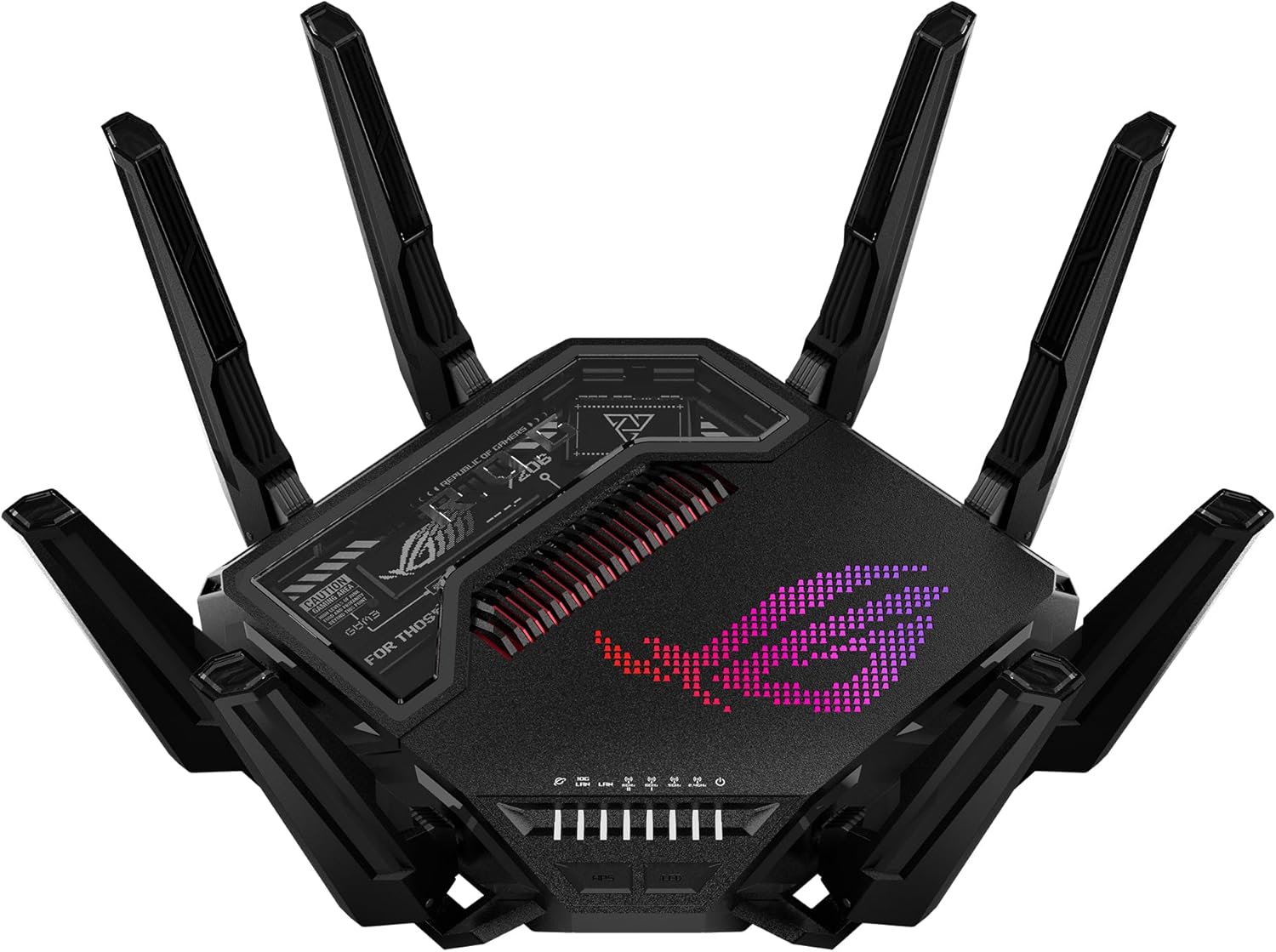
Pros
- Designed with Beyond-fast WiFi 7 802.11be with new 320MHz channels in the for reliable daily operation
- Designed with Multi-link Operation links to multiple bands at the same time for reliable daily operation
- Designed with Cutting-edge external dual-feeding antennas boost coverage by providing high efficiency for reliable daily operation
Cons
- Positioning near central open spaces is recommended for optimal wireless coverage
- Requires pairing with compatible internet service provider modems or gateways
- Note placement considerations for batch 9161

Pros
- 4804 Mbps available on 5 GHz thanks to a four-stream HE160 radio, alongside 574 Mbps on 2.4 GHz
- Six external antennas driven by high-power front-end modules push usable signal into far bedrooms and kitchens
- OFDMA and MU-MIMO together quadruple average throughput when dozens of devices are active at once
- A USB 3.0 port turns an external drive into shared media storage or a private cloud without extra hardware
- OneMesh support lets a compatible extender join as one roaming network rather than appearing as a second name
Cons
- All WAN and LAN ports are Gigabit, so a 2 Gbps fibre plan cannot be used anywhere near its full speed
- The included security suite covers basic scanning and parental controls, with the advanced tier behind a subscription
- Rated for 0 to 40 degrees Celsius operation, so an unventilated cupboard in summer can push it beyond spec
The AX5400 figure breaks down as 4804 Mbps on 5 GHz plus 574 Mbps on 2.4 GHz. The 5 GHz side uses a four-transmit, four-receive arrangement with 160 MHz channel width, which is what produces the high number.
- Six antennas plus beamforming concentrate signal towards each connected device
- High-power front-end modules boost transmit strength within regulatory limits
- OFDMA lets one transmission carry data for several devices at once
- MU-MIMO serves multiple clients simultaneously rather than in sequence
- A large vented top surface, 167 square centimetres of it, keeps the radios from throttling
Real-world coverage in a three-bedroom house is typically strong throughout, with 2.4 GHz reaching a garage or garden. The 160 MHz channels that produce the headline speed are also the ones most likely to clash with radar detection outdoors, so speeds vary by location.

Pros
- 1.8 GHz quad-core processor keeps NAT and QoS from bottlenecking a gigabit fibre line
- A 2.5 Gbps LAN port sits alongside the gigabit ports, ready for multi-gig switches and network cards
- Tri-band layout lets one entire 5 GHz radio be reserved for consoles and PCs only
- Eight external antennas can be angled per floor rather than sealed inside the shell
- AiMesh support means it can adopt other compatible units as satellites instead of being replaced
Cons
- Wi-Fi 6 only, so newer 6E and 7 clients fall back to the 5 GHz bands and gain nothing from a 6 GHz radio
- The eight-antenna chassis needs open shelf space and cannot be hidden in a cupboard without hurting coverage
- Powered by a 19 V 3.42 A external brick rather than a slim inline supply
Three radios split the load: a 2.4 GHz band for smart plugs and older phones, and two 5 GHz bands. The second 5 GHz band can be walled off for gaming so a 4K stream in another room never competes with your session.
- Eight external antennas give directional control, which matters across floors more than across open plan rooms
- Dynamic frequency selection opens extra 5 GHz channels where neighbouring networks are crowded
- The 2.5 Gbps port is the one to feed a multi-gig switch or a workstation network card
In a typical three-bedroom house it works as a single hub. In a long or stone-walled property, plan on adding an AiMesh node rather than expecting one unit to blanket everything.
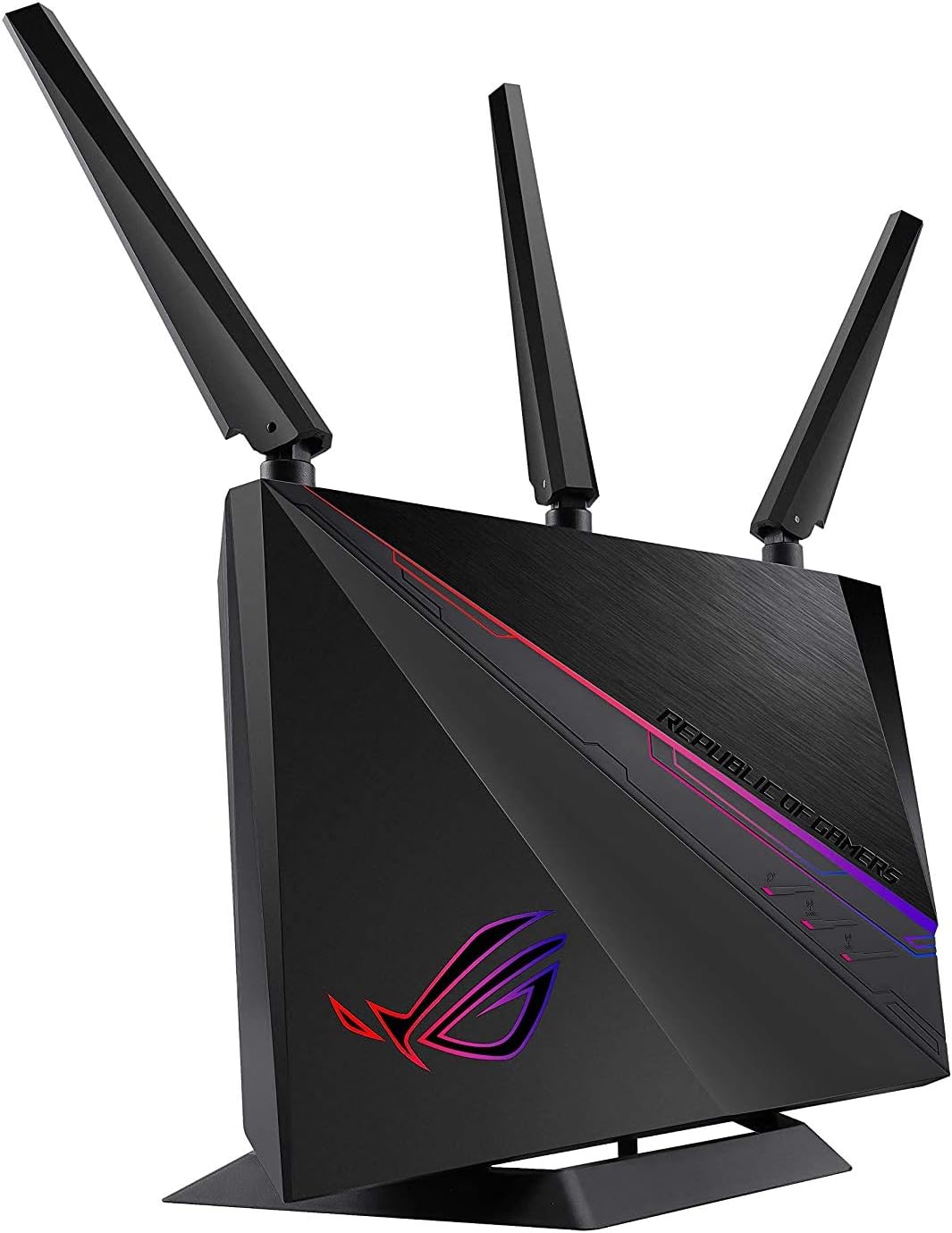
Pros
- Triple-level game acceleration prioritises game packets from the device, through the router and out towards the game server
- Listed as a GeForce NOW recommended router, aimed at cloud gaming sessions where latency matters more than raw throughput
- AiMesh teams it with other compatible ASUS units to form one roaming network instead of separate network names
- AiProtection Pro from Trend Micro is included for the life of the unit with no separate plan required
- Aura RGB lighting can be configured to reflect network status rather than only cycle colours
Cons
- 802.11ac dual-band rather than Wi-Fi 6, so there is no OFDMA and none of the airtime efficiency newer clients expect
- Gigabit WAN and LAN ports only, which caps any multi-gigabit internet plan
- No modem inside, so a separate cable modem or fibre ONT is still required

Pros
- Rated up to 5400 Mbps combined throughput on WiFi 6 with 160MHz channel support
- 1.5GHz tri-core processor handles simultaneous device traffic without a separate mesh node
- One of the 4 Gigabit LAN ports is hardwired to auto-prioritize gaming traffic
- AiMesh compatibility lets you add another ASUS router later to erase dead zones instead of replacing the whole setup
- Includes lifetime AiProtection Pro network security powered by Trend Micro, no separate subscription needed for that layer
Cons
- Wired ports are standard Gigabit Ethernet, not multi-gig, so pairing with a 2.5Gbps+ ISP plan requires an additional switch to use the full line speed
- Instant Guard VPN and AiProtection Pro run through the ASUS Router app, so setup outside the app is not offered
- Dual-band only (2.4GHz/5GHz), with no dedicated 6GHz WiFi 6E band for the newest client devices
The RT-AX82U is built on WiFi 6 (802.11ax) with 160MHz channel support, rated for combined dual-band speeds up to 5400 Mbps. A 1.5GHz tri-core processor manages the radios and handles multiple simultaneous device connections without the router becoming the bottleneck.
- Dual-band 2.4GHz and 5GHz radios, no 6GHz WiFi 6E band
- 160MHz channels for higher peak throughput on supported client devices
- AiMesh support extends coverage by adding compatible ASUS routers as nodes
Actual throughput and range depend on building materials, interference, and how many devices are connected at once, so real-world speeds will sit below the rated maximum.

Pros
- Total bandwidth of 6.5 Gbps across 2.4GHz and 5GHz bands with 6 spatial streams
- Two 2.5 Gbps ports (WAN/LAN and LAN) plus three 1 Gbps LAN ports
- Rated coverage up to 2,400 sq ft and 90 simultaneously connected devices
- USB 3.0 port for network-attached storage or printer sharing
- WPA3 encryption plus a separate managed network for IoT devices
Cons
- Dual-band design only, with no dedicated 6GHz band despite the Wi-Fi 7 label
- Full 5764 Mbps and 6.5 Gbps figures are only reached with Wi-Fi 7 client devices; older phones and laptops connect at lower legacy speeds
- Deeper security scanning and remote management run through the cloud-connected Tether app rather than working fully offline
This dual-band Wi-Fi 7 router combines a 5764 Mbps 5GHz band with a 688 Mbps 2.4GHz band for 6.5 Gbps of combined bandwidth across 6 spatial streams.
- Rated coverage of up to 2,400 sq ft with 6 external antennas and beamforming
- Supports up to 90 simultaneously connected devices
- Multi-Link Operation combines both bands for lower latency on supported clients
Because this is a dual-band design rather than tri-band, there is no dedicated 6GHz lane; devices without Wi-Fi 7 support fall back to standard 5GHz or 2.4GHz speeds rather than the peak combined figure. For a typical single-floor or small two-floor home, the antenna layout and beamforming keep signal consistent across rooms, though a very large multi-floor house may still benefit from a mesh add-on at the edges of the stated coverage area.

Pros
- Dual 2.5G WAN/LAN ports carry wired traffic at more than double the throughput of standard Gigabit ports
- 2.0GHz quad-core CPU handles simultaneous QoS, VPN, and traffic prioritization without a separate router
- AiMesh compatibility lets it extend coverage with other ASUS routers instead of needing a matched mesh kit
- 160MHz channel support on WiFi 6 raises the theoretical throughput ceiling versus 80MHz-limited routers
Cons
- Dual-band only, without a dedicated tri-band backhaul channel for mesh setups under heavy load
- Actual data throughput varies with building materials and network traffic, so rated speeds are a ceiling, not a guarantee
- External power brick rated at 19-19.5V adds another component to route and hide near the router
WiFi 6 dual-band speeds are rated up to 6000 Mbps combined, supported by 160MHz channel width for higher per-connection throughput than routers limited to 80MHz channels.
- Wireless speed: up to 6000 Mbps combined across both bands.
- Channel width: 160MHz channels raise the throughput ceiling versus standard 80MHz support.
- Processor: a 2.0GHz quad-core CPU handles simultaneous traffic prioritization tasks without slowing down.
As with any wireless router, real-world speeds depend on building materials, distance, and network congestion, so the figures above represent a best-case ceiling rather than a guaranteed result in every home.

Pros
- High-efficiency WiFi 6 – Ultrafast WiFi 6 tri-band boosts speeds up
- Expanded coverage – Exclusive ASUS RangeBoost Plus improves signal
- Flexible networking ports – One 2.5 G port and one 10 G port can be
- Extreme quad-core CPU power – High-performance WiFi chipsets and

Pros
- WiFi 6 (802.11ax) with speeds up to 5400 Mbps
- New-generation WiFi 6 - Enjoy ultrafast speeds up to 5400 Mbps with the latest WiFi 6 (802.11ax) and
- Commercial-grade home network security – Lifetime free ASUS AiProtection Pro, powered by Trend Micro
- Supports mesh networking with AiMesh
- Lifetime free AiProtection Pro security
Cons
- Some customers reported build quality or durability issues in reviews
- Refurbished product may show cosmetic wear or missing original packaging

Pros
- AX5400 WiFi 6 speeds with 160 MHz channels for 5 Gbps throughput
- Gaming Port with Gear Accelerator optimizes traffic for console and PC gaming
- VPN Fusion allows simultaneous VPN and standard connection without speed loss
- Subscription-free security with Instant Guard and AiProtection Pro
Cons
- Advanced features require learning router admin interface and setup process
- Large antenna design takes up significant desk or shelf space in room
What “RGB” Actually Means on a Gaming Router
On most routers in this category, RGB isn’t a single static light — it’s a set of addressable zones you control through a companion app, usually ASUS Aura Sync. You can dim the lighting, sync colors with your PC case and peripherals, or set it to pulse when a game console pulls a strong connection.
Beyond looks, the lighting layer often doubles as a status indicator, flashing differently for a weak signal, an active VPN connection, or a firmware update in progress. That’s worth knowing before you buy, since a router with basic RGB but no real software control usually means you’re stuck with one fixed pattern and no way to turn it off for a dark bedroom setup.
How We Compared These RGB Wi-Fi Routers
Lighting is the theme, but it isn’t the deciding factor. We weighed a handful of practical criteria against each other so the picks below actually hold up as gaming routers first.
- Wi-Fi standard (AX or WiFi 7) and whether the CPU can handle a busy household without lag spikes.
- Quality of the RGB software: adjustable zones and sync options versus a single fixed color.
- Port speed and WAN aggregation for households with fast internet plans.
- Price relative to features, since a flashy router isn’t worth it if the throughput doesn’t match the cost.
- Owner rating and review volume as a signal of long-term reliability.
Best RGB Routers for Every Kind of Setup
There’s no single “best” pick for every household, so the list below is organized by the situation each router solves best. Match your budget, room count, and how much the lighting matters to you.
Best Overall RGB Router: ASUS ROG Rapture GT-AX11000
The ASUS ROG Rapture GT-AX11000 earns the top spot with a 4.5-star rating across nearly 3,500 reviews, which is the kind of track record you want before trusting a router to run your whole network. Its tri-band 10-gigabit design, quad-core CPU, and 2.5G port give it real headroom for gaming, streaming, and video calls happening at once.
The Aura RGB ring around the base syncs with other ASUS components through Armoury Crate, and it’s genuinely adjustable rather than a single stuck-on color. If you want one router that covers both performance and the lighting this category promises, start here.
Best WiFi 7 RGB Flagship: ASUS ROG Rapture GT-BE98 PRO
For households ready to move to WiFi 7, the ASUS ROG Rapture GT-BE98 PRO is a quad-band router built for 320MHz channels and dual 10G ports, aimed at multi-gig internet plans and serious multi-device gaming setups. It’s the most expensive router on this list, and it’s worth flagging that this listing is a renewed unit with a small review count so far.
That trade-off matters: if you want the newest standard and the fastest theoretical speeds, it’s a strong option, but buyers who prefer a longer track record of reviews may feel more confident with the GT-AX11000 above.
Best Mid-Range RGB Pick: ASUS ROG Rapture GT-AX11000 Pro
Sitting between flagship and budget, the ASUS ROG Rapture GT-AX11000 Pro pairs a 10G port with a 2.5G port and RangeBoost Plus antennas for better range in larger homes. With a 4.4 rating across nearly 600 reviews, it’s a reasonable step up for anyone outgrowing an entry-level router without paying flagship prices.
It also includes subscription-free network security, so you’re not stuck paying an annual fee just to keep basic protections active.
Best for Multi-Device Households: ASUS ROG Rapture GT-AX6000
If your home runs a console, a gaming PC, several laptops, and a stack of smart home gear at once, the ASUS ROG Rapture GT-AX6000 is built for that load. Dual 2.5G WAN/LAN ports and WAN aggregation let it combine bandwidth from two connections, which is unusual at this level.
Its quad-core 2.0GHz processor keeps things responsive even when several devices are streaming and downloading simultaneously, and AiMesh compatibility means you can extend coverage later without replacing the whole setup.
Best Value RGB Router: ASUS ROG Strix GS-AX5400
The ASUS ROG Strix GS-AX5400 brings a dedicated gaming port, mobile game mode, and Aura RGB into a package that undercuts most of the flagship models here. VPN Fusion support is a nice extra if you want to route specific devices through a VPN without slowing your whole network.
It won’t match the raw throughput of the 10-gigabit models, but for a mid-size home with one or two gamers, it’s a well-rounded pick that doesn’t ask you to compromise much.
Best Budget RGB Pick: ASUS RT-AX82U (Renewed)
The ASUS RT-AX82U renewed listing brings AX5400 speeds, mobile game boost, and Aura RGB down to, making it the most accessible RGB gaming router in this roundup. It’s also backed by over 400 reviews at a 4.4 rating, which is solid for a renewed product.
Just keep in mind renewed units typically ship without original retail packaging and sometimes carry a shorter warranty window than new stock, so confirm the seller’s return policy before you buy.
Best Non-RGB Alternative if Lighting Isn’t a Priority: TP-Link Archer AX73
Not everyone wants a light show on their entertainment center, and that’s a completely reasonable stance. The TP-Link Archer AX73 skips RGB entirely and focuses on dual-band WiFi 6 speed, long-range coverage, and a price backed by an enormous 8,674 reviews at 4.5 stars.
We’re including it here because plenty of shoppers land on “RGB router” searches while really just wanting a modern gaming-capable router, and this one earns its keep on reliability alone.
Aura Sync and RGB Control: What to Expect Out of the Box
Most ASUS routers on this list use Armoury Crate or the ASUS Router app to manage lighting, letting you pick a static color, a slow breathing effect, or full sync with compatible motherboards, GPUs, and peripherals. You can also just turn it off completely, which matters if the router lives in a bedroom.
Setup is usually a few taps in the app rather than anything technical, but it’s worth checking during your return window that the lighting controls actually work as advertised, since firmware updates occasionally change what’s available.
Common Mistakes to Avoid When Buying an RGB Gaming Router
A router that looks great on your desk is only useful if the network underneath it actually performs, so watch out for these pitfalls.
- Buying for looks alone. Check the Wi-Fi standard and port speeds before assuming a flashy design means fast performance.
- Ignoring renewed listings’ review counts. A low number of reviews on a renewed unit isn’t disqualifying, but it’s worth weighing against a better-reviewed alternative at a similar price.
- Overpaying for WiFi 7 on a slower internet plan. If your provider caps out well under a gigabit, a WiFi 6 router will feel just as fast day to day.
- Assuming RGB software will work with non-ASUS gear. Full Aura Sync compatibility usually requires other ASUS-branded components.
- Skipping firmware updates. Security patches and stability fixes often ship well after launch, so update before trusting the router with your whole home network.
Who Should (and Shouldn’t) Buy an RGB Router
RGB routers make the most sense if you already run a themed gaming setup, want a router that visually fits with your PC and peripherals, or simply like the extra visual feedback on network status. Gamers chasing the lowest possible latency should also look at our best routers for gaming guide, since several of the same models show up there for their performance rather than their lighting.
If you’re working with a tighter budget and don’t care about the glow, a well-reviewed non-RGB router will usually save you money without costing you speed — our best routers under $200 roundup covers several strong options in that range, RGB or not.
RGB Routers vs. Standard Gaming Routers
Strip away the lighting and an RGB router is, functionally, the same hardware category as any other gaming router: Wi-Fi standard, CPU, ports, and antenna design still do the heavy lifting. The RGB layer adds a software and hardware cost that manufacturers usually offset by bundling it into their higher-tier gaming lines.
If your home has dead zones a single router can’t reach regardless of how it lights up, it’s worth comparing against a mesh setup instead — our best mesh routers guide breaks down systems built specifically for larger or multi-story homes. And if you want a VPN client built in rather than added later, see our best routers with VPN picks for models designed around that use case.
Frequently Asked Questions
Does RGB lighting slow down a router’s Wi-Fi performance?
No. The lighting runs on a separate low-power circuit and has no measurable effect on Wi-Fi speed, latency, or range. Performance depends on the Wi-Fi standard, CPU, and antenna design instead.
Can I turn off the RGB lighting on these routers?
Yes, on every ASUS model listed here you can dim or fully disable the lighting through the Armoury Crate or ASUS Router app, which is useful if the router sits in a bedroom.
Do I need other ASUS products for Aura Sync to work?
Full cross-device syncing generally requires other Aura Sync-compatible ASUS or partner components. Without them, the router’s RGB still works on its own, just not synced to the rest of your setup.
Are renewed RGB routers a safe option?
Often yes, especially from reputable renewed programs, but check the review count and return window carefully. A renewed unit with limited reviews carries more uncertainty than a widely reviewed new model at a similar price.
Is a WiFi 7 RGB router worth it over WiFi 6 right now?
Only if your internet plan and devices can actually use the extra bandwidth. For most households on standard gigabit plans, a well-reviewed WiFi 6 RGB router delivers nearly the same real-world experience for less money.
Whichever pick fits your setup, take a few minutes to check the current price on Amazon and compare it against your router’s replacement cycle, since pricing on this category shifts often and today’s standout pick may not last. A router that matches your space, your device count, and how much lighting you actually want will outlast whatever’s trending this month.


