 Ryan Delgado
 Best Interconnected Smoke Detectors: A Complete Buying Guide
When it comes to protecting your home and family, few upgrades matter as much as choosing the best interconnected smoke detectors. Unlike standalone units that only sound where the smoke is detected, interconnected alarms all trigger together the moment one senses danger. That means if a fire starts in the basement at night, the alarm in your upstairs bedroom will wake you up in time. This guide walks you through everything you need to know before you buy, so you can make a confident, informed decision.
Below is a curated list of top-rated interconnected smoke detectors currently available, giving you a quick overview of trusted options across hardwired and wireless categories.

Pros
- 120 V AC power with a 9 V battery backup for outage coverage
- 85 decibel horn, loud enough to wake sleepers through a closed door
- Interconnects with compatible hardwired alarms so one detection sounds all
- Latching indicator identifies which unit triggered after the air clears
- Side-load battery drawer swaps the cell without dismounting the alarm
Cons
- Ionization sensing reacts more slowly than photoelectric to smouldering fires
- Needs a 120 V junction box, so it is not a swap for a battery-only alarm
- Detects smoke only, so carbon monoxide needs separate alarms entirely
This alarm runs on 120 volt AC household power with a 9 V battery backup, so it needs an existing junction box and a supply cable at the ceiling. It is not a drop-in swap for a battery-only alarm unless that wiring is already run.
- Universal mounting bracket twists onto the box, with no gasket to align
- Tamper-resistant locking pins hold the alarm to the bracket
- Side-load battery drawer opens without taking the alarm down
Get the neutral connection solid. A loose white conductor in the junction box is the single most common cause of odd behaviour and phantom chirps across hardwired alarms. If the run also serves other alarms, keep the interconnect conductor separate from the hot and neutral pair and cap it properly at every unit.
Detection uses an ionization sensor, which reacts quickly to the small particles thrown off by fast flaming fires such as burning paper, kindling or cooking oil. The horn sounds at 85 decibels, the level used across residential alarms and loud enough to wake most sleepers through a closed bedroom door.
- Tested to UL standards for residential smoke alarms
- Latching indicator marks which unit first detected smoke
- A single button handles both testing and silencing
The trade-off is well documented: ionization sensors respond more slowly than photoelectric ones to slow, smouldering fires such as a cigarette in upholstery. Many households cover both by mixing sensor types across the property rather than relying on one technology throughout.
One alarm is not a plan. Fire services advise one on every level of the home and inside each bedroom, plus the hallway serving them, which means most houses need several units linked together on the same circuit.
- Interconnect with compatible BRK and First Alert hardwired alarms so one detection sounds all
- Keep each unit at least 10 feet from a stove to cut nuisance alarms
- Mount on the ceiling, or high on a wall within 10 inches of the ceiling
Smoke alarms do not detect carbon monoxide. If you burn gas, oil or wood anywhere on the property you need separate CO alarms as well. Allow for a 9 V cell per unit per year, test monthly with the button, and replace the whole alarm once its end-of-life chirp starts.

Pros
- Six hardwired alarms, enough for each bedroom plus every level of a typical house
- 85 decibel horn sounding the T3 temporal fire pattern
- 120 V supply with 9 V backup keeps monitoring through an outage
- Interconnects across the chain so one detection sounds every unit
- Battery drawer opens from the side without dismounting any alarm
Cons
- Ionization sensing only, slower on smouldering fires than photoelectric units
- Every location needs a 120 V box and a solid neutral, and a loose white conductor causes faults
- Six 9 V backup cells to change annually, and no carbon monoxide detection at all
Each alarm in this six-pack runs on 120 volt AC with a 9 V battery backup and joins the others on a shared interconnect conductor, so smoke found in the basement sounds the horn in every bedroom upstairs.
- Universal bracket and locking pins at each mounting point
- Confirm wiring polarity at every box before energising the circuit
- A loose neutral anywhere on the run can make a unit misbehave
A contractor pack exists because whole-house wiring is done once, on one visit, with matching alarms. Mixing brands on an interconnect line is where trouble usually starts, so keep the whole chain to compatible BRK and First Alert units. The side-loading battery drawer means annual cell changes across six alarms never involve taking one off the ceiling.
Six units is the number that covers a typical family house: one inside each bedroom, one in the hallway serving them, and one on each level including the basement.
- Ceiling mounting is preferred, or high on a wall within 10 inches of the ceiling
- Keep at least 10 feet from a stove or oven to reduce cooking trips
- Avoid bathrooms, draughty vents and unheated attics where humidity and dust cause faults
Each alarm is 5.6 in across and 1.9 in deep, so it protrudes modestly from a flat ceiling. Plan the interconnect run before drilling, since retrofitting the third conductor afterwards means opening ceilings twice. Stairwells count as a level and are one of the first places smoke travels.
An 85 decibel horn sounding the T3 temporal pattern is the standard fire signal: three beeps, pause, repeat. Learning that pattern matters in a house that also has carbon monoxide alarms, which use a different four-beep cadence.
- Press the test button on each unit monthly
- Change the 9 V backup cell in every alarm once a year
- The latching indicator shows which unit triggered, even after the air clears
Smoke alarms have a service life and an end-of-life chirp that tells you when it is up, because the sensor degrades whether or not it has ever seen smoke. These detect smoke only. Carbon monoxide needs separate alarms, and those carry a shorter replacement interval of roughly five to seven years.

Pros
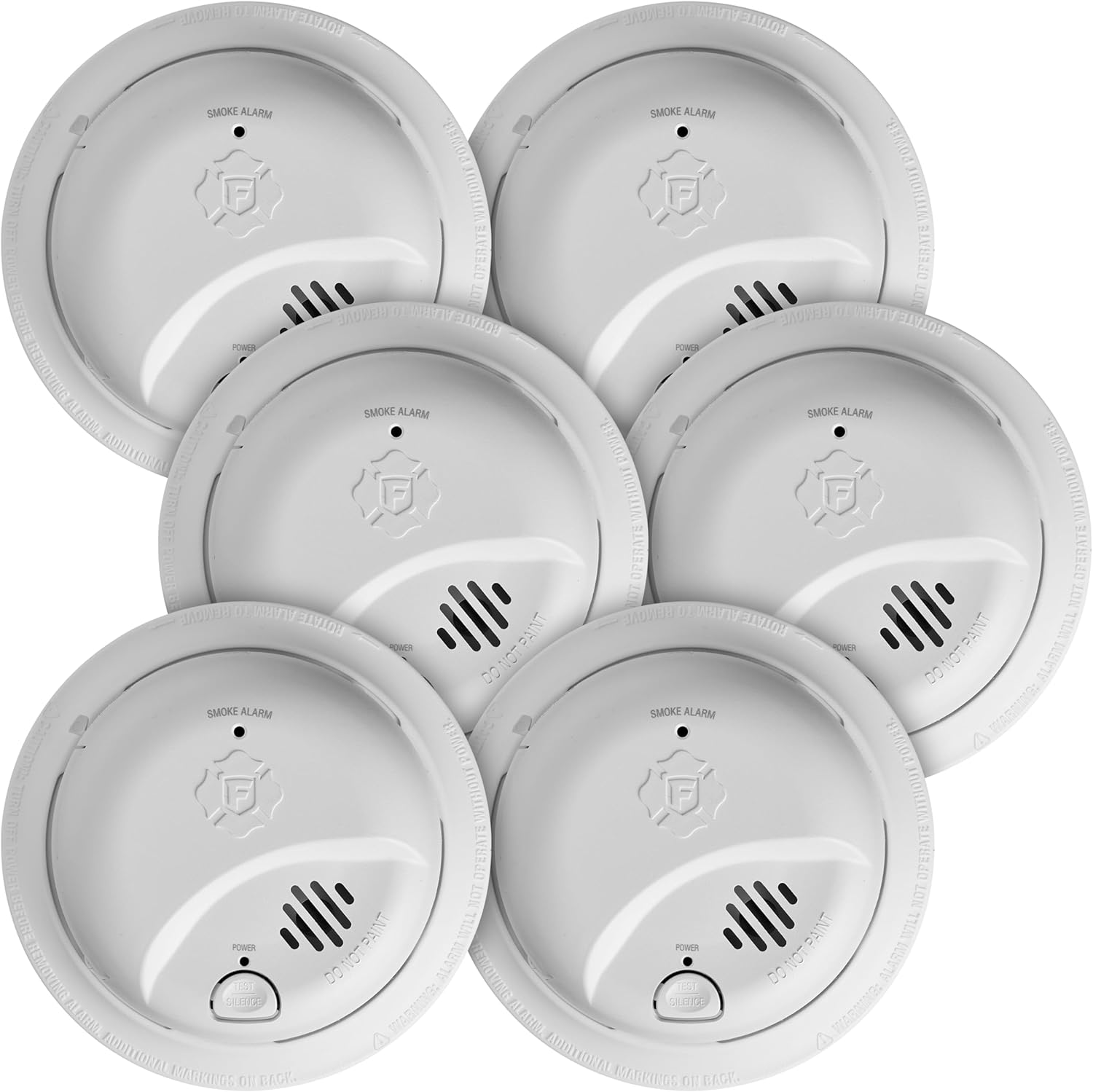
- 6 pack of hardwired smoke alarms, includes battery backup for power
- Tamper resistant locking pins, single button silence/test and loud
- 120-Volt AC power with 9-volt battery backup (included) to keep
- Open mounting design for easy installation with side load battery
- Dimensions of 2.2"D x 5.6"W x 5.6"H engineered for optimal spatial fitting
Cons
- Requires verifying placement clearance for 2.2"D x 5.6"W x 5.6"H prior to installation
- Best placed in well ventilated indoor spaces away from excess moisture
The FirstAlert First Alert BRK SMI100-AC Hardwired Smoke Detector with offers a refined combination of structural durability and user convenience for Smoke Detectors & Fire Alarms setups. Key physical design elements prioritize user comfort through 6 pack of hardwired smoke alarms, includes battery backup for power outages. Equipped with Tamper resistant locking pins, single button silence/test and loud 85Db alarm, the hardware delivers reliable structural support under regular demands. Measurements of 2.2"D x 5.6"W x 5.6"H provide clear dimensional boundaries for precise space planning. User centered design choices streamline routine interactions and enhance practical convenience.
Component assessment indicates careful selection of durable materials tailored for active usage. Key structural features including 120-Volt AC power with 9-volt battery backup (included) to keep alarm functioning during power outage support overall longevity during regular operational cycles. Careful manufacturing ensures that frame connections retain rigidity over long term use. User centered design choices streamline routine interactions and enhance practical convenience. Robust physical construction provides verified peace of mind during heavy daily usage. Thoughtful spatial layout allows versatile placement across modern living environments. Dependable hardware performance ensures consistent operational output throughout the year. Precision engineering delivers a stable foundation tailored for active household demands.
Preserving structural integrity over extended service life is achieved through consistent daily care. Attributes like Open mounting design for easy installation with side load battery compartment for quick replacement and interconnect able up to 18 units (12 smoke, 6 co/heat/relay) allow hassle-free integration into existing room configurations. Preventing prolonged exposure to harsh environmental factors helps preserve original finish quality. User centered design choices streamline routine interactions and enhance practical convenience. Robust physical construction provides verified peace of mind during heavy daily usage. Thoughtful spatial layout allows versatile placement across modern living environments. Dependable hardware performance ensures consistent operational output throughout the year.
Pros
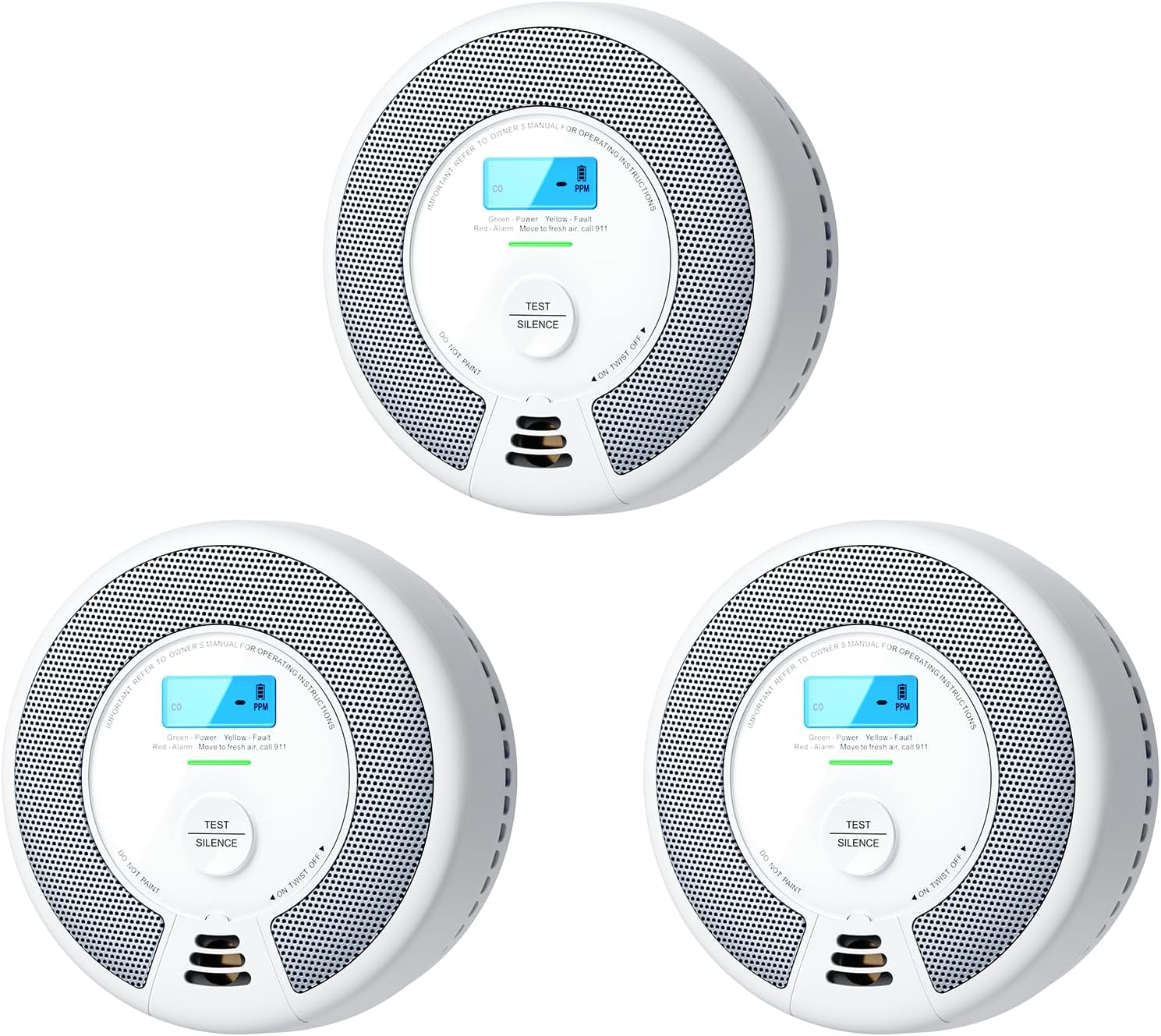
- Sealed lithium cell is specified for 10 years, so there are no yearly 9V swaps or 3am low-battery chirps
- Photoelectric smoke chamber reacts sooner to smouldering fires and shrugs off most cooking steam
- Certified to UL 217 Ed.9 and UL 2034 Ed.5, the standards written into most US fire codes
- LCD panel shows live carbon monoxide concentration instead of only sounding at a threshold
- Each 5.7 in disc is 2 in deep and mounts to wall or ceiling with the supplied bracket, screws and anchors
Cons
- Standalone units only, with no RF interconnection, so one alarm sounding will not wake the other two
- No Wi-Fi, hub or app, so there is no phone alert when the house is empty
- The whole unit is replaced at end of life because the 10-year cell is sealed inside
Three units in a pack usually means one per sleeping level plus the hallway outside the bedrooms, which is the layout most US codes describe.
- Ceiling mounting works best for smoke, at least 4 in away from any wall
- Wall mounting should sit 4 to 12 in below the ceiling line
- Keep the alarm at least 10 ft from a cooker to cut nuisance alarms
- Avoid bathrooms, unheated garages and spots directly under ceiling fans or vents
Carbon monoxide mixes fairly evenly through room air, so the same positions serve both sensors in this combo unit. Each detector is a 5.7 in disc standing 2 in off the surface, small enough not to dominate a hallway ceiling.
These are battery units, not hardwired ones, so no circuit work or electrician is involved.
- The bracket, screws and wall plugs are supplied in the box
- Mark two holes, drill, plug, screw the bracket, then twist the alarm onto it
- Press the test button once mounted to confirm the sounder and LCD respond
- Nothing needs pairing, since this model has no radio and no app
Maintenance over the decade is limited to a monthly test press and vacuuming dust off the vents a couple of times a year. There is no battery drawer, no compartment latch and no interconnect wire, which is the trade for the sealed 10-year cell. If you later want alarms that trigger together, the interconnected SC07-W is the model to look for.
Certification is to UL 217 Edition 9 for smoke and UL 2034 Edition 5 for carbon monoxide, tested independently rather than self-declared. Clear markings on the housing help when an inspector checks a property.
- The photoelectric chamber is tuned for smouldering fires, while ionisation types react faster to flaming fires with little smoke
- Electrochemical CO sensing has a finite service life, which is why the unit is dated for a decade
- Heat-resistant polycarbonate housing, 5.7 in across and 2 in deep
Neither sensor detects natural gas, propane or heat alone, so a fuel-gas leak still needs a separate detector. Treat the end-of-life chirp as a hard replacement date rather than a suggestion, because the cell and the CO sensor reach the end of their service life together.
Pros
- Interconnects with compatible hardwired alarms, so one triggered unit sounds the whole set
- Includes battery backup, keeping detection active during a power outage
- Quick Connect Plug lets you swap out an existing hardwired alarm without rewiring the ceiling box
- Alarm indicator light shows exactly which unit in the house triggered the alert
- Sold as a 6-pack, enough to cover a full home's bedrooms, hallways, and common areas
Cons
- Requires an existing hardwired smoke alarm circuit; it is not a battery-only standalone unit for homes without that wiring
- Interconnect only works with alarms built for a compatible interconnect system, not universally with other brands
- Backup batteries still need periodic replacement even though the unit is primarily AC powered
These alarms use Precision Detection sensing to reduce false alarms triggered by cooking smoke while still responding to genuine fire conditions. When one alarm in an interconnected set detects smoke, every compatible alarm in the home sounds together, rather than relying on a single unit near the fire to wake the household.
An alarm indicator light on each unit identifies which specific alarm triggered first, which speeds up locating the source of smoke or fire in a multi-alarm home. The 6-pack count is sized for covering bedrooms, hallways, and common living spaces in a typical single-family home in one order.
Each alarm is designed to replace an existing hardwired smoke alarm using a Quick Connect Plug, so there is no need to cut into ceiling wiring or rewire the junction box. Installation is essentially a swap: remove the old alarm, plug the new one into the existing harness, and mount it in place.
A battery backup keeps the alarm functioning during power outages, so protection does not lapse if the household loses electricity. Because these units depend on the home's existing hardwire interconnect circuit, they are not a fit for houses without that wiring already in place; battery-only standalone alarms would be needed instead.
With six alarms in the box, this set is sized to interconnect across a full house — bedrooms, hallway, and living areas — so that smoke detected anywhere triggers every alarm in the network. This is a meaningfully wider coverage approach than installing single standalone alarms room by room.
The alarms are built to meet current industry sensing standards for reduced cooking-related nuisance alarms. Since compatibility depends on all interconnected units coming from the same interconnect-compatible lineup, mixing in older or different-brand alarms on the same circuit is not guaranteed to work as a set.

Pros
- Please Note: SC01 is a basic standalone unit; it does not support
- 10-Year Sealed Battery (Not AC Hardwired): Contains a long-life
- 2-in-1 Protection: This combination detector protects your family
- Simple Installation: Requires no rewiring; easy to mount this fire
- Dimensions of 5.7"D x 5.7"W x 2"H engineered for optimal spatial fitting
Cons
- Requires verifying placement clearance for 5.7"D x 5.7"W x 2"H prior to installation
- Requires gentle maintenance routines to preserve the Heat-Resistant PC Material finish
The X-Sense X-Sense Smoke Detector and Carbon Monoxide Detector SC01 offers a refined combination of structural durability and user convenience for Combination Smoke & Carbon Monoxide Detectors setups. Daily usage reveals robust utility supported by Please Note: SC01 is a basic standalone unit; it does not support wireless interconnection, does not have Wi-Fi, and cannot be used with a base station; for interconnection, search for SC01-W. Complementing its primary framework, the design also incorporates 10-Year Sealed Battery (Not AC Hardwired): Contains a long-life lithium battery that powers the device for its entire 10-year life to optimize routine handling. Measurements of 5.7"D x 5.7"W x 2"H provide clear dimensional boundaries for precise space planning.
Focusing on material selection, this hardware is constructed to resist ongoing physical fatigue. Reinforced internal elements like 2-in-1 Protection: This combination detector protects your family against two dangers-both smoke and carbon monoxide; tested and certified to meet UL 217 and UL 2034 safety standards maintain steady operational balance under continuous use. Solid structural engineering allows the unit to maintain physical stability under load. Constructed using quality Heat-Resistant PC Material, outer surfaces withstand routine contact without losing visual appeal. Attention to manufacturing details ensures reliable utility for your Combination Smoke & Carbon Monoxide Detectors. Using proper installation techniques maintains physical stability across daily activities.
Maintaining optimal hardware conditions involves simple periodic inspection and spatial planning. Featuring Simple Installation: Requires no rewiring; easy to mount this fire and CO alarm on any wall or ceiling with the included mounting bracket, screws and anchor plugs, ongoing operation remains intuitive across varied household routines. Wiping surfaces periodically with a soft cloth prevents dust accumulation in functional crevices. Attention to manufacturing details ensures reliable utility for your Combination Smoke & Carbon Monoxide Detectors. Using proper installation techniques maintains physical stability across daily activities. This balanced configuration fits smoothly into existing interior designs while maximizing efficiency.
Pros
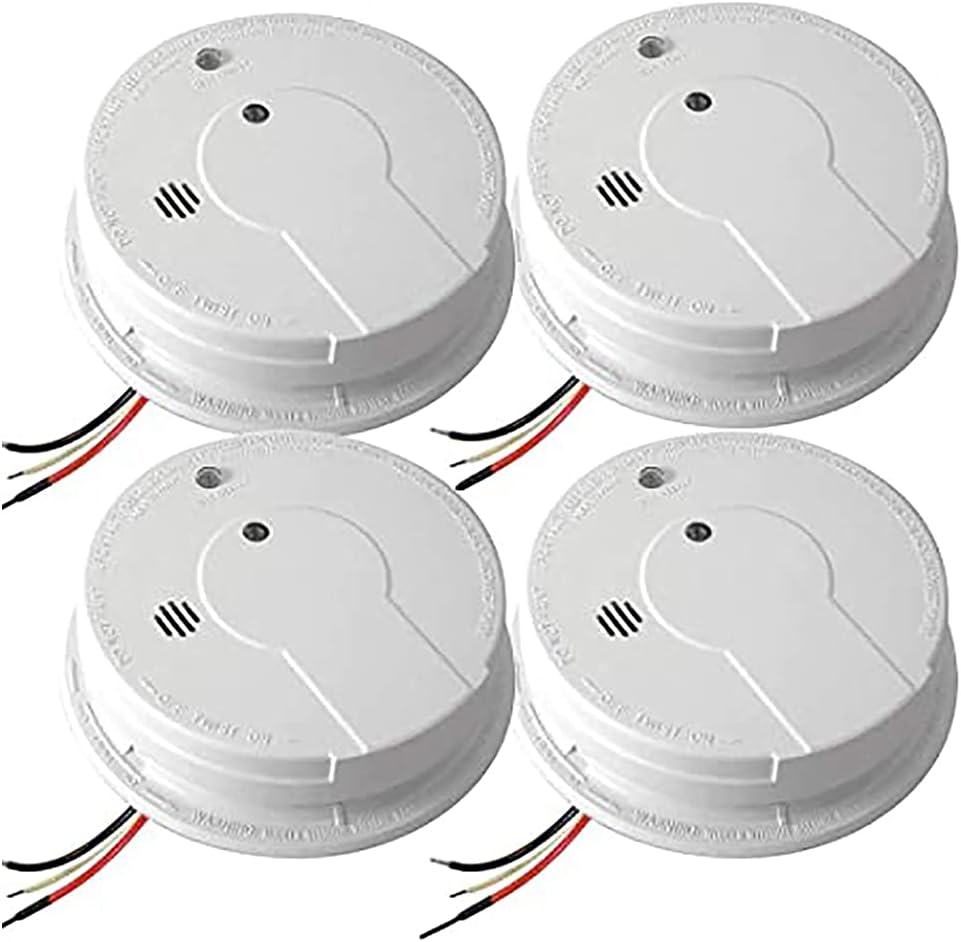
- Pack includes 4 hardwired units, enough to interconnect a small home so every alarm sounds together
- AC hardwired power draws directly from household wiring rather than relying solely on replaceable batteries
- Hush button temporarily silences nuisance alarms triggered by cooking smoke or steam without disabling the unit
- Compact housing profile sits flush against ceilings for a lower-visibility installation than bulkier alarm models
Cons
- AC hardwired installation requires accessing household wiring, so retrofitting into a home without existing alarm wiring calls for an electrician
- No smart or Wi-Fi connectivity is listed, so alerts stay local rather than reaching a phone when away from home
- Sold as a 4-unit pack only, which may be more or fewer alarms than a specific home's room count requires
This smoke alarm is powered by household AC wiring rather than batteries alone, which changes how it gets installed compared to a plug-in or fully battery unit.
- Hardwired AC power means the unit ties into an existing electrical circuit, typically requiring the power to be shut off during installation.
- The 4-unit pack is sized for interconnecting multiple rooms so every alarm sounds when one is triggered.
- A compact housing keeps the ceiling profile low and less obtrusive than older bulkier alarm designs.
Homes without existing hardwired smoke alarm wiring will likely need an electrician to run new circuits, which adds time beyond a simple swap of an existing unit.
Because these alarms interconnect, triggering one alarm sounds all units wired into the same circuit, which is useful for larger homes where a fire may start far from a bedroom.
- The 4-unit pack suits a small to mid-sized home with hallways, bedrooms and a kitchen area.
- Larger homes with more rooms or multiple floors will need to purchase additional interconnect-compatible units to cover every space.
- Interconnection relies on matching wiring compatibility, so mixing with older non-interconnect alarms is not straightforward.
Planning alarm placement room by room before purchase helps confirm whether a 4-unit pack covers the whole home or needs supplementing.
The hush feature is built to cut down on nuisance alarms without requiring the unit to be removed or disabled.
- Pressing the hush button temporarily silences an alarm triggered by cooking smoke, steam or similar false triggers.
- The alarm returns to normal monitoring automatically after the hush period ends, rather than staying muted.
- Regular testing is still recommended, since hush is a temporary silence rather than a sensitivity adjustment.
Because the listing does not specify smart alerts, checking alarm status still means being in the home to hear a hushed or active alarm.

Pros
- 10-year sealed lithium battery eliminates periodic battery swaps and low-battery chirps
- Wireless interconnection links up to 18 units across a range of up to 820 ft
- Dual sensors combine photoelectric smoke detection with electrochemical CO detection in one unit
- LCD display shows unit status directly on the device without needing a phone app
- Certified to UL 217 and UL 2034 safety standards for smoke and CO detection
Cons
- No Wi-Fi connectivity, so there are no phone push alerts when away from home; alarms only sound locally and across interconnected units
- Sealed 10-year battery cannot be replaced individually, so the entire unit is retired once the battery reaches end of life
- 6-pack interconnection tops out at 18 total units per network, which may not scale further for very large properties without a second network
Each SC07-W combines a photoelectric smoke sensor with an electrochemical CO sensor in one unit, and up to 18 X-Sense alarms can link together wirelessly across a range of roughly 820 ft.
- When any interconnected unit detects smoke or dangerous CO levels, every linked alarm sounds together
- Coverage extends across multi-story homes, basements, and detached garages within wireless range
- The photoelectric sensor responds quickly to slow-smoldering fires while helping reduce false alarms from cooking
Because this model supports wireless interconnection but not Wi-Fi, alerts stay local to the alarms themselves rather than reaching a phone when no one is home to hear them.
Installation does not require rewiring: each unit mounts to a wall or ceiling using the included mounting bracket, screws, and anchor plugs, matching the process used for standard battery-powered smoke alarms.
- An LCD display on each unit shows status information directly on the device
- The 6-pack gives enough units to cover a multi-bedroom home, with room to interconnect additional X-Sense alarms later up to the 18-unit limit
- No hardwiring or electrician visit is needed since the units run entirely on the sealed battery
Interconnection setup between units happens automatically once alarms are within wireless range of each other, without additional configuration steps beyond initial placement.
A built-in sealed lithium battery powers each alarm for 10 years without replacement, removing the need for regular battery swaps or dealing with low-battery chirps in the middle of the night.
- Certified to UL 217 and UL 2034 standards for smoke and carbon monoxide detection
- Certification markings on the unit support code-compliant installation checks
- Because the battery is sealed, the entire alarm is replaced as one unit once the 10-year service life ends rather than swapping a battery
This design trades any mid-life battery maintenance for a fixed, predictable full-unit replacement point roughly a decade after installation.

Pros
- Runs on 120 V AC house wiring with a 9 V battery backup that keeps working through outages
- Up to 12 units interconnect, so one triggered alarm sounds every other unit in the house at the same time
- Conforms to the UL 217 9th edition standard, the revision that tightened resistance to cooking smoke and steam false alarms
- Silence button mutes a nuisance alert for up to 10 hours instead of forcing you to pull the unit down
- Eight units in one pack covers a multi-storey home in a single install session
Cons
- Photoelectric smoke sensing only, with no carbon monoxide detection in this model
- Hardwiring needs a 120 V junction box at each position, so rooms without one require cable to be run
- Backup cells are replaceable 9 V batteries rather than sealed 10-year units, so they need periodic swapping
These are mains-powered alarms. Each unit connects to 120 V AC house wiring through a ceiling junction box, using a three-wire harness where the third conductor carries the interconnect signal between units.
- Up to 12 alarms can be linked, so a detector triggering in a basement wakes the bedrooms upstairs immediately
- Interconnection is the single biggest safety gain over standalone alarms, because it removes the chance of a fire being detected in a room nobody is in
- All units on the loop must share the same interconnect conductor for the linking to work
Switch off the circuit at the breaker before working, and where a room has no existing junction box, plan for an electrician to run the cable rather than improvising a supply.
The alarms conform to the UL 217 9th edition standard, the revision that specifically targets nuisance alerts. Sensors are tuned to tell real smoke apart from cooking fumes and bathroom steam, the two triggers responsible for most alarms being disabled by frustrated homeowners.
- Photoelectric sensing responds well to slow smouldering fires, the type that produces heavy smoke long before flames appear
- The silence button mutes an alert for up to 10 hours, covering a night without leaving the house unprotected permanently
- Low battery warnings can also be silenced overnight, so a chirping unit does not force a 3am ladder trip
An alarm that stays on the ceiling is worth far more than one taken down in irritation, which is exactly the problem the silence function exists to prevent.
Installed alarms still need attention. The test button on each unit should be pressed monthly, and on an interconnected system a single test should sound every other alarm in the house, which is also how you confirm the linking still works.
- Replace the 9 V backup batteries on a set schedule rather than waiting for the low-power chirp
- Vacuum dust from the vents a couple of times a year, since dust build-up is a common cause of unexplained alerts
- Note the manufacture date on each unit, because smoke alarms of every make have a service life measured in years and eventually need replacing
Remember these detect smoke only. A separate carbon monoxide alarm is still needed near fuel-burning appliances, boilers and attached garages.

Pros
- 3-pack lets you wirelessly interconnect units so one triggered alarm sounds all three at once
- 10-year sealed lithium battery removes the need for annual battery swaps, with a built-in low-battery warning
- Up to 18 Link+ devices total can be interlinked for whole-home coverage beyond just this 3-pack
- Certified to UL 217 and UL 2034 safety standards for combined smoke and CO detection
- Test/Silence button on any unit tests or quiets the entire interconnected group at once
Cons
- Uses RF wireless interconnection between units, not Wi-Fi, so there is no app or remote phone alert
- LED status indicators only, with no LCD screen for reading exact CO ppm levels at a glance
- Sealed 10-year battery cannot be replaced individually, so the entire unit is retired once the battery is due
Each unit in this 3-pack is a combined smoke and carbon monoxide detector, certified to UL 217 and UL 2034 safety standards. An 85 dB alarm sounds when either hazard is detected, paired with intuitive LED status indicators rather than an LCD readout for at-a-glance condition checks.
Power comes from a 10-year sealed lithium battery, which is not user-replaceable but removes the need for annual battery swaps and includes a built-in low-battery warning as it approaches end of life. The housing is built from heat-resistant PC material and measures 5.7 x 5.7 x 2 inches per unit.
- Combined smoke and CO detection, UL 217 and UL 2034 certified
- 85 dB alarm with LED status indicators
- 10-year sealed lithium battery
The SC06-W model supports wireless RF interconnection between units, meaning when one alarm in the 3-pack detects smoke or CO, all connected alarms sound together rather than only the unit that triggered. This is distinct from Wi-Fi: there is no internet connection, app, or remote phone alert tied to this interconnection feature.
Up to 18 Link+ devices total can be interlinked, so this 3-pack can be expanded with additional X-Sense Link+ compatible alarms for larger homes needing coverage across more rooms or floors. No rewiring is required for installation, and each unit mounts to a wall or ceiling using the included bracket, screws, and anchor plugs.
A 3-pack is generally suited to placing one detector on each sleeping level of a home plus a hallway location near bedrooms, matching common fire safety placement guidance for combined smoke and CO coverage. The wireless interconnection means an alarm triggered in a basement or garage-adjacent unit will also sound upstairs near sleeping areas.
- One detector per sleeping level plus hallway is a common layout
- Wireless interconnect links all three units without extra wiring
- Mounting bracket and hardware included for wall or ceiling install
Because there is no Wi-Fi or app connection, someone still needs to be within earshot of the alarms to respond, so this setup suits occupied homes rather than remote monitoring needs.
Why Interconnected Smoke Detectors Matter
A traditional smoke alarm protects only the room it sits in. In a real fire, seconds count, and smoke can spread faster than you might expect. Interconnected systems solve this problem by linking every alarm in your home into a single network. When one detects smoke or carbon monoxide, all of them sound at once, giving everyone in the household the earliest possible warning regardless of where they are sleeping or working.
The National Fire Protection Association has long recommended interconnected alarms for exactly this reason. For multi-story homes, larger floor plans, or households with children, elderly relatives, or heavy sleepers, this whole-home coverage can be the difference between a close call and a tragedy. If you are searching for the best interconnected smoke detectors, you are already making one of the smartest safety investments possible.
Types of Interconnected Smoke Detectors
Before comparing individual products, it helps to understand the two main ways these devices connect to one another.
Hardwired Interconnected Alarms
Hardwired systems link alarms through a physical wire running between them, usually installed during construction or a renovation. They draw power from your home’s electrical system and typically include a battery backup for outages. Because the connection is physical, communication is instant and extremely reliable. Popular hardwired options include the First Alert BRK SMI100-AC single-pack, along with contractor bundles like the First Alert BRK 6-Pack and the value-oriented First Alert BRK Hardwired 6-Pack. For larger homes, the First Alert SMI100-AC Interconnect set and the Siterlink Hardwired 8-Pack offer plenty of coverage.
Wireless Interconnected Alarms
Wireless systems use radio frequency signals to talk to each other, so no wiring is required. This makes them ideal for older homes, renters, or anyone who wants a straightforward do-it-yourself installation. Many wireless models also feature sealed 10-year batteries, eliminating the annual battery swap. Strong wireless choices include the X-Sense SC07-W 6-Pack and the X-Sense SC06-W 3-Pack, both offering whole-home interconnection without any electrical work.
Smoke-Only vs. Combination Smoke and CO Detectors
Another key decision is whether you want smoke detection alone or a combination unit that also senses carbon monoxide. Carbon monoxide is an odorless, colorless gas produced by furnaces, water heaters, and other fuel-burning appliances, and it can be deadly. Combination detectors protect against both threats from a single device, reducing clutter on your ceilings.
If dual protection appeals to you, consider models such as the X-Sense SC07 Combo 3-Pack or the X-Sense SC01 Smoke and CO unit, both of which pair smoke and CO sensing in one certified device. For homes that already have separate CO alarms, a smoke-only interconnected set may be all you need.
Key Features to Look For
Not all interconnected alarms are created equal. As you compare options, keep these factors in mind to find the best interconnected smoke detectors for your specific situation.
- Power source and backup: Hardwired units should include battery backup so they keep working during a blackout. Wireless units with sealed 10-year batteries offer worry-free, long-term operation.
- Sensor technology: Photoelectric sensors excel at detecting slow, smoldering fires, while ionization sensors respond faster to fast-flaming fires. Some premium models combine both.
- Certifications: Look for UL 217 certification for smoke and UL 2034 for carbon monoxide. These standards confirm the device has passed rigorous safety testing.
- Silence or hush button: A hush feature lets you quickly quiet nuisance alarms, such as those triggered by cooking, without disabling protection. The Kidde AC Hardwired Hush 4-pack is a good example of this convenience.
- LCD display: Some models, like several X-Sense units, show real-time smoke or CO readings and battery status, making monitoring easier.
- Number of units: Buying a multi-pack sized to your home ensures every level and sleeping area is covered.
How Many Detectors Do You Need?
Fire safety guidelines recommend installing a smoke alarm inside every bedroom, outside each sleeping area, and on every level of your home, including the basement. For a typical two-story house with three bedrooms, that often means six to eight alarms. This is why multi-packs are so popular for interconnected systems.
If you have a smaller home or apartment, a 3-pack such as the X-Sense SC07 Combo or X-Sense SC06-W may cover your needs. Larger homes benefit from bigger bundles like the Siterlink 8-Pack or the X-Sense SC07-W 6-Pack. Contractor packs like the First Alert BRK 6-Pack are also cost-effective when outfitting an entire property at once.
Installation Tips for Interconnected Systems
Wireless interconnected alarms are refreshingly simple to set up. You pair the units together following the manufacturer’s instructions, then mount them on the ceiling or high on the wall. No tools beyond a screwdriver are usually required.
Hardwired systems are more involved. If you are replacing existing hardwired alarms, matching the brand and interconnect wiring makes the swap straightforward. For new installations that require running wire, hiring a licensed electrician is the safest route. Whichever type you choose, always place alarms away from vents, ceiling fans, and kitchens to reduce false triggers, and test the entire interconnected network monthly.
Balancing Budget and Coverage
Interconnected systems range widely in price, from affordable single hardwired units to premium multi-packs with LCD displays and combination sensing. A budget-friendly starting point is the single-pack First Alert BRK SMI100-AC, which lets you build a hardwired network one unit at a time. For homeowners who want everything in one purchase, bundles like the First Alert SMI100-AC 6-Pack or the wireless X-Sense SC01 combo offer strong value.
Remember that the cheapest option is not always the best long-term choice. Sealed 10-year battery models cost more upfront but save money and hassle over their lifespan, since you never buy replacement batteries. Weigh the initial price against maintenance and the size of your home to find the right balance.
Common Mistakes to Avoid
Even the best hardware can fall short if it is installed or maintained incorrectly. One frequent error is mixing incompatible brands within a hardwired network. Interconnect signals are not universally standardized, so alarms from different manufacturers may fail to communicate. When building a hardwired system, stick with one brand and one compatible model line throughout the house to guarantee every unit responds together.
Another mistake is placing detectors too close to kitchens or steamy bathrooms, which leads to constant nuisance alarms. Frustrated homeowners sometimes disconnect the offending unit, defeating the entire purpose of an interconnected setup. Instead, mount alarms at least ten feet from cooking appliances and use a model with a reliable hush button so you can quiet a false trigger without disabling protection.
Finally, do not forget about expiration dates. Smoke detectors do not last forever; most should be replaced roughly every ten years, even if they still appear to work. Sealed-battery wireless units make this easy because their lifespan matches the battery, but hardwired sensors also age and lose sensitivity over time. Mark your installation date on the back of each device so you know when a refresh is due.
Maintaining Your Interconnected Network
Once your system is in place, a little routine care keeps it dependable for years. Test the entire network monthly by pressing the test button on any single unit; every linked alarm should sound within seconds, confirming the interconnection still works. Vacuum the exterior vents of each detector a few times a year to clear dust and cobwebs that can dull sensitivity or cause false alarms.
For hardwired models with replaceable backup batteries, swap those batteries at least once a year, and never ignore the intermittent chirp that signals a low battery. Keeping a small log of test dates and battery changes ensures nothing slips through the cracks. These simple habits cost almost nothing yet dramatically improve the reliability of whatever set you choose from the options above.
Making Your Final Choice
Choosing among the best interconnected smoke detectors ultimately comes down to a few simple questions. Do you have existing hardwiring, or do you need a wireless solution? Do you want smoke-only protection or combined smoke and carbon monoxide sensing? And how many rooms and levels must you cover? Answer those three questions and the right system quickly becomes clear.
Whether you lean toward a reliable hardwired network from First Alert and Kidde or a flexible wireless setup from X-Sense and Siterlink, the most important step is simply upgrading to an interconnected system. Every alarm sounding together means faster warnings, more escape time, and greater peace of mind for everyone under your roof.
Take a moment to review the options above, match one to your home’s layout and budget, and give your household the whole-home protection it deserves. Investing in the right interconnected smoke detectors today is an investment in safety that pays off every single night.