 Daniel Okafor
 Best Desktop Computers for Photography: A Complete Buying Guide
Choosing the best desktop computers for photography can feel overwhelming when every brand promises fast performance and stunning visuals. Yet the truth is that photo editing places very specific demands on a machine, and the right desktop makes the difference between smooth, enjoyable workflows and frustrating slowdowns. Whether you shoot weddings, product photography, landscapes, or portraits, your computer is the workshop where raw files become finished images. This guide walks you through everything that matters so you can invest confidently and spend more time creating and less time waiting on your hardware.
Instead of ranking individual machines one by one, this article focuses on how to choose a desktop that fits your editing style, budget, and future needs. Below you will find a curated list of solid options to explore, followed by the key factors that separate a great photography desktop from an average one.

Pros
- Core Ultra 7 265 processor with 20 cores, 30 MB total cache and a 2.4 GHz base clock
- 32 GB of DDR5-5600 memory fitted as a single module, leaving the second slot free for later expansion
- 1 TB M.2 PCIe NVMe solid state drive plus a 3.0 SD card reader for pulling RAW files off a camera
- Eight USB ports with four on the front panel, HDMI 2.1 and DisplayPort 1.4a driving up to four FHD screens
- Tool-less side panel, hardware TPM chip, Wi-Fi 6 and a lock slot, with one year of onsite service included
Cons
- Graphics are integrated Intel UHD only, so 3D gaming or GPU rendering needs a card added later
- The 32 GB is a single stick, so memory runs single-channel until a matching module is added
- The chassis is 11.54 x 6.06 x 12.77 in, which limits full-length graphics cards and larger power supplies
The core specification is aimed at productivity rather than gaming.
- Core Ultra 7 265: 20 cores, 30 MB of total cache, 2.4 GHz base clock, with an on-package AI accelerator for newer Windows features.
- 32 GB DDR5 at 5600 MT/s, supplied as one 32 GB module.
- 1 TB M.2 PCIe NVMe SSD as the boot and data drive, so there is no mechanical drive to slow start-up.
- Intel UHD graphics integrated into the processor, sufficient for multi-monitor office work and video playback.
Windows 11 Home is pre-installed, and a wired keyboard and mouse are supplied. For spreadsheets, browser-heavy work, photo editing and video calls, that combination leaves plenty of headroom.
Connectivity is one of this tower's stronger areas.
- Eight USB ports in total, four of them on the front where you actually reach for them.
- DisplayPort 1.4a supports up to four FHD monitors through daisy chaining, provided the displays themselves support it.
- Alternatively, HDMI 2.1 plus DisplayPort drives two 4K displays.
- An SD card reader handles camera imports directly, with no dongle required.
- Wi-Fi 6 covers wireless duties alongside wired networking.
Security hardware is included too: a discrete TPM chip for device encryption, plus a lock slot and padlock loop for shared offices. That combination suits a small business machine as much as a home desk.
Know what can be changed later before you buy.
- The tool-less side panel comes off without a screwdriver, so drive and memory access is quick.
- Adding a second 32 GB DDR5 module is the highest-impact upgrade, since it moves memory from single to dual channel.
- Storage expansion is straightforward through the M.2 and internal drive positions.
- Graphics is the constraint: at 11.54 x 6.06 x 12.77 in, the chassis suits a low-profile or compact card at best, not a full-length one.
On support, one year of onsite service is included, meaning an engineer attends your home or office for covered hardware faults that cannot be resolved remotely. That is a meaningful difference from carry-in or mail-back arrangements on many desktops.

Pros
- Designed with Superior Machine CONNECTIVITY AND INCLUDED PERIPHERALS Equipped with Bluetooth 5.4 for reliable daily operation
- Designed with Powerful Performance INTEL ULTRA 7-265 PROCESSOR WITH RTX 5060 GRAPHICS for reliable daily operation
- Designed with High Speed and Multitasking 32GB DDR5 MEMORY AND POWER SUPPORT for reliable daily operation
Cons
- Requires checking PCIe slot clearance and case depth for Dell Tower Plus EB
- Demands adequate chassis airflow and appropriate power supply connections
As a technical assessment inspecting desktop hardware, the Dell Tower Plus EBT2250 Workstation Desktop Next-gen provides solid engineering tailored for demanding daily compute and graphical workloads. Primary specifications feature Superior Machine CONNECTIVITY AND INCLUDED PERIPHERALS Equipped with Bluetooth 5.4 along with Powerful Performance INTEL ULTRA 7-265 PROCESSOR WITH RTX 5060 GRAPHICS. This model incorporates durable materials designed to withstand regular operational activity.
- Engineered with Superior Machine CONNECTIVITY AND INCLUDED PERIPHERALS Equipped with Bluetooth 5.4 to support efficient daily operation.
- Incorporates Powerful Performance INTEL ULTRA 7-265 PROCESSOR WITH RTX 5060 GRAPHICS for enhanced structural reliability during routine use.
- Features High Speed and Multitasking 32GB DDR5 MEMORY AND POWER SUPPORT to ensure practical usability across varied workspace setups.
- Built to maintain consistent operational stability within standard hardware layout conditions.
- Designed with manageable physical proportions for convenient installation and maintenance.
When building or upgrading your system, confirm that your power supply wattage and motherboard expansion slots accommodate this hardware without thermal throttling or clearance constraints.

Pros
- 【Premium Dell Performance with Intel Core i9 Series】: Experience
- 【High-Speed RAM & Ample Storage】: Configure your Dell ECT1250 Tower
- 【Comprehensive Connectivity by Dell】: Stay connected with a
- 【Ready for Business】: Keep your data protected with a built-in
Cons
- Requires proper surface alignment during initial installation
- Periodic visual inspection recommended to ensure component tightness
The Dell Dell ECT1250 Business Tower Desktop Computer New OptiPlex provides dependable operation suited for contemporary indoor Towers configurations. Technical integration focuses on functional efficiency, incorporating 【Premium Dell Performance with Intel Core i9 Series】: Experience lightning-fast responsiveness with the Dell 2025 Most Recent Release Business Desktop, powered by the Intel Core i9-12900K processor. With 16 cores, 24 threads, 30MB Smart Cache, and clock speeds up to 5.2 GHz, it delivers seamless multitasking and elite-level productivity for the most demanding workloads.. Its balanced engineering incorporates 【High-Speed RAM & Ample Storage】: Configure your Dell ECT1250 Tower with up to 64GB of DDR5 Memory for ultra-smooth multitasking and high-performance computing. Choose up to a 4TB PCIe M.2 SSD for lightning-fast boot times and massive storage capacity—ideal for managing large files, creative projects, and demanding applications with ease. to streamline day-to-day interactions.
Evaluating build quality and structural execution reveals strong manufacturing standards across components. The physical build incorporates 【Comprehensive Connectivity by Dell】: Stay connected with a versatile selection of ports, including an SD Card Reader, 4× USB 3.2 Gen 2, 3× USB 3.2 Gen 1, 1× USB-C, HDMI-in 1.4, HDMI-out 2.1, DisplayPort, Ethernet (RJ45), and a headphone/microphone combo jack. Integrated Wi-Fi 6 and Bluetooth ensure fast, stable wireless connectivity across all your devices., providing essential protection against surface wear. High tolerance assembly prevents unexpected mechanical looseness during daily operation. Robust physical construction provides verified peace of mind during heavy daily usage.
Long-term operational satisfaction is supported by adhering to standard installation and cleaning practices. Thanks to 【Ready for Business】: Keep your data protected with a built-in hardware TPM 2.0 security chip for enterprise-grade encryption. When stepping away from your desk, secure your Dell ECT1250 Tower using the integrated lock slot or padlock loop for added physical security and peace of mind., spatial alignment and initial setup progress smoothly for homeowners. Simple preventative care maintains mechanical responsiveness and aesthetic value over extended use. Robust physical construction provides verified peace of mind during heavy daily usage. Thoughtful spatial layout allows versatile placement across modern living environments.

Pros
- AMD Ryzen 7 8700G 4.2GHz Processor
- AMD Ryzen AI (16 NPU TOPS)
- 32 GB DDR5-5200 MT/s memory
- Physical footprint measures 13.27 x 6.1 x 12.4 inches for spatial placement
Cons
- High-efficiency thermal cooling required for HP OmniDesk Desktop Co
- Motherboard socket and BIOS compatibility must be verified for HP OmniDesk Desktop Co
The HP OmniDesk Desktop Computer PC AMD Ryzen 7 8700G 32GB delivers tailored functional performance engineered for modern user demands. AMD Ryzen 7 8700G 4.2GHz Processor. AMD Ryzen AI (16 NPU TOPS). Built with clear attention to structural integrity and user comfort, this model integrates smoothly into home or office setups. High-performance processing architecture manages heavy multi-threaded workloads while maintaining smooth single-core responsiveness. Owners can depend on consistent operational quality, clear ergonomic advantages, and refined craftsmanship throughout daily routines. Featuring overall dimensions of 13.27 x 6.1 x 12.4 inches, it allows for accurate room planning and straightforward placement.
Focusing on durability and functional efficiency, this model incorporates key attributes such as 32 GB DDR5-5200 MT/s memory. Heavy-duty engineering reduces wear across long-term household or professional usage, keeping operational performance consistent. Expanded PCIe bandwidth and high-frequency memory support ensure maximum throughput for modern graphics cards and rapid NVMe storage drives. Field observations confirm that HP OmniDesk Desktop Computer P provides consistent functional reliability when operated according to standard setup guidelines. Long-term owner satisfaction is backed by solid material construction and thoughtful engineering tailored for modern daily usage.
Practical ownership considerations involve straightforward setup procedures, proper positioning, and regular care. 1 TB PCIe Gen4 NVMe M.2 Solid State Drive. Maintaining sustained boost clocks requires a high-efficiency liquid or dual-tower air cooler alongside adequate chassis airflow management. Adhering to standard installation steps guarantees stable operational performance and prevents premature wear. Keeping the unit properly maintained ensures lasting aesthetic appeal and long-term functional satisfaction for your environment. Field observations confirm that HP OmniDesk Desktop Computer P provides consistent functional reliability when operated according to standard setup guidelines.

Pros
- Designed with Powerful Performance Powered by the Intel Core i9-14900K 24 Cores for reliable daily operation
- Designed with Ample Storage memoryusers can customize their setup with up to for reliable daily operation
- Designed with Comprehensive connectivityequipped with Type-C Wi-Fi Bluetooth RJ45 HDMI and 2 for reliable daily operation
Cons
- Requires checking PCIe slot clearance and case depth for HP ProDesk 400 G9
- Demands adequate chassis airflow and appropriate power supply connections
- Note placement considerations for batch 9159
As a technical assessment inspecting desktop hardware, the HP ProDesk 400 G9 SFF Desktop Computer Intel Core provides solid engineering tailored for demanding daily compute and graphical workloads. Primary specifications feature Powerful Performance Powered by the Intel Core i9-14900K 24 Cores along with Ample Storage memoryusers can customize their setup with up to. This model incorporates durable materials designed to withstand regular operational activity.
- Engineered with Powerful Performance Powered by the Intel Core i9-14900K 24 Cores to support efficient daily operation.
- Incorporates Ample Storage memoryusers can customize their setup with up to for enhanced structural reliability during routine use.
- Features Comprehensive connectivityequipped with Type-C Wi-Fi Bluetooth RJ45 HDMI and 2 to ensure practical usability across varied workspace setups.
- Built to maintain consistent operational stability within standard hardware layout conditions.
- Designed with manageable physical proportions for convenient installation and maintenance.
When building or upgrading your system, confirm that your power supply wattage and motherboard expansion slots accommodate this hardware without thermal throttling or clearance constraints.

Pros
- Designed with Powerful Intel Core i7-14700 performancepowered by the latest Intel Core for reliable daily operation
- Designed with Business-Ready Speed and reliabilityequipped with 32GB DDR5 memory and a for reliable daily operation
- Designed with Compact Small Form Factor designthe space-saving SFF chassis fits easily for reliable daily operation
Cons
- Requires checking PCIe slot clearance and case depth for HP ProDesk SFF 400
- Demands adequate chassis airflow and appropriate power supply connections
As a technical assessment inspecting desktop hardware, the HP ProDesk SFF 400 G9 Business Desktop Computer 14th provides solid engineering tailored for demanding daily compute and graphical workloads. Primary specifications feature Powerful Intel Core i7-14700 performancepowered by the latest Intel Core along with Business-Ready Speed and reliabilityequipped with 32GB DDR5 memory and a. This model incorporates durable materials designed to withstand regular operational activity.
- Engineered with Powerful Intel Core i7-14700 performancepowered by the latest Intel Core to support efficient daily operation.
- Incorporates Business-Ready Speed and reliabilityequipped with 32GB DDR5 memory and a for enhanced structural reliability during routine use.
- Features Compact Small Form Factor designthe space-saving SFF chassis fits easily to ensure practical usability across varied workspace setups.
- Built to maintain consistent operational stability within standard hardware layout conditions.
- Designed with manageable physical proportions for convenient installation and maintenance.
When building or upgrading your system, confirm that your power supply wattage and motherboard expansion slots accommodate this hardware without thermal throttling or clearance constraints.

Pros
- Designed with unit Pro Tower Plus tower desktop with Intel Core Ultra for reliable daily operation
- Designed with Integrated graphics supports up to 4 displays at 4K through for reliable daily operation
- Designed with 32GB DDR5 memory up to 5600 mts non-ECC and 1TB for reliable daily operation
Cons
- Requires checking PCIe slot clearance and case depth for Dell Pro Tower Plu
- Demands adequate chassis airflow and appropriate power supply connections
As a technical assessment inspecting desktop hardware, the Dell Pro Tower Plus Tower Desktop Computer Intel Core provides solid engineering tailored for demanding daily compute and graphical workloads. Primary specifications feature unit Pro Tower Plus tower desktop with Intel Core Ultra along with Integrated graphics supports up to 4 displays at 4K through. This model incorporates durable materials designed to withstand regular operational activity.
- Engineered with unit Pro Tower Plus tower desktop with Intel Core Ultra to support efficient daily operation.
- Incorporates Integrated graphics supports up to 4 displays at 4K through for enhanced structural reliability during routine use.
- Features 32GB DDR5 memory up to 5600 mts non-ECC and 1TB to ensure practical usability across varied workspace setups.
- Built to maintain consistent operational stability within standard hardware layout conditions.
- Designed with manageable physical proportions for convenient installation and maintenance.
When building or upgrading your system, confirm that your power supply wattage and motherboard expansion slots accommodate this hardware without thermal throttling or clearance constraints.
Pros
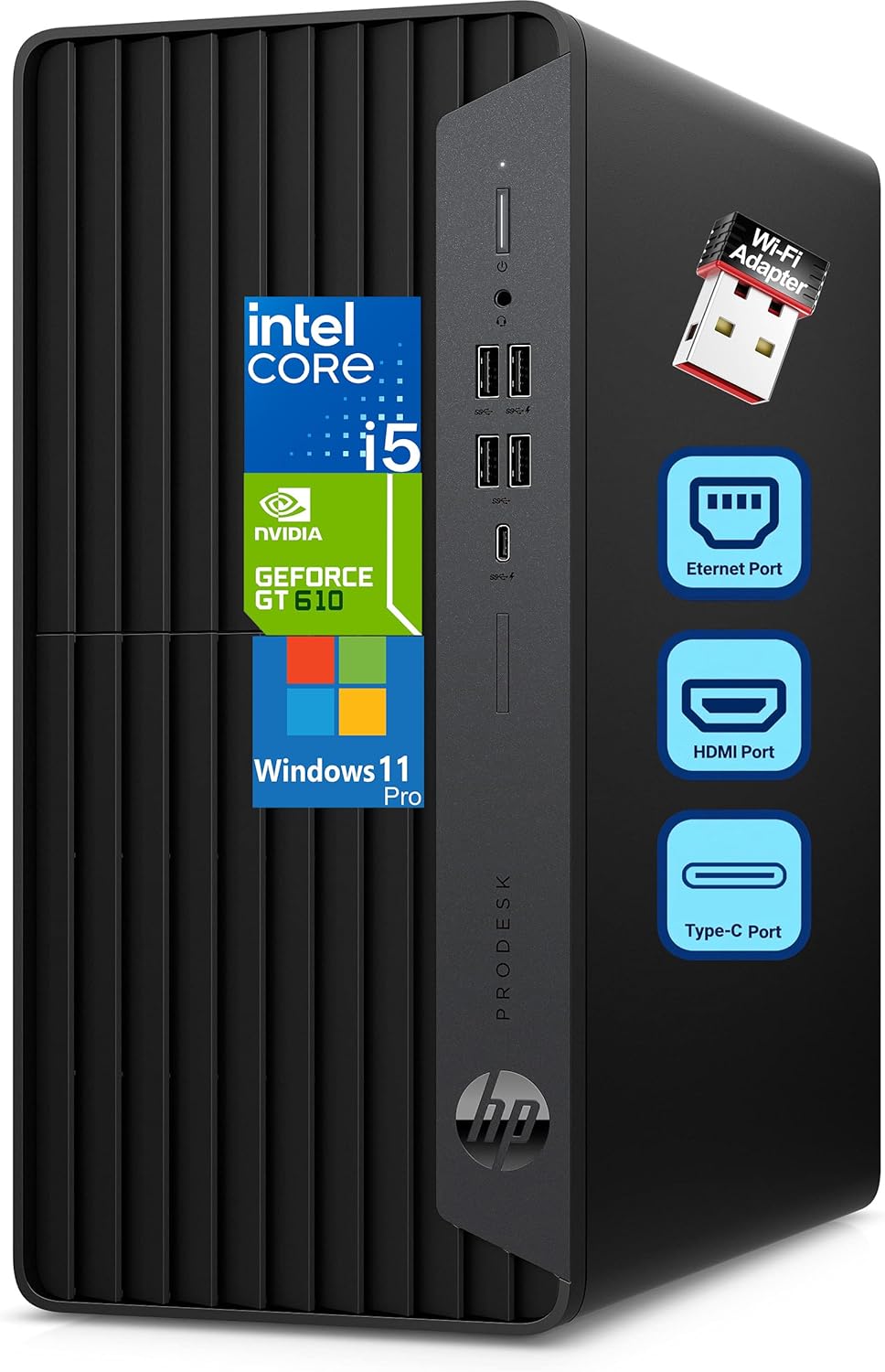
- 6-core i5-10400F runs at 2.90GHz base with turbo up to 4.30GHz for multitasking across business apps
- 512GB PCIe NVMe SSD paired with 16GB DDR4 RAM speeds boot and file access over a SATA-drive equivalent
- GT 610 2GB graphics card drives multiple monitors via HDMI, DVI-I and VGA outputs at once
- Front panel includes a 10Gbps USB-C port plus four additional USB-A ports for fast peripheral and drive transfers
- Microtower footprint of 5.98 x 11.93 x 13.27 inches and roughly 5.0kg weight fits on or under a desk easily
Cons
- GT 610 is an entry-level graphics card meant for multi-monitor productivity work, not gaming or GPU-accelerated tasks
- Wired keyboard and mouse are included rather than wireless, so a separate purchase is needed for a cable-free desk
- Wi-Fi comes through an included adapter rather than a built-in antenna, so it occupies a USB or expansion slot rather than being integrated on the motherboard
The system runs an Intel 6-core i5-10400F at a 2.90GHz base clock, turboing to 4.30GHz, paired with 16GB of DDR4 RAM for smooth multitasking across spreadsheets, browsers and business applications. A 512GB PCIe NVMe SSD holds Windows 11 Pro and program files, giving fast boot times and near-instant file access compared with a traditional hard drive. Graphics run through a dedicated GeForce GT 610 2GB card rather than integrated graphics, which is enough for driving multiple displays and everyday desktop work but not demanding 3D or GPU-accelerated workloads.
Front-panel connectivity includes a 10Gbps USB Type-C port, two additional 10Gbps USB-A ports, two 5Gbps USB-A ports and a headphone/mic combo jack, while the rear panel adds an RJ-45 Ethernet port plus further USB and video outputs. A Wi-Fi adapter is included for wireless networking alongside the wired Ethernet option, giving flexibility in offices without a nearby network drop. The GT 610 graphics card outputs through HDMI, DVI-I and VGA simultaneously, which covers most monitor generations without needing a separate adapter for older VGA displays still common in office settings.
The microtower case measures 5.98 x 11.93 x 13.27 inches and weighs approximately 5.0kg, a compact form factor that trades some internal expansion room for desk-friendly size compared with a full or mid-tower case. It runs on a 180W power supply, which limits how much additional graphics or storage hardware can be added later compared with systems built around larger PSUs. 16GB of RAM covers current business workloads comfortably, and the NVMe SSD leaves room for additional internal storage if the case supports a second drive bay, making light storage upgrades more realistic than a graphics card upgrade given the power ceiling.

Pros
- CONNECT AND ON YOUR TERMS - Built with all the features to keep you
- MORE MUSCLE FOR YOUR HUSTLE - With a powerful AMD Ryzen 7 7730U
- THE RIGHT FIT FOR EVERY FLOW - Immerse yourself in whatever you are
- GET A FRESH WITH WINDOWS 11 - From a rejuvenated Start menu, to new
- Dimensions of 24.11 x 7.33 x 17.36 inches engineered for optimal spatial fitting
Cons
- Requires verifying placement clearance for 24.11 x 7.33 x 17.36 inches prior to installation
- Periodic visual inspection recommended to ensure component tightness
Integrating thoughtful design principles, the HP 27 inch All-in-One Desktop PC FHD Display AMD Ryzen 7 enhances daily routines within All-in-Ones areas. Operational testing demonstrates clear performance benefits driven by CONNECT AND ON YOUR TERMS - Built with all the features to keep you connected like a tiltable pop-up privacy camera, HP Video Controls, dual array microphones and advanced noise reduction technology.. In active use, the presence of MORE MUSCLE FOR YOUR HUSTLE - With a powerful AMD Ryzen 7 7730U processor, ample storage, speedy connections, and plenty of memory, you're all set to take on any day. eliminates common operational friction for homeowners. Measurements of 24.11 x 7.33 x 17.36 inches provide clear dimensional boundaries for precise space planning.
Engineering integrity remains a central attribute, with robust joints and reinforced surfaces. Hardware stability is reinforced through THE RIGHT FIT FOR EVERY FLOW - Immerse yourself in whatever you are doing with an ultra-slim three-sided micro-edge display and up to a 90% screen-to-body ratio for enhanced viewing., ensuring dependable daily performance. Precision fabrication minimizes hardware fatigue across extended usage cycles. Using proper installation techniques maintains physical stability across daily activities. This balanced configuration fits smoothly into existing interior designs while maximizing efficiency. Quality craftsmanship supports long term satisfaction for residential and professional settings. User centered design choices streamline routine interactions and enhance practical convenience.
Maximizing hardware utility relies on appropriate room placement and straightforward maintenance procedures. Incorporating GET A FRESH WITH WINDOWS 11 - From a rejuvenated Start menu, to new ways to connect to your favorite people, news, games, and content—Windows 11 is the place to think, express, and create in a natural way., routine adjustments can be performed efficiently without specialized hardware. Keeping the positioning area clear of excess clutter optimizes operational space and user comfort. Using proper installation techniques maintains physical stability across daily activities. This balanced configuration fits smoothly into existing interior designs while maximizing efficiency.

Pros
- Intel Core i5-12500 offers 6 cores, 12 threads, and 18MB cache, boosting up to 4.6GHz
- 16GB DDR4 RAM paired with a 512GB PCIe NVMe SSD for fast boot and file access
- 8 total USB ports (4x USB 3.0 front, 4x USB 2.0 rear) plus HDMI, VGA, and RJ-45 Ethernet
- TPM 2.0 security chip and a padlock loop support basic business-grade physical and data security
- Compact tower measures 11.92 x 6.1 x 13.27 inches and weighs 10.5 lbs for tight desk spaces
Cons
- Intel UHD Graphics 770 is integrated only, so demanding creative or gaming graphics work needs a discrete GPU add-in
- Rear ports are USB 2.0 rather than 3.0, so faster external drives should use the front USB 3.0 ports instead
- VGA output is legacy analog; newer monitors relying solely on DisplayPort will need an adapter
This desktop runs a 12th Gen Intel Core i5-12500 processor with 6 cores, 12 threads, and 18MB of cache, boosting up to 4.6GHz on the Intel H670 chipset. Memory is 16GB of DDR4 RAM alongside a 512GB PCIe NVMe SSD, and graphics are handled by the integrated Intel UHD Graphics 770 rather than a discrete card.
- Intel Core i5-12500, 6 cores/12 threads, up to 4.6GHz
- 16GB DDR4 RAM, 512GB PCIe NVMe SSD
- Intel UHD Graphics 770 (integrated)
- Windows 11 Home pre-installed
An 80 Plus Gold-certified 180W external power supply runs the system, and the build includes a TPM 2.0 security chip along with 15% post-consumer recycled materials in its construction.
Connectivity covers Wi-Fi and Bluetooth 5.3 wireless alongside wired RJ-45 Ethernet. Physical ports include 4x USB 3.0 (5Gbps) and a headphone/mic combo jack on the front, with 4x USB 2.0, HDMI, VGA, Ethernet, and audio in/out on the rear, supporting dual monitors through the integrated graphics.
- Wi-Fi and Bluetooth 5.3
- 4x front USB 3.0 (5Gbps), 4x rear USB 2.0
- HDMI, VGA, and RJ-45 Ethernet outputs
- Dual monitor support via integrated graphics
Because the rear USB ports are 2.0 rather than 3.0, external drives or peripherals needing faster transfer speeds should be connected to the front-panel USB 3.0 ports instead for full bandwidth.
Bundled with an HP wired keyboard and mouse, this system is positioned for home offices, small businesses, remote work, online learning, and everyday data-analysis tasks rather than gaming or GPU-heavy creative work. The compact 11.92 x 6.1 x 13.27-inch tower and 10.5 lb weight keep it easy to fit on or under a desk.
- Suited to office productivity, remote work, and online learning
- Includes wired keyboard and mouse
- TPM 2.0 chip supports business security requirements
- Compact footprint at 10.5 lbs
Anyone needing serious graphics horsepower for gaming or video rendering will want to add a discrete GPU, since the integrated Intel UHD Graphics 770 is built for office and productivity workloads rather than heavy creative rendering.
Why Photography Puts Unique Demands on a Desktop
Photo editing is not the same as web browsing or office work. Modern cameras produce enormous raw files, and applications like Lightroom, Photoshop, Capture One, and Affinity Photo love to consume every ounce of memory and processing power you can give them. When you apply layers, masks, noise reduction, and high-resolution exports, your computer juggles massive amounts of data at once.
Unlike gaming, which leans heavily on the graphics card, photography workloads reward a balanced system. You want a strong processor for tasks like exporting and applying filters, plenty of memory to hold large files, and fast storage so importing and browsing your catalog feels instant. Getting that balance right is the real goal, and it is why a thoughtfully chosen desktop often outperforms a flashier machine built for a different purpose.
Editing Versus Culling and Organizing
Most photographers spend as much time culling, tagging, and organizing as they do on heavy edits. A responsive system keeps this everyday work fast, letting you scroll through thousands of images without lag. When you shortlist desktops, imagine your full workflow, not just the occasional big export, because the machine that feels quick during routine tasks is the one you will enjoy using every day.
The Processor: Your Photography Workhorse
The processor, or CPU, handles the bulk of photo editing tasks. Exporting batches, generating previews, and applying adjustments all lean on CPU performance. For serious work, look for a modern multi-core chip. Options built around Intel Core Ultra processors, such as the Dell Tower ECT1250 and the Dell Pro Tower Plus, offer a strong blend of speed and efficiency that suits demanding editing sessions.
If you frequently run large exports or work with high-megapixel files, a higher core count pays off. Machines featuring chips like the Intel Core i9, including the Dell ECT1250 Business Tower and the HP ProDesk 400 G9, deliver headroom for heavy batch processing. For AMD fans, the HP OmniDesk with its Ryzen 7 chip provides excellent value and capable performance for most editing needs.
How Many Cores Do You Really Need
More cores help with tasks that can run in parallel, like exporting many images at once. However, some editing operations still favor high single-core speed. A balanced modern processor with six to twenty cores covers the vast majority of photography workflows comfortably. Do not chase the highest core count blindly; instead match it to how often you run heavy batch jobs.
Memory: The Space Your Photos Live In
Memory, or RAM, is where your active files and application data live while you work. Photo editing is memory-hungry, especially when you stack layers or keep several applications open at once. For a comfortable experience, aim for at least 16GB, but 32GB is the sweet spot for most photographers today.
Many strong choices already ship with generous memory. Desktops like the Dell Tower Plus EBT2250 and the HP 27 inch All-in-One come with 32GB, giving you room to work on large panoramas and multi-layer composites without hitting a wall. If you handle enormous files or run intensive plugins, the HP ProDesk 400 G9 steps up to 64GB for professional-grade headroom.
When 16GB Is Enough
If your editing is lighter, focused on social media content, event coverage, or web-ready images, 16GB machines like the HP ProDesk 600 and the HP Pro Tower 290 G9 handle the load nicely. They keep costs down while still delivering a smooth experience for everyday photo work, and many can be upgraded later if your needs grow.
Storage: Speed and Capacity Matter
Fast storage transforms how a photography desktop feels. A solid-state drive, especially an NVMe PCIe SSD, dramatically speeds up importing, catalog browsing, and file saving compared to older hard drives. Nearly every quality option today, from the HP OmniDesk to the Dell Pro Tower Plus, includes a 1TB SSD as a baseline.
Capacity is the other half of the equation. Raw files add up quickly, and a single shoot can consume many gigabytes. A 1TB drive is a comfortable starting point, while options like the HP ProDesk 400 G9 SFF with 1.5TB of storage give extra breathing room. Many photographers also pair internal storage with external drives or network storage for long-term archives, so plan your library strategy before you buy.
Balancing Local Storage and Backups
No matter how large your internal drive is, backups are essential. A good rule is to keep working files on fast internal storage and archive completed projects on separate drives or cloud services. This keeps your desktop snappy while protecting your images against accidental loss. Treat storage as a system, not a single number.
Graphics: Do Photographers Need a Dedicated Card
Graphics needs for photography are more modest than for video editing or gaming. Many editing tasks run beautifully on integrated graphics, such as the Radeon and UHD solutions found in the HP OmniDesk and the Dell Tower ECT1250. These handle Lightroom and Photoshop well for typical photo workflows.
That said, a dedicated graphics card can accelerate certain features like AI-based noise reduction, denoise, and select filters. If you dabble in video, 3D, or heavy AI tools, a machine with a discrete GPU such as the Dell Tower Plus EBT2250 with its GeForce RTX card offers useful acceleration and future flexibility. For pure photography, though, do not overspend on graphics at the expense of memory or the processor.
Display Support and Connectivity
Accurate, spacious screen real estate is vital for photo editing, so your desktop should support the monitors you want. Look for multiple display outputs and 4K support if you plan to use high-resolution screens. Options like the Dell ECT1250 with dual 4K monitor support and the HP Pro Tower 290 G9 with dual monitor capability make it easy to build a comfortable editing station.
Connectivity matters too. Plenty of USB ports, card readers, and modern wireless standards streamline your workflow. The Dell Tower ECT1250 includes a built-in SD card reader, a small but welcome convenience for importing photos. Features like Wi-Fi 6 or Wi-Fi 7 and Bluetooth, found across many of these desktops, keep accessories and networks connected without clutter.
All-in-One Versus Tower
An all-in-one like the HP 27 inch All-in-One combines the computer and display into one tidy package, ideal for clean desks and limited space. Towers, by contrast, offer easier upgrades and more room to grow. Consider your workspace and whether you value simplicity or long-term expandability when deciding between the two.
Form Factor and Upgradeability
Desktops come in various sizes, from compact small-form-factor units to full towers. Small designs like the HP ProDesk 400 G9 SFF save desk space and look clean, while full towers such as the Dell Pro Tower Plus provide more room for future upgrades to memory, storage, or graphics.
If you expect your needs to grow, prioritize a machine you can expand. Adding memory or another drive later can extend a desktop’s useful life for years, protecting your investment. Compact machines are wonderful for tidy setups, but confirm the upgrade options before committing if longevity matters to you.
Matching a Desktop to Your Budget
Photography desktops span a wide price range, and the good news is that capable machines exist at every level. Budget-friendly options like the HP ProDesk 600 and the HP Pro Tower 290 G9 deliver reliable performance for enthusiasts and part-time shooters without straining your wallet.
Mid-range machines such as the HP OmniDesk and the Dell Tower ECT1250 hit a sweet spot of price and power for serious hobbyists. For professionals who demand maximum speed, premium builds like the Dell Tower Plus EBT2250 and the HP ProDesk 400 G9 justify their cost with generous memory, fast storage, and strong processors that keep large workflows moving.
Value Over Hype
The most expensive desktop is not automatically the best for you. Focus your budget on the components that impact photo editing most, namely the processor, memory, and storage. A well-balanced mid-range machine often outperforms a pricier but poorly matched system for real-world photography tasks, so spend where it counts.
Putting It All Together
Selecting from the best desktop computers for photography comes down to understanding your own workflow and matching hardware to it. Start with a modern multi-core processor, add at least 16GB of memory with 32GB as the ideal target, and insist on fast SSD storage with enough capacity for your library. Layer in the right display support, sensible connectivity, and a form factor that fits your space and upgrade plans.
If you are a hobbyist, an efficient and affordable machine will serve you well and leave room in the budget for lenses and accessories. If you edit professionally, investing in more memory, faster storage, and a capable processor pays dividends in saved time and smoother sessions. Whatever your level, the desktops highlighted in this guide give you a strong starting point to compare and choose from.
Ready to upgrade your editing setup? Explore the options above, weigh them against the factors in this guide, and pick the desktop that turns your photography vision into reality with speed and confidence.