
 Daniel Okafor
Running two, three, or four screens changes what a desk needs to do. You want depth for monitor arms, width for peripherals, and a surface that stays steady during a heated match. That is why the best desks for multi monitor setup gaming prioritize footprint, clamp-friendly edges, and cable routing over flashy extras. This guide ranks 10 strong options from brands like EUREKA, SEDETA, ODK, and FEZIBO. You will see which desks suit tight bedrooms, which handle a triple-monitor wall, and which give you a standing option. Every pick below carries a 4.7 out of 5 rating, so the differences come down to size, layout, and price.
Quick answer: For most gamers in 2026, our top pick among the best desks for multi monitor setup gaming is the EUREKA ERGONOMIC Captain Series 60″ — our #1 rated choice. See the full ranked comparison, alternatives and buying advice below.

Pros
- 60 LARGE GAMING DESKTOP Captain GIP-P60 gaming desk is a extraordinary
- STURDY AND STABLE STRUCTURE Captain GIP-P60 gaming desk s support
- EXCLUSIVELY AND FULLY COVERED MOUSE PAD FOR FREE Captain GIP-P60 gaming
- EUREKA GAMING OFFERS YOU FREE ACCESSORY OPTIONS All come together with
- CUSTOMER SERVICE We hold our products to a high standard and hope you
Cons
- Requires checking room layout clearance for 27.56"D x 60"W x 30.12"H dimensions
- Requires periodic vacuuming and fabric care for Carbon Fiber

Pros
- Reversible frame converts between a 67-inch corner desk and a 94.5-inch straight desk, so the same unit adapts to different room layouts
- Built-in charging station adds 4 AC outlets and 2 USB ports for up to 6 devices without an extra power strip
- Top hutch, pegboard, and 2-tier storage shelves keep monitors, files, and accessories off the main desktop
- Keyboard tray sits below desk height, freeing the desktop surface for a mouse, notebook, or second monitor
- Frame is rated to hold 2 desktop computers and 1 notebook computer plus up to 3 monitors
Cons
- Engineered wood construction is lighter-duty than a solid wood or steel-frame desk, so very heavy CPU towers need to sit on the included stand rather than directly on the surface
- LED lighting strip and charging station both depend on the desk being plugged into a wall outlet, so it offers no backup power if power is cut
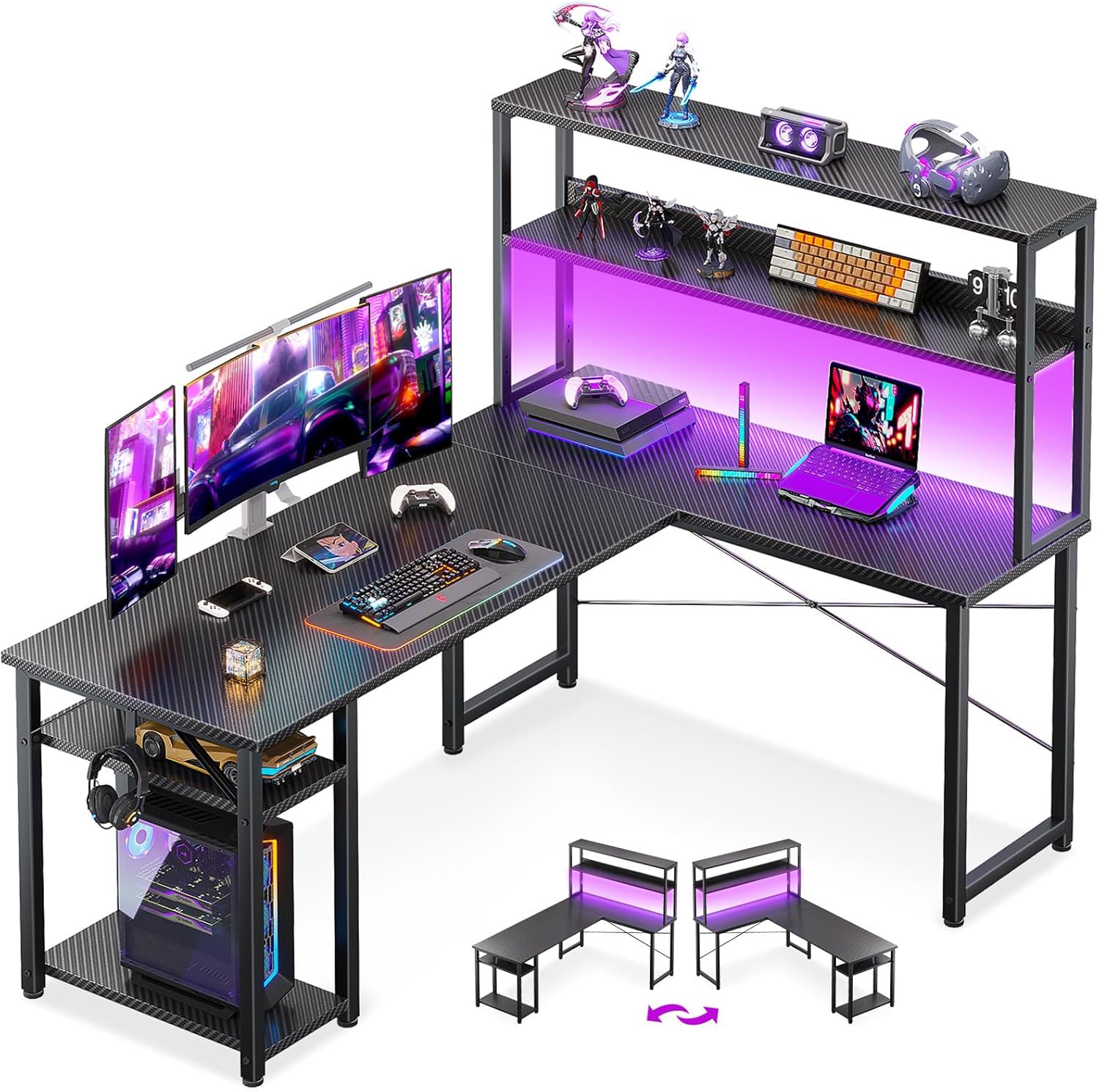
The desk measures 19.7"D x 67"W x 57"H in its L-shaped corner configuration, and the frame reverses to a 94.5-inch straight desk when the top hutch is moved to the opposite side. The extended length is built to hold up to 3 monitors across the surface alongside a CPU stand and two-tier storage shelves.
- 67-inch corner layout tucks into a room corner for a compact home office footprint
- 94.5-inch straight layout suits two people working side by side without interference
- Frame supports 2 desktop computers and 1 notebook computer at once
Because the same hardware converts between both layouts, the desk can move with a room redesign or a switch from single-person to shared use without buying a second piece of furniture.

Pros
- 300 lb weight capacity metal frame handles dual towers and monitors
- 55" x 21.6" desktop, large enough for two full computer setups side by side
- Two open storage shelves plus a top hutch keep consoles and speakers off the desktop
- RGB LED strip syncs to music with an adjustable-sensitivity mic, over 60,000 colours via app
- Built-in CPU holder and monitor stand free up desk surface for keyboard and mouse
Cons
- 78.8" width needs a dedicated wall run, not suited to small bedrooms
- LED strip depends on a companion app and Bluetooth pairing, no physical remote mentioned
- Metal frame with hutch and shelves means a longer bolt-together assembly than a basic table
This desk measures 78.8"W x 21.6"D x 60"H, giving it enough footprint for a triple-monitor arrangement or two workstations sharing the surface. The metal frame is rated to hold 300 pounds, which covers a full tower PC, two monitors on stands, and typical desktop accessories without flexing.
- Desktop area: 55"L x 21.6"W for keyboard, mouse and paperwork
- Two lower storage shelves for CPU towers, consoles or speakers
- Top hutch shelf for books, figures or plants
- Built-in monitor stand raises screens above desk clutter
The dimensions suit a dedicated office or gaming room rather than a shared or compact bedroom corner.
This desk fits gamers and remote workers who want a single station that also stores hardware. The 300 lb capacity and dual shelving make it practical for anyone running two PCs, streaming equipment, or console peripherals that would otherwise clutter the floor.
- Suited to dedicated gaming rooms or home offices with wall space for a 78.8" run
- Good for users who want LED ambiance synced to games or music
- Storage shelves help households consolidating a PC and console setup on one desk
It is less practical for small apartments or shared bedrooms where a 78.8" wide footprint will not fit comfortably against available wall space.

Pros
- 150 lb weight capacity across the desktop surface supports multiple monitors and equipment at once
- Built-in LED lighting offers 10 colors and 10 modes, with a memory function that restores the last setting on power-up
- 3 standard outlets plus 2 USB ports are built into the desk for charging and power without extra cords crossing the floor
- Reversible design lets the L-shape be configured for either a left or right corner setup
Cons
- MDF board construction is less impact-resistant than solid wood, especially at drilled connection points
- Assembly is required, with a metal frame and multiple storage sections to fit together
- 66.14-inch width needs a genuine corner space; it will not fit a straight-wall single-desk layout without waste
This L-shaped desk measures roughly 66.14 inches wide, 18.9 inches deep and 34.92 inches tall overall, with a 150 lb weight capacity across the surface and a main desktop section running 36 inches long, longer than the roughly 26-inch main sections found on many comparable L-desks. The larger main surface leaves room for a wide multi-monitor setup without crowding a keyboard and mouse into a narrow strip.
- 150 lb capacity accommodates monitors, a tower, and peripherals together
- 36-inch main desktop section outsizes the roughly 26-inch sections on similar desks
- Full monitor stand raises screens for improved sightlines without a separate monitor arm
Because the desk spans over 66 inches in an L configuration, it needs a genuine corner in the room rather than fitting flush against a single flat wall.
Pros
- Dimensions of 39.37"D x 53.15"W x 29.9"H engineered for optimal spatial fitting
Cons
- Requires verifying placement clearance for 39.37"D x 53.15"W x 29.9"H prior to installation

Pros
- Workstation surface measures 53 inches wide by 18.9 inches deep at 29.8 inches tall, rated to hold up to 300 pounds
- Built-in power strip adds 3 AC outlets and 2 USB ports directly on the desk for centralized charging
- RGB LED strip offers 10 color presets, 8 brightness levels and 10 dynamic modes with a memory function
- X-shaped steel frame construction adds stability for dual-monitor or multi-display setups
- Reversible left/right side modules let the L-shape orientation match either side of a room
Cons
- Assembly takes an estimated 50 to 70 minutes even with included tools and labeled parts, and is easier with two people when flipping the desk upright
- Corner L-shape footprint needs more floor space than a straight desk, so it will not fit tight rooms as easily
The main workstation area measures 53 inches wide by 18.9 inches deep at a 29.8-inch working height, rated to support up to 300 pounds across the desktop. Built-in power comes from 3 AC outlets and 2 USB ports mounted on the desk itself, along with cable management channels to keep cords off the floor during long sessions.
- Dual open shelves, a CPU stand, an accessory hook and a tool bag are included for onboard storage
- RGB LED strip supports 10 color presets, 8 brightness grades and 10 dynamic lighting modes with a memory function
- X-shaped steel frame is designed to add stability under the weight of dual monitors and a desktop tower
The overall L-shape footprint spans 53.15 x 39.37 inches at the base, so it needs a corner or wall space to match.

Pros
- 70.8-inch width with a 55 x 21.6-inch desktop area holds two full computer setups side by side
- 3-tier storage shelves separate a CPU tower, speakers, and console gear instead of piling them on the desktop
- Built-in RGB LED strip offers over 60,000 colors and 29 modes, including music-reactive sync via a built-in microphone
- Integrated 2-outlet, 2-USB charging station powers up to 4 devices without a separate power strip
- Cup holder and headphone hook keep drinks and headsets off the desk surface during long sessions
Cons
- Weight capacity of 55 lbs on the desktop limits how much monitor and accessory weight can sit on top at once
- RGB lighting requires an app connection to access the full 29 modes, adding a setup step beyond plug-and-play
- 70.8-inch width needs a dedicated wall run, too large for narrow bedrooms or shared desk corners
The desktop spans 70.8 inches wide by 21.6 inches deep, with a listed weight capacity of 55 lbs across the main surface. Three tiered storage shelves sit to the side, sized to hold a CPU tower, speakers, or console hardware separately from the desktop workspace, and the layout is wide enough to fit two complete computer setups.
A built-in monitor shelf raises screens above the main desktop, following ergonomic eye-level positioning without requiring a separate monitor riser purchased on top of the desk itself.

Pros
- Spacious 55-inch width accommodates dual monitors plus keyboard and accessories
- Supports up to 149 kg, well above typical desk equipment loads
- Sturdy Z-shaped metal legs provide stable base without wobbling
- Simple assembly requires just 15 minutes with included tools
- Smooth particleboard top resists scratches from daily use
Cons
- Fixed height at 29.5 inches may feel low for users over 6 feet tall
- Desktop is not height-adjustable for sitting or standing work positions
The extra-large 55-inch desktop provides ample workspace for modern multi-monitor setups, office supplies, and decorative elements without requiring constant reorganization. The smooth particleboard surface resists scratches from keyboard and mouse movement while maintaining a professional appearance suitable for both home offices and professional environments.
- Width of 55 inches accommodates dual 27-inch monitors side by side with keyboard between them
- Depth of 23.6 inches allows monitor stands and pull-forward peripherals without excessive reach required
- Height of 29.5 inches aligns with standard office desk heights for most users between five feet four inches and six feet
- Smooth finish top prevents snagging cables or damaging monitor bases during repositioning
- Neutral gray color coordinates with most office furniture and lighting fixtures without clashing
The spacious layout eliminates cramped feeling common with compact desks, enabling comfortable positioning of multiple monitors and peripherals for enhanced productivity and reduced neck strain from excessive head turning.

Pros
- Dimensions of 37"D x 71"W x 28.3"H engineered for optimal spatial fitting
Cons
- Requires verifying placement clearance for 37"D x 71"W x 28.3"H prior to installation
- Load weight limits should not exceed 220 Pounds during active operations

Pros
- Physical footprint measures 47.2"D x 18.9"W x 35.5"H for spatial placement
Cons
- Spacious wall or desk clearance needed for Furologee 47 Gaming De
- Careful cable routing recommended for Furologee 47 Gaming De wall mounting
What makes a desk right for a multi-monitor gaming setup
A single-monitor desk can be 40 inches wide and shallow. A multi-monitor rig cannot. Two 27-inch panels side by side eat roughly 48 inches of width before you add speakers or a mic arm. Three panels push past 60 inches fast.
Depth matters just as much as width. Monitor arms and stands need clearance so screens sit at a comfortable arm’s length. Shallow desks force you to crane your neck, which ruins long sessions.
Look at the rear edge too. If you plan to clamp monitor arms, the desk needs a flat, accessible back lip without a hutch blocking the clamp zone. That single detail decides whether your setup works.
Weight capacity and stability
Multiple screens add real weight and leverage. A wobbly frame lets vibration travel every time you type or mouse hard. Steel legs, cross-braces, and a thick tabletop keep things planted. The EUREKA Captain Series uses polygon-shaped legs specifically to fight wobble under load.
How to choose the best desks for multi monitor setup gaming
Start with your monitor count, then work backward to width. This keeps you from overpaying for space you will never fill.
Match desk size to screen count
- Two monitors: 47 to 60 inches of usable width is plenty.
- Three monitors flat: aim for 70 inches or more, or use a deep L-shape.
- Curved ultrawide plus a vertical panel: depth of 28 to 30 inches helps most.
If you run two screens today but plan to expand, buy wider now. A cramped desk is the most common upgrade regret. For a focused breakdown of two-screen layouts, our guide to the best desks for a dual monitor gaming setup covers width and arm clearance in detail.
Straight desk or L-shape
Straight desks give you one clean plane for a monitor wall. They suit triple flat setups and center your view. L-shaped desks split screens across two planes, freeing the corner for a laptop, tablet, or stream deck.
An L-shape also fits a room corner, reclaiming floor space many gamers waste. If you like that approach, compare options in our roundup of the best corner desks for a gaming setup before deciding.
Extras worth paying for
Built-in power outlets cut cord clutter with several devices plugged in. A headphone hook, cup holder, and cable trays keep the surface clear. LED lighting is cosmetic, but many of these desks bundle it free anyway.
Top recommendations by use-case
Every desk here holds a 4.7 rating, so pick by fit, not fear of quality. Here is how the field breaks down.
Best overall for multi-monitor gaming
The EUREKA Captain Series 60″ earns the top spot on balance. With 2465 reviews, it has the deepest track record here. The 60-inch surface fits dual 27-inch panels comfortably and squeezes in a modest triple setup. The polygon leg design resists the shake that plagues cheaper frames. It costs more, so budget shoppers should look lower on this list.
Best budget pick
The Furologee 47″ Gaming Desk is the cheapest way in. You get a USB-C port, monitor stand, storage shelves, two fabric drawers, and power outlets. The trade-off is width; 47 inches suits a dual setup but not three flat screens. With only 13 reviews, it is also the least proven, so early adopters should set expectations accordingly.
Best for small spaces
Tight bedrooms need a footprint that hides in a corner. The ODK 53″ L Shaped Desk costs and tucks two screens across its corner while the hutch lifts one panel to eye level. It is not for anyone chasing a wide flat triple wall. For that, look at a longer straight top instead.
Best for a triple-monitor wall
Three flat screens demand length. The SEDETA 78.8″ Gaming Desk stretches nearly 79 inches, with a hutch, storage shelves, and a monitor stand. That width lets three 24-inch panels breathe. If you want mounted screens instead of stands, read our notes on the best desks for 3 monitor mounted gaming for clamp-edge guidance.
Best standing option
Sitting for a raid marathon wears you down. The FEZIBO Electric Standing Desk gives a 71 x 37 inch surface with a memory height motor. The dual-beam frame and 1-inch three-piece top handle several monitors while you alternate sit and stand. It is the priciest here, and the depth of 37 inches is generous for arms.
Best value L-shape with power
The ODK 66″ L Shaped Desk lands with a built-in power outlet, LED lights, carbon-fiber texture, and a monitor stand. The 66-inch reach across the L spreads two or three screens without crowding your keyboard. It is a strong middle-ground buy between the budget models and the premium EUREKA.
Your practical buying guide: sizes, specs, and compatibility
Numbers prevent buyer’s remorse. Measure your room and your monitors before you order anything.
Get the dimensions right
Measure the wall or corner where the desk will live. Leave clearance for a chair to roll back at least 20 inches. Then confirm the desktop depth clears your monitor stand base plus keyboard room.
For monitor arms, verify the tabletop thickness fits your clamp range, usually 0.4 to 2 inches. Also check that the rear edge is unobstructed. Hutches and raised shelves can block clamp jaws entirely.
Confirm weight and mounting compatibility
Add up your monitor weights and compare against the desk’s rated capacity. Heavier VESA arms concentrate force on one spot, so err toward sturdier steel frames. If you plan to mount three screens on a single arm, prioritize a solid, thick top over a hollow particleboard panel.
Think about cable and power management
Multi-monitor rigs create a nest of cables. Desks with grommets, trays, and onboard outlets like the SEDETA and ODK models tame that mess. The FEZIBO includes integrated cable management, which matters more once a motor and several power bricks join the pile.
Planning a full battlestation, not just a desk? Our overview of the best gaming desks for multiple monitors ties these specs to complete room layouts.
Common mistakes to avoid
Even good desks disappoint when the wrong one meets the wrong room. Sidestep these traps.
- Buying too shallow. A 20-inch depth crushes multi-monitor ergonomics. Screens end up in your face.
- Ignoring the clamp zone. A gorgeous hutch is useless if it blocks your monitor arm.
- Underestimating width. Two 27-inch panels need more room than most people guess.
- Overpaying for LEDs. Lights are nice, but stability and size decide long-term comfort.
- Skipping capacity checks. Three heavy monitors on a flimsy top invites sag and wobble.
One more: do not assume assembly is trivial. Larger L-shapes and standing desks take longer to build. Clear an afternoon and keep the manual handy.
Frequently asked questions
How wide should a desk be for three monitors?
For three flat 24-inch monitors, aim for at least 70 inches of width. The SEDETA 78.8″ model gives comfortable spacing at that count. If you mount screens on arms, you can go slightly narrower since stands no longer take base space.
Are L-shaped desks good for multi-monitor gaming?
Yes, especially in corners or when you split screens across two planes. An L-shape frees the corner for a laptop or stream gear. The trade-off is that a wide flat triple wall works better on one straight surface.
Do I need a standing desk for a multi-monitor setup?
No, but it helps during long sessions. The FEZIBO Electric Standing Desk lets you alternate posture with a memory height motor. If you rarely stand, a sturdy fixed desk like the EUREKA Captain Series saves money.
Can these desks support heavy monitor arms?
Most can, but check tabletop thickness and the rear clamp edge first. Thicker steel-framed models handle VESA arms better than thin hollow tops. Confirm your arm’s clamp range fits the desk edge before ordering.
Which desk is best on a tight budget?
The Furologee 47″ is the cheapest full-featured option, with USB-C and power outlets. For a proven corner build, the ODK 53″ offers more reviews. Both suit dual setups better than triple walls.
The bottom line
Your monitor count and room shape should drive the choice, not the LED glow. The EUREKA Captain Series 60″ wins on balance for most gamers, while the SEDETA 78.8″ owns the triple-screen wall and the Furologee 47″ protects tight budgets. Measure your space, check the clamp edge, and match width to your screens. Do that, and any 4.7-rated pick above will anchor a battlestation you actually enjoy sitting at.


