
 Hannah Lindqvist
Matte black has become the default finish for home networking gear, and it’s not just a style choice. A lot of manufacturers reserve their newest chipsets for the darker-finished models in a lineup, so shopping the best black routers often means getting current Wi-Fi standards without hunting through discontinued colorways. This guide walks through what actually matters when you compare specs — speed class, coverage, security, and device capacity — then points you toward specific picks for gaming setups, apartments, home offices, and mixed-use households.
Quick answer: If you want a router that disappears into a media console instead of standing out, the best black routers pick for 2026 is the TP-Link Archer AX55 — our #1 rated choice for its balance of speed, coverage, and price. See the full ranked list, budget and premium alternatives, and buying advice below.
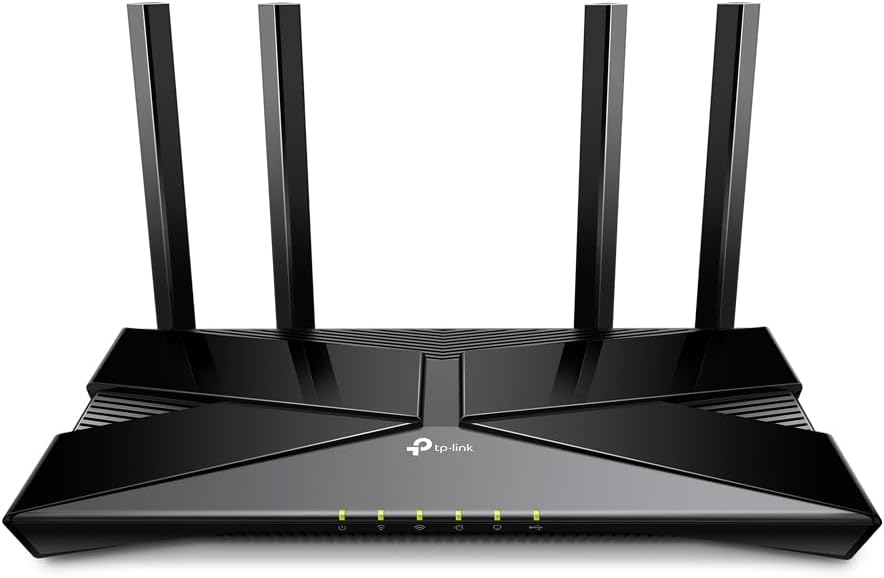
Pros
- Designed with Parental Controls Manage online time and block inappropriate content to for reliable daily operation
- Designed with Increased Battery Life for Devices Target Wake Time technology reduces for reliable daily operation
- Designed with More Reliable Coverage Achieve the strongest most reliable WiFi coverage for reliable daily operation
Cons
- Positioning near central open spaces is recommended for optimal wireless coverage
- Requires pairing with compatible internet service provider modems or gateways
- Note placement considerations for batch 8906

Pros
- 867 Mbps on the 5 GHz band plus 300 Mbps on 2.4 GHz, enough headroom to hold a 4K stream and a video call at once
- Four Gigabit LAN ports and a Gigabit WAN port, so a console, desktop and NAS can drop off the airwaves entirely
- WPA3 security support, a protocol many older 802.11ac units never received in firmware
- Four external antennas with beamforming that aim signal at active clients instead of radiating evenly in every direction
- Access Point mode turns it into a wireless arm of an existing gateway, avoiding a double NAT setup
Cons
- 802.11ac generation only, so Wi-Fi 6 and Wi-Fi 6E clients gain nothing over older speeds
- No USB port, so attached storage or a shared printer needs separate hardware
- Requires a separate modem for most home internet services, and none is supplied in the box
The AC1200 label splits into 300 Mbps on 2.4 GHz and 867 Mbps on 5 GHz, so no single device ever sees 1200 Mbps at once. In daily use the 5 GHz band carries 4K video and game traffic while 2.4 GHz handles smart plugs, printers and anything sitting far from the unit behind masonry.
- Four fixed external antennas with beamforming steer signal toward active clients rather than spraying it evenly
- MU-MIMO on the 5 GHz band serves several compatible clients in parallel instead of one after another
- A two-bedroom apartment or a compact two-storey house sits within comfortable reach; long single-level layouts do better with a OneMesh extender added
Wired traffic is the quiet strength here. Four Gigabit LAN ports let heavy devices bypass Wi-Fi completely and leave the airtime free for phones and tablets.
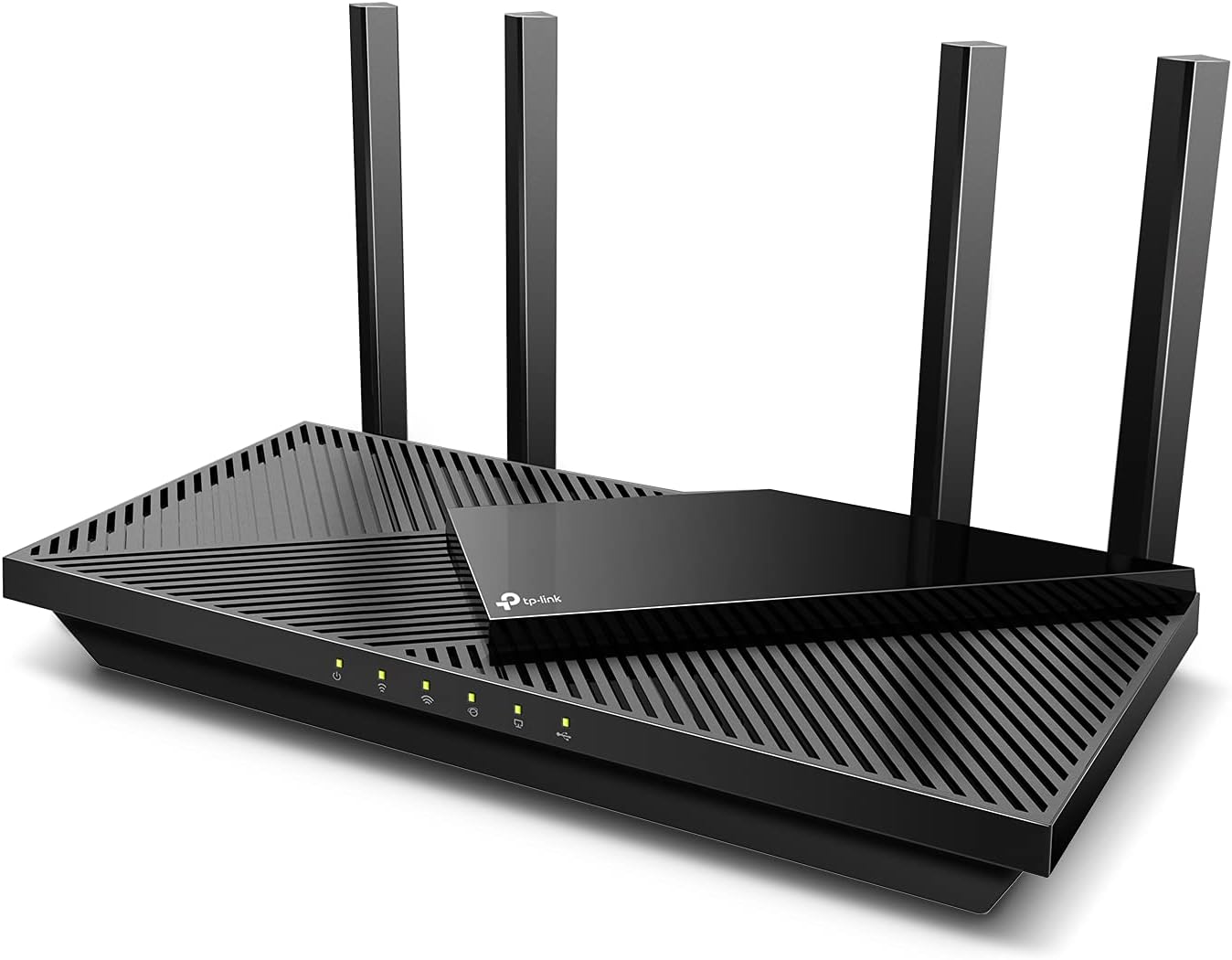
Pros
- AX3000 splits 2402 Mbps on 5 GHz and 574 Mbps on 2.4 GHz, with OFDMA and MU-MIMO dividing airtime between clients
- Four high-gain external antennas plus beamforming steer signal towards devices in back bedrooms
- USB 3.0 port shares a drive or printer across the whole network
- Built-in VPN server and VPN client, so you can reach home files remotely or route outbound traffic through a provider
- An enlarged heatsink and reworked case shed heat, which matters in a cupboard or an unventilated shelf
Cons
- Dual-band only, so mesh traffic shares the same 5 GHz band as your devices instead of a dedicated backhaul
- Gigabit WAN and LAN ports cap it below multi-gigabit internet plans
- Only the basic HomeShield tier is included, and the deeper network protections need a separate plan
The headline split is 2402 Mbps on 5 GHz and 574 Mbps on 2.4 GHz, a sensible balance for a three or four bedroom home.
- OFDMA lets several devices share a single transmission slot rather than queueing, which is what trims latency and jitter when a household streams, calls and games at once
- MU-MIMO serves multiple clients in parallel instead of round-robin
- Four high-gain antennas with beamforming concentrate signal towards each device rather than radiating evenly into the garden
- Target Wake Time lets phones and sensors sleep between transmissions, which shows up as longer battery life on those devices
The 2.4 GHz band remains the one that reaches through brick and up a floor, so keep smart plugs and doorbells there and reserve 5 GHz for laptops and TVs.
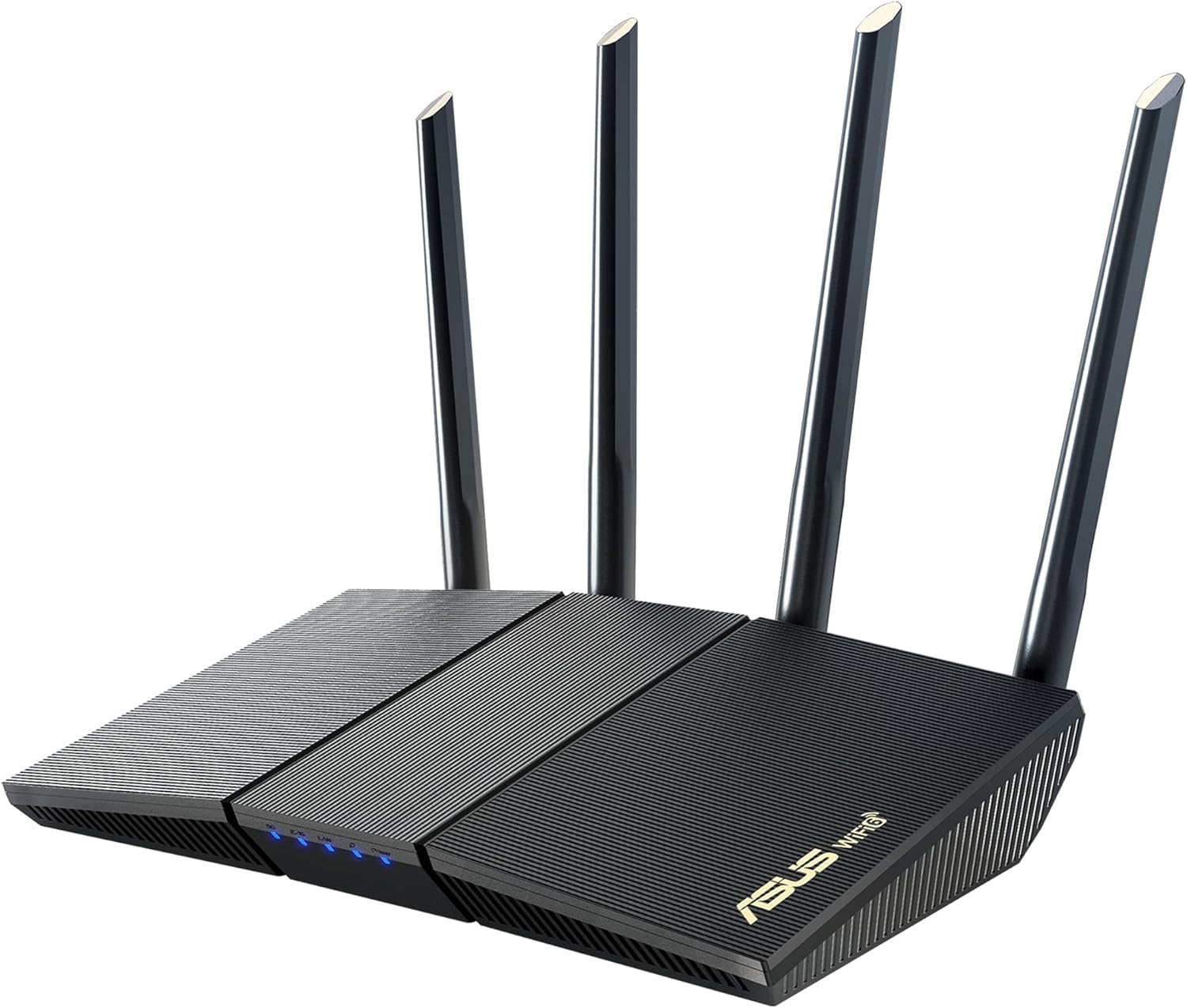
Pros
- Trend Micro powered network protection runs with no ongoing subscription attached
- Four external antennas on a 2x2 dual-band radio using 1024-QAM and 80 MHz channels
- AiMesh support, so a second compatible unit extends one network name rather than adding a second SSID
- Instant Guard opens a one-click encrypted tunnel home from a laptop on public Wi-Fi
Cons
- 2x2 radios cap the 5 GHz band near 1201 Mbps, so a multi-gig line cannot be fully used
- No USB port, so a shared drive or printer cannot be attached to the router itself
- Dual-core processor and no 160 MHz channel support, which limits top single-client speed

Pros
- AX4200 WiFi 6 speed class with 5 simultaneous streams, built for up to 25 connected devices without the network stalling
- 1.5GHz tri-core processor with a fully offloaded CPU handles routing overhead separately from radio traffic
- OFDMA, 160MHz channels, and 1024-QAM push more data per transmission than older WiFi standards
- NETGEAR Armor adds cyber-threat and malware protection across every connected device from one dashboard
Cons
- Coverage is rated around 2,000 sq. ft., so larger homes will likely need a satellite or mesh extender for full-house signal
- Made for use in the U.S. only, per the manufacturer, limiting it for buyers relocating abroad
- Four Ethernet ports are standard Gigabit, not multi-gig, so a 2.5Gbps+ wired connection needs a separate switch

Pros
- Combined throughput up to 2882 Mbps on 5GHz plus 688 Mbps on 2.4GHz across dual bands using Wi-Fi 7's Multi-Link Operation
- Two 2.5 Gbps ports (one WAN/LAN switchable) plus three 1 Gbps LAN ports break past the single-gigabit bottleneck of older routers
- 2.0GHz quad-core processor and 4 internal antennas with beamforming target coverage up to 2,000 sq. ft. for up to 60 connected devices
- EasyMesh compatibility lets it pair with additional routers or extenders to expand coverage without replacing the whole system
- USB 3.0 port adds local network storage or printer sharing that many entry routers skip entirely
Cons
- Dual-band only, so it does not include the 6GHz band found on tri-band Wi-Fi 7 routers, reducing available spectrum in congested networks
- 2,000 sq. ft. coverage figure is on the smaller end for whole-home Wi-Fi 7 systems, so larger homes may need an EasyMesh extender
- HomeShield's advanced security and parental control features typically require an ongoing subscription beyond the basic free tier
The Archer BE230 is a dual-band BE3600-class Wi-Fi 7 router with combined speeds up to 2882 Mbps on 5GHz and 688 Mbps on 2.4GHz, using 4-stream Multi-Link Operation to keep connections stable as devices roam between bands. Four internal antennas with beamforming push signal toward hard-to-reach corners, with coverage figures up to 2,000 sq. ft. and support for up to 60 connected devices at once.
- Combined throughput up to 2882 Mbps (5GHz) and 688 Mbps (2.4GHz)
- 4-stream Multi-Link Operation for Wi-Fi 7 devices
- Coverage figures up to 2,000 sq. ft. for up to 60 devices
- 4K-QAM modulation for added data capacity per stream
Because this is a dual-band model, it skips the 6GHz band found on tri-band Wi-Fi 7 routers, which matters most in dense apartment buildings with heavy 5GHz interference from neighboring networks.

Pros
- Total bandwidth of 6.5 Gbps across 2.4GHz and 5GHz bands with 6 spatial streams
- Two 2.5 Gbps ports (WAN/LAN and LAN) plus three 1 Gbps LAN ports
- Rated coverage up to 2,400 sq ft and 90 simultaneously connected devices
- USB 3.0 port for network-attached storage or printer sharing
- WPA3 encryption plus a separate managed network for IoT devices
Cons
- Dual-band design only, with no dedicated 6GHz band despite the Wi-Fi 7 label
- Full 5764 Mbps and 6.5 Gbps figures are only reached with Wi-Fi 7 client devices; older phones and laptops connect at lower legacy speeds
- Deeper security scanning and remote management run through the cloud-connected Tether app rather than working fully offline
This dual-band Wi-Fi 7 router combines a 5764 Mbps 5GHz band with a 688 Mbps 2.4GHz band for 6.5 Gbps of combined bandwidth across 6 spatial streams.
- Rated coverage of up to 2,400 sq ft with 6 external antennas and beamforming
- Supports up to 90 simultaneously connected devices
- Multi-Link Operation combines both bands for lower latency on supported clients
Because this is a dual-band design rather than tri-band, there is no dedicated 6GHz lane; devices without Wi-Fi 7 support fall back to standard 5GHz or 2.4GHz speeds rather than the peak combined figure. For a typical single-floor or small two-floor home, the antenna layout and beamforming keep signal consistent across rooms, though a very large multi-floor house may still benefit from a mesh add-on at the edges of the stated coverage area.

Pros
- Covers up to 2,500 square feet and supports up to 80 connected devices simultaneously per the maker's figures
- WiFi 7 dual-band radios reach combined speeds up to 6.5Gbps (BE6500 class), about 2.4 times faster than a WiFi 6 router by the same spec sheet
- 2.5 Gig WAN port supports multi-gig internet plans beyond what a standard 1 Gig port allows
- LAN side includes 1x 2.5 Gig port plus 3x 1 Gig ports for wired devices needing higher throughput
- NETGEAR Armor adds an automatic security shield across all connected devices on the network
Cons
- This is a router only, with no built-in modem, so a separate cable or fiber modem is required to actually reach the internet
- Reaching the full 2.5Gbps WAN speed requires an internet plan and modem that also support 2.5Gbps, so a slower plan or older modem caps throughput well below the router's ceiling
- Coverage of 2,500 sq ft and 80 devices is the entry point in NETGEAR's WiFi 7 Nighthawk line, with larger homes needing a higher model in the same series for more coverage or device capacity
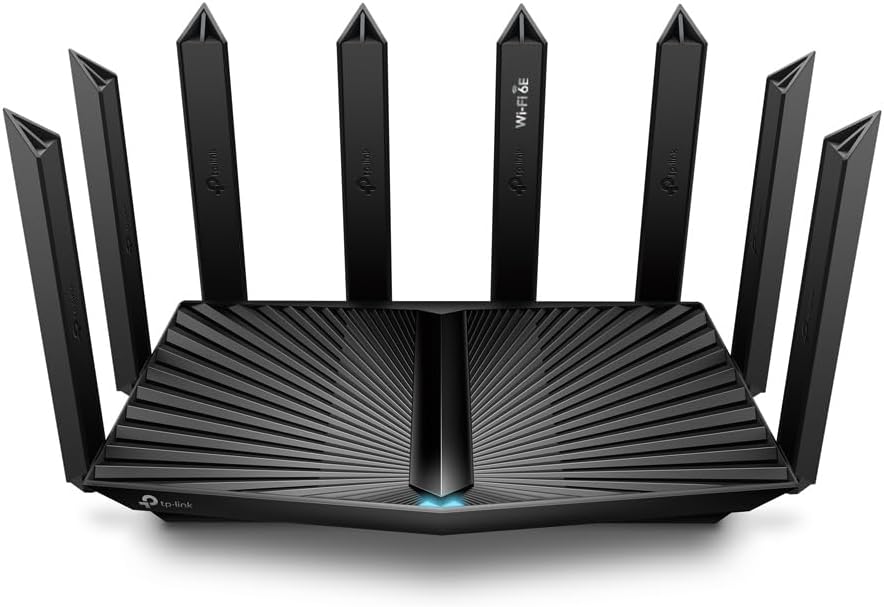
Pros
- New Congestion-Free 6 GHz Band Provides High-Speed Connections
- 2.5 Gbps WAN LAN Ethernet Port for High-speed Internet Plans
- True Tri-Band Speeds up to 7.8 Gbps (7800 Mbps) with WiFi 6E (802.11AX)
- Tri-Band Speed for More Devices with Backhaul to Support up to 200
- Compatible with All Wi-Fi-Enabled Devices and Works with All Internet

Pros
- Tri-band radios at 2402 Mbps on 6GHz, 2402 Mbps on 5GHz and 574 Mbps on 2.4GHz
- 2.5 Gbps port usable as either WAN or LAN, for multi-gig service or a wired NAS
- 1.0 GHz dual-core CPU with 512 MB of memory and six high-gain antennas with beamforming
- 160MHz channels on the 6GHz band, clear of legacy device traffic and neighbouring overlap
- Runs OpenVPN, PPTP and L2TP as both server and client, with WPA3 and a 2-year warranty
Cons
- Only Wi-Fi 6E clients can use the 6GHz band, and 6GHz signal attenuates faster through walls than 5GHz
- A separate modem is still required for most cable and DSL services
- Just one 2.5 Gbps port, so a second multi-gig wired device drops back to Gigabit
Three radios rather than two: 2402 Mbps on 6GHz, 2402 Mbps on 5GHz and 574 Mbps on 2.4GHz, making up the 5400 Mbps combined headline. The 6GHz band is the reason to buy a 6E unit at all, because it carries no legacy traffic from older devices and has room for 160MHz channels without overlapping the neighbours.
Six high-gain antennas with beamforming shape signal toward connected devices, and OFDMA plus true tri-band working raises capacity roughly fourfold against a comparable dual-band unit when many devices are active at the same time.
Behind the radios sit a 1.0 GHz dual-core CPU and 512 MB of memory, which is what stops throughput collapsing when dozens of clients, QoS rules and a VPN tunnel are all live at once. The housing is shaped for heat dissipation rather than stacking.
It works with any provider that hands off an Ethernet connection, including AT&T, Verizon, Xfinity, Spectrum, RCN, Cox, CenturyLink and Frontier. As with any standalone router, a separate modem is still needed for most cable and DSL services, so this replaces the router half of an existing gateway rather than the whole box.
On the client side, only Wi-Fi 6E devices can use the 6GHz band. Recent flagship phones, current laptops and newer 6E adapters qualify; anything older sits on 5GHz or 2.4GHz and sees no benefit from the third radio at all. Worth knowing too: 6GHz attenuates faster through walls than 5GHz, so the fastest band is also the shortest ranged.
OneMesh support lets a compatible extender join as a single roaming network name rather than appearing as a second SSID.
What to Look for in the Best Black Routers
Color aside, a router’s job is to move data cleanly between your internet connection and every device in your home. Before you compare black finishes against each other, it helps to know which specs actually change your day-to-day experience and which ones are mostly marketing.
Wi-Fi Standard and Speed Class
Wi-Fi 6 is the practical baseline right now, offering better performance in crowded households through a technology called OFDMA, which lets the router talk to multiple devices at once instead of one at a time. Wi-Fi 6E adds a wide-open 6GHz band with far less interference, and Wi-Fi 7 pushes speed and latency further still. You don’t need the newest standard to be happy, but matching your router to your internet plan’s speed keeps you from paying for headroom you’ll never use.
Coverage and Antenna Count
A router’s advertised square-footage number assumes an open floor plan with few walls, so treat it as a best-case figure. Homes with plaster walls, multiple floors, or a lot of brick usually need either a stronger single unit placed centrally or a mesh system with satellite nodes. More antennas generally mean better signal spread, but placement matters just as much as antenna count.
Security and Parental Controls
Look for WPA3 encryption, automatic firmware updates, and a security suite that doesn’t lock basic protections behind a subscription. Built-in parental controls and device-level pausing are worth having if kids share your network, even if you rarely touch the settings.
Ports and Expandability
A router with only Fast Ethernet ports can quietly bottleneck a fast internet plan even if the Wi-Fi itself is quick. Look for at least one Gigabit LAN port, and consider a 2.5G port if you plan to connect a gaming PC, NAS, or a fast home office setup directly with a cable. A USB port is a nice extra for sharing a printer or an external drive across every device on the network without a separate server.
How Many Devices Will Actually Connect
Count more than just phones and laptops. Smart bulbs, plugs, a video doorbell, a couple of streaming boxes, and a game console add up fast, and a lot of households cross 20 connected devices without realizing it. If you’re regularly near or above that number, prioritize a router explicitly rated for higher device counts rather than assuming any Wi-Fi 6 model will handle it gracefully.
Our Top 10 Black Router Picks for 2026
Every model below ships in a black or near-black finish and covers a different use case, from tight budgets to gaming rigs. Prices and ratings reflect the listings in the table above, so check the current numbers before you decide.
Best Overall: TP-Link Archer AX55
The TP-Link Archer AX55 earns the top spot with a 4.4-star rating across more than 10,000 reviews, which tells you it holds up outside a lab. It runs Wi-Fi 6, supports EasyMesh if you later add satellite units, and includes a USB 3.0 port for network-attached storage or a shared printer. It lands in the sweet spot between entry-level routers that struggle with more than a dozen devices and premium models most households don’t need.
Best Value Under $50: TP-Link Archer A6
If your household runs fewer smart devices and you mainly need reliable dual-band Wi-Fi, the TP-Link Archer A6 covers the basics without the extra cost of Wi-Fi 6 features you might not use yet. It supports OneMesh for simple range extension later and has racked up over 4,200 reviews at a 4.5-star average. For apartments and small homes, it’s hard to beat for the price. Readers comparing options specifically by budget can see more choices in our guide to the best routers under $50.
Best for Large Homes: NETGEAR Nighthawk RAX43
The NETGEAR Nighthawk RAX43 is built for square footage, with a rated coverage of up to 2,500 square feet and support for 25 connected devices at once. Its five-stream design helps it hold steady bandwidth even when several people are streaming or working from home simultaneously. If your house is larger still or has a tricky layout, a mesh kit will usually outperform a single router — our best mesh routers guide breaks down that comparison in more depth.
Best for Gaming and Streaming: TP-Link Archer BE230
The TP-Link Archer BE230 brings Wi-Fi 7 and a 2.5G port to a mid-range price point, which matters if you’re pairing it with a fast fiber or cable plan. Lower latency and higher throughput translate into fewer dropped frames during competitive play and smoother 4K streaming when multiple people are online. Gamers who want a deeper breakdown of router features that actually affect ping should check our best routers for gaming roundup.
Best Built-In Security: ASUS RT-AX1800S
The ASUS RT-AX1800S stands out for including subscription-free network security and a built-in VPN server, so you’re not paying an annual fee just to keep basic protections active. It’s also AiMesh compatible, meaning you can expand coverage later with a second ASUS unit instead of replacing the whole system. If a VPN is a must-have for your setup, our best routers with VPN guide compares more models built around that feature.
Best Wi-Fi 6E Value: TP-Link Archer AXE75
The TP-Link Archer AXE75 adds a 6GHz band on top of the usual dual-band setup, which is useful if you have newer phones, laptops, or a VR headset that can use it. It’s earned recognition from tech reviewers and carries a strong review count for a tri-band model at this price. A 2.5Gbps WAN port future-proofs it for faster internet plans down the line.
If none of these match your exact need, the lineup also includes a renewed Archer AX3000 Pro for shoppers who don’t mind a certified-refurbished unit, plus the higher-end BE6500 models from TP-Link and NETGEAR for households chasing top-tier Wi-Fi 7 speeds and larger device counts. All ten options are listed above so you can compare specs side by side.
Common Mistakes When Buying a Black Router
A few buying habits consistently lead to disappointment, even with a genuinely good router.
- Buying based on top speed alone. The advertised “AX3000” or similar number is a combined theoretical figure across bands, not what any single device will see.
- Ignoring your internet plan’s actual speed. A router rated for multi-gig traffic won’t make a 200 Mbps connection faster.
- Placing the router in a closet or cabinet. Enclosed spaces trap heat and block signal; central, open placement matters more than the unit’s rated range.
- Skipping firmware updates. Security patches close real vulnerabilities, and outdated firmware is a common cause of random disconnects.
- Overbuying device capacity. Most households don’t need a router rated for 90+ devices unless they run a lot of smart home hardware.
Does a Black Finish Affect Wi-Fi Performance?
Not meaningfully. Case color has no real effect on antenna performance or signal strength; what matters is the internal hardware, antenna design, and placement. Darker plastics can absorb slightly more heat under direct sunlight, so it’s worth keeping any router — black or otherwise — out of a sunny window rather than worrying about the finish itself. The bigger reason black routers have become popular is aesthetic: they blend in with TVs, soundbars, and other dark electronics instead of standing out like older white or gray units used to.
Frequently Asked Questions
Do black routers run hotter than white ones?
Slightly, in direct sunlight, since darker plastics absorb more heat. In a typical shaded or indoor location, the difference is negligible and won’t affect performance or lifespan.
What Wi-Fi standard should I look for in 2026?
Wi-Fi 6 is a safe, current baseline for most homes. If you’re on a fast fiber plan or want the least interference, Wi-Fi 6E or Wi-Fi 7 models are worth the extra cost.
How many antennas do I actually need?
More antennas generally help with coverage and multi-device performance, but placement and internal design matter more than the raw count. Don’t choose a router on antenna number alone.
Can I pair a black router with mesh satellites in a different color?
Usually yes, as long as they’re the same brand and support the same mesh protocol, like EasyMesh or AiMesh. Color has no bearing on compatibility.
Is a renewed router a safe option?
Certified-renewed units are typically tested and come with a limited warranty, making them a reasonable way to save money. Just compare specs and availability before assuming a renewed model matches the newer version’s features.
Whichever pick fits your home, it’s worth checking the current price on Amazon before deciding, since router pricing shifts often around new product launches. The models above cover most budgets and use cases, from a simple apartment upgrade to a household running a dozen connected devices at once.


