
 Priya Raghavan
 Spectrum is one of the largest cable internet providers in the United States, offering plans that range from a modest 100 Mbps all the way up to gigabit speeds. While Spectrum does supply a rental router for a monthly fee, buying your own device is almost always the smarter long-term move. A good router unlocks the full speed you are paying for, extends coverage into every corner of your home, and saves you money over time. If you are shopping for the best routers for Spectrum, this guide walks you through everything you need to know before you buy, without turning into a product-by-product review.
Below you will find a curated list of popular options, followed by a practical buying guide that explains how compatibility, speed tiers, WiFi standards, and home size all factor into the right choice for your setup.

Pros
- Up to 1200 Mbps on 5 GHz plus 574 Mbps on 2.4 GHz for 1.8 Gbps of combined bandwidth
- Four high-gain external antennas with beamforming to focus signal toward distant devices
- OFDMA scheduling keeps dozens of smart-home devices from congesting the available airtime
- Joins an EasyMesh network, so a compatible extender shares one network name across a house
- Built-in OpenVPN and PPTP server plus a 2-year warranty on the hardware
Cons
- Dual-band only - there is no 6 GHz radio, so Wi-Fi 6E and 7 clients gain nothing extra
- WAN and LAN ports top out at gigabit, which bottlenecks any internet plan faster than 1 Gbps
- A separate modem is still required for most internet services, since none is built in
Bandwidth splits into up to 1200 Mbps on 5 GHz and up to 574 Mbps on 2.4 GHz, which is where the AX1800 label comes from. Those are link speeds shared across connected devices, not a guaranteed per-device figure.
- 5 GHz carries the fast traffic - 4K streaming, gaming, large downloads - over shorter distances.
- 2.4 GHz travels further through walls and is where most smart plugs, cameras and sensors live.
- Four high-gain antennas plus beamforming aim signal at devices rather than radiating evenly.
OFDMA lets the router talk to several devices within the same transmission slot, which is the practical Wi-Fi 6 gain in a busy household: fewer stalls when a dozen devices all want airtime at once.
Initial setup runs through a phone app that walks through connection type, network name and password, so no browser configuration page is needed to get online.
- Parental controls allow per-profile time limits and content filtering.
- Guest networks can be raised on both bands to keep visitors off the main network.
- Quality-of-service settings prioritise a chosen device, useful when one machine handles video calls.
The router can also act as an OpenVPN or PPTP server, letting a laptop away from home reach the home network. It joins an EasyMesh setup with compatible units, so coverage can be extended later without replacing it. Note that the more advanced security and parental control features move to a paid tier once the included trial ends.
Wiring is conventional: a gigabit WAN port for the modem and four gigabit LAN ports for wired devices such as a desktop, console, NAS or television.
- Every port is gigabit, so a plan above 1 Gbps cannot be delivered in full through this router.
- Plans up to about 940 Mbps are matched comfortably.
- A modem or ONT from the internet service is still needed - this is a router, not a combined unit.
It works with the major cable, fibre and DSL services in the same way any standalone router does, since the connection type is set in software during setup. If the existing service supplies a combined modem-router, that unit usually has to be switched to bridge mode before this one takes over routing.
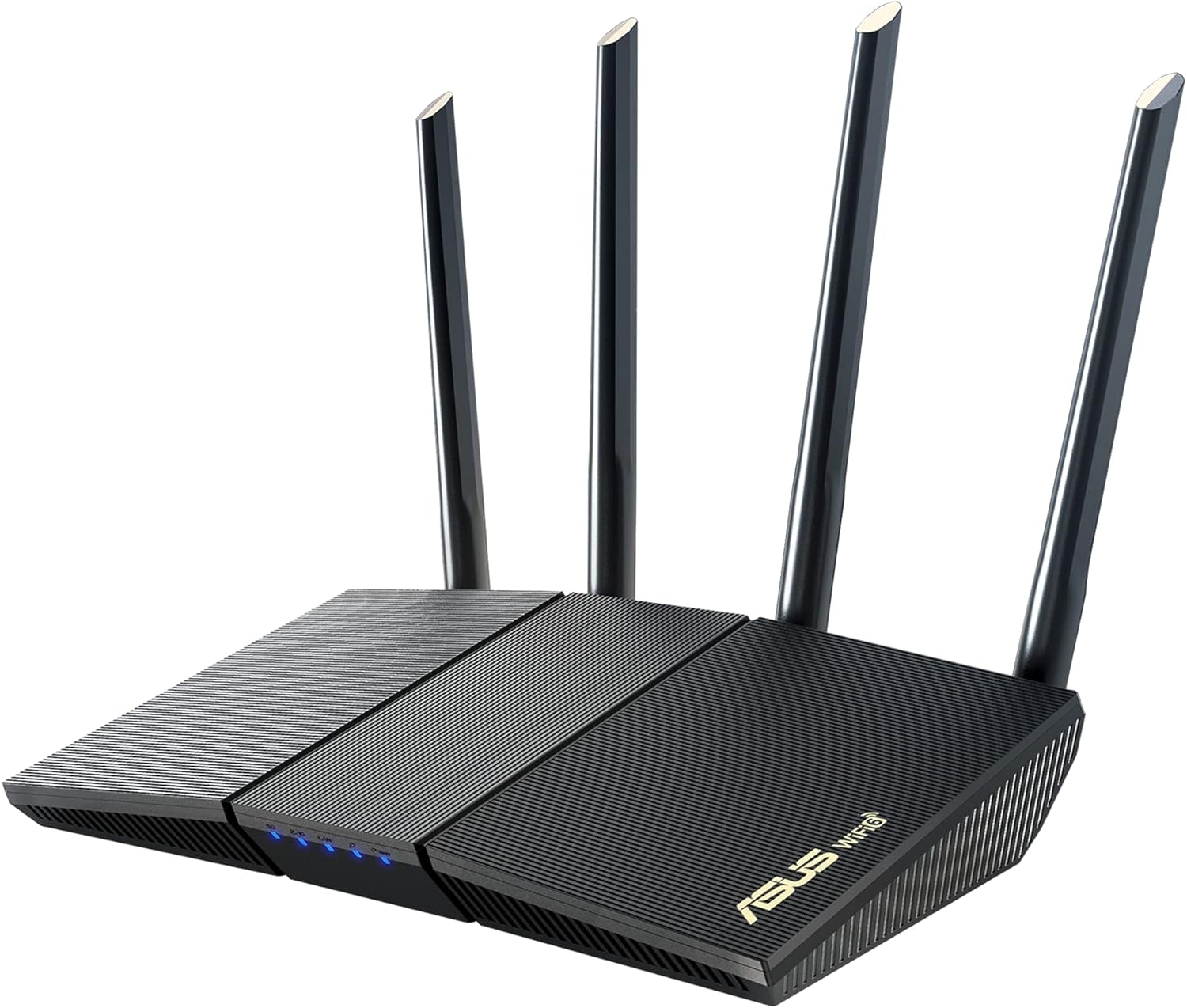
Pros
- Five gigabit ports, one WAN and four LAN, instead of the 100 Mbps ports common on entry Wi-Fi 6 units
- Trend Micro powered network protection runs with no ongoing subscription attached
- Four external antennas on a 2x2 dual-band radio using 1024-QAM and 80 MHz channels
- AiMesh support, so a second compatible unit extends one network name rather than adding a second SSID
- Instant Guard opens a one-click encrypted tunnel home from a laptop on public Wi-Fi
Cons
- 2x2 radios cap the 5 GHz band near 1201 Mbps, so a multi-gig line cannot be fully used
- No USB port, so a shared drive or printer cannot be attached to the router itself
- Dual-core processor and no 160 MHz channel support, which limits top single-client speed
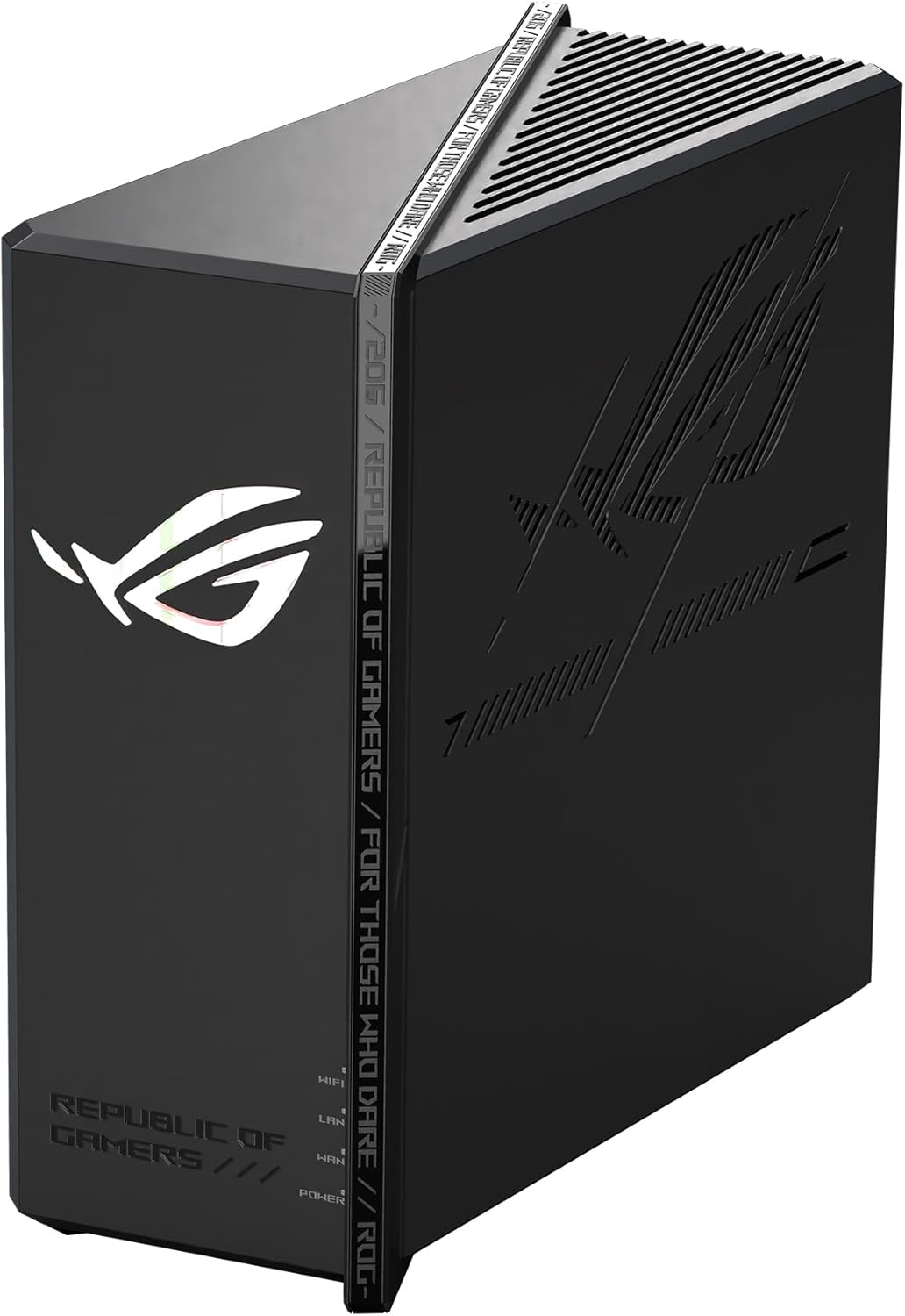
This is a 2x2 dual-band 802.11ax unit: roughly 1201 Mbps on 5 GHz and 574 Mbps on 2.4 GHz, radiated from four external antennas.
- 1024-QAM packs more data into each transmission than 256-QAM Wi-Fi 5 gear
- OFDMA splits one channel between several small transmissions instead of queueing them
- MU-MIMO serves two streams at once to capable clients
- Target Wake Time lets phones and sensors sleep between check-ins
The practical gain over an older AC1750 unit is not headline speed to a single laptop, it is behaviour when fifteen devices are awake. OFDMA cuts the airtime each small packet consumes, so a video call holds steady while a console downloads. Coverage depends heavily on wall construction: plasterboard and timber are kind, dense masonry is not.
The router app walks through the first boot: plug the WAN port into your modem, scan the label, name the network and set an admin password.
- Trend Micro powered filtering blocks known malicious sites with no ongoing fee
- Parental controls schedule access per device
- Built-in VPN server covering WireGuard and OpenVPN protocols
- Instant Guard builds an encrypted tunnel home from a laptop abroad
Change two settings straight away. Turn on automatic firmware updates, since router security depends on them, and give the 2.4 GHz and 5 GHz bands the same network name so devices roam between them without manual selection. If you later add a second compatible unit, AiMesh pairing is handled from the same app in a few taps.
The unit is a router, not a modem, so it connects to whatever your provider supplies.
- Works behind cable, fibre ONT, DSL and satellite terminals with an Ethernet handoff
- One gigabit WAN plus four gigabit LAN ports
- Power input 110 to 240 V, output 12 V at 1.5 A maximum
- PPPoE, dynamic and static WAN modes all supported
If your provider supplies a combined modem-router, put that box into bridge or modem mode first, because leaving two routers in series creates double NAT and breaks console networking and port forwarding. There is no USB socket, so shared storage needs its own network connection. For lines up to about 900 Mbps the gigabit WAN is the correct match; anything faster wants multi-gig hardware.

Pros
- AX3000 splits as 2402 Mbps on 5 GHz with HE160 channel width and 574 Mbps on 2.4 GHz
- One unit is specified to cover about 2,500 sq ft, with more units addable to the same mesh
- Three Gigabit Ethernet ports per unit, and any of them can serve as the WAN input
- Wired Ethernet backhaul is supported, so a Cat 5e run frees the radios entirely for clients
- Two-year warranty with 24/7 technical support, a year longer than many networking brands offer
Cons
- Ethernet ports are Gigabit only, so an internet plan above 1 Gbps will be capped by the wired interface
- No USB port, so shared drives and printers must hang off a computer instead
- This is a 1-pack and replaces the router only — most connections still need the provider modem in front of it
A single unit is specified to cover roughly 2,500 sq ft, which in practice means a typical two-storey home with the unit placed centrally and high rather than in a ground-floor corner.
- AX3000 breaks down as 2402 Mbps on 5 GHz (2x2 with HE160 channel width) and 574 Mbps on 2.4 GHz.
- Wi-Fi 6 brings OFDMA and MU-MIMO, which matter most when many devices are awake at once — support is quoted for over 150 connections.
- Real throughput to any one client sits below the radio figures, and HE160 needs a client that supports 160 MHz channels to approach the headline number.
- Adding a second unit extends coverage under one network name, with devices handed between units as you move.
Thick masonry walls, a converted loft or a detached garage all argue for two units rather than expecting one to reach.
Setup runs through the Deco app rather than a browser page. You connect the unit to the modem with Ethernet, power it up and follow the guided steps on a phone.
- The app handles naming the network, setting the password and checking the internet link, and takes about ten minutes for a first unit.
- Three Gigabit Ethernet ports sit on each unit and any one can act as the WAN input, so you are not tied to a fixed socket.
- Wired Ethernet backhaul is supported: run Cat 5e or better between units and the mesh link stops consuming wireless airtime.
- HomeShield adds network security features and parental controls from inside the same app.
Keep the app installed afterwards. Firmware updates, device lists and guest network toggles all live there rather than on a local web page.
This replaces your router, not your modem. Most connections still need the provider modem or ONT in front of it, with the Deco taking an Ethernet feed from that box.
- If your provider supplied a combined modem-router, switch it to bridge or modem mode before adding this unit, or you end up with two layers of network address translation.
- Ports are Gigabit, so a plan faster than 1 Gbps is limited by the wired interface no matter what the radios can do.
- It joins the same mesh as other Deco models, so an existing X20 or similar can stay in service alongside it.
- The manufacturer lists a two-year warranty and 24/7 technical support for most home products.
There is no USB socket, so network storage or a shared printer needs a computer or a separate NAS.

Pros
- Combined throughput up to 2882 Mbps on 5GHz plus 688 Mbps on 2.4GHz across dual bands using Wi-Fi 7's Multi-Link Operation
- Two 2.5 Gbps ports (one WAN/LAN switchable) plus three 1 Gbps LAN ports break past the single-gigabit bottleneck of older routers
- 2.0GHz quad-core processor and 4 internal antennas with beamforming target coverage up to 2,000 sq. ft. for up to 60 connected devices
- EasyMesh compatibility lets it pair with additional routers or extenders to expand coverage without replacing the whole system
- USB 3.0 port adds local network storage or printer sharing that many entry routers skip entirely
Cons
- Dual-band only, so it does not include the 6GHz band found on tri-band Wi-Fi 7 routers, reducing available spectrum in congested networks
- 2,000 sq. ft. coverage figure is on the smaller end for whole-home Wi-Fi 7 systems, so larger homes may need an EasyMesh extender
- HomeShield's advanced security and parental control features typically require an ongoing subscription beyond the basic free tier
The Archer BE230 is a dual-band BE3600-class Wi-Fi 7 router with combined speeds up to 2882 Mbps on 5GHz and 688 Mbps on 2.4GHz, using 4-stream Multi-Link Operation to keep connections stable as devices roam between bands. Four internal antennas with beamforming push signal toward hard-to-reach corners, with coverage figures up to 2,000 sq. ft. and support for up to 60 connected devices at once.
- Combined throughput up to 2882 Mbps (5GHz) and 688 Mbps (2.4GHz)
- 4-stream Multi-Link Operation for Wi-Fi 7 devices
- Coverage figures up to 2,000 sq. ft. for up to 60 devices
- 4K-QAM modulation for added data capacity per stream
Because this is a dual-band model, it skips the 6GHz band found on tri-band Wi-Fi 7 routers, which matters most in dense apartment buildings with heavy 5GHz interference from neighboring networks.
Physical connectivity runs through one 2.5G WAN/LAN switchable port, a second dedicated 2.5 Gbps LAN port, and three additional 1 Gbps LAN ports, so multi-gig internet plans and wired devices are not bottlenecked by a single gigabit port the way many entry-tier routers are. A USB 3.0 port adds local file sharing or printer connectivity without extra hardware.
- One 2.5G WAN/LAN switchable port plus a second 2.5 Gbps LAN port
- Three additional 1 Gbps LAN ports
- USB 3.0 port for shared storage or printers
- EasyMesh support to add extenders or additional routers later
The 2.0GHz quad-core processor is built to manage this port and antenna load without introducing lag, and EasyMesh compatibility means the network can grow into a mesh system later instead of requiring a full router swap.
The Archer BE230 works with any cable or fiber internet service since it is a standalone router rather than a modem-router combo, so it slots in behind whatever modem your provider supplies. It includes built-in VPN client and server support alongside HomeShield network security tools and Private IoT network separation for keeping smart home devices off the main network.
- Works with any standard cable or fiber modem, ISP-agnostic
- Built-in VPN client and server functionality
- Private IoT network separates smart home devices from primary devices
Advanced HomeShield features such as extended parental controls and deeper security scanning commonly sit behind an ongoing subscription, so check which protections are included at no extra cost versus which require a paid tier before relying on them.

Pros
- Total bandwidth of 6.5 Gbps across 2.4GHz and 5GHz bands with 6 spatial streams
- Two 2.5 Gbps ports (WAN/LAN and LAN) plus three 1 Gbps LAN ports
- Rated coverage up to 2,400 sq ft and 90 simultaneously connected devices
- USB 3.0 port for network-attached storage or printer sharing
- WPA3 encryption plus a separate managed network for IoT devices
Cons
- Dual-band design only, with no dedicated 6GHz band despite the Wi-Fi 7 label
- Full 5764 Mbps and 6.5 Gbps figures are only reached with Wi-Fi 7 client devices; older phones and laptops connect at lower legacy speeds
- Deeper security scanning and remote management run through the cloud-connected Tether app rather than working fully offline
This dual-band Wi-Fi 7 router combines a 5764 Mbps 5GHz band with a 688 Mbps 2.4GHz band for 6.5 Gbps of combined bandwidth across 6 spatial streams.
- Rated coverage of up to 2,400 sq ft with 6 external antennas and beamforming
- Supports up to 90 simultaneously connected devices
- Multi-Link Operation combines both bands for lower latency on supported clients
Because this is a dual-band design rather than tri-band, there is no dedicated 6GHz lane; devices without Wi-Fi 7 support fall back to standard 5GHz or 2.4GHz speeds rather than the peak combined figure. For a typical single-floor or small two-floor home, the antenna layout and beamforming keep signal consistent across rooms, though a very large multi-floor house may still benefit from a mesh add-on at the edges of the stated coverage area.
Setup runs through the Tether app, which walks through connecting the WAN port to a modem and configuring the wireless network name and password in a few steps.
- 1x 2.5 Gbps WAN/LAN port, 1x 2.5 Gbps LAN port, and 3x 1 Gbps LAN ports
- 1x USB 3.0 port for a shared drive or printer
- Powered by an included 12V 2.5A adapter
The unit measures 10.6 x 6 x 1.9 inches and stands vertically, so placement needs a bit of clearance around the antennas rather than lying flat under other equipment. Guest networks, port forwarding, and a separate IoT network are all configurable from the same app, and firmware updates are pushed automatically once cloud services are enabled during setup.
The 2.5 Gbps WAN port supports multi-gig internet plans when paired with a compatible modem, while standard gigabit or slower ISP connections still work through the same port without any adapter needed.
- Supports IPv4 and IPv6, PPPoE, and dynamic or static IP connection types common across ISPs
- WPA3 encryption plus a separate network for IoT devices through HomeShield
- Compatible with Alexa and Google Assistant for voice-based network commands
Because the 2.5 Gbps WAN port only reaches its full speed with a matching multi-gig plan, anyone on a standard gigabit or lower connection will see their own connection's ceiling rather than the port's ceiling. HomeShield's deeper security scanning and parental controls are managed through the cloud-connected Tether app rather than a fully local dashboard.

Pros
- Covers up to 2,500 square feet and supports up to 80 connected devices simultaneously per the maker's figures
- WiFi 7 dual-band radios reach combined speeds up to 6.5Gbps (BE6500 class), about 2.4 times faster than a WiFi 6 router by the same spec sheet
- 2.5 Gig WAN port supports multi-gig internet plans beyond what a standard 1 Gig port allows
- LAN side includes 1x 2.5 Gig port plus 3x 1 Gig ports for wired devices needing higher throughput
- NETGEAR Armor adds an automatic security shield across all connected devices on the network
Cons
- This is a router only, with no built-in modem, so a separate cable or fiber modem is required to actually reach the internet
- Reaching the full 2.5Gbps WAN speed requires an internet plan and modem that also support 2.5Gbps, so a slower plan or older modem caps throughput well below the router's ceiling
- Coverage of 2,500 sq ft and 80 devices is the entry point in NETGEAR's WiFi 7 Nighthawk line, with larger homes needing a higher model in the same series for more coverage or device capacity
The RS200 is a dual-band WiFi 7 router figured in the BE6500 class, reaching combined wireless speeds of up to 6.5Gbps across its bands, a figure the maker positions as roughly 2.4 times faster than a comparable WiFi 6 router. Coverage is specified at up to 2,500 square feet with support for as many as 80 connected devices at once, figures that sit at the entry point of NETGEAR's current WiFi 7 Nighthawk lineup.
Wired connectivity includes a 2.5 Gig internet (WAN) port for multi-gig internet plans, plus 1x 2.5 Gig and 3x 1 Gig LAN ports for wired devices such as a desktop PC, a NAS or a games console needing a stable, high-throughput connection.
- WiFi class: WiFi 7, BE6500 (up to 6.5Gbps)
- Coverage: up to 2,500 sq. ft.
- Device capacity: up to 80
- WAN port: 2.5 Gig
This listing is for the router only; it does not include a built-in cable modem, so a separate modem with coax input is required to connect to a cable internet service, or an ONT for fiber service. It is compatible with any internet service provider, since the router itself just needs a wired connection from a modem into its WAN port.
To reach the router's full 2.5Gbps WAN speed, both the internet plan and the modem feeding it need to support that same 2.5Gbps figure; a standard 1 Gig plan or an older modem will cap throughput at that lower ceiling regardless of the router's own capability. NETGEAR Armor runs in the background once set up, adding automatic monitoring across every device connected to the network.
- Modem: not included, required separately
- WAN speed ceiling depends on modem and ISP plan
- Security: NETGEAR Armor included
This router suits households in roughly a 2,500 square foot home running up to about 80 devices between phones, laptops, smart home gadgets, and streaming devices, wanting a step into WiFi 7 without the coverage of a larger mesh system. Gamers and anyone doing frequent 4K streaming or video conferencing benefit from the added bandwidth WiFi 7 provides across multiple devices at once.
Larger homes beyond 2,500 square feet, or households needing to connect more than 80 devices, are better matched to a higher model in the same Nighthawk WiFi 7 range built for greater coverage and device capacity. Anyone without a modem already in place will need to plan for that as a separate purchase alongside this router.
Pros
- Individual weight pouches allow customizable resistance levels
- Soft moisture-absorbing fabric cushions skin to prevent chafing
- Sturdy hook-and-loop closure straps hold weights firmly during movement
- Reinforced double stitching prevents internal filling leakage
- Ideal for walking routines, leg lifts, cardio, and physical therapy
Cons
- Requires securing straps tightly to prevent slipping during active runs
- Not recommended for high-impact jumping exercises to protect joints
These adjustable ankle weights add targeted resistance to intensify walking workouts, leg exercises, core training, and physical rehabilitation routines. Designed with removable weight inserts, users can adjust total resistance to match their current fitness level and workout goals. Wearing these weights during daily walks or leg lifts increases calorie burn while strengthening calves, thighs, and lower body muscles. Fitness enthusiasts of all levels can use these versatile weights to improve exercise efficiency in home workouts or outdoor walking routines across every workout session.
Constructed from soft, breathable neoprene fabric, these ankle wraps cushion skin comfortably to minimize friction and chafing during repetitive leg movements. Heavy-duty hook-and-loop adjustment straps adjust easily around ankles or wrists of different sizes, keeping weights locked in place during active movement. Double-stitched seam construction holds weight inserts securely, preventing leaks during intense exercise. The comfortable fabric lining keeps skin dry, allowing you to focus entirely on maintaining proper exercise form throughout your workout, home physical training, and daily exercise routines.
For optimal comfort, wrap the straps snugly around lower ankles or wrists just above shoe cuffs before starting your exercise session. Starting with lighter weight inserts lets your muscles and joints adapt gradually before increasing load levels over time. After workouts, wipe down the fabric exterior with a damp cloth and let the weights air dry completely before storing them in a workout bag or closet. Proper maintenance ensures durable performance for daily fitness routines, leg exercises, and home workouts.
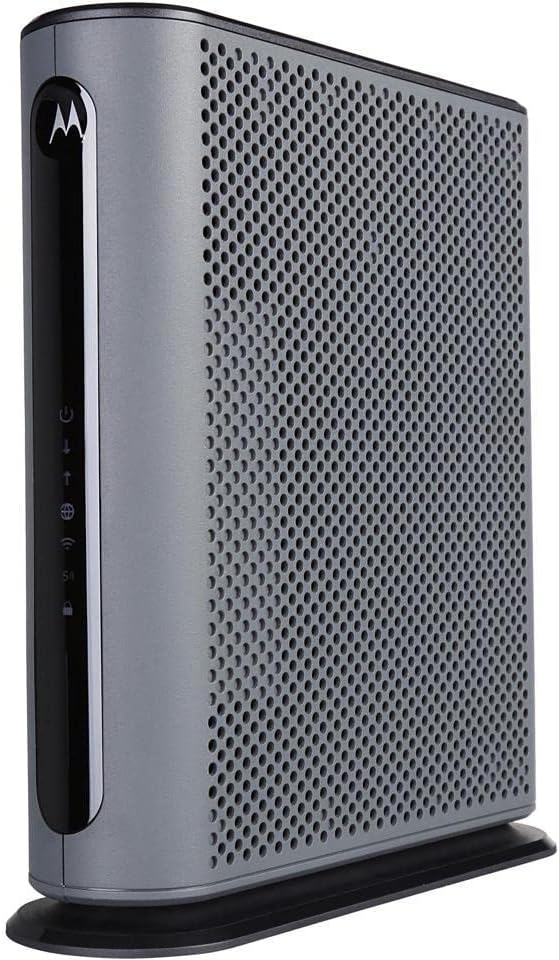
Pros
- 16x4 DOCSIS 3.0 channel bonding supports actual cable service speeds up to 375 Mbps
- AC1900 dual-band Wi-Fi runs 2.4GHz and 5GHz simultaneously alongside 4 Gigabit Ethernet ports
- Built-in DFS support opens extra 5GHz channels that most routers cannot access, cutting neighbor interference
- Broadcom modem chipset adds denial-of-service attack protection at the hardware level
- Combines modem and router into one unit, removing a second power cable and box from the desk
Cons
- No phone jack, so it cannot be used for any landline or VoIP calling service
- Only compatible with cable internet; fiber, DSL and satellite services such as Verizon, AT&T or CenturyLink will not work with it
- AC1900 Wi-Fi standard predates Wi-Fi 6, a ceiling for the newest high-throughput client devices
The modem side uses 16x4 DOCSIS 3.0 channel bonding, rated for actual cable internet service speeds up to 375 Mbps. The router side runs AC1900 dual-band Wi-Fi across 2.4GHz and 5GHz simultaneously, with Power Boost amplifying the wireless signal to the FCC-allowed limit for extended range.
- Four Gigabit Ethernet LAN ports handle wired connections to PCs, game consoles or streaming boxes
- DFS channel support opens additional 5GHz spectrum that standard routers cannot use, reducing crowding from neighboring Wi-Fi networks
- AnyBeam beamforming focuses the wireless signal toward connected devices instead of broadcasting evenly in all directions
Larger homes with multiple floors may still see weaker signal at the far edges, since this is a single-unit router rather than a mesh system.
Because the modem and router are combined into one unit, setup involves connecting a single coax cable from the wall and a single power cord, rather than pairing two separate boxes. Activation is completed with the cable provider using the device's serial number and MAC address.
- Four Gigabit Ethernet ports are ready for immediate wired connections out of the box
- A built-in firewall and Broadcom chipset add protection against denial-of-service attacks by default
- No phone jack is present, so this model cannot support telephone or VoIP service
Since it is not a mesh unit, homes with dead zones will need a separate access point added to the network.
This modem is approved for use with Comcast Xfinity (including X1), Cox, Charter Spectrum, Time Warner Cable, Suddenlink, WOW!, CableOne and several other cable internet providers. Buyers should confirm their specific provider's approved device list before ordering, since approval can vary by region.
- Not compatible with fiber, DSL or satellite services from Verizon, AT&T, CenturyLink, Frontier and similar providers
- Requires an active cable internet subscription; it does not work as a standalone Wi-Fi router without one
- Replaces a rented modem/router combo from the provider, removing that unit from the account once activated
Anyone switching providers in the future should re-check the approved device list, since not every cable company accepts every third-party modem model.

Pros
- Tri-band radios at 2402 Mbps on 6GHz, 2402 Mbps on 5GHz and 574 Mbps on 2.4GHz
- 2.5 Gbps port usable as either WAN or LAN, for multi-gig service or a wired NAS
- 1.0 GHz dual-core CPU with 512 MB of memory and six high-gain antennas with beamforming
- 160MHz channels on the 6GHz band, clear of legacy device traffic and neighbouring overlap
- Runs OpenVPN, PPTP and L2TP as both server and client, with WPA3 and a 2-year warranty
Cons
- Only Wi-Fi 6E clients can use the 6GHz band, and 6GHz signal attenuates faster through walls than 5GHz
- A separate modem is still required for most cable and DSL services
- Just one 2.5 Gbps port, so a second multi-gig wired device drops back to Gigabit
Three radios rather than two: 2402 Mbps on 6GHz, 2402 Mbps on 5GHz and 574 Mbps on 2.4GHz, making up the 5400 Mbps combined headline. The 6GHz band is the reason to buy a 6E unit at all, because it carries no legacy traffic from older devices and has room for 160MHz channels without overlapping the neighbours.
Six high-gain antennas with beamforming shape signal toward connected devices, and OFDMA plus true tri-band working raises capacity roughly fourfold against a comparable dual-band unit when many devices are active at the same time.
Behind the radios sit a 1.0 GHz dual-core CPU and 512 MB of memory, which is what stops throughput collapsing when dozens of clients, QoS rules and a VPN tunnel are all live at once. The housing is shaped for heat dissipation rather than stacking.
The standout wired feature is the 2.5 Gbps port, which can face either direction. Used as WAN it lets a multi-gig cable or fibre service exceed the old Gigabit ceiling; used as LAN it gives one machine, typically a NAS or a workstation, a 2.5 Gbps link to the rest of the network.
Setup runs through the Tether app, which handles connection type, network naming and firmware. Do the firmware update first, before anything else gets configured.
VPN support is unusually complete for a home unit. It runs as both a server and a client, covering OpenVPN, PPTP and L2TP, so you can either reach your home network from outside or push household traffic out through a provider. Security is WPA3, and the unit carries a 2-year warranty.
It works with any provider that hands off an Ethernet connection, including AT&T, Verizon, Xfinity, Spectrum, RCN, Cox, CenturyLink and Frontier. As with any standalone router, a separate modem is still needed for most cable and DSL services, so this replaces the router half of an existing gateway rather than the whole box.
On the client side, only Wi-Fi 6E devices can use the 6GHz band. Recent flagship phones, current laptops and newer 6E adapters qualify; anything older sits on 5GHz or 2.4GHz and sees no benefit from the third radio at all. Worth knowing too: 6GHz attenuates faster through walls than 5GHz, so the fastest band is also the shortest ranged.
OneMesh support lets a compatible extender join as a single roaming network name rather than appearing as a second SSID.

Pros
- Dual-band throughput quoted at 867 Mbps on 5 GHz and 300 Mbps on 2.4 GHz
- Four fixed external antennas with beamforming, covering roughly 1,000 sq ft
- WPA3 encryption alongside guest networking and keyword-based parental controls in the companion app
- EasyMesh support lets it pair with any EasyMesh router or extender to form one roaming network
- Router, access point and range extender modes, plus IPv6 and IPTV handling through IGMP and tagged VLANs
Cons
- The WAN and LAN ports are 10/100 Mbps, so wired devices cannot exceed about 100 Mbps whatever your line delivers
- Wi-Fi 5 hardware with no Wi-Fi 6 support and no 6 GHz band
- No USB port, so network storage and printer sharing are off the table, and a separate modem is still required
This is a dual-band AC1200 router: up to 867 Mbps on 5 GHz and 300 Mbps on 2.4 GHz, quoted as 1,200 Mbps combined because the two bands are simply added together.
- Four fixed external antennas with beamforming aim signal at connected devices rather than radiating evenly in all directions
- Coverage is quoted at around 1,000 sq ft, which suits an apartment or a compact single-floor home
- MU-MIMO with two spatial streams lets it serve several devices at once instead of in turn
- 5 GHz handles streaming and gaming, while 2.4 GHz reaches further through walls for doorbells and sensors
For a larger home or thick internal walls, pair it with an EasyMesh extender to form one roaming network rather than a second, separate network name.
Setup runs through the maker's mobile app on Android or iOS, or through a browser page if you prefer a keyboard.
- Connect the WAN port to your existing modem, power up, and follow the prompts
- Set the wireless names and passwords, then let the app check for a firmware update - keeping firmware current is the main ongoing security task
- Guest Wi-Fi is a single toggle and keeps visitors off the main network
- Parental controls block sites by keyword and limit access times per device
- Access Point mode turns it into a wireless bridge behind an existing router, while range extender mode rebroadcasts a network you already have
The unit accepts 100-240 V input, so it travels internationally with nothing more than a plug adapter.
This is a router, not a modem. Cable, DSL and fibre lines each need their own modem or ONT in front of it, which most providers supply as part of the service.
- It speaks standard DHCP, PPPoE and static IP connection types, covering the major providers
- IPv6 is supported, which several providers now hand out by default
- IPTV set-top boxes are handled through IGMP Proxy and Snooping, bridge mode and tagged VLANs where the provider requires them
- WPA3 is available for devices that support it, with WPA2 fallback for older equipment
The limitation to plan around is the wired side: every Ethernet port is 10/100 Mbps. If your line delivers more than roughly 100 Mbps, wired devices will never see it.
Why Buy Your Own Router for Spectrum?
Spectrum bundles a wireless router into many of its plans, and while it works, it comes with trade-offs. First, there is the ongoing rental cost that adds up month after month. Over the course of two or three years, that fee often exceeds the price of a capable router you could own outright. Second, provider-supplied hardware is frequently a few generations behind, which means you may not get the WiFi 6 or WiFi 7 performance that modern devices are built to take advantage of.
Buying your own device also gives you control. You choose the features, the coverage footprint, and the security tools. Whether you want built-in parental controls, a VPN, or a mesh system that blankets a large house, the aftermarket offers far more flexibility than a one-size-fits-all rental. Options like the TP-Link Archer AX21 deliver solid WiFi 6 performance at a budget-friendly price, making them an easy upgrade over standard rental gear.
Understanding Spectrum Compatibility
The single most important thing to understand is the difference between a router and a modem. Spectrum is a cable internet service, so you need a device that connects to the coaxial line coming into your home. There are two ways to handle this.
Separate Modem and Router
Most Spectrum customers already have a Spectrum modem (or a rented one) that handles the internet connection. In that case, you only need to buy a standalone router. This is the most flexible approach because you can upgrade the router independently whenever a better standard arrives. Nearly every router in this guide, from the ASUS RT-AX1800S to the TP-Link Archer AXE75, is a standalone router that plugs into an existing modem.
Modem-Router Combo Units
If you want to eliminate the Spectrum modem rental entirely, a combo unit does both jobs in one box. The Motorola MG7550 is a good example. It is a DOCSIS 3.0 cable modem and AC1900 router in a single device, and it is explicitly approved for Spectrum, Xfinity, Cox, and other cable providers. A combo unit can save you the most money on rental fees, but keep in mind that when you want to upgrade your WiFi later, you will have to replace the whole unit rather than just the router half.
Match the Router to Your Spectrum Speed Tier
Spectrum plans vary widely, and there is little point in overpaying for a router that far outpaces your subscription, or underbuying one that bottlenecks it. Here is a simple way to think about it.
- Plans up to 300 Mbps: An affordable dual-band router is plenty. Something like the TP-Link Archer A54 or the Archer AX21 will comfortably handle everyday browsing, streaming, and video calls without breaking a sweat.
- Plans from 300 to 500 Mbps: Step up to a stronger WiFi 6 router with gigabit ports so wired and wireless devices alike get full speed. The ASUS RT-AX1800S and the mesh-ready TP-Link Deco X55 both fit this range well.
- Gigabit plans (940 Mbps and up): You want a router with a 2.5 Gigabit WAN port so the internet connection itself is not the limit. WiFi 7 models such as the TP-Link Archer BE230 and TP-Link Archer BE400 include multi-gig ports built for these faster tiers.
Buying slightly ahead of your current plan is reasonable if you expect to upgrade your Spectrum service, but there is no need to spend on a 12 Gbps flagship if you are on a 200 Mbps plan.
WiFi 6, WiFi 6E, and WiFi 7 Explained
The WiFi standard printed on the box tells you how modern and future-proof the router is. Understanding the differences helps you decide how much to spend.
WiFi 6
WiFi 6 (802.11ax) is the current mainstream standard and the sweet spot for most Spectrum households. It improves efficiency in homes with many connected devices, reduces lag, and boosts battery life on phones and laptops. The Archer AX21, RT-AX1800S, and Deco X55 are all WiFi 6 devices that offer excellent value.
WiFi 6E
WiFi 6E adds an entirely new 6 GHz band on top of the usual 2.4 GHz and 5 GHz. This extra band is clean and congestion-free, which is great for gaming and high-bandwidth streaming. The TP-Link Archer AXE75, a tri-band WiFi 6E router and PCMag Editors’ Choice, is a strong pick if you have newer devices that support the 6 GHz band.
WiFi 7
WiFi 7 (802.11be) is the newest standard, offering higher throughput, lower latency, and a feature called Multi-Link Operation that lets devices use multiple bands at once. If you want the most future-proof setup, WiFi 7 routers like the Archer BE230, Archer BE400, the NETGEAR Nighthawk RS200, and the high-end ASUS ROG Strix GS-BE12000 gaming router represent the cutting edge. They cost more today but will stay relevant as your devices catch up.
Coverage and Home Size
Speed means nothing if the signal cannot reach your bedroom or backyard. Coverage is determined by the router’s antennas, transmit power, and whether it uses a single unit or a mesh network.
For apartments and smaller homes under about 1,500 square feet, a single powerful router such as the Archer AX21 or Archer AXE75 is usually enough. For medium homes, look at the coverage rating on the box. The Archer BE400, for instance, covers up to 2,400 square feet and up to 90 devices, while the NETGEAR Nighthawk RS200 reaches around 2,500 square feet.
For larger or multi-story homes, and for houses with thick walls or awkward layouts, a mesh system is the better answer. The TP-Link Deco X55 is designed exactly for this. A single unit covers up to 2,500 square feet, and you can add more nodes to expand seamlessly under one network name. Many standalone routers here, including the ASUS models with AiMesh and the TP-Link models with EasyMesh, can also be paired with matching units later to build a mesh network as your needs grow.
Features Worth Paying Attention To
Beyond raw speed, several features can make daily life easier and your network safer.
- Multi-gig ports: A 2.5 Gbps WAN or LAN port future-proofs your setup for gigabit-plus Spectrum plans. The Archer BE230, Archer BE400, and Nighthawk RS200 all include one.
- Built-in security: Look for subscription-free protection. TP-Link’s HomeShield and the ASUS AiProtection suite guard your network without extra monthly fees, and several models include a built-in VPN.
- Parental controls: If you have kids, features that limit screen time and filter content are invaluable. The RT-AX1800S and most TP-Link routers offer this out of the box.
- USB ports: Models like the Archer BE230 and Archer BE400 include USB 3.0 ports for sharing a drive or printer across your network.
- Smart home support: Several routers work with Alexa and offer dedicated IoT networks to keep your smart devices isolated and secure.
Gaming and Streaming Considerations
If your household leans heavily on online gaming or 4K streaming, prioritize low latency and dedicated bandwidth. Tri-band routers give you an extra lane of traffic so heavy users do not slow everyone else down. The ASUS ROG Strix GS-BE12000 is a tri-band WiFi 7 gaming router built specifically for competitive play, while the tri-band Archer AXE75 balances gaming performance with everyday value. For streaming-focused homes, a strong WiFi 6 router like the Archer AX21 paired with a gigabit connection is often all you need.
How to Set Up Your Own Router on Spectrum
Getting a personal router running on Spectrum is straightforward. If you are keeping the Spectrum modem, simply connect an Ethernet cable from the modem to the WAN port on your new router, power both devices, and follow the router’s app to configure your network name and password. Most modern routers, including the TP-Link and ASUS models here, walk you through this in a few minutes using a smartphone app.
If you are replacing the Spectrum modem with a combo unit like the Motorola MG7550, you will need to activate the device on your account. This usually means calling Spectrum or using their activation page and providing the modem’s identifiers, which are printed on the label. Once activated, your combo unit handles both the internet connection and your WiFi.
Final Thoughts on Choosing the Best Router for Spectrum
The right router for you comes down to three questions: what speed tier are you on, how large is your home, and how future-proof do you want to be. Budget-conscious users on standard plans will be well served by an affordable WiFi 6 router like the TP-Link Archer AX21 or the Archer A54. Those who want to cut the modem rental entirely should consider the Motorola MG7550 combo. Larger homes benefit from the Deco X55 mesh system, and anyone on a gigabit plan or planning ahead should look at WiFi 7 options like the Archer BE230, Archer BE400, or NETGEAR Nighthawk RS200.
Whatever you choose, owning your router pays off in better performance, wider coverage, and real savings over the life of your Spectrum plan. Match the device to your home and your speed tier, and you will get every megabit you are paying for.






