 Sofia Marchetti
 The best wireless light bulbs solve a problem that trips up almost every home at some point: you want light somewhere there is no convenient wiring or outlet. Maybe it is a sconce that was never hardwired, a closet with no fixture, a rental where you cannot run new circuits, or a power outage that leaves you fumbling in the dark. Wireless, battery-powered, and rechargeable light bulbs put bright, controllable light exactly where you need it, no electrician required.
This guide explains how to choose the best wireless light bulbs for your situation, covering the different types, power and runtime, brightness and color options, controls, and safety. Rather than reviewing individual bulbs in depth, we focus on the decisions that lead you to the right choice for lamps, sconces, closets, and emergency backup.

Pros
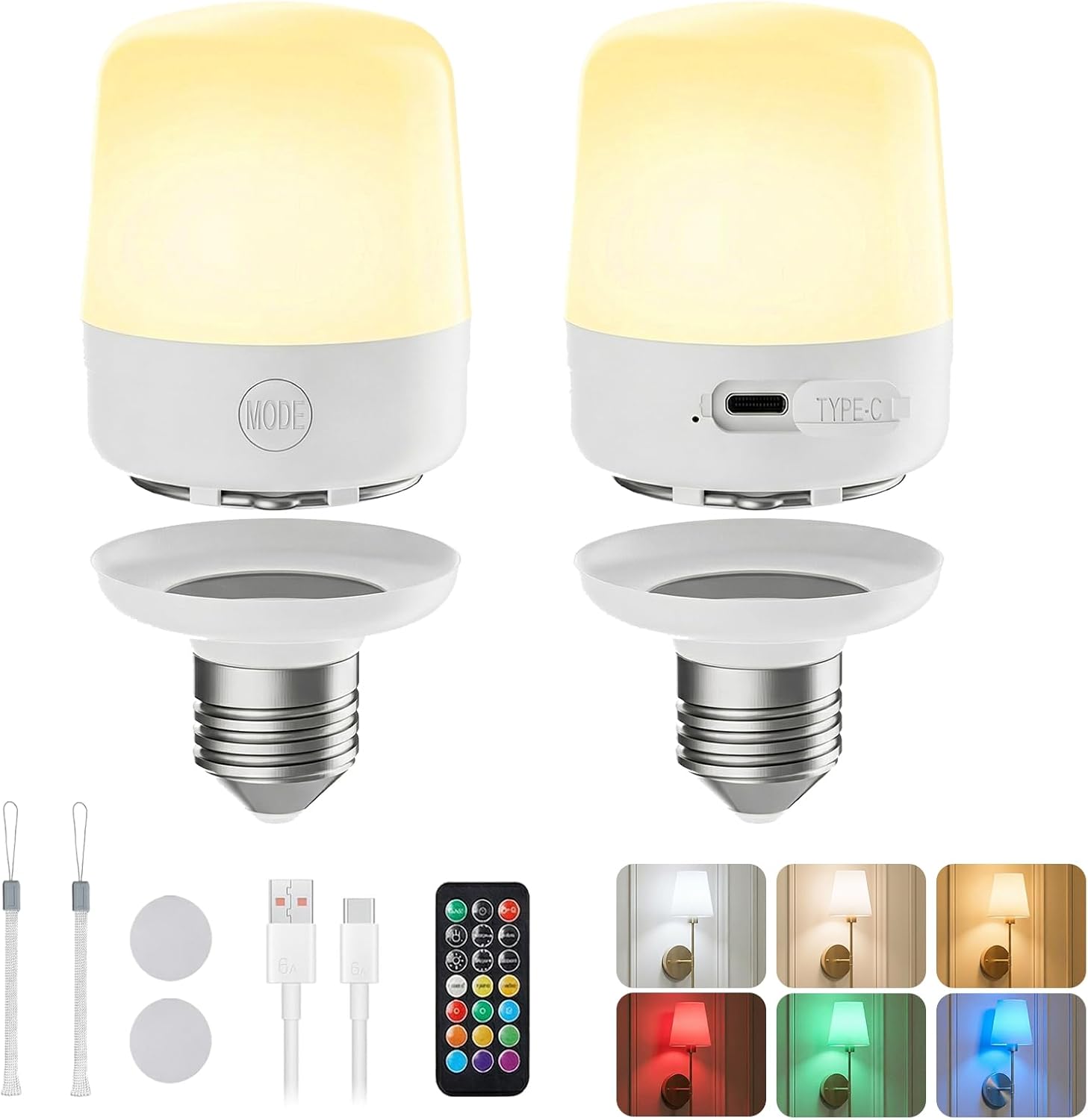
- A 2400mAh cell drives 7W for 700 lumens, roughly matching a 40 watt incandescent bulb
- Runs 6 to 9 hours from a 4 to 6 hour charge over the supplied Type-C cable
- Remote works to about 10 metres and selects 3 whites plus 9 RGB colors, with 30 and 120 minute timers
- Magnetic base stays screwed into the socket while the head pulls away to charge, so no unscrewing is needed
- A 3M adhesive pad and lanyard let the same bulb work in a wardrobe, cupboard or tent as well as a fitting
Cons
- There is no mains power path, so once the cell empties the light is out until it has been recharged
- At 700 lumens it falls short of the 800 lumens a 60 watt equivalent bulb produces
- The battery is built in and not user replaceable, which caps the useful service life of the bulb
The whole point of this bulb is that it carries its own power. A 2400mAh cell supplies a 7W LED, producing 700 lumens with no wiring behind it.
- Run time is quoted at 6 to 9 hours, with the spread depending on brightness setting and colour mode
- A full charge takes 4 to 6 hours over the supplied Type-C cable, using the same charger as a modern phone
- The magnetic base is the clever part. The screw section stays in the socket permanently while the illuminated head detaches magnetically for charging, so there is no repeated screwing and unscrewing
- Memory mode restores the last used colour and brightness on the next power up
Two bulbs per pack allows one to charge while the other is in the fitting, which is the practical way to run a sconce continuously without ever leaving a dark socket.
Control is entirely by the bundled remote, which works across roughly a 10 metre range and covers everything the bulb can do.
- Three white settings are available: warm white, natural white and cold white, so the same bulb suits a bedroom in the evening and a wardrobe in the morning
- Nine RGB colours add accent lighting for a shelf, a party or a child's room
- Brightness is adjustable across the range rather than fixed at full output
- Timers can be set at 30 or 120 minutes, so it shuts off on its own after bedtime reading or a camping evening
Remote control is especially useful given where these bulbs tend to end up: high sconces, deep cupboards and tent ceilings, all places where reaching the fixture to press a switch is inconvenient.
Three mounting methods ship in the box, which is why this is more flexible than a standard replacement bulb.
- Screw into any E26 socket, the obvious use in a decorative sconce or lamp that was never wired to a supply
- Stick the magnetic base to a surface with the included 3M adhesive pad, turning a cupboard interior, wardrobe rail or under-shelf into a lit space
- Hang it from the supplied lanyard, which covers tent ceilings, awnings, garages and temporary work areas
The strongest case is a fixture with no hardwiring: a decorative wall sconce in a rented flat, a pendant over a stairwell with no supply, or an outbuilding with no circuit. It also functions as power-cut backup, provided the cell is kept charged rather than left flat between uses.

Pros
- 2000mAh battery drives brightness up to 350 lumens, enough to light a hallway or closet without wall power
- 15 color and white-temperature options plus 10 brightness steps from 10% to 100% cover both task light and mood lighting
- Three built-in timers (30, 60, and 120 minutes) shut the light off automatically so it won't run down overnight
- 2.76-inch diameter fits standard E26 sockets, and a magnetic base or double-sided adhesive works for sconces with no socket at all
- Type-C charging replaces the older micro-USB connectors found on many rechargeable puck lights
Cons
- Sold as a 2-pack only, so lighting a 4-bulb fixture needs two separate orders
- Battery is built in and not user-replaceable, so total lifespan is tied to the internal 2000mAh cell
- Remote control relies on line of sight, so it won't trigger the bulb through a closed cabinet door
Each bulb combines 12 RGB colors with 3 white color temperatures, 3000K warm white, 4000K natural white, and 6000K cool white, for 15 total lighting options. 10 dimmable brightness grades from 10% to 100% let you scale from a soft night-light glow up to full task lighting from the same fixture.
Two lighting modes round out the feature set: a smooth mode that fades gradually between colors for ambiance, and a flash mode that cycles quickly through all 12 RGB colors. With 15 LED beads producing up to 350 lumens, the output is bright enough for general room lighting, not just accent use, while still being small enough to fit inside a standard puck-light housing.
The bulb measures 2.76 inches in diameter, sized to fit standard E26 fixtures without looking oversized once installed. For sconces or fixtures with no live socket, the base unscrews and the bulb can instead be mounted with the included magnetic strip or double-sided adhesive tape, making it workable in places with no wiring at all.
Because it is non-hardwired, there is no electrician or wiring work involved, it simply screws in, sticks on, or attaches magnetically. This makes it suited to wall sconces, closets, stairwells, or rental spaces where running new electrical isn't an option. The remote and an onboard press-button both control power and mode, so the bulb can be operated even after it's mounted somewhere hard to reach.
Power comes from a built-in 2000mAh rechargeable battery, larger than the cells used in many similar puck lights, which helps it sustain higher brightness for longer between charges. Two Type-C charging cables are included in the box, matching the connector used on most current phones and laptops rather than an older micro-USB tip.
Three timer settings, 30, 60, and 120 minutes, let the bulb shut off on its own instead of running until the battery empties, useful for overnight use in a bedroom or hallway. Runtime at full brightness will be shorter than at lower dimming levels, so buyers planning extended use each night should expect to recharge more often when running the bulb near 100% output.
Pros
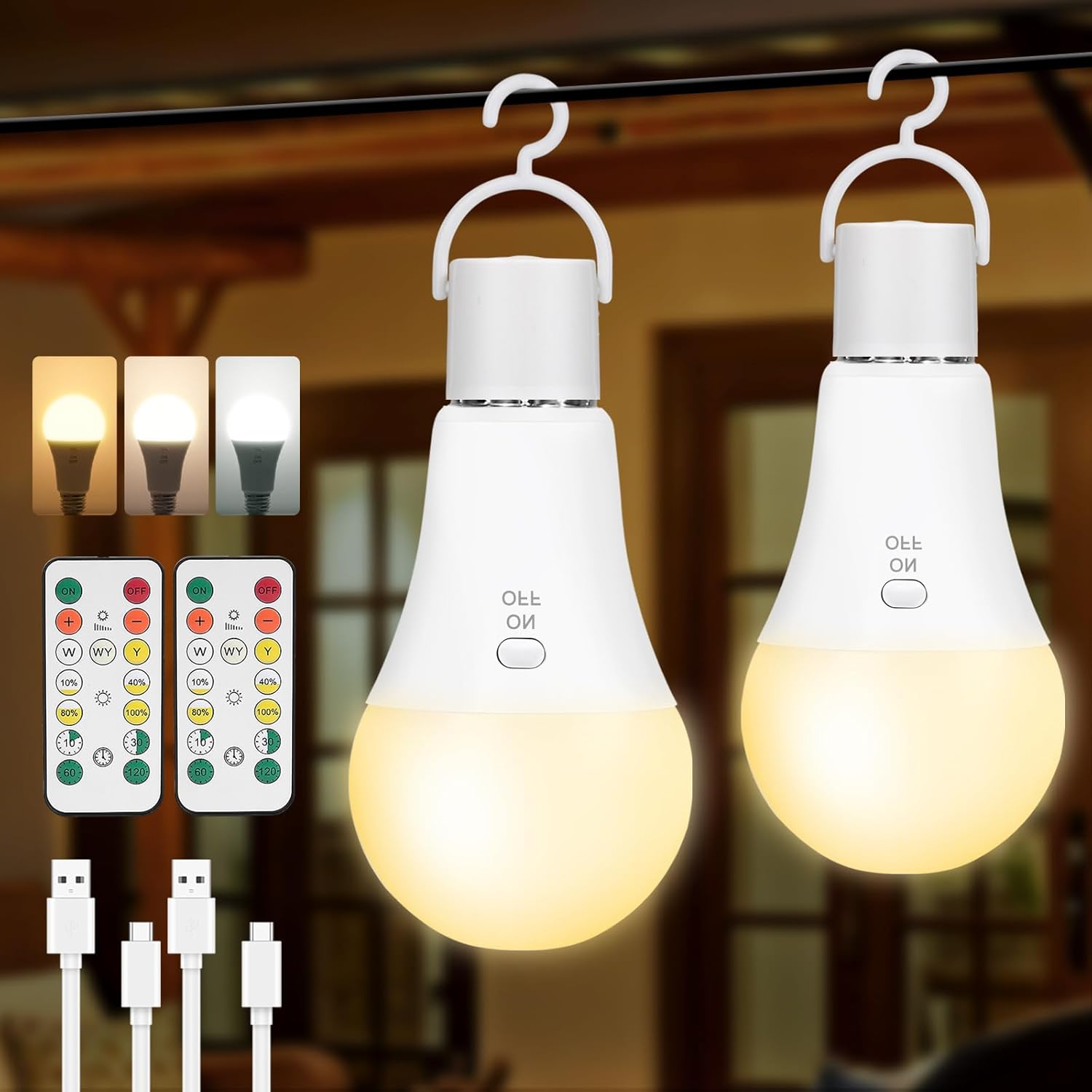
- 2300mAh battery runs 20 to 50 hours per charge and refills in 3 to 4 hours over Type-C
- 9 RGB colors plus 3 white temperatures (3000K, 4000K, 6000K) cover mood and task lighting
- Stepless dimming lets brightness be tuned gradually rather than in fixed steps
- 3 mounting options, screw-in E26, magnetic, or hanging, fit fixtures without one
- Built-in 30 or 120-minute auto-off timer suits bedtime or short-event use
Cons
- Battery life of 20 to 50 hours means more frequent recharging under daily heavy use than a wired bulb
- Standard E26 screw base is included, but no E12/E14 candelabra adapter ships in the box
- Two lighting modes (Smooth, Flash) is a narrower pattern set than dedicated party-light strings offer
A built-in 2300mAh battery runs the bulb for 20 to 50 hours per charge depending on brightness and color settings, and recharges fully in 3 to 4 hours over the included Type-C USB cable. That range makes the bulb usable well away from an outlet, whether that is a shed, a tent, or a room without a working fixture.
Because the bulb depends on that internal battery, regular daily use at higher brightness will land toward the lower end of the 20-50 hour range, meaning frequent users will recharge more often than someone using it only for occasional accent lighting or backup power during an outage.
Color options span 9 RGB colors plus 3 white color temperatures at 3000K warm white, 4000K natural white, and 6000K cool white, covering both mood lighting and task lighting from the same bulb. Stepless dimming lets brightness be adjusted smoothly rather than snapping between preset levels.
Two lighting modes, Smooth and Flash, control how the RGB colors transition, either gently cycling or switching more abruptly between them. That is a narrower pattern set than dedicated party-light strings offer, so buyers wanting elaborate multi-effect sequences may find the two-mode set more limited than a purpose-built decorative light string.
Three mounting options are available: a standard E26 screw base, a magnetic back, or a hanging loop, so the same bulb fits a lamp socket, a metal surface, or a hook without needing extra hardware. Control runs through either the included remote or the built-in button on the bulb itself.
A built-in timer offers 30-minute or 120-minute auto-off settings, useful for bedtime use or short events without needing to remember to switch it off manually. The set includes 2 bulbs, and while the E26 base is included, no separate E12 or E14 candelabra adapter ships with the set for smaller fixtures.
Pros
- MORE THAN JUST BULBS: Kimjo rechargeable light bulbs works as
- 3 COLORS + DIMMING: out wireless light bulbs feature 3 light color
- LED BULBS FITS MOST LAMPS: battery operated light bulb Compatible
- LIGHT BULB WITH REMOTE: the battery light bulbs for lamps Operation
- Built with high grade Acrylonitrile Butadiene Styrene (ABS) for lasting wear resistance
Cons
- Requires gentle maintenance routines to preserve the Acrylonitrile Butadiene Styrene (ABS) finish
- Best placed in well ventilated indoor spaces away from excess moisture
Built for everyday utility, the Kimjo 2 Pack Rechargeable Light Bulbs Battery Operated Light provides reliable functionality in active LED Bulbs settings. Key physical design elements prioritize user comfort through MORE THAN JUST BULBS: Kimjo rechargeable light bulbs works as normal LED bulb and can auto self-charging when daily use. When home power failure, the bulbs lighting works and stays light up with no electricity when fixture switch is on. Emergency light bulb builts in 2600mAh battery backup can lasts for 3-20 hours.. Equipped with 3 COLORS + DIMMING: out wireless light bulbs feature 3 light color choices (cool white/daylight/warm white) with stepless dimming function. Now, you can choose the perfect color to set the right ambiance for any occasion!, the hardware delivers reliable structural support under regular demands.
Component assessment indicates careful selection of durable materials tailored for active usage. Key structural features including LED BULBS FITS MOST LAMPS: battery operated light bulb Compatible with A19 Fixtures: Often struggling to wire up your lights? With A19 standard base,our rechargeable light bulbs for lamp can be screwed in most light fixtures such as table lamps, wall sconces, floor lamps and so on. support overall longevity during regular operational cycles. Careful manufacturing ensures that frame connections retain rigidity over long term use. Constructed using quality Acrylonitrile Butadiene Styrene (ABS), outer surfaces withstand routine contact without losing visual appeal.
Preserving structural integrity over extended service life is achieved through consistent daily care. Attributes like LIGHT BULB WITH REMOTE: the battery light bulbs for lamps Operation is simple with the included remote control that allows you to turn the lights on and off quickly, and set a timer, across the space with a 10-16.5ft long working range. It is convenient if the LED bulbs are set up in a hard-to-reach location allow hassle-free integration into existing room configurations. Preventing prolonged exposure to harsh environmental factors helps preserve original finish quality. Thoughtful spatial layout allows versatile placement across modern living environments.

Pros
- 【Universal A19 Fit & 4-Level Timer】 Enjoy cordless convenience
- 【Dual Control with Remote】 Take full command of your lighting. The
- 【3 Colors & Stepless Dimming】This wireless light bulb creates the
- 【All-in-One Portable Light】 Never be left in the dark! With its
- Built with high grade Plastic for lasting wear resistance
Cons
- Requires gentle maintenance routines to preserve the Plastic finish
- Best placed in well ventilated indoor spaces away from excess moisture
The Powfloven Powfloven Rechargeable Light Bulbs with Remote and USB is engineered to address the operational demands of LED Bulbs environments. Key physical design elements prioritize user comfort through 【Universal A19 Fit & 4-Level Timer】 Enjoy cordless convenience anywhere at home. The standard A19 size fits most lamps. Plus, use the 15/30/60/120-minute auto-off timer as a night light for kids or to save energy, giving you complete peace of mind.. Equipped with 【Dual Control with Remote】 Take full command of your lighting. The included remote lets you control multiple bulbs from across the room, while the touch-sensitive base allows for quick on-the-spot adjustments—no remote needed., the hardware delivers reliable structural support under regular demands.
Component assessment indicates careful selection of durable materials tailored for active usage. Key structural features including 【3 Colors & Stepless Dimming】This wireless light bulb creates the perfect ambiance for any moment. Easily switch between warm white, cool white, and daylight color temperatures, and smoothly dim to your desired brightness for reading, relaxing, or setting the mood. support overall longevity during regular operational cycles. Careful manufacturing ensures that frame connections retain rigidity over long term use. Constructed using quality Plastic, outer surfaces withstand routine contact without losing visual appeal. Thoughtful spatial layout allows versatile placement across modern living environments.
Preserving structural integrity over extended service life is achieved through consistent daily care. Attributes like 【All-in-One Portable Light】 Never be left in the dark! With its built-in 2200mAh battery and convenient portable hook, this rechargeable light bulb isn't just for lamps. Unplug it and use it as a hangable work light in the garage, a camping lantern, or an emergency flashlight during power outages. Enjoy up to 8-20 hours of cordless light on a single charge for ultimate convenience. allow hassle-free integration into existing room configurations. Preventing prolonged exposure to harsh environmental factors helps preserve original finish quality.

Pros
- Professional-grade construction
- Versatile design and broad compatibility
- Premium materials and durability
Cons
- Setup required before first use
- Some accessories sold separately
Lighting color temperature profoundly affects mood and perception in any space. Flexible color and brightness controls allow you to adapt illumination to different times of day and activities throughout your home.
- Warm white 2700K tones create cozy, relaxing atmosphere ideal for living rooms and bedrooms
- Cool white 5000K tones promote alertness and focus, perfect for home offices and reading areas
- Dimmable function adjusts brightness from full intensity down to gentle accent lighting levels
- Multiple color temperature options enable switching between warm and cool based on time of day
- Smart memory function remembers your preferred settings and automatically applies them when lights activate
- Gradual dimming transitions reduce eye strain when changing from bright to dim lighting
Customizable lighting creates the perfect ambiance for work, relaxation, or entertainment throughout your day.
Installing lighting fixtures involves careful consideration of electrical capacity, socket compatibility, and mounting methods. Proper installation ensures safe operation and longevity of your lighting investment.
- E26 and E27 socket compatibility works with most standard bulbs available in stores nationwide
- Voltage requirements from 120V standard household circuits ensure safe operation without special wiring
- Easy ceiling or wall mounting requires basic tools and takes less than thirty minutes for installation
- Included hardware provides everything needed for installation without additional trips to hardware stores
- Dimmable fixtures require compatible dimmer switches for smooth brightness adjustment without flickering
- Electrical safety compliance ensures protection against hazards during normal operation
Straightforward installation means you can upgrade your lighting this weekend without professional electrician fees.
Different rooms benefit from different lighting approaches. Strategic lighting placement and selection enhance both functionality and aesthetic appeal throughout your home for different times of day.
- Living room ambient lighting creates welcoming atmosphere for family gatherings and entertaining guests
- Bedroom soft lighting promotes relaxation and supports healthy sleep cycles without harsh glare
- Kitchen task lighting ensures proper visibility for food preparation and cooking safety
- Bathroom lighting provides adequate illumination for grooming while creating spa-like relaxation ambiance
- Home office lighting reduces eye strain during extended work or study sessions at desks
- Accent lighting highlights artwork, architectural features, and decorative elements throughout your space
Well-designed lighting makes every room more functional, comfortable, and inviting for daily activities.

Pros
- Adjustable Color Temperature/Brightness: The rechargeable light
- Rechargeable Light Bulb: The battery operated light bulb with
- Remote Control and Timing: The rechargeable light bulbs with remote
- Three Ways of Use: The battery powered rechargeable light bulbs
- Built with high grade Plastic for lasting wear resistance
Cons
- Requires gentle maintenance routines to preserve the Plastic finish
- Best placed in well ventilated indoor spaces away from excess moisture
Integrating thoughtful design principles, the Rechargeable Light Bulbs with Remote Control 2 Packs enhances daily routines within LED Bulbs areas. From an operational perspective, this model emphasizes key capabilities such as Adjustable Color Temperature/Brightness: The rechargeable light bulbs offer 3 light color options (warm white/natural white/cool white) with a range from 3000K to 6000K, and battery operated light bulbs offer 10 brightness levels adjustable from 10% to 100% to help set the mood in various scene. Additionally, the integration of Rechargeable Light Bulb: The battery operated light bulb with remote features a 2000mAh rechargeable battery and is easily removable for charging. A full charge in just 3-4 hours delivers up to 24 hours of light, ensuring illumination during power outages, camping trips, or emergencies enhances overall usability during continuous activity.
Structural analysis confirms an emphasis on long-term mechanical resilience and component stability. Designed for lasting service, the structure leverages Remote Control and Timing: The rechargeable light bulbs with remote support control via a remoter or power switch. With 3 timing options, you can set the battery operated light bulbs to turn off automatically after 15 /30 /60 /120 minutes as needed for convenience and ease to minimize mechanical stress. Advanced joint reinforcement guards against structural sagging or premature joint wear. Constructed using quality Plastic, outer surfaces withstand routine contact without losing visual appeal. Robust physical construction provides verified peace of mind during heavy daily usage.
Following practical maintenance guidelines ensures the unit retains its performance properties. Highlighting Three Ways of Use: The battery powered rechargeable light bulbs with E26 base can be screwed easily into any E26 fixtures, attached wireless light bulbs to metal surfaces without the base or fixed with the included adhesive iron disc to various locations like wardrobes, mirrors, or ceilings, initial assembly and positioning remain straightforward using basic tools. Gentle surface cleaning with non-abrasive tools keeps outer materials looking clean and pristine. Robust physical construction provides verified peace of mind during heavy daily usage. Thoughtful spatial layout allows versatile placement across modern living environments.

Pros
- Runs 10-24 hours continuously on a single charge, after 3-4 hours plugged in via the included cable
- Magnetic mount lets the bulb detach from its E26 base for portable use without unscrewing it each time
- Charging indicator shows red while charging and switches to green once fully charged
- Comes with a remote control for dimming and timer functions without reaching the fixture
- Includes a metal mounting plate so it can attach to flat surfaces beyond a standard socket
Cons
- Runs slightly dimmer than a wired bulb of similar wattage, a tradeoff for battery safety
- Needs recharging every 10-24 hours of use, unlike a wired bulb with continuous power
- Not a permanent replacement for hardwired fixtures needing constant, uninterrupted brightness
This bulb offers 12 RGB colour options plus adjustable white tones, controlled through the included remote for dimming without touching the fixture. Because it runs on battery power rather than a direct wired connection, output is tuned to run slightly dimmer than an equivalent wired bulb, a tradeoff made for battery safety.
- High-transmittance lampshade design aims to soften the beam and reduce glare or ghosting
- Remote handles dimming and timer settings from across the room
- Touch controls back up the remote directly on the bulb housing
Good fit for accent or mood lighting rather than a primary bright-task light source.
The bulb uses a standard E26 screw-in base for compatibility with most existing fixtures, but its real feature is a built-in magnet that lets the bulb itself detach from that base for portable placement elsewhere. An additional metal mounting plate is included for attaching it to flat surfaces that aren't wired for a socket at all.
- Measures about 2.5 inches wide, compact enough for tight lamp shades or sconces
- Works in non-hardwired wall sconces where running electrical wiring isn't practical
- Compatible with most standard lampshade sizes once mounted to the E26 base or metal plate
Useful for spaces without existing wiring, like closets, sheds, or temporary lighting spots.
A full charge takes around 3-4 hours using the included charging cable, delivering roughly 10-24 hours of continuous light afterward depending on brightness and colour settings used. A charging indicator shows red while charging and turns green once complete, making it easy to check status at a glance.
- No AC power connection is needed once charged, useful during power outages
- High-efficiency LED technology is used to stretch runtime between charges
- Runtime will drop faster when using RGB colour modes at higher brightness than in standard white mode
Best treated as a backup or portable light source rather than a full-time replacement for wired lighting.

Pros
- ⚡ Always On When Power Goes Out – No Electricity? No Problem: This
- 🔋 Daily Use + Battery Powered Backup in One Bulb: Screw it in like
- 🧰 From Home to Hurricane Kits – Lights for Every Space: Use in
- 💡 Bright Daylight, Low Energy – 80W/100W Equivalent: Delivers crisp
- Built with high grade Plastic for lasting wear resistance
Cons
- Requires gentle maintenance routines to preserve the Plastic finish
- Requires proper surface alignment during initial installation
Crafted with attention to functional details, the Neporal Neporal 4 Pack Emergency-Rechargeable-Light-Bulb Stay brings efficient performance to your LED Bulbs. Practical hands-on evaluation highlights core functional attributes including ⚡ Always On When Power Goes Out – No Electricity? No Problem: This isn’t just a bulb—it’s a backup plan. When your power cuts, fails, or goes out, the light stays on thanks to its self-charging 1500mAh battery backup. Keep your family safe during emergencies, apagones, storms, or hurricanes—automatically. Furthermore, features like 🔋 Daily Use + Battery Powered Backup in One Bulb: Screw it in like a regular E26 bulb and use it every day. It charges itself while in use, and during a power failure, it instantly becomes a battery operated, non-electric light source—no plug, no outlet, no power needed ensure seamless adaptability across varied spatial layouts.
High standards of material craftsmanship ensure the framework manages daily physical loads easily. Materials engineering centers on 🧰 From Home to Hurricane Kits – Lights for Every Space: Use in ceiling fixtures, table lamps, classrooms, balconies, or any room at home (casa). Comes with power hooks for portable light in storage areas, barns, or tents. It's the bulb that works wherever others fail, preserving visual appeal and physical integrity over time. Thoughtful material placement preserves functional responsiveness throughout continuous service. Constructed using quality Plastic, outer surfaces withstand routine contact without losing visual appeal. Attention to manufacturing details ensures reliable utility for your LED Bulbs.
To optimize operational lifespan and maintain visual quality, proper setup and care routines are recommended. With user-friendly details such as 💡 Bright Daylight, Low Energy – 80W/100W Equivalent: Delivers crisp 6000K daylight at 750 lumens while using just 15W—80 to 100 watt equivalent performance with 80% less energy. Great for indoor lighting when you still want brightness—especially in blackout conditions, setting up the equipment requires minimal effort. Routine visual checks ensure that mounting hardware and structural screws stay properly tightened. Attention to manufacturing details ensures reliable utility for your LED Bulbs. Using proper installation techniques maintains physical stability across daily activities.

Pros
- ►[NO WIRING FOR WALL SCONCES]: Our bulb is 66mm diameter with 7W
- ►[SMART REMOTE CONTROL & AUTO OFF TIMERS]: The bulb has a manual
- ►[BRIGHT 40W ]:Equiped with high capacity Li-battery and the
- ►[3 COLOR FOR OPTIONS]:It offers soft warm 2700K, Natural White
- Built with high grade Polycarbonate (PC) for lasting wear resistance
Cons
- Requires gentle maintenance routines to preserve the Polycarbonate (PC) finish
- Requires proper surface alignment during initial installation
The BluEye BLUEYE Rechargeable Light Bulbs with Remote 7W 350LM provides dependable operation suited for contemporary indoor LED Bulbs configurations. Technical integration focuses on functional efficiency, incorporating ►[NO WIRING FOR WALL SCONCES]: Our bulb is 66mm diameter with 7W 350Lumens and it can be fixed without an electrician, These battery light bulbs are the perfect for non-hardwired wall sconces, table lamps, or dark corners. It is a renter friendly items and compatible with any standard E26 socket. Just 1 secs to help you to get the bubl out from the base or put it back when the battery runs out—no messy cords or electrical work needed.. Its balanced engineering incorporates ►[SMART REMOTE CONTROL & AUTO OFF TIMERS]: The bulb has a manual button and remote controller,that allows you to turn the lights on & off quickly without leaving your bed or couch, adjust the brightness and 3 Color Temperatures from Warm White to Cold White,.
Evaluating build quality and structural execution reveals strong manufacturing standards across components. The physical build incorporates ►[BRIGHT 40W ]:Equiped with high capacity Li-battery and the highest output is 350Lumens.It can work 4-6hrs if fully charged by 5V/1A adapter(NOT included). The 350Lumens is a serious lab data, it is same bright as Brightown's 700Lumens which equals to 40W too. For safety concern, Better to select a battery light bulb less than 10W for Non-hardwired & No outlet, otherwise, the bulb is too hot to work at a long time becuase of heat issue., providing essential protection against surface wear. High tolerance assembly prevents unexpected mechanical looseness during daily operation. Constructed using quality Polycarbonate (PC), outer surfaces withstand routine contact without losing visual appeal.
Long-term operational satisfaction is supported by adhering to standard installation and cleaning practices. Thanks to ►[3 COLOR FOR OPTIONS]:It offers soft warm 2700K, Natural White 4000K and Cool White 6000K illumination which is Flicker-Free. it is small but powerful with only 75mm height and this height helps to light up shade much better than A19 bulb size, it is IP44 waterproof for indoor use only. Anyway, It can't be bright as regular bulb,as the fire risk of heat issue gets too high when the battery bulb exceeds 10W, spatial alignment and initial setup progress smoothly for homeowners. Simple preventative care maintains mechanical responsiveness and aesthetic value over extended use.
What “Wireless” Actually Means for Light Bulbs
The term “wireless light bulbs” covers a few overlapping ideas, and understanding the distinction helps you buy the right thing. Some bulbs are wireless in the sense that they are battery-powered or rechargeable, needing no wired electrical connection at all. Others are wireless in the sense of control, screwing into a standard socket but operated by remote, app, or voice without a physical switch.
Most people searching for the best wireless light bulbs want the first kind: a bulb that works with no hardwiring, powered by an internal battery you recharge or replace. These are ideal for non-hardwired fixtures, temporary setups, and backup lighting. This guide focuses primarily on that category while touching on smart-control features too.
Types of Wireless Light Bulbs
Rechargeable Battery Bulbs
These contain a built-in rechargeable battery that you top up via USB or a charging base, then use cord-free for hours. They are perfect for sconces and lamps that were never wired for power. A well-rounded option like the Brightown Rechargeable Bulb screws into a standard E26 socket, includes a remote and timer, and offers multiple color modes, making it a versatile pick for a non-hardwired fixture.
Battery-Operated Bulbs with Remote
Similar in concept, these emphasize convenient controls. A model such as the Powfloven Wireless Bulb pairs USB recharging with a remote and timer in an A19 shape, so you can mount it in a wall sconce and dim or schedule it without any wiring. These shine in rentals and older homes with decorative-but-dead light fixtures.
Emergency and Backup Bulbs
Some bulbs charge while wired power is available, then automatically keep glowing when the power goes out. These double as everyday bulbs and emergency lighting, a smart choice for storm-prone areas.
Smart (Wirelessly Controlled) Bulbs
These screw into a live socket but connect over Wi-Fi or Bluetooth for app and voice control. They are not battery-powered, so they suit hardwired fixtures where you want scheduling, dimming, and color from your phone. For a broader look at everyday screw-in options, see our guide to the best led light bulbs.
Power, Battery, and Runtime
For battery-powered bulbs, runtime is the make-or-break spec. It is a balance of battery capacity, brightness, and how you use the bulb.
- Runtime per charge: Quality rechargeable bulbs run several hours to a full day on a charge, depending on brightness. Lower brightness and warm color settings stretch runtime.
- Recharge method: USB charging is the most convenient and universal. Some bulbs use a magnetic base or a charging dock.
- Recharge time: Most take a few hours to fully charge. If you rely on the bulb daily, consider owning two so one charges while the other works.
- Battery lifespan: Rechargeable batteries last for hundreds of cycles before capacity noticeably declines, typically a few years of use.
Think about your usage pattern before buying. A closet you glance into briefly has very different runtime needs than a reading lamp you use for hours each evening.
Brightness and Color Temperature
Brightness is measured in lumens, and battery bulbs often trade some maximum output for portability. Match the level to the task:
- 50 to 200 lumens: Fine for accent light, closets, and ambiance.
- 200 to 500 lumens: Comfortable for sconces, hallways, and general use.
- 500+ lumens: Better for reading and task areas.
Color temperature matters just as much. Many wireless bulbs offer selectable color temperatures, letting you switch between warm white for cozy evenings and cool white for tasks. Some, like the Brightown Rechargeable Bulb, add RGB colors for accent and mood lighting. Dimmability is a valuable feature too, since lower brightness both suits the mood and extends battery life.
Controls: Remote, Timer, App, and Voice
Because wireless bulbs often go in fixtures without a wall switch, the control method is essential. Consider what fits your space:
- Remote control: The most common approach for battery bulbs, letting you turn the light on or off and adjust brightness from across the room.
- Timers: Very useful for battery bulbs so the light shuts off automatically and does not drain overnight. Look for multiple timer presets like those on the Powfloven Wireless Bulb.
- App control: Found on smart bulbs, enabling schedules, scenes, and remote operation.
- Voice control: Alexa or Google Assistant compatibility on smart bulbs for hands-free use.
If you are outfitting several fixtures, a remote that controls multiple bulbs at once, or grouped app control, keeps things simple.
Base Type and Fixture Compatibility
Wireless bulbs come in standard shapes and bases so they fit familiar fixtures. The most common is the E26 (standard medium base) found in most North American lamps and fixtures, often in an A19 bulb shape. Before buying, confirm:
- The base size matches your fixture (E26 is standard; smaller fixtures may use E12 candelabra).
- The bulb dimensions fit inside the shade or globe, since some battery bulbs are slightly larger to house the battery.
- The fixture orientation works with the charging method, especially for magnetic-base designs.
For fixtures that do have power, standard screw-in options may be simpler; our overview of the best light bulbs covers those in detail.
Where Wireless Bulbs Shine (Use Cases)
- Non-hardwired wall sconces: Decorative fixtures that were installed for looks but never wired come alive with a rechargeable bulb.
- Rentals: Add light without altering wiring or losing your deposit.
- Closets, pantries, and cabinets: Instant light where running power is impractical.
- Emergency backup: Keep essential rooms lit during outages.
- Outdoor and temporary setups: Patios, sheds, and event lighting where cords are inconvenient.
- Bathrooms without adequate fixtures: A safe, cord-free way to add light; our guide to the best light bulbs for bathrooms covers moisture considerations.
Safety and Maintenance Basics
Battery-powered bulbs are generally safe, but a few habits keep them reliable:
- Use the included charger and avoid overcharging beyond what the manufacturer recommends.
- Keep bulbs within their temperature range; extreme heat shortens battery life and can be unsafe.
- Recharge before full depletion when possible, which is gentler on lithium batteries.
- Dust the bulb and any solar or charging contacts periodically.
- Store spares partially charged if you keep them for emergencies, and top them off every few months.
Budget Guidance
- Value: Basic single-color rechargeable bulbs with a simple remote. Fine for closets and occasional backup.
- Mid range: Bulbs with selectable color temperatures, dimming, timers, and USB charging. The best balance for sconces and everyday use.
- Premium: Multi-color RGB bulbs, longer runtimes, and multi-bulb remotes, or full smart bulbs with app and voice control for hardwired fixtures.
Because you often need more than one, buying a two-pack or a set that shares a remote usually offers better value than single bulbs. Match the tier to how central the light is to daily life.
Frequently Asked Questions
How long do wireless light bulbs last on a charge?
Rechargeable bulbs typically run from several hours up to a full day per charge, depending on brightness and color settings. Using lower brightness and warm white extends runtime significantly.
Can wireless bulbs fit normal lamps and fixtures?
Most use a standard E26 base and A19 shape, so they fit common lamps and sconces. Always check the bulb dimensions against your shade or globe, since battery bulbs can be slightly larger.
Are battery-powered bulbs bright enough to read by?
Higher-output models at 500 lumens or more work for reading, while lower-lumen bulbs are better for ambiance and accent light. Check the lumen rating rather than the wattage.
Do I need a switch to use wireless bulbs?
No. Most battery-powered wireless bulbs are controlled by remote and often include timers, so they work in fixtures with no wall switch at all.
What is the difference between wireless and smart bulbs?
Wireless (battery) bulbs need no wiring and are controlled by remote. Smart bulbs screw into a live socket and are controlled by app or voice over Wi-Fi or Bluetooth. Choose battery bulbs for non-wired spots and smart bulbs for hardwired fixtures.
The best wireless light bulbs free you from wiring, letting you add bright, controllable light to sconces, closets, rentals, and emergency setups with nothing more than a recharge. Focus on battery runtime, the right brightness and color options, a convenient remote or timer, and a base that fits your fixture, and you will land on a bulb that solves your specific lighting gap. For moisture-rated needs, also see our guide to the best light bulbs for bathroom use.