 Claire Whitmore
 Finding the best rechargeable light bulbs can completely change how you handle power outages, off-grid spaces, and rooms that were never wired for a fixture. Unlike a standard bulb that goes dark the moment the electricity cuts out, a rechargeable light bulb stores energy in a built-in battery and keeps glowing for hours, giving you dependable light exactly when you need it most.
This guide walks you through everything that matters before you buy: how these bulbs actually work, the specs to check, where they shine around the house, and how to match a bulb to your real needs. Whether you want emergency backup lighting or a cord-free glow for a shed or closet, understanding the fundamentals will help you pick the best rechargeable light bulbs for your home.

Pros
- A 2400mAh cell drives 7W for 700 lumens, roughly matching a 40 watt incandescent bulb
- Runs 6 to 9 hours from a 4 to 6 hour charge over the supplied Type-C cable
- Remote works to about 10 metres and selects 3 whites plus 9 RGB colors, with 30 and 120 minute timers
- Magnetic base stays screwed into the socket while the head pulls away to charge, so no unscrewing is needed
- A 3M adhesive pad and lanyard let the same bulb work in a wardrobe, cupboard or tent as well as a fitting
Cons
- There is no mains power path, so once the cell empties the light is out until it has been recharged
- At 700 lumens it falls short of the 800 lumens a 60 watt equivalent bulb produces
- The battery is built in and not user replaceable, which caps the useful service life of the bulb
The whole point of this bulb is that it carries its own power. A 2400mAh cell supplies a 7W LED, producing 700 lumens with no wiring behind it.
- Run time is quoted at 6 to 9 hours, with the spread depending on brightness setting and colour mode
- A full charge takes 4 to 6 hours over the supplied Type-C cable, using the same charger as a modern phone
- The magnetic base is the clever part. The screw section stays in the socket permanently while the illuminated head detaches magnetically for charging, so there is no repeated screwing and unscrewing
- Memory mode restores the last used colour and brightness on the next power up
Two bulbs per pack allows one to charge while the other is in the fitting, which is the practical way to run a sconce continuously without ever leaving a dark socket.
Control is entirely by the bundled remote, which works across roughly a 10 metre range and covers everything the bulb can do.
- Three white settings are available: warm white, natural white and cold white, so the same bulb suits a bedroom in the evening and a wardrobe in the morning
- Nine RGB colours add accent lighting for a shelf, a party or a child's room
- Brightness is adjustable across the range rather than fixed at full output
- Timers can be set at 30 or 120 minutes, so it shuts off on its own after bedtime reading or a camping evening
Remote control is especially useful given where these bulbs tend to end up: high sconces, deep cupboards and tent ceilings, all places where reaching the fixture to press a switch is inconvenient.
Three mounting methods ship in the box, which is why this is more flexible than a standard replacement bulb.
- Screw into any E26 socket, the obvious use in a decorative sconce or lamp that was never wired to a supply
- Stick the magnetic base to a surface with the included 3M adhesive pad, turning a cupboard interior, wardrobe rail or under-shelf into a lit space
- Hang it from the supplied lanyard, which covers tent ceilings, awnings, garages and temporary work areas
The strongest case is a fixture with no hardwiring: a decorative wall sconce in a rented flat, a pendant over a stairwell with no supply, or an outbuilding with no circuit. It also functions as power-cut backup, provided the cell is kept charged rather than left flat between uses.

Pros
- Built-in 2000mAh battery powers the bulb without any hardwiring or outlet needed at the fixture itself
- Magnetic detachable base lets you pull just the top off to recharge, without unscrewing the whole bulb from its socket
- Remote control operates from up to 10 meters away, adjusting brightness, color temperature, and a 15/30/60/120-minute timer
- Produces 700 lumens at 7W, roughly matching the output of a 40W incandescent bulb
- Recharges via included Type-C cable in about 4-6 hours for 6-9 hours of continuous runtime
Cons
- Runtime tops out around 6-9 hours per charge, so daily use in a frequently lit space means recharging every day or two
- Fixed to E26 sockets only, so it won't fit smaller E12 candelabra bases without an adapter
- Remote range is rated to 10 meters, which may not reach across larger rooms or through multiple walls reliably
A built-in 2000mAh battery lets this bulb operate in fixtures that have no hardwiring or accessible outlet, such as decorative wall sconces.
- The magnetic top detaches from the base for charging, so there's no need to unscrew the whole bulb from its socket
- Charging via the included Type-C cable takes roughly 4-6 hours for a full charge
- A full charge provides approximately 6-9 hours of continuous runtime
- Memory mode retains your last brightness and color settings between charges
Because runtime is limited to single-digit hours per charge, this bulb suits accent and occasional lighting better than a fixture that needs to stay lit for a full workday.
The included remote handles brightness, color temperature, and timer functions from a distance.
- Remote range is rated up to 10 meters, useful for hard-to-reach fixtures like high sconces
- 3 color temperatures are available: warm white, natural white, and cold white
- A built-in timer offers 15, 30, 60, or 120-minute auto-off settings
- Output is rated at 700 lumens from 7W of power draw, comparable to a 40W incandescent bulb
Because control depends on the remote's line-of-sight range, very large rooms or multiple interior walls may reduce reliable operating distance below the rated 10 meters.
The bulb screws into a standard E26 socket like any wired bulb, but the magnetic top can then be removed and used independently for charging or portable use.
- Works well in wall sconces, lamps, and fixtures without accessible wiring or outlets
- A 3M sticky adhesive and lanyard base are included for mounting it as a portable light outside a fixture entirely
- Suitable for closets, cupboards, wardrobes, and outdoor uses like camping or tent lighting when detached
Because it's built for E26 sockets specifically, confirm the target fixture uses that base size before buying, since smaller candelabra sockets won't accept it without a separate adapter.
Pros
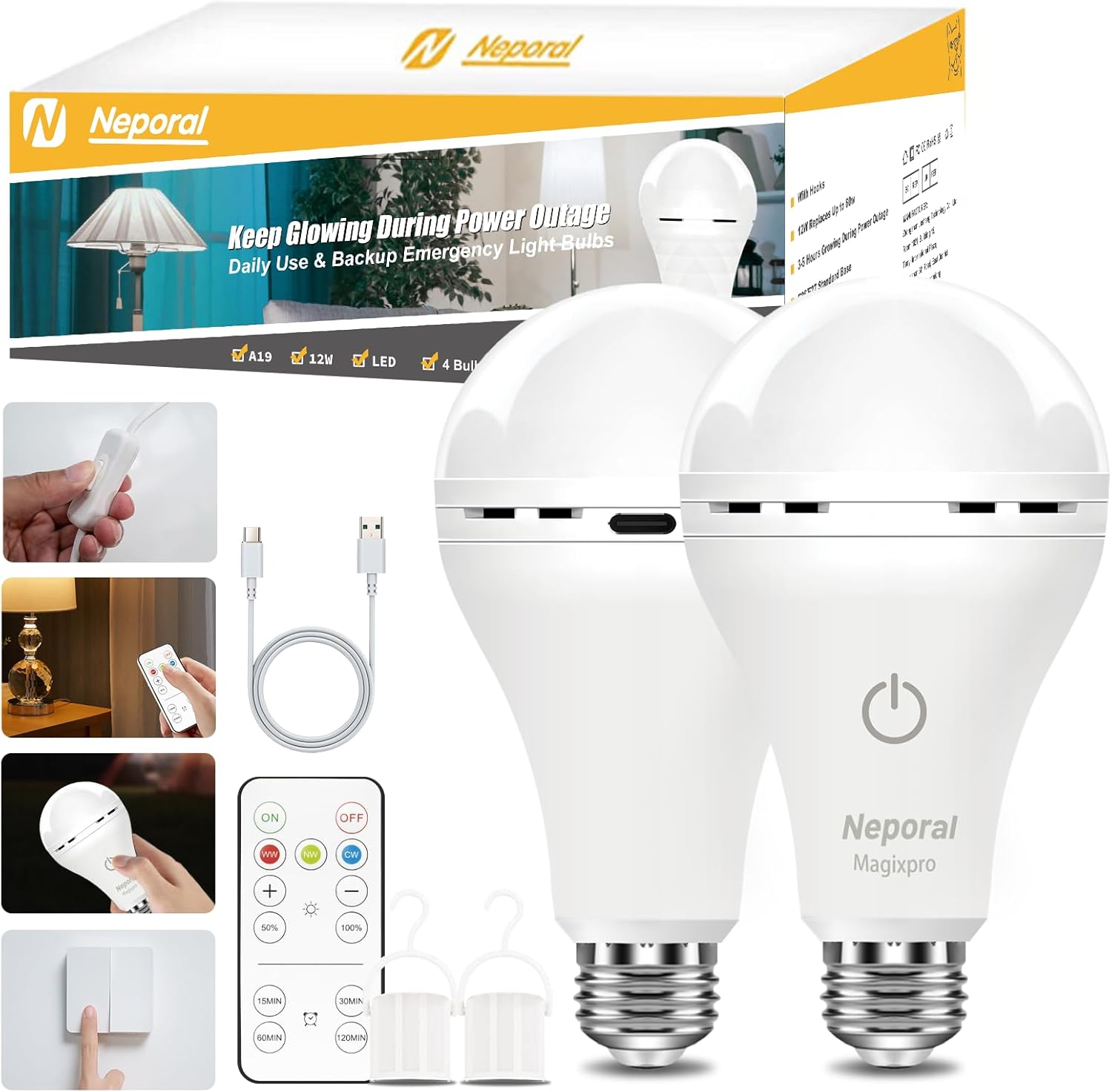
- 1800mAh battery per bulb runs cordless once charged, with a full recharge in about 2 hours over USB-C
- Dual charging methods: standard E26 socket or USB-C cable, so a wall switch being off doesn't block recharging
- Adjustable color temperature from 3000K to 6500K plus touch-based brightness control
- One remote can control brightness, color and timer settings across multiple bulbs at once
- 25 ft remote range works from bed without getting up to adjust lighting
Cons
- Dimmer switches are not supported; the bulbs only respond to simple wall-switch on/off toggling
- No smartphone app control is offered, only the physical remote and touch controls on the bulb
- Shipping can leave the battery low, so a full charge on arrival is needed before normal use
Each bulb runs on a built-in 1800mAh battery, chargeable either by screwing it into a standard E26 lamp socket or by plugging in the included USB-C cable.
- Full charge takes about 2 hours over USB-C
- Charges via E26 socket even when a wall switch is left off
- Works completely wire-free once charged, for lamps and fixtures with no live power
- UL-certified battery cells with 4-layer safety protection
Because the battery tops up through the socket itself, a hard-wired fixture without a live switch position still keeps the bulb charged whenever the switch happens to be on, rather than requiring the bulb to be removed for USB charging every time.
Color temperature adjusts between 3000K warm white and 6500K cool white, with brightness fine-tuned either by touch on the bulb or from the included remote.
- One remote can control brightness, color and timer for multiple bulbs together
- Touch control: short-press changes color temperature, long-press dims brightness
- 25 ft remote range for control from across a room or from bed
- Wall switch toggles the bulb on and off, but does not dim it
Since dimmer switches aren't supported, a fixture already wired with a dimmer should be set to full on and left there, using the bulb's own touch or remote controls for brightness adjustment instead of the wall dimmer.
Because power comes from the internal battery rather than constant wiring, these bulbs work in fixtures and locations that a standard bulb can't reach.
- No electrician needed for lamps or sconces without a live wire
- Battery-powered operation suits closets, hallways and cabins without reliable outlets
- Compatible with hardwired fixtures as well as plug-in lamps
- Sold as a 2-pack for matching fixtures like paired sconces
A first full charge is recommended right after delivery, since shipping time can leave the battery low enough to cause brief flickering before that initial charge is complete.
Pros
- 3500mAh battery provides up to 8 hours at full brightness or 36 hours on low output per charge
- 10W LED delivers 900 lumens, positioned as a 60W incandescent equivalent
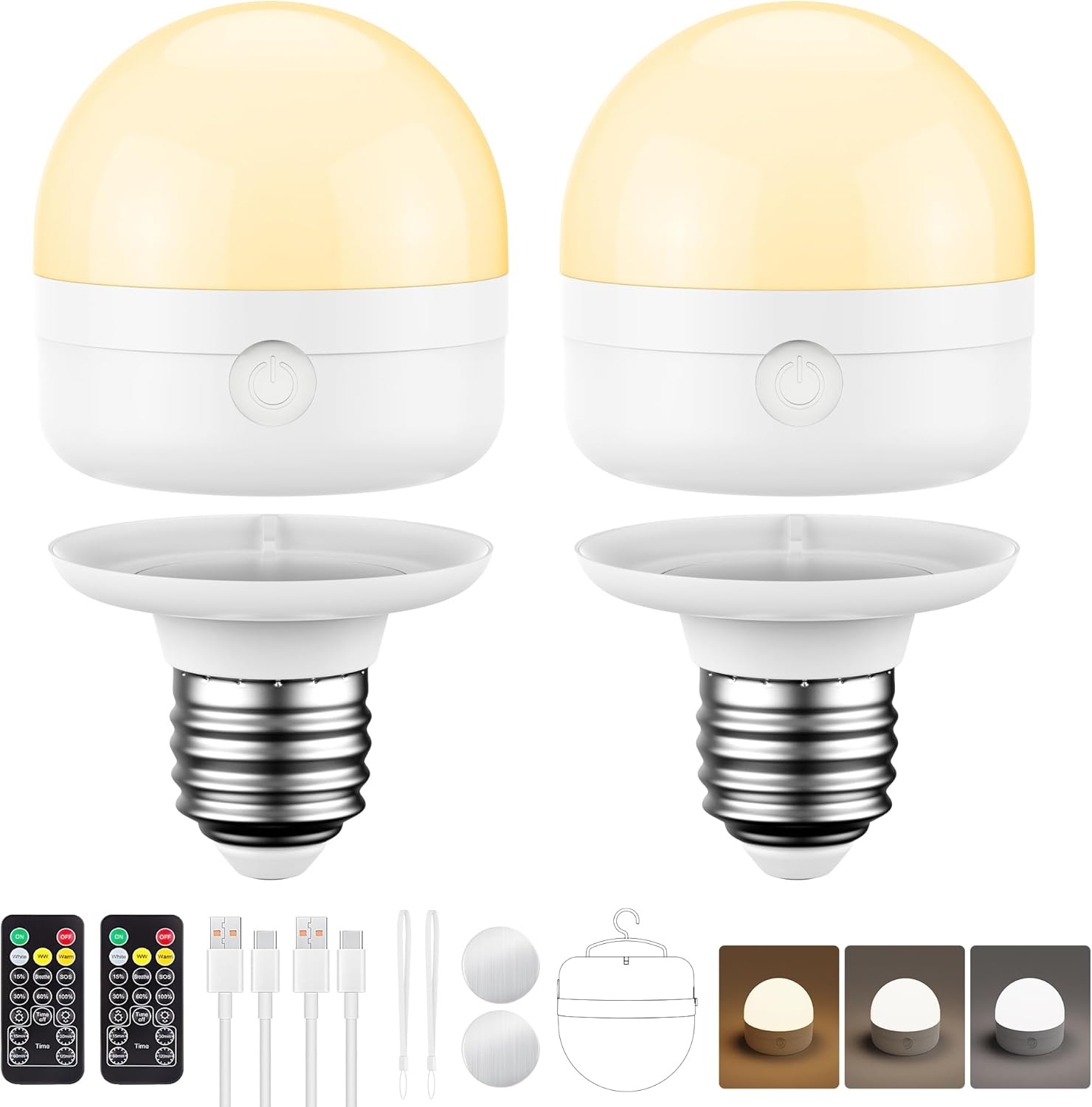
- Three mounting options: standard E26 screw base, magnetic surface attachment, or hanging hook
- Remote control adjusts brightness from 15% to 100% plus 3 selectable colour temperatures
- SOS and breathing modes are built in specifically for emergency signaling
Cons
- Full recharge takes 4 to 5 hours before the bulb is ready for extended emergency use again
- Magnetic mount only holds on ferrous metal surfaces, not on wood, drywall, or plastic
- Sold as a 2-pack, which may not be enough to cover multiple rooms during an extended outage
Each bulb houses a 3500mAh rechargeable battery, delivering up to 8 hours of light at full brightness or stretching to 36 hours when set to low brightness. A full recharge from empty takes 4 to 5 hours, which is a useful benchmark for anyone planning to keep these topped up ahead of storm season or scheduled outages.
- Battery capacity: 3500mAh
- Runtime: up to 8 hours full brightness, 36 hours low
- Recharge time: 4-5 hours
SOS and breathing modes are built into the remote-accessible settings, giving a way to signal for help or keep a low ambient glow going overnight during an extended power interruption.
Three mounting methods are built into the design: screwing into a standard E26 socket like an ordinary bulb, sticking to a metal surface with the built-in magnet, or hanging from the included hook and cord. This range of options is aimed at homes with older wiring or areas where a working light fixture isn't available during an outage.
- Base type: E26 standard screw
- Alternate mounts: magnetic base, hanging hook
- Wattage: 10W, 900 lumens, 60W equivalent
The magnetic mount only works on metal surfaces such as appliance sides or metal shelving, so drywall or wood surfaces will need the hook or a standard socket instead.
The included remote lets brightness be dimmed from 15% to 100% and switches between 3 colour temperatures: white, warm white, and warm, along with timer settings of 15, 30, 60, or 120 minutes. These controls are aimed at both everyday use as a regular light source and emergency use during blackouts, storms, or camping trips.
- Dimming range: 15%-100%
- Colour options: 3 selectable temperatures
- Timer settings: 15/30/60/120 minutes
Because the pack includes 2 bulbs, larger homes wanting backup lighting in more than two rooms during an outage would need to purchase an additional pack.
Pros
- Runs up to 24 hours in battery mode across 3 selectable durations: 2-3, 6-7, or 12 hours
- 3 brightness levels (100%/50%/10%) let one bulb serve as bedside dim light or full room light during an outage
- Built-in hook hanger allows carrying the bulb like a lantern away from its socket
- Automatically recharges whenever the lamp or fixture is switched on, no separate charging cradle needed
- Standard E26 base screws into any existing lamp or fixture for everyday use
Cons
- Battery mode duration depends on brightness setting chosen, so the longest 12-hour run only applies to lower output
- Rechargeable battery is built into the bulb, so a failing cell means replacing the whole bulb, not swapping cells
- Fixed at 5000K daylight color, no warm-white option in this listing
In battery mode, the bulb offers 3 duration settings: 2-3 hours, 6-7 hours, or 12 hours, selected via the on/off button on the hanger or the wall switch. Output is adjustable across 100%, 50%, or 10% brightness, so a single bulb can serve as a full-room light or a low bedside glow depending on the setting chosen.
- 3 selectable battery-mode durations: 2-3, 6-7, or 12 hours
- 3 brightness levels: 100%, 50%, 10%
- Fixed 5000K daylight color temperature
Because runtime and brightness trade off against each other, the longest 12-hour duration is intended for lower-brightness settings like a hallway night light rather than full-brightness room lighting.
The bulb uses a standard E26 base, so it screws into an existing lamp, ceiling fixture, or ceiling fan light the same way as any ordinary bulb. During daily use, it behaves as a normal light source and recharges automatically whenever the fixture's switch is on, with no separate charging dock to manage.
- Standard E26 medium base fits existing fixtures
- Works as an ordinary bulb during normal use
- Recharges automatically whenever powered on
Because it relies on the fixture being switched on to recharge, a fixture that stays off for long stretches will leave the internal battery undercharged when an outage does occur, so an occasional test run is worth doing.
A built-in hook hanger lets the bulb be unscrewed and carried through a dark house, hung from a nail, or hooked onto a bag handle during a power failure, functioning as a stand-in flashlight or lantern. The ABS housing keeps the bulb lightweight for this kind of handheld use.
- Removable, hook-equipped design for handheld or hung use
- ABS plastic housing for a lightweight carry
- Functions as ordinary bulb or portable light depending on need
Since the rechargeable cell is sealed inside the bulb rather than user-replaceable, its useful life is tied to the internal battery's charge-cycle lifespan, and the bulb itself will need replacing once that battery degrades.

Pros
- 1200mAh battery keeps each bulb lit for 4-5 hours on standard brightness during a power outage
- Three brightness levels stretch runtime from 2-3 hours at 2.5W up to 4-6 hours at the 1W minimum setting
- Screws into standard E26/E27 sockets and works as a regular bulb when mains power is present
- Charge holds for up to 60 days in storage, so bulbs stay ready between uses
- Each bulb includes a hook, making it usable as a hanging light for camping or outdoor tasks
Cons
- Full recharge from empty takes 7-8 hours connected to mains power
- Maximum emergency brightness of 450 lumens at 2.5W is well below the 800 lumens produced on mains power
- Pack of 6 covers a household's core rooms but larger homes may need a second pack for full coverage
On mains power the bulb outputs 800 lumens at 9W with a 6000K daylight color temperature. Once running on battery, output steps down across three levels: 450 lumens at 2.5W for 2-3 hours, 220 lumens at 1.5W for 3-4 hours, and 110 lumens at 1W for 4-6 hours of runtime.
- 800 lm / 9W on mains power
- Three battery brightness levels from 110 lm to 450 lm
- Rated life of 25,000 hours
The lower brightness settings trade light output for longer runtime, which suits situations like an extended overnight outage where stretching battery life matters more than peak brightness.
Each bulb threads into a standard E26/E27 socket the same way a regular bulb does, and it recharges automatically whenever mains power is connected. A built-in hook lets it double as a hanging light source for camping or outdoor activities when unscrewed from a fixture.
- Standard E26/E27 socket fit
- Automatic recharge while connected to mains power
- Built-in hook for hanging use away from a fixture
Because it needs to be pre-charged in a socket before an outage, bulbs installed and left unused for long stretches should be checked periodically, since performance depends on the battery having been topped up beforehand.
The built-in 1200mAh battery reaches a full charge in 7-8 hours when powered through the socket, then holds that charge for up to 60 days if the bulb is left unused. This makes it practical to install as a normal light and have it double as an emergency source without manual charging steps.
- 1200mAh built-in battery
- 7-8 hours for a full recharge
- Holds charge for up to 60 days when idle
Battery capacity is fixed and non-swappable, so once the cell degrades with age the bulb's emergency runtime will shorten with no way to replace just the battery component.

Pros
- 15W LED output rated at 800 lumens, brighter than typical 3W puck-style rechargeable lights
- USB-C rechargeable with a red-to-green charge indicator, no disposable batteries needed
- Remote control operates multiple bulbs at once from up to 16 feet away
- Standard A19 base fits most existing lamp fixtures and harps
- Touch control on the bulb itself allows brightness and color changes without the remote
Cons
- Battery is internal and rechargeable only, not swappable if it degrades after repeated charge cycles
- Fixtures with an in-line dimmer switch are not compatible, since dimming is handled by the bulb's own control
- Newly charged bulbs occasionally need the battery activated with a few charge cycles before first use, per the manufacturer's setup note
Each bulb outputs up to 800 lumens from a 15W LED engine, with three selectable color temperatures and stepless dimming controlled by touch or remote.
- Brightness: up to 800 lumens
- Power draw: 15W LED
- 3 color temperature options: cool white, daylight, and warm white
- Stepless dimming across the full brightness range
The stepless adjustment means brightness and color are not locked to a handful of preset levels; holding the touch control or remote button glides through the full range, which is useful for matching the bulb's tone to different times of day without swapping bulbs.
Power comes from an internal rechargeable battery, topped up over USB-C rather than disposable batteries.
- USB-C charging cable included
- Charge indicator glows red while charging, green near full
- Up to 24 hours of runtime per full charge, per the manufacturer
- Battery is sealed inside the bulb, not user-replaceable
Because there is no removable battery, longevity depends on how the internal cell holds up over repeated charge cycles, similar to a rechargeable flashlight or power bank; anyone who wants a bulb with swappable batteries for indefinite use should look at a different, non-rechargeable emergency bulb instead.
A single included remote can control multiple MagicGlow bulbs from up to 16 feet away, alongside touch controls built into each bulb.
- Remote range: up to 16 feet (5 meters)
- One remote can operate multiple bulbs at once
- Standard A19 base fits most common lamp fixtures
- Built-in auto-off timer for hands-free shutoff
The A19 form factor is sized to match typical incandescent replacement bulbs, so it should fit table lamps and standard fixtures without clearance issues, but fixtures with an inline mechanical dimmer switch should not be paired with these bulbs, since dimming is handled electronically by the bulb rather than the fixture's wiring.
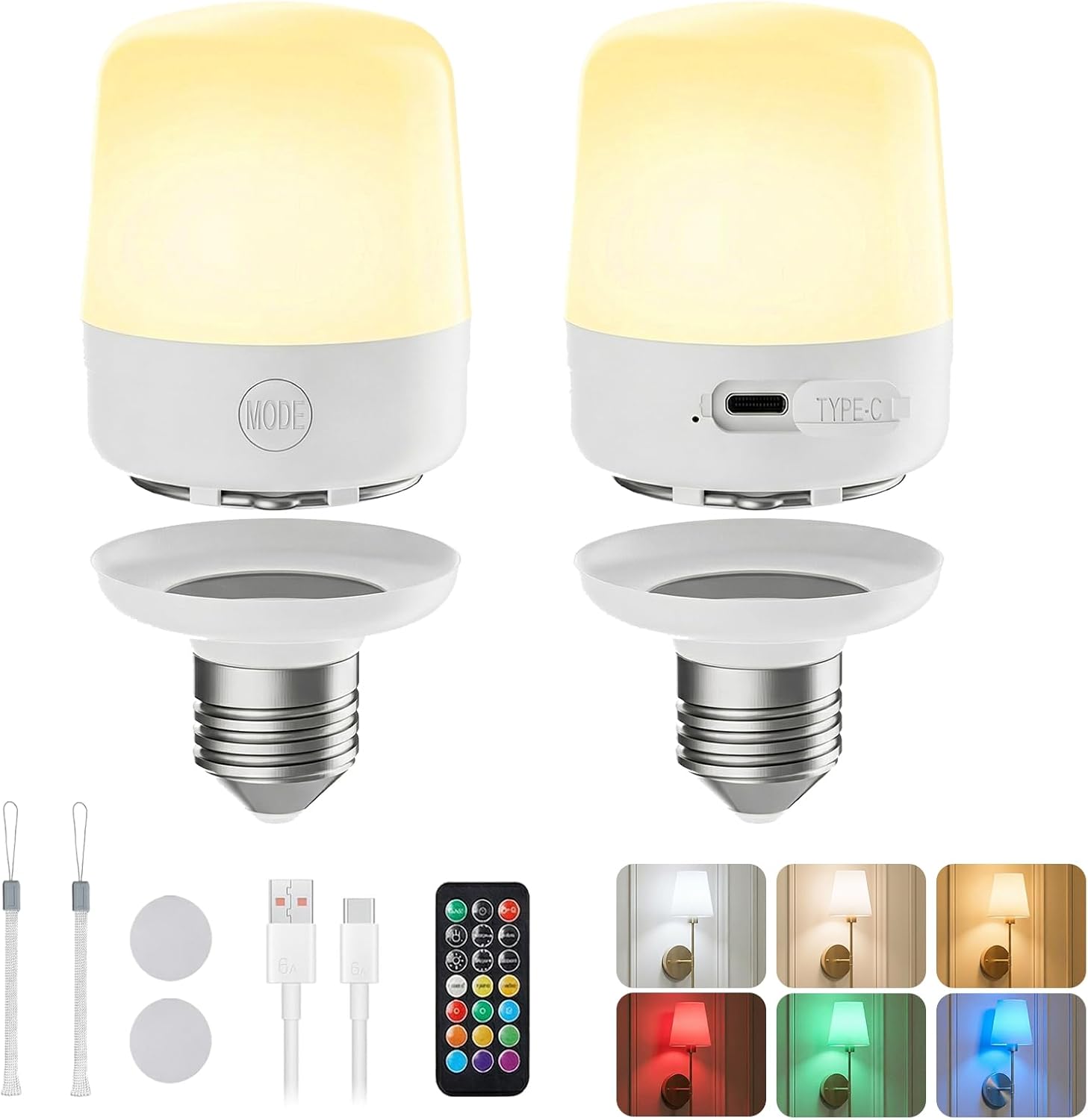
Pros
- 2300mAh battery runs 20 to 50 hours per charge and refills in 3 to 4 hours over Type-C
- 9 RGB colors plus 3 white temperatures (3000K, 4000K, 6000K) cover mood and task lighting
- Stepless dimming lets brightness be tuned gradually rather than in fixed steps
- 3 mounting options, screw-in E26, magnetic, or hanging, fit fixtures without one
- Built-in 30 or 120-minute auto-off timer suits bedtime or short-event use
Cons
- Battery life of 20 to 50 hours means more frequent recharging under daily heavy use than a wired bulb
- Standard E26 screw base is included, but no E12/E14 candelabra adapter ships in the box
- Two lighting modes (Smooth, Flash) is a narrower pattern set than dedicated party-light strings offer
A built-in 2300mAh battery runs the bulb for 20 to 50 hours per charge depending on brightness and color settings, and recharges fully in 3 to 4 hours over the included Type-C USB cable. That range makes the bulb usable well away from an outlet, whether that is a shed, a tent, or a room without a working fixture.
Because the bulb depends on that internal battery, regular daily use at higher brightness will land toward the lower end of the 20-50 hour range, meaning frequent users will recharge more often than someone using it only for occasional accent lighting or backup power during an outage.
Color options span 9 RGB colors plus 3 white color temperatures at 3000K warm white, 4000K natural white, and 6000K cool white, covering both mood lighting and task lighting from the same bulb. Stepless dimming lets brightness be adjusted smoothly rather than snapping between preset levels.
Two lighting modes, Smooth and Flash, control how the RGB colors transition, either gently cycling or switching more abruptly between them. That is a narrower pattern set than dedicated party-light strings offer, so buyers wanting elaborate multi-effect sequences may find the two-mode set more limited than a purpose-built decorative light string.
Three mounting options are available: a standard E26 screw base, a magnetic back, or a hanging loop, so the same bulb fits a lamp socket, a metal surface, or a hook without needing extra hardware. Control runs through either the included remote or the built-in button on the bulb itself.
A built-in timer offers 30-minute or 120-minute auto-off settings, useful for bedtime use or short events without needing to remember to switch it off manually. The set includes 2 bulbs, and while the E26 base is included, no separate E12 or E14 candelabra adapter ships with the set for smaller fixtures.

Pros
- 2000mAh battery drives brightness up to 350 lumens, enough to light a hallway or closet without wall power
- 15 color and white-temperature options plus 10 brightness steps from 10% to 100% cover both task light and mood lighting
- Three built-in timers (30, 60, and 120 minutes) shut the light off automatically so it won't run down overnight
- 2.76-inch diameter fits standard E26 sockets, and a magnetic base or double-sided adhesive works for sconces with no socket at all
- Type-C charging replaces the older micro-USB connectors found on many rechargeable puck lights
Cons
- Sold as a 2-pack only, so lighting a 4-bulb fixture needs two separate orders
- Battery is built in and not user-replaceable, so total lifespan is tied to the internal 2000mAh cell
- Remote control relies on line of sight, so it won't trigger the bulb through a closed cabinet door
Each bulb combines 12 RGB colors with 3 white color temperatures, 3000K warm white, 4000K natural white, and 6000K cool white, for 15 total lighting options. 10 dimmable brightness grades from 10% to 100% let you scale from a soft night-light glow up to full task lighting from the same fixture.
Two lighting modes round out the feature set: a smooth mode that fades gradually between colors for ambiance, and a flash mode that cycles quickly through all 12 RGB colors. With 15 LED beads producing up to 350 lumens, the output is bright enough for general room lighting, not just accent use, while still being small enough to fit inside a standard puck-light housing.
The bulb measures 2.76 inches in diameter, sized to fit standard E26 fixtures without looking oversized once installed. For sconces or fixtures with no live socket, the base unscrews and the bulb can instead be mounted with the included magnetic strip or double-sided adhesive tape, making it workable in places with no wiring at all.
Because it is non-hardwired, there is no electrician or wiring work involved, it simply screws in, sticks on, or attaches magnetically. This makes it suited to wall sconces, closets, stairwells, or rental spaces where running new electrical isn't an option. The remote and an onboard press-button both control power and mode, so the bulb can be operated even after it's mounted somewhere hard to reach.
Power comes from a built-in 2000mAh rechargeable battery, larger than the cells used in many similar puck lights, which helps it sustain higher brightness for longer between charges. Two Type-C charging cables are included in the box, matching the connector used on most current phones and laptops rather than an older micro-USB tip.
Three timer settings, 30, 60, and 120 minutes, let the bulb shut off on its own instead of running until the battery empties, useful for overnight use in a bedroom or hallway. Runtime at full brightness will be shorter than at lower dimming levels, so buyers planning extended use each night should expect to recharge more often when running the bulb near 100% output.

Pros
- Automatically stays lit during a power outage, providing up to 5 hours of illumination at 650 lumens on a full charge
- Doubles as a handheld flashlight by unscrewing the bulb and switching it to flashlight mode
- Offers 3 selectable colour temperatures from one bulb, rather than needing separate bulbs for different lighting moods
- Rated for a 13.7-year lifespan with a 3-year manufacturer warranty included
- Screws into a standard E26 medium base, working as a drop-in replacement for a 65-watt incandescent bulb
Cons
- At 5.63 inches in length, it is slightly longer than most common bulbs, so tight fixtures or enclosed shades should be measured first
- Full charge takes 10 hours before backup runtime is available, so a bulb installed just before an outage will not yet be ready
- Sold as a 2-pack only, limiting how many rooms can be covered without buying multiple sets
Once charged, this bulb automatically stays lit during a power outage, providing up to 5 hours of continuous illumination at 650 lumens. Charging happens passively while the bulb is powered on in its socket, requiring 10 consecutive hours of normal use to bring the internal battery to a full charge.
- Up to 5 hours of backup illumination
- 650 lumens output on backup power
- 10-hour charge time for a full charge
- Recharges automatically whenever the light is switched on
Because charging happens passively during normal use, a bulb that has been in service for a while stays ready for an outage without any separate charging step.
Turning off the switch and unscrewing the bulb from its socket switches it into handheld flashlight mode, giving a portable light source without a separate flashlight in the house. Installation is a standard screw-in process into any E26 medium-base fixture, with no wiring or special tools needed.
- Flashlight mode activated by unscrewing the bulb
- Standard E26 medium base fitting
- 3 selectable colour temperatures
- Suited to camping, storm prep, or everyday use
Having flashlight mode built into the same bulb used every day removes the need to hunt for a separate flashlight when the power first goes out.
The bulb measures 5.63 inches in length, slightly longer than most standard A21 bulbs, so enclosed fixtures or tight lampshades are worth measuring before installing. LED components are rated for a 13.7-year lifespan under normal use, and the 2-pack is backed by a 3-year manufacturer warranty.
- Bulb length: 5.63 inches
- Rated lifespan: 13.7 years
- 3-year manufacturer warranty
- Sold as a 2-pack
Because the bulb runs slightly longer than average, checking clearance in enclosed globe fixtures or tight recessed housings avoids a fit problem after installation.
What Makes a Rechargeable Light Bulb Different
A rechargeable bulb looks like an ordinary LED bulb, but it hides a small lithium battery inside the housing. When it is screwed into a live socket, it draws power from the grid like any other bulb and simultaneously tops up its internal battery. The moment the power fails, the bulb automatically switches to battery mode and keeps shining, often for several hours.
This dual behavior is the whole appeal. You get a normal-looking light source during everyday use, plus a seamless backup that kicks in without you fumbling for a flashlight in the dark. Some models, like the Brightown E26 Rechargeable Bulb, add a remote control, timer, and color options so the bulb doubles as a flexible accent light even when the grid is fine.
Battery Backup vs. Fully Cordless Use
There are two broad categories to understand. The first is the emergency backup bulb, which lives in a wired fixture and only runs on battery during outages. The second is the fully portable bulb that you can carry anywhere, sometimes with a hook, magnetic base, or handle, and recharge with a cable. Deciding which style you need is the single most important step before you buy.
Why Rechargeable Bulbs Are Worth Considering
Power outages are more common than most people expect, and they rarely happen at convenient times. A storm can knock out electricity for hours, and scrambling for candles or dying flashlights is stressful. Rechargeable bulbs solve that problem quietly in the background. Here are the biggest reasons homeowners add them to their setup:
- Automatic outage protection. No switches to flip, no scrambling in the dark. The light simply stays on.
- No wiring required. Portable models bring light to closets, sheds, garages, and camping trips without an outlet nearby.
- Reusable and eco-friendly. A rechargeable battery replaces stacks of disposable batteries and short-lived candles.
- Familiar form factor. Because they screw into standard sockets, there is nothing new to learn.
If you are still building out your overall lighting plan, it helps to compare these against everyday options in our roundup of the best light bulbs so you know where rechargeables fit alongside your regular fixtures.
Key Factors to Consider Before You Buy
Not all rechargeable bulbs perform the same. A few specifications separate a genuinely useful bulb from a novelty that disappoints during a real outage. Focus on these before you commit.
Runtime on Battery
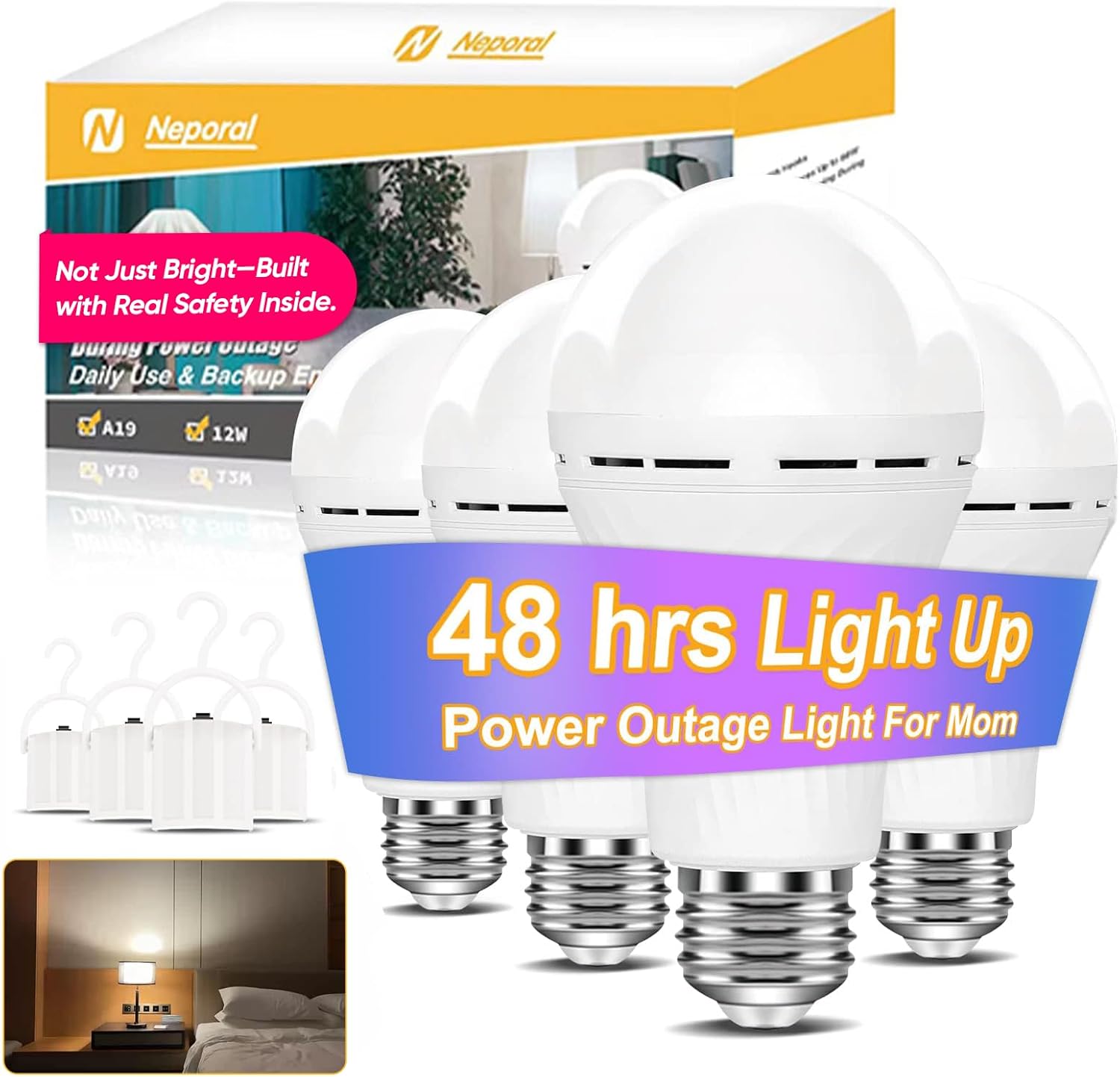
Runtime is the headline number. Some bulbs last only an hour or two, while stronger models such as the Neporal LITE Emergency Bulb advertise up to 48 hours at lower brightness. Longer runtime almost always means running at reduced output, so read the fine print. For general emergency use, look for at least three to five hours at usable brightness.
Brightness and Lumens
Lumens measure how much light the bulb actually produces. A bulb rated around 800 lumens roughly matches a traditional 60-watt bulb, which is plenty for a room. Emergency bulbs often dim themselves on battery to stretch runtime, so check both the plugged-in brightness and the battery-mode brightness. If you need to read or work, prioritize higher lumens.
Color Temperature
Color temperature, measured in Kelvin, controls the mood of the light. Warm white (around 2700K) feels cozy and is great for living areas, while cool or daylight white (5000K) is crisp and better for tasks and emergencies. Some bulbs offer selectable color temperatures so a single product can flex between comfort and clarity.
Base Type and Fit
Most rechargeable bulbs use the standard E26 medium base found in typical North American lamps and fixtures. Always confirm the base matches your socket. Also consider the bulb’s physical size, since some batteries make the bulb slightly bulkier than a normal LED and it may not clear a tight shade or enclosed globe.
Extra Features
Convenience features can tip the decision. Remote controls let you turn the bulb on and off without a wall switch, which is handy in a non-hardwired fixture. Timers, dimming, magnetic bases for hanging in odd spots, and multiple color modes all add versatility. Decide which of these you will actually use rather than paying for features you will ignore.
Where Rechargeable Bulbs Work Best Around the Home
Because they combine backup power with a familiar shape, rechargeable bulbs earn their keep in several spots.
- Hallways and stairwells. Keeping these lit during an outage prevents trips and falls in the most dangerous areas of the house.
- Bedrooms. A bulb that stays on lets you settle in safely even when the grid is down, and a warm option keeps the room restful.
- Bathrooms. Windowless bathrooms turn pitch black in an outage. A backup bulb here is a genuine safety upgrade, and you can compare fixture-specific picks in our guide to the best light bulbs for bathrooms.
- Garages, sheds, and closets. Portable models with hooks or magnetic bases bring light to spaces that were never wired for a fixture.
- Outdoor and camping use. A cordless bulb doubles as a lantern for the patio, a tent, or a power-free cabin.
Sizing and Specs to Double-Check
Before adding a bulb to your cart, run through this quick mental checklist to avoid a mismatch:
- Socket base: confirm E26 or whatever your fixture uses.
- Physical dimensions: make sure it fits inside enclosed shades or globes.
- Battery-mode lumens: not just the plugged-in brightness.
- Charge behavior: whether it recharges in the socket, via USB, or both.
- Switch compatibility: some emergency bulbs need the wall switch left on to sense an outage correctly.
That last point trips up a lot of buyers. Many emergency bulbs only switch to battery mode when they detect a true power loss, not when you flip the wall switch off. Read the instructions so you understand how the model behaves.
Budget Guidance: How Much Should You Spend
Rechargeable bulbs cost more than ordinary LEDs because of the battery and electronics inside. Entry-level single bulbs are affordable, while multi-packs and models loaded with remotes, timers, and color modes cost more per unit. Think about how many rooms you want covered. Outfitting a few key areas, like a hallway, bathroom, and bedroom, gives you the most safety benefit without buying a bulb for every socket in the house.
Value also depends on battery quality. A cheaper bulb with a weak battery may lose capacity within a year, so weighing reviews about long-term battery life is smart. A feature-rich pick like the Brightown rechargeable bulb costs more up front but can replace both a backup light and an accent lamp, while a no-frills long-runtime option like the Neporal emergency bulb focuses purely on outage protection.
Maintenance and Getting the Most From Your Bulbs
Rechargeable bulbs are low-maintenance, but a few habits keep them ready.
- Keep them charged. Leave them in a live socket so the battery stays topped up and ready for the next outage.
- Cycle the battery occasionally. Letting the bulb run down and recharge now and then helps maintain battery health over time.
- Test periodically. Every few months, simulate an outage per the instructions to confirm the bulb still holds a charge.
- Store spares properly. If you keep a portable bulb in a drawer, recharge it every few months so it is not dead when you grab it.
With basic care, a quality rechargeable bulb will serve reliably for years. If you want to round out your home with efficient everyday lighting too, our guides to the best LED light bulbs and the best light bulbs for bathroom spaces pair nicely with a rechargeable backup strategy.
Frequently Asked Questions
How long do rechargeable light bulbs last on a single charge?
It varies widely by model and brightness setting. Many bulbs deliver three to five hours at full brightness, and some stretch to twenty or even forty-plus hours when dimmed. Always check the runtime at the brightness level you actually plan to use.
Do rechargeable bulbs work in any lamp or fixture?
As long as the base matches, usually E26, they screw in like a normal bulb. The main caveat is that some emergency models need the wall switch or fixture to stay powered so they can detect an outage and switch to battery mode automatically.
Can I use a rechargeable bulb as my everyday light?
Yes. During normal conditions the bulb runs on grid power just like a standard LED, and it charges in the background. This makes it easy to have backup lighting in place without changing your daily routine.
Are rechargeable bulbs safe to leave plugged in all the time?
Reputable bulbs include charging circuitry designed for continuous use, so leaving them in a live socket is normal and expected. That is actually the best way to keep them ready for the next power failure.
What should I look for if I only care about outages?
Prioritize long battery runtime, adequate battery-mode brightness, and reliable automatic switching. Extra features like remotes and color modes are nice but secondary if pure emergency performance is your goal.
The best rechargeable light bulbs are the ones that match your space and your priorities, whether that is maximum runtime, easy portability, or added convenience features. Focus on runtime, brightness, base fit, and how the bulb switches to battery power, and you will end up with dependable light that is ready the instant you need it.