
 Marcus Bell
Choosing the best CPUs for streaming is trickier than picking a gaming chip off a spec sheet. Your processor has to render the game, encode video, run chat and OBS overlays, and juggle a browser tab or two, all at once. Pick the wrong one and you will see dropped frames, stutter, or a laptop-fan roar every time you go live. Below we break down what actually matters for streaming performance and point you toward the picks worth your money.
Quick answer: For most streamers in 2026, our top pick among the best CPUs for streaming is the AMD Ryzen 9 9900X — our #1 rated pick, thanks to a rare balance of high core count for background encoding and strong per-core speed for the game itself. Keep reading for the full ranked list, budget alternatives, and buying advice.

Pros
- 6 cores and 12 threads on the Zen 5 architecture, with a 5.4 GHz max boost clock
- Unlocked multiplier allows manual overclocking on compatible AM5 motherboards
- 38MB of combined cache and DDR5-5600 support speed up memory-bound workloads and gaming
- AM5 socket supports PCIe 5.0 on select motherboards for current-generation SSDs and GPUs
- Delivers over 100 FPS in many popular titles at stock settings, per official gaming benchmarks
Cons
- No cooler is included in the box, so a compatible AM5 cooler must be purchased separately
- Unlocked overclocking headroom requires a motherboard with adequate VRM cooling to fully use
- AM5 platform requires DDR5 memory only, so existing DDR4 kits from an older build cannot be reused

Pros
- Play some of the most popular games at 1080p with the fastest processor
- 8 Cores and 16 processing threads, bundled with the AMD Wraith Stealth
- 4.6 GHz Max Boost, unlocked for overclocking, 20 MB cache, DDR4-3200
- For the advanced Socket AM4 platform. Maximum Operating Temperature
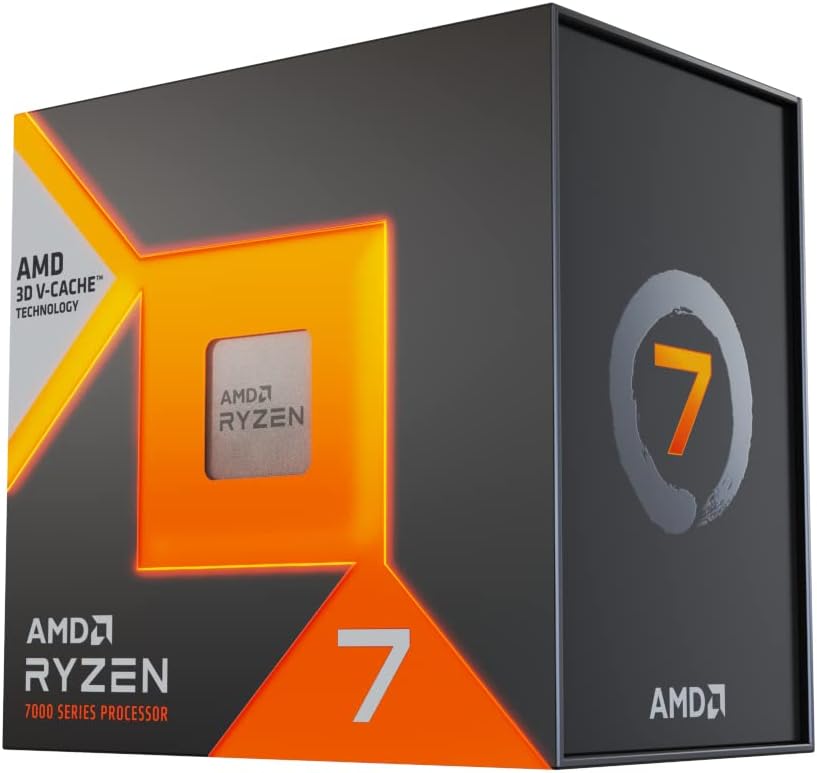
Pros
- 8 cores and 16 threads on a 5 nm process, with a 4.2 GHz clock quoted for the part
- 96 MB of L3 cache stacked on the compute die plus 8 MB of L2, which is what lifts frame rates in simulation-heavy games
- Integrated graphics running at 2200 MHz, so the machine boots and drives a display with no card fitted
- AM5 platform brings DDR5 memory and PCIe 5.0 lanes for both the graphics slot and an M.2 drive
- Holds clocks until it reaches a Tjmax of 89 C, so high load numbers are designed behaviour rather than a warning
Cons
- No cooler is included, so a large air tower or a 240 mm liquid cooler has to be added
- AM5 socket and DDR5 only, so an AM4 board and existing DDR4 kits do not carry over
- The integrated graphics are display-out class rather than gaming class, so a discrete card is effectively mandatory

Pros
- Eight Zen 5 cores and sixteen threads paired with 96MB of L3 from second-generation 3D V-Cache
- Boosts to 5.2 GHz because the stacked cache now sits beneath the compute die, letting heat escape upward
- Roughly 16% IPC uplift over the previous generation at comparable power draw
- Drops into existing Socket AM5 boards after a firmware update, reusing DDR5 memory and coolers
- Unlocked for overclocking and curve tuning, unlike earlier X3D parts with restricted voltage control
Cons
- No cooler in the box, so a large tower cooler or a 240mm liquid cooler has to be planned for separately
- Integrated graphics are display-class only, so a discrete card is effectively required for gaming
- AM5 only — AM4 and Intel boards cannot take it, making this a full platform decision

Pros
- 8 cores and 16 threads on the Zen 3 architecture, built for multi-threaded workloads as well as gaming
- Boosts up to 4.8 GHz and ships fully unlocked for overclocking, no locked multiplier to work around
- 36 MB of combined cache, more headroom for keeping frequently used data close to the cores
- Includes the Wraith Prism cooler with RGB LED, so there's no separate cooler purchase needed to get started
Cons
- Limited to DDR4-3200 support, so it can't take advantage of faster DDR5 memory kits
- Socket AM4 only, meaning newer AM5 motherboards and their PCIe 5.0 lanes are off the table
- No integrated graphics mentioned, so a discrete GPU is required to get a display signal at all

Pros
- The world's best gaming desktop processor that can deliver
- 12 Cores and 24 processing threads, based on AMD "Zen 5"
- 5.6 GHz Max Boost, unlocked for overclocking, 76 MB cache,
- For the state-of-the-art Socket AM5 platform, can support PCIe 5.0
Pros
- 16 cores and 32 threads on the Zen 5 architecture handle heavy multi-threaded workloads alongside gaming
- 5.7 GHz max boost clock and 80MB of cache push single-core responsiveness for latency-sensitive tasks
- Unlocked multiplier supports manual overclocking on compatible AM5 motherboards
- Supports DDR5-5600 memory, taking advantage of higher bandwidth than older DDR4 platforms
- AM5 socket carries PCIe 5.0 support on select motherboards for current-generation GPUs and NVMe drives
Cons
- No cooler is included in the box — AMD recommends a liquid cooler, which is an added purchase most basic air coolers won't fully replace
- AM5 socket motherboards run costlier on average than mature previous-generation AM4 boards, an ecosystem cost beyond the chip itself
- 80MB of cache and 16 active cores draw more power under full multi-threaded load than lower-core-count chips in the same family

Pros
- 16 cores and 32 threads on Zen 3 architecture handle heavily multi-threaded content creation and gaming workloads alike
- Boosts up to 4.8 GHz with an unlocked multiplier for overclocking on compatible AM4 motherboards
- 72MB of total cache is well above what quad-core or 6-core chips from the same socket generation offer
- Built for the AM4 platform, letting it drop into existing AM4 motherboards rather than requiring a new socket
- Supports PCIe 4.0 for compatible GPUs and NVMe storage on the AM4 platform
Cons
- No cooler is included, so a compatible cooling solution is a separate purchase before the chip can be installed
- DDR4-3200 is the supported memory standard, without a path to the higher bandwidth DDR5 offers
- AM4 is a mature platform nearing the end of new-CPU releases, so long-term upgrade headroom is more limited than a newer socket

Pros
- 6 cores and 12 threads with a 4.2 GHz maximum boost, enough for 100+ FPS in mainstream titles alongside a discrete card
- 19 MB of combined cache keeps working sets close to the cores in games and compile workloads
- Fully unlocked multiplier, so overclocking is available on B450, B550 and X570 boards
- A stock air cooler is supplied in the box, so no separate heatsink is needed to run at default clocks
- Drops into the mature Socket AM4 platform with DDR4-3200 memory support
Cons
- No integrated graphics at all, so a discrete graphics card is mandatory just to reach the desktop
- Limited to PCIe 3.0, so a Gen4 NVMe drive or a Gen4 graphics card runs at half its available link bandwidth
- AM4 is the end of its own road; there is no upgrade path to newer CPU generations without changing motherboard and memory together

Pros
- Sixteen Zen 5 cores and 32 threads, running a 4.3 GHz base up to a 5.7 GHz boost
- Second-generation 3D V-Cache sits under the compute die so clock speeds stay high
- AM5 socket drops into existing X670 and B650 boards after a BIOS update
- Integrated graphics allow display output without a discrete card fitted
- Boxed retail unit aimed at both gaming and multi-threaded content work
Cons
- No cooler in the box, so a 360 mm liquid unit or a large tower cooler is a separate purchase
- Draws enough power to demand a strong board VRM and steady case airflow
- The 3D V-Cache sits on one core complex, so current chipset drivers matter for correct thread scheduling
What Makes a CPU Great for Streaming?
Gaming and streaming ask your processor for two different things at the same time. The game wants fast single-core performance so frame rates stay smooth. Encoding, chat overlays, and browser sources want extra cores sitting in reserve so none of that background work steals cycles from the game.
That is why core count matters more here than it does for a pure gaming build. A 6-core chip can handle gaming alone just fine, but add software encoding on top and it starts to sweat. Look for at least 8 physical cores if you plan to encode with your CPU instead of your graphics card.
Cache size matters too. Bigger cache (like AMD’s 3D V-Cache models) keeps more game data close to the processor, which smooths out frame times during busy scenes. That helps your stream look consistent even when the action on screen gets chaotic.
How to Choose the Best CPUs for Streaming for 2026
Start with your encoding method. If your graphics card handles encoding through NVENC or a similar hardware encoder, you can lean on a CPU with fewer cores and save some money. If you plan to encode in software for the best possible video quality, prioritize a chip with 8 or more cores.
Next, think about what else runs alongside your stream. Multiple monitors, a browser full of tabs, Discord, and a music player all add up. Extra threads give that workload somewhere to go without touching your frame rate.
Budget matters as much as specs. You do not need the priciest chip on the shelf to stream well. A well-chosen mid-range processor paired with a capable graphics card will outperform an expensive CPU stuck behind a weak GPU or a cramped case with poor airflow.
Finally, plan your whole setup, not just the processor. A CPU that can encode smoothly is only half the picture; pairing it with one of the best webcams for streaming and a stable connection rounds out a setup that looks and feels professional.
Best CPUs for Streaming by Use Case
Not every streamer needs the same chip. Here is how to match a processor to your channel, your budget, and your current PC, drawn from the 10 picks in the list above.
Best Overall: AMD Ryzen 9 9900X
The AMD Ryzen 9 9900X gives you 12 cores and 24 threads, which is more than enough headroom to game and encode at the same time without either task starving the other. Reviewers consistently praise it for staying cool and quiet under sustained load, which matters during long streams. It is not the least expensive chip here, but it is the one we would recommend first if you plan to grow your channel and add more overlays, scenes, and alerts over time.
Best Budget Pick: AMD Ryzen 5 5500
If you are just getting started and want to lean on hardware encoding through your GPU, the AMD Ryzen 5 5500 is worth checking the current price on Amazon for. Its 6 cores and 12 threads handle gaming comfortably, and since it ships with a cooler included, you will not need to buy one separately. This is the pick for streamers who want to test the waters before investing more.
Best for Gaming and Streaming Together: AMD Ryzen 7 9800X3D
Thanks to its extra-large 3D V-Cache, the AMD Ryzen 7 9800X3D delivers some of the smoothest frame times you can get in demanding games, even with a stream running in the background. If your channel focuses on fast-paced titles like shooters or racing games where frame consistency shows up on camera, this is a strong match. It runs hotter than some rivals, so plan for solid case airflow.
Best High-End: AMD Ryzen 9 9950X3D
For streamers who also edit VODs, run multiple encoders, or stream to several platforms at once, the AMD Ryzen 9 9950X3D offers 16 cores of headroom plus 3D V-Cache for gaming performance. It is the most expensive chip on this list, so it makes the most sense for creators already earning from their channel rather than a first build.
Best Value for Multi-Core Work: AMD Ryzen 7 5700G
The AMD Ryzen 7 5700G pairs 8 cores with built-in graphics, which makes it a smart pick for a low-cost second PC dedicated purely to encoding, or a budget-friendly main rig while you save for a discrete graphics card. It will not match the newer chips for raw gaming speed, but for the price it covers a lot of streaming workload.
CPU Cores, Threads, and Encoding: What Actually Matters
There are two ways to turn your gameplay into a stream: hardware encoding and software encoding. Hardware encoding uses a dedicated chip on your graphics card, which frees your CPU almost entirely. Software encoding uses your CPU’s cores directly and generally produces a slightly sharper picture at the same bitrate, but it demands more from your processor.
If you are on a tight budget, hardware encoding paired with a mid-range CPU is the more forgiving choice. If picture quality is a priority and you already have a chip with 8 or more cores, software encoding through a program like OBS is worth testing.
Thread count also determines how many background apps you can run without a hit to frame rate. Chat bots, alert software, and a browser with several tabs open all add small but constant CPU demand. More threads simply give that work somewhere to live.
Storage speed plays a supporting role here too. If you record local backups of your stream or edit highlight clips afterward, pairing your CPU with one of the best SSDs for streaming keeps large video files from bottlenecking your workflow.
AMD vs. Intel: Does the Brand Matter for Streaming?
Every processor recommended above is AMD, and that is not a coincidence. The current Ryzen lineup offers strong multi-core value along with 3D V-Cache designs that specifically smooth out frame times, which matters when your gameplay is being watched live by an audience. Intel chips can stream well too, especially if you already own an Intel motherboard and would rather not switch platforms just to upgrade one part.
If you are building a new PC with no existing parts to work around, the Ryzen chips above tend to offer a clearer upgrade path and better value per core for streaming workloads specifically. If you are simply adding streaming to an existing Intel gaming PC, do not feel pressured to switch platforms for the sake of a brand name alone; a strong graphics card and enough RAM often matter more day to day.
Common Mistakes to Avoid When Buying a Streaming CPU
The most common mistake is buying a powerful CPU and then pairing it with a power supply that cannot comfortably feed it under sustained load. Higher-core chips draw more power during long encoding sessions than during a quick benchmark, so check that your power supply has real headroom; browsing the best PSUs for streaming before you upgrade your CPU can save you a return later.
Another mistake is ignoring cooling. A great CPU throttled by a weak stock cooler will drop frames exactly when your stream needs stability most. Budget for a case with decent airflow, especially if you pick one of the higher core-count chips above.
Streamers also tend to overlook their motherboard’s chipset and BIOS support. Newer processors sometimes need a BIOS update on older boards before they will even boot, so confirm compatibility before you order.
Finally, do not assume more cores always beats fewer cores. A 16-core chip is wasted money if your games and software only ever use half of it. Match the processor to your actual workload instead of chasing the biggest number on the box.
Frequently Asked Questions
Do I need a CPU with more cores just for streaming?
Only if you plan to encode in software. If your graphics card handles encoding, a 6-core chip can still stream comfortably alongside most modern games.
Can I stream and game well on a 6-core processor?
Yes, especially when you rely on hardware encoding through your GPU. Pair it with enough RAM and a stable connection, and a 6-core chip handles most games fine.
Is a bigger cache actually worth the extra cost?
For gaming-heavy channels, yes. 3D V-Cache designs smooth out frame times in demanding titles, which viewers notice even if they cannot name the reason why.
How much RAM should I pair with a streaming CPU?
32GB is a comfortable, future-proof amount for streaming with several background apps open. 16GB can work if you keep your setup lean.
Do I need a separate capture card if my CPU is strong enough?
Not for streaming from the same PC you game on. Capture cards matter more for console streaming or a dedicated second-PC setup.


