
 Daniel Okafor
 A tower rig needs a surface that handles weight, cable clutter, and marathon sessions. Finding the best desks for a gaming desktop means matching your case size, monitor count, and room layout to the right build. This guide ranks proven models by real ratings and review counts, then breaks down who each one suits. You will see budget L-shaped corners, wide workstations with hutches, and compact writing desks for tight bedrooms. Every pick below is a full-tower-friendly option, not a laptop stand. We weigh trade-offs honestly, flag who should skip each desk, and cite prices so you plan spending. Read on for the ranked list and a practical buying guide.
Quick answer: For most players in 2026, the best desks for a gaming desktop is the Mr IRONSTONE L-Shaped Gaming Desk — our #1 rated choice. It pairs a 51-inch carbon-fiber corner surface with a huge 40910-review track record. See the full ranked comparison, alternatives and buying advice below.

Pros
- 50.8 by 50.8 inch corner span with two 18.2-inch deep tops at 29.5 inches high
- Carbon-fibre-textured P2 MDF surface resists mouse-sweep scuffing and wipes clean
- App-controlled RGB strip runs hundreds of lighting effects from a phone
- Steel X-shaped legs bolt to both tops for a rigid corner join
- Cup holder and headphone hook mount into pre-drilled holes on either side
Cons
- Listed load capacity is 220 pounds, below the 350 pound figure used in the marketing copy, so plan around the lower number
- The corner layout needs a genuine free corner of about 51 by 51 inches and cannot be pushed flat against one wall
- 18.2-inch wing depth is shallow, so a keyboard plus an A4 pad fills it quickly
The L-shape spans 50.8 by 50.8 inches across the corner, each wing 18.2 inches deep, with the surface sitting 29.5 inches off the floor. That is standard desk height with clear knee space under both wings, so a tall user is not forced to splay their legs around a crossbar.
- Two tops meet at the corner to form a continuous work area
- Carbon-fibre-textured surface over P2 MDF on a steel X-leg frame
- Listed load capacity is 220 pounds
An 18.2-inch depth is shallow by desk standards, so a 27-inch monitor on a tall stand sits closer to your face than it would on a 24-inch deep top. The included riser helps by lifting the screen rather than pushing it further back.
It arrives flat-packed and goes together with the supplied hardware and hex key: the X-legs bolt to the underside of each top, the two tops join at the corner bracket, then the RGB strip peels and sticks along the front lip. Allow around an hour, with a second pair of hands useful for squaring the corner.
- Run every bolt in loosely first, square the frame, then tighten fully to avoid a wobble
- Cup holder and headphone hook screw into pre-drilled holes on either side
- The light strip draws from a USB lead and pairs to a phone app
Keep the MDF edges away from standing water. Particleboard cores swell permanently if a drink soaks into an unsealed screw hole, and that swelling cannot be sanded out.
A corner L-desk suits anyone who wants a screen wall on one wing and clear writing or console space on the other, and it uses a room corner far better than a straight desk pushed against a single wall. The RGB strip, cup holder and headphone hook aim it squarely at gaming rooms and streaming setups.
- Needs a genuine free corner measuring at least 51 by 51 inches
- Suits dual-monitor or monitor-plus-laptop layouts using the riser
- Black finish only, which reads well in dark gaming rooms and less well in bright offices
Anyone doing paper-heavy desk work should note the 18.2-inch depth, which fills up fast once a keyboard and a notepad are both in play.

Pros
- Built-in strip carries 4 AC outlets at 120V and 12A plus 2 USB-A ports at 5V 2.2A
- Rated for a 1500W total load, enough for a tower, a monitor and peripherals from one wall plug
- Shelf tower mounts on the left or the right, so the desk works in either corner of a room
- Second shelf sets to 3 heights or lifts out entirely to clear a full-tower case or an upright PS5
- Steel frame with an X-crossbar carrying a 100 pound capacity
Cons
- 44 inches wide by 19 inches deep, too tight for two 27-inch monitors side by side
- USB ports are 5V 2.2A Type-A only, with no USB-C and no fast-charge standard
- LED strip runs on its own buttons with 7 colours and 22 modes, but has no app and no sync to other RGB gear
The writing surface measures 44 inches wide by 19 inches deep, with the shelf tower taking overall height to 44 inches. Depth is the number to check before anything else.
- 19 inches deep puts a 27-inch panel closer to the eyes than the usual 24 to 30 inch guideline, so a monitor arm or riser helps a lot
- 100 pound capacity spread across the steel frame and X-crossbar
- Second shelf sets to three heights or comes out completely for tall tower cases
- Headset hook and side bag move gear and cables off the main surface
For a single ultrawide or a pair of 24-inch panels this span works. Two 27-inch monitors will overhang the ends, which is fine visually but leaves no room for a mouse mat at the edges.
Panels arrive pre-drilled and the steel frame bolts together with supplied hardware. The shelves are the fiddly part, because they mount left or right and that decision is far easier made before the frame is tightened.
- Choose the shelf side first - swapping later means dismantling the tower
- Power module fixes to the frame and feeds from one wall lead, replacing the floor extension block most setups rely on
- LED strip wires into the same run and is driven by buttons on the light itself
Allow a couple of hours working on carpet or the flattened carton, keep the hardware sorted by step, and get a second pair of hands for flipping the assembled top upright.
This is a compact single-user gaming station rather than a general-purpose office desk, and it fits some rooms far better than others.
- Bedroom setups where a 44-inch span is all the wall allows
- Console players who need the adjustable shelf heights to clear a PS5 standing upright
- Anyone tired of floor extension leads, since four AC outlets and two USB ports sit on the desk itself under a 1500W total
It suits less well if you work with paper, need a keyboard tray, or run three screens. The black carbon-fibre-look finish and the LED strip commit hard to a gaming aesthetic, so it will look out of place in a shared living room where furniture is expected to blend in.

Pros
- 60 LARGE GAMING DESKTOP Captain GIP-P60 gaming desk is a extraordinary
- STURDY AND STABLE STRUCTURE Captain GIP-P60 gaming desk s support
- EXCLUSIVELY AND FULLY COVERED MOUSE PAD FOR FREE Captain GIP-P60 gaming
- EUREKA GAMING OFFERS YOU FREE ACCESSORY OPTIONS All come together with
- CUSTOMER SERVICE We hold our products to a high standard and hope you
Cons
- Requires checking room layout clearance for 27.56"D x 60"W x 30.12"H dimensions
- Requires periodic vacuuming and fabric care for Carbon Fiber
- Requires basic manual assembly following included hardware instructions
The EUREKA ERGONOMIC Gaming Desk 60 Home Office Computer offers reliable functional utility tailored for modern home and workplace environments. Designed to enhance daily productivity, this unit integrates 60 LARGE GAMING DESKTOP Captain GIP-P60 gaming desk is a extraordinary alongside STURDY AND STABLE STRUCTURE Captain GIP-P60 gaming desk s support. Users will find the intuitive design straightforward to operate across various room configurations and daily routines. The versatile construction adapts easily to personal workspaces, providing consistent practical value and streamlined usability. Physical dimensions measuring 27.56"D x 60"W x 30.12"H allow for straightforward spatial planning prior to final placement.
Built using resilient structural components, this unit features a sturdy outer housing engineered to resist operational wear. Precision manufacturing ensures that all joints and surface connections remain firmly aligned during regular daily activity. EXCLUSIVELY AND FULLY COVERED MOUSE PAD FOR FREE Captain GIP-P60 gaming reinforces overall physical stability over extended service periods. Premium Carbon Fiber construction maintains structural integrity and cosmetic appearance under routine handling. The load capacity limit of 227 kg provides dependable structural support for heavy daily demands. Structural integrity remains firm throughout regular usage, giving owners peace of mind.
Initial setup requires placing the unit on a flat, stable surface with adequate clearance around all sides for proper operation. Ensure all power or connection cables are routed neatly without sharp bends to prevent wire strain. Regular care involves wiping exterior housing surfaces with a soft cloth to remove dust buildup. Inspecting mechanical connections periodically preserves operational efficiency and maintains cosmetic appearance over time. Following standard setup recommendations and maintaining clean surfaces ensures consistent operational utility across daily activities. This functional equipment provides steady performance and practical convenience when properly integrated into your workspace.

Pros
- 300 lb weight capacity metal frame handles dual towers and monitors
- 55" x 21.6" desktop, large enough for two full computer setups side by side
- Two open storage shelves plus a top hutch keep consoles and speakers off the desktop
- RGB LED strip syncs to music with an adjustable-sensitivity mic, over 60,000 colours via app
- Built-in CPU holder and monitor stand free up desk surface for keyboard and mouse
Cons
- 78.8" width needs a dedicated wall run, not suited to small bedrooms
- LED strip depends on a companion app and Bluetooth pairing, no physical remote mentioned
- Metal frame with hutch and shelves means a longer bolt-together assembly than a basic table
This desk measures 78.8"W x 21.6"D x 60"H, giving it enough footprint for a triple-monitor arrangement or two workstations sharing the surface. The metal frame is rated to hold 300 pounds, which covers a full tower PC, two monitors on stands, and typical desktop accessories without flexing.
- Desktop area: 55"L x 21.6"W for keyboard, mouse and paperwork
- Two lower storage shelves for CPU towers, consoles or speakers
- Top hutch shelf for books, figures or plants
- Built-in monitor stand raises screens above desk clutter
The dimensions suit a dedicated office or gaming room rather than a shared or compact bedroom corner.
The desk ships as a flat-pack metal frame with a hutch, two storage shelves, a CPU holder and a monitor stand, all needing bolt-together assembly. Expect more hardware and panel alignment than a simple two-leg table because of the added shelving structure.
- LED light strip attaches along the frame and pairs with a mobile app
- Music-sync mode uses a built-in microphone with adjustable sensitivity
- App control offers over 60,000 colours and 29 flashing modes
- A timer function can schedule the lighting on or off
Because the RGB system relies on an app and Bluetooth connection, users without a smartphone on hand will only get static lighting from the physical controls.
This desk fits gamers and remote workers who want a single station that also stores hardware. The 300 lb capacity and dual shelving make it practical for anyone running two PCs, streaming equipment, or console peripherals that would otherwise clutter the floor.
- Suited to dedicated gaming rooms or home offices with wall space for a 78.8" run
- Good for users who want LED ambiance synced to games or music
- Storage shelves help households consolidating a PC and console setup on one desk
It is less practical for small apartments or shared bedrooms where a 78.8" wide footprint will not fit comfortably against available wall space.

Pros
- Workstation surface measures 53 inches wide by 18.9 inches deep at 29.8 inches tall, rated to hold up to 300 pounds
- Built-in power strip adds 3 AC outlets and 2 USB ports directly on the desk for centralized charging
- RGB LED strip offers 10 color presets, 8 brightness levels and 10 dynamic modes with a memory function
- X-shaped steel frame construction adds stability for dual-monitor or multi-display setups
- Reversible left/right side modules let the L-shape orientation match either side of a room
Cons
- Assembly takes an estimated 50 to 70 minutes even with included tools and labeled parts, and is easier with two people when flipping the desk upright
- LED lighting and power outlets add electrical components to a furniture piece, meaning more parts that could eventually need troubleshooting versus a plain desk
- Corner L-shape footprint needs more floor space than a straight desk, so it will not fit tight rooms as easily
The main workstation area measures 53 inches wide by 18.9 inches deep at a 29.8-inch working height, rated to support up to 300 pounds across the desktop. Built-in power comes from 3 AC outlets and 2 USB ports mounted on the desk itself, along with cable management channels to keep cords off the floor during long sessions.
- Dual open shelves, a CPU stand, an accessory hook and a tool bag are included for onboard storage
- RGB LED strip supports 10 color presets, 8 brightness grades and 10 dynamic lighting modes with a memory function
- X-shaped steel frame is designed to add stability under the weight of dual monitors and a desktop tower
The overall L-shape footprint spans 53.15 x 39.37 inches at the base, so it needs a corner or wall space to match.
Assembly is estimated at 50 to 70 minutes using the included tools and hardware, with labeled parts and step-by-step instructions provided. One person can complete the build alone, though the maker notes two people make it faster, particularly when flipping the desk upright partway through assembly.
- Side modules are interchangeable, so the L-shape can be built with the extension on the left or right
- Adjustable foot pads help level the desk on uneven flooring after assembly
- Included accessory hook and tool bag attach during the build rather than as separate add-ons
Because the frame is alloy steel rather than particleboard, expect more weight to handle during assembly compared with lighter all-wood desks.
The corner L-shape and RGB lighting are aimed squarely at gaming setups and dual-monitor workstations, though the desk also suits remote workers and students who want built-in storage and power without adding a separate power strip. Reversible side placement means it can be configured for either side of a room depending on layout.
- 300-pound capacity supports dual monitors, a desktop tower and peripherals together
- Built-in outlets reduce the need for a separate surge protector on the desk surface
- Storage shelves and hooks keep headsets, controllers and cables organized without extra furniture
The L-shape's larger footprint suits dedicated gaming or home office rooms more than small apartments short on floor space.

Pros
- 70.8-inch width with a 55 x 21.6-inch desktop area holds two full computer setups side by side
- 3-tier storage shelves separate a CPU tower, speakers, and console gear instead of piling them on the desktop
- Built-in RGB LED strip offers over 60,000 colors and 29 modes, including music-reactive sync via a built-in microphone
- Integrated 2-outlet, 2-USB charging station powers up to 4 devices without a separate power strip
- Cup holder and headphone hook keep drinks and headsets off the desk surface during long sessions
Cons
- Weight capacity of 55 lbs on the desktop limits how much monitor and accessory weight can sit on top at once
- RGB lighting requires an app connection to access the full 29 modes, adding a setup step beyond plug-and-play
- 70.8-inch width needs a dedicated wall run, too large for narrow bedrooms or shared desk corners
The desktop spans 70.8 inches wide by 21.6 inches deep, with a listed weight capacity of 55 lbs across the main surface. Three tiered storage shelves sit to the side, sized to hold a CPU tower, speakers, or console hardware separately from the desktop workspace, and the layout is wide enough to fit two complete computer setups.
A built-in monitor shelf raises screens above the main desktop, following ergonomic eye-level positioning without requiring a separate monitor riser purchased on top of the desk itself.
An RGB LED strip built into the frame connects to a companion app, unlocking access to more than 60,000 colors and 29 lighting modes, including a music-sync mode driven by a built-in sensitivity-adjustable microphone. A timer function allows the lighting to switch on and off automatically.
- App-controlled RGB with 29 lighting modes
- Music sync mode with built-in microphone
- 2 power outlets and 2 USB ports built into the desk
The charging station supplies power for up to 4 devices at once directly from the desk, removing the need for a separate power strip running across the floor to a wall outlet.
This desk suits gamers or streamers who want a wide dual-computer workspace with built-in lighting and charging, rather than a minimalist desk without extras. The 3-tier shelving is particularly useful for anyone storing multiple consoles or a PC tower alongside a monitor setup.
- Good fit for dual-PC or PC-plus-console setups
- Suited to streamers wanting music-reactive lighting
- Less ideal for minimalist or small-bedroom layouts
Because the desk pairs a large footprint with built-in electronics, it works best in a dedicated gaming or office room rather than a shared or narrow living space.

Pros
- Alloy steel R-frame carries a stated 150 lb across the 47-inch top, enough for a mid-tower plus two 24-inch panels
- Four leg pads screw down individually, so the frame stops rocking on carpet or uneven floorboards
- Two grommet holes and a clip-on cable box drop power leads straight to the floor
- Cup holder and headphone hook hang off the frame edge, keeping the shallow 23.45-inch depth clear
- Carbon fibre textured laminate hides fingerprints far better than a gloss black surface
Cons
- Fixed 29.55-inch height with no sit-stand adjustment beyond the levelling pads
- 23.45-inch depth is shallow, so a deep monitor stand pushes the screen close to your face
- MDF core beneath the laminate swells permanently if a spill is left standing
The surface measures 47 inches wide by 23.45 inches deep and sits at a fixed 29.55 inches high, which lines up with standard task chairs rather than drafting stools. The steel frame is quoted at a 150 lb load, so a mid-tower, two 24-inch panels and a laptop dock stay comfortably inside the limit.
- The curved front edge pulls the keyboard zone closer to the body than a straight-edged slab
- 23.45 inches of depth suits a single monitor arm better than a wide twin-screen stand
- The levelling pads take up a few millimetres of floor variation each
Measure the alcove first. The frame is rigid, so nothing can be trimmed down to fit a tight recess.
Everything arrives in one flat carton: the R-shaped steel legs, the laminated top, the cross-brace, the cup holder, the headphone hook and all fixings. Build it on the floor with the top face down on the packaging so the laminate does not pick up scuffs.
- Start every leg bolt by hand and leave them loose until the cross-brace is seated, then tighten in sequence
- Decide whether the hook and cup holder sit on the left or right before you close up the fixings
- Wind the four pads out until the frame stops rocking, checking with a spirit level on the top
One person can manage the build, though a second pair of hands makes flipping the finished desk far less awkward.
A 47-inch width targets a single-screen or compact twin-screen station rather than a triple-monitor wall. It handles a console setup, a laptop plus an external panel, or a tower parked on the floor underneath.
- Students and teens working in a bedroom corner where a 63-inch top simply will not fit
- Anyone who wants a drinks holder and headset hook built in rather than clamped on afterwards
- Renters who need furniture that breaks back down into a flat carton on moving day
It suits standing work poorly, since the height cannot change, and it is the wrong choice for stacking heavy studio speakers and a laser printer together. Treat the 150 lb figure as a working ceiling, not a target.
Pros
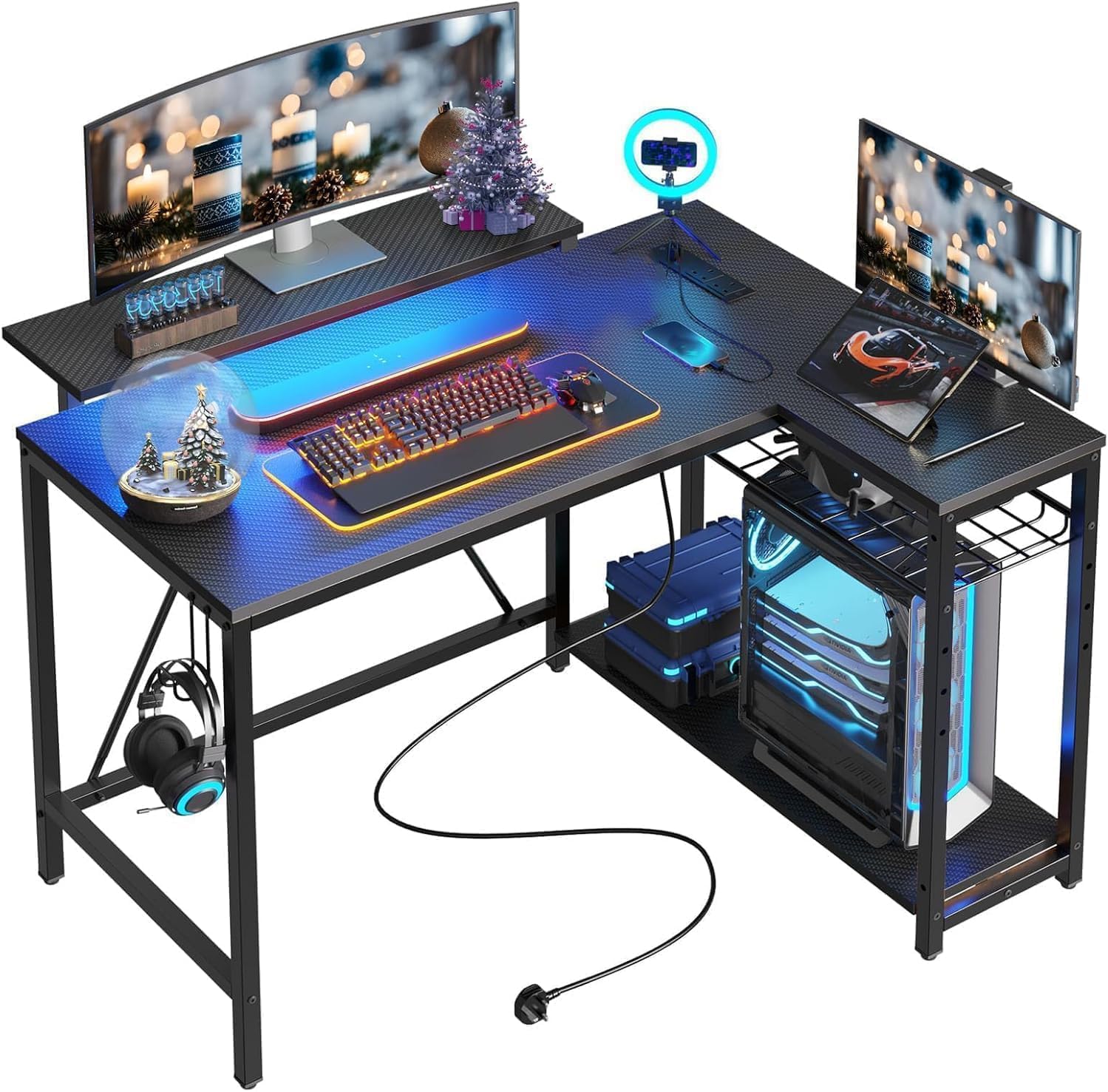
- 41.93 by 32.28 inch corner footprint standing 35.91 inches tall, shaped to occupy a wasted bedroom corner
- Built-in power strip carries 2 AC outlets plus USB-A and USB-C on a 6 foot cord, so the wall socket can be across the room
- Side shelves mount on the left or right, and the frame supports four different assembly layouts
- Upper stand works either as a raised monitor platform or as a side display shelf
- Height-adjustable CPU tray plus a hook for headphones, a backpack or keys
Cons
- The maker states it fits a single monitor or laptop rather than two large screens
- Assembly runs from about 40 minutes to 2.5 hours, and the top panel is far easier with a second pair of hands
- No load capacity is published for the desktop or the storage shelves
The overall envelope is 41.93 inches wide by 32.28 inches deep, standing 35.91 inches tall, which is a deliberately small L for a room that has no spare wall.
- The L shape puts the return into a corner that would otherwise hold nothing, turning dead space into a workstation
- At just under 42 inches on the long side, it fits between a bed and a wardrobe in a typical bedroom
- The taller overall height accounts for the upper shelf structure rather than the writing surface itself
Measure both wall lengths before ordering, and add chair clearance to the deeper side. The maker is explicit that this is a single-screen desk, one monitor or a laptop rather than two large displays side by side. If a dual-monitor setup is the goal, a wider desk is the right answer instead of this one.
Expect a real build rather than a ten minute job. Most people finish in 40 minutes to 2.5 hours depending on experience.
- Assemble in the room where the desk will live, since a completed L is awkward through a doorway
- Put a cushion or the flattened carton under the top board while working, to protect the carbon fibre finish
- Get help for the top panel, the one stage where a second person genuinely speeds things up
The payoff is flexibility. The side shelves mount on the left or right, which lets you match the desk to your wall and socket position, and the frame supports four assembly modes in total. The CPU tray height can be changed to suit the tower you own, and the upper stand works as either a monitor riser or a side display shelf.
The integrated power strip is the feature that changes daily use most.
- 2 AC outlets plus a USB-A and a USB-C port, built into the desk rather than trailing on the floor
- A 6 foot cord back to the wall, which is enough to reach a socket on the opposite side of a small bedroom
- Monitor, lamp, phone and headset all plug in at desk level, so no cables run under your feet
The LED strip is a soft glow rather than a hard directional light, which suits evening use without throwing glare across a screen. Reversible shelving also simplifies cable routing, since the shelf column can go on the same side as the wall socket. Keep the loading on the strip sensible, as it is a desk convenience rather than a substitute for a wall circuit.
Pros
- Steel square-tube legs stated to carry 265 pounds, enough for a tower, printer and two screens
- X-brace under the frame resists the diagonal wobble that shows up while typing on a lightweight desk
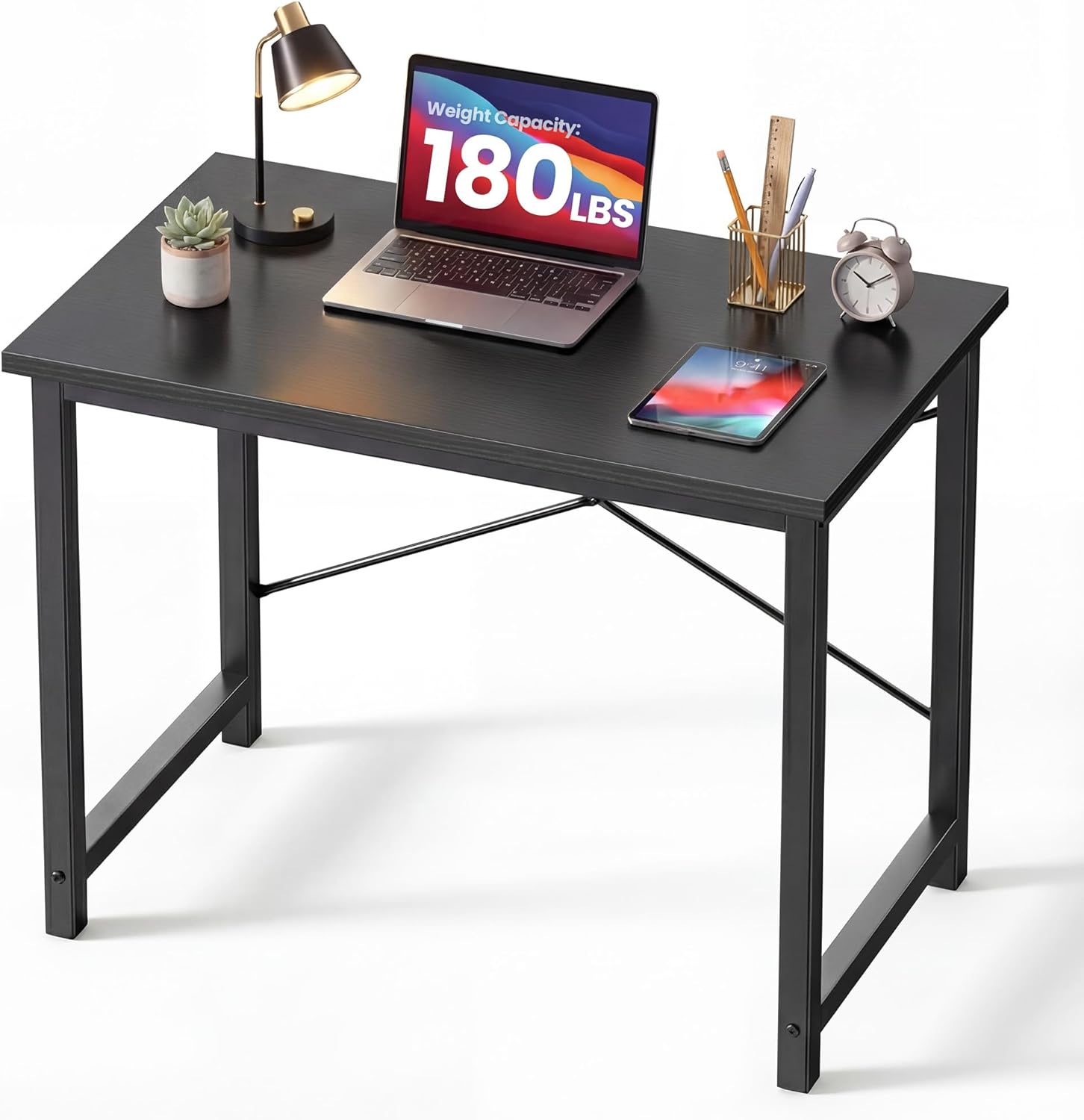
- Top listed at 31.5 inches wide by 19.69 inches deep, standing 29.69 inches high, sized for a narrow bedroom wall
- High-density engineered wood surface with a wear-resistant coating that shrugs off mug rings and pen pressure
- Offered in six lengths from 32 to 63 inches and three colourways, so the same design scales to a larger room later
Cons
- 19.69 inch depth is shallow, so a 27 inch monitor sits close unless it moves onto an arm
- The maker states dual-monitor use begins at the 55 inch size, so this length is a single-screen desk
- Fixed height with no drawers, cable tray or under-desk storage of any kind
Two structural details do the work on a desk this size.
- Thick square-tube steel legs rather than folded angle, which is why the stated capacity reaches 265 pounds
- An X-brace across the frame, the part that stops diagonal racking, which is the specific wobble you feel through the keyboard when a desk is braced only at the ends
The dimensions to plan against are 31.5 inches wide, 19.69 inches deep and 29.69 inches high. That height is standard for a task chair with a 17 to 21 inch seat, so your forearms sit level without a footrest. The 265 pound figure is generous for the footprint, and in practice the limiting factor is surface area rather than strength, since you run out of desktop long before you run out of load capacity.
Everything needed to build the desk is included, with no separate trip to a hardware shop involved.
- All fixings and the required tools ship in the carton alongside printed instructions
- Work with the top face down on the packaging so the wear-resistant coating is not scratched during the build
- Attach both legs and the X-brace loosely, then tighten everything once the frame is square, which is what prevents a permanent lean
It is a small parts count, so most people are finished well inside an hour. Once upright, check it on the actual floor rather than a rug, since a bedroom floorboard slope shows up as a rock that no amount of retightening fixes. Revisit the bolts after a couple of weeks of use, as any new bolted frame beds in slightly.
At 31.5 inches wide this is one of the smaller desks in the range, and that defines its use.
- Bedrooms and box rooms, where the desk has to tuck against a short wall or into an alcove
- Students working from a laptop with a notebook beside it
- Secondary stations such as a hallway console, a craft table or a place to park a printer
The maker sells the same design at 40, 44, 47, 55 and 63 inches, and states that dual monitor setups start at the 55 inch sizes. If you already run two screens, choose a longer version from the outset. The shallow 19.69 inch depth is the other thing to check honestly, since a large monitor on a stock stand will sit closer to your eyes than is comfortable.

Pros
- Main top measures 48 by 19.7 inches at 30 inches high, inside an overall 48 by 31.5 inch corner footprint
- Stated 100 pound load across the desk surfaces
- 3 AC outlets and 2 USB charging ports built into the frame, so a phone and headset charge at desk level
- LED strip offers 10 static colours, 6 brightness steps, 10 dynamic modes and a memory function that recalls the last setting
- Reversible build puts the return on the left or right, with monitor stand, PC tower stand, hook and side storage bag all included
Cons
- 100 pound total capacity is modest once a full tower, two monitors and peripherals are loaded onto it
- Main top depth of 19.7 inches is tight for a large curved ultrawide on its stock stand
- The L shape needs a genuine corner measuring at least 48 by 31.5 inches, since the return does not detach
There are two sets of numbers worth keeping apart here.
- The main desk surface is 48 inches wide, 19.7 inches deep and 30 inches high, standard desk height for a task chair
- The overall corner envelope is 48 by 31.5 inches, rising to 34.6 inches at the shelf structure
- Stated load capacity is 100 pounds across the surfaces
The maker describes the 48 inch top as holding three monitors and a laptop, though the 19.7 inch depth means shallow-stand monitors or a mount is the sensible route for anything above 24 inches. Measure both wall lengths before ordering, and allow separately for chair clearance and the depth of your PC tower. In a small bedroom the corner is usually available and it is the chair swing that runs short.
The desk arrives with labelled parts and printed instructions, and the build rewards a bit of preparation.
- Check every part against the list before starting, so a missing fixing is found at the beginning rather than an hour in
- Sort the hardware into groups by step, since several similar-length bolts are used
- Have a second person for the larger panels, which is where a solo build gets awkward
The layout is reversible, so the return and the storage column can go on the left or the right. Decide which side before assembly by looking at where your wall socket sits and which way the room door opens, because changing your mind afterwards means partly dismantling the desk. Included in the build are a raised monitor stand, an under-desk PC tower stand, open shelves, a side storage bag and a hook.
Two features aimed squarely at a PC setup are built into the frame rather than added on.
- 3 AC outlets and 2 USB charging ports at desk level, which covers a monitor, a lamp, a phone and a headset without a floor extension lead
- An LED strip with 10 static colours, 6 brightness grades and 10 dynamic modes, plus a memory function that returns to your last setting after switch-off
Dropping the brightness a couple of steps and leaving a static colour behind the monitor reduces the contrast between a bright screen and a dark room, which is easier on the eyes during long evening sessions than the animated modes. Keep total draw on the built-in outlets sensible, since it is designed for desk devices rather than heaters or high-draw appliances.
What makes a good desk for a gaming desktop
A desktop tower changes the math versus a laptop setup. You need floor or shelf clearance for the case, plus airflow around its vents. Heat builds fast when a PC sits boxed in a closed cupboard.
Surface depth matters more than most buyers expect. A 24-inch monitor wants at least 23.6 inches of depth for comfortable eye distance. Shallow desks push screens too close and strain your eyes.
Steel frames beat particleboard-only legs for stability during frantic mouse swipes. Look for cable holes, a headphone hook, and a monitor riser. These small features keep a battlestation tidy and reduce neck fatigue.
Weight capacity and stability
Full towers plus dual monitors can top 60 pounds combined. Cheap desks wobble under that load and during aggressive gameplay. A cross-braced steel frame with adjustable leg pads levels wobble on uneven floors.
Surface material and finish
Carbon-fiber-textured tops resist scratches and let a mouse glide well. The BestOffice 47″ uses this finish at just $55.99. Matte laminate hides fingerprints better than glossy panels under RGB lighting.
How to choose the best desks for a gaming desktop
Start with your room, not the desk. Measure the wall or corner where the setup lives. Then subtract space for your chair to roll back freely.
Next, count your monitors and peripherals. One ultrawide needs width; a triple-screen stack needs both width and depth. Streamers should add room for a mic arm, capture cards, and a second keyboard.
Match the shape to your space
L-shaped and corner desks turn dead corner space into usable surface. They give you a main gaming zone plus a side wing for a printer or console. If you want more corner-focused options, our roundup of the best L-shaped gaming desks compares the layouts in depth.
Straight rectangular desks suit narrow walls and simpler builds. The EUREKA ERGONOMIC 60″ gives a clean 60-inch run for $239.99. It is the pick for large monitors and a spacious keyboard-plus-mouse arc.
Budget tiers explained
Under $80 gets you a capable steel-framed corner desk with basic extras. The $80 to $130 band adds power outlets, LED strips, and storage shelves. Above $150, you pay for premium legs, wider tops, and full hutches.
Shoppers watching spend should scan our list of the best gaming desks under $200. Almost every desk in this guide fits that ceiling comfortably.
Top picks by use-case
Here is how the ranked models sort by need. Each recommendation cites a real reason to choose or skip it.
Best overall value
The Mr IRONSTONE L-Shaped Desk earns the top spot on trust alone. Its 4.7 rating across 40910 reviews is the deepest track record here. At $72.99 you get an LED-lit 51-inch corner, cup holder, and headphone hook.
It is not for you if you crave built-in power outlets or a tall hutch. But for a first serious battlestation, the price-to-durability ratio is hard to beat.
Best with built-in power
The Bestier 44″ Gaming Desk integrates power outlets into the frame. That kills the reach behind furniture for a free socket. It adds four reversible shelves and a side storage bag for $89.09.
The ODK 48″ corner desk, at $109.99, also bundles USB charging ports and outlets. Its 4.6 rating over 2130 reviews signals solid, consistent quality.
Best for big multi-monitor setups
The SEDETA 78.8″ Workstation stretches nearly 79 inches wide. That length swallows triple monitors, a stream deck, and speakers. Its hutch and storage shelves lift clutter off the main surface for $159.99.
Skip it if your room is small; this desk dominates a wall. A 70.8-inch SEDETA variant at $124.99 offers a slightly tamer footprint with the same LED-and-shelf formula.
Best for small spaces and bedrooms
The DUMOS 32″ Desk fits where nothing else will. At 32 inches and $26.99, it suits dorms and tight corners. Its reinforced structure holds a mid-tower and one monitor without complaint.
The trade-off is obvious: little room for sprawling peripherals. Pair it with a floor-standing tower to reclaim surface area.
Best budget L-shaped corner
The ODK 53″ L-Shaped Desk delivers corner space with outlets for $89.99. It reverses to fit either side of a room. Storage shelves, a bag, and an iron hook round out a tidy gamer package.
Practical buying guide: sizes, specs and compatibility
Width drives comfort more than any single spec. For one monitor and a keyboard, 44 to 48 inches works well. For dual monitors, aim for 55 inches or more of usable width.
Depth should hit 23 to 27 inches for proper viewing distance. Corner desks vary depth by wing, so measure both arms. Confirm your chair armrests slide under the apron without catching.
Where the tower actually sits
Decide this before buying. A CPU shelf keeps the case off carpet and improves airflow. On-floor placement works too, but leave a few inches from walls for exhaust.
Some models include a lower open shelf sized for a mid-tower. Measure your case height and width against that opening. A crammed tower runs hot and throttles performance.
Cable management and power
Grommet holes and under-desk trays hide the spaghetti. Desks with onboard outlets, like the Bestier and ODK models, cut clutter further. Add Velcro straps to bundle loose runs along the frame.
If a clean corner build is your goal, browse the wider field of best PC gaming desks for cable-friendly designs. Prioritize a top edge with routing cutouts over a flat, hole-free plank.
Common mistakes to avoid
Do not buy on width alone and forget depth. A wide but shallow desk still crowds your eyes. Many returns happen because a monitor sat too close to focus comfortably.
Avoid all-particleboard legs for heavy rigs. They flex and creak under a loaded top. Steel frames cost little more and last years longer.
Do not ignore assembly reviews. A desk with confusing hardware wastes an afternoon. High review counts, like the 3128 on the Bestier 42″ L-shaped model, usually flag clear instructions.
Finally, do not trap your tower in a sealed cabinet. Thermal buildup shortens component life and triggers throttling. Open shelving or floor placement keeps temperatures safe.
Overlooking your chair and posture
The desk is half the ergonomic equation. A fixed-height desk near 29 inches suits most seated players. If you want to explore compact corner fits, the best corner desks for gaming guide covers layout and reach angles.
Frequently asked questions
What size desk do I need for a gaming desktop?
For one monitor, a 44 to 48-inch width with 24 inches of depth is plenty. Dual-monitor and streaming setups want 55 inches or more. Corner and L-shaped desks add surface without eating extra wall length.
Should my tower sit on the desk or the floor?
Either works if airflow is protected. Floor or open-shelf placement keeps heavy cases stable and cool. Avoid sealed cabinets, which trap heat and can cause thermal throttling during long sessions.
Are cheap gaming desks durable enough for a full tower?
Yes, if they use a steel frame with cross bracing. Budget picks like the $72.99 Mr IRONSTONE hold high review scores over tens of thousands of buyers. Skip desks with particleboard-only legs for heavy multi-monitor loads.
Do I need built-in power outlets and LED lights?
Outlets are a genuine convenience that reduces cable reach and clutter. LED strips are cosmetic and do not affect performance. Choose outlets if your wall sockets sit far from the desk.
What is the best desk shape for a corner room?
An L-shaped or corner desk converts unused corner space into a wide work zone. It gives a main gaming area plus a side wing for peripherals. Confirm which wing reverses so it fits your specific corner.
Final take
Your ideal desk balances footprint, surface depth, and build quality against budget. The Mr IRONSTONE corner leads on proven durability and price, while the EUREKA 60″ and SEDETA 78.8″ reward larger, multi-monitor rigs. Small rooms lean on the DUMOS 32″, and outlet lovers will favor the Bestier and ODK corners. Measure your space, protect your tower’s airflow, and pick the shape that fits your wall. Any model above gives your gaming desktop a stable, tidy home for years.






