 Marcus Bell
 Choosing one of the best modems for Comcast internet is one of the smartest upgrades you can make to your home network. Xfinity by Comcast rents equipment on a monthly basis, and those fees add up quickly over the life of a plan. By buying a compatible modem outright, you take control of your connection, stop paying recurring rental charges, and often enjoy a faster, more stable signal. This guide walks you through what actually matters when shopping – so you can match the right device to your plan speed and household needs without guesswork.
Below you will find a curated shortlist of Comcast-approved modems and modem-router combos to consider, followed by a practical buying framework covering DOCSIS standards, channel bonding, speed tiers, and setup tips.

Pros
- DOCSIS 3.1 with wide OFDM channels, supporting cable plans advertised up to 2 Gbps downstream
- Two 1 Gigabit Ethernet ports, with the second able to carry a separate IP where the provider supports it
- CableLabs certified and qualified for Xfinity, Cox and Spectrum, so activation follows the standard self-install path
- Compact 5.13 x 1.75 x 5.25 in footprint standing vertically in a narrow media cabinet
- Separate LED indicators for power, upstream, downstream and online status, which makes a failed activation easy to diagnose
Cons
- Modem only, so a separate router or mesh system is required for any Wi-Fi at all
- Each Ethernet port is capped at 1 Gbps, meaning a single router link cannot carry a full 2 Gbps plan
- Works on cable coax only, with no support for fiber, DSL or satellite lines, and no telephone ports for cable voice service
This is a DOCSIS 3.1 modem, which uses wide OFDM channels rather than bonding many narrow DOCSIS 3.0 carriers. The practical result is support for cable plans advertised up to 2 Gbps downstream, along with lower latency under heavy load than the previous generation manages.
- Two 1 Gigabit Ethernet ports on the rear panel
- Each port is capped at 1 Gbps, so no single link carries a full 2 Gbps plan
- The second port can carry a separate IP where the provider supports it
That port ceiling is the detail to check against a service plan. On a gigabit tier it is irrelevant. On a multi-gig tier the throughput exists at the coax side but arrives on the LAN split across two ports, which needs a router able to use both, or acceptance that a single link tops out at a gigabit.
Installation follows the standard self-install path: run the coax from the wall outlet to the modem, connect power, wait for the front indicators to settle, then register the device MAC address with the provider through the companion app, a web portal or a phone call. The LEDs report power, upstream, downstream and online status separately, which makes diagnosing a stalled activation straightforward.
- Cabinet footprint of about 5.13 x 1.75 x 5.25 in standing vertically
- No wireless configuration to do, because the unit has no radio inside
- A router or mesh node plugs into the first Ethernet port
Keep the coax run short and avoid splitters wherever possible. Every split drops signal level at the modem, and that is the usual cause of intermittent downstream errors appearing days after an otherwise clean install.
Every modem in this line is CableLabs certified, and this model is tested and qualified for Xfinity, Cox and Spectrum. Providers keep their own approved device lists, so confirming the model against a specific plan beforehand avoids an activation refusal on the day.
- Cable coax service only, with no support for fiber, DSL or satellite lines
- This is a modem only, so a router or mesh system is required for Wi-Fi
- No telephone ports, meaning cable voice service still needs the provider's own device
That separation is a design decision rather than an omission. Keeping the modem and the router as separate boxes means the wireless side can be upgraded to a newer standard, or swapped for a mesh set, without touching the part that has to stay certified with the cable provider.

Pros
- Handles cable plans up to 900 Mbps, with a Full-Band Capture tuner that locks onto channels faster than older tuner designs
- Single Gigabit Ethernet port pairs with any router you like, including mesh kits and gaming routers
- Upright 7.25 by 2.25 by 7.88 inch body takes almost no shelf depth beside a router
- Certified with Comcast Xfinity, Cox and Charter Spectrum, so activation follows a documented path
- Three connections total, power, coax and Ethernet, which keeps fault-finding down to a short list
Cons
- No Wi-Fi inside, so a separate router is mandatory for any wireless device in the house
- No telephone ports, which rules it out for bundled cable voice service
- Not compatible with Verizon Fios, AT&T, CenturyLink or any fibre, DSL or satellite connection
This is a modem and nothing more, which is exactly why it holds its speed ceiling well.
- Sized for actual cable service speeds up to 900 Mbps, so it comfortably covers the 400 to 800 Mbps tiers most households sit on
- A Full-Band Capture digital tuner scans the whole spectrum at once rather than hunting channel by channel, which shortens lock times after a reboot
- The Gigabit Ethernet port is the single outlet for all traffic, so the router you attach becomes the real determinant of Wi-Fi performance
If the Ethernet port is not feeding a router, it will drive a computer, smart TV or games console directly. That makes it a reasonable choice for a single-desk setup where wireless is not needed at all.
Installation comes down to three leads and one registration step with your provider.
- Coax from the wall plate to the modem, hand-tightened until snug rather than wrenched
- Power from the supplied adapter
- Ethernet out to the WAN port of your router
After that, the provider has to register the modem MAC address and serial number, both printed on the label. Photograph them before the unit goes behind furniture, because reading a label in a cupboard later is a chore. Give the modem several minutes on first power-up while it downloads its configuration file. The upright body has a small footprint but wants airflow around it, so avoid stacking a router directly on top of the case.
Compatibility is the single thing to confirm before ordering, because a cable modem is useless on the wrong network type.
- Certified with Comcast Xfinity, Cox, Charter Spectrum and a number of other cable operators
- Not compatible with Verizon Fios, AT&T, CenturyLink and any other fibre optic, DSL or satellite service
- No voice capability, so households on a cable telephone bundle need the provider supplied eMTA and cannot swap this in
One more check worth making is the plan tier. DOCSIS 3.0 here is matched to plans up to 900 Mbps, so a multi-gigabit service would need a DOCSIS 3.1 unit instead. Because there is no router inside, you also need a working router or mesh system ready before the changeover.

Pros
- 24x8 DOCSIS 3.0 channel bonding supports cable plans up to 800 Mbps
- AC1900 dual-band Wi-Fi covers both 2.4GHz and 5GHz devices from one unit
- Four Gigabit Ethernet ports handle wired connections for desktops, consoles or smart TVs
- Power Boost amplifiers extend Wi-Fi signal strength and range beyond a standard router
- Approved for use with Comcast Xfinity, Cox and Charter Spectrum cable service
Cons
- Not compatible with fiber, DSL or satellite internet service, cable only
- Does not support home telephone service through the modem
- Residential use only, ruling out business-tier deployments needing higher device counts
This combo unit pairs a DOCSIS 3.0 modem with an AC1900 router in a single device.
- 24x8 DOCSIS 3.0 channel bonding supports cable internet plans up to 800 Mbps
- AC1900 dual-band Wi-Fi covers both 2.4GHz and 5GHz bands simultaneously
- The modem itself supports speeds up to 1000 Mbps, with actual throughput capped by the subscribed service tier around 650 Mbps
- Power Boost amplifiers and AnyBeam technology focus signal strength on connected devices
Because throughput is ultimately capped by the internet service plan, the modem's 800 Mbps ceiling matters most for households on higher-tier cable plans rather than entry-level speeds.
Setup centers on activation with a supported cable provider rather than complex configuration.
- Certified for Comcast Xfinity, Cox and Charter Spectrum cable internet service
- Not compatible with fiber, DSL, or satellite internet connections
- Technical support is available by phone, chat or email for activation or connection issues
- Built-in firewall security protects the network without needing a separate security appliance
Because compatibility is limited to specific cable ISPs, confirm your provider is on the certified list before purchase, since fiber and DSL households cannot use this modem.
Beyond wireless coverage, the unit includes dedicated ports for devices that benefit from a wired connection.
- Four Gigabit Ethernet ports support wired connections for desktops, consoles or smart TVs
- The built-in AC1900 router serves smartphones, laptops and tablets over Wi-Fi
- Power Boost amplification extends wireless range further than a standard built-in router
- The combo design replaces a separate modem and router with one device on the network
Because the modem does not support home telephone service, households needing VoIP through their cable provider will need a separate compatible device.
Pros
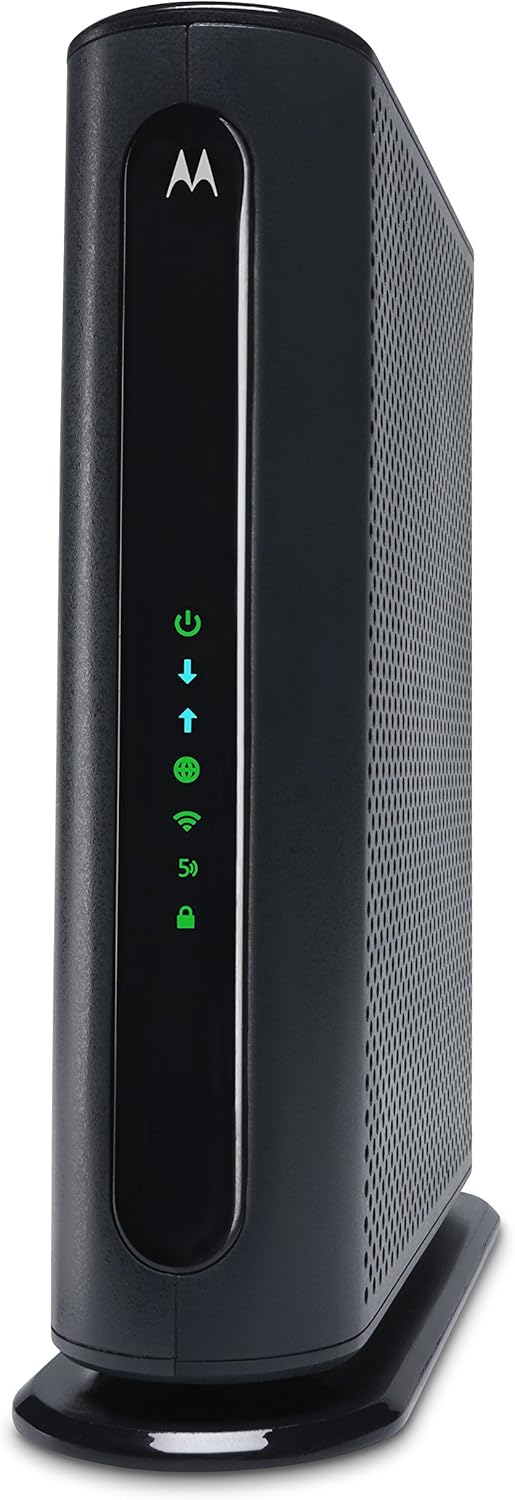
- 16x4 DOCSIS 3.0 bonding supports actual cable service speeds up to 375 Mbps
- AC1600 dual-band Wi-Fi (2.4GHz and 5GHz) pairs with 4 Gigabit Ethernet LAN ports for wired devices
- DFS channel access reduces Wi-Fi interference from neighboring networks compared with standard routers
- Broadcom modem chipset adds hardware-level denial-of-service attack protection
- Single combined unit removes a second power adapter and box compared with separate modem and router hardware
Cons
- No phone jack, so it cannot handle landline or VoIP calling
- Works only with cable internet; fiber, DSL and satellite services from Verizon, AT&T and CenturyLink are not compatible
- AC1600 Wi-Fi tops out below the AC1900 tier of Motorola's own higher-end model, a ceiling for very high-throughput home networks
The modem uses 16x4 DOCSIS 3.0 channel bonding, recommended for actual cable service speeds up to 375 Mbps. The built-in router runs AC1600 dual-band Wi-Fi across 2.4GHz and 5GHz bands running at the same time, so devices are not forced to share one crowded band.
- Four Gigabit Ethernet LAN ports provide wired connections for PCs, consoles and streaming devices
- DFS frequency support lets the router use 5GHz channels that many standard routers cannot access
- AnyBeam beamforming on both bands focuses the signal toward connected devices for a stronger link
Coverage in larger homes may still thin out at distant rooms or additional floors, since this is a single-point router rather than a multi-unit mesh system.
Combining the modem and router into one box means setup involves a single coax connection and one power cord rather than pairing two separate devices together. Activation with the cable provider uses the unit's MAC address and serial number, typically completed online or by phone.
- Four Gigabit LAN ports are active as soon as the modem finishes activation
- A Broadcom chipset provides built-in protection against denial-of-service attacks
- No phone jack is present, so voice calling is not supported by this model
Because there is no mesh or extender pairing built in, homes with dead zones will need a separate access point added to the network.
This modem is approved for use with Comcast Xfinity, Cox, Charter Spectrum, BrightHouse, WOW!, CableOne, RCN, Mediacom and other cable internet providers. As with any third-party modem, checking the current approved-device list for your specific provider before ordering avoids activation issues.
- Not compatible with fiber, DSL or satellite internet services, including those from Verizon, AT&T and CenturyLink
- Requires an active cable internet subscription; it will not function as a Wi-Fi router without one
- Replaces a provider-rented modem/router unit once activated, so only one device sits between the wall jack and your home network
Provider-approved device lists change periodically, so it is worth reconfirming compatibility if switching cable companies down the line.
Pros
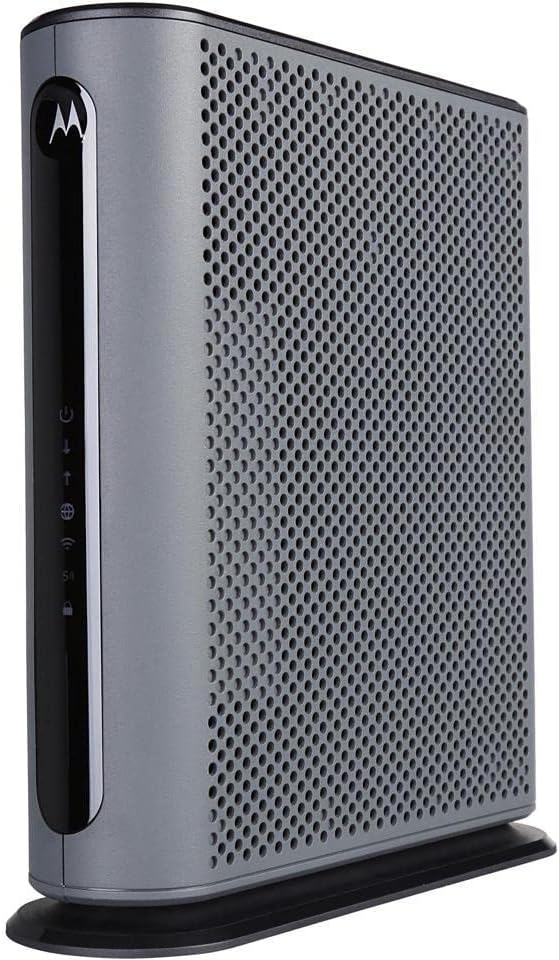
- 16x4 DOCSIS 3.0 channel bonding supports actual cable service speeds up to 375 Mbps
- AC1900 dual-band Wi-Fi runs 2.4GHz and 5GHz simultaneously alongside 4 Gigabit Ethernet ports
- Built-in DFS support opens extra 5GHz channels that most routers cannot access, cutting neighbor interference
- Broadcom modem chipset adds denial-of-service attack protection at the hardware level
- Combines modem and router into one unit, removing a second power cable and box from the desk
Cons
- No phone jack, so it cannot be used for any landline or VoIP calling service
- Only compatible with cable internet; fiber, DSL and satellite services such as Verizon, AT&T or CenturyLink will not work with it
- AC1900 Wi-Fi standard predates Wi-Fi 6, a ceiling for the newest high-throughput client devices
The modem side uses 16x4 DOCSIS 3.0 channel bonding, rated for actual cable internet service speeds up to 375 Mbps. The router side runs AC1900 dual-band Wi-Fi across 2.4GHz and 5GHz simultaneously, with Power Boost amplifying the wireless signal to the FCC-allowed limit for extended range.
- Four Gigabit Ethernet LAN ports handle wired connections to PCs, game consoles or streaming boxes
- DFS channel support opens additional 5GHz spectrum that standard routers cannot use, reducing crowding from neighboring Wi-Fi networks
- AnyBeam beamforming focuses the wireless signal toward connected devices instead of broadcasting evenly in all directions
Larger homes with multiple floors may still see weaker signal at the far edges, since this is a single-unit router rather than a mesh system.
Because the modem and router are combined into one unit, setup involves connecting a single coax cable from the wall and a single power cord, rather than pairing two separate boxes. Activation is completed with the cable provider using the device's serial number and MAC address.
- Four Gigabit Ethernet ports are ready for immediate wired connections out of the box
- A built-in firewall and Broadcom chipset add protection against denial-of-service attacks by default
- No phone jack is present, so this model cannot support telephone or VoIP service
Since it is not a mesh unit, homes with dead zones will need a separate access point added to the network.
This modem is approved for use with Comcast Xfinity (including X1), Cox, Charter Spectrum, Time Warner Cable, Suddenlink, WOW!, CableOne and several other cable internet providers. Buyers should confirm their specific provider's approved device list before ordering, since approval can vary by region.
- Not compatible with fiber, DSL or satellite services from Verizon, AT&T, CenturyLink, Frontier and similar providers
- Requires an active cable internet subscription; it does not work as a standalone Wi-Fi router without one
- Replaces a rented modem/router combo from the provider, removing that unit from the account once activated
Anyone switching providers in the future should re-check the approved device list, since not every cable company accepts every third-party modem model.

Pros
- Combines a DOCSIS 3.0 cable modem and an AC1900 dual-band router in one chassis, removing a second power lead
- Certified for Xfinity by Comcast and Cox cable service on plans up to 800 Mbps
- Gigabit Ethernet ports on the rear for a console or desktop that needs a stable wired link
- Sold through the Amazon Renewed programme, inspected and reset to factory defaults before dispatch
Cons
- Not compatible with Verizon, Spectrum, AT&T, CenturyLink, DSL providers, DirecTV or DISH
- No support for bundled cable voice service, so a phone line needs a separate eMTA modem
- Wi-Fi 5 radios only, so Wi-Fi 6 and 6E clients connect at Wi-Fi 5 rates with no 6GHz band
This is the first thing to check and the reason most returns happen. The unit is certified for Xfinity by Comcast and Cox cable networks, and it is explicitly not compatible with Verizon, Spectrum, AT&T, CenturyLink, any DSL provider, DirecTV or DISH.
It also does not support bundled cable voice service. If your account includes a home phone line through the cable provider, this cannot carry it, and you will need an eMTA modem with telephony ports instead.
Provisioning follows the usual route: register the device MAC address with the provider through their app or by phone, then wait for the downstream and upstream lights to lock before testing anything. Keep the account details to hand, because activation is the step where a self-installed modem most often stalls for an evening.
The unit combines a DOCSIS 3.0 cable modem and an AC1900 dual-band router in a single chassis, so one power lead and one coax feed replace two boxes plus the Ethernet cable between them, and there is one fewer thing to reboot.
It is specified for cable plans up to 800 Mbps. Treat that as the practical ceiling: a plan above that figure will be constrained by the modem rather than by the line, so households on multi-gig service should be looking at a DOCSIS 3.1 unit instead.
Wired devices connect over Gigabit Ethernet on the rear, which is the connection to use for a desktop, a games console or a heavy-streaming TV, since a wired link sidesteps Wi-Fi congestion completely. The wireless side is dual-band Wi-Fi 5.
This unit is sold through the Amazon Renewed programme rather than as new stock. In practice that means it has been inspected and tested by a qualified supplier, cleaned, and reset to factory defaults so that no previous owner's settings or credentials remain on it.
Two things follow. Packaging and accessories are not guaranteed to match a new retail box, so a coax lead or an Ethernet patch cable may or may not be in the carton; check before assuming. And light cosmetic marks are possible, because the standard applied is functional rather than visually pristine.
Before activation, run a factory reset yourself with the recessed rear button, then set a new admin password and a new Wi-Fi passphrase. After that, check for a firmware update, because a unit that has been sitting in stock will be behind on security patches.

Pros
- Mid/high-split DOCSIS 3.1 cable modem delivers up to 2Gbps of
- Unlock faster cable internet speeds, such as Xfinity’s 900Mbps
- Faster download speeds powers your digital lifestyle with enhanced
- 10x faster upload speeds for seamless multi-family gaming, video
Cons
- Requires proper surface alignment during initial installation
- Periodic visual inspection recommended to ensure component tightness
Crafted with attention to functional details, the NETGEAR NETGEAR Nighthawk DOCSIS 3.1 Mid high-Split Cable Modem brings efficient performance to your Modems. Practical hands-on evaluation highlights core functional attributes including Mid/high-split DOCSIS 3.1 cable modem delivers up to 2Gbps of download speeds and 1Gbps of upload speeds. Furthermore, features like Unlock faster cable internet speeds, such as Xfinity’s 900Mbps download speeds and 100Mbps upload speeds. Works with all major US internet providers. Not compatible with Xfinity Voice plans ensure seamless adaptability across varied spatial layouts. Precision engineering delivers a stable foundation tailored for active household demands.
High standards of material craftsmanship ensure the framework manages daily physical loads easily. Materials engineering centers on Faster download speeds powers your digital lifestyle with enhanced speed, capacity, efficiency, and response times, preserving visual appeal and physical integrity over time. Thoughtful material placement preserves functional responsiveness throughout continuous service. Precision engineering delivers a stable foundation tailored for active household demands. Carefully selected components ensure minimal maintenance overhead over long service life. Attention to manufacturing details ensures reliable utility for your Modems. Using proper installation techniques maintains physical stability across daily activities. This balanced configuration fits smoothly into existing interior designs while maximizing efficiency.
To optimize operational lifespan and maintain visual quality, proper setup and care routines are recommended. With user-friendly details such as 10x faster upload speeds for seamless multi-family gaming, video conferencing and uploading even the largest files—simultaneously. Plus provides easy remote access to your home security cameras and files on your NAS, setting up the equipment requires minimal effort. Routine visual checks ensure that mounting hardware and structural screws stay properly tightened. Precision engineering delivers a stable foundation tailored for active household demands. Carefully selected components ensure minimal maintenance overhead over long service life. Attention to manufacturing details ensures reliable utility for your Modems.

Pros
- Combines a DOCSIS 3.0 cable modem, AC1900 dual-band router, and 2 phone lines into one device
- 4 Gigabit Ethernet ports plus 3 internal antennas support up to 253 wired and wireless devices
- AnyBeam beamforming on both 2.4GHz and 5GHz bands focuses signal toward connected devices
- Backed by a 2-year quality agreement and phone, chat, or email technical support
Cons
- Compatible with Xfinity (Comcast) internet service only, not other cable ISPs
- Phone ports only support Xfinity Voice service, so they are unusable for other VoIP or landline providers
- Guest network is included, but there is no Wi-Fi 6 support, so throughput tops out at AC1900 wireless speeds
The MT7711 is rated for up to 800 Mbps cable internet speed and up to 1900 Mbps combined wireless throughput across its dual-band AC1900 radios. Three internal antennas support three send and three receive channels, and AnyBeam beamforming focuses the 2.4GHz and 5GHz signals toward connected devices rather than broadcasting evenly in all directions.
- Up to 800 Mbps cable internet speed
- Up to 1900 Mbps combined wireless throughput
- 3 internal antennas with AnyBeam beamforming
Wireless Power Boost adds amplification on top of the base signal, aimed at extending range in larger homes without a separate extender.
This device combines a cable modem, Wi-Fi router, and 2 phone lines in a single box, which cuts down on separate equipment and cabling during setup. A guest network keeps visitor internet access separate from the main network, and the router supports up to 253 wireless and Ethernet devices connected at once.
- 3-in-1 modem, router, and phone line setup
- Guest network for visitor access
- 4 Gigabit Ethernet ports for wired connections
Setup support is available by phone, chat, or email if you run into issues connecting to your specific internet service.
The MT7711 is certified for Xfinity Internet and Xfinity Voice specifically, and Motorola notes it is only compatible with Xfinity (Comcast) internet service, it is not built to work with other cable providers. The two telephone ports support Xfinity Voice features like caller ID, call forwarding, and conference calling, but the device can also run without phone service active.
- Certified for Xfinity Internet and Xfinity Voice
- 2 phone ports with caller ID, call forwarding, and conference calling
- Works without phone service, but only on Xfinity internet
Anyone switching away from Xfinity in the future would need a different modem, since this unit is not certified for other ISPs.
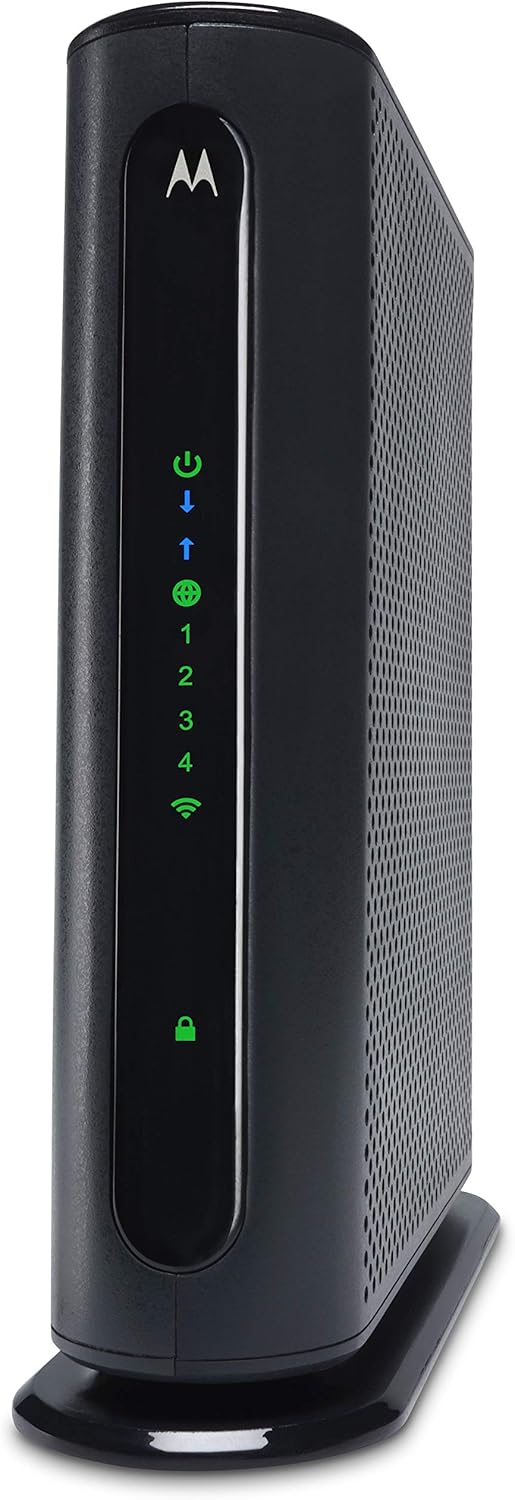
Pros
- Combines a DOCSIS 3.0 cable modem with an N450 WiFi router in one unit, reducing cable clutter versus two separate boxes
- 4 Gigabit Ethernet ports support wired connections for gaming consoles, smart TVs, and other devices
- Power Boost technology extends WiFi signal range for gaming, streaming, and video conferencing
- Owning the unit outright means avoiding the recurring modem rental fee some ISPs charge for provided equipment
Cons
- No telephone jack support, so it cannot be used for VoIP or landline phone service through the modem
- N450 WiFi is a single-band, older WiFi standard, without WiFi 6 or dual-band 5GHz support
- Speeds are capped around 343 Mbps, below the throughput ceiling of newer DOCSIS 3.1 modems
This is a DOCSIS 3.0 cable modem combined with an N450 WiFi router in a single unit, rated for internet speeds up to 343 Mbps.
- Confirmed compatible with Cox and Charter Spectrum internet plans, with similar service speed support for other providers
- Because it runs N450 WiFi rather than a newer dual-band or WiFi 6 standard, wireless throughput is a step behind current-generation routers
- No telephone jacks are included, so this modem does not support voice call service over the connection
For internet-only service without a phone line requirement, the combined modem and router setup covers standard broadband speeds without needing a separate router purchase.
Combining the modem and router into one device reduces the wiring and separate power adapters that two standalone boxes would require.
- 4 Gigabit Ethernet ports support wired connections to smart TVs, game consoles, and computers
- A single user interface manages both modem and router settings, rather than juggling two separate admin pages
- Because it is DOCSIS 3.0 rather than a newer wired-in modem, it does not include a battery backup for phone service during outages, matching its lack of telephone jack support
The vertical design also reduces the shelf footprint compared with two separate stacked devices, improving airflow around the unit.
Power Boost technology amplifies the wireless signal up to the limit set by the FCC, aimed at extending WiFi range and improving speeds for gaming, streaming, and video conferencing.
- AnyBeam beamforming focuses the wireless signal toward connected devices on the 2.4GHz N450 band rather than broadcasting evenly in all directions
- Because this is a single-band N450 router, there is no separate 5GHz band to offload devices onto during high traffic
- Owning the modem and router outright avoids the recurring modem rental fee some internet providers charge for supplied equipment
For households prioritizing straightforward setup over the newest WiFi standard, this combo covers basic wireless coverage for a small to mid-size home.

Pros
- Mid/high-split DOCSIS 3.1 technology supports download speeds up to 2.5Gbps and upload speeds up to 1Gbps
- Includes a 2.5Gig port for direct multi-gig connection, plus two Gigabit ports supporting link aggregation up to 2Gbps combined
- Compatible with all major US cable providers, including Xfinity, Spectrum and Cox, without provider-specific firmware
- Mid/high-split support is built specifically for newer high-upload-speed plans like Xfinity's 200Mbps upload tier
Cons
- Does not include Wi-Fi, so a separate router or mesh system is required to distribute the connection
- Made for use in the U.S. only, limiting compatibility with cable systems in other countries
- Reaching the full 2.5Gbps download speed depends on subscribing to an internet plan that actually offers it
Built on mid/high-split DOCSIS 3.1 technology, this modem supports download speeds up to 2.5Gbps and upload speeds up to 1Gbps, specifically engineered for newer cable plans that use mid/high-split infrastructure rather than older DOCSIS standards.
- 10x faster upload speeds than typical low-split modems, useful for video conferencing and large file uploads
- Supports simultaneous multi-device use like gaming and remote access to home security cameras
- Actual throughput depends on the internet plan subscribed to through your provider
Because mid/high-split speeds require a matching plan tier, checking with your ISP about mid/high-split availability in your area confirms whether the full 2.5Gbps ceiling is reachable.
This is a modem only, with no built-in Wi-Fi router, so it needs to be paired with a separate router or mesh system such as a WiFi 6E or WiFi 7 unit to distribute the connection through the home. A 2.5Gig port allows a direct multi-gig connection to a compatible router.
- 2.5Gig port for direct multi-gig speed to a supporting router
- Two Gigabit ports support link aggregation for up to 2Gbps combined
- Setup typically involves activating the modem with your provider before connecting a router
Anyone without an existing Wi-Fi router already in place will need that as a separate purchase, since this modem handles only the incoming internet connection, not in-home Wi-Fi distribution.
The modem works with all major US cable internet providers, including Xfinity, Spectrum, and Cox, without needing provider-specific firmware or activation codes beyond standard account setup. It is built for use in the United States only.
- Compatible across multiple major US cable ISPs rather than one specific provider
- Mid/high-split support targets providers rolling out higher upload tiers, such as Xfinity's 2Gbps/200Mbps plans
- Not intended for use with cable systems outside the U.S.
Before purchasing, confirming that your specific provider has enabled mid/high-split service in your area helps ensure the modem's top speeds are actually available on your account.
Why Buy Your Own Modem for Comcast Internet
Comcast Xfinity typically charges a monthly gateway rental fee. Over a couple of years, that cost can exceed the price of a quality modem you would own outright. When you purchase your own hardware, that money stays in your pocket after the first year or so. Ownership also means you decide when to upgrade, rather than waiting on your provider.
Beyond savings, a dedicated modem gives you flexibility. You can pair it with whatever router you prefer, swap components independently, and troubleshoot more easily. Just confirm the device is on Comcast’s approved list before buying. Popular options like the Motorola MB7621 and the ARRIS SURFboard SB8200 are widely recognized as compatible with Xfinity service.
Rental Fees vs One-Time Purchase
The math is simple. If your rental fee is a fixed monthly amount, calculate the annual total and compare it against the one-time cost of a modem. Most mid-range modems pay for themselves within twelve to eighteen months. After that, everything you would have paid in rental becomes pure savings, year after year.
Understand DOCSIS Standards Before You Buy
DOCSIS is the technology standard that governs how cable modems communicate with your provider. It is the single most important spec to understand, because it determines both the maximum speed your modem can handle and how future-proof your purchase will be.
DOCSIS 3.0 vs DOCSIS 3.1
DOCSIS 3.0 is the older but still very capable standard. It is measured in channels – you will see numbers like 16×4 or 24×8, referring to download and upload channels. More channels generally mean higher potential speeds. DOCSIS 3.0 modems are affordable and perfectly suited to plans up to roughly 600-900 Mbps. The Motorola MB7621 is a strong DOCSIS 3.0 pick for mainstream plans.
DOCSIS 3.1 is the newer standard, designed for gigabit and multi-gigabit plans. If you subscribe to one of Comcast’s fastest tiers – or plan to upgrade soon – a DOCSIS 3.1 modem like the ARRIS SURFboard SB8200 or the NETGEAR Nighthawk CM2500 is the safer long-term choice. These devices handle today’s high-speed plans and remain relevant as your provider rolls out faster service. For the very fastest multi-gig plans, the NETGEAR Nighthawk CM3000 targets plans up to 2.5 Gbps.
Match the Modem to Your Plan Speed
The golden rule: buy a modem rated for at least the speed you pay for, ideally with headroom. A modem capped at 300 Mbps will bottleneck a gigabit plan no matter how good your router is. Check your current Xfinity plan tier, then pick a modem whose maximum rated throughput comfortably exceeds it. Overbuying slightly is fine and future-proofs you; underbuying wastes the speed you are paying for.
Modem Only vs Modem-Router Combo
One of the biggest decisions is whether to buy a standalone modem or an all-in-one modem-router combo. Each approach has clear advantages depending on your priorities.
When a Standalone Modem Makes Sense
A modem-only device does one job and does it well. You then pair it with a separate router of your choice. This route is ideal if you want the best possible Wi-Fi, plan to use a mesh system, or like upgrading components independently. When a new Wi-Fi standard arrives, you simply replace the router and keep the modem. The ARRIS SURFboard SB8200 and Motorola MB7621 are both modem-only units that pair with any router.
When a Combo Unit Wins
A modem-router combo bundles everything into a single box. That means fewer cables, less clutter, and simpler setup – a great fit for smaller homes, apartments, or anyone who values simplicity. Options such as the Motorola MG7700, the Motorola MG7550, and the Motorola MG7540 combine a modem with a built-in Wi-Fi router. If you also want telephone service over your cable line, the Motorola MT7711 adds two phone ports. Budget-focused shoppers with basic plans might consider the compact Motorola MG7315, while the NETGEAR Nighthawk C7000 is another combo aimed at Xfinity users.
Key Features to Compare
Once you have settled on DOCSIS standard and form factor, a few remaining specs help separate good buys from great ones.
Channel Bonding
For DOCSIS 3.0 devices, channel counts matter. A 16×4 modem bonds 16 download and 4 upload channels; a 24×8 modem bonds more and typically supports higher plan speeds. If you are choosing between two similar DOCSIS 3.0 units, the higher channel count is usually the better long-term pick.
Ethernet Ports and Speed
Check the Ethernet port specification. Many modems include Gigabit Ethernet, but the fastest models offer multi-gig ports to unlock plans above 1 Gbps. A modem with two 1 Gbps ports, like the ARRIS SURFboard SB8200, gives you flexibility for high-speed setups. If your plan exceeds a single gigabit, prioritize a modem such as the NETGEAR Nighthawk CM3000 that is built for that headroom.
Wi-Fi Standard on Combo Units
If you go with a combo, look at the built-in Wi-Fi rating. AC1600, AC1900, and similar labels indicate the router’s wireless capacity. A combo like the Motorola MG7550 pairs a DOCSIS 3.0 modem with dual-band AC1900 Wi-Fi, which suits most everyday households streaming, gaming, and working from home.
How to Choose the Right Modem for Your Home
Bringing it all together, here is a simple decision path that fits most Comcast customers:
- Know your plan speed. Log into your Xfinity account and note your download tier – this sets your minimum modem requirement.
- Pick your DOCSIS standard. Choose DOCSIS 3.0 for plans up to around 900 Mbps, or DOCSIS 3.1 for gigabit and multi-gig plans and better future-proofing.
- Decide modem-only or combo. Go standalone for maximum Wi-Fi flexibility, or a combo for simplicity and fewer devices.
- Confirm compatibility. Make sure the model is on Comcast’s approved equipment list before purchasing.
- Leave room to grow. When in doubt, buy slightly more capability than you need today so you avoid another upgrade soon.
Households on a Budget
If you have a standard plan and want to stop paying rental fees quickly, an affordable DOCSIS 3.0 unit is the fastest way to break even. The Motorola MB7621 for a modem-only setup, or the value-oriented Motorola MG7700 combo, both deliver dependable performance without a premium price.
Power Users and Gigabit Plans
If you stream in 4K across multiple devices, work from home, or subscribe to Comcast’s fastest tiers, invest in DOCSIS 3.1. A device like the NETGEAR Nighthawk CM2500 handles today’s higher plans, and the NETGEAR Nighthawk CM3000 steps up to multi-gigabit service for the most demanding homes.
Installation and Activation Tips
Setting up a new modem on Comcast is straightforward. Connect the coaxial cable, power on the device, plug in Ethernet to your router or computer, and then activate through the Xfinity app or activation website. Have your account details ready. If activation stalls, a quick call to Comcast support to register the modem’s MAC address usually resolves it. Once online, run a speed test to confirm you are getting the throughput your plan promises.
Placement matters too. Keep your modem and router in a central, open location away from thick walls, metal objects, and other electronics that can cause interference. If you use a combo unit, elevating it off the floor and clear of clutter helps the built-in Wi-Fi reach every room. For larger homes, consider pairing a standalone modem such as the ARRIS SURFboard SB8200 with a mesh router system so coverage extends evenly across multiple floors.
Keep Firmware and Equipment Current
Comcast pushes firmware updates to approved modems automatically, so you rarely need to manage them yourself. Still, it is worth rebooting your modem occasionally to clear temporary glitches and refresh your connection to the network. If you notice speeds dropping over time, a simple power cycle – unplugging the modem for thirty seconds and plugging it back in – often restores full performance. Should problems persist, verify your coaxial connections are snug and that no splitters are weakening the signal reaching your device.
Final Thoughts
Selecting the best modems for Comcast internet comes down to three questions: what speed do you pay for, do you want an all-in-one or separate components, and how future-proof do you want to be. Match a Comcast-approved DOCSIS 3.0 modem to standard plans, or step up to DOCSIS 3.1 for gigabit and beyond. Whichever you choose, buying your own equipment ends recurring rental fees and puts you in control of your connection. Compare the options above, weigh the features that matter to your household, and make the switch today to start saving on every future bill.