 Naomi Tanaka
 Upgrading to smart lighting is one of the easiest and most affordable ways to make any room feel modern, and the best smart bulbs deliver voice control, custom colors, and energy savings without rewiring a thing. Whether you want warm white light for reading, vivid colors for movie night, or an automated schedule that turns lights on before you get home, there is a smart bulb for your setup. This buying guide walks you through what actually matters when shopping, how to match a bulb to your ecosystem, and which top-rated options are worth a closer look.
Instead of reviewing each product in depth, we focus on helping you choose smart bulbs with confidence. Below you will find our curated shortlist, followed by the practical criteria that separate a great smart bulb from a frustrating one.

Pros
- Controls up to 10 lights in one room over Bluetooth alone, with no Hue Bridge purchase required to get started
- Adding a Hue Bridge later extends control to up to 50 light points plus away-from-home access and automations
- Offers millions of colors plus a warm-to-cool white range, versus the fixed 2700K-only output of a basic white LED bulb
- 800-lumen output matches a 60W incandescent equivalent per bulb, sold as a 2-pack
- Works with Alexa and Google Assistant-enabled speakers and displays for voice control, plus Matter support for wider smart-home integration
Cons
- Full scheduling, away-from-home control and the widest device compatibility require purchasing a separate Hue Bridge, sold apart from this bulb
- Bluetooth-only control caps out at 10 lights in a single room, which multi-room smart-lighting plans will outgrow quickly
- E26-only base means this pack fits standard sockets but not smaller candelabra (E12) fixtures without an adapter
Each bulb in this 2-pack outputs 800 lumens, matching a 60W incandescent equivalent, and covers both a warm-to-cool white range and millions of colors straight out of the box once paired. Dimming and color changes happen instantly through the app rather than needing a separate dimmer switch, and preset scenes can mimic a 24-hour natural light cycle or set a fixed tone for focus or winding down.
- 800 lumens per bulb, 60W incandescent equivalent
- Millions of colors plus warm-to-cool white range
- Standard E26 base, indoor use
Note: this is a White and Color Ambiance bulb rather than a White Ambiance-only or basic white bulb, so it carries a higher setup step than a plain non-color smart bulb.
Out of the box, these bulbs pair over Bluetooth and can control up to 10 lights in a single room without needing a separate Hue Bridge. Adding a Hue Bridge unlocks control of up to 50 light points across a home, enables automations and scheduling, and adds away-from-home control along with Matter support for connecting other smart home brands into the same system.
- Bluetooth pairing for up to 10 lights, no Bridge required
- Optional Hue Bridge extends control to 50 light points
- Matter support for cross-brand smart home integration
Limitation: away-from-home control, full automation routines and the largest device counts are gated behind the separate Hue Bridge purchase, not included with this bulb pack.
Voice control sets up through the Hue app and works with Alexa and Google Assistant-enabled speakers and displays once configured, letting owners change color, brightness or scenes hands-free. The bulbs are also compatible with an existing Hue Bridge setup for anyone already running other Philips Hue products in the home.
- Voice control via Alexa and Google Assistant
- App-based scene and routine setup
- Compatible with existing Hue Bridge systems
Note: voice control depends on already owning a compatible Alexa or Google Assistant device, since none is included with this bulb pack.

Pros
- 800 lumens per A19 unit with a 2700K to 6500K white range plus RGBWW colour mixing
- E26 medium screw base drops straight into table lamps, floor lamps and open pendants
- 2.4GHz Wi-Fi and Bluetooth in each unit, so voice control needs no hub or bridge
- 54 preset scenes with group control, so all four change together in a single tap
- Sunrise and sunset schedules ramp brightness gradually instead of switching hard on
Cons
- Cannot be paired with smart switches or wall dimmers, since cutting power kills the radio
- No 5GHz support, so the phone has to sit on a 2.4GHz network during pairing
- Music sync listens through the phone microphone and stops when another app claims the mic
Each A19 unit puts out 800 lumens, the standard replacement figure for a 60W incandescent. In a bedside lamp that is generous; in a ceiling fitting lighting a whole living room, having four of them is what makes the room work rather than one doing all the lifting.
White output spans 2700K to 6500K, so the same fitting covers a warm evening lamp and a cool daylight reading light. Colour is RGBWW, meaning the white emitters are separate from the colour emitters rather than being mixed from red, green and blue. Whites therefore look like whites instead of a tinted approximation, which is the practical difference against an RGB-only design.
Fifty-four preset scenes and full app dimming are available, and everything runs on AC 120V.
The base is E26 medium screw, the standard North American size, so physical fit is rarely the problem. The wiring behind the fixture is.
Two rules decide whether these work in your house. First, the switch feeding the fixture has to stay on permanently, because a lamp with no power has no radio. That rules out smart switches and wall dimmers, both of which also interfere with the internal electronics. Second, the phone must be joined to a 2.4GHz network during pairing; there is no 5GHz support at all, and a merged single-name network is the usual reason setup stalls halfway.
Once paired, group all four in the app straight away. Controlling a four-lamp room one fitting at a time gets old inside a day, and grouping is also what makes voice commands behave sensibly.
Day-to-day control runs through the Govee Home app, with Bluetooth as a local fallback and Wi-Fi for anything remote or voice driven. Alexa and Google Assistant both handle on, off, brightness and colour by name once the account is linked, with no hub sitting in between.
The scheduling side is the part that earns its keep. Sunrise and sunset modes ramp brightness gradually rather than snapping to full output, which is far kinder at 6am. Timers cover the reverse case, dimming a bedroom down over a set period.
Music sync is worth understanding before you build around it. It listens through the phone microphone, not a microphone in the fitting, so the phone has to be in the room and no other app can hold the mic. For a party that is fine; for a permanent installation it is not the mode to depend on.

Pros
- Over 1000 lumens per lamp at 120V, equal to a 75 watt incandescent
- RGBWW layout adds dedicated warm white diodes, so the lamp works as a main light rather than only an accent
- 16 million colours plus tunable white from 2700K to 6500K, with CRI 90 or above
- 54 scene modes, a music sync mode and sunrise or sunset timers in the app
- Connects over 2.4GHz Wi-Fi and Bluetooth together with no separate hub required
Cons
- Cannot be used behind a smart switch or a wall dimmer, since cutting power drops them off the network
- Wi-Fi is 2.4GHz only, so a merged 5GHz network needs a split SSID for setup
- Preset saving requires an active Wi-Fi link with Bluetooth switched off on the phone
Each lamp reaches over 1000 lumens at 120V, equivalent to a 75 watt incandescent, which is brighter than many colour-changing lamps that trade output for the extra red, green and blue diodes. The RGBWW arrangement explains why: dedicated warm white emitters handle everyday lighting while the colour set handles scenes, so the bulb serves as a room light rather than an accent alone. White output tunes from 2700K warm through to 6500K cool daylight, and colour rendering is quoted at CRI 90 or above for accurate skin tones and fabrics.
- Over 1000 lumens per lamp, a 75 watt equivalent
- 16 million colours plus 2700K to 6500K tunable white
- Dimmable from 1 to 100 percent within the app
The bulbs connect over 2.4GHz Wi-Fi and Bluetooth together, using Bluetooth for quick local setup and Wi-Fi for remote access once you leave the house. The Govee Home app carries 54 scene modes, a music mode that reacts to sound in the room, and sunrise or sunset timers that ramp brightness gradually rather than snapping on at full output. Grouping lets a four-pack in one room behave as a single light, and Alexa or Google Assistant take over voice control once the account is linked.
- 2.4GHz Wi-Fi plus Bluetooth with no separate hub needed
- 54 scene presets, music sync and schedule timers
- Group control changes a whole room in one tap
Smart bulbs need constant power to stay reachable, so the wall switch has to remain closed. That rules out pairing these with a smart switch or a wall dimmer: cutting the supply drops them off the network entirely and the app loses control until someone flips the switch back on. Households where people habitually kill lights at the wall are the usual source of frustration with any bulb of this type. Preset saving also requires an active Wi-Fi link with Bluetooth turned off on the phone.
- Do not install behind smart switches or wall dimmers
- Presets save over Wi-Fi only, not over Bluetooth
- 2.4GHz networks only, so 5GHz-only setups need a split SSID
Pros
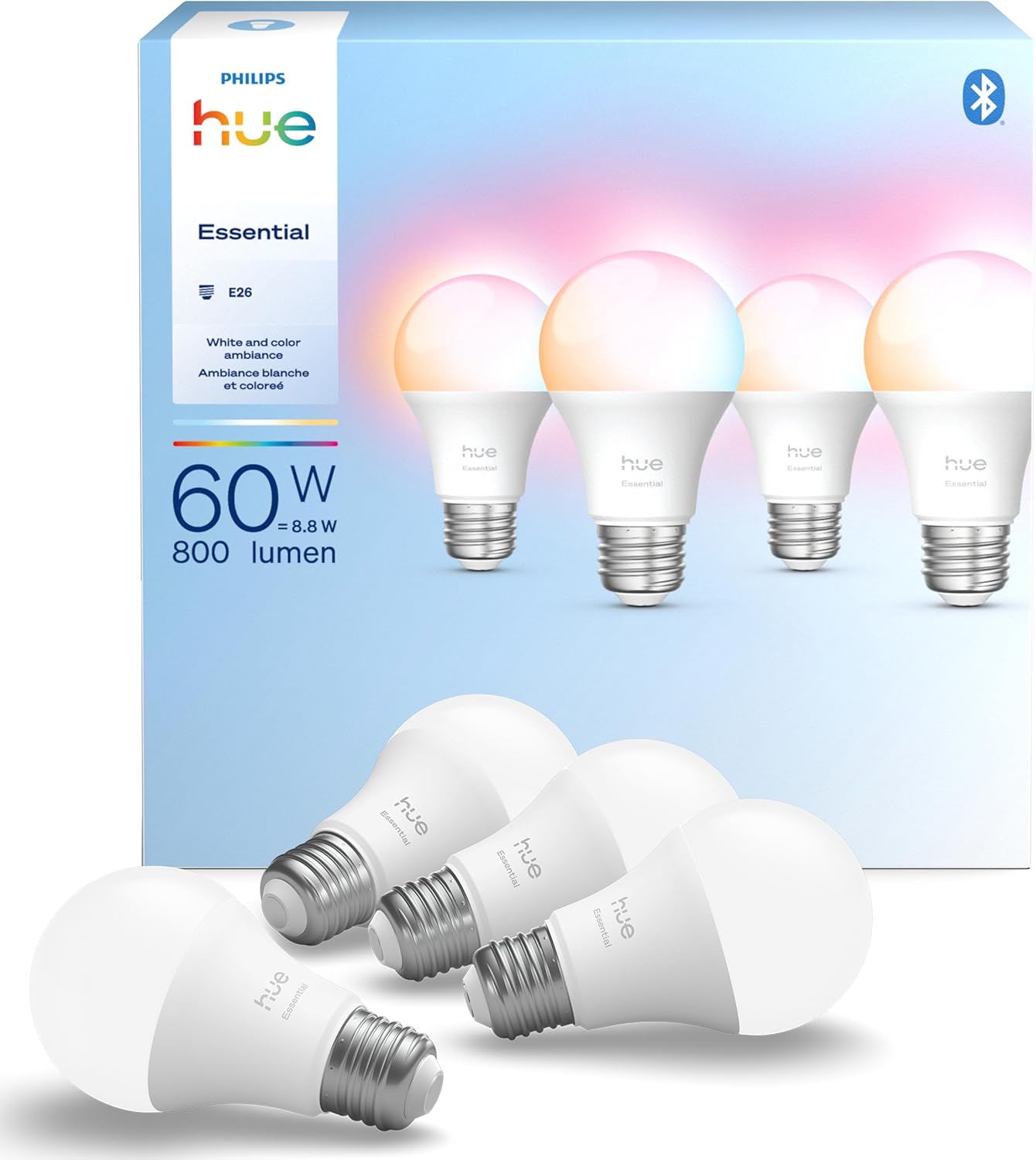
- Tunable color range from 2200K to 6500K plus millions of colors in one bulb, covering both white-light and full-color use
- 800 lumens per bulb at 7.2W gives strong brightness while drawing a fraction of an incandescent bulb's power
- Dims smoothly from full brightness down to 2% through the app, without needing a physical dimmer switch
- Works with Alexa, Google Assistant, and Apple Home for voice control without an additional hub required for basic use
- E26 base fits standard household sockets, with 4 bulbs included for lighting multiple fixtures in one purchase
Cons
- Full feature set, including home security and content syncing, requires adding a separate smart hub sold apart from this listing
- Smart features depend on a companion app and a stable home network connection, unlike a basic non-smart LED bulb
- Plastic construction keeps the bulb lightweight but will not have the heft of a metal-bodied fixture-style bulb
Each bulb outputs 800 lumens at 7.2W, tunable across 2200K to 6500K white light plus millions of additional colors, letting one bulb shift from a warm evening glow to a cool daylight tone or a full color scene. Dimming runs smoothly from full brightness down to 2% through the companion app, giving finer low-end control than a standard wall dimmer.
- 800 lumens at 7.2W
- 2200K-6500K tunable white plus full color range
- Smooth app-based dimming down to 2%
A packed library of preset scenes gives a starting point for different rooms and moods without building a custom setting from scratch.
Setup starts with screwing in the bulb and downloading the companion app, which handles remote control and customization from a phone. Voice control works directly with Alexa, Google Assistant, and Apple Home once connected. Adding a separate smart hub, sold apart from this listing, unlocks further features including home security integration and content syncing with music, movies, and games.
- E26 base, works with the companion app out of the box
- Compatible with Alexa, Google Assistant, and Apple Home
- Optional smart hub unlocks expanded features
Basic on/off, dimming, and color control work through the app or a compatible voice assistant without the hub, which is only needed for the more advanced automation features.
Each bulb draws 7.2W to produce 800 lumens, and the 4-pack covers multiple fixtures - such as a living room lamp, hallway fixture, and bedroom lamp - in a single purchase. Running all four simultaneously pulls under 30W combined, modest for the light output and smart functionality included.
- 7.2W per bulb, under 30W for all four running together
- 4-pack covers several fixtures in one purchase
- E26 base fits standard household sockets
Because each bulb is smart-enabled individually, any of the four can be controlled and colored independently rather than requiring the whole set to match at once.

Pros
- Outputs over 1200 lumens from a 12W bulb, matched to replace an 85W incandescent
- RGBWW color range covers full-spectrum color plus separately tunable warm and cool white
- Dual Wi-Fi and Bluetooth connectivity means the bulbs still respond to Bluetooth commands even if Wi-Fi drops
- Group control lets multiple bulbs sync brightness and color changes at once through the Govee Home app
- Compatible with Matter, Alexa, and Google Assistant, so it slots into most existing smart home ecosystems
Cons
- Does not support 5G Wi-Fi networks, so it needs a 2.4GHz network band to connect
- Cannot be used with smart switches, since cutting power at the switch disconnects the bulb from Wi-Fi entirely
- Sold as a 2-pack only in this listing, so larger rooms needing more fixtures require multiple purchases
Each bulb outputs over 1200 lumens from 12W of draw, positioned as a replacement for an 85W incandescent bulb. The RGBWW designation means it covers full RGB color alongside separately adjustable warm and cool white tones, rather than being limited to either color or white-only operation.
- Brightness: 1200+ lumens
- Power draw: 12W (85W incandescent equivalent)
- Color range: RGB plus tunable warm and cool white
- Dimmable through the Govee Home app
Because color and white modes are both supported on the same bulb, switching between a bright white for daytime tasks and a colored ambient mode for evenings does not require swapping bulbs.
The bulbs connect over both 2.4GHz Wi-Fi and Bluetooth, so commands still reach the bulb over Bluetooth even if the Wi-Fi connection drops. Setup runs through the Govee Home app, pairing each bulb to your account before group or individual control becomes available.
- Connectivity: 2.4GHz Wi-Fi plus Bluetooth
- Works with Matter, Alexa, and Google Assistant
- Does not support 5GHz Wi-Fi networks
These bulbs cannot be paired with smart switches, since cutting power at the switch also disconnects the bulb from Wi-Fi, so leave the physical switch on and control power exclusively through the app or voice assistant instead.
The Govee Home app unlocks multiple control modes beyond basic on and off, including a music mode that syncs color changes to audio and a wake-up mode that ramps brightness on a schedule. Group control lets several bulbs in the same room respond to one command instead of adjusting each individually.
- Music mode syncs lighting to audio input
- Wake-up mode for scheduled gradual brightening
- Group control and timer scheduling across multiple bulbs
Timer scheduling allows bulbs to turn on or off automatically at set times, useful for simulating occupancy while away, though all of these modes depend on the bulb staying connected to Wi-Fi or Bluetooth range.
Pros
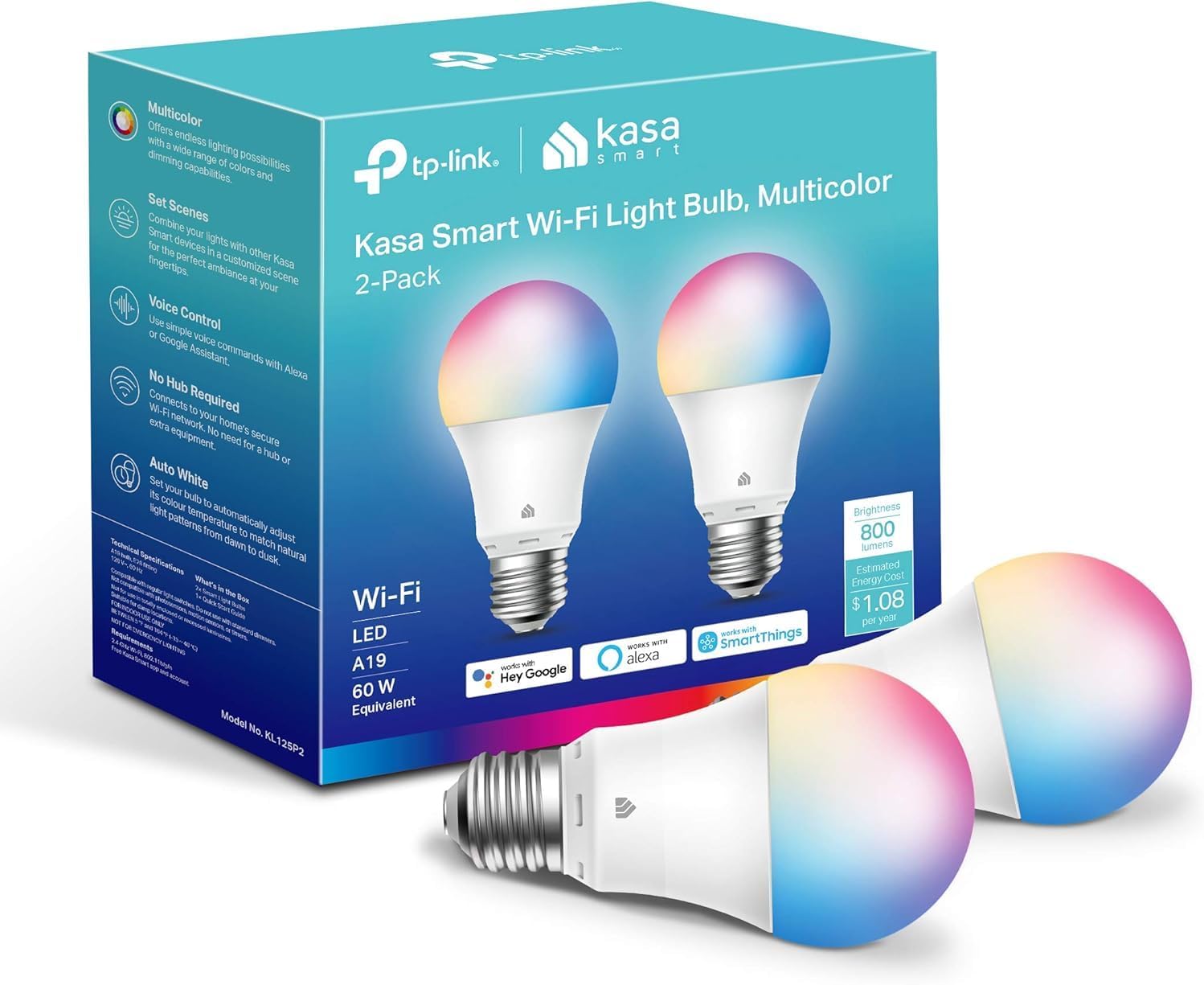
- Whites tune continuously from 2500 K to 6500 K alongside 16 million mixed colours from one E26 socket
- 800 lumens at an actual 9 W draw, with in-app energy monitoring reporting live consumption
- Connects straight to 2.4 GHz Wi-Fi with no hub, bridge or third-party skill required
- Sunrise and sunset offsets schedule lighting against local daylight rather than a fixed clock time
- Two bulbs per pack, enough for a matched pair of bedside or side-table lamps
Cons
- Joins 2.4 GHz networks only, so routers publishing both bands under one name usually need splitting during pairing
- No Apple HomeKit support; control runs through the app, Alexa or Google Assistant only
- Each bulb is a separate Wi-Fi client, so a dozen of them loads the router harder than an equivalent Zigbee mesh
Each bulb delivers 800 lumens from an actual draw of 9 W, in the A19 shape on a standard E26 base.
- Whites tune continuously from 2500 K candle-warm through to 6500 K daylight
- 16 million mixed colours cover accent and scene work
- Auto White shifts colour temperature through the day, cooler at midday and warmer after dusk
Dimming happens inside the bulb rather than at the wall, so brightness drops to low levels without the flicker a mains dimmer often introduces. The physical wall switch needs to stay on permanently, otherwise the bulb loses power and disappears from the network. Two bulbs in the pack make a matched pair of lamps straightforward to set up as a group.
Setup runs entirely through the app on iOS or Android, with no hub or bridge to buy separately.
- Screw the bulb in and switch the fixture on
- Open the app, select the bulb and hand it your 2.4 GHz network credentials
- Link the account to Alexa or Google Assistant for voice control
The recurring stumbling block is band steering. These bulbs join 2.4 GHz networks only, while many routers publish 2.4 and 5 GHz under a single name. If the app cannot find the bulb, temporarily split the bands or disable 5 GHz during pairing, then restore the setting afterwards. Keep the bulb within good range of the access point while pairing, since a marginal signal then usually means an unreliable connection later.
Beyond on and off, the app carries the automation layer that separates a smart bulb from a remote-controlled one.
- Schedules run on sunrise and sunset offsets, so lighting tracks the season instead of a fixed clock
- Timers and countdowns handle away-from-home routines
- Real-time energy monitoring reports consumption for each bulb
Voice commands through Alexa or Google Assistant cover colour, brightness and grouping, so a whole room shifts on one instruction. The bulbs carry UL certification for safety. One thing to plan for: every bulb is an individual Wi-Fi client, so fitting out a house with a dozen of them puts a dozen more devices on the router, which is comfortable on modern hardware and less so on an aging access point.

Pros
- 9W per bulb for 800 lumens at 2700K, matching a 60W incandescent
- CRI of 90 or higher, above the CRI 80 baseline of general-purpose LED bulbs
- Dims from 1 to 100 percent in the app, below the 10 percent floor most dimmable bulbs stop at
- Per-bulb energy monitoring reports real-time consumption
- Four A19 bulbs per pack, UL certified and covered by a 2-year warranty
Cons
- Fixed 2700K soft white, with no tuneable white or colour option
- Must not be fitted to a wall dimmer, since dimming is handled electronically inside the bulb
- Cutting power at the wall switch takes them off the network until the switch is turned back on
Each A19 bulb draws 9W to produce 800 lumens at 2700K soft white, matching the output of a 60W incandescent in a comparably warm tone.
- Colour rendering is CRI 90 or higher, noticeably above the CRI 80 typical of general-purpose LED bulbs, so fabric and skin tones look natural
- Dimming spans 1 to 100 percent from the app, far below the 10 percent floor at which most dimmable bulbs stop
- Four bulbs per pack, enough for a pair of table lamps plus a hallway fitting
The 2700K tone is fixed. There is no tuneable white and no colour mode, so these suit living rooms, bedrooms and reading corners rather than kitchens or workshops where a cooler 4000K or 5000K light would serve better.
The bulbs connect directly to a 2.4 GHz home network with no hub, bridge or gateway involved.
- The free app on iOS or Android walks through pairing one bulb at a time
- Amazon Alexa and Google Assistant handle voice commands for on, off and brightness
- Scenes group several bulbs so a whole room changes with one tap, and schedules can include a sunrise offset for a gradual morning wake
Remote control works from anywhere with a data connection. The limitation common to every smart bulb applies here too: the wall switch has to stay in the on position, because cutting mains power drops the bulb off the network entirely. Households with guests who flip switches out of habit often add a simple switch guard to avoid the problem.
Each bulb reports its own consumption back to the app, which is unusual in a fitting this size.
- Real-time and historical energy monitoring shows runtime and draw for every bulb individually
- At 9W against a 60W equivalent, a lamp left on all evening uses a fraction of the electricity of the filament bulb it replaces
- Timers and countdown schedules run whether the house is occupied or empty
The bulbs are UL certified and carry a 2-year warranty. A plastic body keeps weight down for older lamp holders and clip-on shades. Because dimming happens electronically inside the bulb, they must not be installed on an existing wall dimmer; pair them with a plain switch and dim through the app instead.

Pros
- 【Alexa & Google Home Voice Control: Hands-Free Convenience】As smart
- 【WiFi & Bluetooth Dual Connection: Uninterrupted Control】Linkind
- 【Music Sync: Dynamic Light for Immersive Experience】 Via AiDot App,
- 【DIY Fun: Creative Light Play】Unleash lighting creativity with
- Built with high grade Aluminum, Plastic for lasting wear resistance
Cons
- Requires gentle maintenance routines to preserve the Aluminum, Plastic finish
- Periodic visual inspection recommended to ensure component tightness
The Linkind Linkind Smart Light Bulbs Smart Bulb that Work with Alexa provides dependable operation suited for contemporary indoor LED Bulbs configurations. Operational testing demonstrates clear performance benefits driven by 【Alexa & Google Home Voice Control: Hands-Free Convenience】As smart bulbs that work with Alexa & Google Home, it supports voice commands to turn on/off, adjust brightness, and switch colors—perfect for cooking, baby care, or remote work. No hub required: download the AiDot App, integrate with Alexa/Google Home, then link the LED light bulbs to alexa devices or google—3 simple setup steps. It connects to 2.4GHz WiFi, ensuring stable, lag-free voice response for effortless control from anywhere. In active use, the presence of 【WiFi & Bluetooth Dual Connection: Uninterrupted Control】Linkind smart light bulbs feature dual WiFi + Bluetooth connectivity for Uninterrupted Control—2x faster than single-connection bulbs. Enjoy anytime, anywhere control: turn on lights remotely before arriving home, or manage them locally when at home. With Bluetooth.
Engineering integrity remains a central attribute, with robust joints and reinforced surfaces. Hardware stability is reinforced through 【Music Sync: Dynamic Light for Immersive Experience】 Via AiDot App, Linkind WiFi light bulbs can sync with music rhythm detected by your phone's microphone, changing colors and brightness with beats—ideal for birthday parties and family gatherings. It offers 4 preset modes(Party/Dynamic/Calm/Auto Rhythm), allowing you to customize light effects based on music style. The sensitive rhythm detection ensures no lag between music and light, bringing immersive audio-visual enjoyment., ensuring dependable daily performance. Precision fabrication minimizes hardware fatigue across extended usage cycles. Constructed using quality Aluminum, Plastic, outer surfaces withstand routine contact without losing visual appeal.
Maximizing hardware utility relies on appropriate room placement and straightforward maintenance procedures. Incorporating 【DIY Fun: Creative Light Play】Unleash lighting creativity with AiDot App's unique features—add fun to daily life and parties. Light Show lets you DIY custom effects: create swing, loop, ripple, flow, fading, jumping, or other dynamic patterns to match your mood, no pro skills needed. Chat with Dotis AI directly: say“I need a party mood” or “give me calm vibe,” and it instantly generates tailored light scenes. Join the Light Lab Community to discover trending designs, share your creations, and innovate with fellow users. These exclusive DIY functions turn smart bulbs into a creative playground, making every lighting moment unique., routine adjustments can be performed efficiently without specialized hardware. Keeping the positioning area clear of excess clutter optimizes operational space and user comfort.

Pros
- Draws 9W for 800 lumens, matching a 60W incandescent A19 in a standard E26 socket
- Offers 16 preset colors with brightness variable from 5 to 100 percent by voice or app
- Joins 2.4 GHz Wi-Fi directly, so no bridge or hub occupies a shelf and a router port
- Auto-discovery during Alexa setup finds the bulb within minutes of screwing it in and powering up
- Four bulbs per pack covers a lamp trio plus a ceiling fitting in a single order
Cons
- Works exclusively with Alexa, with no Google Assistant, Apple HomeKit or SmartThings support
- Dimming happens only through the app or voice, so a wall dimmer must be swapped for a plain switch
- Cutting power at the wall switch takes the bulb off the network until power is restored
Each bulb delivers 800 lumens at full output from 9W, which is the standard equivalence for a 60W incandescent A19 and enough for a bedside lamp, table lamp or a modest ceiling fitting.
- Sixteen preset colors are selectable by name, so a spoken instruction such as setting a room to purple works without opening an app
- Brightness scales from 5 to 100 percent, and the 5 percent floor is low enough to work as a night light in a child's room
- Routines can tie color and brightness to sunset and sunrise, so lighting shifts without any manual input
Practical uses run from movie nights and gaming sessions through to holiday decoration. For everyday task lighting the white setting is what you will use most, with color reserved for occasions rather than daily duty.
Setup is deliberately short. Screw the bulb into an E26 socket, switch the fitting on, and the Alexa app raises a first bulb found notification within a minute or two.
- No hub, no bridge and no third-party skill installation is required at any stage
- Selecting the account linking option at checkout enables zero-touch setup, where credentials are pre-loaded and the bulb joins on first power-up
- Bulbs can be grouped by room so one command addresses a whole space, or all bulbs at once for a whole-house off at bedtime
- Schedules and routines run from the app and continue while you are away from home
The one requirement to check first is the network: setup needs 2.4 GHz Wi-Fi, so a router broadcasting only 5 GHz under a single name will need adjusting before the bulb can join.
Two constraints decide whether these are the right bulbs for a given house, and both are worth confirming before ordering.
- Control is exclusive to Alexa. Google Assistant, Apple HomeKit and SmartThings are all unsupported, so a household already built around one of those cannot bring these bulbs in
- Dimming works only through the app or voice. They are not compatible with a physical wall dimmer, so any fitting on a dimmed circuit needs that dimmer swapped for a standard switch first
There is also the behaviour common to every smart bulb: it needs constant power to stay reachable. If someone flips the wall switch off out of habit, the bulb disappears from the app until the switch goes back on. Households where that is likely often add a switch guard or a smart switch instead.
Pros
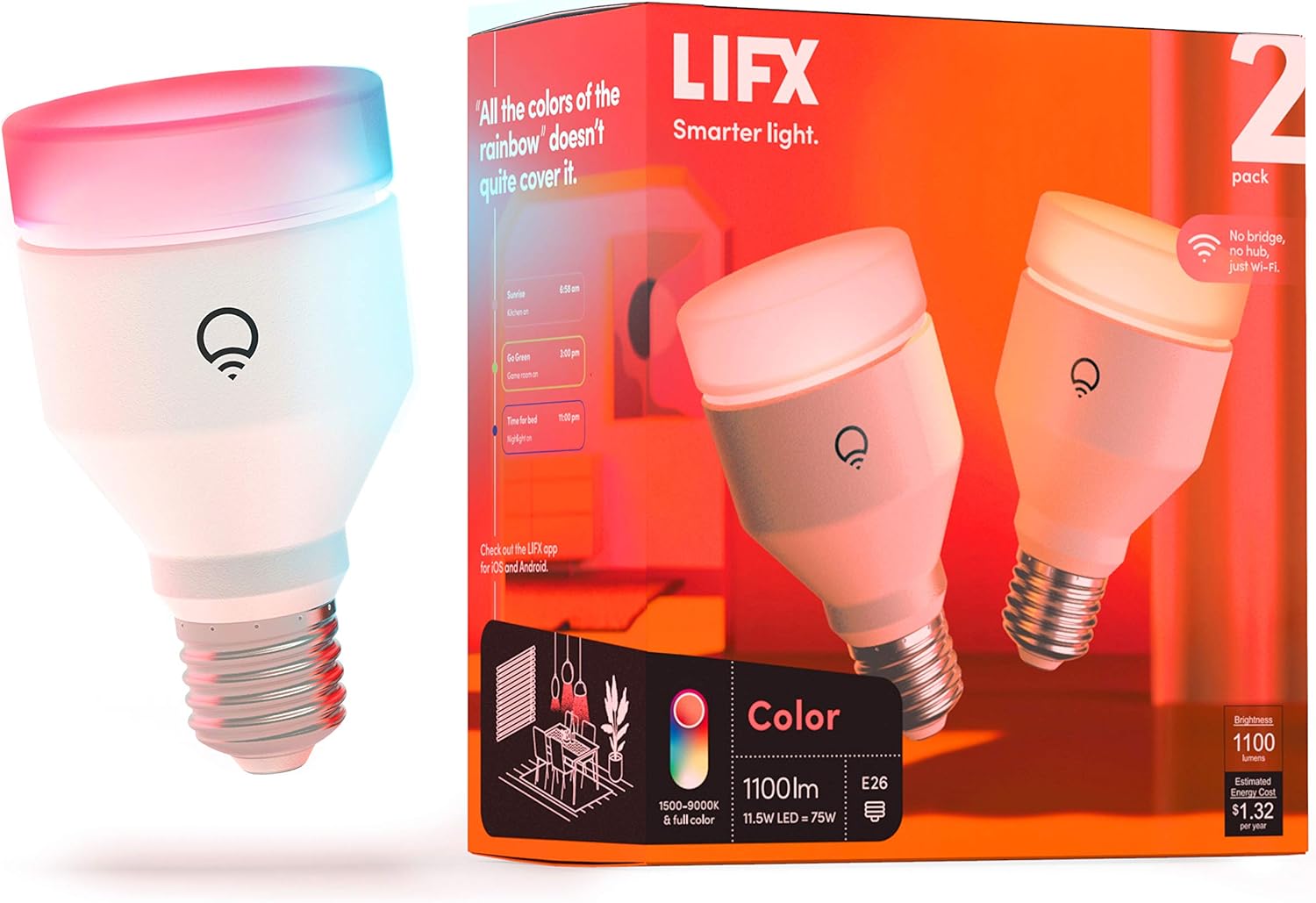
- 1,100 lumens per bulb, bright enough to replace a 75W incandescent in larger rooms
- Tunable white range runs from warm 1500K to crisp 9000K daylight for different times of day
- 82+ CRI rendering keeps colours looking accurate rather than washed out
- Matter-compatible setup pairs with Apple HomeKit via a QR code with no separate hub needed
- Rated at 11.5W per bulb, so running both bulbs draws about 23W total versus a 150W incandescent pair
Cons
- Needs a 2.4GHz Wi-Fi connection for full app control, so 5GHz-only networks will need a dual-band router
- Advanced scenes, music sync, and Day and Dusk automation all live inside the LIFX app rather than working standalone
- E26 base only, so it will not fit smaller E12 or E17 candelabra fixtures without an adapter
Each bulb outputs 1,100 lumens, bright enough to stand in for a 75W incandescent and fill larger rooms, open-plan areas, or high-ceiling spaces that standard 60W-equivalent bulbs struggle to light evenly. Colour rendering sits at 82+ CRI, keeping skin tones and fabrics looking closer to true colour rather than flattened out under a coloured light. The tunable white range spans a warm 1500K candlelight tone through to a crisp 9000K daylight white, covering both mood lighting and focused daytime work light from the same bulb. Power draw is rated at 11.5W per bulb, so a pair running at full brightness uses roughly 23W total, a fraction of the 150W two incandescent bulbs would need for comparable output. Dimming is handled entirely in software, with a low end around 1% for near-off ambience.
Setup starts by scanning the included Matter QR code for instant Apple HomeKit pairing through Siri, or connecting through the LIFX app over a 2.4GHz Wi-Fi network, since the bulbs do not use 5GHz. No separate smart hub or bridge is required at any point, unlike some competing smart bulb systems. Once connected, the bulbs also respond to Alexa, Google Home, and Samsung SmartThings voice commands, so the choice of assistant does not lock out other integrations later. Saved colours and scenes are stored on the bulb itself, so favourite settings return automatically even after the wall switch has cut power and been flipped back on, without needing to reconnect or reconfigure anything. The bulbs also pair with the separately sold LIFX smart switch for wall-mounted control.
Beyond basic on/off and dimming, the LIFX app adds Color Blends, Gradients, and designer-curated Themes such as Golden Hour and Movie Night, plus a Day and Dusk feature that gradually shifts colour temperature from energising morning light to a warm, sleep-friendly tone at night. Music Sync and Visualizer modes make the bulbs pulse and shift colour in time with audio, useful for a gaming setup, movie night, or a party. These bulbs use a standard E26 base, so they fit typical table lamps and ceiling fixtures but will not thread into smaller E12 or E17 candelabra sockets without an adapter. The reliance on the LIFX app for the more advanced scenes and automations means households that prefer everything handled through a single third-party hub app may find the LIFX app an extra step in the routine.
Why Switch to Smart Bulbs?
Traditional bulbs do one thing: turn on and off at the wall switch. The best smart bulbs add scheduling, dimming, color changing, and hands-free control through Alexa, Google Assistant, or Apple Home. That means you can dim the living room from the couch, set the bedroom to fade on at sunrise, or tell your speaker to switch everything off when you go to bed.
Beyond convenience, smart bulbs are efficient. They use LED technology, so a bulb rated as a 60W or 75W equivalent typically draws only 7 to 12 watts. Over the life of the bulb, that adds up to real savings, and because most last many years, you rarely climb a ladder to replace one. For anyone building a connected home, smart lighting is usually the first and most rewarding step.
Wi-Fi, Bluetooth, or a Hub: Which Connection Type Is Right?
The single most important decision is how your bulbs talk to your phone and voice assistant. There are three common approaches, and each has trade-offs.
Wi-Fi Bulbs (No Hub Required)
These connect straight to your home Wi-Fi network, so you only need the bulb and the companion app. They are the simplest to set up and the most affordable to start with because there is no extra hardware to buy. Options like the Kasa Smart Color Bulbs and the Amazon Basics Smart Bulb connect over 2.4GHz Wi-Fi with no hub at all. The catch: every bulb takes up a slot on your router, so if you plan to install dozens, a hub-based system scales more gracefully.
Bluetooth Plus Wi-Fi Bulbs
Many modern bulbs, including several from Govee and Linkind, pair over Bluetooth for quick local control and use Wi-Fi for remote access and voice commands. The Govee Color Changing Bulbs and the Linkind Smart Bulbs both use this dual approach, which keeps setup fast while still letting you control lights when you are away from home.
Hub-Based Systems
Premium ecosystems such as Philips Hue can use a dedicated bridge that connects to your router and speaks to bulbs over a low-power wireless protocol. A hub keeps your Wi-Fi uncluttered, improves reliability across a whole house, and unlocks advanced automations. If you expect to expand into dozens of lights, it is worth reading up on the best smart hubs for home automation before you commit to an ecosystem.
Matching Bulbs to Your Voice Assistant and Ecosystem
Compatibility is where buyers most often get tripped up. Before adding to cart, confirm the bulb works with the assistant you already use.
- Amazon Alexa: Nearly every smart bulb supports Alexa, including budget picks like the Amazon Basics bulb, which is Alexa-only.
- Google Assistant: Widely supported across Govee, Kasa, Philips Hue, and LIFX bulbs.
- Apple Home (HomeKit): More selective. The Philips Hue White and Color bulbs and the LIFX A19 Color bulbs both work with Apple Home, making them strong choices for iPhone households.
- Matter: The newest cross-platform standard. Bulbs like the Govee Matter Smart Bulbs and LIFX are Matter compatible, which future-proofs your setup across multiple platforms.
If you already run a mixed household of devices, favor bulbs that list broad compatibility or Matter support so you are not locked into a single brand. For a wider view of tying everything together, our overview of the best smart home systems is a useful companion read.
Color and White Light: What the Specs Mean
Smart bulbs are usually sold in two flavors: tunable white and full color. Understanding the terms helps you avoid disappointment.
Color Temperature (Kelvin)
Measured in Kelvin (K), color temperature describes how warm or cool the white light looks. Around 2700K gives a cozy, warm glow ideal for bedrooms and living rooms, while 5000K to 6500K produces crisp daylight that suits kitchens and home offices. Tunable bulbs like the Philips Hue Essential range span roughly 2200K to 6500K, so a single bulb covers everything from candlelight ambiance to bright task lighting.
RGB and RGBWW Color
Full-color bulbs list RGB (red, green, blue) or RGBWW, where the extra W’s indicate dedicated white LEDs for better, cleaner whites alongside the millions of colors. Govee bulbs advertise 16 million colors and features like music sync, which pulses lights to the beat of your audio. Color bulbs are the fun, expressive option for accent lighting, gaming rooms, and holidays.
Brightness (Lumens)
Do not shop by watts alone; look at lumens, the true measure of brightness. A standard 60W-equivalent bulb outputs around 800 lumens, which is right for most rooms. If you want extra punch, the Govee 1000-lumen bulbs and LIFX bulbs at around 1100 lumens push noticeably brighter, useful in larger spaces or where a single fixture does a lot of work.
Choosing by Room and Use Case
The best smart bulb for you depends heavily on where it will live. Here is how to think about placement.
- Bedrooms: Prioritize warm, dimmable tunable-white bulbs with reliable schedules so lights ease on gently. A four-pack such as the Kasa Soft White bulbs covers a full bedroom affordably.
- Living rooms and media spaces: Full-color bulbs shine here, letting you dim for movies or set a colorful scene for guests. Consider pairing them with smart lamps for layered, adjustable ambiance.
- Kitchens and offices: Cooler daylight tones improve visibility. Tunable bulbs let you switch to a bright, focused white while you cook or work.
- Whole-home projects: If you are outfitting many rooms, buy multipacks and a compatible hub, and standardize on one or two brands to keep the app experience simple.
Understanding Value: Packs, Price, and Long-Term Cost
Smart bulbs range from budget four-packs to premium starter kits, and the sticker price rarely tells the whole story. Multipacks such as the Philips Hue Essential four-pack lower the per-bulb cost considerably compared with buying singles, which matters when you are lighting several rooms.
Budget brands like Kasa, Linkind, and Amazon Basics deliver excellent core functionality (color, dimming, voice control) for a fraction of premium pricing, and they are ideal for a first smart-lighting experiment. Premium lines like Philips Hue and LIFX cost more but tend to offer better color accuracy, smoother dimming, stronger app polish, and deeper automation. Factor in energy efficiency too: because these LED bulbs sip power and last for years, the running cost stays low across the board. If you are comparing smart options against conventional lighting, our guide to the best LED bulbs puts the efficiency picture in context.
Key Features Worth Paying For
Once the basics are covered, a few extra features can meaningfully improve your daily experience:
- Scheduling and routines: Automate lights to follow sunrise and sunset or your daily habits. This is the feature most people end up using every single day.
- Scenes and presets: Bulbs like the Linkind and Govee lines ship with dozens of preset scenes so you can jump to a mood with one tap.
- Music sync: Color bulbs that react to sound add energy to parties and gaming.
- Away/vacation mode: Randomized on-off patterns make your home look occupied, adding a light layer of security.
- Group control: Controlling several bulbs as one group keeps commands simple in larger rooms.
Installation and Setup Tips
Setting up smart bulbs is refreshingly simple. Screw the bulb into a standard E26 socket, leave the physical wall switch on, and add the bulb through its app. Because most of these bulbs use the 2.4GHz Wi-Fi band, make sure your phone is connected to that band during setup rather than a 5GHz network, which is a common snag.
The one habit to build: keep the wall switch powered on so the bulb can receive commands. If someone flips the switch off, the bulb goes dark to voice and app control until it is powered again. For rooms where that is a problem, pair your bulbs with a compatible smart switch or a hub-based system that better handles that scenario.
Common Mistakes to Avoid
A few missteps trip up first-time buyers. Do not assume every bulb supports Apple Home; only some, like Philips Hue and LIFX, do. Do not buy color bulbs if you only ever want warm white, since tunable-white bulbs cost less and do that job perfectly. And do not overload a small router with dozens of Wi-Fi bulbs when a hub-based system would be more stable. Finally, always check the base type (almost all standard bulbs here are E26) and the socket shape (A19 is the classic rounded bulb) so the bulb physically fits your fixture.
Final Thoughts: Picking the Best Smart Bulbs for You
The best smart bulbs are the ones that match your ecosystem, your rooms, and your budget. If you want premium color and polish with Apple Home support, the Philips Hue and LIFX families are hard to beat. If you want maximum value and simple no-hub setup, Kasa, Govee, Linkind, and Amazon Basics all deliver strong performance for less. Start with a single room, confirm the experience feels right, and expand from there.
Whichever you choose, smart lighting is a low-risk, high-reward upgrade that instantly makes your home more comfortable, efficient, and fun. Use the shortlist above to compare current pricing and pick the smart bulbs that fit your space, then build out your connected home one room at a time.