 Ethan Caldwell
 Choosing among the best security systems can feel overwhelming once you start comparing wireless alarm kits, camera bundles, and professionally monitored packages side by side. The good news is that today’s systems are more affordable, easier to install, and more flexible than ever, so almost any household can build reliable protection without a long-term contract. This guide walks through how the best home security systems actually work, what features matter most, and how to match a setup to the size and layout of your home.
Instead of drowning you in per-product reviews, we focus on the decisions that shape your purchase: monitoring style, wired versus wireless design, camera coverage, storage, and smart-home compatibility. Along the way we point to a curated shortlist of popular, well-reviewed options so you can jump straight to shopping once you know what you need.

Pros
- 8-piece kit bundles one base station, one keypad, four contact sensors, one motion detector and one range extender
- Sized for 1-2 bedroom homes, with additional sensors and accessories sold separately if more coverage is needed
- Mobile app sends notifications the moment a sensor or the alarm is triggered
- Voice arm/disarm through Alexa becomes available once linked to a compatible monitoring subscription
- Range extender in the kit helps sensors stay connected in rooms farther from the base station
Cons
- 24/7 professional monitoring, cellular backup, and Alexa voice control all require a separate Ring Protect subscription, not included by default
- Kit is sized for 1-2 bedrooms, so larger homes need extra sensors purchased separately to cover every entry point
- Sensors rely on the base station's connection, so a lengthy internet outage limits remote monitoring unless the Wi-Fi backup subscription tier is active
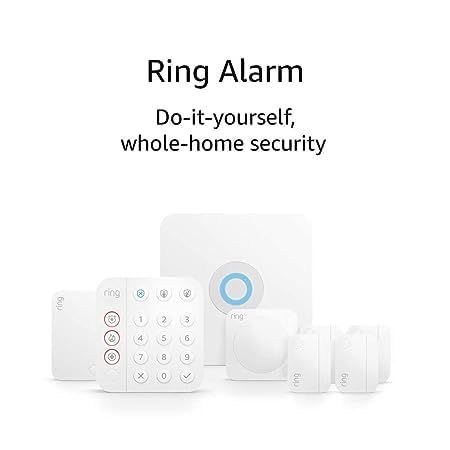
The 8-piece kit includes one base station, one keypad, four contact sensors, one motion detector and one range extender, sized for 1-2 bedroom homes. The keypad handles arming and disarming, while the contact sensors detect when a monitored door or window opens, sending that event to the Ring app in real time.
- 1 base station, 1 keypad, 4 contact sensors, 1 motion detector, 1 range extender
- Sized for 1-2 bedroom coverage out of the box
- Additional alarm sensors and accessories sold separately for larger homes
- Range extender helps maintain sensor connectivity in rooms farther from the base station
Setup runs through the Ring app, which walks through placing and pairing each sensor; no professional installation is required for the base kit, though rooms beyond the included coverage need extra sensors bought separately.
Out of the box, the kit sends mobile notifications through the Ring app whenever a sensor or the alarm itself is triggered, letting you check in on the system from anywhere with a connection. A compatible Ring Protect Plan, sold separately, adds the ability to arm the alarm remotely, keep the system online if home Wi-Fi drops, and route alerts to 24/7 professional monitoring for police, fire, or medical response.
- Mobile notifications included with the base kit and Ring app
- 24/7 professional monitoring available only with a compatible Ring Protect Plan
- Wi-Fi backup connectivity requires the same subscription
- Alexa voice arm/disarm also requires a Ring Protect subscription
Without an active plan, the system still functions locally and sends app alerts, but loses the cellular backup and professional dispatch features that a full home security setup typically relies on.
Because this kit is built around a 1-2 bedroom footprint, larger homes or those with more doors and windows to cover will want to add extra contact sensors, motion detectors, or a second range extender, all sold separately and compatible with the same base station.
- Additional contact sensors for extra doors and windows
- Extra motion detectors for larger open spaces
- Second range extender for homes where the base station signal does not reach every room
- Works alongside other Ring devices through the shared Ring app
The kit suits renters and homeowners wanting a self-monitored starting point that can grow sensor by sensor, rather than a single fixed configuration that has to be replaced entirely as a home's security needs change.
Pros
- 14-piece kit includes 8 contact sensors, enough to cover every door and window in a typical 2-4 bedroom home
- 2 keypads let you arm or disarm from more than one entry point instead of just one
- 1 range extender helps the base station reach sensors in far rooms or upper floors
- Expandable with additional sensors and accessories sold separately as a household's needs grow
- Mobile app sends notifications any time a sensor is triggered
Cons
- 24/7 professional monitoring and cellular backup both require a separate Ring Protect Plan subscription, not included in this kit
- Voice control through Alexa also depends on an active Ring Protect subscription, not just an Alexa-enabled device
- Sized for 2-4 bedroom homes - larger homes will need extra sensors bought separately to get full coverage
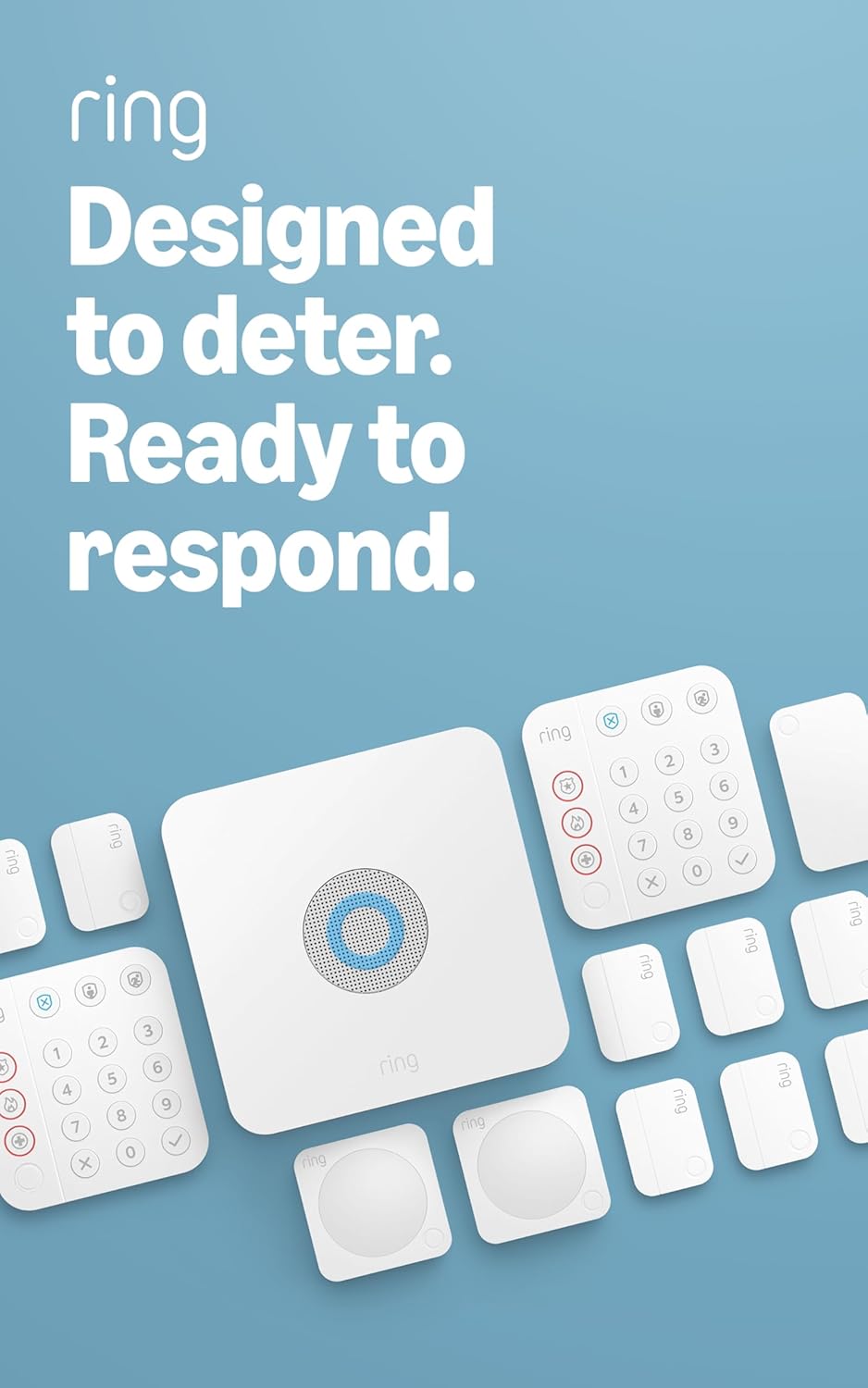
The 14-piece kit is built around one Base Station, two Keypads, eight Contact Sensors, two Motion Detectors, and one Range Extender, sized by Ring as a fit for 2-4 bedroom homes. Contact sensors mount on doors and windows to detect opening, while motion detectors cover larger open areas like hallways or living rooms.
- 1 Base Station, 2 Keypads, 8 Contact Sensors, 2 Motion Detectors, 1 Range Extender
- Sized for 2-4 bedroom homes
- Additional sensors and accessories sold separately for expansion
Homes with more than 8 doors and windows, or with detached structures like a garage, will need to add sensors beyond what's included in this base kit to reach full coverage.
The Ring app is the primary way to arm, disarm, and monitor the system, sending mobile notifications any time a sensor is triggered so you know what happened even when you're away from home. Keypads offer a physical way to arm or disarm without pulling out a phone.
- Ring app for remote monitoring and control
- 2 keypads for on-site arming and disarming
- Voice control with Alexa is available with an active Ring Protect subscription
Without a Ring Protect subscription, core arm/disarm control and mobile alerts still work through the app and keypads, but hands-free Alexa voice control and keeping the system online during a WiFi outage both depend on adding that subscription separately.
Out of the box, this kit provides self-monitoring through the Ring app - you get the alert, and you decide what to do next. Adding a compatible Ring Protect Plan (sold separately) unlocks 24/7 professional monitoring for police, fire, and medical dispatch, plus cellular backup if home WiFi goes down.
- Base kit supports self-monitoring via app notifications
- 24/7 professional monitoring requires a separate Ring Protect Plan
- Additional Alarm sensors and accessories can be added at any time
Because professional monitoring isn't bundled in, it's worth deciding upfront whether ongoing self-monitoring through app alerts is enough, or whether the household wants the added Ring Protect subscription layered on top of this hardware kit.
Pros
- Kit bundles a base station, keypad, four contact sensors, one motion detector, and a range extender in one box
- Certified refurbished process includes functionality testing and basic cleaning before resale
- Range extender in the kit stretches sensor coverage to rooms farther from the base station
- Voice arm/disarm works through a paired Alexa device, and Echo Show or Fire TV adds Live View monitoring
- Sized for 1-2 bedroom homes, matching sensor count to a smaller footprint rather than overselling coverage
Cons
- Renewed unit ships in a generic Amazon-branded box rather than original retail packaging
- 24/7 professional monitoring, offline backup, and remote arming all require a separate Ring Protect Plan subscription
- Four contact sensors and one motion detector may not fully cover homes larger than 1-2 bedrooms without buying extra sensors
The 8-piece kit includes one base station, one keypad, four door/window contact sensors, one motion detector, and one range extender, sized specifically for a 1-2 bedroom home rather than a larger house. The keypad handles arming and disarming directly, while each contact sensor reports when a monitored door or window opens.
- Kit contents: base station, keypad, 4 contact sensors, 1 motion detector, 1 range extender
- Sized for 1-2 bedroom homes
- Range extender pushes sensor connectivity to rooms farther from the base station
Homes with more than four entry points or additional rooms to cover can add extra Ring Alarm sensors and accessories separately, since the base station supports expansion beyond the kit's included pieces.
The Ring app centralizes control of the whole kit, sending mobile notifications whenever a sensor triggers and providing a single dashboard for every connected Ring device. Paired with a compatible Alexa device, the system can be armed or disarmed by voice, and an Echo Show, Fire TV, or Fire Tablet can display a Live View feed from connected Ring cameras.
- Mobile notifications through the Ring app for every triggered sensor
- Voice arm/disarm through a paired Alexa device
- Live View available on Echo Show, Fire TV, or Fire Tablet
A separate Ring Protect Plan subscription unlocks additional capabilities such as 24/7 professional monitoring, keeping the system online during a Wi-Fi outage, and remote arming from outside the home.
This is a Like-New Amazon Renewed unit, meaning it has gone through refurbishing that includes functionality testing, basic cleaning, and inspection before being repackaged for resale. It carries the same limited warranty terms as a new Ring Alarm kit, and it may arrive in a generic, unbranded box rather than the original retail packaging.
- Refurbishing includes functionality testing, cleaning, and inspection
- Same limited warranty coverage as a new unit
- May ship in generic packaging instead of original retail box
Buyers replacing a failed component later can source individual Ring Alarm sensors and accessories separately, since the base station is not locked to only the parts included in this specific kit.
Pros
- Built-in 32GB local storage holds up to 120 days of event-loop recording without a subscription
- 360° pan-tilt-zoom coverage eliminates the blind spots a fixed-lens camera leaves at driveway corners
- Four LED lights plus a PIR sensor spot motion up to 40 ft (12 m) away after dark
- Runs on a 2-hour solar top-up, so there is no cable to route to an outdoor mount
- 8x digital zoom lets you pull in a license plate or package label without walking outside
Cons
- Local storage tops out at 32GB, so heavy motion zones will loop and overwrite footage faster than a cloud-backed system
- Solar charging depends on consistent daylight, so shaded mounting spots may need a supplemental charge
- Four-camera kit ships as one fixed bundle, with no single-camera expansion option listed
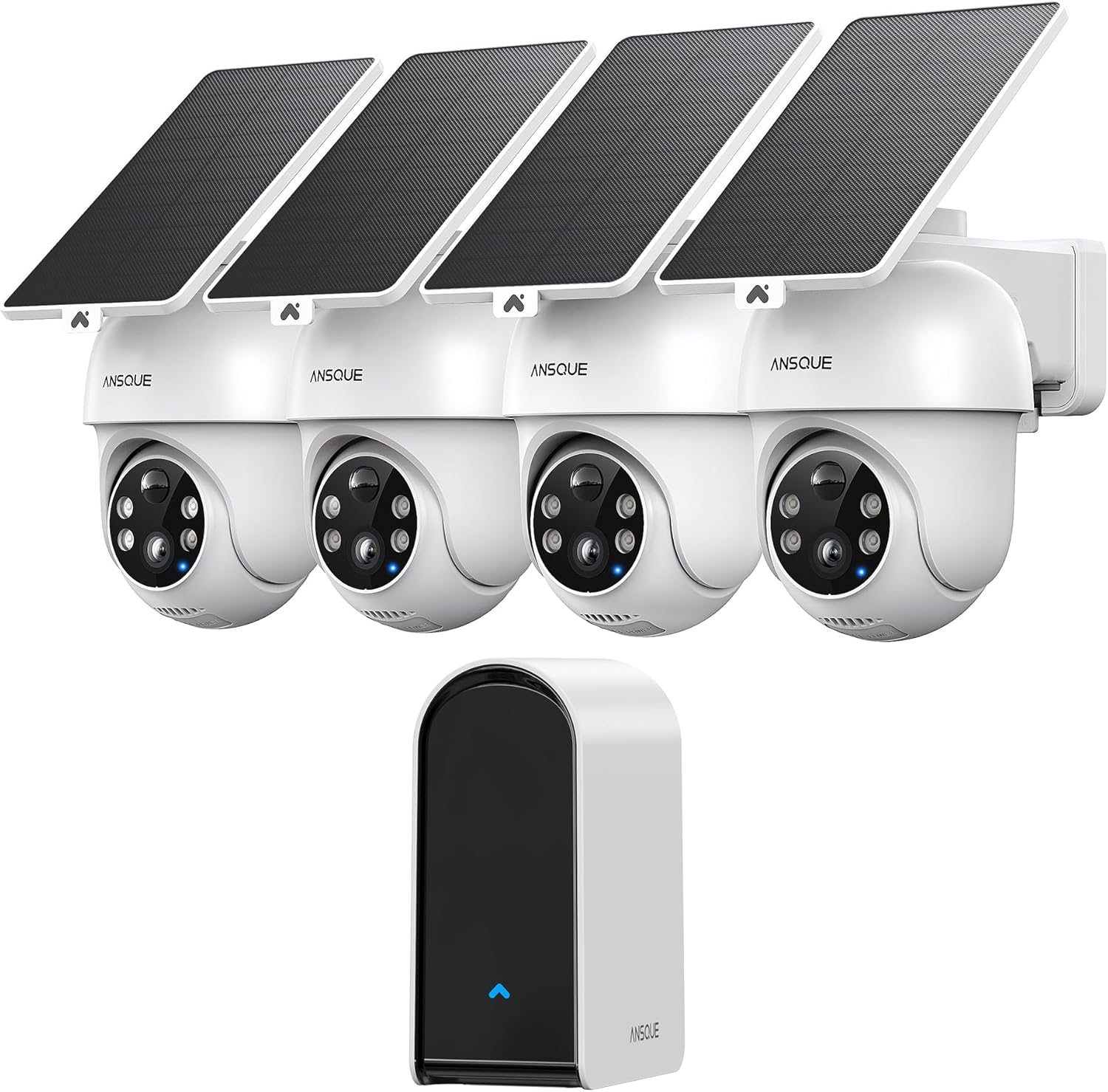
Each camera mounts with the included hardware and draws power from an attached solar panel, so no outdoor electrical outlet is needed nearby. Two hours of direct sunlight is enough to keep the unit running through a full day and night cycle, and the built-in panel eliminates the cable run that wired outdoor cameras usually require.
- 360° pan-tilt-zoom motor covers a driveway, porch, or pool area from a single mounting point
- Cross-camera tracking hands a moving subject off between units instead of losing them at the edge of one frame
- Best placed where the panel gets consistent midday sun rather than under an eave or dense tree cover
Because the kit ships with four cameras, most single-family homes can cover front, back, and side approaches from one setup without buying separate accessories.
Footage is written to a 32GB local storage module built into the base station, giving up to 120 days of event-loop recording without a recurring subscription or a memory card to swap. Video is protected with AES-128 encryption, and if a camera is removed from its mount, recorded clips stay on the base rather than the camera itself.
- No app paywall: motion alerts, playback, and zone settings are included with the hardware
- Loop recording means older clips are overwritten once the 32GB module fills, so long-term archiving needs a manual backup
- 2K color night vision keeps footage readable after dark instead of switching to grainy black-and-white
This setup suits households that want footage to stay on-site rather than uploaded to a cloud server by default.
The kit covers cameras, mounting hardware, and solar panels, but a few extras make setup smoother. A phone or tablet with the companion app is required to view live feeds and set custom detection zones, and a stable home Wi-Fi connection is needed since the cameras are not cellular-connected.
- Two-way talk needs a quiet mounting spot; wind noise near the microphone can mask the person speaking
- Auto human tracking works best in open areas like driveways and yards rather than cluttered porches with furniture
- Package includes four cameras and one base station, so an add-on camera purchase is not offered separately
Best suited to a single-family home perimeter rather than an apartment balcony or a rental where permanent mounting is not an option.

Pros
- Complete Coverage for Every Part of Home — Includes four 3K
- An AI-Native Security System for Modern Homes — aosuCortex combines
- AI That Understands Activity — Receive intelligent notifications
- Track Movement Across Cameras — aosuCortex links related footage
- Dimensions of 2 x 2 x 2 inches engineered for optimal spatial fitting
Cons
- Requires verifying placement clearance for 2 x 2 x 2 inches prior to installation
- Requires proper surface alignment during initial installation
Crafted with attention to functional details, the AOSUSecurityOfficial aosu 3K Solar Security Camera Outdoor Wireless Kit System brings efficient performance to your Dome Cameras. Practical hands-on evaluation highlights core functional attributes including Complete Coverage for Every Part of Home — Includes four 3K solar-powered outdoor cameras with full-color night vision, a true head-to-toe video doorbell for front-door visibility, and a 2K indoor camera with One-Touch Call to stay connected with family inside the home.. Furthermore, features like An AI-Native Security System for Modern Homes — aosuCortex combines connected devices and local AI intelligence to actively understand activity around your home and respond smarter in real time. ensure seamless adaptability across varied spatial layouts. Measurements of 2 x 2 x 2 inches provide clear dimensional boundaries for precise space planning.
High standards of material craftsmanship ensure the framework manages daily physical loads easily. Materials engineering centers on AI That Understands Activity — Receive intelligent notifications for family arrivals, package deliveries, vehicles, and potential intrusions instead of generic motion alerts., preserving visual appeal and physical integrity over time. Thoughtful material placement preserves functional responsiveness throughout continuous service. Attention to manufacturing details ensures reliable utility for your Dome Cameras. Using proper installation techniques maintains physical stability across daily activities. This balanced configuration fits smoothly into existing interior designs while maximizing efficiency. Quality craftsmanship supports long term satisfaction for residential and professional settings.
To optimize operational lifespan and maintain visual quality, proper setup and care routines are recommended. With user-friendly details such as Track Movement Across Cameras — aosuCortex links related footage together automatically, making it easier to quality feature events and understand what happened., setting up the equipment requires minimal effort. Routine visual checks ensure that mounting hardware and structural screws stay properly tightened. Attention to manufacturing details ensures reliable utility for your Dome Cameras. Using proper installation techniques maintains physical stability across daily activities. This balanced configuration fits smoothly into existing interior designs while maximizing efficiency.

Pros
- AI Motion Detection 2.0 – Driving AI to the next level,
- Tried-and-True Safe Guard – This one-stop security solution can
- Reliable 24/7 Continuous Recording – With a pre-installed 1TB
- Smart Dual-Light Effectively Guard Your Home – This newly upgraded
- Dimensions of 17.32 x 13.39 x 7.09 inches engineered for optimal spatial fitting
Cons
- Requires verifying placement clearance for 17.32 x 13.39 x 7.09 inches prior to installation
- Best placed in well ventilated indoor spaces away from excess moisture
The ANNKE ANNKE 3K Lite Wired Security Camera System Outdoor with AI offers a refined combination of structural durability and user convenience for Surveillance DVR Kits setups. Key physical design elements prioritize user comfort through AI Motion Detection 2.0 – Driving AI to the next level, human&vehicle detection and flexible detection area are more accurate than before. For quicker locating in crucial moments, human&vehicle smart searching in recordings offers you great help.. Equipped with Tried-and-True Safe Guard – This one-stop security solution can work with TVI, AHD, CVI, CVBS & IP cameras, the kit includes 1080P cams. The 8CH 3K lite DVR can hook up with 1080P@30fps or 3K/5MP@20fps cams. Therefore, you can also DIY it with other cameras in your home., the hardware delivers reliable structural support under regular demands. Measurements of 17.32 x 13.39 x 7.09 inches provide clear dimensional boundaries for precise space planning.
Component assessment indicates careful selection of durable materials tailored for active usage. Key structural features including Reliable 24/7 Continuous Recording – With a pre-installed 1TB HDD(Support up to 10TB HDD), providing 24/7 surveillance recording for you. Upgraded H.265+ saves more storage space and uses less bandwidth, recording videos longer and smoother viewing. support overall longevity during regular operational cycles. Careful manufacturing ensures that frame connections retain rigidity over long term use. User centered design choices streamline routine interactions and enhance practical convenience. Robust physical construction provides verified peace of mind during heavy daily usage. Thoughtful spatial layout allows versatile placement across modern living environments.
Preserving structural integrity over extended service life is achieved through consistent daily care. Attributes like Smart Dual-Light Effectively Guard Your Home – This newly upgraded security system offers you a crisp full color night vision, IR mode and color night vision switch flexibly. Once detect intruders, immediate pushes pop up on your phone, securing your peace of mind day&night. allow hassle-free integration into existing room configurations. Preventing prolonged exposure to harsh environmental factors helps preserve original finish quality. User centered design choices streamline routine interactions and enhance practical convenience. Robust physical construction provides verified peace of mind during heavy daily usage.

Pros
- 8-channel DVR ships with a 1TB drive fitted and accepts a replacement up to 10TB
- Eight IP67 cameras with infrared reach to 100 ft and full-colour night vision to 66 ft
- H.265+ encoding stretches 24/7 continuous recording much further on the same drive
- AI human and vehicle filtering with drawable detection zones cuts alerts from trees and pets
- Recorder accepts TVI, AHD, CVI, CVBS and IP inputs, so higher-resolution heads can be added later
Cons
- Bundled cameras are 1080p, so 3K and 5MP live view needs separate cameras bought later
- Fully wired, so every camera needs a video and power run back to the recorder
- Privacy masking is limited to four areas per camera, and there is no cloud copy if the recorder is stolen
This is a wired system, which is its main strength and its main cost in labour. Each of the eight cameras needs a run back to the recorder carrying both video and power, so plan cable routes, drill points and the recorder location before mounting anything at all.
The cameras are rated IP67, so rain, dust and a wide temperature swing are all within scope for exterior mounting under an eave or on a wall. Mount them at a height that keeps faces in frame rather than the tops of heads, typically 8 to 10 ft, and angle them away from direct sunrise and sunset lines to avoid blown-out footage twice a day.
Useful reach is up to 100 ft, so aim at driveways, gates and approach paths rather than trying to cover a whole field with one head.
A 1TB hard drive comes pre-installed and the recorder accepts up to 10TB, so retention can be extended later without replacing the whole unit. H.265+ encoding is what makes 24/7 continuous recording across eight channels practical, since it cuts file sizes substantially against plain H.264 and lowers bandwidth for remote viewing at the same time.
Everything is stored locally on that drive, with no cloud account in the loop. The recorder keeps working with the internet down; a connection is only needed for remote viewing, phone playback and push alerts.
For privacy, up to four masked areas per camera can be blanked so the system never records them, which is how you keep a neighbour's window or a shared path out of your footage. Access can be shared with family through the app for simultaneous live views.
The bundled cameras are 1080p. The recorder itself supports 3K and 5MP at 20fps and works with TVI, AHD, CVI, CVBS and IP cameras, so higher-resolution heads can be swapped in later, but they are not in this box. Plan for that if you want plate-level detail at a gate.
You will also want, at minimum: a monitor or TV with HDMI for the initial setup, cable clips and weatherproof junction boxes for the outdoor runs, and a spare router port for the recorder if remote access matters to you. A UPS is worth considering as well, since a wired recorder captures nothing during a power cut unless it is backed up.
Full-colour night vision reaches about 66 ft against 100 ft in infrared, so distant night scenes will be monochrome.

Pros
- Ships with a pre-installed 1TB hard drive, expandable up to 10TB for longer recording history
- Four 1920TVL 2MP cameras rated IP67 for outdoor exposure to rain and dust
- 8-channel DVR accepts TVI, AHD, CVI, CVBS and IP cameras for mixed-camera setups
- Color night vision plus IR mode switches automatically, with B&W range to 100 feet
- H.265+ compression extends recording time on the same drive versus older H.264 systems
Cons
- DVR supports up to 3K/5MP at 20fps, but the included cameras are 1080P, so the higher resolution tier requires separate camera purchases
- System weighs in at a sizable 14.57 x 11.81 x 7.56 inch DVR footprint, needing a shelf or cabinet rather than a small desk spot
- Remote access, live viewing and playback require an internet connection; only local recording works if the internet is down
This is a wired system: four cameras connect to the 8-channel DVR by cable, and the DVR itself connects to a monitor or network for viewing.
- 4 x 1920TVL 2MP cameras rated IP67 for outdoor weatherproofing
- DVR accepts TVI, AHD, CVI, CVBS and IP camera types on the same unit
- Pre-installed 1TB hard drive, expandable to 10TB
- DVR footprint measures 14.57 x 11.81 x 7.56 inches
Because the cameras are wired rather than wireless, installation involves running cable from each camera position back to the DVR, which suits a garage, attic or crawlspace run more than a fully finished home without existing conduit. Mounting hardware ships with the cameras for wall or eave installation.
The system records continuously to the built-in 1TB drive and overwrites the oldest footage once storage fills, so there is no subscription fee for local recording.
- H.265+ compression reduces file size versus H.264 for longer retention on the same drive
- AI human and vehicle detection reduces false alerts from branches or animals
- Privacy masking blocks up to 4 areas from being recorded
- Remote access via the ANNKE Vision app when internet is available
Because recording and playback are stored locally on the hard drive rather than in the cloud, there is no monthly fee tied to storage. The tradeoff is that remote viewing depends on the home's internet connection; the DVR keeps recording locally even if that connection drops.
The kit includes four 1080P cameras, cabling and the 8CH DVR, but a few extras make setup smoother depending on the install location.
- A monitor or spare TV with HDMI input for local viewing during setup
- Additional cable length if camera runs exceed what's included, since distances vary by installation
- A UPS or surge protector for the DVR, since it runs continuously
Anyone planning to mix in the higher-resolution 3K/5MP cameras the DVR supports will need to buy those separately, as the bundled units are 1080P. For a straightforward four-camera perimeter setup with a year or more of local storage, the included hardware is enough to start recording the same day it's mounted.

Pros
- Base Station includes a built-in cellular connection and up to 24 hours of battery backup during power outages
- 95dB siren is loud enough to be heard through most interior doors and walls
- Includes 4 entry sensors to cover multiple doors and windows out of the box
- The included indoor camera has a physical stainless steel shutter for closing off the lens without unplugging it
- No-wiring, no-drilling setup lets sensors be placed with adhesive rather than screws
Cons
- Professional monitoring is optional and separate from the hardware, so live police dispatch requires an added monitoring plan
- The indoor camera is wired, not a battery or outdoor unit, so it needs a nearby power outlet
- 4 included entry sensors may not cover every door and window in larger homes without buying more
The system is designed for plug-and-place installation: the Base Station and camera connect to power, entry sensors attach with adhesive backing rather than screws, and the companion app walks through placement for each piece. No wiring or drilling is required for a standard setup, which keeps installation to roughly the time it takes to place each sensor.
- Base Station: built-in cellular connection, 24-hour battery backup
- Entry sensors included: 4
- Mounting: adhesive, no drilling required
Because the Base Station has its own cellular link, alarm signals can still reach the monitoring center during an internet or Wi-Fi outage, which is a meaningful backup for anyone relying on the system as their primary home protection rather than a secondary layer.
The included indoor camera has a built-in stainless steel physical shutter, letting the lens be closed off completely rather than just software-disabled, which is a stronger privacy control than a digital toggle alone. Video verification, when enabled, allows a monitoring agent to visually confirm a break-in before dispatching help.
- Camera type: wired indoor, physical shutter
- Privacy control: manual shutter close
- Verification: video-based, tied to the applicable monitoring plan
Because the camera is wired rather than battery powered, it needs to stay within reach of an outlet, which limits placement compared with a fully wireless outdoor camera. Storage and monitoring plan details depend on which service tier is active on the account.
This 9-piece bundle covers a Base Station, keypad, camera, and 4 entry sensors, which suits a starter setup for a small home but larger houses with more doors, windows, or floors will likely need additional sensors sold separately to close every entry point. The system also works with Alexa and Google Assistant for voice arm and disarm commands.
- Bundle includes: Base Station, keypad, camera, 4 entry sensors
- Voice control: Alexa and Google Assistant compatible
- Contract: none required for hardware
Additional sensors, extra cameras, and hazard detectors such as smoke or flood sensors are sold as separate add-ons rather than bundled here, so a full walkthrough of doors and windows before purchase helps identify what else to add for complete coverage.

Pros
- Comprehensive Protection: This Home Security System offers 24/7
- 6-in-1 Keypad Sensor Hub with Integrated Sensors: Control, pair
- 8 Sensing Functions in 1 Device: Place the sensor anywhere you need
- Reliable Connectivity: With Arlo's SecureLink technology, enjoy
- Dimensions of 12.03 x 8.39 x 7.83 inches engineered for optimal spatial fitting
Cons
- Requires verifying placement clearance for 12.03 x 8.39 x 7.83 inches prior to installation
- Best placed in well ventilated indoor spaces away from excess moisture
The Arlo Home Security System - Alarm System with Wired Keypad is engineered to address the operational demands of Home Security Systems environments. Key physical design elements prioritize user comfort through Comprehensive Protection: This Home Security System offers 24/7 Professional Monitoring and an easy-to-use DIY setup with a plug-in Keypad and wire-free Sensors. Equipped with 6-in-1 Keypad Sensor Hub with Integrated Sensors: Control, pair devices, and set your security system to arm away, arm home, or standby and use rapid One Tap Emergency Response buttons to send fire, police, or medical responders to your home; Also features Integrated Siren, Motion Detection, and Smoke and CO Alarm Listening, the hardware delivers reliable structural support under regular demands. Measurements of 12.03 x 8.39 x 7.83 inches provide clear dimensional boundaries for precise space planning.
Component assessment indicates careful selection of durable materials tailored for active usage. Key structural features including 8 Sensing Functions in 1 Device: Place the sensor anywhere you need coverage in your home and use it as a motion sensor, door alarm, and more; manage your security alarm system effortlessly with the Arlo Secure App support overall longevity during regular operational cycles. Careful manufacturing ensures that frame connections retain rigidity over long term use. Precision engineering delivers a stable foundation tailored for active household demands. Carefully selected components ensure minimal maintenance overhead over long service life.
Preserving structural integrity over extended service life is achieved through consistent daily care. Attributes like Reliable Connectivity: With Arlo's SecureLink technology, enjoy extended range, a more secure connection, and longer battery life for devices paired with the Arlo home alarm system allow hassle-free integration into existing room configurations. Preventing prolonged exposure to harsh environmental factors helps preserve original finish quality. Precision engineering delivers a stable foundation tailored for active household demands. Carefully selected components ensure minimal maintenance overhead over long service life. Attention to manufacturing details ensures reliable utility for your Home Security Systems. Using proper installation techniques maintains physical stability across daily activities.
What Makes the Best Security Systems Stand Out
The best security systems share a few common traits: they are reliable, easy to arm and disarm, and simple enough that every member of the household will actually use them. A system that constantly throws false alarms or requires a technician for every change quickly gets ignored, and an ignored system protects no one. When you evaluate options, look past the marketing and focus on how the system behaves day to day.
Modern kits generally fall into two families. The first is the alarm-and-sensor system, built around a hub, a keypad, and a collection of door, window, and motion sensors. The second is the camera-first system, which centers on indoor and outdoor cameras with recording and alerts. Many shoppers ultimately combine both, and several of the best home security systems now bundle sensors and cameras into a single ecosystem.
Entry-friendly alarm kits such as the Ring Alarm 8-Piece Kit and the larger Ring Alarm 14-Piece Kit illustrate how far do-it-yourself protection has come. They pair a base station, keypad, contact sensors, and a motion detector with optional professional monitoring, so you can start small and expand room by room. A like-new version of the same 8-piece kit covers the identical essentials at a lower entry price.
Professional Monitoring vs. Self-Monitoring
One of the biggest decisions when comparing the best security systems is whether you want professional monitoring or plan to watch alerts yourself. With professional monitoring, a central station receives alarm signals and can dispatch emergency responders even when you are asleep or unreachable. With self-monitoring, your system sends notifications straight to your phone and you decide how to respond.
- Professional monitoring is ideal for busy households, frequent travelers, and anyone who wants a human in the loop 24/7. It usually adds a monthly fee but no long-term contract on modern DIY systems.
- Self-monitoring keeps ongoing costs near zero and works well for tech-comfortable users who keep their phones close and have trusted neighbors nearby.
The flexibility to choose matters. Kits like the SimpliSafe 9-Piece System and the Arlo Home Security System let you start self-monitoring for free and add professional coverage only if your needs change. That no-contract approach is a big reason these rank among the best home security systems for renters and first-time buyers alike. If professional response is your priority, read our deeper breakdown of the best home security systems before you commit.
Wired vs. Wireless: Which Design Fits Your Home
Another core choice is wired versus wireless. Each approach has clear strengths, and the right answer depends on your home, your tolerance for installation work, and how permanent you want the setup to be.
Wireless Systems
Wireless systems communicate over Wi-Fi or a dedicated radio signal and run on batteries, which makes them fast to install and easy to move. They are the natural fit for apartments, rentals, and anyone who wants to avoid drilling. Because sensors and cameras are not tethered to cables, you can reposition them as your needs evolve. Solar-powered wireless cameras go a step further by cutting battery maintenance almost entirely.
The ANSQUE Solar Camera Kit shows how mature wireless outdoor coverage has become, offering local storage, pan-tilt-zoom motion, and long battery life with no monthly fees. For a more expandable ecosystem, the aosu 3K Solar Kit bundles outdoor cameras with a video doorbell and indoor camera for whole-property awareness. If cameras are your main concern, our guide to the best wireless camera security systems compares coverage patterns in more detail.
Wired Systems
Wired camera systems trade installation effort for rock-solid reliability. Because they use physical cabling for power and data, they are not affected by Wi-Fi congestion, and they typically record continuously to a local recorder rather than relying on cloud clips. That makes them a favorite for larger homes, small businesses, and anyone who wants dependable 24/7 footage without subscription costs.
Multi-camera DVR bundles such as the ANNKE 3K Lite Wired System and the compact ANNKE 4-Camera Kit deliver human and vehicle detection, color night vision, and included hard-drive storage. They are a strong pick when you want extensive exterior coverage and prefer to own your footage outright.
How Many Sensors and Cameras Do You Need
Coverage planning is where many buyers either overspend or leave gaps. Start by walking your property and listing every entry point: exterior doors, ground-floor and accessible windows, the garage, and any basement access. Each of those should ideally get a contact sensor. Then identify open areas a burglar would have to cross, such as hallways and stairwells, and cover those with motion detectors.
- Small apartments or condos: a compact alarm kit with a hub, keypad, two or three door and window sensors, and one motion detector is usually enough.
- Mid-size homes: plan for coverage on every exterior door, key windows, and at least one or two cameras at the front and back.
- Large homes or properties: a larger sensor kit plus a multi-camera system covers sprawling layouts, driveways, and outbuildings.
For camera placement, prioritize the front entry, the driveway, and any secondary door out of street view, since those are the most common approach points. If you plan to build out coverage gradually, choose an expandable ecosystem so you can add pieces without replacing the hub. Households leaning toward a hands-on, budget-friendly build should also review the best DIY home security systems for tips on phasing an installation over time.
Storage, Alerts, and Smart Features
Once your hardware is chosen, day-to-day usefulness comes down to how footage is stored and how alerts reach you. There are two main storage models. Local storage keeps recordings on a microSD card, hard drive, or base station in your home, avoiding recurring fees and keeping data under your control. Cloud storage saves clips off-site so footage survives even if a device is stolen, usually for a monthly fee.
Smart alerts have also improved dramatically. The best security systems now use AI to distinguish people and vehicles from passing animals or swaying branches, which dramatically cuts down on nuisance notifications. Features to look for include:
- Person and vehicle detection to reduce false alerts and highlight what matters.
- Color night vision for clearer identification after dark than traditional black-and-white infrared.
- Two-way audio so you can speak to visitors or deter intruders remotely.
- Mobile app control to arm, disarm, and check live views from anywhere.
Smart-Home Integration and Voice Control
If you already use smart speakers or connected lighting, integration is worth prioritizing. Many of the best home security systems work with Alexa and Google Assistant, letting you arm the system by voice, trigger lights when motion is detected, or view a camera feed on a smart display. This turns a standalone alarm into part of a broader automation routine, which both improves convenience and adds deterrence when lights and cameras respond together.
Security also pairs naturally with smart access control. Adding a keypad or app-controlled deadbolt lets you grant temporary access, receive lock-status alerts, and stop hiding spare keys under the mat. If you want to round out your setup, our overview of the best smart locks explains how to layer keyless entry on top of your alarm and cameras.
Budgeting for the Best Security Systems
Price spans a wide range, and higher cost does not always mean better protection for your particular home. Think in terms of total cost of ownership rather than sticker price alone. A slightly pricier kit with no monthly fees and local storage may be cheaper over three years than a budget bundle that requires a subscription to unlock its most useful features.
- Upfront hardware: the hub, sensors, cameras, and any storage drive.
- Ongoing fees: optional professional monitoring or cloud storage, billed monthly and usually cancelable anytime on DIY systems.
- Expansion costs: extra sensors and cameras as your coverage needs grow.
The no-contract systems highlighted throughout this guide keep you in control of those ongoing costs, which is a major reason DIY kits now dominate lists of the best security systems. You can start lean, prove the setup works for your household, and scale up only when you are ready.
Final Thoughts on Choosing the Best Security Systems
The best security systems are the ones you will set up correctly and use consistently. Begin by deciding between an alarm-centric or camera-centric core, choose professional monitoring or self-monitoring based on your lifestyle, and pick wired or wireless hardware to match your home and installation comfort. From there, plan coverage entry point by entry point, confirm your preferred storage and alert style, and check smart-home compatibility so everything works together.
Whether you lean toward an expandable wireless alarm kit, a subscription-free solar camera bundle, or a wired multi-camera system with local recording, there is a well-reviewed option that fits your space and budget. Use the shortlist above as a starting point, match the features to the priorities outlined here, and you will have a dependable, future-proof setup guarding your home in 2026 and beyond.