 Naomi Tanaka
 Carpet is where cheap robot vacuums go to fail. Deep pile traps dust, pet hair weaves into the fibers, and low-suction models simply skim the surface without pulling out the grit underneath. If you want a machine that actually deep-cleans rugs and wall-to-wall carpet, you need the right combination of suction power, brush design and smart navigation. This guide breaks down what separates the best robotic vacuums for carpets from the ones that leave your floors looking only half-done, and rounds up ten strong options across every budget.
Below you will find our current top picks, followed by a plain-English buying guide so you can match a robot to your home instead of guessing.
Pros
- 6000Pa suction with 3 adjustable levels, plus auto carpet boost that raises suction when carpet is detected
- LiDAR navigation builds precise maps and supports up to 5 saved maps for multi-level homes
- Runs up to 150 minutes per charge in ECO mode, covering up to 2,000 sq ft before returning to recharge
- Combined 2-in-1 dustbin and water tank vacuums and mops in the same pass
- Clears obstacles up to 15mm high and climbs slopes up to 15 degrees
Cons
- Only supports 2.4GHz Wi-Fi networks, not 5GHz, which can complicate setup on dual-band routers using one network name
- Mop holder needs to be removed before cleaning carpet to avoid wetting the pile, so mopping and carpet vacuuming are not fully hands-off in mixed-flooring homes
- Runtime drops to about 60 minutes in Max suction mode, well under the 150-minute ECO figure
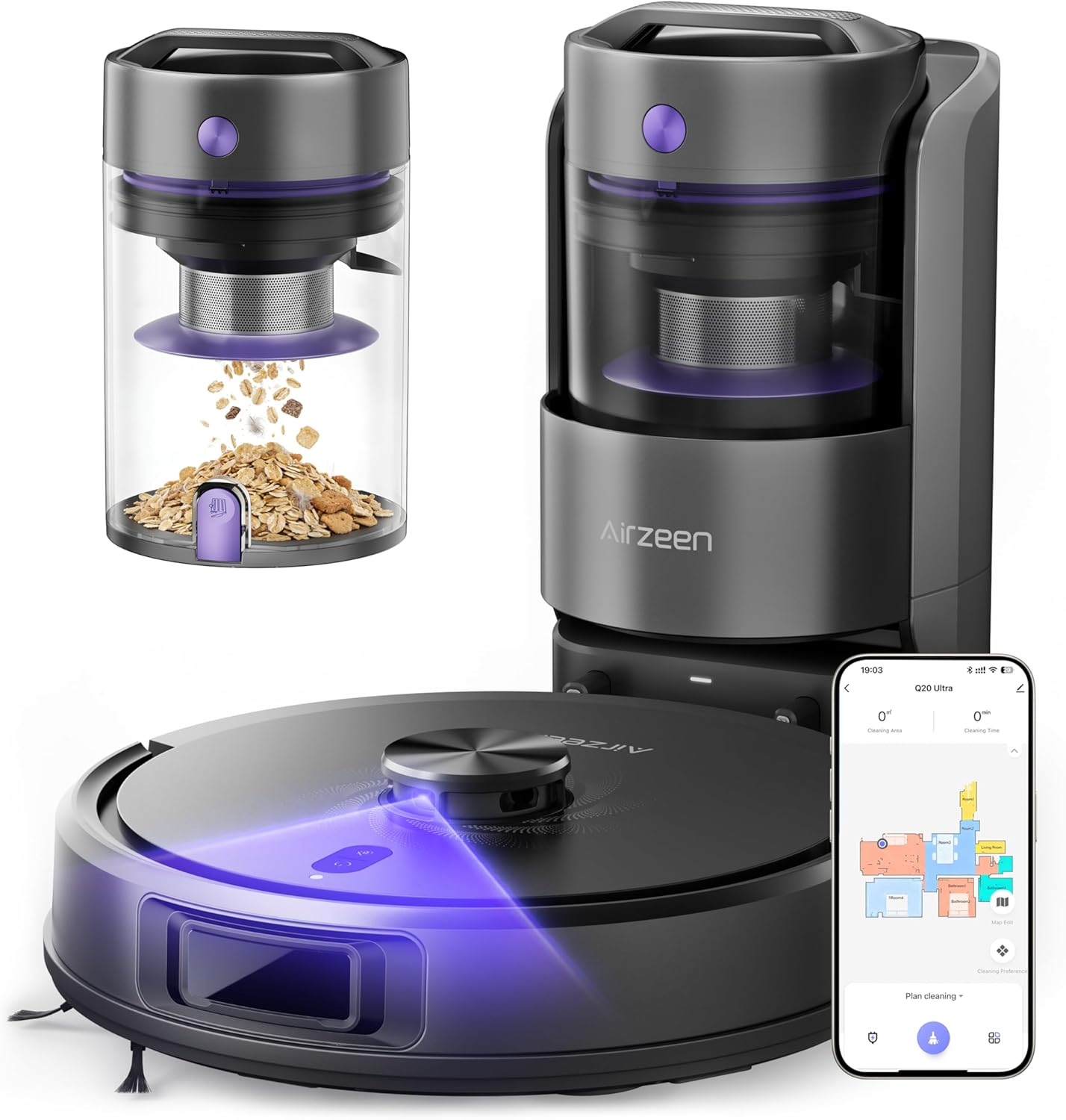
The Q20 Ultra empties its own bin into a larger base-mounted reservoir, extending the interval between manual dust cup emptying to as long as 45 days under typical use.
- The base uses a bagless, reusable dust cup rather than disposable bags, so there is no recurring bag purchase
- The onboard dustbin is a combined 2-in-1 dustbin and water tank, so both the vacuum and mop functions draw from the same removable unit
- The reusable dust cup is designed to be rinsed and reused rather than replaced
Because emptying is largely automated, day-to-day upkeep is mostly limited to periodically rinsing the dust cup and refilling the water tank for mopping, rather than manual bin changes after every run.
This robot vacuum and mop combo is built primarily for hardwood floors, tiles, and low-pile carpets, using auto carpet boost to raise suction up to 6000Pa when it detects a carpet transition.
- It clears obstacles up to 15mm high and can climb slopes up to 15 degrees, useful for room thresholds and slight ramps
- The mop holder should be removed before running on carpet, since the mopping pad is not designed to lift clear of thicker pile automatically
- 3 adjustable suction levels let the unit be tuned lower for delicate rugs or higher for embedded pet hair
Homes with thick or high-pile carpet will get less benefit from the mopping function specifically, since that mode is intended for hard flooring rather than textured carpet.
LiDAR navigation scans the home in a 360-degree sweep to build precise floor maps, supporting up to 5 saved maps for multi-level homes.
- Cleaning routes follow a matrix grid pattern intended to reduce missed spots compared with random-bounce navigation
- App and voice control are supported, but the robot connects only to 2.4GHz Wi-Fi networks, not 5GHz, which matters on routers broadcasting a single combined network name
- On a full charge, runtime reaches up to 150 minutes in ECO mode, dropping to around 100 minutes in Standard and 60 minutes in Max suction mode
If the robot cannot find its way back to the dock, repositioning it roughly 3 feet in front of the charging base is the recommended fix.

Pros
- 11500Pa suction lifts embedded pet hair and debris from both carpet and hard floors
- 230ml water tank and 240ml dustbin run at the same time for combined vacuum and mop passes
- LiDAR navigation builds detailed multi-floor maps with no-go zones for pet bowls or fragile areas
- Self-empties into a base holding up to 90 days of debris before the bag needs changing
- 160-minute max runtime covers a full-home clean on one charge
Cons
- 230ml water tank is small, so very large homes may need a mid-clean refill for mopping
- Washable mop pad needs manual removal and cleaning, since it is not a self-washing dock
- App, Alexa, and voice control all depend on a home Wi-Fi connection, so it will not map or self-empty offline
The vacuum runs at up to 11500Pa of suction, strong enough to lift embedded pet hair, crumbs, and fine debris from both carpet and hard flooring in a single pass. A 3-in-1 design vacuums, sweeps, and mops together, using a 230ml water tank alongside a separate 240ml dustbin so wet and dry cleaning happen simultaneously rather than in two separate runs. Carpet Auto-Boost automatically raises suction power when the robot detects it has moved from hard floor onto carpet, then drops back down again for quieter, more efficient runs on bare floors. Edge cleaning is tuned to reach into corners and along baseboards, addressing one of the more common weak points for round robot vacuums. A full charge supports up to 160 minutes of continuous runtime, enough to cover most home layouts in one session.
LiDAR navigation builds a precise map of the home, allowing multi-floor map storage, custom no-go zones around pet bowls or fragile decor, and targeted zone cleaning for specific rooms or high-traffic spots. The self-emptying base collects debris automatically after each run, and the listed 90-day large capacity dust bag means the bin only needs emptying roughly every three months under typical use rather than after every single clean. The mop pad is washable and removes for manual cleaning, so it is not a fully self-washing mop dock, and buildup should be checked periodically to keep mopping results consistent. Auto-recharge sends the robot back to its base when battery runs low mid-clean, and it resumes from where it left off once charged.
This robot is built for mixed-flooring homes, moving between carpet and hard floors in the same run while adjusting suction automatically for each surface. Control runs through a companion app, Alexa voice commands, or the robot's own buttons, and features like custom routines, scheduling, and room-specific cleaning all depend on that app connection over home Wi-Fi. Threshold crossing and obstacle avoidance are built in to handle rugs, low furniture legs, and small drops between rooms. Very large multi-level homes may need to empty or refill the 230ml water tank mid-session for mopping-heavy cleans, since that tank is sized for a standard single-floor run rather than back-to-back mopping across an entire large house.

Pros
- 20,000 Pa suction pulls embedded dirt from carpet fibers well above typical robot vacuums in the 4,000-8,000 Pa range
- All-in-One station auto-empties into a 3L bag rated for roughly 75 days before it needs changing
- DuoSpiral brushes cut hair tangling by a stated 53% compared with the manufacturer's earlier models
- CornerRover arm extends automatically to reach baseboards and furniture legs standard round-brush designs miss
- 125-minute runtime with laser-guided navigation covers larger homes with up to 5 saved floor plans
Cons
- 2.4GHz WiFi only, with no 5GHz band support, which can be an issue on mesh routers that push devices to 5GHz by default
- 110V US power specification limits it to North American electrical systems without a separate converter
- Mop lift is limited to 10.8mm to protect carpet, so it will not out-clean a dedicated deep-cleaning mop on hard floors with heavy stains
The All-in-One station handles most day-to-day upkeep automatically: it empties collected dust into a 3L bag rated to last around 75 days, washes the roller mop pads after each run, dries them with 50°C hot air to prevent mildew odor, and refills the onboard water tank for the next mopping pass. The HydroJet system also refreshes the roller mop with clean water twice per second while it is actively cleaning.
- 3L dust bag, rated for roughly 75 days
- Automatic mop washing and 50°C hot-air drying
- Auto water refill from the station
- DuoSpiral brushes reduce hair tangling by a stated 53%
Because washing and drying happen inside the station rather than in a sink, day-to-day involvement is mostly limited to keeping the station's clean and dirty water tanks topped up and emptied, plus periodic filter and brush inspection for buildup the automated cycles do not fully clear.
The roller mop and 20,000 Pa suction are built for hard floors, wood, and tile, with the CornerRover side brush extending to reach along baseboards and furniture legs for edge cleaning. On carpet, the mop lifts by 10.8mm to avoid wetting the fibers, and the unit is rated to climb thresholds up to 21mm high.
- Hard floors, wood, and tile: full HydroJet mopping
- Short carpet: vacuum-only, with mop lifted 10.8mm
- Threshold climbing up to 21mm
- Up to 5 saved floor plans for multi-room or multi-level homes
Because the mop pad lifts rather than detaches on carpet, thick pile carpet is not this robot's strongest area; it is tuned primarily for mixed hard-floor homes with shorter carpet runs rather than a house that is mostly deep-pile carpeting throughout.
The package centers on the All-in-One docking station alongside the robot itself, which handles emptying, washing, and drying without separate accessories needed for daily operation. The robot connects to the companion app over 2.4GHz WiFi for scheduling, mapping, and voice control setup through Alexa, Google Assistant, or Siri.
- Robot vacuum/mop unit and All-in-One station
- App-based setup with no drilling required, roughly 5 minutes
- Voice control via Alexa, Google Assistant, or Siri
- 110V US power specification
Because the station relies on 2.4GHz WiFi only, homes running WiFi 6 mesh systems that default new devices to the 5GHz band may need to manually assign a 2.4GHz network name during setup. Laser-guided navigation builds and stores floor maps directly through the app rather than needing a separate mapping accessory.
Pros
- AutoEmpty dock holds up to 75 days of debris in a bag that traps 99% of allergens as small as 0.7 microns
- Delivers 70x more suction than Roomba 600 series models, with an edge-sweeping brush rated 20% better at corner cleaning
- ClearView LiDAR maps the home for navigation and includes sensors that detect stairs to prevent falls
- Automatically detects and avoids carpet while in mopping mode, so rugs stay dry without manual room exclusion zones
- App supports vac-only, mop-only, or combo cleaning modes with adjustable suction and mopping solution levels
Cons
- Mop pad is a washable microfiber pad rather than disposable, adding a wash-and-dry step between mopping sessions
- AutoEmpty bags are a proprietary consumable that need periodic reordering, unlike bagless models with a reusable bin
- LiDAR-based navigation and app scheduling depend on a stable WiFi connection, so offline use loses mapping and remote scheduling features
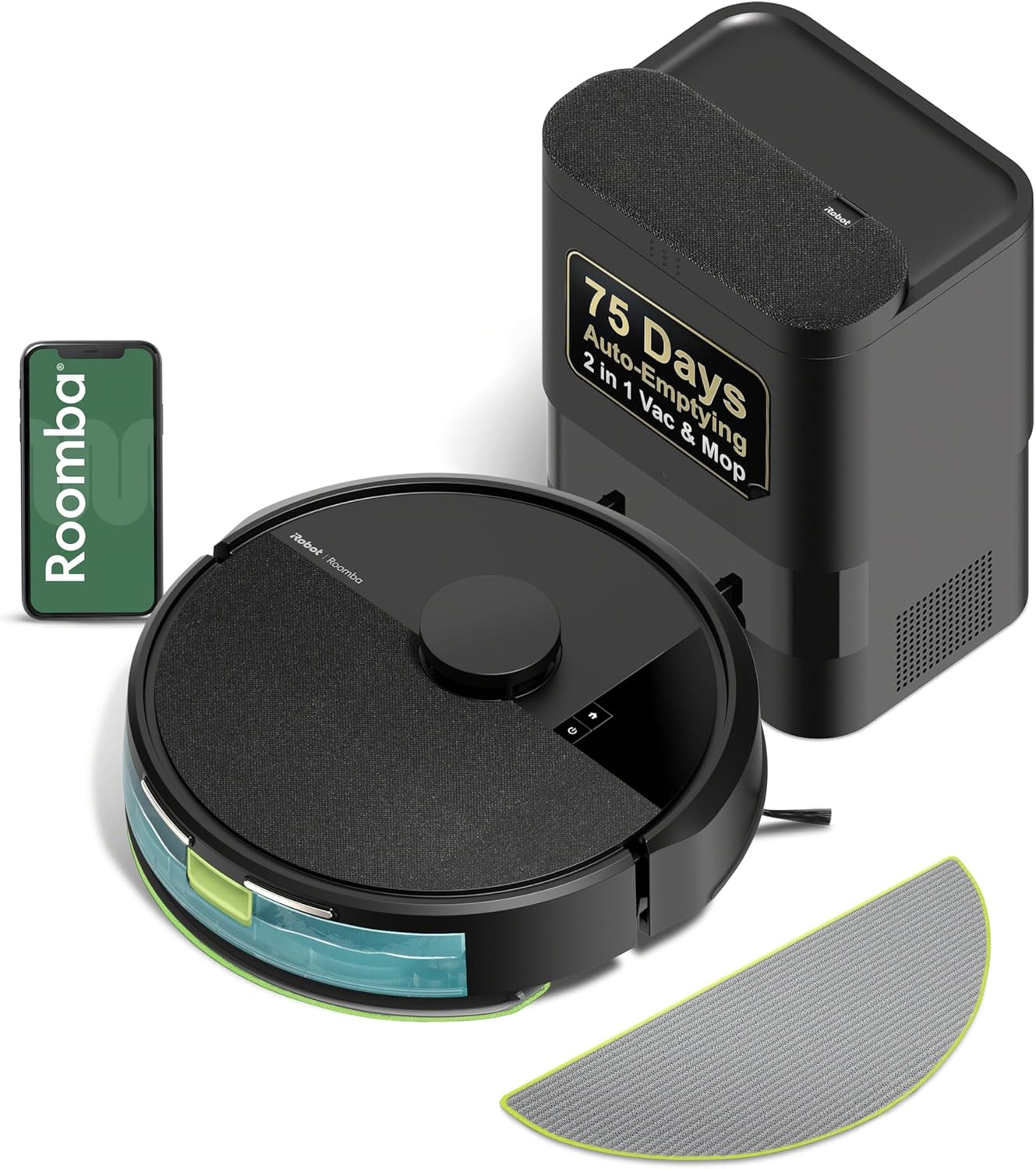
The AutoEmpty dock is the core maintenance feature here, holding up to 75 days of collected debris in a sealed bag that traps 99% of allergens as small as 0.7 microns, so emptying the robot itself is not a daily task. When the bag does fill, it lifts straight out and drops in the trash, with a fresh bag replacing it in the base rather than requiring the bin to be washed or scraped out.
- AutoEmpty dock holds up to 75 days of debris
- Bag traps 99% of allergens down to 0.7 microns
- Microfiber mop pad is washable and reusable
- App tracks filter and maintenance status
The mop pad needs to be removed, washed, and dried between sessions to stay effective, and the AutoEmpty bags themselves are a recurring consumable that will need periodic reordering over the life of the machine.
A multi-surface brush combined with 70x more power-lifting suction (versus Roomba 600 series models) is built to pull debris from both carpet and hard flooring in the same pass, while an edge-sweeping brush adds a claimed 20% improvement in corner and edge cleaning. For mopping, the robot automatically detects carpet and steers around it, so rugs are not accidentally soaked during a combo cleaning run.
- Multi-surface brush works across carpet and hard floors
- 70x more suction than Roomba 600 series
- Automatic carpet detection and avoidance while mopping
- ClearView LiDAR navigation with stair-drop sensors
Because carpet avoidance is automatic during mopping, homes with mixed flooring do not need manually defined no-mop zones, though thick, high-pile rugs still rely on the same detection sensor working correctly to stay dry.
Three core cleaning modes, vacuum only, mop only, or combo vac-and-mop, are selectable through the app, along with adjustable suction power, number of cleaning passes, and how much mopping solution is applied per session. Scheduling can target specific rooms based on the LiDAR-built map rather than cleaning the whole home every time.
- Vac-only, mop-only, and combo cleaning modes
- Adjustable suction levels and mopping solution amount
- Room-targeted scheduling via the mapped floor plan
- Works with Alexa, Siri, and Google Assistant voice commands
Voice and app control both depend on the robot being connected to home WiFi, so scheduling changes or targeted room cleaning are not available if the network connection drops, though the robot can still complete a previously scheduled or manually started clean.

Pros
- AutoWash Dock self-empties for up to 75 days and washes plus heat-dries the mop pads between runs, cutting down on manual maintenance
- PerfectEdge technology and DualClean mop pads extend cleaning 18% further along walls and corners versus standard vacuum-and-mop mode
- Up to 70x more suction than the Roomba 600 series, paired with a multi-surface rubber brush and edge-sweeping brush for mixed flooring
- ClearView Pro LiDAR mapping combines with PrecisionVision AI to route around cords, socks, and pet messes rather than driving through them
Cons
- AutoWash Dock is a large multifunction base that needs its own counter or floor footprint near an outlet, bigger than a simple charging dock
- Self-emptying interval tops out at 75 days for debris, but mop pad washing and drying cycles still run on a shorter schedule that needs monitoring
- SmartScrub's extra scrubbing pressure is aimed at hard floors, and the listing does not describe a deep-carpet cleaning mode for thick pile rugs
The AutoWash Dock handles most of the day-to-day upkeep: it empties collected debris automatically for up to 75 days, then rinses the mop pads during cleaning so dirt is not dragged back across the floor, and finishes by washing and heat-drying the pads once a cleaning run is done. A self-cleaning cycle inside the dock also cuts down on residue buildup over time.
- Debris self-emptying: up to 75 days
- Mop pad care: rinse, wash, and heat-dry cycles
- Dock self-cleaning: built in
Because the dock takes over emptying and pad washing, the main recurring task left for an owner is checking the dock's water and debris reservoirs periodically rather than hand-washing mop pads after every run.
PerfectEdge technology and DualClean spinning mop pads are built to reach 18% further into corners and along walls than standard vacuum-and-mop mode, targeting the edges where dirt tends to collect. A multi-surface rubber brush and edge-sweeping brush handle the transition between carpets and hard floors in the same pass.
- Hard floors: mopping plus vacuuming in one pass
- Carpets: rubber brush with Carpet Boost suction increase
- Edges and corners: PerfectEdge reach, 18% more coverage
PrecisionVision AI and ClearView Pro LiDAR work together to map the home and steer around obstacles like cords or pet accidents, while built-in cliff sensors are designed to stop the robot from rolling down stairs or off raised ledges.
The AutoWash Dock is the centerpiece accessory included with this model, combining a debris bin, mop pad washing station, and heat-drying function in one unit rather than requiring separate purchased add-ons. The DualClean spinning mop pads and multi-surface rubber brush ship attached and ready to run.
- Included: AutoWash Dock with debris bin and mop pad washer
- Included: DualClean spinning mop pads
- Included: multi-surface rubber brush, edge-sweeping brush
Because the dock bundles debris emptying with mop pad care, there are fewer separate consumables to buy right away, though replacement mop pads and the sealed debris bags used by the dock will still need restocking over time.

Pros
- 5000Pa suction power handles short- and medium-pile carpet as well as hard floors
- Combined 450ml dustbin and 300ml water tank runs vacuuming and mopping in a single pass
- Runs up to 150 minutes per charge in quiet mode before returning to self-charge
- Ultra-slim 2.99" height clears under most beds, sofas, and low cabinets
- 4 control methods (app, remote, voice, button) work without a smartphone if preferred
Cons
- 300ml water tank needs frequent refilling on larger homes covered in a single mopping run
- Anti-fall sensors handle stairs and drop-offs but the unit still can't climb them, so multi-level homes need a unit per floor or manual carrying
- Self-charging returns it to the dock, but the battery is not listed as user-replaceable once it degrades
This robot runs at 5000Pa suction power, built to lift pet hair, dust, and debris from hard floors as well as short- and medium-pile carpet. Battery life reaches up to 150 minutes in quiet mode before it returns to its dock.
- 5000Pa suction power
- Up to 150 minutes runtime in quiet mode
- Self-recharging when battery runs low
The combined 450ml dustbin and 300ml water tank let it vacuum and mop in one pass, a design the maker states cuts total cleaning time by around half compared with running two separate passes.
Built for hard floors, tile, and both short- and medium-pile carpet or rugs, this robot uses large wheels to help transition between floor types without getting stuck at thresholds.
- Handles hard floors, tile, and short-to-medium-pile carpet
- Ultra-slim 2.99" height clears under beds, sofas, and cabinets
- Anti-collision and anti-fall sensors navigate around obstacles and stairs
Thick, high-pile carpet isn't listed among the supported floor types, so homes with deep-pile rugs should treat medium-pile as the practical ceiling for this unit's brush and suction setup.
Four separate control methods, app, remote, voice, and the on-unit button, cover different household preferences without forcing everyone to use a smartphone. Four cleaning modes, including a zig-zag pattern for maximum coverage, are selectable from any of those inputs.
- 4 control methods: app, remote, voice, button
- 4 cleaning modes including Spot, Edge, and Zig-zag
- Auto-recharge dock for battery maintenance
The water tank needs manual refilling and the dustbin manual emptying after mopping/vacuuming runs, since this model doesn't include a self-empty or self-refilling base station.

Pros
- 5200Pa suction across 3 levels lifts dirt and crumbs from hardwood, tile, and low-pile carpet in one pass
- Low 2.99-inch height and 12-inch diameter slide under sofas and low furniture that taller robots cannot reach
- 4400mAh battery powers self-recharging cycles, returning to the dock automatically once charge drops below 20%
- 4-stage adjustable water tank tailors mopping wetness to different flooring and stain levels
- Voice control through Alexa or Google Assistant starts cleaning without opening the companion app
Cons
- Suction and mopping are tuned for hard floors and low-pile carpet, so thick or high-pile carpet is outside its effective range
- Mop pad requires manual removal and washing after wet cleaning, since there is no self-cleaning base station included
- HEPA filter and side brushes are consumable parts that will need periodic replacement over the vacuum's service life
The S1 combines a 3-level, 5200Pa suction system with electronically controlled mopping, aiming to lift dirt and crumbs while also keeping floors free of footprints and light stains in a single pass. It is built for wood, hard floors, and low-pile carpets, using a compact 2.99-inch height and 12-inch diameter to slide under furniture other robots cannot reach.
- 5200Pa suction across 3 adjustable levels
- 2.99" height, 12" diameter for low-clearance furniture
- 4-stage water tank adjustment for mopping wetness
Thick pile carpet sits outside the intended range, since the mopping function and low-clearance body are optimized for hard flooring rather than deep carpet fibers.
Between cleaning cycles, the mop pad and water tank need manual removal, emptying, and washing, since this model does not include a self-emptying or self-cleaning base station. The dustbin also needs periodic emptying, and the included HEPA filter and side brushes are wear parts that require replacement over time as they pick up dirt and debris.
- Manual mop pad removal and washing required after wet cleaning
- Onboard dustbin needs periodic emptying by hand
- HEPA filter and side brushes are replaceable consumable parts
Buyers used to fully self-cleaning robot vacuum stations should note this model relies on hands-on upkeep rather than an automated cleaning base.
Cleaning can be started, scheduled, or adjusted through the companion smartphone app or by voice command through Alexa or Google Assistant, and the robot returns automatically to its charging base once its 4400mAh battery drops below 20%. The box includes the robot, mop pad holder, charging base, power adapter, water tank, mopping cloth, HEPA filter, side brushes, cleaning brush, and a user manual.
- App control plus Alexa and Google Assistant voice control
- Self-recharging when battery falls below 20%
- Includes charging base, water tank, HEPA filter, side brushes, and cleaning tools
This bundle suits buyers who want a ready-to-run kit without sourcing separate mop pads or filters immediately after purchase.

Pros
- 15,000 Pa turbo suction with automatic carpet boost lifts dander and kibble crumbs out of pile rather than skimming it
- 28cm roller mop spins at 270 RPM through 24 water ports with a built-in scraper, so it rinses itself mid-clean
- DuoSpiral brush clears hair up to 30 cm long without wrapping, which is the difference-maker in multi-pet homes
- Dock empties into a 3L bag and dries the mop with 50 degree C hot air, covering roughly 75 days of upkeep
- LiDAR mapping with no onboard cameras, running at 54.89 dB in normal use
Cons
- Obstacle avoidance is specified down to 3 x 3 x 3 cm, so thin cables, socks and small chargers still need picking up first
- Mop lift is 10.8mm, enough for flatweave rugs but not for shag or thick pile, which must be excluded in the app map
- The all-in-one dock needs a permanent floor footprint plus side clearance, unlike a bare charging plate
The dock handles most of the work owners normally do by hand. After each run it empties debris into a 3L bag, washes the roller mop, dries it with 50 degree C hot air so mould cannot take hold, collects the dirty water and refills the clean tank.
- Roughly 75 days between dust bag changes for an average household, with the maker claiming the dock covers about 95% of routine upkeep.
- The internal scraper strips dirt off the roller continuously while mopping, so the pad is washing floors rather than smearing them.
- What you still do: swap the bag, top up clean water and rinse the wastewater tank every week or two.
Filters, the roller and the brush remain consumables, so factor replacement parts into ownership across a couple of years of daily cleaning.
Suction peaks at 15,000 Pa and steps up automatically when the machine detects carpet, which is what pulls dander and crumbs out of pile. On hard floors the 28cm HydroJet roller spins at 270 RPM through 24 water ports, so it is wet-scrubbing rather than dragging a damp cloth around.
- Hard floors: sealed wood, tile and vinyl are the sweet spot, since the roller rinses itself throughout the run.
- Low pile carpet: the mop lifts 10.8mm, enough clearance for flatweave rugs and thin runners.
- Thick or shag pile: 10.8mm is not enough lift, so those rooms should be excluded as no-mop zones in the map.
The DuoSpiral brush is specified to clear hair up to 30 cm long without wrapping, which is what keeps a household with long-haired pets from cutting tangles off the roller by hand each week.
Mapping uses LiDAR rather than a camera. That means no lens pointing into your rooms, and it also means navigation works in complete darkness, which camera-based machines struggle with on a night schedule.
- Obstacle avoidance is specified for objects of 3 x 3 x 3 cm and larger, covering pet bowls, shoes and most toys.
- Below that threshold — thin cables, socks, small chargers — a quick tidy before the run is still sensible.
- 54.89 dB in normal running is quiet enough to leave working while you sit in an adjoining room, though turbo mode on carpet is noticeably louder.
Multi-floor maps mean several storeys can be stored at once, but the dock lives on one level only, so cleaning upstairs means carrying the machine up and bringing it back down to empty.

Pros
- Suction rated at 20,000Pa, paired with DualClean mop pads for combined vacuum and mop passes in one run
- AutoWash Dock empties collected debris automatically for up to 90 days between manual bin changes
- Mop pads are washed and heat-dried at 113°F after every run, so the mop begins each session with an already-cleaned pad
- Body is 46% slimmer than the Roomba 105 series, letting it reach under lower furniture that blocks bulkier robots
- Offers 4 selectable cleaning modes: vacuum-only, mop-only, simultaneous vacuum-and-mop, or vacuum-first-then-mop
Cons
- SmartScrub's extra scrubbing pressure targets dried-on messes, but heavily soiled floors may still need a manual pass first
- AutoWash Dock's 90-day self-emptying interval depends on the dock's water tank and debris bin also being kept filled and emptied
- LiDAR mapping and obstacle avoidance handle common household clutter, but cords and small objects on the floor should still be cleared before a run for best results
This robot combines 20,000Pa of suction with DualClean mop pads, running vacuum and mop passes together or separately depending on the selected mode. SmartScrub technology applies extra pressure specifically to break down dried food, muddy tracks and kitchen splatter that a lighter pass would leave behind.
- 20,000Pa suction
- DualClean mop pads for wet cleaning
- SmartScrub adds pressure on stubborn, dried-on messes
- 4 selectable modes: vacuum-only, mop-only, combined, or sequential
Switching between the four modes lets a single run be tailored to a quick dry pickup or a deeper combined vacuum-and-mop pass without changing machines.
The AutoWash Dock empties collected debris automatically for up to 90 days between manual bin changes, and washes plus heat-dries the mop pads at 113°F after every single run. This keeps each new cleaning session starting with pads that were not left sitting dirty since the last use.
- Debris self-emptying for up to 90 days
- Mop pads washed and heat-dried at 113°F after each run
- Reduces manual mop pad washing between sessions
- Dock refills the onboard water tank automatically
Because the dock's water tank and debris bin still need periodic refilling and emptying by hand, the 90-day interval assumes those are kept topped up.
A 46% slimmer body compared with the Roomba 105 series lets this robot reach under sofas and low cabinets that block bulkier designs, while extending edge brushes pull debris from corners and along baseboards. Tangle-free rubber brushes are built to handle pet fur without repeated stops to clear the roller.
- 46% slimmer profile than the Roomba 105 series
- Extending brushes clean edges and corners
- Tangle-free rubber brushes resist pet hair wrap
- LiDAR mapping navigates around cords and furniture
Because navigation relies on LiDAR mapping and obstacle recognition rather than a physical bumper alone, clearing loose cables and small objects from the floor before a run still helps avoid snags.

Pros
- ClearView LiDAR mapping navigates in organized rows instead of random bounce patterns
- 3-stage cleaning system pairs a multi-surface brush with an edge-sweeping brush for baseboards and corners
- Spot Cleaning mode repeats passes over one area for up to five minutes when spills happen
- Auto-recharge and resume lets it finish a job after topping up battery mid-clean
- Keep Out Zones can be set around cords and pet bowls through the companion app
Cons
- Requires Wi-Fi and the companion app for scheduling and zone features, offline use limits it to onboard buttons only
- No self-emptying base included with this bundle, so the bin needs manual emptying after each run
- Navigation performs best on a single level, so multi-floor homes need to be remapped per floor
The 3-stage cleaning system combines suction with a multi-surface brush and an edge-sweeping brush, aimed at pulling embedded dust and pet hair from both carpet and hard flooring in the same pass. Suction is rated at 70 times the power-lifting force of the Roomba 600 series, giving it more pull through deeper carpet pile than entry-level robot vacuums typically manage.
- Surfaces: carpets and hard floors
- Brush system: multi-surface roller plus edge-sweeping brush
- Suction: 70X power-lifting versus Roomba 600 series
Edge and corner coverage relies on the sweeping brush design to pull debris out from baseboards, since the round chassis cannot reach flush into square corners. Rooms with a mix of hardwood, tile, and area rugs are the sweet spot, though very thick shag carpet can still slow the brush roll compared with low-pile carpet or hard flooring.
Setup pairs the robot with the companion app over Wi-Fi, where LiDAR mapping builds a room-by-room map used for scheduled cleans, high-traffic targeting, and Keep Out Zones around cords or pet bowls. Filter life and cleaning history are also tracked in the app, giving a maintenance reminder rather than requiring a manual log.
- Navigation: LiDAR mapping, row-pattern cleaning
- App features: scheduling, Keep Out Zones, filter life tracking
- Connectivity: Wi-Fi required for full feature set
Without an active Wi-Fi connection, scheduling and zone editing are unavailable, leaving only the onboard start/stop control. Routine maintenance is limited to emptying the bin and clearing hair from the brush roll after each run, since this bundle does not include an automatic emptying dock.
When battery runs low mid-clean, the robot returns to its dock, recharges, and resumes the same job rather than starting over, which matters most in larger homes where a single charge cannot cover every room. Voice control through a connected assistant adds a hands-free way to start or stop a clean without opening the app.
- Recharge behavior: auto-return and resume mid-job
- Control options: app, onboard buttons, voice assistant
- Spot cleaning: repeats one area for up to 5 minutes
Obstacle handling is tuned for everyday clutter like cords, toys, and furniture legs, including in low light, but very low-profile obstacles or thick rugs with fringe can still occasionally cause a pause. Homes with stairs benefit from the built-in drop sensors, though gates or barriers are still advisable for open stairwells during unattended runs.
Why carpets are harder for robot vacuums
Hard floors are forgiving. Debris sits on top, and almost any robot can sweep it into the bin. Carpet is a different job entirely. Dirt sinks below the surface, and the vacuum has to generate enough airflow to lift it back out through the pile. That is why suction, measured in pascals (Pa), matters so much more on carpet than on tile or hardwood.
Pile height complicates things further. Plush and shag rugs choke weak motors and can strand a robot that lacks the drive power to climb. Pet hair adds a third challenge: long strands wrap around spinning brushes and turn into a matted rope that kills performance within weeks unless the brush is designed to resist tangles.
The good news is that 2026 models have made real progress. Suction figures that used to be premium-only now show up on mid-range machines, anti-tangle rollers are widespread, and carpet detection lets a robot automatically boost power the moment it rolls off a hard floor and onto a rug.
Our top picks for carpet cleaning
Best all-around for deep carpet
The eufy E25 leads the pack for raw cleaning ability, pairing 20,000 Pa of suction with a zero-tangle brush design that handles pet hair without wrapping. Its all-in-one station keeps maintenance low, so it suits busy households with lots of carpet and shedding pets. If you want a slightly different take from the same brand, the eufy C28 offers 15,000 Pa with an auto-washing, self-refilling dock and is an upgrade over the older X10 Pro.
Best from a trusted name
iRobot remains the default recommendation for shoppers who want a proven brand. The Roomba 505X delivers 70x more suction than iRobot’s older entry models, adds a self-cleaning multifunction dock, and lifts its mop pads so it never drags a wet cloth across your rugs. Stepping up, the Roomba 415X pushes suction to 20,000 Pa with 90-day self-emptying and lifting spinning mops for homes that want the most hands-off experience iRobot offers.
Best value picks
You do not have to spend a fortune. The Roomba 105 Combo brings LiDAR navigation, power-lifting suction and automatic carpet detection at a price that undercuts most rivals, and it smartly avoids mopping carpet. For an even leaner budget, the Tikom G8000 Max and the ROPVACNIC combo both handle low and medium pile carpet, pet hair and hard floors while costing a fraction of the premium models. They skip the fancy self-emptying docks, but the core vacuuming is more than capable for smaller homes.
Best for smart mapping
If you want precise, room-by-room control, look at LiDAR-equipped machines. The Q20 Ultra combines 6,000 Pa suction with LiDAR navigation, smart mapping and self-emptying, making it a versatile pick for medium-pile carpet and multi-room layouts. Two more strong mapping options round out the list: a 3-in-1 LiDAR robot that pushes a hefty 11,500 Pa through a 90-day self-emptying dock, and the vacuum-only Roomba 105X, which uses smart LiDAR mapping and power-lifting suction to target specific rooms on command. Both are included in the product list above so you can compare their current pricing directly.
How to choose the best robotic vacuum for carpets
Suction power comes first
For low-pile carpet and area rugs, aim for at least 4,000 to 6,000 Pa. For medium and high pile, or homes with heavy pet shedding, target 10,000 Pa and up. The premium models in this guide reach 15,000 to 20,000 Pa, and the difference is obvious on plush carpet where embedded dust and dander need to be pulled up rather than brushed around. Remember that manufacturer suction numbers are marketing figures, so treat them as a rough ranking rather than an exact measurement.
Look for carpet detection and boost
The best machines sense when they move from hard floor onto carpet and automatically ramp suction to maximum, then dial it back on tile to save battery and reduce noise. This auto-boost is the single most useful carpet feature because it means you never have to fiddle with settings. Every mid-range and premium pick above includes some form of it.
Brush design and tangle resistance
Bristle brushes agitate carpet fibers well but grab long hair. Rubber or anti-tangle rollers, like the zero-tangle systems on the eufy models, resist wrapping and are far easier to maintain in a home with dogs or long-haired occupants. If you are specifically fighting fur, it is worth reading a dedicated roundup of robotic vacuums for dog hair before you commit, since brush design is even more critical there.
Navigation: LiDAR versus bump-and-go
Cheaper robots wander semi-randomly and eventually cover a room, which is fine for small, open spaces. LiDAR and smart-mapping models build an accurate floor plan, clean in efficient rows, remember room boundaries and let you send the robot to a specific area from an app. If you have a larger or multi-room home, mapping is well worth the premium because it means faster, more thorough coverage and fewer missed patches of carpet.
Mopping on a carpeted home
Many of these picks are vacuum-and-mop combos, which raises an obvious question on carpet: you do not want a wet pad dragged over your rugs. Look for mop pads that lift automatically or a system that detects carpet and avoids mopping it entirely, as the Roomba 105 Combo does. If mopping is a big priority alongside vacuuming, our guide to the best vacuum mops digs deeper into combo performance and pad-lifting mechanisms.
Self-emptying and maintenance
Carpet and pet hair fill a small onboard bin quickly. A self-emptying dock, offered here on the eufy models and the higher Roombas, transfers debris automatically and can go 60 to 90 days between manual emptying. It costs more upfront and the replacement bags add a small ongoing expense, but for shedding households it dramatically cuts hands-on maintenance and keeps suction consistent between cleans.
Battery life and home size
Deep carpet cleaning at high suction drains batteries faster than gliding over tile. Look for runtimes of 120 minutes or more if you have a large area to cover, and confirm the robot supports auto-recharge and resume so it can top up and finish the job on its own. Most models here handle a typical apartment or single floor on one charge.
Matching a robot to your home
Small apartment with a few rugs and no pets? An affordable model like the Tikom G8000 Max or ROPVACNIC combo will keep things tidy without straining your budget. Larger home with wall-to-wall carpet and shedding pets? Spend up for the eufy E25 or a high-suction Roomba, where the extra power and self-emptying dock pay for themselves in cleaner floors and less effort. If you have a mix of carpet and hardwood, prioritize carpet detection and lifting mop pads so a single robot can handle both surfaces without compromise, and compare notes with a broader roundup of vacuums for carpets to see how robots stack up against upright and canister alternatives.
Whatever your budget, the carpet-cleaning gap between good and mediocre robots comes down to the same short checklist: enough suction for your pile height, automatic carpet boost, a tangle-resistant brush and, ideally, smart mapping. Nail those and any of the picks above will keep your rugs genuinely clean rather than merely surface-swept.
Frequently asked questions
How much suction do I really need for carpet?
For thin area rugs and low-pile carpet, 4,000 to 6,000 Pa is enough to lift everyday dust and crumbs. Medium-pile carpet benefits from 8,000 Pa or more, and if you have plush or shag rugs plus shedding pets, the 15,000 to 20,000 Pa premium models are worth the jump. More suction also means the robot pulls embedded dander out of the fibers instead of just grooming the surface, which matters for allergy sufferers.
Can a robot vacuum replace my regular vacuum on carpet?
For daily and weekly upkeep, yes, a capable robot keeps carpet visibly clean and stops dust and hair from building up. For occasional deep cleaning, a spot treatment or a periodic pass with a full-size upright still helps, especially on high-traffic areas. Think of the robot as the machine that handles the routine so your manual vacuum only comes out now and then.
Will the mop function damage my carpet?
Not if you choose wisely. The safest combos either lift their mop pads automatically when they detect carpet or skip mopping carpeted zones entirely. Avoid basic combos that drag a fixed damp pad everywhere, since a wet cloth on carpet is both ineffective and messy. Every combo highlighted above manages carpet and mopping without soaking your rugs.
Do robot vacuums handle transitions between carpet and hard floor?
The models here climb typical carpet edges and thresholds without getting stuck, and carpet detection lets them adjust suction on the fly. Very high pile or thick rug tassels can still trip up budget robots, so if your home has deep shag, favor a model with higher drive power and confirmed carpet-climbing ability before buying.
Final thoughts
Robot vacuums have finally become powerful enough to be a real carpet-cleaning tool rather than a novelty that just tidies hard floors. The models in this guide span every price point, from sub-$100 workhorses to premium, fully automated stations, so there is a strong match for almost any home. Prioritize suction and brush design first, add smart navigation if your layout demands it, and let the self-emptying dock save you time if pets keep your floors busy. Use the product list above to compare current prices and pick the best robotic vacuum for carpets that fits your space and budget.