 Naomi Tanaka
 Choosing the best locks for your needs sounds simple until you start shopping and realize just how many types exist. Padlocks, luggage locks, door reinforcement locks, combination locks, key lock boxes, the options seem endless. The truth is that no single lock is right for every situation. The best lock for your gym locker is very different from the one guarding your front door or protecting your suitcase at the airport.
This guide breaks down the main categories of locks, explains what to look for before you buy, and highlights a curated list of dependable, highly rated options. Instead of drowning you in per-product reviews, we focus on helping you understand which style fits your situation so you can buy with confidence.
Top Lock Picks for 2026
Below is our shortlist of reliable locks covering the most common security needs, from travel and storage to home entry reinforcement. Each has earned strong ratings and thousands of reviews from real buyers.
Pros
- Braided and sheathed steel cable resists cutting better than a soft nylon zip lock
- 3-digit combination resets as many times as needed via a lever mechanism, no tools required
- Cable extends 4 inches end to end with a 1.5 inch internal loop, enough to thread through most zipper pulls and hard-case lock holes
- Backed by an unconditional lifetime guarantee against breakage
Cons
- 3-digit combination offers only 1,000 possible codes, fewer than a 4-digit TSA lock
- Cable-style shackle is thinner than a rigid steel shackle, so it will not deter someone with cable cutters as long
- Alloy body adds a small amount of weight versus a plastic-bodied combination lock
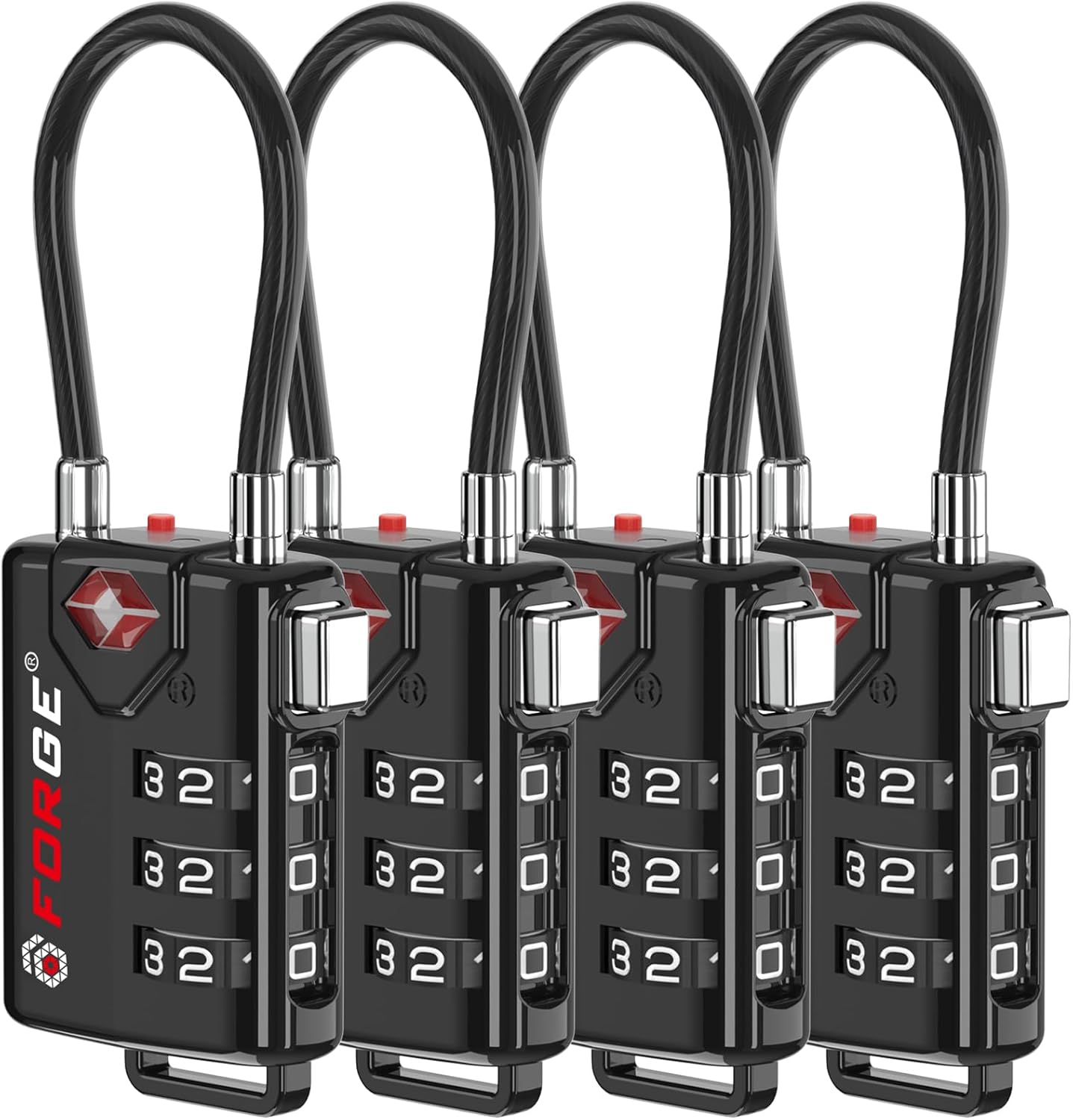
The lock body is machined from alloy steel and paired with a tightly braided, sheathed steel cable rather than a rigid shackle. That construction is built to resist cutting and prying better than the plastic-bodied combination locks sold alongside it, and the patented internal mechanism is backed by an unconditional lifetime guarantee against breakage.
- Alloy steel lock body
- Braided, sheathed steel cable
- 3-digit re-settable combination
Because the shackle is a cable rather than a solid bar, it will flex around irregular shapes but offers less cutting resistance than a hardened steel shackle lock.
At 6.1 x 3.7 x 0.1 inches folded, the lock is thin enough to lie flat in a suitcase pocket. The cable is 4 inches from end to end with a 1.5 inch internal loop when locked, thin enough to pass through zipper pulls, hard-case lock holes, gym locker latches and gun-case loops.
- 6.1 x 3.7 x 0.1 inch folded size
- 4 inch cable, 1.5 inch locked loop
- Fits standard zipper pulls and hard-case holes
The compact size means it will not reach around a wide duffel handle or thick strap the way a longer cable lock would.
The 3-digit combination ships set to 0-0-0 and is changed by flipping an internal lever with a pen tip, then dialing in a new code. Because the mechanism resets externally, there is no risk of a screwdriver mid-flight jostling the combination the way it can on simpler dial locks.
- Factory default 0-0-0 combination
- Lever reset with a pen, no tools
- Recognized by TSA master-key screening
Two red diamond logos mark it as TSA-recognized, letting screeners open and relock the bag with a master key instead of cutting the cable during a bag check.

Pros
- Cable design threads through zippers and hard-case lock holes that rigid shackles cannot reach
- 3-digit combination resets easily with a pen and a lever mechanism, no key to lose
- Alloy lock body with braided, sheathed steel cable and hardened cable ends
- TSA-recognized red diamond logos let agents open the lock with a master key instead of cutting it
- Backed by an unconditional lifetime guarantee against breakage
Cons
- 3-digit combination offers fewer possible codes than a 4-digit lock, a tradeoff for the quicker-reset design
- Cable length is limited to about 4 inches end to end, restricting use to smaller zipper pulls and lock holes
- Sold as a 2-pack only, so larger luggage sets may need an additional order
Each lock in this 2-pack measures 1.2 x 0.7 x 3.4 inches and combines an alloy steel lock body with a braided, sheathed steel cable and hardened cable ends. The cable runs about 4 inches end to end, with an internal looped length of 1.5 inches when locked.
- Materials include alloy steel, chrome, iron and zinc components
- Cable format threads through zippers and hard-case lock holes that rigid shackle locks cannot reach
- Backed by an unconditional lifetime guarantee against breakage
The cable's flexibility is built to secure suitcases, hard cases and gun cases where a fixed shackle shape would not fit the available lock points.
Locks ship with a factory default combination of 0-0-0. To set a personal code, flip the internal lever with a pen and enter the new 3-digit combination, which can be changed again as many times as needed.
- No key required for day-to-day use, only for the TSA master-key override
- Lever mechanism prevents the combination from shifting accidentally during handling
- Two red diamond TSA logos mark the lock as agent-openable without cutting
Because TSA agents can open these locks with a master key during screening, the locks are relocked afterward rather than cut, avoiding lost luggage security mid-trip.
Built for travelers who need TSA-compliant security on zippered luggage, backpacks or hard cases where a rigid shackle lock will not fit the available lock points. The cable format handles a wider range of closures than a standard padlock shape.
- Air travelers wanting master-key compatible locks to avoid cut locks after screening
- Users securing zippered duffel bags or backpacks with small pull loops
- Anyone wanting a resettable combination without needing to track a physical key
Less suited to securing very large hasps or lock points beyond the roughly 1.5 inch internal loop, since the cable length is fixed and not extendable.

Pros
- Rated to withstand up to 800 lbs of force, about 16 times a standard deadbolt's resistance to kicking
- Installs with 8 included screws (4 long, 4 short) and a 1/8 inch drill bit in about 5 minutes
- Opens with a simple pinch-and-swing motion on the top and bottom grooves for fast exit during an emergency
- Compact 2.5 x 1.5 x 3 inch body adds minimal bulk to the door edge
- Rubber-covered contact points are designed to avoid scratching the door surface during use
Cons
- Not compatible with French double doors, garage doors, outward-opening doors, or doors with gaps under 0.07 inches
- Requires drilling into the door frame, so it is not a no-damage or fully reversible install
- Provides supplemental reinforcement only and is not a substitute for the door's primary lock or deadbolt
Made from an alloy body, this lock is rated to withstand up to 800 lbs of applied force, described by the maker as roughly 16 times more resistant to kicking-in than a standard deadbolt alone. The hardware measures 2.5 x 1.5 x 3 inches once mounted, keeping the profile low against the door edge and frame.
Fit is restricted by door type: it is not suited to French double doors, garage doors, doors that open outward, or doors with a gap under 0.07 inches between the door and frame, since the mechanism needs a standard inward-swinging door with enough gap to engage. Misaligned frames can also prevent a secure fit.
- Size: 2.5 x 1.5 x 3 inches
- Force capacity: up to 800 lbs
- Door type: inward-opening standard doors only
The kit includes 8 screws in total, 4 long and 4 short, so the right length can be matched to the door and frame thickness at hand. A 1/8 inch (3.18mm) drill bit, a common bit size already found in most home tool kits, is needed to pre-drill mounting holes, and the maker estimates a full install at around 5 minutes with an electric drill.
Because it is a drilled installation rather than an adhesive or clamp-on design, mounting is not reversible without leaving screw holes in the door and frame. Checking the product images against the door's own dimensions before drilling is worthwhile, since fit varies by door thickness and frame alignment.
- Screws included: 8 (4 long, 4 short)
- Drill bit needed: 1/8 inch
- Install time: about 5 minutes
Opening the lock from the inside uses a pinch-and-swing motion on the top and bottom grooves, designed to be worked quickly by hand during an emergency without needing a key or tool. This makes it a workable choice for households wanting extra security on a bedroom or exterior door while still being able to exit fast if needed.
It is aimed at supplementing an existing lock rather than replacing one, since it does not include a primary latch or deadbolt mechanism of its own. The maker positions it as added protection for situations like a break-in attempt, giving occupants, including elderly residents or those living alone, more time to react. It will not fit outward-opening doors, garage doors, or doors with narrow gaps under 0.07 inches.

Pros
- Hardened steel shackle at 1/4 inch (6.1mm) thick resists cutting and prying better than standard carbon steel shackles
- 4-pin brass cylinder with dual locking levers adds pick resistance beyond a basic single-lever mechanism
- Ships with 2 keys cut from 1.8mm thick copper, reducing the chance of a bent or snapped spare
- Compact 43mm body width fits standard locker hasps, small gates and toolbox latches
Cons
- Sold as 1 pack with keys alike only within that single lock, so pairing multiple locks to one key needs a separate multi-pack purchase
- ABS plastic shell covers the body for scratch protection, but is not a substitute for the aluminum underneath if the shell cracks
- Beam outer height of only 1-1/8 inch (28mm) limits it to thinner gate loops, chains or hasps rather than thick chain links
The lock body measures 1-11/16 inch (43mm) wide by 5/8 inch (16mm) thick, with an overall body height of 2-3/8 inch (60mm). The shackle stands 1-1/8 inch (28mm) tall on the outside and measures 1/4 inch (6.1mm) thick, made from hardened steel rather than standard carbon steel.
- Body materials: aluminum shell over an alloy steel core, with a brass cylinder
- Includes 2 keys cut from 1.8mm thick copper stock
- Compact footprint suited to hasps, chains and loop diameters under 28mm
Because the shackle opening is on the smaller side, it is worth measuring the hasp or chain link it needs to pass through before ordering, since thicker chains will not fit.
Inside the aluminum shell, a 4-pin brass cylinder paired with a dual locking lever mechanism resists picking and prying better than the single-lever design found in many basic padlocks. The hardened steel shackle adds cut resistance, while a black ABS plastic cover wraps the lock body against scratches and everyday wear.
- Copper lock cylinder resists corrosion better than plain steel pins
- Rust-resistant aluminum body suits both indoor and outdoor mounting
- ABS shell is cosmetic protection, not an additional structural layer
None of this makes it a high-security commercial lock, but the combination of a hardened shackle and multi-pin cylinder puts it ahead of the single-pin locks bundled with many storage products.
The compact 43mm body and 28mm shackle height suit school and gym lockers, garden gates, sheds, toolboxes and storage units where a bulky commercial padlock would be overkill. Both keys are cut to the same pattern, so either one operates that single lock.
- Indoor and outdoor rated thanks to the corrosion-resistant aluminum and copper components
- Good fit for lightweight security tasks rather than high-value asset protection
- Small enough to carry a spare key on a keyring without added bulk
Anyone securing a thick chain, heavy-duty gate or wide hasp should check the 28mm shackle clearance first, since it is sized for lighter-duty hardware rather than industrial fittings.

Pros
- Holds up to 5 standard house keys behind a single resettable 4-digit code
- Metal body with a protective shutter door shields the combination dials from rain and dust for year-round outdoor mounting
- Vinyl-coated shackle installs in seconds over ball, biscuit, or tulip-style doorknobs without scratching the surface
- Combination resets anytime to a new 4-digit code, no locksmith or key duplication needed when access needs to change
- Also hangs on gates, fences, or select mailboxes, not limited to doorknob mounting alone
Cons
- Holds a maximum of 5 keys, so households needing to store more than one set will run out of room
- Hanging mount over a doorknob or fence means it can be removed by anyone willing to cut or force the shackle, unlike a bolted wall-mounted safe
- Shackle is sized for ball, biscuit, and tulip-style knobs plus select mailboxes, so it will not fit every door handle style without checking compatibility first
This lock box holds up to 5 standard house keys in one compartment, secured behind a resettable 4-digit combination. The code can be changed at any time without a locksmith, so access can be revoked from a former renter, contractor, or cleaner simply by resetting the dials to a new sequence rather than replacing hardware.
Because the numbers are user-set from a range of thousands of possible 4-digit combinations, the box works for rotating access among guests, short-term rental visitors, or family members without cutting extra physical keys. Anyone needing to store more than 5 keys, such as a property manager handling several units from one box, will need multiple boxes or a larger-capacity option instead.
The box is built with a solid metal body and a protective shutter door covering the combination dials, shielding them from rain, dust, and general outdoor exposure for year-round use. A vinyl-coated shackle wraps around the mounting point, which prevents scratching on painted doorknobs or fence rails during installation and removal.
It is designed to hang over ball, biscuit, and tulip-style doorknobs, as well as gates, fences, and select mailboxes, installing in seconds without tools. Because it is a hanging design rather than a bolted or drilled-in mount, it should not be relied on as the sole security layer for high-value items; its main role is convenient, controlled key access rather than safe-level protection against a determined attempt at removal.
This lock box fits situations where a key needs to be accessible to more than one person without handing out physical copies: real estate showings, short-term rental check-ins, or a family coordinating access for a caregiver or dog walker. Real estate agents in particular use this style of box to let multiple agents show a property without scheduling around a single keyholder.
Homeowners managing a rental or a vacation property will find the resettable code useful between guest turnovers, since the combination can be changed after each stay without changing the door lock itself. It is less suited to anyone wanting a permanent, tamper-resistant install, since the hanging shackle mount trades some physical security for the convenience of quick removal and relocation.

Pros
- Hardened steel shackle at 1/4 inch diameter and 7/8 inch long resists cutting and sawing better than a soft-metal shackle
- 4-pin cylinder combined with dual locking levers adds resistance to both picking and prying attempts
- Comes with 2 keys for a single lock, so a spare stays available if the primary key is misplaced
- Vinyl-covered aluminum body resists scratches and corrosion, suited to humid gym locker rooms or outdoor gates
- Backed by a limited lifetime warranty from Master Lock
Cons
- Ships as a single lock, so securing multiple access points requires buying more than one unit separately
- Aluminum body is lighter-duty than Master Lock's solid brass or hardened-steel-bodied padlock lines
- Compact 2.59-inch overall length may not clear thicker hasps or wide chain links built for larger padlocks
This padlock uses a hardened steel shackle, 1/4 inch in diameter and 7/8 inch long, designed to resist cutting and sawing better than an untreated, softer metal shackle would under the same attempt. A 4-pin cylinder pairs with dual locking levers inside the lock body, a combination aimed at resisting both picking and prying or hammering compared to a basic single-lever design. The body is aluminum wrapped in a black vinyl cover, which helps resist scratches and slows corrosion, relevant for a lock that spends time in a humid gym locker room or exposed to rain on an outdoor gate or shed. This is a general-purpose security lock rather than a high-security commercial-grade unit.
The lock body measures 1-9/16 inch (40mm) wide, with a shackle 1/4 inch (6mm) in diameter, 7/8 inch (22mm) long, and 13/16 inch (21mm) wide at the opening, giving an overall compact footprint of 0.69 x 1.56 x 2.59 inches. Before buying, checking the hasp, locker latch, or chain link the lock needs to pass through is worth doing, since this shackle size fits standard gym lockers and light-duty gates but will not clear thicker hasps or heavy chain built for larger-diameter shackles. The compact size makes it a practical fit for gym or school lockers, toolboxes, and cabinets where a bulkier padlock would not sit flush against the mounting bracket or staple.
This listing includes one padlock and two keys, giving a spare key to keep separately in case the primary one is lost or left at home, rather than a single key with no backup. The included limited lifetime warranty covers the lock against defects for as long as it is owned, handled through Master Lock directly rather than through the retailer. Because this is a single-lock listing, anyone needing to secure more than one access point, such as a locker plus a gate, will need to purchase additional units separately, and those additional locks are not guaranteed to be keyed alike unless bought together as a matched set. No mounting hardware, hasp, or chain is included beyond the lock and its two keys.

Pros
- TSA LUGGAGE LOCKS FOR AIRPORT & TRAVEL – TSA-approved combination
- OPEN ALERT – KNOW IF TSA OPENED YOUR LUGGAGE – Exclusive TSA
- 3 DIGIT LOCK – FAST & EASY TO USE – Set and reset your personal 3
- STEEL CABLE LOCK FOR MORE TYPES OF BAGS – Braided steel cable
- Dimensions of 1.42 x 3.54 x 0.67 inches engineered for optimal spatial fitting
Cons
- Requires verifying placement clearance for 1.42 x 3.54 x 0.67 inches prior to installation
- Requires gentle maintenance routines to preserve the Alloy Steel, Stainless Steel, Zinc finish
Designed with precision, the Hopeyoucanstaysafe SURE LOCK TSA Approved Luggage Locks with Open Alert delivers versatile performance for modern Luggage Locks spaces. From an operational perspective, this model emphasizes key capabilities such as TSA LUGGAGE LOCKS FOR AIRPORT & TRAVEL – TSA-approved combination luggage locks allow airport security agents to inspect your luggage without cutting or damaging the lock. Constructed with a durable zinc alloy body and reinforced internal components, these travel locks provide dependable protection for checked luggage, carry-on bags, backpacks, travel bags, suitcases, and personal travel gear during both domestic and international trips.. Additionally, the integration of OPEN ALERT – KNOW IF TSA OPENED YOUR LUGGAGE – Exclusive TSA inspection indicator displays a visible red alert button when your luggage lock has been opened by TSA agents during baggage screening. The indicator remains visible until unlocked with your personal combination, giving travelers added peace of mind during airport security checks, international flights, cruises,.
Structural analysis confirms an emphasis on long-term mechanical resilience and component stability. Designed for lasting service, the structure leverages 3 DIGIT LOCK – FAST & EASY TO USE – Set and reset your personal 3 digit combination in seconds for convenient daily travel use. TSA agents can inspect luggage without viewing or changing your code. Ideal for suitcases, carry-on luggage, backpacks, lockers, travel cases, and personal bags. to minimize mechanical stress. Advanced joint reinforcement guards against structural sagging or premature joint wear. Constructed using quality Alloy Steel, Stainless Steel, Zinc, outer surfaces withstand routine contact without losing visual appeal.
Following practical maintenance guidelines ensures the unit retains its performance properties. Highlighting STEEL CABLE LOCK FOR MORE TYPES OF BAGS – Braided steel cable design easily fits zipper holes and hard-to-lock bags better than standard rigid locks. Perfect for luggage, suitcases, backpacks, gym lockers, Pelican cases, camera bags, toolboxes, sports bags, and equipment cases while adding security without extra bulk., initial assembly and positioning remain straightforward using basic tools. Gentle surface cleaning with non-abrasive tools keeps outer materials looking clean and pristine. Using proper installation techniques maintains physical stability across daily activities. This balanced configuration fits smoothly into existing interior designs while maximizing efficiency.

Pros
- 3-inch stop and aluminum construction rated to withstand up to 800 lbs of force, well beyond a standard deadbolt
- Comes with 8 mounting screws, 4 long and 4 short, to match screw length to door frame thickness
- Installs in under 5 minutes with just a power screwdriver and drill
- No tools needed to open from inside, using a simple pinch-and-pull release for emergencies
- Sold as a 2-pack, enough to cover two entry points such as a front door and a bedroom door
Cons
- Only fits doors that swing inward; outward-swinging doors are explicitly not compatible
- Aluminum stop plate is a visible add-on to the door frame rather than a concealed lock
- Pack size is fixed at 2, so a household needing more coverage must buy multiple sets
This lock is built from aluminum with a 3-inch stop, rated by the maker to withstand up to 800 lbs of force, well beyond the resistance of a standard deadbolt on its own. Eight mounting screws come included, split between 4 long and 4 short options, so the fit can be matched to a given door frame's thickness.
- Aluminum construction with a 3-inch stop
- Rated to withstand up to 800 lbs of applied force
- 8 screws included: 4 long, 4 short
That combination is meant to add resistance against forced kick-in attempts beyond what the door's existing deadbolt provides on its own.
Installation is designed to be completed with a power screwdriver and drill in under 5 minutes, mounting directly to the existing door frame rather than requiring any modification to the door itself. An installation manual is included, and the maker states support is available if questions come up during the mounting process.
- Mounts to the door frame with a power screwdriver and drill
- Listed install time is under 5 minutes
- Installation manual included in the box
No professional locksmith visit is implied by the listed process, though anyone unfamiliar with basic drilling into a frame may still want a second pair of hands.
Each lock measures 1 x 2.43 x 3 inches and is designed specifically for doors that swing inward; the listing is explicit that outward-swinging doors are not a fit for this hardware. Opening from inside needs no tools at all, using a pinch-top-and-bottom, pull-outward motion that the maker states takes only a little practice to use quickly.
- Fits inward-swinging doors only
- Compact 1 x 2.43 x 3 inch footprint
- No-tool pinch-and-pull release for quick interior exit
Sold as a 2-pack, it covers two separate doors, such as a front entry and a bedroom, from one purchase.
Pros
- Stainless steel body measures 2-3/4 inch wide with a hardened steel shackle for cut resistance
- 4-pin cylinder plus dual locking levers resist picking and prying attempts
- Shrouded shackle design limits exposure to bolt cutter attacks
- Shackle diameter of 3/8 inch with 5/8 inch length suits garage, shed and trailer doors
- Ships with 2 keys, so a spare stays on hand without ordering separately
Cons
- Single key type only, with no rekeying or combination option offered in this listing
- 3/8 inch shackle diameter is narrower than heavy-duty padlocks built for chain-link fencing
- No weatherproof cover included, so the keyway is exposed to direct rain and grit
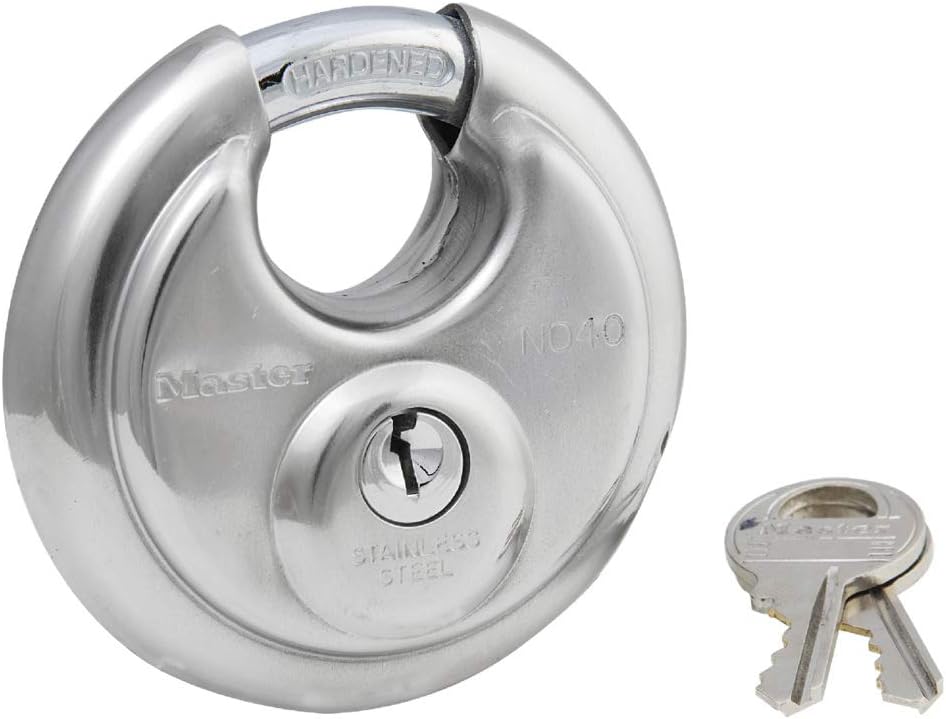
The lock body is 2-3/4 inches (70mm) wide and made from stainless steel for corrosion resistance in outdoor settings. The shackle is hardened steel at 3/8 inch diameter and 5/8 inch length, offering resistance to sawing and cutting attempts.
- 4-pin cylinder resists common picking techniques
- Dual locking lever mechanism adds resistance to prying and hammering
- Shrouded shackle design limits exposure to bolt cutter jaws
The fully shrouded body trades some shackle clearance for extra cut resistance, so it suits hasps and rings sized to fit a discus-style lock rather than very thick chain links.
Overall lock dimensions are 0.2 x 6 x 3.4 inches in packaging, with a shackle width of 3/4 inch (19mm). Buyers should measure their hasp's backset, cross bore and material thickness before ordering, since the shrouded design limits how much shackle is exposed for larger fittings.
- 3/8 inch shackle diameter suits garage doors, sheds and trailers
- Shrouded body reduces the shackle length available for thick hasps
- Includes 1 padlock and 2 keys in the package
This lock is best matched to hasps and rings designed for a compact discus padlock rather than oversized chain or gate applications.
Master Lock positions this padlock for storage use — garages, sheds, trailers and outdoor storage boxes — where both indoor and outdoor exposure are expected. The stainless steel body is built to resist corrosion better than a standard laminated steel padlock left outside.
- Suited to fixed storage points rather than daily-use door locks
- Stainless construction holds up to repeated outdoor weather exposure
- Backed by a Limited Lifetime Warranty from Master Lock
For high-security applications like commercial gates or chain-link fencing, a heavier-duty padlock with a thicker shackle diameter would offer more clearance and cut resistance.

Pros
- 4-digit combination offers 10,000 possible codes, more combination options than a basic 3-digit travel lock
- Red pop-up indicator shows if TSA agents have opened and inspected the lock during screening
- Zinc alloy body construction, backed by an unconditional lifetime guarantee against breakage
- Cable design fits a range of items beyond suitcases, including backpacks, gym lockers, and gun cases
- Sold as a 2-pack, enough to secure both a checked bag and a carry-on in one purchase
Cons
- Cable-style shackle is thinner than a rigid metal shackle padlock, offering less resistance to bolt cutters
- The key system only opens with the matching official TSA key, a lost personal combination still requires TSA access to override
- Compact 1.2 x 0.6 x 3.4 inch size limits use to zippers and cable loops, not heavier chain-style securing
These locks use the TSA008 key system, the current Travel Sentry standard, allowing TSA agents to open the lock with an official round key during screening without cutting it off.
- 4-digit combination with 10,000 possible code combinations
- Red indicator pops up if the lock was opened during inspection
- Reset the combination yourself after any TSA inspection
Because the TSA008 key is standardized across approved locks, security agents at airports worldwide can access the lock without cutting the cable, while the personal 4-digit combination still keeps it closed to anyone without that key.
The lock body is built from zinc alloy, a denser and more corrosion-resistant material than the plastic bodies found on some low-cost cable locks.
- Cable-style shackle for flexible looping through zippers and straps
- Compact size of 1.2 x 0.6 x 3.4 inches per lock
- Backed by an unconditional guarantee against breakage
Because the shackle is a flexible cable rather than a rigid steel loop, it resists casual tampering well but offers less cut resistance than a hardened-steel padlock shackle, a tradeoff for the added flexibility around irregular straps and handles.
Beyond standard checked luggage, the cable design fits a range of items that need a compact, combination-based lock rather than a bulkier padlock, especially where a rigid shackle would not thread through fabric loops or narrow zipper pulls.
- Suitcases, duffel bags, and backpacks
- Gym lockers and gun cases
- Zippered carry-ons and travel totes
Because the 2-pack includes two separate locks, one can stay on checked luggage while the other secures a gym locker or carry-on, each set to its own 4-digit combination for independent use.
These picks span several categories, so the right choice depends on what you are actually locking. In the sections below we explain how each type works and who it is best for.
Understanding the Main Types of Locks
Before comparing specific models, it helps to know the broad families of locks. Each is engineered for a particular job, and buying the wrong category is the most common mistake shoppers make.
Padlocks
Padlocks are the classic portable lock: a body, a shackle, and either a key or a combination. They are ideal for gates, sheds, toolboxes, storage units, fences and gym lockers. Keyed models like the Puroma Keyed Padlock are simple and inexpensive, making them great for low-stakes everyday use where you just want to keep casual hands out. If you prefer a rugged, weather-ready option, the Master Lock Aluminum Padlock pairs a lightweight body with a protective vinyl cover that stands up to outdoor conditions.
For higher-security applications, a shrouded or discus-style padlock is worth the extra money. The Master Lock Discus Padlock uses a stainless steel body and a concealed shackle that is far harder to attack with bolt cutters, which makes it a smart pick for storage lockers, trailers and outdoor gates where cut resistance matters. If you want a deeper comparison of shackle styles and body materials, our roundup of the best padlocks for outdoor and heavy-duty use goes into more detail.
Combination Locks
Combination locks trade keys for a numeric code, which means you never get locked out because you lost a key. They are the standard for school and gym lockers, shared storage and situations where multiple people need access. The obvious trade-off is that you must remember the code, and cheaper dial models can be slower to open than a key.
Resettable combination locks are especially convenient because you can change the code whenever access needs change. If a keyless approach appeals to you, browse our guide to the best combination locks for lockers and storage to weigh dial versus push-button designs.
Luggage and Travel Locks
Travel locks are a specialized subset built for suitcases, backpacks and duffel bags. In the United States, the key feature to look for is TSA approval, which lets security screeners open and relock your bag with a master tool instead of cutting your lock off. Nearly every good travel lock also uses a flexible cable shackle so it threads easily through zipper pulls.
The TSA Cable Luggage Locks offer a resettable combination and an alloy body that resists everyday knocks, while the SURE LOCK TSA Locks add an open-alert indicator that flips red if a screener has opened your bag. For a four-digit code with more possible combinations, the Forge TSA Luggage Locks deliver open-alert peace of mind in a compact zinc-alloy package. Frequent flyers often buy these in pairs so every checked bag stays secured.
Door Reinforcement Locks
Door reinforcement locks are a different animal entirely. Rather than replacing your deadbolt, they add a secondary barrier that braces an inward-swinging door against forced entry. They are popular with renters, travelers staying in hotels, parents childproofing rooms and anyone who wants extra privacy without changing existing hardware.
The Door Reinforcement Lock is rated to withstand hundreds of pounds of force and installs on the door frame to block unauthorized entry. For homes that want coverage on more than one door, a two-pack version of the same style lets you reinforce front and interior doors at once. These are a smart complement to a quality deadbolt rather than a replacement, so if you are also upgrading your main entry, see our picks for the best door locks for home entry security.
Key Lock Boxes
A key lock box is not there to secure a door directly. Instead it safely stores a spare key behind a combination, so family members, guests, dog walkers or contractors can let themselves in without you handing out copies. The Master Lock Key Lock Box uses a resettable four-digit code inside a weather-resistant metal shell and holds several keys, making it a favorite for rental hosts and busy households alike.
How to Choose the Best Lock for Your Needs
With the categories clear, the next step is matching a lock to your specific situation. Keep these factors in mind before you buy.
1. Define What You Are Securing
Start with the object and the threat. A gym locker only needs to deter a casual opportunist, so an inexpensive padlock or combination lock is plenty. An outdoor gate or storage unit faces weather and bolt cutters, which calls for a hardened, shrouded body. A suitcase needs a TSA-friendly travel lock. Matching the lock to the actual risk saves you money and frustration.
2. Key vs. Combination
Keyed locks are fast and simple but leave you vulnerable to lost keys. Combination locks free you from keys but require you to memorize a code and can be slower to open. Many buyers keep a mix: keyed padlocks for spots they access often and combination locks for shared or occasional-use areas.
3. Build Quality and Materials
Look at the body and shackle material. Solid brass and stainless steel resist corrosion and cutting far better than cheap zinc. Boron or hardened steel shackles dramatically improve cut resistance. For anything left outdoors, a weather-resistant cover or sealed keyway helps prevent rust and freezing.
4. Security Level vs. Convenience
There is always a trade-off between how secure a lock is and how easy it is to use. A high-security discus padlock is tough to defeat but heavier and pricier. A slim travel lock is featherweight and convenient but only meant to deter casual tampering. Decide where your situation lands on that spectrum before spending more than you need.
5. Quantity and Consistency
If you are securing several lockers, gates or bags, buying a multi-pack keyed alike, meaning one key opens every lock, saves a lot of hassle. For travel, matched pairs mean the same combination on every bag. Consistency reduces the chance you fumble at a critical moment.
Tips for Getting the Most From Your Locks
Even the best locks perform better with a little care and smart habits. A few simple practices go a long way:
- Set a unique code. Never leave combination locks on the factory default, and avoid obvious numbers like 0000 or 1234.
- Lubricate periodically. A shot of graphite or dry lubricant in the keyway keeps pins and dials moving smoothly, especially on outdoor locks.
- Keep spare keys secure. Store backups in a labeled, safe spot, or use a key lock box so you are never truly locked out.
- Layer your security. Combine tools. A reinforcement lock plus a quality deadbolt, or a padlock plus a hasp, is far stronger than any single device.
- Inspect regularly. Check shackles and bodies for rust, wear or signs of tampering, and replace any lock that no longer operates cleanly.
Frequently Asked Questions
Are combination locks as secure as keyed locks?
For everyday use they are comparable. The bigger factor is build quality and shackle strength, not whether it uses a key or a dial. A well-made combination lock beats a flimsy keyed one, and vice versa.
What makes a luggage lock TSA approved?
TSA-approved locks include a special keyway that screeners can open with a universal master tool, then relock. This lets airport security inspect your bag without cutting the lock, so your lock survives the trip.
Do door reinforcement locks replace a deadbolt?
No. They are a secondary barrier that adds force resistance and privacy on inward-swinging doors. Use them alongside a solid deadbolt for the best protection, not instead of one.
Can I keep a spare key outside safely?
Yes, if you use a proper key lock box with a resettable code rather than hiding a key under a mat. A weather-resistant box mounted in a discreet spot is the safest option for spare-key access.
Final Thoughts
The best locks are the ones matched precisely to what you are protecting. A quick padlock secures a gym locker, a TSA travel lock guards your suitcase, a reinforcement lock hardens a rental door, and a key lock box keeps spare keys handy without risk. Rather than hunting for one perfect lock, most people are better served by a small collection that covers travel, storage and home entry.
Use the top picks above as a starting point, weigh key versus combination, and prioritize build quality for anything exposed to weather or serious threats. Whether you need a simple padlock, a keyless combination lock, or extra home reinforcement, there is a proven, well-reviewed option ready to keep your belongings safe in 2026.