 Ryan Delgado
 Best Light Switch Timers: A Complete Buying Guide
Finding the best light switch timers can transform how your home runs, cutting energy bills, boosting security, and adding everyday convenience without any smart-home headaches. Whether you want your porch lights to glow at dusk, your bathroom fan to shut off automatically, or your closet bulb to never be left on again, a good timer switch quietly handles the job for you. This guide walks you through the different types of light switch timers, the features that matter most, and how to match the right model to each room in your house.
Instead of reviewing each product one by one, we focus on helping you understand what to look for so you can shop with confidence. Below is a curated list of top-rated timer switches to consider as you read through the guide.

Pros
- 4 programmable on/off buttons plus 2 manual override buttons for changing plans without reprogramming the schedule
- Battery backup keeps programmed times saved through a power outage
- Rated for 120VAC, 15A general/resistive load and up to 1200W of tungsten lighting
- Compatible with LED, CFL, incandescent, halogen and select dimmable LED/CFL bulbs
- Blue LED indicators next to each button show at a glance which program is active
Cons
- Requires a neutral wire at the switch box, so it will not install in older 2-wire-only wall boxes without adding one
- Wall plate is not included, so a separate cover plate needs to be purchased to match your decor
- Screw-terminal wiring takes more time to install than a plug-in outdoor timer, and is best handled by someone comfortable working at a breaker panel
The timer offers 4 programmable on/off time slots along with 2 manual override buttons for turning the connected light or fan on or off outside the set schedule, all on a repeating 24-hour daily cycle.
- 4 programmable on/off buttons for scheduled times
- 2 manual override buttons for immediate control
- Blue LED indicators show which program is currently active
Because the schedule repeats every 24 hours without needing to be reset, it is built for a routine that stays the same day to day, such as porch lighting or an exhaust fan, rather than a schedule that changes daily.
This timer installs in place of an existing wall switch and requires a neutral wire at the box, connected using screw terminals rather than flying leads, which saves space compared with older in-wall timer designs.
- Neutral wire required at the switch box
- Screw-terminal connections for a more compact fit in standard boxes
- Wall plate not included and must be purchased separately
Because it replaces a standard switch and ties into house wiring, installation should be done with the breaker off, and anyone unsure about identifying a neutral wire should confirm compatibility before purchase or bring in an electrician.
Electrical specifications cover 120VAC 60Hz at 15A for general/resistive loads, 1200W for tungsten lighting, 1200VA for ballast loads, and up to 1/2 HP for connected motors such as exhaust fans, and the unit is UL Listed.
- Compatible with LED, CFL, incandescent and halogen bulbs
- Also works with select dimmable LED and dimmable CFL bulbs
- Battery backup preserves programmed settings through a power outage
Because the load specifications are specific to bulb and motor type, checking the connected fixture's wattage and bulb type against these limits beforehand avoids overloading the switch on a high-draw fixture.

Pros
- Green Flex Sleeve wires to ground when no neutral wire is present, or connects to neutral if available
- Shallow design fits inside standard wallboxes without extra depth
- Interchangeable line and load wires reduce the chance of miswiring during a DIY install
- Handles 600W LED/CFL, 1800W incandescent/halogen, or 1/2 HP/9.8A fan and motor loads
- Faceplate color can be changed later using separate DTKIT faceplates
Cons
- Preset countdown times are fixed at 2, 4, 8, and 12 hours, with no custom interval in between
- A ground wire is required for installation, so older wiring without a ground path won't support it
- Single pole switch only, not built for 3-way circuits controlling a light from two locations
Installation uses Leviton's Green Flex Sleeve, which wires directly to ground when no neutral wire is present in the wallbox, or can have the sleeve removed to connect to a neutral wire where one exists. A shallow design lets the switch fit into standard wallboxes without the depth issues some timer switches run into.
- Green Flex Sleeve for no-neutral or neutral wiring
- Shallow profile fits standard wallboxes
- Interchangeable line and load wires
A ground wire is required for the install regardless of neutral wiring, so homes without a grounded circuit at the switch location cannot use this timer as-is.
Four preset buttons cover 2, 4, 8, and 12-hour countdowns, along with a manual off button for ending a cycle early. Pressing a preset starts the countdown immediately, and the switch turns the connected load off automatically once time expires, without needing to remember to switch it off manually.
- Presets: 2, 4, 8, and 12 hours
- Manual off button for early cancellation
- Automatic shutoff at the end of each countdown
Because the presets are fixed rather than freely adjustable, tasks needing an odd interval, like 6 hours, require rounding up or down to the nearest available preset.
The switch is rated for 600W of LED/CFL, 1800W of incandescent or halogen, 1200VA of magnetic or electronic low-voltage and fluorescent loads, and 1/2 HP/9.8A for fans and motors, at 15A resistive overall. That range covers most single-fixture lighting circuits as well as bathroom exhaust fans and similar small motor loads.
- 600W LED/CFL, 1800W incandescent/halogen
- 1200VA MLV/ELV/fluorescent
- 1/2 HP / 9.8A fan or motor load
Checking the connected fixture's wattage or motor draw against these limits beforehand avoids overloading the switch on a large lighting bank or a higher-draw exhaust fan.

Pros
- Works without a neutral wire via the Green Flex Sleeve, wiring to ground instead when needed
- Four preset countdown times (5, 10, 15, 30 minutes) plus a manual off button
- Rated for 15A resistive loads and up to 1/2 HP / 9.8A fan or motor loads
- Two interchangeable black wires reduce the chance of miswiring line and load
- Faceplate color can change independently using separately sold DTKIT faceplates
Cons
- A ground wire is required for installation even though a neutral is not, so wallboxes without any ground wire cannot use this switch
- Not intended as the sole light source for a room, per the manufacturer's own installation guidance
- Preset times are fixed at 5, 10, 15, and 30 minutes, with no custom time entry between those steps
The Green Flex Sleeve is the key feature here: it wires to ground when no neutral wire is present in the wallbox, or it can be removed to connect to a neutral wire if one is available. A ground wire is required either way, and two interchangeable black wires cut down on line-versus-load wiring mistakes during install.
- Green Flex Sleeve wires to ground when no neutral is present
- Ground wire required for installation
- Shallow, single-pole design fits standard wallboxes
The slim profile is built to fit in wallboxes that are already crowded with other wiring, which is common in older bathrooms being retrofitted with a timer switch instead of a standard toggle.
Four preset buttons cover 5, 10, 15, and 30-minute countdowns, each starting the timer on press and shutting the load off automatically once time expires, with a separate manual off button for early shutoff. This fixed-preset design keeps operation simple compared to a fully programmable timer switch with a screen and menu.
- Preset times: 5, 10, 15, and 30 minutes
- Manual off button for early shutoff
- No screen or app, all control is on the switch itself
Because the presets are fixed rather than freely adjustable, anyone needing a specific duration outside those four steps will round up or down to the nearest available preset.
Load capacities cover 600W LED/CFL, 1800W Incandescent/Halogen, 1200VA Magnetic or Electronic Low Voltage/Fluorescent, and up to 1/2 HP or 9.8A for fans and motors, at a 15A resistive capacity overall. That range covers bathroom exhaust fans, heat lamps, and towel warmers, which are the manufacturer's listed use cases.
- Up to 1/2 HP / 9.8A for fan or motor loads
- 15A resistive, 600W LED/CFL, 1800W Incandescent/Halogen capacity
- Compatible with Decora and Decora Plus Screwless wallplates
The manufacturer specifically notes this switch should not control the only light source in a room, since the countdown will shut that light off automatically once the preset time runs out.
Pros
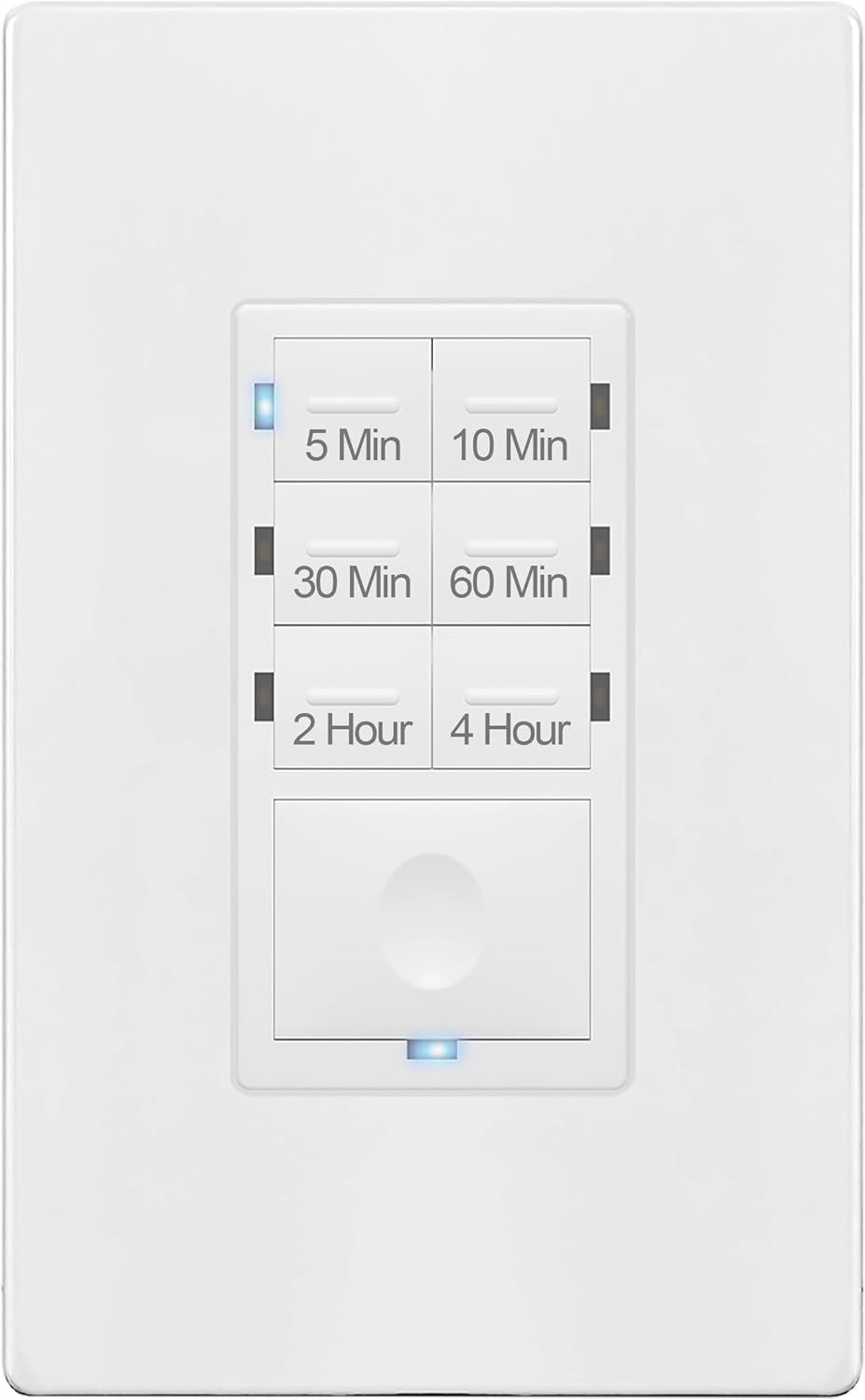
- 6 preset countdown options from 5 minutes to 4 hours, plus a manual on/off button
- UL listed and rated for 120VAC 60Hz operation with a stated 3-year warranty
- Handles incandescent loads up to 1000W, fluorescent up to 1200VA, or motor loads up to 1/2HP
- Blue LED flash confirms a successful timer setting before it counts down silently
- Screwless wall plate is included, so no separate plate purchase is needed
Cons
- Requires a neutral wire in the wall box, so older homes without one cannot install it without rewiring
- Operating range is limited to 32°F–131°F (0°C–55°C), so unconditioned spaces outside that range are not rated for it
- Single white finish only, with no color or decora-style variant listed
This switch requires a neutral wire present in the wall box, which is standard on newer construction but often missing on older single-pole switch runs. It's built to replace a standard single-pole light or fan switch, and ships with a screwless wall plate for a finished look without buying a separate cover.
- Neutral wire required for installation
- Replaces a standard single-pole switch
- Screwless wall plate included
Because the neutral wire requirement is non-negotiable, checking the wall box before ordering avoids a return or an electrician visit to add the missing wire.
Six countdown presets cover 5, 10, 30 and 60 minutes, plus 2-hour and 4-hour options, selected with a button press rather than a dial. A manual on/off button is also available for standard, non-timed operation. Two indicator modes confirm the setting: a double blue flash on success, then the LED stays lit for the full countdown before shutting off.
- Presets: 5 min, 10 min, 30 min, 60 min, 2 hr, 4 hr
- Manual on/off mode available alongside the timer
- LED indicator confirms active countdown status
All connected loads shut off automatically once the selected time expires, with no override needed to end the cycle early beyond pressing the button again.
The switch is UL listed and rated for 120VAC at 60Hz, handling incandescent loads up to 1000W, fluorescent loads up to 1200VA, or motor loads up to 1/2HP, which covers most bathroom exhaust fans, ceiling fans and light fixtures. It's rated for operation between 32°F and 131°F with humidity up to 95% non-condensing.
- Incandescent: up to 1000W
- Fluorescent: up to 1200VA
- Motor loads: up to 1/2HP
The stated 3-year warranty covers the switch itself, though the load limits mean it is not intended for higher-draw motors or industrial-grade fans beyond 1/2HP.

Pros
- Handles up to 1800W or 3/4 HP at 120V, enough for ceiling fans, pond pumps, and pool pumps as well as lighting circuits
- Stores up to 7 on/off schedules per week, repeatable daily or weekly from a 3-button interface
- Compatible with LED, CFL, incandescent, halogen, and fluorescent lighting, so it works across older and newer bulb types
- Programs are retained through power outages, so a blackout will not wipe the weekly schedule
- Rated for indoor and outdoor installation, covering porch and yard fixtures as well as interior rooms
Cons
- Requires a neutral wire in the electrical box; homes without one cannot use this switch
- One switch controls a single circuit, so multi-device schedules across a home need one unit per switch location
- 3-button programming interface is more involved to set up than a smartphone app-based smart switch
The ECONOswitch is rated for 1800W or up to 3/4 HP at 120V, enough to run motor-operated devices like ceiling fans, bathroom fans, pond pumps, and pool pumps in addition to standard lighting circuits. It works across LED, CFL, incandescent, halogen, and fluorescent bulb types, so mixed fixtures on one circuit stay compatible.
- Rated load: 1800W, 3/4 HP at 120V
- Works with LED, CFL, incandescent, halogen, and fluorescent lighting
- One switch controls one circuit per home installation
Because it is rated for a single circuit rather than whole-home control, larger properties with several independently timed fixtures will need one ECONOswitch per switch location rather than one unit managing everything centrally.
Installation replaces an existing wall switch and requires cutting power at the circuit breaker first. The switch needs a neutral wire present in the electrical box; homes wired without one, common in some older construction, are not compatible with this model.
- Requires a neutral wire (white wires joined together) in the box
- Rated for indoor and outdoor installation
- Sleek wall-mount design fits flush with standard wall plates
Once wired in, the backlit screen stays readable at night, which helps when reprogramming schedules in a dim hallway or an outdoor fixture location after dark.
Up to 7 on-and-off schedules can be programmed per week through a 3-button interface, and each schedule can repeat daily or weekly depending on the routine. The switch also adjusts automatically for daylight saving time changes, so schedules stay accurate without manual resets twice a year.
- Up to 7 programmable on/off schedules per week
- Automatic daylight saving time adjustment
- Programs are retained through power outages
A manual override mode is also available for one-off control outside the programmed schedule, useful for nights when the usual lighting routine needs to change without reprogramming the whole week.

Pros
- - Experience automatic astronomic On/Off control, providing the
- SETUP WITH LARGE LCD - ASCEND's intuitive setup and large backlit
- MODERN SLEEK DESIGN - Enhance your home's aesthetics with ASCEND's
- DST WITH BATTERY BACKUP - Enjoy automatic Daylight Saving Time
- Dimensions of 1.33"D x 1.75"W x 2.75"H engineered for optimal spatial fitting
Cons
- Requires verifying placement clearance for 1.33"D x 1.75"W x 2.75"H prior to installation
- Requires gentle maintenance routines to preserve the Plastic, Steel finish
The Intermatic Intermatic ST700W Ascend 7-Day in-Wall Programmable Timer provides dependable operation suited for contemporary indoor Timer Switches configurations. Technical integration focuses on functional efficiency, incorporating - Experience automatic astronomic On/Off control, providing the most accurate lighting schedule with dusk and dawn times for enhanced energy efficiency.. Its balanced engineering incorporates SETUP WITH LARGE LCD - ASCEND's intuitive setup and large backlit LCD screen make programming up to 42 unique events effortless, empowering homeowners to automate lighting schedules easily. to streamline day-to-day interactions. Measurements of 1.33"D x 1.75"W x 2.75"H provide clear dimensional boundaries for precise space planning.
Evaluating build quality and structural execution reveals strong manufacturing standards across components. The physical build incorporates MODERN SLEEK DESIGN - Enhance your home's aesthetics with ASCEND's modern and sleek design, suitable for various lighting applications, including porches, hallways, patios, and more., providing essential protection against surface wear. High tolerance assembly prevents unexpected mechanical looseness during daily operation. Constructed using quality Plastic, Steel, outer surfaces withstand routine contact without losing visual appeal. Using proper installation techniques maintains physical stability across daily activities. This balanced configuration fits smoothly into existing interior designs while maximizing efficiency. Quality craftsmanship supports long term satisfaction for residential and professional settings.
Long-term operational satisfaction is supported by adhering to standard installation and cleaning practices. Thanks to DST WITH BATTERY BACKUP - Enjoy automatic Daylight Saving Time (DST) adjustment and non-replaceable battery backup, ensuring time and date information retention during power loss for uninterrupted functionality., spatial alignment and initial setup progress smoothly for homeowners. Simple preventative care maintains mechanical responsiveness and aesthetic value over extended use. Using proper installation techniques maintains physical stability across daily activities. This balanced configuration fits smoothly into existing interior designs while maximizing efficiency. Quality craftsmanship supports long term satisfaction for residential and professional settings.

Pros
- Countdown timer adjusts from 5 to 60 minutes in six preset steps (5, 10, 15, 30, 45, 60), set with a rocker panel on the side
- Rated to control a 3 Amp high-efficiency exhaust fan, and compatible with up to 150W of LED lighting or 600W of incandescent/halogen load
- Double-tap switches to always-on mode, bypassing the countdown when continuous lighting or ventilation is needed
- Softly lit LED indicators show remaining time at a glance without needing to check a display
- Installs in about 15 minutes into a standard wall box, though a neutral wire is required for the switch to function
Cons
- Requires a neutral wire at the switch box, so older homes wired without one need an electrician before this switch can be installed
- Multi-location control needs a separate Maestro accessory switch (MA-AS), sold separately, added to the wiring
- Coordinating Claro wallplate is sold separately, so the switch ships without a finished cover plate
The countdown timer runs from 5 minutes up to 60 minutes across six fixed presets: 5, 10, 15, 30, 45, and 60 minutes. A single tap on the large tap switch starts the countdown at whichever preset the rocker panel is set to, while a double tap switches the load to always-on, bypassing the timer entirely.
- Six countdown presets: 5 / 10 / 15 / 30 / 45 / 60 minutes
- Single tap starts the countdown; double tap holds the load on continuously
- Rocker panel on the side sets which preset is active
- Softly lit LEDs indicate the time remaining before shutoff
That range covers both quick uses, like a bathroom exhaust fan, and longer uses, like lighting in a closet or garage while carrying items back and forth.
This switch is rated to control a 3 Amp high-efficiency exhaust fan, which covers most DC and high-efficiency bathroom fans on the market, and it also handles lighting loads up to 150W of LED bulbs or 600W of incandescent, halogen, magnetic, or electronic low-voltage lighting.
- Controls up to a 3A high-efficiency exhaust fan
- Up to 150W LED lighting load
- Up to 600W incandescent, halogen, magnetic, or electronic low-voltage lighting load
For a bathroom setup, Lutron suggests pairing this timer with a Maestro motion sensor (MS-OPS2, sold separately) so the timer runs the exhaust fan while the sensor independently handles the lighting, rather than tying both to the same switch.
Installation is designed to take about 15 minutes and works in both single-pole setups and multi-location setups, though multi-location control requires pairing with a separate Maestro accessory switch (MA-AS), sold separately. A neutral wire is required at the switch box for the timer to operate.
- Single-pole installation out of the box; multi-location needs an MA-AS accessory switch
- Neutral wire required at the switch location
- Fits a standard wall box at 1.5 x 2.2 x 4 inches
- Coordinating Claro wallplate sold separately for a finished look
Because the neutral wire requirement rules out some older two-wire switch loops, checking the existing wiring at the box before ordering avoids a return trip to the hardware store mid-installation.

Pros
- Four preset countdown intervals: 60, 40, 20, and 10 minutes with visual time indication
- Built from high-impact thermoplastic for long-term blade retention and durability
- Narrow back body design leaves more room for wiring inside the electrical box
- Accepts #12-#14 AWG solid wire via side screw terminals or #14 AWG via push wire terminals
Cons
- Requires a neutral wire, so it will not work in older two-wire switch boxes without one
- Countdown-only operation with no full programmable scheduling across days or times
- Wall plate is sold separately and must be purchased to match the Radiant collection finish
This is a preset countdown timer switch rather than a full seven-day programmable timer. Four buttons trigger fixed delays of 60, 40, 20, or 10 minutes, and a visual indicator shows the remaining countdown at a glance before the connected load switches off automatically.
- Four fixed countdown presets: 60 / 40 / 20 / 10 minutes
- Visual time indication while counting down
- Automatically turns off the load when the countdown ends
- Suited to lights, fans, and small motors left running unattended
Because the intervals are fixed rather than custom, it works best for routine tasks like bathroom fans or exterior lights that always need roughly the same amount of run time.
The switch measures 0.31 x 5 x 5 inches and uses a screwless, narrow-body design from the Legrand Radiant collection, which leaves extra clearance for wiring inside standard electrical boxes. It requires a neutral wire at the switch location, which is common in newer construction but not always present in older homes.
- Side wire terminal screws accept #12-#14 AWG solid wire
- Push wire terminals accept #14 AWG solid copper wire only
- Narrow back body frees up space for wiring in the box
- Neutral wire required for operation
Wall plates from the Radiant collection are sold separately, so plan to buy a matching plate to complete the screwless finished look.
This timer switch suits homeowners who want a simple way to limit how long a fan, light, or motor stays running without remembering to switch it off manually. It's a practical fit for bathroom exhaust fans, garage lights, or heat lamps where a fixed run time covers most situations.
- Bathrooms and other rooms with fans or heat lamps that shouldn't run indefinitely
- Homes already wired with a neutral conductor at the switch box
- Anyone standardizing on the Legrand Radiant collection's screwless look
It's less suited to households wanting full scheduling by day and time, or to older homes without a neutral wire already run to the switch location.

Pros
- 60-minute mechanical timer needs no electricity of its own to keep time, just a twist of the dial
- CSA certified, with a resistive load capacity up to 20A at 125VAC and 10A at 250/277VAC
- Fits standard single or multi-gang wall boxes and works behind both toggle and decorator-style plates without modification
- Compatible with LED and CFL bulbs as well as fans, motors and heaters, not limited to incandescent loads
Cons
- Manual dial only, no digital programming or repeat-schedule memory, so it needs resetting by hand every time
- Maximum run time is fixed at 60 minutes, so anything needing a longer single cycle needs a different timer
- Wall plate is sold separately, so the listing doesn't include a finished cover for the switch box
This is a spring-wound mechanical timer: turning the dial winds a spring that counts down toward zero, powering off whatever's connected once the 60-minute window ends, without drawing any electricity of its own to track time. That mechanical design means there's no battery to replace and no clock to reset after a power outage.
- Spring-wound mechanism, no standby electricity used
- Maximum single cycle of 60 minutes
- Single pole, single throw switch design
Because there's no digital memory, the dial has to be turned again by hand each time a new countdown is needed.
The timer is built to replace a standard wall switch, fitting single or multi-gang boxes without any field modification needed for the switch plate style. An up-front terminal connection with teeter-type terminals, along with a press-on knob design, is meant to speed up wiring and final assembly during installation.
- Fits standard single or multi-gang wall switch boxes
- Compatible with toggle or decorator-style switch plates
- Up-front terminal connections for easier wiring
The wall plate itself is sold separately, so a cover plate needs to be sourced to finish the installation.
The timer is CSA certified and rated for a resistive (heater) load of 20A at 125VAC or 10A at 250/277VAC, a tungsten load of 7A at 125VAC, and motor loads up to 1 HP at 125VAC or 2 HP at 250VAC, across 50/60 Hz systems. It's engineered to work with modern LED and CFL bulbs as well as older incandescent and tungsten loads.
- CSA certified for resistive, tungsten and motor loads
- Compatible with LED, CFL and incandescent lighting
- Rated for fans, lighting fixtures, electric motors and heating devices
Because it's a single pole, single throw device, it's built for controlling one circuit at a time rather than switching multiple loads independently.

Pros
- 9 preset timer options span 5 minutes to 4 hours, covering both short bathroom-fan runs and long security-light cycles
- Illuminated button and a red LED program indicator stay visible for operating the switch in a dark room
- Rated for 15A and 1/2 HP capacity, enough headroom for heavier loads like bathroom heaters or exhaust fans
- ETL listed and UL certified (E211835) for tested electrical safety compliance
- Backed by a limited lifetime warranty and sold as a 2-pack for two switch locations
Cons
- A neutral wire is required for installation, so older homes without one at the switch box cannot use it as-is
- No smartphone app or smart home integration, this is a manual preset switch only
- Only single-gang cover plates are included, so multi-gang boxes need separately purchased plates
This switch offers 9 preset timer options covering 5, 10, 15, 20, and 30 minutes plus 1, 2, and 4 hours, alongside a straightforward off setting. An illuminated button and a red LED program indicator make it easy to see and operate the switch even in a dark bathroom.
- 9 preset options from 5 minutes to 4 hours
- Illuminated blue button for visibility in low light
- Red LED indicator stays lit while a timer is actively running
- Manual off setting available alongside the timed presets
Because settings are preset rather than freely adjustable, users pick from the fixed list of durations instead of dialing in a custom time.
Installation requires a neutral wire at the switch box, which is standard in most homes built or rewired in recent decades but can be missing in older construction. The switch is designed to replace a standard single-gang wall switch and includes one single-gang cover plate.
- Neutral wire required at the switch box for installation
- Ground wire connection included for added protection
- Fits standard single or multiple gang boxes and brackets
- One single-gang cover plate included per switch
Homes without a neutral wire present at the switch location will need an electrician to run one before this timer switch can be installed safely.
The switch is rated for 15A and up to 1/2 HP, enough capacity for bathroom exhaust fans, space heaters, or security and night lighting that need to run on a schedule rather than staying on continuously.
- 15A and 1/2 HP load capacity
- Suited to bathroom fans, heaters, and night or security lighting
- ETL listed and UL certified under E211835
- Backed by a limited lifetime warranty
Devices drawing more than the rated 15A or 1/2 HP capacity, such as larger appliances, fall outside what this switch is built to handle safely.
Why Install a Light Switch Timer?
A light switch timer replaces your standard wall switch and controls power to lights, fans, or small appliances on a schedule you set. The payoff is bigger than it first appears. Timers reduce wasted electricity by ensuring lights are never left burning overnight, and they extend bulb life by limiting run time. For safety, automated lighting makes an empty house look occupied, which is one of the simplest deterrents against break-ins.
There are practical comfort gains too. A bathroom exhaust fan that runs for a set number of minutes and then shuts itself off clears humidity without you thinking about it. Outdoor lights that follow sunrise and sunset keep your entry safe and welcoming year round. Once you experience that hands-off reliability, going back to a plain switch feels like a step backward.
Types of Light Switch Timers
Understanding the main categories is the fastest way to narrow your choices. Each type solves a different problem, so the best light switch timers for your needs depend on how you plan to use them.
Countdown Timer Switches
Countdown timers are the go-to choice for spaces where you want a light or fan to run for a fixed stretch and then turn off automatically. You press a button, the timer counts down, and the circuit shuts off when it reaches zero. These are ideal for bathrooms, closets, garages, laundry rooms, and heat lamps.
Options like the Leviton Countdown Timer with 2-4-8-12 hour presets suit longer-running loads such as fans and heaters, while the shorter-interval Leviton Countdown Timer offering 5-10-15-30 minute settings is a natural fit for quick bathroom ventilation. For a budget-friendly pick with a night-light indicator, the ENERLITES Countdown Timer covers a 5-minute-to-4-hour range. The Fosmon Countdown Timer ships as a two-pack with nine settings, which is handy if you need timers in more than one room.
7-Day Programmable Timers
If you want lights to follow a repeating weekly routine, a 7-day programmable timer is the answer. These let you set different schedules for different days, so weekday and weekend lighting can differ automatically. Many models include astronomic or solar tracking that adjusts on and off times as daylight shifts through the seasons.
The Honeywell ECONOswitch offers 7-day solar programming for indoor and outdoor lights and motors, and the Intermatic Ascend adds automatic daylight-saving adjustment with flexible 42-event scheduling. These are excellent for porch lights, security lighting, and holiday displays.
In-Wall Digital Timers
Digital in-wall timers combine a small screen with programmable on and off cycles, giving you precise control and a clean look. They typically hold multiple daily events so a single light can turn on and off several times a day. The myTouchSmart In-Wall Timer is a popular example, offering programmable buttons, 24-hour daily cycles, and battery backup so your settings survive a power outage.
Spring-Wound Mechanical Timers
Sometimes the simplest solution is best. A spring-wound mechanical timer is a dial you twist to set a run time, and it winds down like a kitchen timer with no electronics involved. There is nothing to program and nothing to reset after an outage. The Intermatic Spring Wound Timer gives you a straightforward 60-minute control that is perfect for exhaust fans, heat lamps, and any load you want to cap without wiring in a neutral.
Decorative and Multi-Location Timers
Style and flexibility also factor into the decision. The Legrand Radiant Timer pairs a modern rocker design with a locator light and preset minute intervals, making it a clean fit for visible living spaces. For rooms with more than one entrance, the Lutron Maestro Timer supports single-pole and multi-location setups so you can control the same fan or light from several switches.
Key Features to Compare
Once you know the type you want, weigh these features to find the best light switch timers for your specific situation.
- Neutral wire requirement: Some timers need a neutral wire in the box and others do not. Older homes often lack a neutral, so a no-neutral model like the Leviton countdown switches can save you a rewiring project.
- Load type and rating: Check whether the switch is rated for LED bulbs, incandescent lights, fans, or motors, and confirm the wattage and amperage match your load. Fan and motor loads in particular need a timer designed to handle them.
- Time range and presets: Match the available intervals to your task. Short 5-to-30-minute presets suit bathroom fans, while multi-hour ranges fit heaters and outdoor lighting.
- Single-pole vs multi-location: If a light is controlled from two or more switches, you need a multi-location capable timer.
- Battery backup: A backup battery preserves your programming through power outages so you do not have to reset the schedule.
- Indicators and night lights: LED locators help you find the switch in the dark and confirm at a glance whether the timer is active.
- Certification: Look for UL or ETL listing to ensure the device meets recognized safety standards.
How to Choose the Right Timer for Each Room
Thinking room by room makes the decision easier. Here is a quick way to match timer types to common spaces.
Bathrooms
Humidity control is the priority here. A short-interval countdown switch lets the exhaust fan run long enough to clear moisture, then shuts off on its own. Models with 5-to-30-minute presets are ideal, and a no-neutral option simplifies installation in older bathrooms.
Outdoor and Entry Lighting
For porches, walkways, and security lights, a 7-day programmable or astronomic timer shines because it tracks sunset and sunrise automatically. This keeps your exterior lit when it should be without constant adjustment as seasons change.
Closets, Garages, and Utility Areas
These are the rooms where lights get left on the longest. A simple countdown or spring-wound timer caps run time so a forgotten closet light turns itself off after a set period. Reliability and ease of use matter more than fancy scheduling.
Living Spaces and Hallways
Here appearance counts. A decorative digital timer or a multi-location model keeps things looking tidy while still delivering automation, and a locator light makes the switch easy to find at night.
Installation Tips and Safety
Most timer switches install like a standard wall switch, but a few precautions protect you and your equipment. Always turn off power at the breaker before removing the old switch, and use a voltage tester to confirm the wires are dead. Note whether your model requires a neutral wire before you buy, since discovering a missing neutral mid-installation is a frustrating surprise.
Match wire connections carefully to the manufacturer diagram, especially with three-way or multi-location wiring. If your box is crowded or the wiring looks unfamiliar, hiring a licensed electrician is a small cost for peace of mind. After installation, test the timer through a full cycle to confirm it powers your load on and off as expected.
Getting the Most From Your Timer
To squeeze the greatest value from a timer switch, review your schedules seasonally. Daylight hours shift throughout the year, so outdoor lighting programs benefit from occasional tweaks unless your model adjusts automatically. Pair timers with efficient LED bulbs to compound the energy savings, and use short countdown windows on fans to avoid over-ventilating and losing heated or cooled air.
For security, vary your lighting patterns slightly rather than using the exact same on and off times every night. Programmable models make this easy and help maintain the impression that someone is always home.
It also helps to keep a written record of how each timer is programmed, especially if you have several throughout the house. A quick note taped inside a nearby cabinet or saved on your phone means you can restore settings fast after an outage or when someone accidentally changes them. Small habits like this keep your automation running smoothly for years and ensure you continue to get the full energy and convenience benefits your timers were installed to deliver.
Final Thoughts
The best light switch timers are the ones that quietly match your routine, cut waste, and make your home safer with zero daily effort. Start by identifying the job you need done, whether that is clearing bathroom humidity, automating outdoor lights, or simply making sure the garage bulb never stays on overnight. From there, choose the timer type and features that fit, confirm the neutral and load requirements, and install with care.
Any of the timer switches highlighted in this guide can be a smart addition to your home. Compare the options above, weigh the features that matter most to you, and pick the model that turns everyday lighting into a set-it-and-forget-it convenience.