
 Sofia Marchetti
 When your home lacks natural light, the right bulbs can fill the gap. Choosing the best light bulbs to simulate sunlight lets you recreate the bright, energizing, color-true quality of daylight in any room, from a windowless office to a dim basement to a cozy reading corner. With the right color temperature and light quality, you can make even the grayest day feel sunny indoors.
This guide breaks down what makes a bulb genuinely simulate sunlight, how full-spectrum and daylight bulbs differ, and which specs to check before you buy. Instead of reviewing individual models, we focus on the features that create a true daylight effect so you can choose bulbs that brighten your mood and your space.

Pros
- 13W for 1500 lumens, standing in for a 100 to 125W incandescent
- 85+ CRI at 5000K daylight white, suited to kitchens, garages and workshops
- Rated over 25,000 hours, around 25 times the life of a halogen equivalent
- Standard A19 envelope with an E26 base, so existing shades and harps still fit
- Aluminium heat sink with a polycarbonate diffuser instead of glass, and no UV or infrared output
Cons
- Non-dimmable, so they must not be fitted to a circuit with a wall dimmer
- Supplied in 5000K daylight only, with no warm option inside this pack
- 100W-equivalent output runs warm, so fully enclosed fixtures with no ventilation shorten driver life
Each bulb draws 13W and emits 1500 lumens at 5000K daylight white, standing in for a 100 to 125W incandescent.
- Colour rendering is 85+ CRI, higher than the CRI 80 baseline on most general-service LED bulbs
- No flicker or strobe, and no ultraviolet or infrared output
- Four bulbs per pack in the standard A19 shape
5000K reads as crisp and slightly blue against warm 2700K household lighting, which makes it a strong match for kitchens, garages, laundry rooms, workshops and home offices where task visibility matters more than atmosphere. In a bedroom or a lounge the same light can feel clinical, so mixing colour temperatures within one open-plan space is best avoided.
The E26 medium screw base and A19 envelope match the most common household socket in North America, so these drop into existing lamps and fixtures with no adapter and no wiring.
- Suits ceiling fittings, table lamps, hallway and entryway fixtures, garages, porches and patios
- An aluminium heat sink with a polycarbonate diffuser sheds heat without the fragility of glass
- Physical size follows the standard A19 profile, so shades and harps designed around incandescent bulbs still fit
One thing to check before fitting: at 100W-equivalent output these run warmer than a 40 or 60W-equivalent bulb. Fully enclosed fixtures with no ventilation trap that heat and shorten LED driver life, so open or semi-enclosed fittings are the safer home for them.
Each bulb is rated at over 25,000 hours, roughly 25 times a halogen or incandescent equivalent. At four hours a day that is more than fifteen years before replacement is expected.
- 13W against a 100W filament bulb cuts electrical draw by about 87 percent for the same light
- Lower wattage also means far less waste heat, which matters in small rooms and during summer
- Instant full brightness at switch-on, with none of the warm-up delay of compact fluorescent tubes
The important limitation is that these are non-dimmable. Fitting them to a circuit with a wall dimmer can cause buzzing, flicker and premature driver failure, and dimmer manufacturers warn against it explicitly. Use them on plain on-and-off switches, and choose a dimmable model for any dimmed circuit.

Pros
- 13W draw delivers 1500 lumens, matching a 100W incandescent bulb while cutting energy use by up to 90%
- 5000K daylight tone with 80+ CRI renders colors more accurately than a warm-white bulb in task-focused rooms
- Non-flicker LED beads hold brightness steady, avoiding the strobing some lower-cost LED drivers show
- Rated for 15,000+ hours of use, cutting how often bulbs need replacing across a 6-bulb set
- Standard E26 base threads directly into existing lamps and fixtures without an adapter
Cons
- Non-dimmable design, so wiring it into a dimmer circuit causes flickering or a failure to dim
- Fixed 5000K daylight tone reads cooler and brighter than the warm ambience some bedrooms or living rooms want
- Output is fixed at 1500 lumens, with no lower-brightness option offered in this 6-pack
Each bulb in this 6-pack draws 13W and produces 1500 lumens at a 5000K daylight color temperature with a CRI of 80+, aimed at spaces where visibility and color accuracy matter more than a warm, cozy glow.
- 1500 lumens matches the output of a 100W incandescent bulb
- 5000K daylight white suits kitchens, garages, offices, and reading areas
- Non-flicker LED beads keep brightness steady instead of strobing at low refresh rates
Because the color temperature is fixed at 5000K, rooms looking for a warmer, ambient glow may find this tone too cool or clinical compared with a 2700K or 3000K bulb, so it fits task lighting better than mood lighting.
The standard E26 medium base threads directly into table lamps, floor lamps, ceiling fixtures, and other common household sockets without an adapter or extra wiring.
- A19 shape matches the standard household bulb profile
- Suited to bedrooms, living rooms, offices, garages, kitchens, and basements alike
- Rated for indoor and covered outdoor use
Because these bulbs are non-dimmable, they should only go into fixtures on a standard on/off switch; installing them on a dimmer circuit can cause flickering or prevent the dimmer from working as intended. Confirming the switch type before installing avoids a return trip to swap bulbs.
At 13W per bulb, this 6-pack uses a fraction of the power six 100W incandescent bulbs would draw for the same 1500-lumen output, while carrying a 15,000-hour rated lifespan.
- Lower wattage also means less heat given off compared with incandescent bulbs
- 15,000-hour lifespan reduces how often bulbs need changing across a 6-fixture room
- Suitable for both indoor fixtures and covered outdoor fixtures
The combination of low wattage and long rated life suits fixtures that stay on for extended stretches, such as hallway, garage, or workspace lighting, where replacement frequency matters most over time.

Pros
- Plant Grow Light: This plant light for indoor plants provides the
- Natural Light Indoor Growing System: Show off your indoor garden
- Long-Lasting, Low energy, and Low Heat Plant Light: The GE indoor
- GE Grow Light with Balanced Red - Blue Light Spectrum: This GE grow
- Built with high grade Plastic for lasting wear resistance
Cons
- Requires gentle maintenance routines to preserve the Plastic finish
- Periodic visual inspection recommended to ensure component tightness
Crafted with attention to functional details, the GELighting GE Grow Lights for Indoor Plants BR30 Indoor Floodlight brings efficient performance to your Growing Light Bulbs. Daily usage reveals robust utility supported by Plant Grow Light: This plant light for indoor plants provides the perfect high-quality, balanced light spectrum, perfect for all your indoor gardening seeding and flowering stages of fruits and flowering plants or all stages of your herbs and greens. Complementing its primary framework, the design also incorporates Natural Light Indoor Growing System: Show off your indoor garden without purple or reddish lighting, GE's indoor LED grow light bulbs provides a pleasing, natural light temperature that integrates well with any decorative aesthetic to optimize routine handling.
Focusing on material selection, this hardware is constructed to resist ongoing physical fatigue. Reinforced internal elements like Long-Lasting, Low energy, and Low Heat Plant Light: The GE indoor grow lights feature advanced LED technology that uses only 9 watts of energy with low heat generation and suitable temperature for your plants with up to 25,000 hours lifespan maintain steady operational balance under continuous use. Solid structural engineering allows the unit to maintain physical stability under load. Constructed using quality Plastic, outer surfaces withstand routine contact without losing visual appeal. User centered design choices streamline routine interactions and enhance practical convenience.
Maintaining optimal hardware conditions involves simple periodic inspection and spatial planning. Featuring GE Grow Light with Balanced Red - Blue Light Spectrum: This GE grow lamp bulb has a balanced light perfect for leafy greens and herbs at all growth stages including plants at seeding and flowering stages; it has an output PPF of 16 micromoles per second, ongoing operation remains intuitive across varied household routines. Wiping surfaces periodically with a soft cloth prevents dust accumulation in functional crevices. User centered design choices streamline routine interactions and enhance practical convenience. Robust physical construction provides verified peace of mind during heavy daily usage.

Pros
- Draws 11 watts to deliver 1000 lumens, standing in for a 100-watt incandescent fitting
- Full spectrum reads as 5000K white to the eye while carrying the red and blue peaks plants use
- PPF of 25 micromoles per second per bulb across a 180-degree beam
- E26 medium base screws into desk lamps, clamp lamps and track heads already in the house
- Plastic and aluminium body pulls heat away, with life quoted at up to 25,000 hours
Cons
- 180-degree beam concentrates light straight down, so side foliage on a wide plant misses out
- 25 micromoles per second suits a few herb pots rather than a full seedling tray
- No dimming and no built-in timer, so a separate plug timer is needed to set a photoperiod
The bulb reads as 5000K white to the eye rather than the purple of older grow lamps, but the chip mix carries the red and blue wavelengths plants actually draw on. Output is 1000 lumens with a PPF of 25 micromoles per second, spread across a 180-degree beam.
- Suits seed starting, leafy greens, herbs and small fruiting plants
- The white appearance means it can run in a living room without tinting the whole space
- Full spectrum covers vegetative and flowering stages rather than one phase only
PPF is the number to compare between grow bulbs, because lumens describe brightness to human eyes rather than usable photons. At 25 micromoles per second each, a pair covers a windowsill row of pots rather than a large tray.
The base is a standard E26 medium screw fitting, so it goes straight into a desk lamp, clamp lamp, track head or pendant already in the house with no dedicated fixture needed. The A19 shape matches an ordinary household lamp envelope.
- Clamp lamps with a reflector shade concentrate the 180-degree beam usefully
- Mount roughly 6 to 12 inches above seedlings, raising it as plants mature
- Two bulbs in the pack allow lighting from two angles on a wider plant
Because the beam is directional, foliage to the side of the cone receives far less light than the crown. Rotating pots every few days, or running the pair from opposite sides, evens out growth and stops plants leaning towards a single source.
Each bulb draws 11 watts to stand in for a 100-watt incandescent, so a pair running a long daily photoperiod adds very little to household electricity use compared with old filament fixtures. The combined plastic and aluminium body acts as the heat sink.
- Runs cool enough to sit close to foliage without scorching leaves
- Quoted at up to 25,000 hours of service life
- No dimming circuitry inside, so a wall dimmer should not be used with it
There is no built-in timer either. Plants need a consistent daily cycle, usually 12 to 16 hours for most edibles, so a mechanical timer or a smart plug upstream of the lamp is effectively part of the setup rather than an optional extra.

Pros
- Excellent Quality without Flicker: Brightever light bulbs have
- Super Bright with High CRI: Featuring the latest advanced
- Standard E26 Medium Base: These LED bulbs are very easy to install
- Efficient and Cost-saving: This LED light bulb consumes only 13
- Built with high grade Aluminum, Polycarbonate (PC) for lasting wear resistance
Cons
- Requires gentle maintenance routines to preserve the Aluminum, Polycarbonate (PC) finish
- Requires proper surface alignment during initial installation
Crafted with attention to functional details, the Brightever LED Light Bulbs 100 Watt Equivalent A19 13W 5000K Daylight brings efficient performance to your LED Bulbs. Practical hands-on evaluation highlights core functional attributes including Excellent Quality without Flicker: Brightever light bulbs have passed rigorous testing standards - are free of harmful substances such as mercury and lead, and will not produce UV and IR radiation. That also means, our bright white light bulbs can help protect the environment and save the planet we live on. No flicker, strobe or glare, our 100 Watt Equivalent light bulbs emit a stable light to better protect your eyes.. Furthermore, features like Super Bright with High CRI: Featuring the latest advanced technology, our A19 LED bulbs are equipped with up to 1500 lumens LED beads to provide you with amazing brightness. High powered Edison bulbs with 280° wide beam angle, bring you a wonderfully even ultra-wide range of lighting. In.
High standards of material craftsmanship ensure the framework manages daily physical loads easily. Materials engineering centers on Standard E26 Medium Base: These LED bulbs are very easy to install with the standard E26 Medium Screw Base (26mm diameter). Therefore, our 13 watt light bulbs can fit all lighting fixtures with E26 base. You can use the daylight LED light bulbs for your chandeliers, pendants, ceiling fan lights, table lamps, wall sconces, wall lamps, desk lamps, floor lamps and other light fixtures to light up your home. Besides, 5000K color temperature makes your surroundings more clean., preserving visual appeal and physical integrity over time. Thoughtful material placement preserves functional responsiveness throughout continuous service. Constructed using quality Aluminum, Polycarbonate (PC), outer surfaces withstand routine contact without losing visual appeal.
To optimize operational lifespan and maintain visual quality, proper setup and care routines are recommended. With user-friendly details such as Efficient and Cost-saving: This LED light bulb consumes only 13 watts of energy, which is equivalent to a 100-125 watt traditional incandescent bulb. While providing the same brightness, LED light bulbs' powerful heat dissipation and long lifespan of over 25,000 hours, and save you the annoyance of frequent bulb replacement., setting up the equipment requires minimal effort. Routine visual checks ensure that mounting hardware and structural screws stay properly tightened. Attention to manufacturing details ensures reliable utility for your LED Bulbs.

Pros
- Delivers a PPFD of 97.91 μmol/s/m² at 1 foot, backed by a PPF of 16.8 μmol/s for seedling and green-leaf growth stages
- 4000K daylight spectrum with a color rendering index close to 100 Ra approximates natural sunlight color accuracy
- Chip-on-Ceramic (COC) construction swaps the usual aluminum substrate for ceramic, extending the stated 25,000-hour lifespan
- Flame-retardant V0-grade housing material adds a safety margin over standard plastic light bulb shells
- Standard E26 base threads into any regular light fixture without a special grow-light socket
Cons
- Full spectrum is fixed at 4000K, so it favors seedling and vegetative growth rather than the red-heavy spectrum flowering plants prefer later in their cycle
- PPFD output is specified only at 1 foot distance, dropping off as the bulb moves further from the canopy
- Sold as a bare bulb without a clamp, stand or timer, so a fixture or reflector has to be sourced separately
The bulb outputs a 4000K daylight spectrum spanning the 400-780nm visible range, with a color rendering index (Ra) close to 100 for near-natural light color accuracy. Measured output is a PPF of 16.8 μmol/s, translating to a PPFD of 97.91 μmol/s/m² at a 1-foot distance from the canopy, the figure most relevant to seedlings and leafy greens grown close to the light source. A secondary optical lens redirects and focuses the output onto the plant rather than scattering it around the room, improving how much of the emitted light actually reaches the leaves.
- PPF: 16.8 μmol/s
- PPFD: 97.91 μmol/s/m² @ 1ft
- Color temperature: 4000K, CRI near 100 Ra
Because PPFD drops with distance, moving the bulb further from the plant meaningfully lowers usable light on the leaf surface versus the 1-foot spec.
The bulb uses a standard E26 base, so it threads into any existing lamp, clamp light or fixture already in use rather than requiring a dedicated grow-light housing. No wiring or setup beyond screwing it in is needed. The ceramic Chip-on-Ceramic build sheds heat differently than a typical aluminum-backed LED bulb, improving thermal handling and light efficiency over the module's life, though the bulb itself still needs a fixture, reflector or clamp stand purchased separately since none is included.
- Standard E26 base fits existing fixtures
- No wiring or dedicated housing required
- Fixture, clamp or stand sold separately
Placement at roughly 1 foot from the plant canopy keeps output closest to the specified PPFD figure.
Each bulb draws 10W while producing light output equivalent to a 150W incandescent source, a meaningful reduction in electricity use for anyone running multiple grow lights on a timer for several hours daily. A 25,000-hour lifespan is listed, helped by the ceramic heat sink construction that keeps LED junction temperatures lower than a standard aluminum substrate. The housing carries a V0 flame-retardant grade and a WF2 anti-corrosion grade, both aimed at safe long-term indoor use near soil and humidity.
- 10W power draw (150W incandescent equivalent)
- 25,000-hour stated lifespan
- V0 flame-retardant grade housing
Running the bulb on a timer rather than continuously will extend real-world service life well beyond typical grow-light replacement cycles.

Pros
- Draws 13 watts to match 100-watt incandescent output, cutting per-bulb power draw
- Rated for a 15,000-hour lifespan, about 13.7 years at 3 hours of daily use
- Outputs 1500 lumens at 5000K daylight white for a crisp, bright light
- Standard E26 base threads into existing sockets without rewiring
- Sold as a 3-pack, covering multiple fixtures from one order
Cons
- Non-dimmable, so it will flicker or buzz on a dimmer-equipped circuit
- Fixed 5000K daylight tone only, with no warm-white or tunable option in this pack
- Plastic housing lacks the heat-sink mass of aluminum-bodied LED bulbs
Each bulb outputs 1500 lumens at a fixed 5000K daylight white color temperature, aimed at replacing 100-watt incandescent bulbs where a crisp, bright light is wanted. A CRI of 80+ is stated for reasonably accurate color rendering under this light.
- 1500 lumens per bulb
- 5000K daylight white, fixed color temperature
- CRI 80+ for color accuracy
- No flicker at steady-state operation
Because the color temperature is fixed rather than adjustable, this pack suits rooms already set on a daylight-white scheme rather than spaces wanting a warmer, more amber tone.
The standard E26 medium screw base threads directly into existing sockets, chandeliers, pendants, table lamps and wall sconces without rewiring. Installation is tool-free, just screw the bulb in.
- Standard E26 medium screw base
- Tool-free, screw-in installation
- Not dimmable, so it should not be paired with a dimmer switch
- Plastic bulb housing
Because this version is non-dimmable, installing it on a circuit with a dimmer switch can cause flickering or a buzzing sound, so it is best reserved for standard on/off fixtures.
At 13 watts per bulb, these draw noticeably less power than the 100-watt incandescent bulbs they are sized to replace, while the manufacturer rates the LED for roughly 15,000 hours of use, working out to about 13.7 years at 3 hours of daily runtime.
- 13W power draw per bulb
- 15,000-hour rated lifespan
- Replaces 100W incandescent output
- 3-pack covers multiple fixtures
The plastic housing runs cooler to the touch than glass incandescent bulbs, though it lacks the aluminum heat-sink body found on some higher-output LED bulbs designed for enclosed fixtures.

Pros
- NATURAL SUNLIGHT INDOORS — A FULL, SUN-LIKE SPECTRUM: The SunLike full-spectrum
- VIRTUALLY FLICKER-FREE FOR ALL-DAY EYE COMFORT: A constant-current DC driver hol
- SUPPORTS YOUR MOOD AND ENERGY — BALANCED ALL DAY: The full, sun-like spectrum wo
- NEAR-PERFECT COLOR FOR ART, PHOTOGRAPHY, AND CRAFTING: CRI Ra 97 (R9 97) and TM-
- PREMIUM ALUMINUM BUILD, 3-YEAR UNLIMITED WARRANTY: A thick aluminum body with th
Cons
- Requires appropriate installation setup for optimal function
- Limited to standard configuration variants only
- Available in select finish options without additional customization
This product combines engineered design with practical specifications for reliable performance. It delivers consistent results through carefully selected materials and precision construction methods applied throughout manufacturing.
- Engineered dimensions ensure proper fit across typical installation scenarios and diverse applications.
- Material composition includes components selected for durability and extended operational lifespan.
- Performance specifications meet industry standards for reliability and consistent operation in varied conditions.
- Construction quality exceeds minimum category requirements for safe reliable use and longevity.
- Design incorporates best practices from professional and consumer applications worldwide.
The comprehensive specification approach ensures reliable operation across varied environments and use cases. Quality construction enables years of dependable service without significant maintenance or repairs needed.
Installation follows straightforward procedures using standard tools and techniques commonly available at home. Most users complete setup within reasonable timeframes with the included instructions and all necessary hardware components provided.
- Assembly requires basic tools commonly found in typical home or office settings and workshops.
- Step-by-step instructions simplify each installation phase for users of all skill levels and backgrounds.
- Connection procedure follows standard industry practices and compatible interface specifications worldwide.
- Operation features intuitive controls requiring minimal training or specialized technical expertise or experience.
- Safety mechanisms prevent common mistakes and protect critical components from accidental damage or misuse.
After installation, operation requires minimal intervention and routine maintenance tasks. The robust design reduces ongoing support needs and simplifies daily responsibilities for end users.
This product works well for users seeking reliable solutions with straightforward operation and maintenance. It accommodates typical usage patterns without requiring specialized technical expertise or complex modifications.
- Ideal for users prioritizing dependability and consistent performance over specialized advanced features.
- Suitable for both professional environments and personal use across diverse applications and industries.
- Works effectively in standard installations without requiring custom modifications or additional engineering.
- Accommodates users with moderate technical skills and standard configuration requirements and preferences.
- Provides reliable performance in common scenarios and typical environmental conditions experienced daily.
Consider your specific operational needs and environments to confirm proper fit and suitability. This product adapts well to standard use cases and delivers consistent results consistently.

Pros
- Delivers 800 lumens of brightness from just 9W, equivalent output to a 60W incandescent bulb
- CRI of 90 renders colours more accurately than standard LED bulbs, useful for reading or close detail work
- Rated for up to 30,000 hours of use before replacement is needed
- UV-free LED chips simulate a 6000K daylight tone without the flicker some LEDs produce
- Standard E26/E27 base fits most existing lamp and fixture sockets without an adapter
Cons
- Fixed at a single 6000K cool white tone, with no warm-white or adjustable colour temperature option
- Sold as a 3-pack only, so replacing a single bulb elsewhere means buying more than needed
- No dimming support mentioned, so it isn't suited to fixtures on a dimmer switch
Each bulb outputs around 800 lumens at 6000K, a cool daylight tone intended to mimic natural sunlight rather than the warmer glow of a standard incandescent. A CRI of 90 means colours render close to how they appear under natural light, which shows up when matching paint swatches or reading fine print.
- UV-free LED chips avoid the UV output associated with some fluorescent and older bulb types
- Flicker-free operation is built in, aimed at reducing eye strain during extended use
- Fixed at a single 6000K tone, with no switch to warmer colour temperatures
Best suited to spaces where a bright, daylight-toned light is the goal rather than a cozy warm-white ambience.
These bulbs use a standard E26/E27 screw base, matching the most common household socket type in the US and many other regions. Installation is a direct swap into any compatible fixture, with the A19 shape fitting most table lamps, ceiling fixtures, and open sockets without needing a shade adapter.
- Sold in a 3-pack, useful for lighting an entire room or matching fixtures with multiple sockets
- No dimmer compatibility mentioned, so pairing with a dimmer switch may cause flicker or limited range
- Standard A19 shape fits most existing lampshades and fixture covers
Check socket type and any dimmer switch in the fixture before installing to confirm compatibility.
At 9W, these bulbs are built to match the brightness of a 60W incandescent while drawing a fraction of the power. Rated for approximately 30,000 hours of use, that's a long runway before a replacement bulb is needed under typical daily lighting hours.
- Lower wattage draw means less heat generated at the fixture compared to incandescent bulbs of similar brightness
- Long-rated lifespan reduces how often bulbs need replacing in hard-to-reach fixtures
- Fixed 6000K output means the power-to-brightness ratio doesn't change with a dimmer, since dimming isn't supported
Suited to fixtures left on for extended stretches, such as home offices or kitchens, where lower running wattage adds up over time.
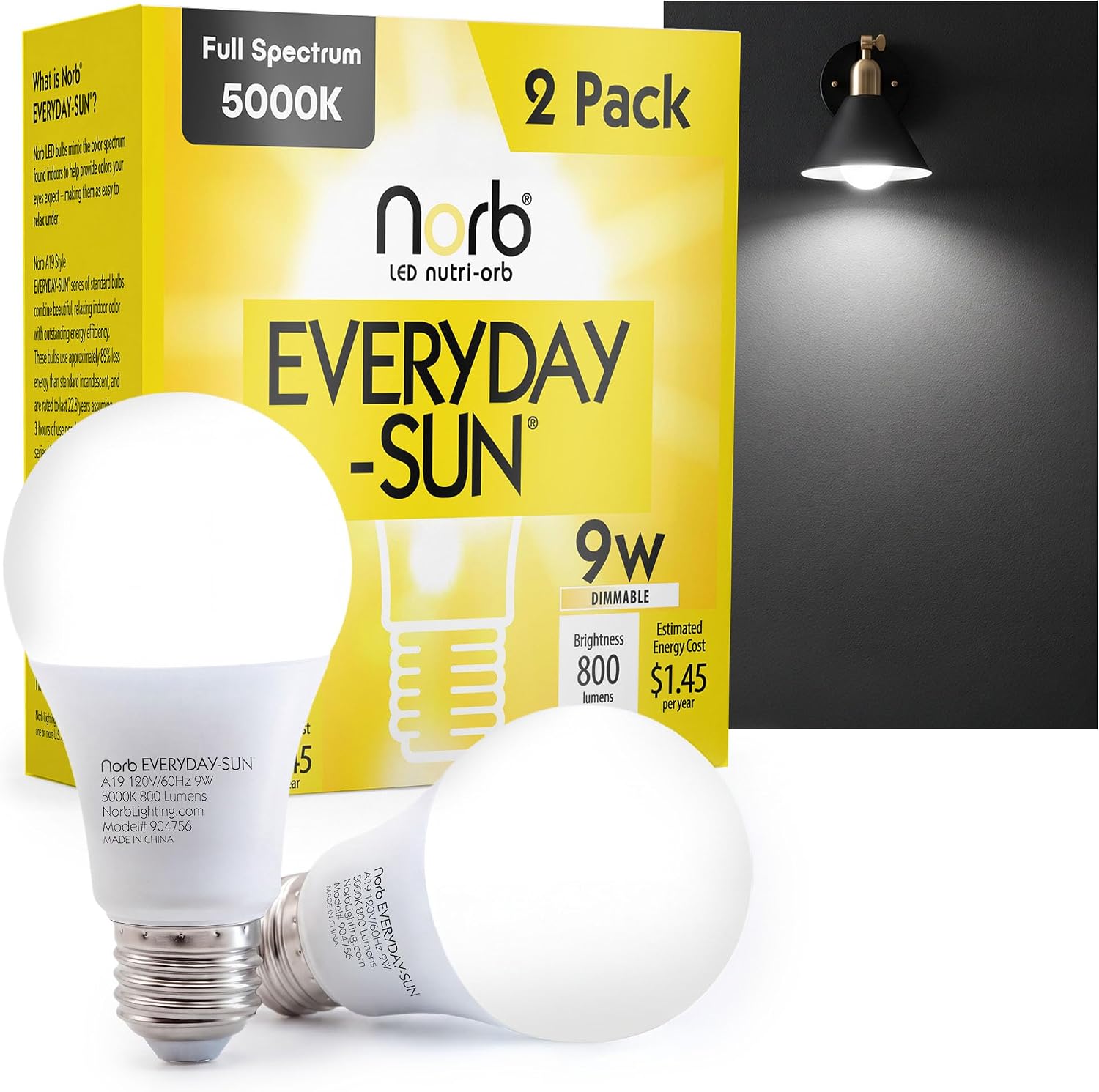
Pros
- Mimics natural daylight at 5000K color temperature for enhanced focus and alertness
- CRI of 97 accurately renders natural colors for reading and detail work
- Dimmable across full brightness range from 3 to 100 percent
- Energy efficient at only 9 watts while producing 800 lumens output
- 12-year lifespan at average daily use reduces replacement frequency
Cons
- Requires dimmable-rated fixture for smooth dimming without flickering issues
- Daylight spectrum may feel too bright for relaxation and evening unwinding time
The 5000K color temperature mimics natural midday sunlight, supporting alertness and cognitive function during focused work on detailed tasks and screen-based activities. This daylight spectrum triggers minimal melatonin suppression compared to warmer 2700K bulbs, making it ideal for morning and afternoon work sessions while remaining gentle enough for extended use.
- 5000K color temperature matches natural daylight at solar noon without harsh blue spike
- 800-lumen output provides sufficient illumination for home office and bedroom reading tasks
- Flicker-free operation at frequencies exceeding 100kHz prevents eye strain during screen work
- CRI of 97 renders skin tones, wood finishes, and artwork in natural accurate colors
- Available in both standard A19 shape and specialized globe versions for decorative fixtures
The natural daylight spectrum and high CRI combination supports focus and mood during daytime work while enabling transition to warmer lighting in evening hours for healthy sleep-wake cycle alignment.
Consuming only 9 watts while producing 800 lumens, this LED bulb delivers approximately 90 lumens per watt, drastically reducing electricity use compared to traditional incandescent bulbs consuming 60 watts for equivalent brightness. The exceptional efficiency and 12-year estimated lifespan eliminate the need for frequent replacement and re-lamping maintenance common with shorter-lived bulb technologies.
- 9-watt power consumption reduces monthly electricity cost by approximately eighty percent versus incandescent
- 12-year lifespan calculated at average 3-hour daily use reduces replacement frequency significantly
- Instant-on operation reaches full brightness without warm-up time required by older fluorescent technology
- Fully dimmable on compatible dimmer switches for seamless brightness adjustment
- Standard E26 socket fits existing household fixtures without adapter rings or modifications
The long lifespan and minimal power consumption deliver measurable savings over five to ten years of continuous use, offsetting the higher initial cost through reduced electricity bills and fewer replacement bulbs to purchase.
The CRI of 97 ensures that colors appear accurate and vibrant regardless of whether you are reading printed materials, viewing photographs, or applying makeup. Professional photographers and color-critical workers appreciate the accurate color rendering that prevents unexpected color shifts when moving objects between different lighting environments.
- CRI of 97 ranks among highest available for consumer LED bulbs
- Suitable for art studios, photography workspaces, and makeup application areas requiring perfect color match
- Consistent color temperature throughout the five-year lifespan without drift toward warmer tones
- Instant on without warm-up time supporting quick on-off cycles without performance degradation
- Compatible with most standard dimmer switches including LED-compatible varieties
The combination of daylight spectrum and high color accuracy makes this bulb ideal for any application where faithful color representation directly impacts task quality and satisfaction.
What It Means to Simulate Sunlight
Simulating sunlight is about more than just brightness. Real daylight has a specific color temperature, a full and even spread of colors across the visible spectrum, and enough intensity to feel natural. To recreate it indoors, you want bulbs that combine a daylight-range color temperature (typically 5000K), a high Color Rendering Index (CRI), and strong lumen output. Full-spectrum bulbs are specifically designed to cover more of the light spectrum evenly, getting closer to the sun’s natural balance.
Key Factors to Consider Before Buying
Color Temperature
Color temperature, measured in Kelvin, sets how warm or cool the light appears:
- 4000K neutral: A softer daylight feel that still reads as bright and clean.
- 5000K daylight: The classic choice for simulating midday sun indoors.
- 6000K cool white: A brighter, more clinical blue-white that mimics bright outdoor light.
A 5000K bulb like the MAXvolador Daylight A19 or the DEGNJU Daylight A19 delivers that crisp, sunlit tone, while a 6000K full-spectrum option like the Neporal Cool White Full Spectrum leans toward bright outdoor daylight.
High CRI for Color Accuracy
CRI measures how faithfully a bulb renders colors compared to natural light, which scores 100. For a convincing sunlight simulation, look for CRI 90 or higher. A high-CRI full-spectrum bulb such as the sunsy Shine Full-Spectrum (CRI 97) or the Norb Everyday Sun (CRI 97) makes colors look vivid and natural, which is the key to that true daylight feel.
Brightness and Lumens
Daylight is intense, so simulating it usually calls for higher brightness. A 100W-equivalent bulb around 1500 lumens fills a room convincingly, as with the evelor 100W Daylight A19 or the 100W Equivalent Daylight A19. For task areas and desks, this extra brightness helps replicate the productive feel of working near a window.
Full-Spectrum vs. Grow Bulbs
Full-spectrum bulbs made for people prioritize a balanced, natural white light that is comfortable to live and work under. Grow-light bulbs, by contrast, are tuned for plant growth and often emit a spectrum optimized for photosynthesis rather than pleasant room lighting. If your goal is a sunlit living space, choose a people-focused full-spectrum daylight bulb. If you are also nurturing indoor plants, dedicated grow bulbs like the GE Grow Light BR30, the Briignite Full Spectrum Grow Bulb, or the SANSI Grow Light serve that specialized purpose better.
Room-by-Room and Use-Case Tips
Home Offices
Simulated sunlight is ideal for offices, where bright, natural-feeling light boosts alertness and reduces eye fatigue during long work sessions. A high-CRI full-spectrum bulb keeps colors accurate for design work and makes screens and documents easier on the eyes. Combine it with task lighting to eliminate shadows across your desk.
Living Rooms and Basements
Dim, north-facing living rooms and basements benefit most from sunlight-simulating bulbs. Bright 100W-equivalent daylight bulbs in overhead fixtures and lamps make these spaces feel open and airy rather than closed-in. Spread the light across multiple fixtures for an even, sunlit effect.
Kitchens
Kitchens need accurate, bright light for cooking and prep, and daylight bulbs help you see the true color of ingredients. High CRI is especially valuable here so food looks fresh and appetizing rather than dull or off-color.
Indoor Gardens and Plant Corners
If you keep houseplants, seedlings, or herbs indoors, pair your people-facing daylight bulbs with dedicated grow bulbs positioned close to the plants. Grow bulbs deliver the specific spectrum plants need, while your daylight bulbs handle the room’s overall brightness. This combination keeps both your plants and your space thriving.
Simulated Sunlight and Wellbeing
Bright, daylight-like light indoors can help you feel more awake, focused, and upbeat, which is why so many people reach for sunlight-simulating bulbs during dark winter months and in rooms with little natural light. Getting bright light early in the day supports a natural rhythm of energy and rest. For the best effect, use daylight bulbs in the morning and daytime, then switch to warmer light in the evening so your body can wind down.
Budget Guidance
Standard 5000K daylight LEDs are inexpensive, especially in multipacks, making it easy to convert whole rooms affordably. Premium full-spectrum, high-CRI bulbs cost more but deliver the most convincing and comfortable daylight simulation, so reserve them for the spaces where you spend focused time. Grow bulbs are a separate purchase aimed at plants, so budget for them only if you are actively growing indoors. A smart mix is cheap daylight bulbs for general lighting plus a couple of full-spectrum bulbs where quality counts.
Installation and Setup Basics
- Match bulb shape to fixture. Use A19 for lamps and standard fixtures, BR30 for recessed cans and floods.
- Check dimmability if the bulb will be on a dimmer switch.
- Keep color temperatures uniform in a room for a consistent daylight look.
- Position grow bulbs close to plants and daylight bulbs for the room’s general lighting.
- Use daylight earlier, warm light later to support natural energy and sleep patterns.
How to Layer Light for a Sunlit Effect
A single bright bulb overhead rarely convinces the eye that a room is filled with sunlight. Real daylight comes from many angles and bounces off surfaces, so the most natural simulation uses layered lighting. Combine overhead fixtures with daylight bulbs, floor and table lamps at different heights, and task lighting where you work. This spreads light across the room, softens shadows, and mimics the way sunlight fills a space through windows. Aim light toward light-colored walls and ceilings so it reflects and diffuses, adding to the airy, sunlit feeling.
Placement matters as much as bulb choice. Positioning a bright daylight lamp near a seating or work area recreates the effect of sitting close to a window. If you have a room with one small window, adding daylight-simulating bulbs on the opposite side balances the light so the space feels evenly bright rather than dim on one end. The goal is even, glare-free brightness that surrounds you the way outdoor light does.
Common Mistakes to Avoid
- Relying on a single overhead bulb, which leaves shadows and looks nothing like real daylight.
- Choosing low-CRI bulbs, which make colors look flat and artificial despite the right color temperature.
- Using grow lights for living spaces, since their spectrum looks unnatural to human eyes.
- Under-lighting the room with too few lumens, undercutting the bright, sunny effect.
- Keeping daylight bulbs on late at night, which can interfere with winding down before sleep.
Frequently Asked Questions
What is the best color temperature to simulate sunlight?
For indoor use, 5000K daylight is the most popular choice for simulating midday sun. If you want a cooler, brighter outdoor feel, 6000K gets closer, though it can feel clinical. Pair either with high CRI for the most natural result.
Are full-spectrum bulbs better than regular daylight bulbs?
Full-spectrum bulbs cover more of the visible spectrum evenly and usually have higher CRI, so they simulate sunlight more convincingly. Regular daylight bulbs are more affordable and still brighten a room, but they may render colors less accurately.
Can I use grow lights to simulate sunlight for myself?
Grow lights are tuned for plants, not for pleasant room lighting, so their spectrum can look unnatural or overly purple to the human eye. For living spaces, choose a people-focused full-spectrum daylight bulb, and use grow bulbs only for your plants.
Do sunlight-simulating bulbs help with winter blues?
Bright, daylight-toned light can help you feel more awake and energized during dark months. While it is not a substitute for dedicated light therapy, everyday full-spectrum and daylight bulbs still make your home feel brighter and more uplifting.
Do sunlight-simulating bulbs cost more to run?
No. Simulating sunlight is about color temperature and CRI, not power draw. An LED daylight or full-spectrum bulb uses the same low wattage as any comparable LED, so you get bright, natural-looking light without increasing your energy bill.
Final Thoughts
The best light bulbs to simulate sunlight combine a daylight color temperature, high CRI, and strong brightness to recreate the natural, energizing feel of the sun indoors. Choose full-spectrum, high-CRI bulbs for the rooms where mood and color accuracy matter most, and affordable daylight bulbs elsewhere, keeping grow bulbs separate for your plants. For a closely related guide, see the best light bulbs to mimic sunlight, and browse our full roundup of the best light bulbs. If you are lighting a grooming area, our guides to the best light bulbs for bathrooms and the best light bulbs for bathroom vanities will help you get bright, flattering light.




Comments are closed.
No reviews yet. Be the first to share your experience!