 Ryan Delgado
 Choosing the best cctv security cameras for your home or business can feel overwhelming when every system promises 4K clarity, AI detection, and 24/7 recording. This guide cuts through the noise and walks you through what actually matters, so you can match a camera system to your property, your budget, and your peace of mind. Instead of ranking one product over another, we focus on the buying decisions that determine whether a setup will serve you well for years.
Whether you want a simple wired kit for your driveway or a multi-channel network that covers a whole warehouse, the fundamentals are the same. Understand your coverage needs, know the specs that count, and pick a reliable brand. Below you will find the current picks worth comparing, followed by a practical framework for choosing.
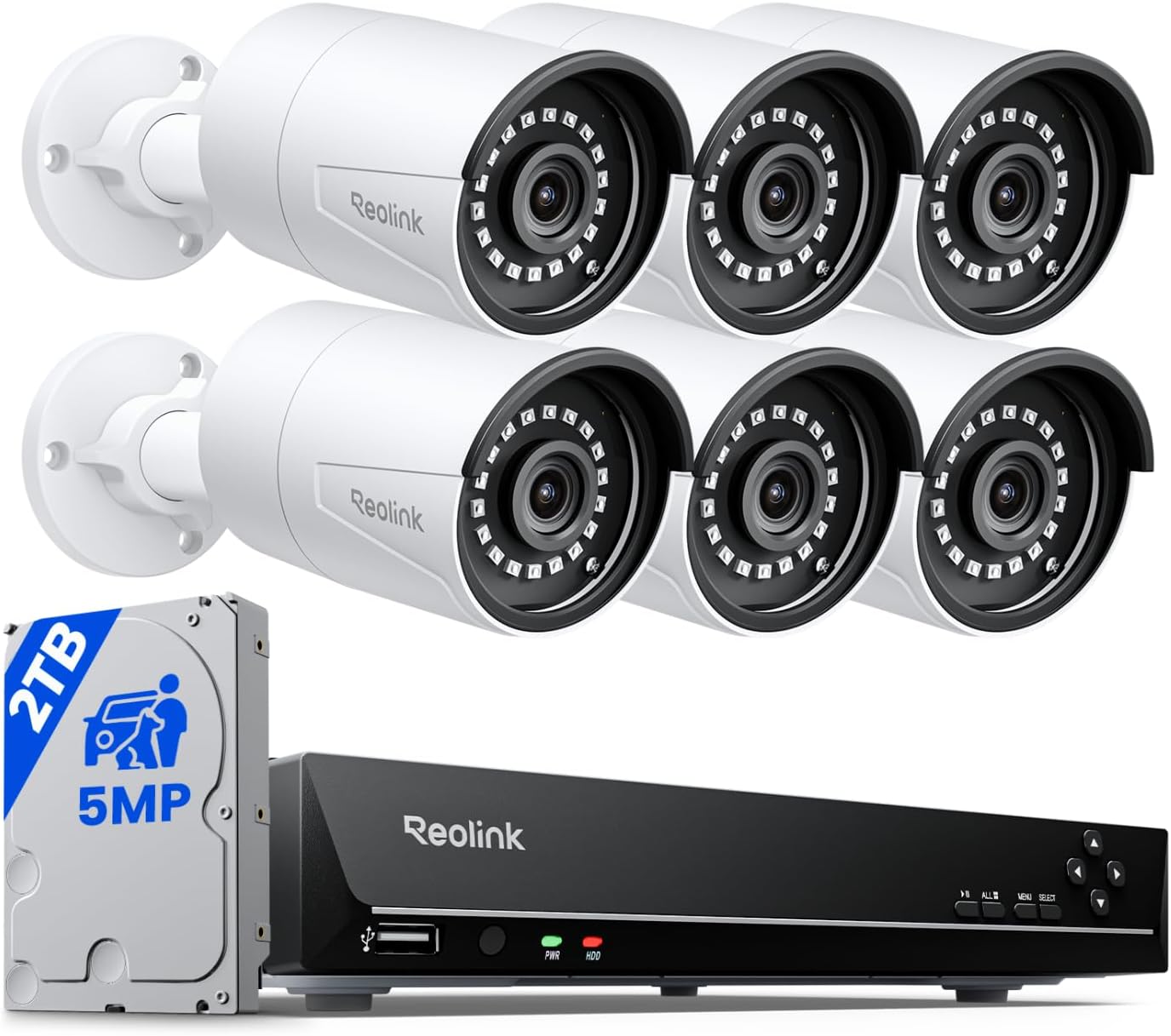
Pros
- 6 cameras record simultaneously with 18 IR LEDs each for night vision up to 100 feet
- AI-based person, vehicle, and pet detection cuts down on false alerts from shadows or small animals
- 2TB HDD ships pre-installed, expandable up to 16TB total across SATA and eSATA
- PoE design runs power and video over a single cable per camera, no separate power adapters needed
- 2-year warranty with lifetime tech support included
Cons
- Cameras only work with the included NVR and other compatible hardware; third-party cameras aren't supported
- Smart Home functions are not available on this NVR-based kit, unlike standalone Wi-Fi camera models
- Remote access via the companion app requires an internet connection; without it, the system only works locally
Each of the 6 cameras connects to the 8-channel NVR over a single PoE (Power over Ethernet) cable, supplying both power and video without a separate power adapter at each camera location. Cameras use a 5MP CMOS sensor with an f=4.0mm fixed lens and 18 infrared LEDs delivering night vision up to 100 feet.
- PoE installation simplifies wiring for DIY setups since only one cable run is needed per camera
- Cameras are wired, not wireless, so cable runs need to be planned to each mounting location
- An IEEE 802.3 af/at PoE-compatible NVR port powers each connected camera
Homes wanting a fixed, wired multi-camera install benefit from not needing outlets near each camera.
The system ships with a 2TB HDD pre-installed for 24/7 continuous recording, with the NVR expandable up to 16TB total across SATA and eSATA connections depending on the hardware version. Video compresses using H.264 for efficient storage use over time.
- 2TB provides a starting buffer before older footage needs to overwrite or be archived
- Expansion beyond the pre-installed drive requires purchasing and installing additional HDDs separately
- Built-in microphones on each camera add ambient audio alongside the video recording
Continuous 24/7 recording across 6 cameras will fill 2TB faster than motion-only recording would.
Onboard AI distinguishes people, vehicles, and pets from other motion, reducing false alerts triggered by shadows or small animals passing by. The system can be configured to send alerts only for specific detection types, and it also works fully offline for local recording.
- Remote viewing and alerts through the companion app require an internet connection; without one, the system still records locally
- Detection alerts can be filtered per camera to reduce notification volume
- Cameras from other brands are not supported on this system, only additional compatible PoE or Wi-Fi cameras
Households wanting fewer nuisance alerts from wildlife or passing shadows benefit from the AI-based filtering.
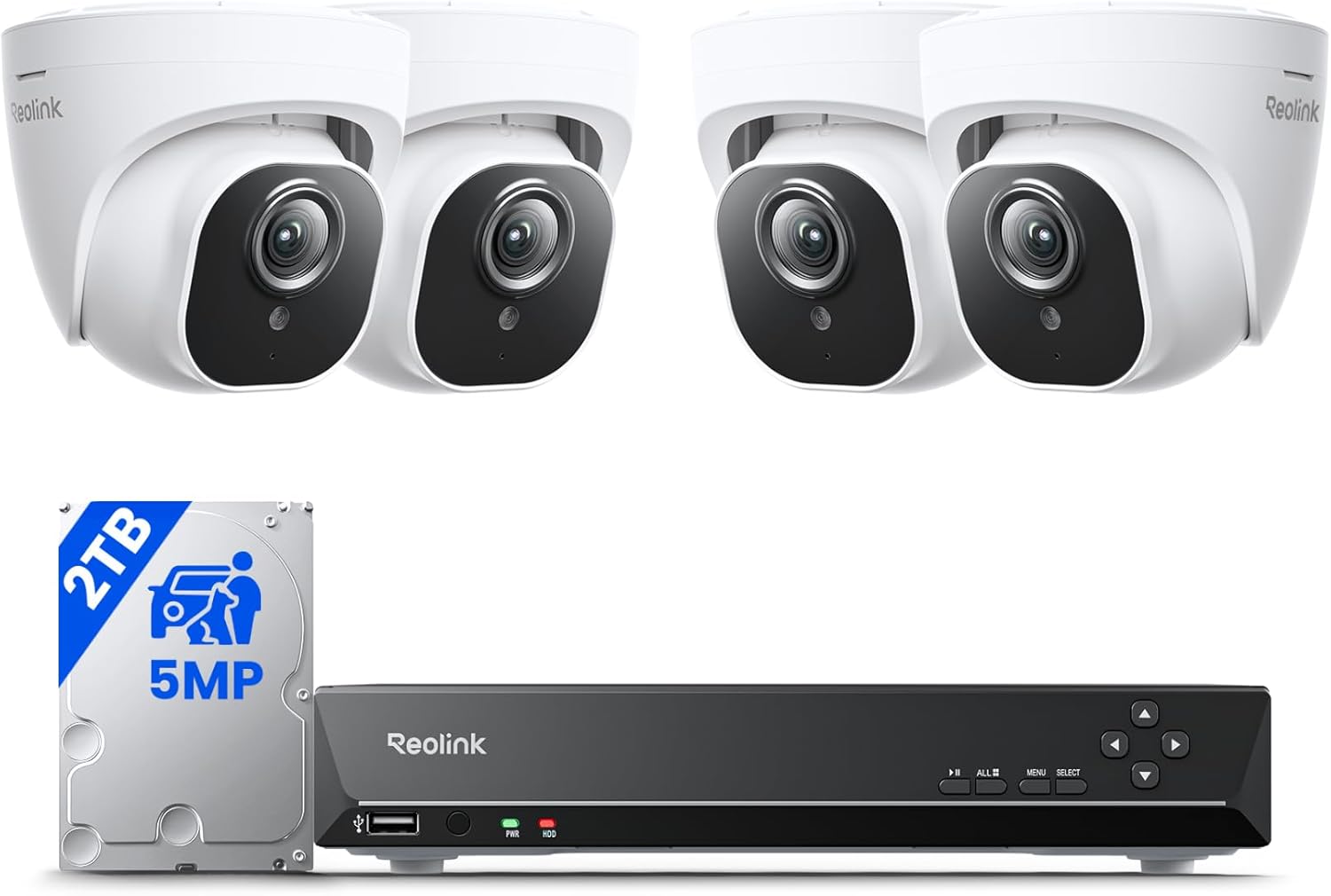
Pros
- Includes 4 wired 5MP PoE cameras plus an 8-channel NVR with a pre-installed 2TB HDD
- Infrared night vision reaches up to 100ft in the dark for outdoor coverage
- Person, animal, and vehicle detection filters out false alerts from bugs or leaves
- Built-in microphones on the cameras capture audio alongside video for fuller context
- NVR's e-SATA port supports adding an external 8TB HDD for extended storage
Cons
- Pre-installed 2TB HDD stores roughly ten days of continuous recording before older footage overwrites, unless expanded
- All four cameras are wired PoE units, so cable runs to each camera location are required — there's no wireless option in this kit
- Smart detection accuracy depends on keeping camera firmware updated to the latest version
This 8-channel kit pairs four 5MP PoE cameras with an NVR built for continuous home or property monitoring.
- 5MP HD resolution across all four included cameras
- Infrared night vision effective up to 100ft in darkness
- Smart detection separates people, animals, and vehicles from irrelevant motion like bugs or leaves
- Built-in microphones record audio alongside video footage
General motion detection remains available as a fallback alongside the smart classification. Because detection accuracy depends partly on firmware, keeping all four cameras updated to the latest version helps maintain the lower false-alert rate the system is built around.
Setup is designed around a plug-and-play PoE connection between each camera and the central NVR.
- Each of the 4 cameras connects to the NVR over a single PoE Ethernet cable, carrying both power and video
- No separate power adapters needed at each camera location thanks to PoE
- NVR handles recording centrally rather than requiring per-camera storage
Because every camera is wired, planning Ethernet cable runs to each mounting location ahead of installation is necessary — there is no wireless camera option within this particular kit. Once cabled, connecting each camera to the NVR is meant to be straightforward without additional network configuration.
Recording storage is handled centrally through the included hard drive, with room to expand.
- Pre-installed 2TB HDD stores about ten days of recording before older footage overwrites
- An additional external 8TB HDD can be added via the NVR's e-SATA port for longer retention
- Free Reolink app enables remote playback and live viewing from a smart device
Households wanting more than ten days of rolling footage should plan on the external HDD expansion from the start, since the internal drive capacity is fixed at 2TB. Remote access through the app does not require an ongoing subscription for basic playback and live viewing.

Pros
- 8 cameras rated IP67 for outdoor exposure, each recording at 5MP resolution
- 355-degree pan plus 90-degree tilt per camera for coverage without fixed blind spots
- Pre-installed 1TB hard drive stores 24/7 footage for 15+ days before overwriting
- Color night vision activates via 6 onboard LEDs when human motion is detected, up to 4 cameras
- Functions on a local monitor without an internet connection or monthly subscription fee
Cons
- AI person/vehicle detection and color night-vision spotlight activation are limited to 4 of the 8 cameras
- Pan/tilt is controlled manually through the app or DVR; there is no automatic tracking or patrol cruise mode
- Wired system requires running BNC cable to each camera, unlike a battery or Wi-Fi kit
Each of the 8 cameras covers 355-degree pan and 90-degree tilt, adjustable from the DVR remote or the mobile app, giving broad coverage without a fixed blind spot. Night vision runs in two modes: an infrared black-and-white mode reaching 100 ft in darkness, and a color mode that triggers 6 onboard LEDs when human motion is detected on up to 4 of the cameras.
- 5MP resolution per camera, sharper than 1080p
- AI human/vehicle filtering reduces false alerts from animals or leaves
- Push notifications sent to the app with no monthly fee
The system does not include automatic tracking or a cruise patrol mode; pan and tilt adjustments are manual, made through the app or DVR interface rather than the camera moving on its own.
The DVR ships with a pre-installed 1TB hard drive, storing continuous or motion-triggered footage for 15 or more days before older recordings are overwritten. Playback supports 256x fast-forward to skip through long recordings quickly, along with an event filter that searches by person or vehicle tags on the 4 AI-enabled cameras.
- 24/7 or motion-only recording modes
- Local monitor viewing without an internet connection
- 256x playback speed for scanning footage
Because storage is local to the included 1TB drive rather than cloud-based, there is no recurring subscription fee, but footage retention depends on how much of the drive gets used by continuous versus motion-only recording settings.
Cameras mount to a wall or ceiling using 4 screws each, then connect to the DVR through BNC cable rather than Wi-Fi. All 8 cameras and the DVR are sealed to IP67, built to run across -40C to 60C (-40F to 140F) for outdoor use in most climates.
- Wired BNC connection to the DVR, not wireless
- IP67 sealing on all included cameras
- One-way audio lets you speak through the camera
Because the system is fully wired, installation involves running cable from each camera position back to the DVR, which takes more planning than a battery or Wi-Fi camera kit but avoids the range and interference issues wireless systems can have.

Pros
- AI Motion Detection 2.0 – Driving AI to the next level,
- Tried-and-True Safe Guard – This one-stop security solution can
- Reliable 24/7 Continuous Recording – With a pre-installed 1TB
- Smart Dual-Light Effectively Guard Your Home – This newly upgraded
- Dimensions of 17.32 x 13.39 x 7.09 inches engineered for optimal spatial fitting
Cons
- Requires verifying placement clearance for 17.32 x 13.39 x 7.09 inches prior to installation
- Best placed in well ventilated indoor spaces away from excess moisture
The ANNKE ANNKE 3K Lite Wired Security Camera System Outdoor with AI offers a refined combination of structural durability and user convenience for Surveillance DVR Kits setups. Key physical design elements prioritize user comfort through AI Motion Detection 2.0 – Driving AI to the next level, human&vehicle detection and flexible detection area are more accurate than before. For quicker locating in crucial moments, human&vehicle smart searching in recordings offers you great help.. Equipped with Tried-and-True Safe Guard – This one-stop security solution can work with TVI, AHD, CVI, CVBS & IP cameras, the kit includes 1080P cams. The 8CH 3K lite DVR can hook up with 1080P@30fps or 3K/5MP@20fps cams. Therefore, you can also DIY it with other cameras in your home., the hardware delivers reliable structural support under regular demands. Measurements of 17.32 x 13.39 x 7.09 inches provide clear dimensional boundaries for precise space planning.
Component assessment indicates careful selection of durable materials tailored for active usage. Key structural features including Reliable 24/7 Continuous Recording – With a pre-installed 1TB HDD(Support up to 10TB HDD), providing 24/7 surveillance recording for you. Upgraded H.265+ saves more storage space and uses less bandwidth, recording videos longer and smoother viewing. support overall longevity during regular operational cycles. Careful manufacturing ensures that frame connections retain rigidity over long term use. User centered design choices streamline routine interactions and enhance practical convenience. Robust physical construction provides verified peace of mind during heavy daily usage. Thoughtful spatial layout allows versatile placement across modern living environments.
Preserving structural integrity over extended service life is achieved through consistent daily care. Attributes like Smart Dual-Light Effectively Guard Your Home – This newly upgraded security system offers you a crisp full color night vision, IR mode and color night vision switch flexibly. Once detect intruders, immediate pushes pop up on your phone, securing your peace of mind day&night. allow hassle-free integration into existing room configurations. Preventing prolonged exposure to harsh environmental factors helps preserve original finish quality. User centered design choices streamline routine interactions and enhance practical convenience. Robust physical construction provides verified peace of mind during heavy daily usage.

Pros
- 8-channel DVR ships with a 1TB drive fitted and accepts a replacement up to 10TB
- Eight IP67 cameras with infrared reach to 100 ft and full-colour night vision to 66 ft
- H.265+ encoding stretches 24/7 continuous recording much further on the same drive
- AI human and vehicle filtering with drawable detection zones cuts alerts from trees and pets
- Recorder accepts TVI, AHD, CVI, CVBS and IP inputs, so higher-resolution heads can be added later
Cons
- Bundled cameras are 1080p, so 3K and 5MP live view needs separate cameras bought later
- Fully wired, so every camera needs a video and power run back to the recorder
- Privacy masking is limited to four areas per camera, and there is no cloud copy if the recorder is stolen
This is a wired system, which is its main strength and its main cost in labour. Each of the eight cameras needs a run back to the recorder carrying both video and power, so plan cable routes, drill points and the recorder location before mounting anything at all.
The cameras are rated IP67, so rain, dust and a wide temperature swing are all within scope for exterior mounting under an eave or on a wall. Mount them at a height that keeps faces in frame rather than the tops of heads, typically 8 to 10 ft, and angle them away from direct sunrise and sunset lines to avoid blown-out footage twice a day.
Useful reach is up to 100 ft, so aim at driveways, gates and approach paths rather than trying to cover a whole field with one head.
A 1TB hard drive comes pre-installed and the recorder accepts up to 10TB, so retention can be extended later without replacing the whole unit. H.265+ encoding is what makes 24/7 continuous recording across eight channels practical, since it cuts file sizes substantially against plain H.264 and lowers bandwidth for remote viewing at the same time.
Everything is stored locally on that drive, with no cloud account in the loop. The recorder keeps working with the internet down; a connection is only needed for remote viewing, phone playback and push alerts.
For privacy, up to four masked areas per camera can be blanked so the system never records them, which is how you keep a neighbour's window or a shared path out of your footage. Access can be shared with family through the app for simultaneous live views.
The bundled cameras are 1080p. The recorder itself supports 3K and 5MP at 20fps and works with TVI, AHD, CVI, CVBS and IP cameras, so higher-resolution heads can be swapped in later, but they are not in this box. Plan for that if you want plate-level detail at a gate.
You will also want, at minimum: a monitor or TV with HDMI for the initial setup, cable clips and weatherproof junction boxes for the outdoor runs, and a spare router port for the recorder if remote access matters to you. A UPS is worth considering as well, since a wired recorder captures nothing during a power cut unless it is backed up.
Full-colour night vision reaches about 66 ft against 100 ft in infrared, so distant night scenes will be monochrome.

Pros
- Ships with a pre-installed 1TB hard drive, expandable up to 10TB for longer recording history
- Four 1920TVL 2MP cameras rated IP67 for outdoor exposure to rain and dust
- 8-channel DVR accepts TVI, AHD, CVI, CVBS and IP cameras for mixed-camera setups
- Color night vision plus IR mode switches automatically, with B&W range to 100 feet
- H.265+ compression extends recording time on the same drive versus older H.264 systems
Cons
- DVR supports up to 3K/5MP at 20fps, but the included cameras are 1080P, so the higher resolution tier requires separate camera purchases
- System weighs in at a sizable 14.57 x 11.81 x 7.56 inch DVR footprint, needing a shelf or cabinet rather than a small desk spot
- Remote access, live viewing and playback require an internet connection; only local recording works if the internet is down
This is a wired system: four cameras connect to the 8-channel DVR by cable, and the DVR itself connects to a monitor or network for viewing.
- 4 x 1920TVL 2MP cameras rated IP67 for outdoor weatherproofing
- DVR accepts TVI, AHD, CVI, CVBS and IP camera types on the same unit
- Pre-installed 1TB hard drive, expandable to 10TB
- DVR footprint measures 14.57 x 11.81 x 7.56 inches
Because the cameras are wired rather than wireless, installation involves running cable from each camera position back to the DVR, which suits a garage, attic or crawlspace run more than a fully finished home without existing conduit. Mounting hardware ships with the cameras for wall or eave installation.
The system records continuously to the built-in 1TB drive and overwrites the oldest footage once storage fills, so there is no subscription fee for local recording.
- H.265+ compression reduces file size versus H.264 for longer retention on the same drive
- AI human and vehicle detection reduces false alerts from branches or animals
- Privacy masking blocks up to 4 areas from being recorded
- Remote access via the ANNKE Vision app when internet is available
Because recording and playback are stored locally on the hard drive rather than in the cloud, there is no monthly fee tied to storage. The tradeoff is that remote viewing depends on the home's internet connection; the DVR keeps recording locally even if that connection drops.
The kit includes four 1080P cameras, cabling and the 8CH DVR, but a few extras make setup smoother depending on the install location.
- A monitor or spare TV with HDMI input for local viewing during setup
- Additional cable length if camera runs exceed what's included, since distances vary by installation
- A UPS or surge protector for the DVR, since it runs continuously
Anyone planning to mix in the higher-resolution 3K/5MP cameras the DVR supports will need to buy those separately, as the bundled units are 1080P. For a straightforward four-camera perimeter setup with a year or more of local storage, the included hardware is enough to start recording the same day it's mounted.

Pros
- Smart Person/Animal/Vehicle Detection – Smart PoE IP cameras can
- Stunning HD Display – This poe security camera system displays at a
- Plug and Play PoE System – The home security camera system includes
- Stable Connection and Digital Signal – Unlike CCTV DVR systems,
- Dimensions of 11.4 x 14.8 x 7.7 inches engineered for optimal spatial fitting
Cons
- Requires verifying placement clearance for 11.4 x 14.8 x 7.7 inches prior to installation
- Requires proper surface alignment during initial installation
Crafted with attention to functional details, the REOLINK 8CH 5MP PoE Security Camera System RLK8-410B4-5MP brings efficient performance to your Surveillance NVR Kits. Practical hands-on evaluation highlights core functional attributes including Smart Person/Animal/Vehicle Detection – Smart PoE IP cameras can identify people, animals, and vehicles, minimizing unwanted alerts such as those triggered by animals or shadows. Cameras can also be configured to specify the type of detection when sending alerts to you. Know what happened simply by glancing at the lock screen.. Furthermore, features like Stunning HD Display – This poe security camera system displays at a 2560 × 1920 HD resolution, providing users with crystal-clear footage both during the day and at night. ensure seamless adaptability across varied spatial layouts. Measurements of 11.4 x 14.8 x 7.7 inches provide clear dimensional boundaries for precise space planning.
High standards of material craftsmanship ensure the framework manages daily physical loads easily. Materials engineering centers on Plug and Play PoE System – The home security camera system includes four 60 ft CAT5 network cables, allowing for easy installation and setup. After connecting the security cameras to the NVR ports, recording and live views can be accessed within seconds via an HDMI monitor., preserving visual appeal and physical integrity over time. Thoughtful material placement preserves functional responsiveness throughout continuous service. User centered design choices streamline routine interactions and enhance practical convenience. Robust physical construction provides verified peace of mind during heavy daily usage.
To optimize operational lifespan and maintain visual quality, proper setup and care routines are recommended. With user-friendly details such as Stable Connection and Digital Signal – Unlike CCTV DVR systems, this wired security camera system‘s video will not lose quality or be degraded by faulty cables. A strong digital signal maintains a 5 MP high-definition image via 330 ft CAT6 or 270 ft CAT5 Ethernet cables. Users will never have to worry about signal degradation from coaxial cables or analog cameras within 100 ft., setting up the equipment requires minimal effort. Routine visual checks ensure that mounting hardware and structural screws stay properly tightened.
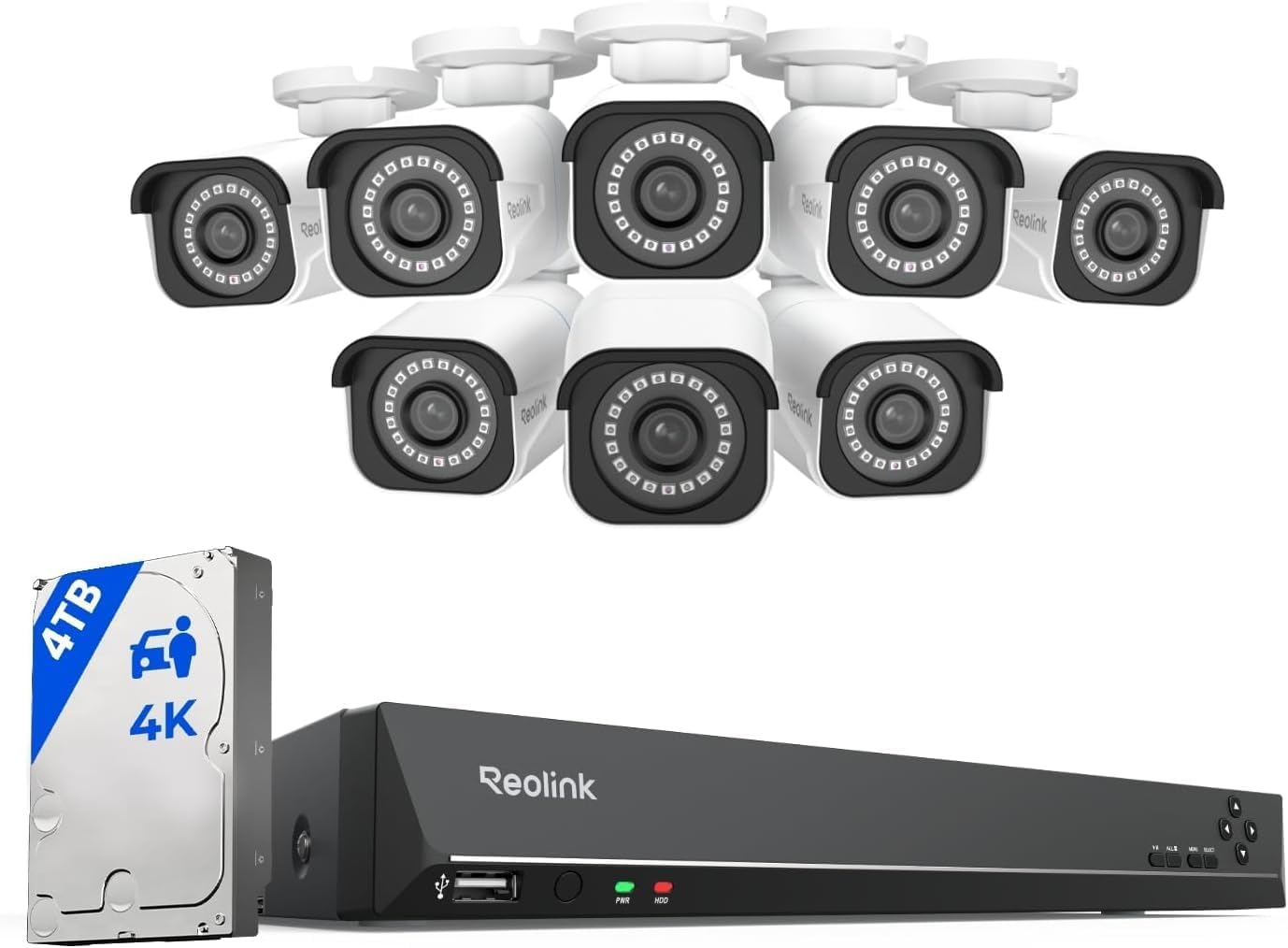
Pros
- Ships with 8 PoE 4K (8MP) cameras and a 16-channel NVR preloaded with a 4TB drive
- Single Cat5e/6 PoE cable carries both power and data up to 330 feet per camera run
- AI-based person and vehicle shape detection cuts down on false alerts from animals or shifting shadows
- NVR storage expands to 16TB total across one internal and one external drive bay for longer 24/7 retention
- H.265 compression keeps continuous recording efficient at up to 20fps per channel
Cons
- 8 cameras and an NVR require a PoE switch with enough ports and sufficient power capacity, not included in the kit
- Simultaneous full-resolution playback is capped at 1 channel at 8MP or 4 channels at 4MP at once
- Wired PoE installation means running cable to each camera location rather than a fully wireless setup
Each of the 8 cameras connects to the 16-channel NVR through a single PoE cable run, carrying both power and video data over one Ethernet line stretching up to 330 feet. That plug-and-play PoE approach removes the need for separate power adapters at each camera location, though it does mean cable runs need planning during installation.
- PoE cabling eliminates separate power wiring at each of the 8 camera positions
- 330 foot maximum cable run per camera covers most home and small business perimeters
- System is designed for both beginners and DIY installers rather than requiring a professional install
- A PoE switch with sufficient ports and enough power capacity is needed to support all 8 cameras, and is not included
The included 16-channel NVR ships with a 4TB hard drive preinstalled, expandable up to 16TB total across one internal and one external drive bay, supporting continuous 24/7 recording across all 8 cameras. H.265 compression keeps file sizes efficient while recording at up to 20fps per channel in up to 4K resolution.
- 4TB drive ships preinstalled, ready for recording without a separate purchase
- Expansion to 16TB total supports longer retention windows before older footage is overwritten
- H.265 compression reduces storage consumption compared to older H.264 systems
- Simultaneous playback tops out at 1 channel in 8MP or 4 channels in 4MP at the same time
Beyond the cameras and NVR in the box, a full install needs a PoE network switch with enough ports and power capacity for all 8 cameras, plus a monitor or display connected via HDMI or VGA for local viewing during setup. Remote access through the Reolink app covers ongoing monitoring once the system is running.
- A PoE switch is required to power and network all 8 cameras, and is sold separately
- A monitor is useful during setup, connecting via HDMI for up to 8MP output or VGA for 1080p
- Ethernet cabling to each camera location should be planned before mounting hardware is installed
- Remote iOS/Android app access lets footage be reviewed without a monitor connected to the NVR after setup

Pros
- 3TB hard drive stores continuous 24/7 footage across all 8 channels before needing to overwrite older recordings
- 8 bullet cameras record at 1080P with night vision reaching up to 65 feet in darkness
- IP66 protection covers each camera against dust and heavy water jets for outdoor mounting
- AI human detection cuts down false motion alerts from blowing leaves or passing shadows
- Cameras and NVR arrive pre-paired, so setup skips manual wireless pairing steps
Cons
- Cameras still need a wired power connection each, so the term wireless here refers only to skipping video cables, not full cordless operation
- 2.4GHz-only wireless connectivity is slower and shorter range than dual-band systems that also support 5GHz
- Local storage caps at 3TB, so very long retention windows across all 8 channels will eventually overwrite the oldest footage
Recording runs continuously across all 8 channels onto a 3TB hard drive built into the NVR, using H.265 compression to fit more footage into the available storage than older H.264 systems. Recording specifications:
- 8-channel NVR with 3TB internal hard drive
- 8 x 1080P bullet cameras included
- H.265 video compression
- 24/7 continuous recording
- Night vision range up to 65 feet per camera
Because recording runs continuously rather than only on motion triggers by default, the 3TB drive is the practical limit on how far back footage can be checked. Once the drive fills, the system overwrites the oldest recordings first, so anyone needing longer retention should plan to export important footage before it cycles out.
The 8 cameras and NVR ship pre-paired, which removes the manual wireless pairing step found on some competing kits. Setup steps:
- Power on all 8 cameras and the NVR using the included adapters
- Connect a mouse to the NVR for on-screen navigation
- Link the NVR to a PC or TV monitor over VGA or HDMI (cable not included)
- Connect the NVR to a router with the included Ethernet cable for remote app access
Despite being marketed as wireless, each camera still needs its own power connection to run continuously, so the term wireless here describes the absence of video cables between cameras and the NVR rather than a fully cordless, battery-only setup. Connectivity for remote features runs over a 2.4GHz network.
Once connected to a router, the system supports remote viewing and two-way audio through a mobile app on Android and iOS, plus playback of stored footage. Remote and detection features:
- Live view, playback and video backup through the companion app
- Two-way audio for communicating through a connected camera
- AI human detection to reduce false alerts from non-human motion
- IP66 waterproof protection suited to driveways, entrances, backyards and other outdoor mounting spots
The 72-degree field of view and 3.6mm lens on each camera favor focused coverage of specific entry points, such as a front door or driveway, over the ultra-wide coverage of fisheye-style cameras, so placement should be planned around the areas that matter most rather than expecting one camera to cover an entire wide yard.

Pros
- Eight 12MP cameras capture detail sharp enough to identify faces or license plates at typical yard distances
- Person, vehicle, and pet detection cuts down false alerts from moving branches or passing shadows
- Spotlight-equipped cameras deliver full-color night vision instead of grainy black-and-white infrared footage
- Two-way talk lets you speak through the camera speaker directly from the Reolink app
- 4TB HDD included, storing recorded footage without an immediate separate hard drive purchase
Cons
- Cameras in this kit only work with the included Reolink PoE NVR, not as standalone Wi-Fi cameras or with generic smart home hubs like Alexa
- 16 PoE ports on the NVR require running Ethernet cable to each camera location, more involved than a wire-free Wi-Fi camera install
- 4TB storage fills faster at 12MP resolution across eight cameras than it would with lower-resolution footage, so long-term archiving may need the external HDD port
Each of the eight cameras records at 12MP (4512x2512) using H.265 compression, with a field of view around 97° horizontal, and includes onboard person, vehicle, and pet detection to filter out irrelevant motion alerts.
- Camera resolution: 12MP, H.265 compression
- Detection types: person, vehicle, pet
- Night vision range: 100ft/30 meters, infrared and full-color modes
The full-color night vision mode relies on the built-in spotlight rather than infrared alone, which produces clearer color footage after dark but draws more power than IR-only night recording.
The system ships with a 4TB internal HDD already installed in the NVR, with capacity to expand up to 16TB total across one internal and one external HDD port, and stores footage using encrypted data protocols.
- Included storage: 4TB HDD (expandable to 16TB across two ports)
- Recording format: H.265 for efficient storage use
- Data protected with encrypted storage and customizable passwords
At 12MP across eight cameras, footage accumulates faster than lower-resolution systems, so households wanting months of continuous archived footage rather than a rolling few weeks should plan for the external HDD expansion.
The 16-channel PoE NVR (expandable to 24 channels with newer firmware) sends both power and data to each camera over a single Ethernet cable, and cameras are rated IP67 waterproof for outdoor mounting in varying weather.
- 16.93 x 14.57 x 13.98 inch NVR unit with 16 PoE ports
- Cameras rated IP67 for outdoor exposure and temperature swings from -10°C to 45°C
- Remote viewing via iOS/Android phone or Windows/Mac PC
Because the cameras in this kit are built to pair only with the Reolink PoE NVR, they can't be repurposed as standalone Wi-Fi cameras or connected to third-party smart home platforms.
Why Investing in the Best CCTV Security Cameras Matters
A security camera system is one of the few home upgrades that works around the clock whether you are home or away. Beyond simply recording events, modern CCTV setups deter intruders, provide evidence for insurance or police reports, and let you check in on deliveries, pets, or family from your phone. The difference between a cheap toy camera and a proper system shows up exactly when you need footage most – in low light, at long range, or during a critical event.
The good news is that quality has become far more affordable. Systems that once cost thousands now deliver crisp, reliable coverage for a fraction of the price. The challenge is knowing which features are worth paying for and which are marketing fluff. That is where a clear buying framework helps.
Wired vs. Wireless: Picking the Right Foundation
The first major fork in the road is how your cameras connect. This single choice shapes installation effort, reliability, and long-term maintenance.
PoE Wired Systems
Power over Ethernet (PoE) systems run a single cable to each camera that carries both data and power. They are the gold standard for reliability because there is no wireless signal to drop and no batteries to swap. Kits like the REOLINK RLK8-410B6 and the REOLINK RLK8-410B4 pair PoE IP cameras with a network video recorder (NVR) and a pre-installed hard drive for continuous recording. If you want a set-and-forget system and are comfortable running cable through walls or soffits, PoE is hard to beat.
WiFi Wireless Systems
Wireless kits trade a little reliability for much easier installation. You still typically run a power cable to each camera, but video travels over WiFi to the recorder. A system such as the Firstrend WiFi Camera System is a strong fit for renters or anyone who wants to avoid drilling long cable runs. Just remember that thick walls and long distances can weaken the signal, so plan camera placement with your router in mind.
DVR vs. NVR
You will see two recorder types. DVR systems, like several ANNKE 3K Lite kits, use coaxial cabling and analog-style cameras, which keeps costs down. NVR systems use IP cameras over Ethernet and generally offer higher resolution and easier expansion. For most new buyers chasing the best cctv security cameras, an NVR-based PoE kit offers the cleanest upgrade path, while a DVR kit remains a budget-friendly workhorse.
Resolution and Image Quality: How Much Do You Need?
Resolution is the spec buyers obsess over, but more megapixels is not always better. Here is how to think about it.
- 2MP / 1080p: Perfectly usable for general coverage of a porch, hallway, or small yard. Budget ANNKE kits such as the ANNKE 1080p System land here and still deliver clear color night vision.
- 3K / 5MP: The current sweet spot for most homes. You get enough detail to read a license plate or recognize a face at moderate range. The REOLINK RLK8-520D4 and the Hiseeu 3K PTZ System sit in this tier.
- 4K / 8MP and above: Best for large properties, wide driveways, or commercial use where you may need to zoom in on footage after the fact. The REOLINK RLK16-800B8 and the high-end REOLINK RLK16-1200D8 deliver this pixel density across many channels.
Remember that higher resolution means larger files, so a 4K system with eight cameras will fill a hard drive faster than a 1080p kit. Match your storage to your resolution.
Night Vision and Low-Light Performance
Most break-ins and suspicious activity happen after dark, so night performance often matters more than daytime clarity. There are two main approaches. Traditional infrared night vision produces clear black-and-white footage in total darkness. Color night vision, increasingly common on newer kits, uses a low-light sensor and a spotlight to keep footage in full color at night, which makes it far easier to identify clothing, vehicles, and faces.
Many current systems, including several ANNKE and REOLINK models, offer a smart dual-light mode that switches between infrared and spotlight-assisted color automatically. The ANNKE 4-Camera Kit is one example that pairs color night vision with a smart dual light. If your priority is capturing usable detail overnight, prioritize color night vision and a bright integrated spotlight.
Smart Detection: Cutting Down False Alerts
Nothing kills confidence in a camera system faster than dozens of pointless alerts triggered by wind, rain, or a passing cat. AI-powered detection solves this by distinguishing people and vehicles from general motion. Instead of a notification every time a shadow moves, you only get pinged when it matters.
Look for terms like person, vehicle, and pet detection in the product description. REOLINK kits are known for reliable smart detection across their lineup, and the Firstrend WiFi System highlights AI human detection as a core feature. For a busy street-facing property, accurate detection is arguably more valuable than an extra few megapixels.
Coverage: How Many Cameras and Channels?
Count the distinct areas you need to watch before you buy. Front door, driveway, back yard, and side gate is already four cameras, and blind spots add up quickly. Channel count on the recorder sets your ceiling for expansion.
- 4-channel kits suit apartments and small homes with a few key angles.
- 8-channel kits are the most popular choice for average houses, giving room to add cameras later.
- 16-channel systems like the REOLINK 16CH Bullet Kit are built for large homes, multi-building properties, and small businesses.
A pan-tilt-zoom (PTZ) camera can also reduce the number of fixed cameras you need. The Hiseeu PTZ System offers 360-degree coverage, letting a single unit sweep a wide area rather than relying on multiple static cameras.
Storage and Ongoing Costs
One of the biggest advantages of a dedicated CCTV kit over cloud-only cameras is local storage with no monthly fees. Most systems ship with a hard drive already installed – commonly 1TB to 4TB depending on the kit. A 2TB drive typically holds weeks of continuous footage on a mid-resolution system, and detection-only recording stretches that even further.
When comparing options, check three things: the included drive size, whether the recorder supports larger drives for future expansion, and whether any features are locked behind a subscription. The best value systems, such as the no-monthly-fee Firstrend and the REOLINK NVR kits, keep your footage entirely under your own control.
Weatherproofing and Build Quality
Outdoor cameras live through rain, snow, heat, and dust, so build quality is not optional. Look for an IP66 or IP67 rating, which indicates strong protection against dust and water jets. Nearly every kit covered here, from the ANNKE IP67 cameras to the Firstrend IP66 bullets, meets this bar. Metal housings also resist tampering and hold up better over the years than lightweight plastic. If cameras will be mounted low enough to reach, vandal resistance is worth prioritizing.
A Simple Framework to Choose the Best CCTV Security Cameras
Bring it all together with a quick decision path:
- Map your property first. Count entry points and problem areas to set your camera and channel count.
- Pick wired or wireless. Choose PoE for maximum reliability, or WiFi if you need an easier install.
- Match resolution to distance. 5MP for most homes, 4K for large or commercial spaces, 1080p for tight budgets.
- Demand smart detection and color night vision. These two features do the most to make footage genuinely useful.
- Confirm local storage with no fees. A pre-installed hard drive and expandable recorder protect both your footage and your wallet.
Follow that path and any kit on this list can serve you well. Budget-focused buyers gravitate to ANNKE DVR kits, reliability-focused buyers to REOLINK PoE systems, and renters or quick-install shoppers to the Firstrend wireless option, while the Hiseeu PTZ suits anyone who wants wide coverage from fewer units.
Final Thoughts
The best security camera is the one that fits your property, records reliably when it counts, and does not nickel-and-dime you with subscriptions. By focusing on coverage, resolution, night performance, smart detection, and local storage rather than marketing buzzwords, you can invest with confidence. Compare the systems above against your own needs, start with the areas that matter most, and you will end up with a setup that quietly protects what you care about every hour of the day.