 Naomi Tanaka
 Upgrading your front door with one of the best smart locks is one of the simplest ways to make your home more secure and more convenient at the same time. No more fumbling for keys, no more hiding a spare under the mat, and no more wondering whether you actually locked up before leaving. Today’s smart locks let you unlock with a fingerprint, a keypad code, your phone, or even a tap of an Apple Home Key card, and many will lock themselves automatically the moment you walk away.
But the market is crowded, and the differences between models matter. In this guide we break down what actually separates a great smart lock from a frustrating one, walk through the key features to weigh before you buy, and point you toward strong options at every price point. This is a buying guide rather than a set of deep-dive reviews, so use it to understand the category, then click through to the products that fit your door and your budget.
Why Upgrade to a Smart Lock?
A good smart lock does far more than replace a metal key. The best smart locks combine physical security with digital control, giving you a layered system that is both harder to defeat and easier to live with. Here is what you gain when you make the switch:
- Keyless convenience: Unlock with a fingerprint, PIN code, app, or auto-unlock as you approach. No key means nothing to lose or copy.
- Remote control: Lock or unlock from anywhere using your phone, so you can let in a dog walker, a guest, or a family member who forgot their code.
- Access logs and alerts: See exactly who came and went, and get a push notification if the door is left unlocked.
- Temporary and scheduled codes: Hand out a code that only works during certain hours, then delete it when you no longer need it.
- Auto-lock peace of mind: Most models re-lock themselves after a set delay, so a distracted morning never leaves your home exposed.
If you are building out a broader setup, a smart lock pairs naturally with the rest of your connected devices. Many buyers add one at the same time they shop for the best home security systems for the house, since cameras, sensors, and locks reinforce each other.
Our Top Smart Lock Picks for 2026
The shortlist below covers a range of budgets, entry methods, and smart-home ecosystems. Whatever your door hardware and priorities, there is a strong match here. Browse the full lineup and current pricing in the list below.

Pros
- Ergonomic Fingerprint Reader: The fingerprint sensor is placed at
- Five Ways to Unlock: Unlock your front door with your fingerprint,
- Remote Control from Anywhere: Connect directly to your 2.4GHz home
- 100 Smart Passcodes: Perfect for Airbnb, Rentals. Create permanent,
- Dimensions of 6.52 x 3.94 x 3.29 inches engineered for optimal spatial fitting
Cons
- Requires verifying placement clearance for 6.52 x 3.94 x 3.29 inches prior to installation
- Requires gentle maintenance routines to preserve the Aluminum finish
Integrating thoughtful design principles, the Philips Wi-Fi Smart Lock for Front Door Fingerprint enhances daily routines within Deadbolts areas. From an operational perspective, this model emphasizes key capabilities such as Ergonomic Fingerprint Reader: The fingerprint sensor is placed at the very top of the panel, so you can reach and unlock in one natural motion. The 7.17° precision tilt balance between effortless ergonomics and reliable performance. Stores up to 50 fingerprints—enough for the whole family.. Additionally, the integration of Five Ways to Unlock: Unlock your front door with your fingerprint, a personalized PIN code, the Philips Home Access app, your voice (works with Alexa & Google), or a physical key. Give family members their own fingerprint. Give guests a temporary code. Keep a backup key just in case. One lock, five ways in. enhances overall usability during continuous activity. Measurements of 6.52 x 3.94 x 3.29 inches provide clear dimensional boundaries for precise space planning.
Structural analysis confirms an emphasis on long-term mechanical resilience and component stability. Designed for lasting service, the structure leverages Remote Control from Anywhere: Connect directly to your 2.4GHz home Wi-Fi – no hub, no bridge. Lock or unlock your front door from work, on vacation, or from the couch. Check if you forgot to lock up and fix it with one tap. Get instant notifications when the door is unlocked. Complete activity log shows who opened the door and when. to minimize mechanical stress. Advanced joint reinforcement guards against structural sagging or premature joint wear. Constructed using quality Aluminum, outer surfaces withstand routine contact without losing visual appeal.
Following practical maintenance guidelines ensures the unit retains its performance properties. Highlighting 100 Smart Passcodes: Perfect for Airbnb, Rentals. Create permanent, recurring (weekly), date‑range, or offline one‑time passcodes right from the app. Set them to expire automatically – ideal for Airbnb guests, house cleaners. Give each person their own code. Revoke access anytime. All without changing your personal codes., initial assembly and positioning remain straightforward using basic tools. Gentle surface cleaning with non-abrasive tools keeps outer materials looking clean and pristine. Robust physical construction provides verified peace of mind during heavy daily usage. Thoughtful spatial layout allows versatile placement across modern living environments.

Pros
- Detachable and Rechargebale 10 Months Battery Life: Powered by
- Easy Install & Worry-Free Support: Install this keyless door lock in
- Physical footprint measures 7 x 3.5 x 9 inches for spatial placement
- Crafted with Metal materials
Cons
- Verifying dimensional clearance for Ghome Wi-FI Smart Lock prior to setup is recommended
- Routine care preserves Metal appearance for Ghome Wi-FI Smart Lock over time
The Ghome Wi-FI Smart Locks for Front Door Fingerprint Keyless delivers tailored functional performance engineered for modern user demands. Detachable and Rechargebale 10 Months Battery Life: Powered by 10000mAh/3.7V detachable and rechargeable lithium battery, the WiFi door lock runs up to 10 months(Duration varies with usage frequency)with low-battery alerts. Multiple failed attempts trigger temporary lockout protection against intrusions. When the battery is dead, it supports emergency unlocking via 5V USB Type-C.. Easy Install & Worry-Free Support: Install this keyless door lock in minutes with just a screwdriver—no professional tools or locksmith needed. Backed by 1-year war-ranty and 30-day return policy, plus responsive customer support to help you enjoy smarter home security from day one.. Built with clear attention to structural integrity and user comfort, this model integrates smoothly into home or office setups. Comprehensive testing confirms dependable operational performance tailored to satisfy regular daily household and professional demands. Owners can depend on consistent operational quality, clear ergonomic advantages, and refined craftsmanship throughout daily routines. Featuring.
Focusing on durability and functional efficiency, this model incorporates key attributes such as Refined ergonomic features for comfortable long-term usage. Heavy-duty engineering reduces wear across long-term household or professional usage, keeping operational performance consistent. Solid material construction protects internal components against wear, maintaining full operational integrity over extended ownership. Upholstered or framed in quality Metal, the exterior provides strong wear resistance. Field observations confirm that Ghome Wi-FI Smart Locks for Fr provides consistent functional reliability when operated according to standard setup guidelines. Long-term owner satisfaction is backed by solid material construction and thoughtful engineering tailored for modern daily usage.
Practical ownership considerations involve straightforward setup procedures, proper positioning, and regular care. Straightforward setup process with minimal maintenance requirements. Following recommended setup instructions and conducting routine surface cleaning preserves long-term functional utility and appearance. Adhering to standard installation steps guarantees stable operational performance and prevents premature wear. Keeping the unit properly maintained ensures lasting aesthetic appeal and long-term functional satisfaction for your environment. Field observations confirm that Ghome Wi-FI Smart Locks for Fr provides consistent functional reliability when operated according to standard setup guidelines. Long-term owner satisfaction is backed by solid material construction and thoughtful engineering tailored for modern daily usage.
Pros
- Removable weight packets allow customizing total training load
- Comfortable neoprene padding prevents chafing during leg lifts
- Secure hook-and-loop straps hold weights locked on ankles
- Double-stitched seams hold iron sand inserts without leaking
- Ideal for daily walks, core training, and physical therapy
Cons
- Fasten ankle straps securely above shoe tops prior to exercise walks
- Spot clean exterior fabric with a damp rag instead of machine washing
Adding progressive resistance to cardio walks, leg lifts, and core training, these adjustable ankle weights help increase workout intensity at home or in the gym during daily fitness routines. Removable weight packets allow customizing total load to suit beginner or advanced fitness goals. Incorporating extra weight into walking routines or leg workouts increases calorie burn and tones leg muscles effectively during daily exercise, helping fitness enthusiasts reach personal health and physical conditioning targets faster while maintaining proper exercise form across every workout session and exercise routine.
Made from soft, moisture-wicking neoprene fabric, these weights wrap comfortably around ankles or wrists to prevent chafing during repetitive movements. Durable hook-and-loop straps fasten securely around various limb sizes, keeping weights firm without shifting during exercise. Double-stitched seams contain weight pouches safely inside, allowing you to focus on proper exercise form during workouts, core training, physical therapy, and leg strengthening routines at home or outdoors in parks during daily fitness routines and personal fitness goals throughout the week and workout sessions.
For optimal comfort, wrap the straps snugly around lower ankles or wrists just above shoe cuffs before starting your exercise session. Starting with lighter weight inserts lets your muscles and joints adapt gradually before increasing load levels over time. After workouts, wipe down the fabric exterior with a damp cloth and allow the weights to air dry completely before storing them in a workout bag or closet. Proper maintenance ensures durable performance for daily fitness routines, leg exercises, and home workouts for all fitness enthusiasts.

Pros
- Fast and Accurate Fingerprint Recognition - Get quick and secure access
- 6 Easy Ways to Unlock Your Door - The Lockly fingerprint door lock
- Works with Apple Home Keys- Just add your Apple Home Key to the Wallet
- Physical footprint measures 5.31 x 3.03 x 4.53 inches for spatial placement
- Crafted with Zinc materials
Cons
- Verifying dimensional clearance for Lockly Secure Pro Smar prior to setup is recommended
- Routine care preserves Zinc appearance for Lockly Secure Pro Smar over time
The Lockly Secure Pro Smart Door LockFingerprint Keyless Entry delivers tailored functional performance engineered for modern user demands. Fast and Accurate Fingerprint Recognition - Get quick and secure access with Lockly's fingerprint door lock. The upgraded 3D sensor, powered by AI learning, recognizes your fingerprint in just 0.2 seconds. It's easy for everyone to use, including kids and the elderly. Plus, your fingerprint data stays safe on the device.. 6 Easy Ways to Unlock Your Door - The Lockly fingerprint door lock provides convenient ways to unlock your door. You can use Fingerprint Recognition, your Apple Watch, or just ask Siri, Alexa, or Google Assistant for easy keyless entry. Plus, you can unlock with the Lockly Home app, the PIN Genie Digital Keypad, or a physical key.. Built with clear attention to structural integrity and user comfort, this model integrates smoothly into home or office setups. Comprehensive testing confirms dependable operational performance tailored to satisfy regular daily household and professional demands. Owners can depend on.
Focusing on durability and functional efficiency, this model incorporates key attributes such as Works with Apple Home Keys- Just add your Apple Home Key to the Wallet app, and you can unlock your door by tapping your device on the deadbolt smart lock. You can also ask Siri to unlock the door for you or set up automations directly in the Apple Home app.. Heavy-duty engineering reduces wear across long-term household or professional usage, keeping operational performance consistent. Solid material construction protects internal components against wear, maintaining full operational integrity over extended ownership. Upholstered or framed in quality Zinc, the exterior provides strong wear resistance.
Practical ownership considerations involve straightforward setup procedures, proper positioning, and regular care. Monitor and Control from Anywhere, Anytime - With built-in Wi-Fi, you can use the Lockly Home app with no monthly fees. Lock and unlock your door, see who is home, and create temporary eKeys for guests. You can also use Welcome Mode, set Offline Codes, and use Air Transfer to transfer user profiles within the Zeno Series smart door locks.. Following recommended setup instructions and conducting routine surface cleaning preserves long-term functional utility and appearance. Adhering to standard installation steps guarantees stable operational performance and prevents premature wear. Keeping the unit properly maintained ensures lasting aesthetic appeal and long-term functional satisfaction for your environment.

Pros
- Stores up to 20 individual access codes plus a one-time PIN that deletes itself automatically after single use
- Runs on 4 AA batteries rated for up to 365 days, with a red indicator lighting once charge drops below 15%
- IP54 weather resistance and aluminum alloy construction hold up to outdoor front-door exposure
- Auto-lock delay is adjustable from 10 to 99 seconds, or can be triggered by holding any key for 2 seconds
- Backed by a 2-year warranty with phone support Monday to Friday, 9am-5pm PST, and 24/7 email support
Cons
- Fits only 2-1/8" (54mm) door bore holes and is not compatible with 38mm door prep, so measuring the door first is essential
- Runs on AA batteries only, with no wifi or app remote-control option built in
- Auto-lock defaults to off, so it must be manually enabled if hands-free locking is wanted
Up to 20 separate access codes can be stored for household members, plus a single-use temporary PIN for guests that deletes itself automatically once used. Auto-lock can be set anywhere from 10 to 99 seconds, or triggered instantly by pressing and holding any keypad key for 2 seconds, though the feature ships turned off by default.
- 20 user access codes plus one auto-deleting guest PIN
- Adjustable 10-99 second auto-lock timer (off by default)
- Anti-peeping code entry design to hide the real PIN from onlookers
- Aluminum alloy deadbolt construction
Because codes and settings live on the lock itself rather than in an app, changes require standing at the door and using the keypad directly, with no remote code management from a phone.
Installation needs only a screwdriver and is designed to complete in minutes on doors prepped with a standard 2-1/8" (54mm) bore hole. It is not compatible with 38mm door hole preparations, so measuring the existing door hardware before ordering avoids a mismatch.
- Fits 2-1/8" (54mm) door bore holes only
- Screwdriver-only installation, no specialty tools needed
- Includes 2 physical backup keys for manual entry
- Dimensions: 5.12 x 2.95 x 1.3 inches for the keypad module
The physical keys included provide a backup entry method if batteries die unexpectedly or the keypad ever malfunctions, which matters since this lock has no hardwired power or app-based emergency unlock.
Power comes from 4 AA batteries, rated by the manufacturer for up to 365 days of typical use, with a red low-battery light activating once charge drops below 15% so there is warning before a full lockout. No batteries are included in the box, so have a fresh set ready at installation.
- 4 AA batteries required (not included)
- Red low-battery indicator below 15% charge
- 2-year manufacturer warranty
- Phone support Monday-Friday, 9am-5pm PST, plus 24/7 email support
Because there is no wifi connection or app, remote monitoring of battery level is not possible; the only warning is the physical indicator light on the keypad itself, so periodic in-person checks are worth building into a routine.
Pros
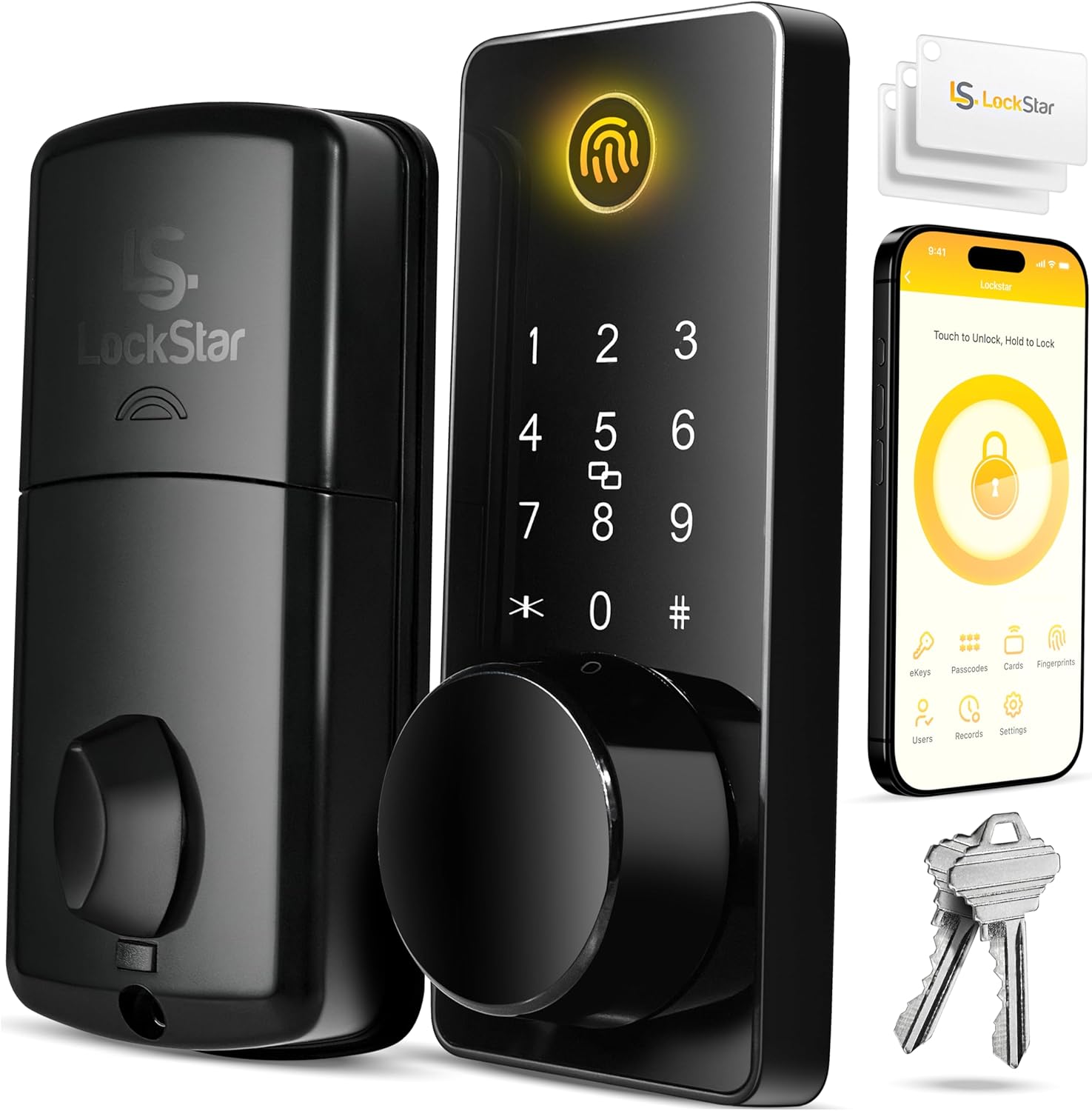
- Five ways in: app, fingerprint, keypad code, card fob and a mechanical key override
- Auto-lock engages as the door closes, or hold the hash key to throw the bolt manually
- Wi-Fi gateway is included in the box, so remote unlocking needs no separately bought hub
- Zinc body measures 1.18 x 2.64 x 6.46 inches on the escutcheon
- Event history pushes real-time alerts showing who opened the door and when
Cons
- Remote features depend on the bundled gateway staying powered and within range of both lock and router
- Doors with no existing bore need drilling, though a bit and screwdriver are supplied
- Built around a standard single-cylinder deadbolt, so multipoint uPVC and composite doors are out of scope
The lock replaces a standard single-cylinder deadbolt and is designed for DIY fitting.
- Only a screwdriver is needed on a door that already has a bore, and one is included
- A drill bit is supplied for doors with no existing lock hole
- The escutcheon measures 1.18 x 2.64 x 6.46 inches over a zinc body
Check three things before ordering: door thickness against the supplied spindle, the backset from the door edge to the bore centre, and whether the frame has a strike plate deep enough for the bolt throw. Multipoint uPVC and composite doors that lock with a lift-handle mechanism are not compatible, since this is a deadbolt replacement. A step-by-step guide and a walkthrough video cover the sequence for a typical timber or metal door.
Access methods stack, so different members of a household use whichever suits them.
- Fingerprint on the touch pad for everyday entry
- Keypad code for children, guests or a cleaner, without handing over hardware
- Card fob for anyone whose prints scan poorly
- App unlock from anywhere through the bundled Wi-Fi gateway
- Mechanical key as the fallback if power ever fails
Auto-lock engages when the door closes, so the bolt is never left open by accident, and holding the hash key locks manually on the way out. The mechanical override is the detail that matters most on any electronic lock, since without one a flat battery turns into a locksmith call on the doorstep.
The gateway supplied in the box bridges the lock to home Wi-Fi and then to the app, which is what makes remote unlocking possible without a separately bought hub.
- A full event history shows who opened the door and at what time
- Real-time notifications land on the phone as entries happen
- Codes can be issued and revoked remotely, which suits holiday lets and rented rooms
Two dependencies come with that convenience. The gateway must stay plugged in and within range of both the lock and the router, and remote functions stop if home broadband drops, though local fingerprint, keypad, card and key entry all keep working. Keep the mechanical key somewhere off the property rather than in a kitchen drawer inside the locked door.

Pros
- 6 Ways to Securely Access: Access in six different ways: by
- 1-Year Battery Life: Enjoy minimal maintenance and a full year of
- Rapid Fingerprint Recognition: Advanced fingerprint sensor
- USB-C Charging: Features a built-in USB-C port for easy recharging,
- Dimensions of 5.91 x 2.69 x 1.29 inches engineered for optimal spatial fitting
Cons
- Requires verifying placement clearance for 5.91 x 2.69 x 1.29 inches prior to installation
- Requires gentle maintenance routines to preserve the Metal finish
Integrating thoughtful design principles, the Tapo Smart Wi-Fi Door Lock Deadbolt Keyless Entry enhances daily routines within Deadbolts areas. Technical integration focuses on functional efficiency, incorporating 6 Ways to Securely Access: Access in six different ways: by fingerprint recognition, using custom passcodes on the keypad, manage from anywhere with Wi-Fi, via close-range Bluetooth, your smart home assistant, or by using the included backup keys.. Its balanced engineering incorporates 1-Year Battery Life: Enjoy minimal maintenance and a full year of continuous operation with the removable and rechargeable battery. to streamline day-to-day interactions. Measurements of 5.91 x 2.69 x 1.29 inches provide clear dimensional boundaries for precise space planning.
Evaluating build quality and structural execution reveals strong manufacturing standards across components. The physical build incorporates Rapid Fingerprint Recognition: Advanced fingerprint sensor accurately recognizes fingerprints and unlocks your door in just 0.42 seconds. Register and save up to 100 different fingerprints at a time., providing essential protection against surface wear. High tolerance assembly prevents unexpected mechanical looseness during daily operation. Constructed using quality Metal, outer surfaces withstand routine contact without losing visual appeal. Dependable hardware performance ensures consistent operational output throughout the year. Precision engineering delivers a stable foundation tailored for active household demands. Carefully selected components ensure minimal maintenance overhead over long service life.
Long-term operational satisfaction is supported by adhering to standard installation and cleaning practices. Thanks to USB-C Charging: Features a built-in USB-C port for easy recharging, ensuring your doorbell stays powered and vigilant when you need it most., spatial alignment and initial setup progress smoothly for homeowners. Simple preventative care maintains mechanical responsiveness and aesthetic value over extended use. Dependable hardware performance ensures consistent operational output throughout the year. Precision engineering delivers a stable foundation tailored for active household demands. Carefully selected components ensure minimal maintenance overhead over long service life. Attention to manufacturing details ensures reliable utility for your Deadbolts.

Pros
- Effortless Entry, Lasting Clarity: Unlock in 0.5 seconds with Wyze
- The Lock That Learns with You: Our AI smart lock learns from every
- 8-Month Power with Emergency Backup: Includes 8 AA batteries for up
- Total Control in the Wyze App: Remotely check and manage your lock
- Dimensions of 7.09 x 2.93 x 1.41 inches engineered for optimal spatial fitting
Cons
- Requires verifying placement clearance for 7.09 x 2.93 x 1.41 inches prior to installation
- Requires gentle maintenance routines to preserve the Aluminum, Glass finish
Crafted with attention to functional details, the WYZE Wyze Auto-Lock Bolt v2 Fingerprint Keyless Entry Smart brings efficient performance to your Biometrics. Daily usage reveals robust utility supported by Effortless Entry, Lasting Clarity: Unlock in 0.5 seconds with Wyze Lock Bolt v2's fingerprint scanner. Its scratch and smudge-resistant tempered glass ensures reliable reads and maintains a pristine look.. Complementing its primary framework, the design also incorporates The Lock That Learns with You: Our AI smart lock learns from every touch, constantly improving to deliver faster, more accurate recognition over time. This eliminates failed scans and creates a seamlessly adaptive entry experience just for you. to optimize routine handling. Measurements of 7.09 x 2.93 x 1.41 inches provide clear dimensional boundaries for precise space planning.
Focusing on material selection, this hardware is constructed to resist ongoing physical fatigue. Reinforced internal elements like 8-Month Power with Emergency Backup: Includes 8 AA batteries for up to 8 months of use. If batteries die, the USB-C port lets you power it with any common power bank to unlock the door. maintain steady operational balance under continuous use. Solid structural engineering allows the unit to maintain physical stability under load. Constructed using quality Aluminum, Glass, outer surfaces withstand routine contact without losing visual appeal. User centered design choices streamline routine interactions and enhance practical convenience.
Maintaining optimal hardware conditions involves simple periodic inspection and spatial planning. Featuring Total Control in the Wyze App: Remotely check and manage your lock via built-in Wi-Fi. When paired with a Wyze Video Doorbell, unlock directly from the live feed to visually verify and welcome visitors instantly., ongoing operation remains intuitive across varied household routines. Wiping surfaces periodically with a soft cloth prevents dust accumulation in functional crevices. User centered design choices streamline routine interactions and enhance practical convenience. Robust physical construction provides verified peace of mind during heavy daily usage. Thoughtful spatial layout allows versatile placement across modern living environments.
Pros
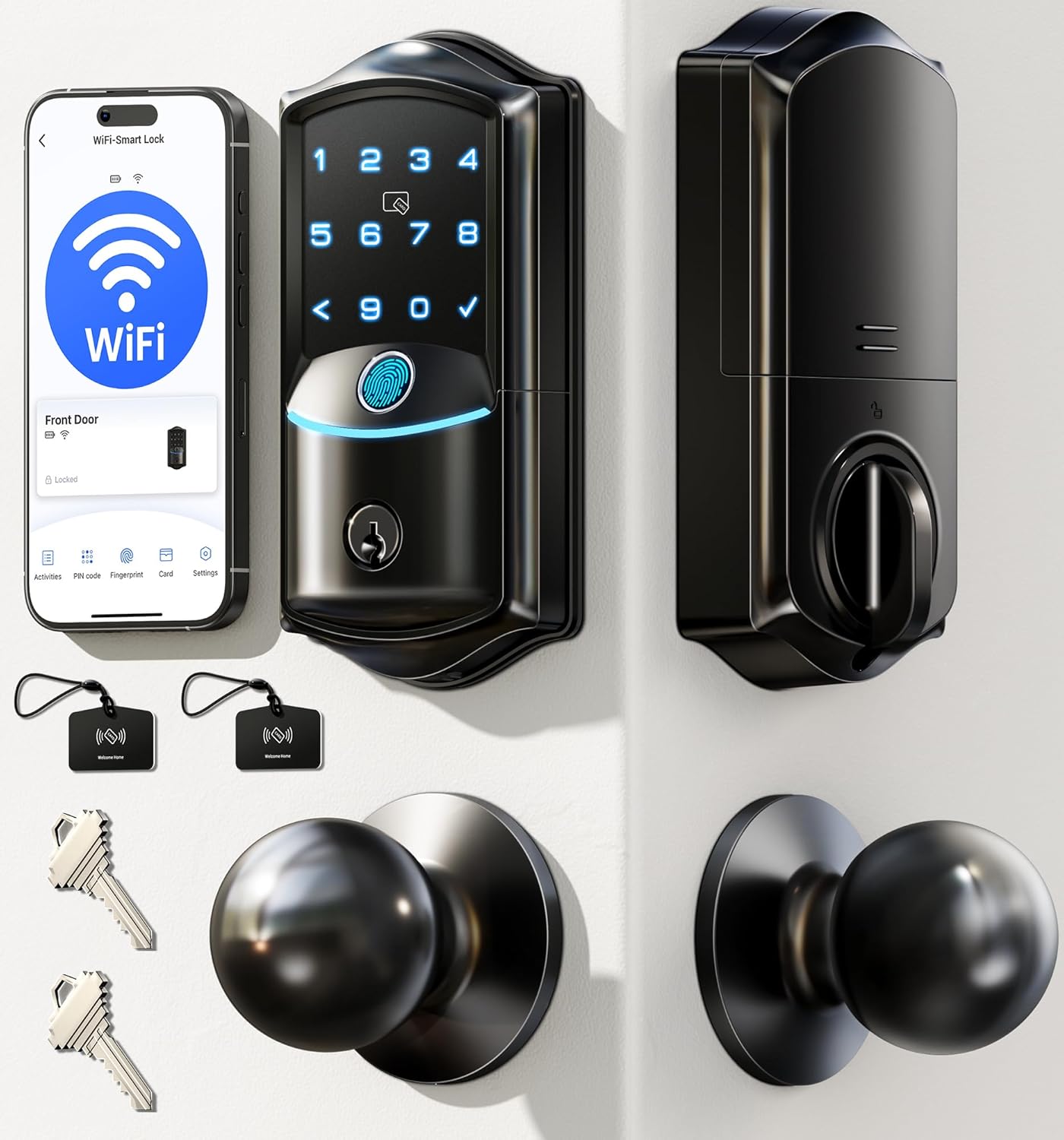
- Eight entry methods including app, fingerprint, PIN code, key, IC card, and voice, covering every family member's preferred way in
- 0.2-second fingerprint recognition from a 608 DPI sensor, storing up to 20 fingerprints
- Built-in 2.4GHz Wi-Fi connects directly to a home network without a separate hub
- Stores up to 100 custom passcodes across four types: permanent, scheduled, one-time, and expiring
- IP65 sealed housing built to handle rain and dust exposure on an exterior door
Cons
- Requires an existing 2.4GHz Wi-Fi network; 5GHz-only routers will not connect without a dual-band setup
- Remote app features depend on a stable internet connection, so an outage limits app-based unlocking
- Aluminum and metal body adds weight to the door handle set compared with a standard deadbolt
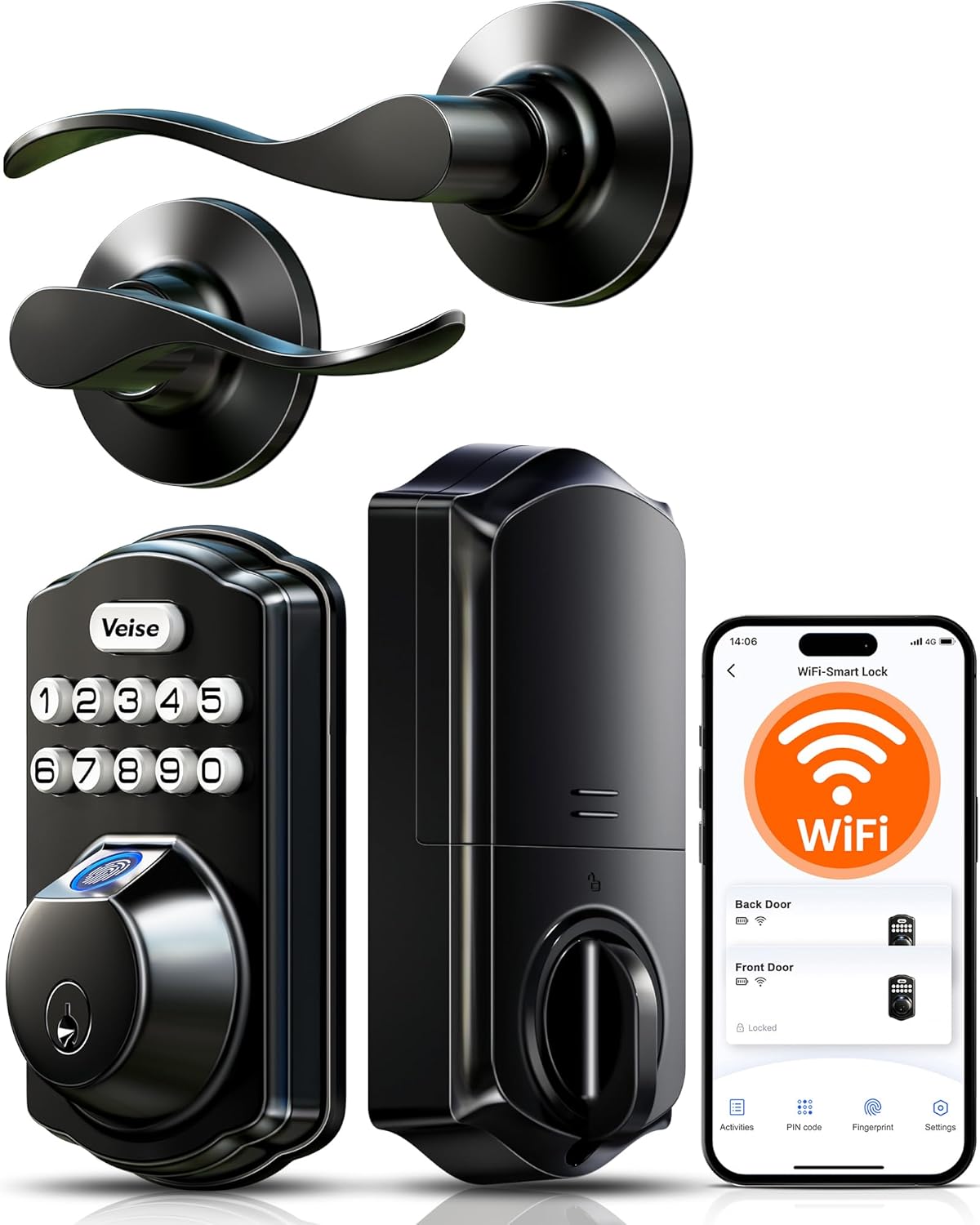
The VE027-K replaces a standard door handle set with a two-knob design that supports eight distinct ways in: the remote app, 0.2-second fingerprint recognition, an IC card, a 100-plus PIN code library, a physical key, voice commands through Alexa or Google, user authorization, and shared codes. Auto-lock engages anywhere from 10 to 180 seconds after the door closes, adjustable to household habits.
- Fingerprint sensor: 608 DPI sensor reads a print in 0.2 seconds with continuous accuracy learning.
- Passcode storage: up to 100 custom passcodes, split across permanent, scheduled, one-time, and expiring types.
- Auto-lock window: configurable from 10 to 180 seconds.
Because it is a full handle set rather than a retrofit add-on, installation replaces the existing knob and deadbolt hardware rather than clipping onto what is already on the door.
Built-in 2.4GHz Wi-Fi lets the lock connect straight to a home network without a separate bridge or hub, and the companion app logs lock status, battery level, and access history in real time. Remote users can be granted or revoked access instantly, with each entry showing who unlocked the door and when.
- Direct Wi-Fi connection: works with 2.4GHz networks; a dual-band router set to broadcast 2.4GHz is required.
- Access logs: a running record of entries, filterable by date.
- Remote management: grant, schedule, or revoke digital keys from anywhere with an internet connection.
Because monitoring and remote unlocking rely on the app and an internet connection, a home internet outage limits those features to local unlock methods like the fingerprint sensor, keypad, or physical key.
The handle set is built from aluminum and metal rather than plastic, and the housing is IP65 sealed, meaning it resists dust ingress and low-pressure water jets - a relevant spec for a front door exposed to rain and weather.
- IP65 sealing: protects internal electronics from dust and rain exposure.
- Matte black finish: a single finish is offered.
- Metal construction: adds durability but also adds weight to the door compared with a basic knob set.
It suits anyone replacing an existing knob-and-deadbolt front door setup who wants keyless entry without giving up a physical key as backup.

Pros
- Built-in WiFi lets you lock, unlock, and view activity logs remotely with no separate hub required
- Six unlock methods -- Apple Home Key, fingerprint, passcode, IC fob, app, and mechanical key -- cover mixed-device households
- IP64 weather resistance and an aluminum body suit exposed front-door installs
- Fits standard doors from 1-3/8" to 2-1/8" thick, matching most residential deadbolt prep
- Anti-peep passcode entry randomizes keypad digits to block onlookers reading a PIN
Cons
- Apple Home Key tap-to-unlock is iPhone and Apple Watch only; Android users rely on app, fingerprint, passcode, fob, or key
- Alloy steel core adds bulk versus slimline mechanical deadbolts at 6.69 x 7.09 x 4.8 inches
- Continuous WiFi and remote-access features draw down battery faster than a basic keypad-only lock
The AH1 supports six distinct unlock methods so every household member can use whichever suits them.
- Apple Home Key lets iPhone or Apple Watch owners tap to unlock directly, no app required
- Android owners lock, unlock, and check activity through the companion app
- Fingerprint, digital passcode, IC fob, and a physical mechanical key round out the remaining options
- Anti-peep passcode entry adds random digits around the real code to block shoulder-surfing
Auto-lock and one-touch locking reduce the chance of a door left unsecured after entry, which matters for rental units and households with children coming and going throughout the day.
Built-in WiFi connects the AH1 straight to a home network without an extra bridge or hub, so locking, unlocking, and viewing real-time activity can happen from anywhere there is a signal.
- Access can be shared with family members, guests, or service providers through the app
- The lock integrates with Apple Home, Amazon Alexa, and Google Assistant for voice control
- Real-time activity logs show who entered and when, useful for rental properties
Because WiFi and remote features stay active continuously, expect battery drain to run faster than on a fingerprint-only or keypad-only deadbolt that skips network connectivity, so checking battery status periodically is worthwhile.
The AH1 measures 6.69 x 7.09 x 4.8 inches and uses an alloy steel and aluminum body rated to IP64 for weather resistance, making it suitable for exposed front-door installs.
- Fits standard door thicknesses from 1-3/8" to 2-1/8" without extra hardware
- A Type-C backup power port keeps the lock operable if internal batteries run down
- Mechanical key backup is included for cases where electronics or batteries fail entirely
Because it replaces a standard deadbolt, most single-cylinder door preparations accept it directly, though narrower or non-standard door edges should be checked against existing hardware before ordering.
To help you narrow it down, here is a quick sense of where each pick shines.
Best All-Rounder for Front Doors
If you want a dependable deadbolt with fingerprint, keypad, app, and voice control without a hub, the Philips Wi-Fi Smart Lock hits the sweet spot. Built-in Wi-Fi means you can check and control the door from your phone anywhere, and it works with both Alexa and Google. For a similar feature set with a huge onboard battery, the Ghome Wi-Fi Smart Lock is worth a look thanks to its long rechargeable runtime.
Best Budget Keyless Entry
You do not have to spend a fortune for reliable keyless entry. The TEEHO TE001 Keyless Deadbolt has earned tens of thousands of reviews for its simple keypad, easy DIY installation, and auto-lock feature, making it a favorite first smart lock. The Wyze Auto-Lock Bolt v2 is another affordable standout, adding fingerprint unlocking and long battery life at a friendly price.
Best Premium and Apple Home Key Options
Shoppers who want top-tier security and a polished ecosystem experience should consider the Lockly Secure Pro, which offers Apple Home Key support, an IP65 weather rating, and anti-peek keypad technology. For a more affordable route into Apple Home Key, the SMONET AH1 supports HomeKit, Alexa, and Google, so you can tap your iPhone or Apple Watch to open the door.
Best Lever and Handle-Set Styles
Not every door takes a deadbolt. If you need a lever-style lock, the Veise VE012W-B Handle Set combines a backlit keypad, fingerprint reader, and built-in Wi-Fi with a full lever handle. The Veise VE027-K Knob Lock offers a comparable feature set in a knob configuration with an IP65 waterproof rating for exterior doors.
How to Choose the Best Smart Lock for Your Home
Picking the right smart lock comes down to matching the hardware to your door and the features to your daily routine. Work through the points below before you buy.
1. Check Your Door and Deadbolt First
Measure your door thickness, backset, and cross-bore, and note whether you currently have a single-cylinder deadbolt, a lever, or a knob. Most retrofit smart locks replace only the interior side of a deadbolt, so they fit standard doors in minutes. If you want a full replacement or a lever set, confirm the style matches. When in doubt, compare against a broader roundup of the best smart door locks to see which body styles are available.
2. Decide Which Entry Methods You Need
The best smart locks support multiple ways in so you are never locked out:
- Fingerprint: The fastest, most convenient option for everyday use, and great for kids who lose keys.
- Keypad code: Perfect for guests, cleaners, and contractors; look for models with fake-code or anti-peek entry.
- App and remote: Lets you manage access from anywhere and check the lock status at a glance.
- Physical key backup: A nice safety net, though many keyless designs skip it in favor of a battery jump or backup code.
3. Connectivity: Wi-Fi, Bluetooth, or a Hub
Bluetooth-only locks are cheaper but only work when your phone is nearby. Locks with built-in Wi-Fi, like several picks above, let you control the door and receive alerts from anywhere without a separate hub. Some ecosystems, especially older HomeKit setups, still benefit from a dedicated bridge. If you are investing in home automation more broadly, think about how the lock connects to the rest of your gear and consider pairing it with the best smart deadbolts that match your platform.
4. Smart-Home Ecosystem Compatibility
Make sure the lock works with the assistant you already use. Alexa and Google Assistant support is common and lets you check the lock by voice or include it in routines. Apple Home Key is the premium convenience feature for iPhone users, letting you unlock with a tap. Buying into a single ecosystem keeps everything in one app and makes automations far simpler.
5. Battery Life and Power Backup
Since smart locks run on batteries, longevity matters. Look for models rated for six months to a year, or ones with large rechargeable packs. Just as importantly, check the low-battery backup: many locks offer a USB or 9V emergency jump on the exterior so a dead battery never traps you outside. Auto-lock and Wi-Fi features draw more power, so factor that in.
6. Weather Resistance and Build Quality
For exterior doors, an IP-rated weatherproof body (IP53 to IP65) protects the electronics against rain and dust. A BHMA or ANSI security grade tells you the lock has been independently tested for strength and durability. Grade 2 is solid for most homes, while Grade 1 is the most robust.
Smart Lock Security Tips
A smart lock is only as strong as how you set it up. Follow these habits to keep your entry truly secure:
- Change the default admin code immediately and use a unique PIN you do not reuse elsewhere.
- Enable two-factor authentication on the companion app and use a strong account password.
- Give guests temporary or scheduled codes rather than sharing your master code, and delete them when access ends.
- Keep the lock firmware updated so security patches are applied.
- Turn on auto-lock and door-left-open alerts so a moment of forgetfulness never becomes a vulnerability.
Pairing a smart lock with a video doorbell is one of the best combinations for front-door security, letting you see and speak to whoever is there before you grant access. If that appeals to you, browse the best door bells to complete the setup.
Frequently Asked Questions
Are smart locks safe from hacking?
Reputable smart locks use bank-grade encryption for their wireless communication, and the physical deadbolt is as strong as a traditional one. The realistic risks come from weak passwords and reused codes, not remote hacking, so good account hygiene matters most.
Do smart locks work when the power or Wi-Fi goes out?
Yes. Smart locks run on their own batteries, so a home power outage does not affect them. If Wi-Fi drops, keypad and fingerprint entry still work locally; you simply lose remote app control until the connection returns.
Can I install a smart lock myself?
Most retrofit and replacement deadbolts are designed for DIY installation with a screwdriver in 15 to 30 minutes. Lever and handle-set models take a little longer but remain manageable for a confident homeowner.
The Bottom Line
The best smart locks turn your front door into a convenient, controllable, and well-monitored entry point without sacrificing security. Start by confirming your door hardware, then decide which entry methods and ecosystem you want, and finally weigh battery life and weather resistance. Whether you choose a budget keypad deadbolt, a fingerprint powerhouse, or a premium Apple Home Key model, any of the picks above will be a meaningful upgrade over a plain metal key. Compare the current options in the list, match one to your door, and enjoy keyless peace of mind every time you come home.