
 Ryan Delgado
 If you grow plants indoors, one small device does more heavy lifting than almost anything else in your setup: the humble timer. Consistent light cycles are the backbone of healthy growth, and the best timers for grow lights take the guesswork out of switching your lamps on and off every single day. Instead of remembering to flip a switch at dawn and dusk, you set a schedule once and let automation handle the rest, giving your seedlings, herbs, and flowering plants the steady rhythm they need to thrive.
This guide walks you through how grow light timers work, the key differences between mechanical and digital models, the features that actually matter, and how to match a timer to your specific setup. Rather than rating each product one by one, we focus on helping you choose confidently so you end up with a timer that fits your garden, your budget, and your daily routine.

Pros
- 96 programmable ON/OFF settings across 24 hours, each pin controlling a 15-minute interval
- ETL-listed for 125VAC/60Hz use, handling up to 1875W resistive load or 8A tungsten lighting loads
- Red signal light shows current power state at a glance, no app or display to check
- 3-prong grounded plug accepts both 2-prong and 3-prong devices for broader compatibility
- Daily schedule repeats automatically once set, without needing to be reprogrammed each day
Cons
- 15-minute is the finest scheduling interval, so it cannot trigger at, say, the 5- or 10-minute mark like some digital timers can
- Purely mechanical pin-based programming with no digital display, app, or precise clock sync
- Single schedule repeats identically every day; there is no way to set different ON/OFF times for weekdays versus weekends
Scheduling works through 96 physical pins around the dial, each representing a 15-minute interval across a full 24-hour cycle. Pushing a pin down sets that interval to ON, while leaving it up keeps it OFF, and the set pattern then repeats automatically every day without reprogramming.
- 96 ON/OFF settings at 15-minute resolution
- Red signal light indicates current power state
- Dial aligns to the current time before switching to TIMER mode
- Daily schedule repeats automatically
Because the schedule is mechanical and repeats identically each day, it suits routines that don't change day to day, such as grow light cycles, rather than a schedule that differs between weekdays and weekends.
This ETL-listed timer is built for 125VAC, 60Hz use with a maximum load of 1875W resistive, 15A resistive, 8A tungsten, or 1/2 HP for motorized loads like small pumps or fans. The 3-prong grounded outlet accepts both 2-prong and 3-prong plugs, covering most small household and hydroponic equipment.
- 125VAC, 60Hz design
- Max load: 1875W resistive, 15A resistive, 8A tungsten, 1/2 HP
- ETL listed for safety compliance
- 3-prong grounded outlet, compatible with 2-prong plugs too
Devices drawing more than the rated wattage, such as high-draw space heaters or large water pumps, sit outside this timer's safe range and need a heavier-duty timer or a direct outlet connection instead.
Common uses include aquarium lighting, grow lights, hydroponics setups, holiday lighting, and general indoor lamps that benefit from a consistent daily on/off cycle. The compact 1.3"D x 2.9"W x 3.3"H body plugs directly into a wall outlet without needing extra desk or floor space.
- Suited to aquarium and grow-light scheduling
- Useful for holiday lighting and general lamp automation
- Compact size: 1.3"D x 2.9"W x 3.3"H
For devices needing precise timing tighter than 15-minute increments, or a schedule that changes across different days of the week, a digital programmable timer would fit better than this mechanical model.

Pros
- 48-pin mechanical dial sets 30-minute on/off intervals without batteries or a digital display
- Rainproof housing rated for outdoor mounting, built to handle rain, snow and wind
- Two grounded outlets share a combined 15A / 1/2HP capacity for two devices at once
- ETL listed for safety on 125V 15A loads
- Retains pin settings through a power outage since the schedule is set mechanically, not digitally
Cons
- Combined outlet load caps at 1875W, so two high-draw devices running together can exceed that limit
- 30-minute intervals are the finest scheduling resolution; there's no minute-level digital timing option
- Mechanical pins must be reset by hand for any schedule change, unlike an app-controlled timer
Scheduling happens by pushing or pulling 48 physical pins around the dial, each representing a 30-minute block across a 24-hour repeating cycle.
- Push pins down for ON, pull up for OFF across 30-minute increments
- Manual override switch for immediate on/off regardless of pin settings
- Two grounded outlets controlled by the same schedule
- Settings are retained through power outages since there's no digital memory to reset
Because the schedule is fully mechanical, there's no app, remote or battery backup required to keep the timing accurate, which also means it keeps working correctly through a power blip without needing the clock reset that digital timers often require.
The housing is built for exterior use, with a rainproof cover and a design meant to be mounted upright roughly 2 feet above ground level for yard or porch applications.
- Polypropylene housing resists weather exposure
- ETL listed for safety compliance on outdoor electrical loads
- Rated for use across rain, snow and wind conditions
- Two outlets: enough for a pool pump plus string lighting together
Because it's rated for combined loads up to 1875W across both outlets, a pool pump alongside multiple light strings needs a quick wattage check first, since a heavy-draw motor paired with several hundred watts of lighting can approach or exceed that ceiling.
For holiday lighting or landscape lighting on a repeating daily schedule, this timer sets once and repeats automatically without needing seasonal reprogramming beyond adjusting pin positions for changing daylight hours.
- 48-pin dial supports a single repeating 24-hour daily schedule
- Manual mode available for immediate control outside the schedule
- Dual outlets let one timer run a pump and a light string together
- Rated 15A, 1/2HP for landscape and seasonal lighting loads
Since the same daily cycle repeats until the pins are changed, seasonal daylight shifts mean occasionally nudging the ON and OFF pins rather than reprogramming a full digital schedule from scratch.

Pros
- ✓ & : Easily set up to 8 on/off programs for the timer’s two
- ✓ JUST SET & GO: Choose your own individual days or simply select
- ✓ PROTECT YOUR HOME: Activate the “Random” Vacation mode to
- ✓ SAVE ENERGY & MONEY: Save costs on electricity. Digital heavy
- Dimensions of 2.7"D x 3.5"W x 3"H engineered for optimal spatial fitting
Cons
- Requires verifying placement clearance for 2.7"D x 3.5"W x 3"H prior to installation
- Requires gentle maintenance routines to preserve the Plastic finish
The BN-LINK BN-LINK Indoor Digital Timer Outlet Dual Outlet 7 Day provides dependable operation suited for contemporary indoor Timer Switches configurations. Operational testing demonstrates clear performance benefits driven by ✓ & : Easily set up to 8 on/off programs for the timer’s two grounded outlets. Outlets are controlled simultaneously, and settings can be as short as one minute.. In active use, the presence of ✓ JUST SET & GO: Choose your own individual days or simply select one of the convenient pre-set combination days. Switch to Daylight Savings mode with a press of a button. Our long-lasting backup battery keeps your settings even in the event of a power outage. eliminates common operational friction for homeowners. Measurements of 2.7"D x 3.5"W x 3"H provide clear dimensional boundaries for precise space planning.
Engineering integrity remains a central attribute, with robust joints and reinforced surfaces. Hardware stability is reinforced through ✓ PROTECT YOUR HOME: Activate the “Random” Vacation mode to randomize your programmed lights. Make your home look “lived in” even when you’re away., ensuring dependable daily performance. Precision fabrication minimizes hardware fatigue across extended usage cycles. Constructed using quality Plastic, outer surfaces withstand routine contact without losing visual appeal. Carefully selected components ensure minimal maintenance overhead over long service life. Attention to manufacturing details ensures reliable utility for your Timer Switches. Using proper installation techniques maintains physical stability across daily activities.
Maximizing hardware utility relies on appropriate room placement and straightforward maintenance procedures. Incorporating ✓ SAVE ENERGY & MONEY: Save costs on electricity. Digital heavy duty timer use for lights, coffee machines, fans., routine adjustments can be performed efficiently without specialized hardware. Keeping the positioning area clear of excess clutter optimizes operational space and user comfort. Carefully selected components ensure minimal maintenance overhead over long service life. Attention to manufacturing details ensures reliable utility for your Timer Switches. Using proper installation techniques maintains physical stability across daily activities. This balanced configuration fits smoothly into existing interior designs while maximizing efficiency.

Pros
- ✓ NO LOOSE PARTS: Unlike classic timers with removable pins,
- ✓ SAVE ENERGY & MONEY: Our mechanical timer plug outlet can be used
- ✓ YOUR HOME OR OFFICE: Turn on and off lamps, small appliances,
- ✓ & : Each pin represents 15 minutes for added customization. Set
- Dimensions of 3"D x 4.8"W x 3"H engineered for optimal spatial fitting
Cons
- Requires verifying placement clearance for 3"D x 4.8"W x 3"H prior to installation
- Requires gentle maintenance routines to preserve the Plastic finish
The BN-LINK BN-LINK 24 Hour Plug-in Mechanical Timer Grounded for offers a refined combination of structural durability and user convenience for Timers setups. Key physical design elements prioritize user comfort through ✓ NO LOOSE PARTS: Unlike classic timers with removable pins, BN-LINK 3 prong plug in timers for electrical outlets features an easy to use, built-in pin dial that allows you to set your outlet timer indoor by pressing the toggle pins down for ON, or keeping them up for OFF.. Equipped with ✓ SAVE ENERGY & MONEY: Our mechanical timer plug outlet can be used to automate most small home appliances. Use on your fans, lamps, hydroponics, coffee machines, grow light, reptile light,fish tank,aquarium and more., the hardware delivers reliable structural support under regular demands. Measurements of 3"D x 4.8"W x 3"H provide clear dimensional boundaries for precise space planning.
Component assessment indicates careful selection of durable materials tailored for active usage. Key structural features including ✓ YOUR HOME OR OFFICE: Turn on and off lamps, small appliances, Christmas trees, and other electrical devices with a handy 24 hour lamp timers for electrical outlets. support overall longevity during regular operational cycles. Careful manufacturing ensures that frame connections retain rigidity over long term use. Constructed using quality Plastic, outer surfaces withstand routine contact without losing visual appeal. Precision engineering delivers a stable foundation tailored for active household demands. Carefully selected components ensure minimal maintenance overhead over long service life.
Preserving structural integrity over extended service life is achieved through consistent daily care. Attributes like ✓ & : Each pin represents 15 minutes for added customization. Set up to as many as 96 ON/OFF programs to automate your home appliances.Automatic light timer for indoor lighting can also be used as an interval timer. allow hassle-free integration into existing room configurations. Preventing prolonged exposure to harsh environmental factors helps preserve original finish quality. Precision engineering delivers a stable foundation tailored for active household demands. Carefully selected components ensure minimal maintenance overhead over long service life. Attention to manufacturing details ensures reliable utility for your Timers.

Pros
- 24-HOUR TIMER — Automates plug-in lights, seasonal décor, holiday
- EASY PUSHPIN — Mechanical timer uses 30-minute interval pushpins
- DUAL OUTLETS — Two timed outlets simultaneously automate multiple
- CONTROL — 30-minute intervals support varied schedules while a
- Dimensions of 2.7"D x 3.4"W x 3.4"H engineered for optimal spatial fitting
Cons
- Requires verifying placement clearance for 2.7"D x 3.4"W x 3.4"H prior to installation
- Requires gentle maintenance routines to preserve the Plastic finish
The GE 24 Hour Mechanical Outlet Timer Switch Dual Grounded is engineered to address the operational demands of Timers environments. Practical hands-on evaluation highlights core functional attributes including 24-HOUR TIMER — Automates plug-in lights, seasonal décor, holiday lighting, fans and small appliances with a simple daily on and off cycle. Furthermore, features like EASY PUSHPIN — Mechanical timer uses 30-minute interval pushpins for fast setup with no Wi Fi, apps or complex programming ensure seamless adaptability across varied spatial layouts. Measurements of 2.7"D x 3.4"W x 3.4"H provide clear dimensional boundaries for precise space planning.
High standards of material craftsmanship ensure the framework manages daily physical loads easily. Materials engineering centers on DUAL OUTLETS — Two timed outlets simultaneously automate multiple three-prong plug-in devices from a single indoor receptacle, preserving visual appeal and physical integrity over time. Thoughtful material placement preserves functional responsiveness throughout continuous service. Constructed using quality Plastic, outer surfaces withstand routine contact without losing visual appeal. Precision engineering delivers a stable foundation tailored for active household demands. Carefully selected components ensure minimal maintenance overhead over long service life. Attention to manufacturing details ensures reliable utility for your Timers.
To optimize operational lifespan and maintain visual quality, proper setup and care routines are recommended. With user-friendly details such as CONTROL — 30-minute intervals support varied schedules while a convenient override switch pauses the timer cycle anytime, setting up the equipment requires minimal effort. Routine visual checks ensure that mounting hardware and structural screws stay properly tightened. Precision engineering delivers a stable foundation tailored for active household demands. Carefully selected components ensure minimal maintenance overhead over long service life. Attention to manufacturing details ensures reliable utility for your Timers. Using proper installation techniques maintains physical stability across daily activities.
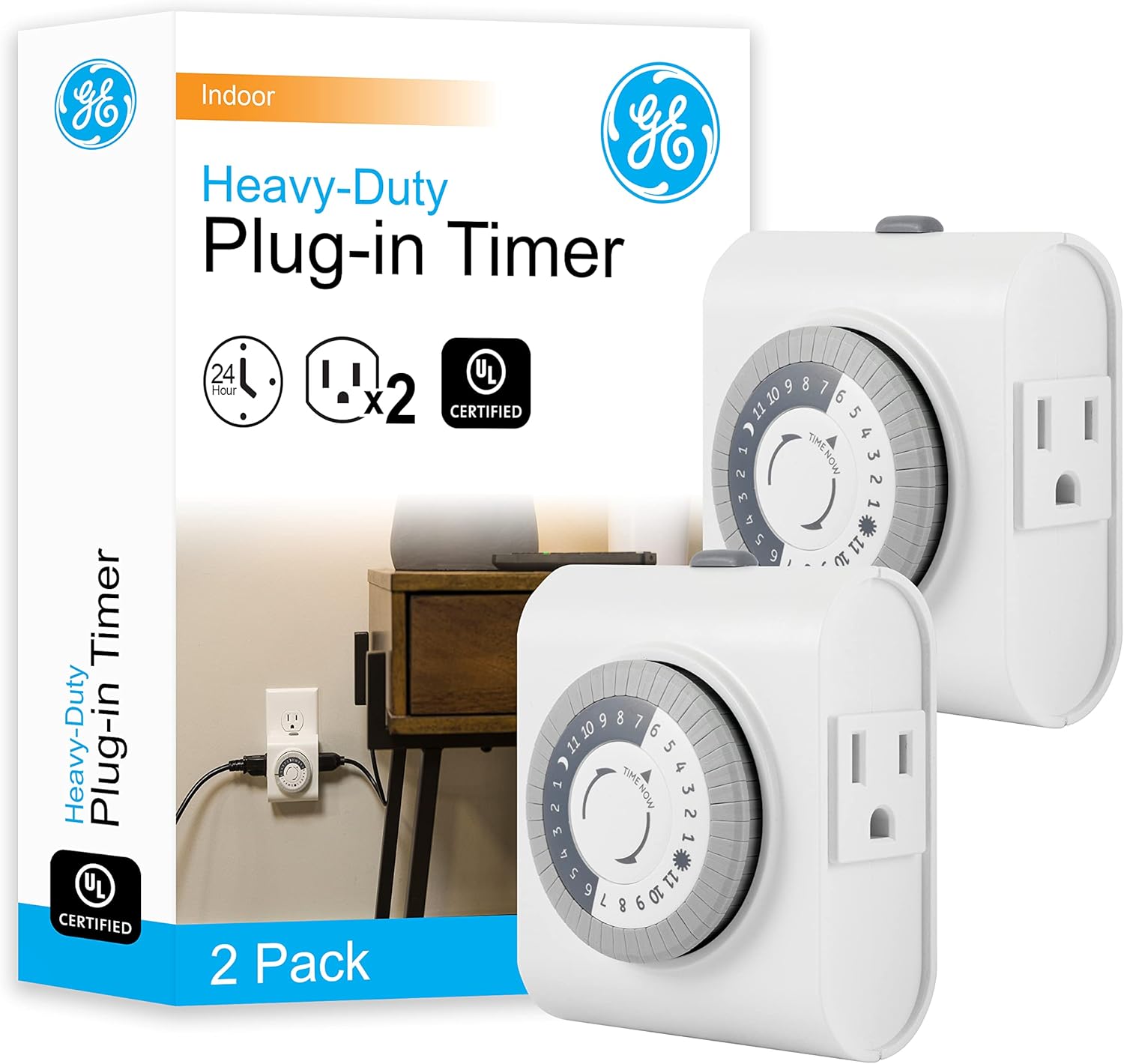
Pros
- Two grounded outlets on each timer run independently timed devices from a single wall receptacle
- 30-minute interval pushpins allow multiple on/off cycles across a full 24-hour rotation
- No WiFi, app or hub pairing needed, so setup is a single rotating dial
- Override switch lets you bypass the schedule for manual control without resetting the pins
- Side-access outlet layout keeps cords flush against the wall for placement behind furniture
Cons
- Mechanical pushpins only allow 30-minute scheduling increments, not the minute-level precision of a smart plug
- No mobile app or remote control, so any schedule change means walking to the outlet itself
- Indoor-rated design only, not suited to outdoor or damp-location use
Instead of an app or WiFi pairing, the timer uses a rotating 24-hour dial fitted with pushpins set at 30-minute intervals. Pushing a pin down programs an on or off point on the dial, and the cycle repeats automatically every 24 hours once set. Because the mechanism is entirely mechanical, there is no hub, account or firmware update involved in daily use.
- 30-minute interval pushpins around a 24-hour dial
- Cycle repeats automatically every day once programmed
- Override switch pauses the schedule for manual control
Anyone wanting minute-precise or randomized scheduling (for security purposes, for example) will find the 30-minute steps coarser than what an app-based smart plug offers.
Each timer plugs into one wall receptacle and provides two grounded outlets that run on the same programmed schedule simultaneously, so a single dial can control two lamps, a fan and a small appliance together, or one device split across both prongs of a heavier plug. The side-access outlet layout is designed to keep cords running flush against the wall rather than sticking straight out.
- Two grounded outlets share one programmed schedule
- Side-access layout for cords routed flush to the wall
- Compatible with LED, CFL and incandescent bulbs
Because both outlets follow the same on/off cycle, this pack suits pairing similar devices like two lamps rather than running one item on a completely separate schedule from the other.
Measuring 2.7 x 3.4 x 3.4 inches with a white plastic housing, the timer is built for indoor placement -- behind furniture, in a hallway outlet, or wherever seasonal lighting and small appliances need daily automation. It suits Christmas trees, lamps and fans that only need a repeating daily cycle rather than a connected, app-controlled routine.
- Compact 2.7 x 3.4 x 3.4-inch housing for indoor outlets
- Two-pack covers two separate receptacles in one purchase
- White finish blends with typical wall and trim colors
It is not built for outdoor or damp locations, so exterior holiday lighting on a porch or in a garage without weatherproofing is outside its intended use.

Pros
- ✓ WITH UPDATED BLACK PINS: We've made the pin dial easier on the
- ✓ TIMER : 4 outlets are controlled by the timer, 4 outlets are
- ✓ LIGHTS: Each row is equipped with a colored LED, indicating when
- ✓ SWITCH: Use the override 'on' switch to manually keep the timer
Cons
- Best placed in well ventilated indoor spaces away from excess moisture
- Requires proper surface alignment during initial installation
The BN-LINK BN-LINK 8 Outlet Surge Protector with Mechanical Timer 4 is engineered to address the operational demands of Surge Protectors environments. Key physical design elements prioritize user comfort through ✓ WITH UPDATED BLACK PINS: We've made the pin dial easier on the eyes! The power cord measures 3 feet.. Equipped with ✓ TIMER : 4 outlets are controlled by the timer, 4 outlets are always on. All 8 outlets are fully protected by the surge protector, with a circuit breaker switch for safety. The timer pin dial can be set in increments as low as 15 min. The programed schedule will repeat every 24 hours., the hardware delivers reliable structural support under regular demands.
Component assessment indicates careful selection of durable materials tailored for active usage. Key structural features including ✓ LIGHTS: Each row is equipped with a colored LED, indicating when the power for that row is on. support overall longevity during regular operational cycles. Careful manufacturing ensures that frame connections retain rigidity over long term use. Attention to manufacturing details ensures reliable utility for your Surge Protectors. Using proper installation techniques maintains physical stability across daily activities. This balanced configuration fits smoothly into existing interior designs while maximizing efficiency. Quality craftsmanship supports long term satisfaction for residential and professional settings.
Preserving structural integrity over extended service life is achieved through consistent daily care. Attributes like ✓ SWITCH: Use the override 'on' switch to manually keep the timer outlet row on allow hassle-free integration into existing room configurations. Preventing prolonged exposure to harsh environmental factors helps preserve original finish quality. Attention to manufacturing details ensures reliable utility for your Surge Protectors. Using proper installation techniques maintains physical stability across daily activities. This balanced configuration fits smoothly into existing interior designs while maximizing efficiency. Quality craftsmanship supports long term satisfaction for residential and professional settings. User centered design choices streamline routine interactions and enhance practical convenience.

Pros
- Programs up to 8 on/off schedules per outlet across both grounded outlets, controlled simultaneously
- Rated for 1875W at 125VAC/60Hz with 15A of current capacity, enough for typical pond pumps or holiday lighting runs
- Random vacation mode varies on/off timing to make a home look occupied while away
- Weatherproof flame-retardant polycarbonate housing is built for both outdoor and indoor placement
- Scheduling can be set in increments as short as 1 minute for precise on/off timing
Cons
- Both outlets are controlled simultaneously by the same schedule, so the 2 outlets cannot run independent programs
- Built-in extension cord measures only 5.9 inches, limiting how far the timer reaches from the wall outlet
- No remote control included, so every schedule change is set directly on the unit's digital display
This timer supports up to 8 on/off programs across its 2 grounded outlets, which are controlled simultaneously on the same schedule, with settings adjustable in increments as short as 1 minute.
- Up to 8 on/off programs per schedule
- 2 grounded outlets, controlled together
- Individual day selection or preset day combinations
A Random vacation mode varies the programmed on/off timing slightly each cycle, intended to make a home look occupied while away rather than following an obvious fixed pattern. A dedicated button switches the clock for Daylight Savings changes without needing to reprogram every schedule from scratch. Because both outlets share one schedule, running two devices on different timing plans requires a second timer.
Rated for 125VAC at 60Hz with 15A of current capacity and a 1875W (1/2HP) maximum load, this timer is built to handle heavier outdoor loads like pond pumps and strings of holiday lighting.
- 1875W / 1/2HP maximum rated load
- 15A current capacity
- 125VAC, 60Hz operation
The 1875W ceiling covers most single-device outdoor loads such as pond pumps, landscape lighting runs, or holiday light strings, though very high-draw equipment should be checked against this limit before connecting. Because the timer is ETL listed, it has been tested against recognized electrical safety standards for its rated load.
Built from flame-retardant polycarbonate, this timer is weatherproofed for both outdoor and indoor placement, with a compact 2 in D x 4.2 in W x 6.6 in H footprint.
- Flame-retardant polycarbonate housing
- Weatherproof construction for outdoor use
- Built-in 5.9-inch extension cord
The weatherproof housing suits placement near pool pumps, garden lighting, or holiday displays exposed to the elements, though the built-in extension cord is only 5.9 inches, so the outlet it plugs into needs to be within close reach of the mounting spot. No remote control is included, so schedule changes are made directly at the unit's digital display.
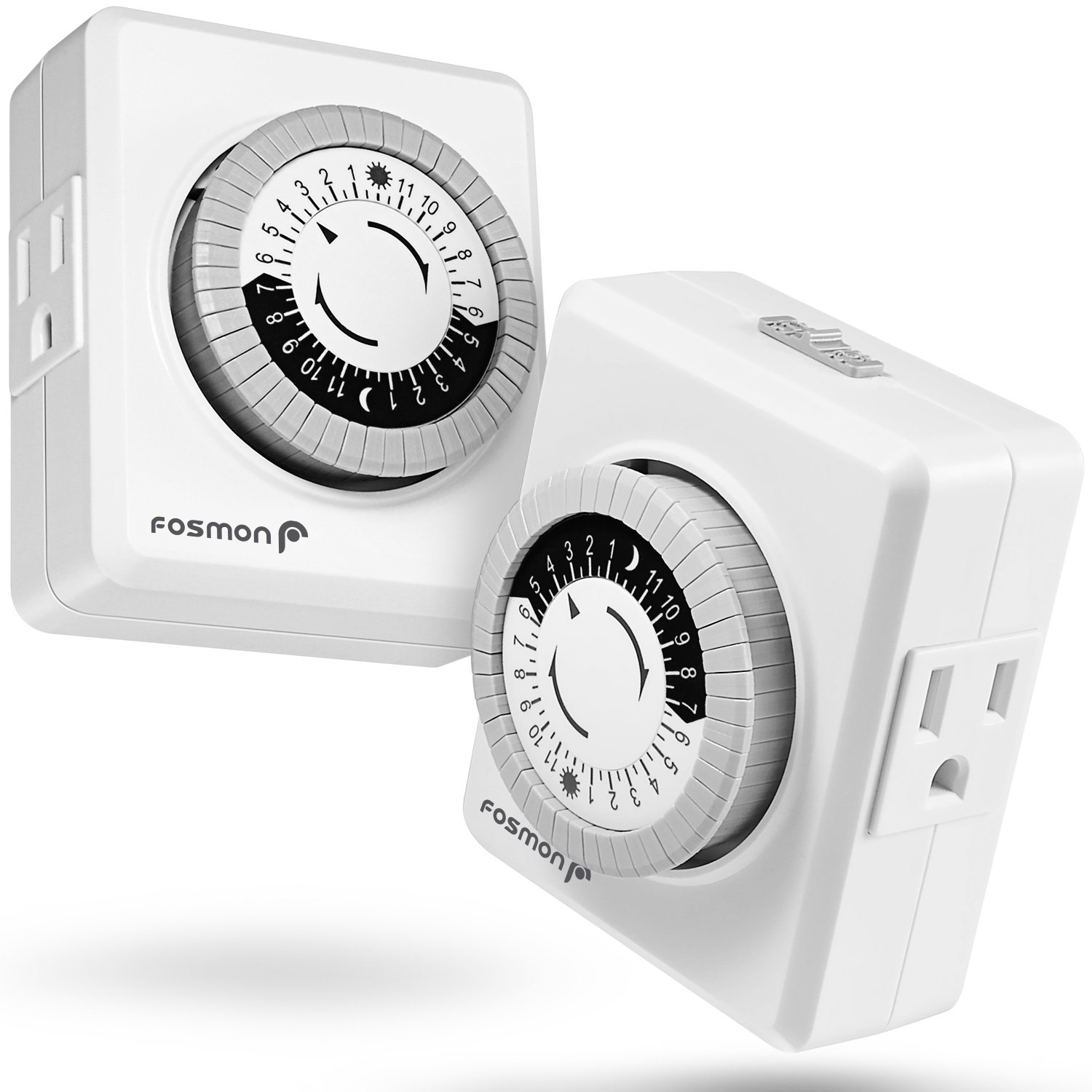
Pros
- Up to 24 on/off settings per day let devices be scheduled in intervals as short as 30 minutes
- Each 2-pack includes dual outlets per timer, controlling up to 4 devices total across both units
- 48 mechanical pushpins set the daily schedule without needing an app or a digital display
- Handles loads up to 15A/1875W, or 10A/3-4HP for tungsten and motor loads, covering typical lamps and small appliances
- ETL listed for tested electrical safety compliance
Cons
- Mechanical pushpin timers reset to a repeating 24-hour cycle, with no day-of-week variation like digital timers offer
- Pins ship pressed down by default, so they must be manually pulled up before the schedule takes effect
- No app or remote control; all scheduling is done physically at the outlet itself
Scheduling is handled through 48 mechanical pushpins per timer, giving up to 24 on/off settings per day in 30-minute increments that repeat automatically every 24 hours. Pins ship pressed down by default and need to be manually pulled up to activate the schedule for that time slot, with a manual override switch on top for immediate control.
- Up to 24 on/off settings per day
- 30-minute minimum scheduling increments
- 48 mechanical pushpins per timer
- Manual override switch for immediate on/off
Because the schedule repeats identically every 24 hours, this setup works best for consistent daily routines rather than schedules that vary between weekdays and weekends.
Each package includes 2 timer plugs, and each timer has 2 grounded outlets, so together the pair can power up to 4 electrical devices across a home or office. The timers work with lamps, small appliances, holiday lighting, reptile habitat lighting, fish tank heaters, grow lights, and compact fluorescent or LED bulbs.
- 2 timers per pack, 2 grounded outlets each
- Compatible with LED bulbs, CFLs, small appliances, and grow lights
- Straightforward plug-in installation, no wiring needed
Because setup is plug-and-play at a standard outlet, no electrician or app pairing is required, though anyone wanting outlet-by-outlet independent scheduling should note each grounded outlet on a given timer shares that timer's single programmed schedule.
These timers are rated for 15A/1875W general use, 10A for tungsten loads, and 3/4HP for motor loads at 125VAC, covering common household lamps, fans, heaters, and seasonal lighting. ETL listing confirms the units have passed independent electrical safety testing for this load range.
- 15A/1875W maximum general load
- 10A limit for tungsten (incandescent-style) loads
- ETL listed for safety compliance
Devices or appliances that exceed these amperage and wattage limits, such as high-draw space heaters or power tools, should not be run through these timers, since staying within the listed capacity is what keeps the unit running safely over time.

Pros
- On durations adjust from 5 seconds to 30 minutes and off durations from 5 seconds to 60 minutes for fine-grained cycling
- Photocell light sensor enables true dusk-to-dawn operation without a manual schedule
- Switches between Day Only, Night Only, and 24-Hour modes to match different equipment needs
- 3-prong grounded outlet is ETL listed and rated for 125VAC, 1875W, 15A
- Dial-based setup requires no app, programming, or digital interface to configure
Cons
- Mechanical dial control is less precise than digital timers, which allow programming down to the second
- Indoor use only, so it cannot be mounted outdoors near sprinklers or exterior equipment without added protection
- Short cycle range tops out at 30 minutes on and 60 minutes off, too short for once-daily schedules some appliances need
This timer is built around short, repeating on/off cycles rather than a single daily schedule. On durations run from 5 seconds to 30 minutes, and off durations from 5 seconds to 60 minutes, set with simple dials rather than digital programming.
- Photocell light sensor enables dusk-to-dawn operation, turning the cycle on only when it is dark
- Day Only, Night Only, and 24-Hour modes switch the timer's active window
- Dial-based interface needs no app or manual programming steps
This range of cycle lengths fits equipment that needs frequent short bursts, such as misting pumps or ventilation fans, rather than appliances that only need to switch once or twice a day.
Setup involves plugging the timer into a standard outlet, plugging the appliance into the timer's outlet, and turning the dials to the desired on and off durations. No wiring, batteries, or software installation is involved.
- 3-prong grounded plug and outlet are ETL listed for safety compliance
- Rated for 125VAC, 60Hz, 1875W, 15A on tungsten and resistive loads, and 1 HP on motor loads
- Photocell sensor is built into the housing, requiring no separate light sensor accessory
Because it is a mechanical device rather than a digital one, there is no clock to reset after a power outage, which keeps it maintenance-free once it is dialed in.
This timer is aimed at hydroponics, aquaponics, and aeroponics setups where pumps, misters, or fans need to cycle repeatedly through the day and night rather than switch on once. It works equally well for humidifiers and small ventilation equipment.
- Photocell sensor makes it suited to grow lights or equipment tied to natural daylight
- Repeat-cycle dials fit tasks like periodic misting or aeration far better than a single daily on/off timer
- Rated for indoor use only, so outdoor sprinklers or exterior lighting need a weatherproof timer instead
Anyone needing digital precision, multiple independent schedules, or outdoor-rated housing should look toward BN-LINK's digital or weatherproof timer models instead of this mechanical interval version.
Why a Timer Is Essential for Grow Lights
Plants rely on predictable day-and-night cycles to regulate photosynthesis, flowering, and rest. When light hours drift because you forgot to turn a lamp on or left it running overnight, plants get stressed, growth slows, and flowering can stall. A dedicated timer keeps your light schedule locked in place, which is exactly why so many indoor growers treat a timer as non-negotiable equipment rather than an optional accessory.
Beyond plant health, a good timer saves electricity by ensuring lights only run when needed. It also protects your fixtures from unnecessary wear and lets you leave home for a weekend without worrying about your garden. In short, the right timer turns a demanding daily chore into a set-it-and-forget-it system that runs quietly in the background.
There is also a consistency benefit that is easy to overlook. Plants respond to the total number of light hours they receive, and even small daily variations add up over a growing season. A timer removes human error entirely, so your plants get the exact same light window whether you are busy, traveling, or simply asleep before your lights are due to switch off. That reliability is what makes automated indoor gardens so much easier to manage than manual ones.
Photoperiod Basics You Should Know
Different plants want different light schedules. Leafy greens and seedlings often do well with long days of 14 to 18 hours of light, while many flowering plants need a strict 12-hours-on, 12-hours-off cycle to trigger blooming. Because these schedules must stay consistent day after day, a timer that can reliably repeat the same on-and-off pattern is the difference between plants that flourish and plants that sulk.
Mechanical vs. Digital Grow Light Timers
The first big decision is whether to go mechanical or digital. Both can run grow lights well, but they suit different growers. Understanding the trade-offs helps you avoid overpaying for features you will not use, or under-buying and wishing you had more control.
Mechanical Timers: Simple and Reliable
Mechanical timers use a rotating dial with small pins or segments you push down to set on-and-off periods, usually in 15- or 30-minute intervals across a 24-hour cycle. They are inexpensive, intuitive, and hold their settings even during a power flicker because the schedule is physical rather than stored in memory. For a straightforward single light cycle that repeats every day, a mechanical model is hard to beat.
Options like the BN-LINK 24-Hour Mechanical Timer and the two-pack BN-LINK Grounded Mechanical Timer are built with aquariums, grow lights, and hydroponics in mind, offering the 15-minute intervals most indoor gardeners want. If you prefer a well-known brand, the GE 24-Hour Mechanical Timer and its GE Dual-Outlet Timer two-pack deliver the same dependable dial-based control for indoor lighting and small appliances.
Digital Timers: Precision and Programmability
Digital timers use a small screen and buttons to store multiple on-and-off programs, often across a full 7-day week. This lets you run more complex schedules, such as slightly different timing on certain days, and set switching times down to the exact minute. They typically include a battery backup so your programs survive a power outage, though you will want to check that battery occasionally.
If you value precision, the BN-LINK Digital Dual-Outlet Timer offers eight on-off programs and independent outlet control, making it a flexible pick for indoor setups. Growers who need weatherproof performance for a greenhouse or patio can look at the BN-LINK 7-Day Outdoor Digital Timer, which is built to handle the elements while keeping accurate schedules.
Key Features to Look For
Once you have chosen between mechanical and digital, a few practical features separate a timer you will love from one that frustrates you. Keep these in mind as you compare models so your final choice matches how you actually garden.
Interval Length and Number of Programs
Interval length determines how finely you can tune your schedule. Mechanical timers with 15-minute intervals give you more precise control than 30-minute ones, which matters if you want lights to shift with sunrise or coordinate with other equipment. On digital units, look at how many separate on-off programs are supported; more programs mean more flexibility for multi-zone or varied schedules.
Number of Outlets and Load Rating
Think about how many lights or devices you need to control. A single-outlet timer is fine for one lamp, while dual-outlet and multi-outlet models let you run several fixtures on one schedule. For larger setups, a surge protector with built-in timing such as the BN-LINK 8-Outlet Timer Surge Protector combines timed and always-on outlets, so your lights follow a cycle while fans or pumps stay powered. Always confirm the wattage and amperage rating comfortably exceeds your combined load.
Indoor vs. Outdoor and Weather Resistance
Where you place the timer matters. Indoor timers are compact and affordable, but if your grow area is a garage, greenhouse, or covered patio exposed to moisture, choose a weatherproof model. The BN-LINK Outdoor Heavy-Duty Timer is designed for damp conditions and heavier loads, making it a safer choice outside than a standard indoor unit.
Specialty and Cycle Timers
Some growing methods, especially hydroponics, aeroponics, and aquaponics, need short repeating cycles rather than a simple daily on-off. For those setups, an interval or cycle timer like the BN-LINK Short-Period Repeat Cycle Timer can switch pumps or lights on and off in short bursts and even respond to light with a photocell. If you have reptiles or a mixed grow-and-terrarium space, a versatile dual timer such as the Fosmon Dual Outlet Timer covers grow lights and heat lamps alike.
How to Match a Timer to Your Setup
The best way to choose is to start with your plants and your space, then work backward to the timer. A little planning here prevents the common mistake of buying a device that is either too basic or more complicated than you need.
For Beginners and Simple Gardens
If you are running one or two grow lights on a single daily schedule, keep it simple with a mechanical timer. They are cheap, foolproof, and reliable, and they hold their settings without any programming knowledge. This is the most common starting point for anyone growing herbs on a windowsill or starting seeds indoors.
For Growing Enthusiasts and Larger Spaces
As your garden grows, you may want different schedules for different plants, multiple outlets, or minute-level precision. That is where digital and multi-outlet timers shine. Investing a little more in programmability pays off when you are juggling seedlings, vegetative growth, and flowering plants that each demand their own light cycle.
For Hydroponics and Automated Systems
Water-based and automated systems often need cycle timers that pulse equipment on and off throughout the day. If pumps and lights must fire in short, repeated intervals, a specialty interval timer is the right tool, since a standard 24-hour timer simply cannot switch quickly enough to match those needs.
Tips for Getting the Most From Your Timer
Whichever model you pick, a few habits will keep your automated garden running smoothly. First, set your schedule to your plants’ growth stage and adjust it as they mature, especially when moving flowering plants to a 12-12 cycle. Second, do not overload the timer; add up the wattage of everything plugged in and stay well under the rated limit for safety.
Third, if you choose a digital model, check the backup battery once in a while so a power outage does not wipe your programs. Finally, place the timer somewhere accessible and dry so you can glance at it and confirm your lights are cycling as expected. These small steps protect both your equipment and your plants over the long run.
Final Thoughts
Choosing among the best timers for grow lights comes down to matching the device to your plants, your space, and how hands-on you want to be. Mechanical timers offer unbeatable simplicity and value for single daily cycles, while digital and cycle timers unlock the precision and flexibility that larger or automated gardens demand. Weatherproof and multi-outlet options round out the choices for anyone growing beyond a single lamp.
Take a moment to map out your schedule, count your outlets, and add up your wattage, then pick the timer that fits. With the right one in place, your grow lights will run on a perfect rhythm day after day, freeing you to focus on the fun part of indoor gardening: watching your plants grow.




Comments are closed.
No reviews yet. Be the first to share your experience!