
 Ryan Delgado
 Switching to LED bulbs is one of the easiest ways to cut your energy bill, but many homeowners quickly discover a frustrating problem: their old dimmer switch makes the new LEDs flicker, buzz, or refuse to dim smoothly. That is because most legacy dimmers were designed for power-hungry incandescent bulbs, not the low-wattage electronics inside a modern LED. Choosing one of the best dimmers for LED lights is what separates a warm, flicker-free glow from a headache-inducing strobe effect. This guide walks you through what actually matters, how to match a dimmer to your setup, and which proven models are worth your attention.

Pros
- Dims across the full 0 to 100 percent range from the wall paddle or the app, not just preset steps
- Single click restores the previous level while a double click fades the light off gradually for bedtime
- Alexa and Google Assistant voice control work directly with no bridge or hub in the circuit
- UL certified polycarbonate body measuring 5.06 by 3.33 by 1.74 inches with the faceplate fitted
- Three switches per pack covers a hall, landing and living room in one wiring session
Cons
- Requires a neutral wire in the back box, which many older properties simply do not have
- Single pole only, so it cannot form a three-way pair controlling one light from two positions
- Joins 2.4 GHz Wi-Fi only, so a 5 GHz-only network name will not appear during setup
Before anything else, open the switch box and confirm there is a neutral conductor bundled at the back. Smart dimmers need constant power to keep their radio alive, and this one will not function on a switch loop without a neutral.
- The body measures 4.13 by 1.71 by 1.74 inches without the faceplate, so it is deeper than a mechanical toggle and needs box volume to fold the conductors back
- Single pole wiring only, so a light already controlled from two switch positions cannot be converted without rewiring
- The Kasa or Tapo app walks through the physical steps and the network join process, but the mains work itself is unchanged
If you are not confident isolating a circuit at the consumer unit and identifying line, load, neutral and ground, bring in an electrician. The manufacturer recommends the same.
Control is deliberately available in two places, so the switch still behaves like a switch for anyone who never opens the app.
- Physical buttons on the plate set brightness anywhere from 0 to 100 percent, and a single click returns the light to its last used level
- A double click triggers a gradual fade to off, which is genuinely useful on a bedroom circuit
- Schedules follow a daily routine, so a landing light can taper up before an alarm or drop away at a fixed hour
- Away Mode cycles lights on and off in a pattern that reads as occupancy while the house is empty
Grouping ties several Kasa devices to one tap, and Smart Actions let a press on this plate mirror across other Kasa hardware, which turns a hallway switch into a whole-floor control.
These switches connect straight to a home router. No hub, bridge or proprietary gateway sits between them and the network, which removes a device from the shelf and a port from the router.
- The radio is 2.4 GHz only. If your router broadcasts a single merged network name across both bands, splitting them apart for a few minutes makes setup far smoother
- Amazon Alexa and Google Assistant are both supported for voice control of on, off and brightness levels
- Remote control works from outside the house through the app, so lights can be checked and changed while away
One consequence of Wi-Fi rather than a low-power mesh protocol is that each switch counts as a client against your router limit. Three of them in one pack means three more entries on the network, which is worth noting on older routers.

Pros
- Works with existing bulbs already installed, so there is no need to buy new smart bulbs to add dimming control
- No neutral wire required for installation, which suits many older homes with two-wire switch boxes
- Supports up to 600 watts of incandescent or halogen load, or 150 watts of dimmable LED or CFL bulbs
- The paired smart hub runs without relying on home Wi-Fi, so switch response stays fast even during router outages
Cons
- A separate smart hub is required for app control, scheduling, and voice assistant integration, it is not included with this switch
- A remote for wireless 3-way setups is sold separately, not bundled with the dimmer
- Wall plate is sold separately as well, so the switch ships without a finishing cover plate
This dimmer supports up to 600 watts of incandescent or halogen bulbs, or 150 watts of dimmable LED or CFL bulbs, and installs without requiring a neutral wire, which matters in older homes wired with only two conductors at the switch box. It measures 1.13 x 2.93 x 4.69 inches and is built with a metal and plastic housing.
- Load capacity: 600W incandescent/halogen or 150W dimmable LED/CFL
- No neutral wire required
- Configuration: single-pole or 3-way
- Dimensions: 1.13 x 2.93 x 4.69 inches
Because it works with the bulbs already in the fixture, switching to smart dimming does not require replacing existing incandescent, halogen, LED, or CFL bulbs with proprietary smart bulbs.
Full smart features, including app control, scheduling, and geofencing, require a separate smart hub, which is not included with this switch on its own. Once paired, the hub connects the switch to Alexa, Apple Home, Google Home, Ring, and Sonos, without depending on a stable Wi-Fi connection for basic switch response.
- Smart hub required for app and voice control (sold separately)
- Compatible with Alexa, Apple Home, Google Home, Ring, Sonos
- Hub-based connection stays responsive without relying on home Wi-Fi
A companion remote, sold separately, can add wireless 3-way switching to any location in a room without running new wiring, useful for lamps or secondary control points.
Beyond the dimmer switch itself, a few components are sold separately rather than bundled: the smart hub for app and voice control, a remote for wireless secondary switching, and a coordinating wall plate for a finished look.
- Smart hub: sold separately
- Wireless remote: sold separately
- Wall plate: sold separately
Anyone planning a full smart lighting setup across several rooms should plan for the hub as a one-time purchase that can then support additional switches added later, since a single hub connects multiple switches throughout a home.
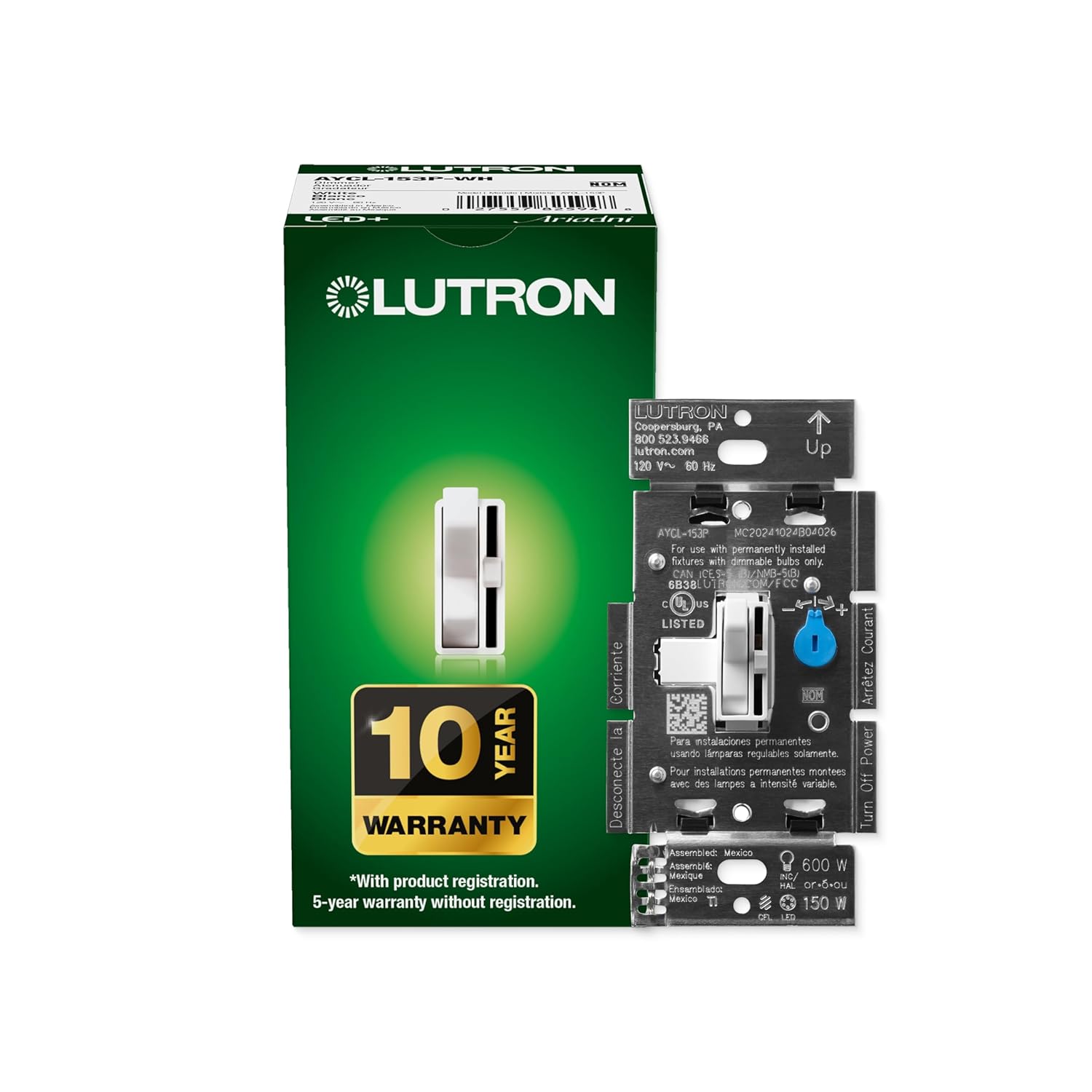
Pros
- Handles up to 150W of dimmable LED/CFL bulbs or 600W of incandescent/halogen on one circuit
- Works in single-pole or 3-way wiring, so it controls lights from one or two switch locations
- No neutral wire required, which keeps installation compatible with older home wiring
- Offers over 250 distinct lighting levels through the slide control next to the toggle
- Metal construction with a compact 1.18 x 2.86 x 4.6-inch footprint fits standard wall boxes
Cons
- Coordinating wall plate is sold separately, so the switch alone ships without a faceplate
- 150W LED/CFL ceiling limits it to smaller fixture groups, since larger multi-bulb chandeliers may exceed that load
- White finish only in this listing, with no other color option included
This Lutron Ariadni dimmer is rated for up to 150W of dimmable LED or CFL bulbs, or 600W of incandescent or halogen bulbs, on a single circuit. It supports both single-pole wiring, controlling lights from one switch location, and 3-way wiring, controlling the same fixture from two separate switches using a standard companion toggle.
No neutral wire is required for installation, which matters in older homes where the electrical box may only carry a hot and a switched-leg wire. The dimmer measures a compact 1.18 x 2.86 x 4.6 inches and is built with metal internal components rather than an all-plastic housing.
- 150W LED/CFL or 600W incandescent/halogen capacity
- Single-pole or 3-way wiring support
- No neutral wire required
Lutron states this switch installs in as little as 15 minutes in homes of most ages, since it does not require a neutral wire connection. The toggle turns the connected lights fully on or off at your last-used brightness, while a separate slide control next to the toggle adjusts brightness across more than 250 available levels.
For a 3-way setup, the dimmer pairs with a standard companion toggle switch at the second location rather than a second dimmer. A coordinating wall plate is not included and needs to be purchased separately to match your room's other switches. Always shut off power at the breaker before working on any wall switch wiring.
Given its 150W LED/CFL and 600W incandescent/halogen limits, this dimmer fits typical living rooms, dining rooms, kitchens and bedrooms where a handful of bulbs share one circuit, rather than rooms with a large multi-bulb chandelier that could exceed the wattage ceiling. The 3-way wiring option makes it useful in rooms with two entry points, such as a hallway-connected living room or a basement with stairs at both ends.
- Suited to standard-size rooms with moderate bulb counts
- 3-way compatibility fits rooms with two switch locations
- Not ideal alone for large chandeliers near the 150W LED ceiling
Because it works with a broad range of dimmable LED and CFL brands, it is a practical fit for anyone gradually converting a home to LED lighting room by room.

Pros
- Handles up to 150 watts of dimmable LED/CFL bulbs or 600 watts of incandescent/halogen on the same circuit
- Works in single-pole setups or 3-way configurations controlling one light from two switches
- Paddle switch plus a separate slide control lets you turn lights on/off and adjust brightness independently
- Advanced circuitry reduces flicker, buzz, and delay compared with basic dimmers on LED bulbs
- Compact 1.31 x 2.94 x 4.69-inch size fits a standard wall box without special wiring
Cons
- Coordinating Claro wall plate is sold separately, not included with the switch
- Almond finish only in this listing, so matching other paddle colors elsewhere in a home may take extra shopping
- Compatible bulb list is broad but not universal, so checking specific LED bulb compatibility beforehand avoids flicker issues
This dimmer is rated for up to 150 watts of dimmable LED or CFL bulbs, or up to 600 watts of incandescent or halogen bulbs, and can handle a mixed load of LED and halogen bulbs on the same circuit. LED+ technology is built specifically to reduce flicker and buzz on compatible LED bulbs.
- 150W maximum for dimmable LED/CFL bulbs
- 600W maximum for incandescent/halogen bulbs
- Supports mixed bulb-type loads on one circuit
Since not every LED bulb dims identically, checking a bulb's dimmer compatibility before installation helps avoid flicker or a limited dimming range, particularly with lower-wattage LED bulbs near the bottom of the dimming curve.
The switch supports both single-pole installations, where one switch controls the light, and 3-way setups, where the same light is controlled from two separate switch locations, such as opposite ends of a hallway or staircase.
- Single-pole wiring for one-switch control
- 3-way wiring for two-switch control of the same fixture
- Fits a standard wall box at 1.31 x 2.94 x 4.69 inches
Installation follows standard dimmer wiring practices, connecting to the existing electrical box, though anyone unfamiliar with home electrical wiring should shut off power at the breaker and confirm wiring configuration before starting, especially for 3-way setups involving a second switch location.
A large paddle switch handles turning the light fully on or off and returns it to the previously set brightness, while an adjacent slide control lets brightness be fine-tuned separately for different activities like reading, relaxing, or movie watching.
- Paddle switch for quick on/off with memory of prior brightness
- Separate slide control for precise brightness adjustment
- Suited for living rooms, bedrooms, kitchens, and other everyday spaces
Because the paddle style matches a widely used dimmer design, it fits alongside existing paddle switches elsewhere in a home for a consistent look throughout, though a matching wall plate needs to be ordered separately to complete the finished appearance.

Pros
- Works with up to 150W of dimmable LED/CFL bulbs or 600W of incandescent/halogen on one switch
- Tap on/off plus a separate rocker for dimming keeps quick toggling and fine adjustment on the same control
- No neutral wire is required, simplifying installation in older homes without one
- Expands to 3-way or multi-location setups for up to 10 locations with a companion switch
- Installs in as little as 15 minutes using standard tools
Cons
- Multi-location setups beyond a single switch require a separate MA-RR-XX companion switch, sold apart
- LED and CFL bulbs are capped at 150W, well below the 600W ceiling for incandescent or halogen bulbs
- Tested compatibility applies to specific bulb brands, so pairing with untested LED bulbs may need trial and error
A tap control turns the connected light fully on or off, while a separate rocker adjusts brightness up or down, keeping quick switching and fine dimming on one control rather than a single all-purpose slider. An LED indicator lights up to show the current dimming level at a glance.
- Delayed fade-to-off gives time to exit a room or settle into bed before lights fully switch off
- Preset light level programming sets a default brightness every time the switch turns on
- Low-end and high-end trim adjustments fine-tune the dimming range for specific bulbs
Because these settings are configured through button presses rather than an app, the initial setup takes a short walkthrough of the programming steps.
This dimmer installs in as little as 15 minutes using standard tools, and no neutral wire is required, which simplifies retrofitting into homes with older wiring. It supports single-pole use on its own or 3-way and multi-location setups covering up to 10 locations when paired with a companion switch.
- No-neutral wiring reduces the rewiring needed compared with some smart dimmer models
- A coordinating Claro wall plate is sold separately for a finished look
- Metal and plastic construction house the internal dimming electronics
For multi-location control, an MA-RR-XX companion dimmer is needed at each additional switch point, since that hardware is not bundled with this single switch.
The dimmer is tested across thousands of bulbs and dozens of brands, including Philips, Cree, GE, EcoSmart, and Lighting Science, to reduce flickering across a broad range of dimmable LED and CFL bulbs. Wattage limits sit at 150W for LED/CFL and 600W for incandescent or halogen bulbs on a single switch.
- Dimmable-labeled bulbs are required, since non-dimmable LED or CFL bulbs may flicker or buzz
- Mixing bulb brands on the same circuit can still affect dimming smoothness
- Button-press setup lets the switch calibrate to a bulb's optimum dim range after installation
Checking that a bulb is labeled dimmable before installation helps avoid the flickering that untested LED bulbs can cause on any dimmer switch.

Pros
- Handles up to 150 watts of dimmable LED or CFL bulbs, or up to 600 watts of incandescent/halogen bulbs on one switch
- Works as either a single-pole switch or in a 3-way setup controlling the same lights from two locations
- No neutral wire required, so it fits older home wiring that lacks a neutral conductor at the switch box
- Rocker turns lights on/off at a memorized level while a separate slider fine-tunes brightness across more than 150 lighting levels
- Installs in about 15 minutes per the manufacturer, though a matching wallplate is not included
Cons
- Coordinating wallplate is sold separately, so the switch alone ships without a decorative cover plate
- Maximum 150W LED/CFL load caps how many bulbs can run on a single switch in a high-fixture-count room
- White finish only in this listing, with no alternate color options bundled
This dimmer handles up to 150 watts of dimmable LED or CFL bulbs, or up to 600 watts of incandescent or halogen bulbs, covering most single-room lighting loads on one switch. It works in either single-pole or 3-way wiring configurations, so the same switch can control a light from one location or coordinate with a second switch controlling it from two locations.
- Up to 150W dimmable LED/CFL load
- Up to 600W incandescent/halogen load
- Single-pole or 3-way wiring compatible
Lutron states the switch has been tested across thousands of bulbs and dozens of brands for flicker-free dimming, though performance still depends on the specific LED driver inside each bulb; pairing with an untested bulb brand can occasionally show flicker at very low dim levels.
Installation does not require a neutral wire, which matters in older homes where the switch box may only have hot and traveler wires and no neutral conductor present. The manufacturer states installation takes about 15 minutes, using standard wire connections rather than specialized tools.
- No neutral wire required
- Approximately 15-minute install per the manufacturer
- Includes the switch only; wallplate sold separately
Because the coordinating wallplate isn't included, plan for a separate Lutron Skylark wallplate purchase to get a finished look; installing the switch alone without a plate leaves the wiring exposed at the box.
The switch offers more than 150 distinct lighting levels between fully off and fully bright, controlled by a slider separate from the rocker on/off button, so the rocker can turn lights on at a memorized brightness while the slider fine-tunes from there. Lutron's dimming technology is built to optimize the dim range for each bulb type and reduce interference with other dimmers installed nearby in the same home.
- Over 150 lighting levels
- Separate rocker (on/off) and slider (dim) controls
- Reduces cross-interference with other dimmers
Very basic or off-brand LED bulbs can still show minor flicker at the lowest dim settings despite this optimization, since bulb-side driver quality plays as large a role in smooth dimming as the switch itself.

Pros
- - an easy way to create a big impact for a minimal cost and
- EASY TO INSTALL - slim profile fits in most wallboxes. 150W LED,
- - designed to dim LED bulbs. To find out which LED bulbs pair best,
- SIMPLE - integrated slider for easy, precise dimming. Slide up to
- Dimensions of 1.73 x 0.93 x 4.12 inches engineered for optimal spatial fitting
Cons
- Requires verifying placement clearance for 1.73 x 0.93 x 4.12 inches prior to installation
- Requires gentle maintenance routines to preserve the Plastic finish
Crafted with attention to functional details, the Leviton Leviton SureSlide Dimmer Switch for Dimmable LED Halogen brings efficient performance to your Dimmer Switches. Key physical design elements prioritize user comfort through - an easy way to create a big impact for a minimal cost and customize the light level in any room, for any occasion and in any home. Equipped with EASY TO INSTALL - slim profile fits in most wallboxes. 150W LED, 600W incandescent/halogen. Works with existing wiring, no neutral wire required for installation, the hardware delivers reliable structural support under regular demands. Measurements of 1.73 x 0.93 x 4.12 inches provide clear dimensional boundaries for precise space planning.
Component assessment indicates careful selection of durable materials tailored for active usage. Key structural features including - designed to dim LED bulbs. To find out which LED bulbs pair best, visit Leviton's bulb compatibility tool on their website support overall longevity during regular operational cycles. Careful manufacturing ensures that frame connections retain rigidity over long term use. Constructed using quality Plastic, outer surfaces withstand routine contact without losing visual appeal. Thoughtful spatial layout allows versatile placement across modern living environments. Dependable hardware performance ensures consistent operational output throughout the year. Precision engineering delivers a stable foundation tailored for active household demands.
Preserving structural integrity over extended service life is achieved through consistent daily care. Attributes like SIMPLE - integrated slider for easy, precise dimming. Slide up to turn on and brighten lights and slide down to dim and turn off lights allow hassle-free integration into existing room configurations. Preventing prolonged exposure to harsh environmental factors helps preserve original finish quality. Thoughtful spatial layout allows versatile placement across modern living environments. Dependable hardware performance ensures consistent operational output throughout the year. Precision engineering delivers a stable foundation tailored for active household demands. Carefully selected components ensure minimal maintenance overhead over long service life.

Pros
- Handles up to 150W of dimmable LED/CFL or 300W of incandescent/halogen load per outlet
- 6-foot cord reaches wall outlets that sit well behind furniture or a headboard
- Full-range slide dimmer gives smooth, stepless control rather than fixed presets
- Sits at 8.25 x 4.25 x 7.13 inches, small enough for a nightstand or side table
- Single-pole design plugs directly between the wall outlet and the lamp cord, with no wiring required
Cons
- Only dims lamps plugged into it, so it cannot control a hardwired ceiling fixture
- Not all LED bulbs are compatible; Leviton recommends checking its bulb compatibility list before buying replacement bulbs
- Sold in white in this listing, though a black version exists as a separate purchase
The TBL03-10W dimmer is rated for 150W of dimmable LED or CFL load, or 300W of incandescent/halogen load, on a single lamp circuit. It is a plug-in, single-pole unit — it sits between the wall outlet and the lamp's own plug rather than replacing a wall switch, so no house wiring is touched during setup.
Not every dimmable LED bulb pairs cleanly with every plug-in dimmer. Leviton publishes a bulb compatibility list on its site, and checking a specific bulb model against it before buying is worth the few minutes it takes, since mismatched bulbs can flicker or buzz at low dim levels.
Setup is two steps: plug the dimmer into the wall outlet, then plug the lamp into the dimmer. The 6-foot cord gives enough slack to reach an outlet positioned behind a dresser, headboard, or console table without needing an extension cord. A full-range slide control on the housing adjusts brightness smoothly from off to full output, rather than stepping through a fixed number of preset levels.
Because the dimmer is a standalone plug-in unit rather than a wall-mounted switch, it can move with the lamp to a different room or outlet whenever furniture gets rearranged, and it works with any single-pole lamp setup without an electrician.
At 8.25 x 4.25 x 7.13 inches, the dimmer housing is compact enough to sit on a nightstand, side table, or the floor behind furniture without becoming a visual centerpiece. Its white finish is designed to blend into most table and floor lamp setups rather than stand out.
Because it is a tabletop unit and not a wall switch, it does take up a small footprint of usable surface or floor space near the lamp, which is worth accounting for on a crowded nightstand that already holds a charger and a reading light.

Pros
- Handles dimmable LED and CFL bulbs up to 150 watts alongside incandescent bulbs up to 600 watts on the same switch
- Includes two knob colors (white and light almond) so it can match either finish without buying a separate switch
- UL listed for standard single-pole household circuits at up to 120VAC maximum
- Rotate on/off design gives full-range dimming rather than a stepped low/medium/high setting
Cons
- Single-pole wiring only, so it will not work in a 3-way switch setup controlling one light from two locations
- Not all LED bulbs are dimmable-compatible; non-dimmable LED bulbs can flicker or buzz even when paired with a quality rotary dimmer
- Polycarbonate housing and knob keep to a plain design, with only two finish colors offered
The switch handles dimmable LED and CFL bulbs up to 150 watts combined load, or incandescent bulbs up to 600 watts, covering most single-fixture and small multi-bulb setups in one switch. Full-range rotary control lets the dimming level move smoothly rather than stepping between fixed brightness settings.
- Dimmable LED/CFL bulbs up to 150 watts
- Incandescent bulbs up to 600 watts
- UL listed, 120VAC maximum
- Smooth rotary dimming range
Because wattage limits differ between bulb types, mixing several dimmable LED bulbs on one switch means adding up their combined wattage against the 150-watt ceiling.
This is a single-pole switch, meaning it replaces a standard one-switch light circuit rather than a 3-way setup with two switches controlling the same fixture from two locations. Installation follows standard single-pole wiring, with the switch body built from polycarbonate for basic impact resistance and the rotary dimmer knob providing smooth, full-range control instead of stepped brightness levels.
- Single-pole wiring only
- Standard wallbox installation
- Two knob colors included: white and light almond
Anyone replacing a 3-way switch setup will need a 3-way dimmer instead, since this model is wired for single-location control only, and the polycarbonate housing keeps the switch plate lightweight during installation.
The wide wattage range suits living rooms, dining rooms, kitchens or bedrooms where one light fixture benefits from adjustable brightness for different times of day. The two included knob colors make it easy to match either a white or light almond wall plate scheme already in the room.
- Living and dining rooms wanting mood-adjustable lighting
- Kitchens with a single overhead fixture
- Bedrooms needing a softer, dimmed setting at night
Rooms wired for 3-way control from two switches will need a different dimmer model, since this one is built for single-pole circuits only.

Pros
- Handles up to 300W of LED load or up to 600W of incandescent/halogen load on a single circuit
- No neutral wire required for installation, working with the existing wiring already in most wallboxes
- Adjustable minimum and maximum dimming range specifically tunes out flicker on compatible LED bulbs
- Includes three faceplate colors (White, Ivory, and Light Almond) in the box for matching different trim
- Slim profile fits in standard wallboxes without needing a deeper or wider box swap
Cons
- 3-way installation requires a separate companion switch sold apart from this unit, adding an extra purchase for two-location control
- LED compatibility and dimming range still depend on the specific LED bulb used, so some bulbs may need manual range adjustment to eliminate flicker
- Load capacity tops out at 300W for LED, lower than the 600W ceiling for incandescent or halogen loads on the same switch
This dimmer handles up to 300W of LED lighting load or 600W of incandescent or halogen load on a single circuit, covering most residential fixture setups. Because LED dimming behavior varies more between bulb models than incandescent dimming does, the switch includes an adjustable minimum and maximum dimming range, letting the low end be tuned to eliminate flicker or a dead zone on a specific LED bulb.
Not every LED bulb dims identically well even on a compatible dimmer switch, so checking bulb compatibility, such as through the manufacturer's published compatibility tool, is worth doing before installing new LED bulbs on this circuit if flicker-free performance at low brightness matters.
The DSL06-1LZ works with existing wiring and does not require a neutral wire to be present in the wallbox, which matters in older homes where wallboxes were not wired with a neutral conductor. Its slim profile is built to fit into standard wallboxes without needing a larger cutout, simplifying a switch swap for anyone replacing a basic toggle switch.
For two-location control, such as a stairway or hallway with switches at both ends, this unit pairs with a separate 3-way companion switch that is sold apart from the dimmer itself. Installation otherwise follows standard switch-replacement wiring, connecting to the same wires the previous switch used.
The switch ships with three interchangeable faceplates included in the box: White, Ivory, and Light Almond, letting the color be matched to existing trim or wall outlets without buying a separate cover plate. This is a practical detail for anyone replacing switches across a home with mixed trim colors from different renovation phases.
Beyond faceplate color, the dimming range itself can be customized per installation to help set the right brightness ceiling and ambiance for the room, whether that is a dining room wanting a soft glow or a kitchen needing brighter task lighting at full output.
Why LED Lights Need a Special Dimmer
Incandescent bulbs draw a lot of current and dim in a very predictable, linear way. An LED bulb, by contrast, uses a tiny internal driver that converts household voltage into the low power the diodes need. When you pair that driver with a dimmer built for high loads, the two can fight each other. The result is the classic list of LED dimming complaints: buzzing, flickering, a narrow dimming range where the light drops out at 40 percent, or a faint glow that never fully turns off.
The best dimmers for LED lights solve this by being specifically engineered for low-wattage, electronic loads. They deliver smooth, full-range dimming down to a low glow, minimize interference that causes flicker, and are tested against a wide list of dimmable LED bulbs. If you have already upgraded your bulbs and something feels off, the switch on the wall is almost always the culprit.
Key Features to Look for in an LED Dimmer
LED+ Technology and Wide Compatibility
The single most important spec is whether the dimmer is rated for dimmable LEDs, not just “compatible” with them. Look for language like LED+ or a published bulb compatibility list. A dimmer such as the Lutron Diva LED+ or the Lutron Ariadni Toggler is tuned to work across a broad range of LED, halogen, and incandescent bulbs, which reduces the guesswork when you buy replacement lamps later.
Single-Pole vs 3-Way Wiring
A single-pole switch controls a light from one location. A 3-way setup controls the same fixture from two switches, common at the top and bottom of a staircase or at either end of a hallway. Many quality dimmers, including the Lutron Maestro LED+ and the Lutron Skylark LED+, support both configurations, but you should confirm the wiring type before buying so the dimmer matches your junction box.
Neutral Wire Requirements
Some smart dimmers require a neutral wire in the wall box, which older homes may not have. If your wiring is dated, choose a model that works without a neutral. The Lutron Caseta is popular precisely because it does not need a neutral, while the Kasa Smart Dimmer does require one. Checking this in advance saves a wasted trip and a frustrating install.
Wattage Rating and Load Capacity
LED bulbs sip power, so a common 150-watt LED rating covers a huge number of fixtures. Still, if you are dimming a large chandelier or a long run of recessed cans, add up the wattage of every bulb on the circuit and stay comfortably under the dimmer’s maximum. Overloading a dimmer is the fastest way to shorten its life or trigger overheating. As a rule of thumb, aim to use no more than about 80 percent of the rated capacity so the device stays cool and lasts longer.
Types of LED Dimmers
Smart and Wi-Fi Dimmers
Smart dimmers connect to your home network and let you control lights by app, schedule, or voice through Alexa, Google Home, or Apple Home. The Kasa HS220P3 is a budget-friendly Wi-Fi option that skips the need for a separate hub, while the Lutron Caseta uses its own reliable wireless system prized for rock-solid performance. Smart models cost more but add automation, remote control, and energy-saving schedules.
Toggle and Slide Dimmers
If you prefer a simple, tactile switch, traditional slide and toggle dimmers remain excellent value. A slide control such as the Leviton SureSlide or the Leviton Decora Slide lets you set a favorite brightness and flip the light on and off at that level. The Lutron Ariadni Toggler pairs a familiar toggle with a hidden dimmer slider for a clean, classic look.
Rotary and Plug-In Dimmers
Rotary dimmers use a knob you turn to adjust brightness, a nostalgic and intuitive design. The GE Rotating Dimmer is an affordable in-wall example. For lamps and fixtures you do not want to hardwire, a plug-in unit like the Leviton Table Top Dimmer sits inline on the cord, giving you dimming control without touching any wiring at all.
How to Choose the Right Dimmer for Your Home
Start by identifying what you are dimming and how you want to control it. If you love the idea of scheduling lights, dimming from your phone, or using voice commands, a smart dimmer is worth the premium. If you simply want reliable manual control at the wall, a well-made slide, toggle, or rotary dimmer will serve you for years at a lower price.
Next, confirm your wiring. Note whether the circuit is single-pole or 3-way and whether a neutral wire is present. This single step eliminates most compatibility problems. Then verify your bulbs are marked dimmable, because even the best dimmers for LED lights cannot smoothly dim a bulb that was never designed to dim. Non-dimmable LEDs will flicker or fail no matter how good the switch is.
Finally, think about the room. A media room or bedroom benefits from deep, low-end dimming for a cozy atmosphere, so prioritize a model with a wide dimming range like the Lutron Diva or Maestro. A kitchen or hallway may only need a dependable, easy-to-use control, where the Leviton SureSlide or GE rotary shines. Matching the dimmer to the room’s purpose keeps both your budget and your lighting in balance.
It also helps to think a step ahead. If you plan to add smart home devices later, starting with a smart dimmer creates a foundation you can build on, while a simple manual dimmer keeps things affordable if you value plug-and-play reliability over connectivity. Either way, buying a quality LED-rated unit now means you will not be back on a ladder swapping switches again next year.
Installation Tips and Safety
Replacing a dimmer is a manageable DIY project, but electricity demands respect. Always turn off the circuit at the breaker before you touch any wiring, and use a voltage tester to confirm the power is truly off. Take a photo of the existing connections before you disconnect anything so you have a reference for matching the line, load, ground, and, if present, neutral wires.
Wall-box space matters too. Smart dimmers are often bulkier than standard switches, so make sure the wires can fold neatly behind the device without cramming. If you are combining several dimmers in one multi-gang box, remember that some models must be derated for heat, meaning their maximum wattage drops when installed side by side. When anything feels beyond your comfort level, especially with unfamiliar wiring or aluminum conductors, hiring a licensed electrician is money well spent.
Common Problems and Quick Fixes
If your LEDs flicker after a new install, the most likely causes are a non-dimmable bulb, a bulb-and-dimmer mismatch, or a loose wire connection. Swapping in a bulb from the dimmer’s tested compatibility list usually resolves it instantly. A faint glow when the light is off often points to a dimmer that was not designed for very low LED loads, which is exactly why choosing a purpose-built LED dimmer from the start pays off.
Buzzing can come from either the bulb or the dimmer. Cheaper LED drivers vibrate at certain dimming levels, while a mismatched dimmer can amplify the noise. Pairing quality bulbs with an LED-rated dimmer like the Lutron Skylark LED+ almost always quiets things down. If a limited dimming range leaves you stuck between bright and off, some dimmers offer an adjustable low-end trim that you can tune during setup to unlock the full range.
Frequently Asked Questions
Can I use any dimmer with LED bulbs?
No. Only dimmers rated for LED loads will give smooth, flicker-free results. Older dimmers built for incandescent bulbs often cause buzzing, limited range, or a persistent glow, which is why upgrading to a dedicated LED dimmer is the reliable fix.
Do all LED bulbs work with dimmers?
Only bulbs labeled dimmable will dim. Standard LED bulbs are not designed for it and will flicker or drop out. Always confirm the packaging says dimmable and, when possible, check the dimmer manufacturer’s compatibility list.
Do I need a neutral wire?
It depends on the model. Many smart dimmers require a neutral, while options like the Lutron Caseta and most traditional dimmers do not. Inspect your wall box before buying to be sure.
Final Thoughts
The right dimmer transforms LED lighting from a source of frustration into one of the most satisfying upgrades in your home, giving you the exact ambiance you want while protecting your bulbs and saving energy. Whether you lean toward a smart, app-controlled switch or a dependable manual slider, the best dimmers for LED lights all share the same DNA: true LED compatibility, smooth full-range control, and reliable, flicker-free performance. Match the dimmer to your wiring and your bulbs, follow safe installation practices, and you will enjoy warm, adjustable light in every room for years to come.


