 Ryan Delgado
 How to Choose the Best IP Security Cameras for Your Home in 2026
Shopping for the best IP security cameras can feel overwhelming when every listing promises 4K clarity, AI detection, and subscription-free storage. The truth is that the right camera depends less on marketing buzzwords and more on where you plan to mount it, how you want to store footage, and how much control you want over your own data. This guide walks you through the decisions that actually matter so you can build a smart, reliable surveillance setup without overspending or over-complicating things.
Rather than ranking one product above another, we focus on the features, trade-offs, and buying scenarios that help you match an IP camera to your real needs. Below you will also find a curated shortlist of popular indoor and outdoor models to help you start comparing options quickly.

Pros
- 2K resolution with full-color and infrared night vision reaching a 33ft visible range
- Fully wireless, battery-powered design rated for 1 to 5 months of use per charge
- IP65 waterproof standard allows outdoor mounting in rain or direct weather exposure
- AI motion detection distinguishes people, vehicles, pets, and packages before sending a phone alert
Cons
- Does not support 5GHz Wi-Fi networks, so it requires a 2.4GHz band connection
- Battery life varies from 1 to 5 months depending on activity, requiring periodic recharging rather than constant power
- Cloud storage and extended AI features depend on the companion app and account setup rather than working fully standalone
Because the camera is fully wireless with no power cord or network cable required, it mounts with the included bracket and screws in locations a wired camera could not reach, such as a detached shed or a spot far from an outlet. It connects over 2.4GHz Wi-Fi only, so the router or network needs a 2.4GHz band available during setup.
- No wiring needed: mounts with the included bracket and screws
- Requires a 2.4GHz Wi-Fi network; 5GHz-only routers need a dual-band setting
- IP65 standard supports outdoor placement under rain or direct sun
Recorded footage can be saved to cloud storage or a local SD card, giving a choice between an ongoing cloud plan and a one-time local storage option. Live and recorded video is reachable through the companion app from any location, and access can be shared with multiple users on the same household account.
- Supports both cloud storage and local SD card recording
- App access can be shared across multiple user accounts
- AI motion recognition (person, vehicle, pet, package) reduces false-alert notifications
Beyond the camera itself, a 2.4GHz home Wi-Fi network and the companion app are required to view live footage, receive push notifications, and manage the two-way talk and siren features. An SD card is needed for local recording since one is not included, and a cloud subscription is the alternative if local storage is not preferred.
- 2.4GHz Wi-Fi network required (5GHz is not supported)
- SD card not included; needed for local recording
- Companion app required for live view, alerts, and two-way talk

Pros
- 2K sensor resolving roughly 2304 x 1296, which holds detail when digitally zooming into a face or a delivery label where 1080p smears
- Motorised head sweeps 360 degrees horizontally and 114 degrees vertically, so one unit covers a whole room instead of a fixed cone
- Records locally to a microSD card up to 512 GB, making a cloud subscription optional rather than required
- RTSP and ONVIF streams feed a local NVR such as Blue Iris or Synology Surveillance Station
- Person and baby-cry detection, two-way audio and a built-in siren all run without a paid plan
Cons
- Joins 2.4 GHz Wi-Fi only, so a router broadcasting a single merged network name usually needs its bands separated during pairing
- Mains powered from a wall adapter with no battery option, so both units must sit within reach of an outlet
- Indoor housing with no weather sealing, and no microSD cards are supplied for either camera
Each camera runs from a mains adapter accepting 100 to 240 V, so placement is dictated by outlets as much as by sightlines. The body measures roughly 3.36 x 3.42 x 4.61 in and can sit on a shelf or be screwed to a ceiling with the image flipped in the app.
- Joins 2.4 GHz Wi-Fi only, never the 5 GHz band
- Motorised head sweeps 360 degrees horizontally and 114 degrees vertically
- Two identical units in the pack, each paired and named separately
If the router broadcasts one merged name across both bands, temporarily splitting them or disabling 5 GHz during pairing is the standard fix. Placement matters more than resolution here: a high corner lets the pan and tilt range sweep an entire room, whereas a low shelf leaves the motor staring at the back of the furniture.
The sensor captures 2K video at roughly 2304 x 1296, a meaningful step over 1080p once you start digitally zooming into a face or a parcel label. Infrared illuminators handle night vision in complete darkness, and detection covers motion, person and baby crying, with notifications separated by type so a pet does not raise the same alert as a stranger.
- Records locally to a microSD card up to 512 GB, which is not supplied
- Cloud video history is an optional subscription rather than a requirement
- RTSP and ONVIF streams feed a local NVR or recording server
Local recording plus RTSP is the part that matters for anyone uneasy about indoor cameras, because footage can stay entirely inside the house. Check the manufacturer compatibility list before buying cards, since not every high capacity microSD is accepted.
Plan the extras before install day. Continuous local recording needs two microSD cards, one per camera, and neither is in the box. Each unit also needs a mains socket within reach of its adapter lead, so an outlet or extension has to exist at the mounting point you have in mind.
- Two cards up to 512 GB each, checked against the manufacturer compatibility list
- A 2.4 GHz Wi-Fi network that actually reaches both mounting positions
- An Echo Show or a Chromecast-capable display for voice-summoned live view
Note the boundaries too. The housing is designed for indoor use with no weather sealing, so a porch or an open garage wall is outside its scope. Streaming through Google is limited to Chromecast and Nest screens, and the built-in siren is a deterrent rather than a monitored alarm system.

Pros
- 4K ULTRA HD CLARITY: Experience 4× the resolution of standard 1080p
- AREA : Enjoy 360º horizontal and 116º vertical views with pan/tilt,
- UP TO 18X ZOOM FOR CLEAR : Zoom in without sacrificing detail.
- SECURE REAL-TIME LOCAL : Get faster alerts and more accurate
- Dimensions of 2.93 x 3.49 x 4.68 inches engineered for optimal spatial fitting
Cons
- Requires verifying placement clearance for 2.93 x 3.49 x 4.68 inches prior to installation
- Periodic visual inspection recommended to ensure component tightness
Designed with precision, the Tapo 4K Indoor Pan Tilt Wired Security Camera - Works as a delivers versatile performance for modern Video Monitors spaces. Operational testing demonstrates clear performance benefits driven by 4K ULTRA HD CLARITY: Experience 4× the resolution of standard 1080p for sharper images and finer details. Capture license plates, small objects, and more. In active use, the presence of AREA : Enjoy 360º horizontal and 116º vertical views with pan/tilt, letting you monitor more space. The camera's field of view is greater than the mechanical pan/tilt range eliminates common operational friction for homeowners. Measurements of 2.93 x 3.49 x 4.68 inches provide clear dimensional boundaries for precise space planning.
Engineering integrity remains a central attribute, with robust joints and reinforced surfaces. Hardware stability is reinforced through UP TO 18X ZOOM FOR CLEAR : Zoom in without sacrificing detail. Capture sharp, magnified images with up to 18x digital zoom to enhance your home or business security, ensuring dependable daily performance. Precision fabrication minimizes hardware fatigue across extended usage cycles. Using proper installation techniques maintains physical stability across daily activities. This balanced configuration fits smoothly into existing interior designs while maximizing efficiency. Quality craftsmanship supports long term satisfaction for residential and professional settings. User centered design choices streamline routine interactions and enhance practical convenience.
Maximizing hardware utility relies on appropriate room placement and straightforward maintenance procedures. Incorporating SECURE REAL-TIME LOCAL : Get faster alerts and more accurate detections with on-device AI that keeps facial recognition and other sensitive data off the cloud - giving you the speed & security with total privacy control, routine adjustments can be performed efficiently without specialized hardware. Keeping the positioning area clear of excess clutter optimizes operational space and user comfort. Using proper installation techniques maintains physical stability across daily activities. This balanced configuration fits smoothly into existing interior designs while maximizing efficiency. Quality craftsmanship supports long term satisfaction for residential and professional settings.

Pros
- 【Up, Down, All Around】This Pan/Tilt IP camera see everything across
- 【Detection & Instant Notification】Get instant push notifications
- 【Secure Local or Cloud Storage】Save footage continuously on up to a
- 【Night Vision up to 30 Ft.】Never miss a thing that goes on, even at
- Dimensions of 3.4 x 3.4 x 4.6 inches engineered for optimal spatial fitting
Cons
- Requires verifying placement clearance for 3.4 x 3.4 x 4.6 inches prior to installation
- Periodic visual inspection recommended to ensure component tightness
The Tapo 1080P Indoor Pan Tilt Wired Security Camera - Works is engineered to address the operational demands of Dome Cameras environments. Daily usage reveals robust utility supported by 【Up, Down, All Around】This Pan/Tilt IP camera see everything across an entire room or walkway with the 360° horizontal and 114° vertical range pan/tilt field of view.. Complementing its primary framework, the design also incorporates 【Detection & Instant Notification】Get instant push notifications when motion, person or baby crying is detected, there is no additional fee to use it as a baby camera monitor. Discern from notifications that matter, so you'll know if someone is there. to optimize routine handling. Measurements of 3.4 x 3.4 x 4.6 inches provide clear dimensional boundaries for precise space planning.
Focusing on material selection, this hardware is constructed to resist ongoing physical fatigue. Reinforced internal elements like 【Secure Local or Cloud Storage】Save footage continuously on up to a 512 GB microSD card (not included) or subscribe to Tapo Care for cloud storage which saves 30-day video history and provides additional benefits such as motion tracking, baby crying detection, and more. [Before purchasing a microSD card, please check the TP-Link website FAQ to ensure compatibility with your device.] maintain steady operational balance under continuous use. Solid structural engineering allows the unit to maintain physical stability under load.
Maintaining optimal hardware conditions involves simple periodic inspection and spatial planning. Featuring 【Night Vision up to 30 Ft.】Never miss a thing that goes on, even at night thanks to the integrated IR system on this indoor camera which provides 30 feet of night vision., ongoing operation remains intuitive across varied household routines. Wiping surfaces periodically with a soft cloth prevents dust accumulation in functional crevices. Attention to manufacturing details ensures reliable utility for your Dome Cameras. Using proper installation techniques maintains physical stability across daily activities. This balanced configuration fits smoothly into existing interior designs while maximizing efficiency.

Pros
- Motorised head covers 360 degrees horizontally and 130 degrees vertically, so one unit watches a driveway, side path and front door in turn
- Infrared night vision reaches up to 98 ft, enough for a typical driveway or back garden in total darkness
- Person detection and high-speed motion tracking keep a moving subject in frame and cut alerts from swaying branches
- Physical privacy mode rotates the lens behind the housing, blocking it mechanically rather than in software
- Records to a microSD card of up to 512 GB, with an optional cloud service as an alternative
Cons
- Mains wired with no battery, so the install is limited to spots you can run power to
- 2.4 GHz Wi-Fi only, so signal strength at the mounting point needs checking before drilling
- 1080p resolution softens quickly under digital zoom, so faces beyond about 15 ft are hard to identify
This is a wired outdoor camera, so the install starts with the power run rather than the view. It draws from a mains adapter, which means an outdoor socket, a hole drilled through a wall to an indoor socket, or a soffit fitting near an existing supply.
- The body measures 4.88 x 4.84 x 3.54 in and fixes to a wall or ceiling with the supplied bracket
- Under an eave is the usual spot. It shelters the housing and puts the lens above head height, out of easy reach
- Wi-Fi is 2.4 GHz only, which is actually the right band outdoors since it carries through brick better than 5 GHz. Test signal strength at the mounting point before you drill
Mount the bracket, seal the cable entry, then aim the head from the app rather than by hand.
Onboard AI performs person detection with no extra step, which cuts the constant alerts a plain motion trigger throws every time a branch moves. When it sees movement, the head rotates to follow the subject and keeps it in frame.
- Footage records to a microSD card of up to 512 GB fitted inside the housing and supplied separately, with an optional cloud service as an alternative
- Two-way audio runs through the app, and you can record your own message to play as an alarm instead of the stock siren
- Physical privacy mode rotates the lens so the housing blocks it. That is genuinely covered rather than merely software-disabled, which matters on a camera pointed anywhere near a neighbouring garden
The head sweeps 360 degrees horizontally and 130 degrees vertically, so one unit mounted on a corner can watch a driveway, a side path and a front door in turn instead of covering a single fixed cone.
Resolution is 1080p. That reads a plate or a face close to the camera, but softens quickly under digital zoom, so mount it where people pass within roughly 15 ft rather than watching the far end of a long garden.
- Infrared night vision reaches up to 98 ft, producing a monochrome image across a typical driveway
- Alexa and Google Assistant can pull the feed to a display, though Google streaming is limited to Chromecast and Nest devices
- Motion tracking rotates at high speed, so a subject crossing the frame quickly stays in view

Pros
- [2.5K Full HD Resolution – Crystal Clear Detail] See every moment
- [AI Smart Detection – Human, Pets & Motion Alerts] Advanced AI
- [360° Pan-Tilt Coverage – No Blind Spots] Get complete room
- [Two-Way Audio & Instant Notifications – Stay Connected in Real
- Dimensions of 3.12 x 3.12 x 4.75 inches engineered for optimal spatial fitting
Cons
- Requires verifying placement clearance for 3.12 x 3.12 x 4.75 inches prior to installation
- Periodic visual inspection recommended to ensure component tightness
Crafted with attention to functional details, the SensForge SensForge 2.5K Pan-Tilt Security Camera 360 Dual-Band WiFi brings efficient performance to your Dome Cameras. Daily usage reveals robust utility supported by [2.5K Full HD Resolution – Crystal Clear Detail] See every moment in sharp HD 2.5K clarity. SensForge’s indoor camera delivers lifelike video and picture quality, so you can easily monitor your baby, pets, or home day or night.. Complementing its primary framework, the design also incorporates [AI Smart Detection – Human, Pets & Motion Alerts] Advanced AI technology automatically detects humans, dogs, cats, and other movement, sending instant alerts to your phone. Reduce false notifications and enjoy intelligent monitoring without constant manual checks. to optimize routine handling. Measurements of 3.12 x 3.12 x 4.75 inches provide clear dimensional boundaries for precise space planning.
Focusing on material selection, this hardware is constructed to resist ongoing physical fatigue. Reinforced internal elements like [360° Pan-Tilt Coverage – No Blind Spots] Get complete room visibility with full 360° horizontal and 90° vertical rotation. The Sensforge Pan-Tilt Camera ensures total protection for every corner of your space, offering wide-angle security for peace of mind. maintain steady operational balance under continuous use. Solid structural engineering allows the unit to maintain physical stability under load. User centered design choices streamline routine interactions and enhance practical convenience. Robust physical construction provides verified peace of mind during heavy daily usage.
Maintaining optimal hardware conditions involves simple periodic inspection and spatial planning. Featuring [Two-Way Audio & Instant Notifications – Stay Connected in Real Time] Speak and listen through the Sensforge app or camera, enabling seamless communication with family members, pets, or visitors—even when you’re away., ongoing operation remains intuitive across varied household routines. Wiping surfaces periodically with a soft cloth prevents dust accumulation in functional crevices. User centered design choices streamline routine interactions and enhance practical convenience. Robust physical construction provides verified peace of mind during heavy daily usage. Thoughtful spatial layout allows versatile placement across modern living environments.
Pros
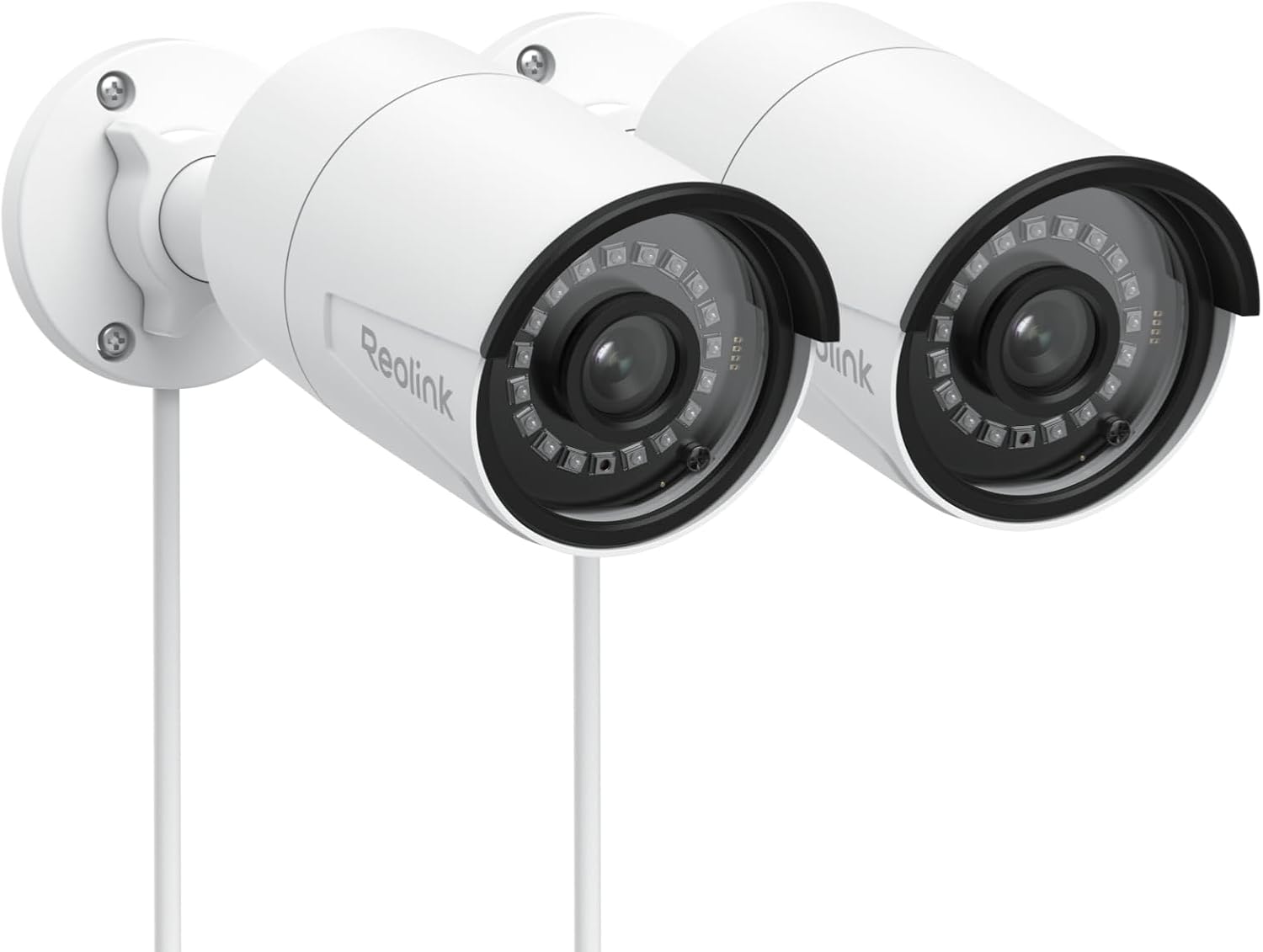
- Two 5MP cameras record at 25fps over a single Ethernet run carrying both data and power
- Person, vehicle and animal detection filters alerts instead of triggering on every moving branch
- 18 infrared LEDs with 3D-DNR processing reach around 100ft of night vision
- Footage saves to a microSD card up to 512GB, an FTP server, a NAS or a matching PoE recorder with no ongoing fee
- Live view and playback run in free apps for iOS, Android, Windows and Mac
Cons
- PoE only, so each camera needs an Ethernet cable back to a PoE switch or recorder
- Not compatible with third-party NVRs or camera systems
- Night vision is infrared, so after-dark footage is black and white, and no microSD card is included
Power over Ethernet means one cable per camera doing two jobs, which is why these units suit permanent installs rather than rentals.
- First-time setup must happen on the same local network, with the camera wired to a PoE switch or recorder
- Run Cat5e or better from the switch to each mounting point before fixing anything to a wall
- Mount at a height that frames faces and plates, typically around eight feet, angled down
- Activate each camera in the app while it is still within reach, then move it to its final position
Plan the cable route first. The limiting factor is run length and where the switch lives, not the camera itself, and drilling twice is the usual outcome of skipping that step.
Recording stays on your own hardware. Each camera takes a microSD card up to 512GB, and the same stream can be sent to an FTP server, a NAS or a matching PoE recorder. Continuous 24/7 recording and motion-only clips are both supported, with no subscription attached to either.
That matters for privacy as much as for running costs: with local storage the footage never has to leave the building, and remote viewing happens through the app when you choose to open it.
The trade-off is responsibility. A card can fail, and a stolen camera takes its card with it, so a NAS or a recorder in a locked cupboard is the safer pattern for anything you might actually need as evidence.
The box holds the cameras and mounting hardware, but a working system needs a few things alongside them.
- A PoE switch or a matching PoE recorder with a free port for each camera
- Ethernet cable in the length each run actually needs, plus slack at both ends
- A microSD card up to 512GB per camera, or a NAS or FTP target, since no card is included
- A drill and fixings suited to brick, render or timber
One more thing to confirm before ordering: these do not work with third-party NVR systems, so an existing recorder from another maker will not adopt them. If the plan is to reuse a mixed setup, check compatibility before the cable is run rather than after.
Pros
- f/1.2 aperture and BSI sensor capture 2.8x more light for full-color night vision without a harsh spotlight
- Sealed to IP66 for dust and water resistance in outdoor patio, garage or driveway installs
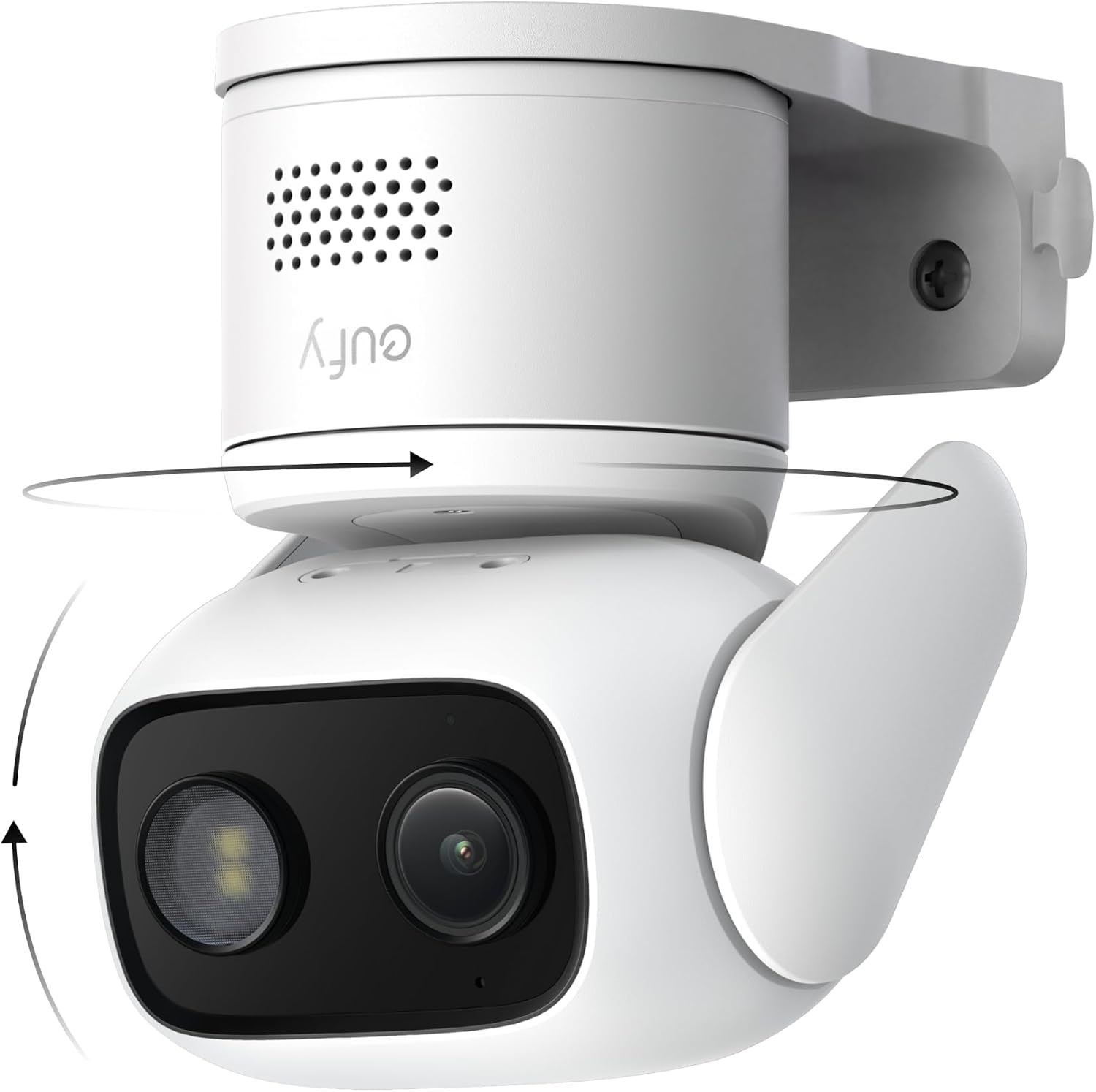
- 360° pan and tilt with AI auto-tracking follows people, vehicles and pets across the whole covered area
- Dual external antennas maintain a stronger Wi-Fi connection at distance from the router
- Operates without a required monthly subscription for local recording
Cons
- Continuous 24/7 recording depends on constant wired power; it's not built for battery-only, wire-free placement
- No-subscription local operation still depends on having local storage set up correctly, unlike fully cloud-hosted competitors
- Dual external antennas and cabling add a slightly more involved mounting footprint than a compact bullet-style camera
The C31 is IP66-certified for waterproofing and dust resistance, suited to patios, garages, driveways or entryways exposed to weather year-round. Mounting is versatile, supporting both upright and inverted orientation with a weather-resistant bracket and a waterproof power cable running to the mount point.
Because the camera relies on continuous wired power rather than a battery, installation needs access to a nearby outlet or run of low-voltage cabling, which is a more involved setup than a fully wireless battery camera but removes the need for periodic battery swaps or recharging.
- IP66-rated for outdoor exposure
- Upright or inverted mounting options
- Continuous wired power, no battery to recharge
An f/1.2 aperture paired with a BSI sensor captures roughly 2.8x more light than a standard security camera sensor, producing full-color night video instead of the grainy black-and-white infrared image typical of standard infrared cameras — and it does this without a bright spotlight that can wash out faces or license plates.
360° pan and tilt movement combined with AI auto-tracking follows people, vehicles and pets across the camera's full field of view in real time, and instant sound and light alerts can be triggered to deter unwanted visitors the moment motion is detected.
- f/1.2 aperture with BSI sensor for color night vision
- 360° pan and tilt coverage
- AI auto-tracking for people, vehicles and pets
The camera is built to run without a required monthly subscription, recording locally instead of depending on a paid cloud tier for basic functionality — a meaningful difference from camera systems that lock continuous recording behind a subscription. Dual external antennas help maintain a stable Wi-Fi connection even when the camera sits farther from the router, which matters for continuous 24/7 recording that can't tolerate frequent dropouts.
Because recording depends on constant wired power and a stable local connection, planning cable routing and Wi-Fi signal strength ahead of installation avoids gaps in the recorded timeline later.
- No required monthly subscription for local recording
- Dual antennas for a more stable Wi-Fi link
- 24/7 recording depends on continuous wired power

Pros
- 【Up, Down, All Around】This Pan/Tilt IP camera see everything across
- 【Motion Tracking】Kasa Smart Camera with Audio/Video can
- 【Detection & Instant Notification】Get instant push notifications
- 【2-Way Audio】Never truly leave home with the built-in 2-way audio.
- Dimensions of 3.23 x 3.23 x 4.43 inches engineered for optimal spatial fitting
Cons
- Requires verifying placement clearance for 3.23 x 3.23 x 4.43 inches prior to installation
- Best placed in well ventilated indoor spaces away from excess moisture
Integrating thoughtful design principles, the Kasa 1080p Indoor Pan Tilt Wired Security Camera - Works enhances daily routines within Dome Cameras areas. From an operational perspective, this model emphasizes key capabilities such as 【Up, Down, All Around】This Pan/Tilt IP camera see everything across an entire room or walkway with the 360° horizontal and 113° vertical range pan/tilt field of view. Set up the 【Patrol Mode】on EC71 to monitor each region at intervals of your choosing.. Additionally, the integration of 【Motion Tracking】Kasa Smart Camera with Audio/Video can automatically track moving objects or people, providing real-time alerts and increasing the overall effectiveness of your security system. Connects via 2.4GHz Wi-Fi Band enhances overall usability during continuous activity. Measurements of 3.23 x 3.23 x 4.43 inches provide clear dimensional boundaries for precise space planning.
Structural analysis confirms an emphasis on long-term mechanical resilience and component stability. Designed for lasting service, the structure leverages 【Detection & Instant Notification】Get instant push notifications when motion or a person is detected, you can even enable baby crying detection to use EC71 as a baby camera monitor. Discern from notifications that matter, so you'll know if it’s your pet playing around or if someone is actually there. to minimize mechanical stress. Advanced joint reinforcement guards against structural sagging or premature joint wear. Quality craftsmanship supports long term satisfaction for residential and professional settings. User centered design choices streamline routine interactions and enhance practical convenience.
Following practical maintenance guidelines ensures the unit retains its performance properties. Highlighting 【2-Way Audio】Never truly leave home with the built-in 2-way audio. Use as a pet camera with phone app to comfort your pet from anywhere in the world., initial assembly and positioning remain straightforward using basic tools. Gentle surface cleaning with non-abrasive tools keeps outer materials looking clean and pristine. Quality craftsmanship supports long term satisfaction for residential and professional settings. User centered design choices streamline routine interactions and enhance practical convenience. Robust physical construction provides verified peace of mind during heavy daily usage.

Pros
- 1080p video with an infrared array giving up to 30 ft of night vision
- microSD slot takes cards up to 512 GB for local recording with no subscription needed
- Two-way audio plus a built-in siren for talking to pets or warning off intruders
- RTSP and ONVIF support let it feed an existing NVR rather than only the phone app
- Housing measures 2.66 by 2.15 by 3.89 inches, small enough to sit on a bookshelf
Cons
- Connects on the 2.4 GHz Wi-Fi band only, with no 5 GHz option
- No microSD card in the box, so local storage is a separate purchase
- Indoor housing with no weather sealing, and a fixed lens with no motorised pan or tilt once mounted
This is a small tabletop unit, 2.66 by 2.15 by 3.89 inches, on a hinged base that either stands on a shelf or screws to a wall or ceiling using the supplied plate. Because it draws power from a USB lead, placement is dictated by how far that cable reaches a socket.
- Setup runs through the Tapo app, which finds the camera on the 2.4 GHz band.
- The lens is aimed by tilting the body on its base; there is no motor to reposition it later.
- Ceiling mounting flips the image in software so the picture stays upright.
Think about backlight before drilling. Pointing the lens at a window turns anyone in the room into a silhouette during daylight, and the infrared array bounces off glass at night. An interior wall facing the doorway usually gives the most useful frame.
Footage can live on a microSD card in the camera, on a home NVR, or in the cloud, and no subscription is required for basic recording and alerts. Motion, person and baby-cry detection all run without a paid plan attached.
- The card slot accepts up to 512 GB, which is a long rolling buffer at 1080p.
- RTSP and ONVIF support let it stream into Synology, Blue Iris or a standalone recorder.
- Activity zones limit alerts to a chosen part of the frame, so a ceiling fan stops triggering notifications.
A privacy mode disables the lens and microphone while you are home, which is the setting to check first if the camera lives in a living room rather than a hallway. Two-way audio and the siren both trigger from the app.
Three things are not in the box and are easy to overlook. First, a microSD card: without one, recording depends on cloud storage or an NVR, and the maker publishes a compatibility list worth checking before buying.
- Second, a 2.4 GHz Wi-Fi network. The camera will not join a 5 GHz-only band, so some combined-band routers need the bands separated temporarily during setup.
- Third, a mains socket within cable reach, since there is no battery in this model.
Also worth planning for: this is an indoor housing with no weather sealing, so a porch or an open carport is outside its brief. Viewing the stream through Alexa or Google Assistant needs a screen at the other end, such as an Echo Show, a Nest Hub or a Chromecast-equipped television.
What Is an IP Security Camera?
An IP (Internet Protocol) security camera is a networked camera that sends video over your home network rather than to a dedicated analog recorder. Because footage travels as digital data, IP cameras typically offer higher resolution, remote viewing from a smartphone app, and smart features like motion zones and person detection. Most modern home security cameras you will find today are IP cameras, whether they connect over Wi-Fi or a wired PoE (Power over Ethernet) cable.
The main appeal is flexibility. You can check a live feed from anywhere, receive alerts when something moves, and store clips locally on an SD card, on a network drive, or in the cloud. Understanding the categories below will help you narrow the field quickly.
Wired vs. Wireless IP Cameras
Wireless (Wi-Fi) cameras are the easiest to install because you only need power and a decent signal. Battery-powered models like the Security Cameras Wireless Outdoor 2K go a step further, letting you mount them almost anywhere without running any cables at all. That freedom is ideal for renters or hard-to-wire spots.
Wired cameras trade convenience for reliability. A PoE system such as the REOLINK RLC-510A PoE pulls both power and data through a single Ethernet cable, so you never charge batteries or fight a weak Wi-Fi signal. Wired indoor cameras like the Tapo C260 4K also tend to support continuous 24/7 recording more gracefully than battery units.
Indoor vs. Outdoor: Match the Camera to the Location
One of the first choices when picking the best IP security cameras is deciding what each unit needs to watch. Indoor and outdoor models are engineered differently, and using the wrong type in the wrong place leads to disappointment.
Outdoor Cameras and Weatherproofing
Outdoor cameras must survive rain, dust, and temperature swings, so look for an IP65 or IP66 weatherproof rating. Features like a spotlight, siren, and color night vision help deter intruders rather than just record them. Models such as the eufy C31 with its IP66 rating and auto-tracking, or the pan/tilt Tapo C500 that follows movement across a 360-degree view, are built for exterior duty like driveways, yards, and entryways.
Indoor Cameras for Rooms, Kids, and Pets
Indoor cameras prioritize a wide field of view, two-way audio, and quiet operation. Pan-and-tilt designs let you sweep an entire room from one spot, which is why they double so well as baby and pet monitors. Compact options like the Tapo C201, the Kasa EC71, and the budget-friendly Tapo C100 are designed to blend into a living space while still catching everything that moves.
Resolution: How Much Detail Do You Really Need?
Resolution is the headline spec on almost every listing, but more megapixels are not always better for every situation. A 1080p (2MP) camera is perfectly sharp for a small room or a close-range doorway. Step up to 2K or 2.5K when you want to read finer detail across a wider area, and reserve 4K for large yards or scenes where you may need to digitally zoom into faces or license plates after the fact.
Higher resolution also means larger files, which fills SD cards faster and demands more upload bandwidth for cloud storage. If you plan to keep many days of continuous footage, a balanced 2K sensor like the one in the Tapo C210 often hits the sweet spot between clarity and storage cost, while a true 4K unit like the Tapo C260 makes sense when detail is the top priority.
Smart Features Worth Paying For
Modern IP cameras bundle software features that dramatically reduce false alerts and make footage more useful. Prioritize these based on how you intend to use the system.
- AI detection: Person, vehicle, and pet recognition filters out swaying trees and passing shadows, so you only get notified about things that matter.
- Motion tracking: Pan/tilt cameras that follow a subject keep it in frame instead of losing it at the edge of view.
- Color night vision: Spotlights or low-light sensors deliver full-color footage after dark rather than grainy black and white.
- Two-way audio and sirens: Speak to a delivery driver or trigger an alarm to scare off an unwanted visitor.
- Smart home integration: Support for Alexa and Google Assistant lets you pull up a feed on a smart display hands-free.
Cameras like the SensForge 2.5K pack free AI human and pet detection alongside dual-band Wi-Fi, while the eufy C31 layers in cry detection and auto-tracking for busy households.
Storage: Cloud, Local, or Both?
How your camera stores video is one of the most important and most overlooked buying factors. It affects both your ongoing costs and your privacy.
Local Storage (SD Card and PoE Recorders)
Local storage keeps footage on a microSD card inside the camera or on a network recorder. It is private, has no monthly fee, and keeps working even if your internet goes down. Many of the best IP security cameras now advertise subscription-free operation, meaning core recording features never sit behind a paywall. Units such as the Tapo C201 and Kasa EC71 highlight local storage as a headline benefit.
Cloud Storage
Cloud storage protects your footage even if a thief steals the camera, since clips are safely off-site. The trade-off is a recurring subscription for anything beyond a short free window. Most Wi-Fi cameras, including the Tapo C100, offer optional cloud plans layered on top of free SD recording, giving you the best of both worlds.
Bandwidth and Retention Planning
It helps to estimate storage before you commit. A single 1080p camera recording motion events might fill a 64GB card in a week or two, while continuous 4K recording can exhaust the same card in a day. Decide whether you need every second saved or just triggered clips, and size your SD card or cloud plan accordingly. Cameras that support cards up to 256GB or 512GB, like several PoE and outdoor models, give you far more headroom for long retention windows.
Common Mistakes to Avoid When Buying
Even careful shoppers stumble on a few predictable traps. Keep these in mind as you compare listings so your first setup is also your best one.
- Chasing megapixels alone: A 4K sensor mounted too far from the action still shows tiny, unusable faces. Placement beats resolution.
- Ignoring the night: Most incidents happen after dark, so verify the night vision mode and whether a spotlight is included before you buy.
- Overlooking recurring fees: A cheap camera with a mandatory subscription can cost more over three years than a pricier subscription-free unit.
- Weak Wi-Fi at the mount point: Test signal strength where the camera will actually live, not just where it is convenient to set up.
- Forgetting field of view: A narrow lens leaves blind spots, while a pan/tilt or wide-angle model covers far more ground per camera.
Installation and Ecosystem Considerations
Before you buy, think about the app you will actually live in day to day. Sticking within one brand ecosystem, such as Tapo or Kasa, means a single app manages every camera and a consistent interface for alerts and playback. Mixing brands is fine, but you may juggle multiple apps and logins.
Also weigh your Wi-Fi coverage. Battery and Wi-Fi cameras placed far from the router may struggle with dropouts, so a dual-band model like the SensForge that can use a stronger frequency helps. For the most set-and-forget reliability across a whole property, a wired PoE approach like the REOLINK RLC-510A removes signal and battery worries entirely.
Matching a Camera to Your Scenario
To simplify the decision, here are a few common buyer profiles and the direction that usually fits best:
- Renter or quick setup: Choose a battery or plug-in Wi-Fi camera with SD storage so there is nothing to wire and no monthly fee.
- New parent or pet owner: A pan/tilt indoor camera with two-way audio like the Tapo C210 covers a whole room and doubles as a monitor.
- Full property coverage: A wired PoE system delivers reliable 24/7 recording without touching a single battery.
- Privacy-focused buyer: Prioritize subscription-free local storage and on-device AI so your footage never leaves home.
- Budget shopper: Affordable indoor units like the Tapo C100 prove strong protection does not require a big spend.
Final Thoughts
The best IP security camera is not a single product but the one that fits your space, storage preference, and budget. Start by deciding indoor versus outdoor, wired versus wireless, then layer on the smart features that reduce noise and the storage model that respects your privacy and wallet. With those priorities set, comparing the shortlisted models above becomes far easier, and you can build a security setup that gives you real peace of mind. Take a moment to review the options and choose the camera that best guards what matters most to you.