 Ryan Delgado
 Best Light Timers: A Complete Buying Guide for 2026
Finding the best light timers can transform how you manage lighting at home, save energy, and boost security while you are away. Whether you want your porch lights to switch on at dusk, your holiday decorations to run on a reliable schedule, or your indoor lamps to mimic an occupied home, a good timer takes the guesswork out of the equation. Instead of remembering to flip switches every day, you set it once and let automation handle the rest.
This guide is not a product-by-product review. Instead, it walks you through what actually matters when shopping for light timers – the types available, the features worth paying for, and how to match a timer to your specific needs. By the end, you will know exactly how to choose the right model for indoor lamps, outdoor string lights, bathroom fans, or pool pumps.

myTouchSmart In-Wall Digital Timer with Battery Backup
Pros
- 4 programmable on/off buttons plus 2 manual override buttons for changing plans without reprogramming the schedule
- Battery backup keeps programmed times saved through a power outage
- Rated for 120VAC, 15A general/resistive load and up to 1200W of tungsten lighting
- Compatible with LED, CFL, incandescent, halogen and select dimmable LED/CFL bulbs
- Blue LED indicators next to each button show at a glance which program is active
Cons
- Requires a neutral wire at the switch box, so it will not install in older 2-wire-only wall boxes without adding one
- Wall plate is not included, so a separate cover plate needs to be purchased to match your decor
- Screw-terminal wiring takes more time to install than a plug-in outdoor timer, and is best handled by someone comfortable working at a breaker panel
The timer offers 4 programmable on/off time slots along with 2 manual override buttons for turning the connected light or fan on or off outside the set schedule, all on a repeating 24-hour daily cycle.
- 4 programmable on/off buttons for scheduled times
- 2 manual override buttons for immediate control
- Blue LED indicators show which program is currently active
Because the schedule repeats every 24 hours without needing to be reset, it is built for a routine that stays the same day to day, such as porch lighting or an exhaust fan, rather than a schedule that changes daily.
This timer installs in place of an existing wall switch and requires a neutral wire at the box, connected using screw terminals rather than flying leads, which saves space compared with older in-wall timer designs.
- Neutral wire required at the switch box
- Screw-terminal connections for a more compact fit in standard boxes
- Wall plate not included and must be purchased separately
Because it replaces a standard switch and ties into house wiring, installation should be done with the breaker off, and anyone unsure about identifying a neutral wire should confirm compatibility before purchase or bring in an electrician.
Electrical specifications cover 120VAC 60Hz at 15A for general/resistive loads, 1200W for tungsten lighting, 1200VA for ballast loads, and up to 1/2 HP for connected motors such as exhaust fans, and the unit is UL Listed.
- Compatible with LED, CFL, incandescent and halogen bulbs
- Also works with select dimmable LED and dimmable CFL bulbs
- Battery backup preserves programmed settings through a power outage
Because the load specifications are specific to bulb and motor type, checking the connected fixture's wattage and bulb type against these limits beforehand avoids overloading the switch on a high-draw fixture.

Pros
- Five preset buttons cover 15 min, 30 min, 1 hour, and 2 hour countdowns plus a manual off
- Handles up to 1800W incandescent, 600W LED/CFL, or a 1 HP/16A fan or motor load
- Shallow housing fits standard wallboxes without extra depth for tight retrofits
- Pairs with a second DT202 unit for multi-timer control, or a DD0SR companion for 3-way wiring
Cons
- Requires a neutral wire in the wallbox, so older homes without one cannot install it
- Should not be the only light source in a room per the manufacturer, limiting where it belongs
- Faceplate colors beyond white require buying a separate DTKIT accessory kit
The DT202-1LW replaces a standard wall switch with five buttons: 15-minute, 30-minute, 1-hour, and 2-hour countdowns, plus a manual off that cancels the timer instantly. Once a preset is pressed the connected load runs for that duration and then shuts off on its own.
- Rated for 1800W incandescent/halogen, 600W LED/CFL, 1200VA magnetic or electronic low-voltage/fluorescent loads
- Handles a 1 HP or 16A fan/motor, and 20A resistive or 16A inductive loads
That range covers exhaust fans, attic fans, pool pumps, hot tub equipment, and heat lamps as well as ordinary lighting circuits, so the same switch can automate several categories of fixture rather than lighting alone. The manual-off button also means a countdown can be cut short at any point without waiting it out.
Installation follows a standard single-pole wall switch swap, but this unit needs a neutral wire present in the box, which is common in newer construction but not guaranteed in older homes. Its shallow design is meant to fit into standard wallboxes without the crowding some electronic timers cause.
- Single-pole wiring covers the most common setup
- A DD0SR switch companion adds 3-way or multi-way control from a second location
- Two DT202 units can be linked for multi-timer operation on the same circuit
The wallplate is sold separately and is compatible with Decora and Decora Plus screwless plate styles, so the finished look can be matched to existing switches in the room. Because a manufacturer caution advises against using it as a room's sole light source, pairing it with another switched fixture is worth planning for ahead of installation.
This switch is built for loads people tend to forget to turn off. Porch and landscape lighting, bathroom exhaust fans, heat lamps, pool pumps, hot tubs, saunas, and attic fans all fit within its rated capacity, and the countdown removes the need to remember a manual shutoff.
- Homeowners with an attic fan or pool pump gain an automatic cutoff without adding a smart hub
- Bathrooms benefit from a fan that runs a fixed cycle after someone leaves
- Multi-timer wiring with a second DT202 suits rooms needing independent zones
It is less suited to anyone lacking a neutral wire in their wallbox, since that is a hard requirement rather than an option, and to rooms where this switch would be the only source of light, given the manufacturer's guidance against that setup.

Pros
- [Countdown Timer and Light Sensor] The timer has multiple settings
- [Remote Control] You can now avoid going out during night or face
- [100ft RF Range] The doors, windows or walls cannot block the RF
- [Resistant and Durable] Our outdoor timer is made by PBT material
- Dimensions of 6.5"D x 4.5"W x 2"H engineered for optimal spatial fitting
Cons
- Requires verifying placement clearance for 6.5"D x 4.5"W x 2"H prior to installation
- Requires gentle maintenance routines to preserve the Polybutylene Terephthalate finish
The Outdoor Timer Outlet Waterproof Outdoor Timer for Lights offers a refined combination of structural durability and user convenience for Timers setups. Practical hands-on evaluation highlights core functional attributes including [Countdown Timer and Light Sensor] The timer has multiple settings like ON/OFF, dusk to dawn, on at dusk and off after 2, 4, 6 or 8 hours. You can control your outdoor device as you wish by simply setting it and can choose also to repeat schedule daily.. Furthermore, features like [Remote Control] You can now avoid going out during night or face the bad weather by controlling the Christmas or holiday decorations, yard lights and lamps, pool pump or your fountain using the remote control directly from your room. ensure seamless adaptability across varied spatial layouts. Measurements of 6.5"D x 4.5"W x 2"H provide clear dimensional boundaries for precise space planning.
High standards of material craftsmanship ensure the framework manages daily physical loads easily. Materials engineering centers on [100ft RF Range] The doors, windows or walls cannot block the RF signal because this is strong enough, as far as 100ft in line of sight, so you can control lights and others electrical devices which are not so close., preserving visual appeal and physical integrity over time. Thoughtful material placement preserves functional responsiveness throughout continuous service. Constructed using quality Polybutylene Terephthalate, outer surfaces withstand routine contact without losing visual appeal. This balanced configuration fits smoothly into existing interior designs while maximizing efficiency.
To optimize operational lifespan and maintain visual quality, proper setup and care routines are recommended. With user-friendly details such as [Resistant and Durable] Our outdoor timer is made by PBT material and is waterproof. It is compatible with most of the electrical appliances because has a 6 Inch SJTW14-3 grounded cord and up to 15 Amp quality feature., setting up the equipment requires minimal effort. Routine visual checks ensure that mounting hardware and structural screws stay properly tightened. This balanced configuration fits smoothly into existing interior designs while maximizing efficiency. Quality craftsmanship supports long term satisfaction for residential and professional settings.

Pros
- 24-HOUR TIMER — Automates plug-in lights, seasonal décor, holiday
- EASY PUSHPIN — Mechanical timer uses 30-minute interval pushpins
- DUAL OUTLETS — Two timed outlets simultaneously automate multiple
- CONTROL — 30-minute intervals support varied schedules while a
- Dimensions of 2.7"D x 3.4"W x 3.4"H engineered for optimal spatial fitting
Cons
- Requires verifying placement clearance for 2.7"D x 3.4"W x 3.4"H prior to installation
- Requires gentle maintenance routines to preserve the Plastic finish
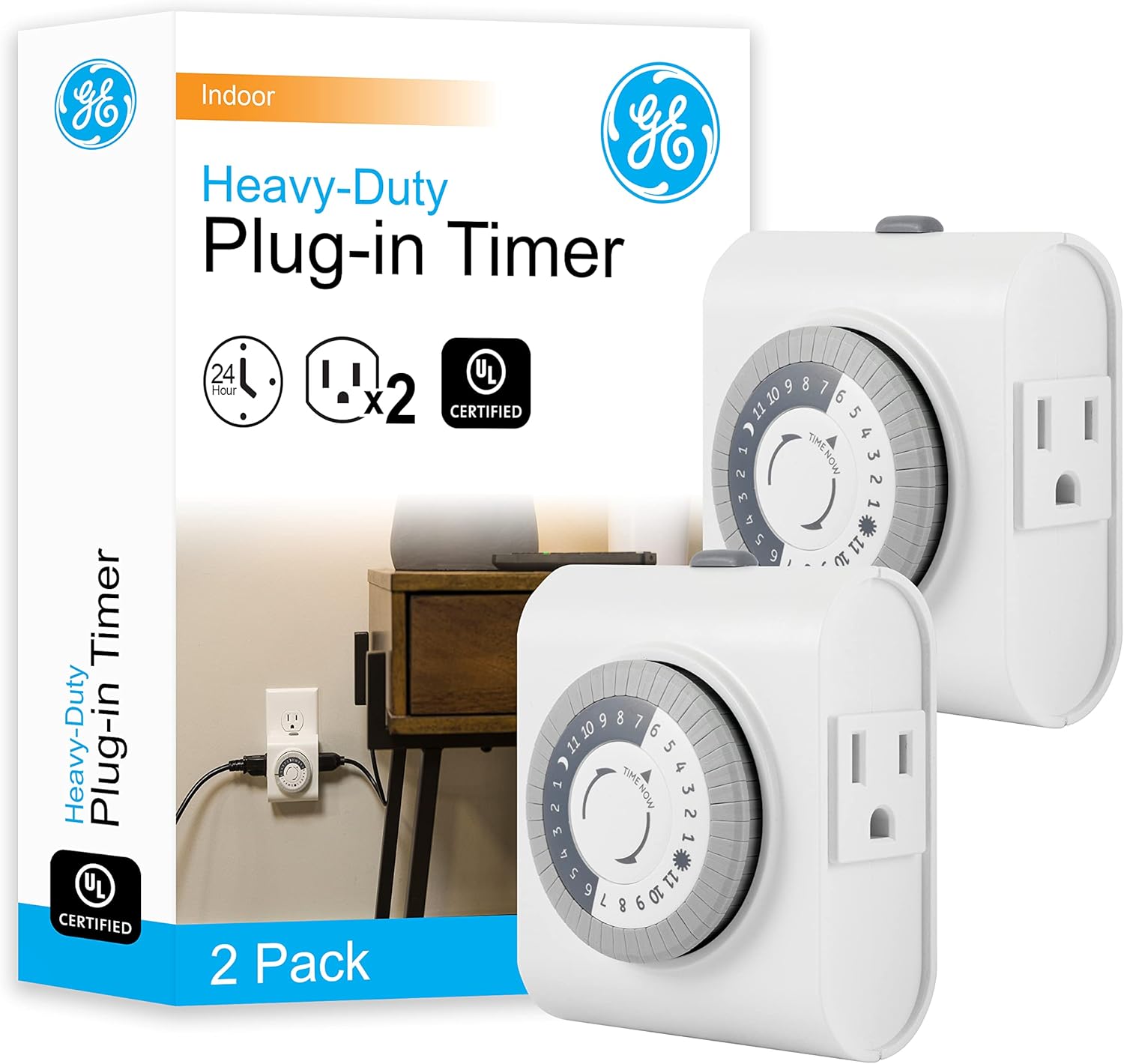
The GE 24 Hour Mechanical Outlet Timer Switch Dual Grounded is engineered to address the operational demands of Timers environments. Practical hands-on evaluation highlights core functional attributes including 24-HOUR TIMER — Automates plug-in lights, seasonal décor, holiday lighting, fans and small appliances with a simple daily on and off cycle. Furthermore, features like EASY PUSHPIN — Mechanical timer uses 30-minute interval pushpins for fast setup with no Wi Fi, apps or complex programming ensure seamless adaptability across varied spatial layouts. Measurements of 2.7"D x 3.4"W x 3.4"H provide clear dimensional boundaries for precise space planning.
High standards of material craftsmanship ensure the framework manages daily physical loads easily. Materials engineering centers on DUAL OUTLETS — Two timed outlets simultaneously automate multiple three-prong plug-in devices from a single indoor receptacle, preserving visual appeal and physical integrity over time. Thoughtful material placement preserves functional responsiveness throughout continuous service. Constructed using quality Plastic, outer surfaces withstand routine contact without losing visual appeal. Precision engineering delivers a stable foundation tailored for active household demands. Carefully selected components ensure minimal maintenance overhead over long service life. Attention to manufacturing details ensures reliable utility for your Timers.
To optimize operational lifespan and maintain visual quality, proper setup and care routines are recommended. With user-friendly details such as CONTROL — 30-minute intervals support varied schedules while a convenient override switch pauses the timer cycle anytime, setting up the equipment requires minimal effort. Routine visual checks ensure that mounting hardware and structural screws stay properly tightened. Precision engineering delivers a stable foundation tailored for active household demands. Carefully selected components ensure minimal maintenance overhead over long service life. Attention to manufacturing details ensures reliable utility for your Timers. Using proper installation techniques maintains physical stability across daily activities.
Pros
- Two grounded outlets on each timer run independently timed devices from a single wall receptacle
- 30-minute interval pushpins allow multiple on/off cycles across a full 24-hour rotation
- No WiFi, app or hub pairing needed, so setup is a single rotating dial
- Override switch lets you bypass the schedule for manual control without resetting the pins
- Side-access outlet layout keeps cords flush against the wall for placement behind furniture
Cons
- Mechanical pushpins only allow 30-minute scheduling increments, not the minute-level precision of a smart plug
- No mobile app or remote control, so any schedule change means walking to the outlet itself
- Indoor-rated design only, not suited to outdoor or damp-location use
Instead of an app or WiFi pairing, the timer uses a rotating 24-hour dial fitted with pushpins set at 30-minute intervals. Pushing a pin down programs an on or off point on the dial, and the cycle repeats automatically every 24 hours once set. Because the mechanism is entirely mechanical, there is no hub, account or firmware update involved in daily use.
- 30-minute interval pushpins around a 24-hour dial
- Cycle repeats automatically every day once programmed
- Override switch pauses the schedule for manual control
Anyone wanting minute-precise or randomized scheduling (for security purposes, for example) will find the 30-minute steps coarser than what an app-based smart plug offers.
Each timer plugs into one wall receptacle and provides two grounded outlets that run on the same programmed schedule simultaneously, so a single dial can control two lamps, a fan and a small appliance together, or one device split across both prongs of a heavier plug. The side-access outlet layout is designed to keep cords running flush against the wall rather than sticking straight out.
- Two grounded outlets share one programmed schedule
- Side-access layout for cords routed flush to the wall
- Compatible with LED, CFL and incandescent bulbs
Because both outlets follow the same on/off cycle, this pack suits pairing similar devices like two lamps rather than running one item on a completely separate schedule from the other.
Measuring 2.7 x 3.4 x 3.4 inches with a white plastic housing, the timer is built for indoor placement -- behind furniture, in a hallway outlet, or wherever seasonal lighting and small appliances need daily automation. It suits Christmas trees, lamps and fans that only need a repeating daily cycle rather than a connected, app-controlled routine.
- Compact 2.7 x 3.4 x 3.4-inch housing for indoor outlets
- Two-pack covers two separate receptacles in one purchase
- White finish blends with typical wall and trim colors
It is not built for outdoor or damp locations, so exterior holiday lighting on a porch or in a garage without weatherproofing is outside its intended use.

Pros
- ✓ FULLY : Up to 6 hours countdown, the repeat function will run
- ✓ SIMPLE AND EASY TO USE: 6 Countdown Time buttons (15min, 30min,
- ✓ & : Use for your home curling iron, hair straighter, coffee
- ✓ SAFE & : ETL listed, and conforms to UL Std. no. 917. Rated 125V,
- Dimensions of 2.05"D x 2.99"W x 2.32"H engineered for optimal spatial fitting
Cons
- Requires verifying placement clearance for 2.05"D x 2.99"W x 2.32"H prior to installation
- Requires gentle maintenance routines to preserve the Plastic finish
Crafted with attention to functional details, the BN-LINK BN-LINK Indoor Countdown Timer with Repeat Function Heavy brings efficient performance to your Timers. Key physical design elements prioritize user comfort through ✓ FULLY : Up to 6 hours countdown, the repeat function will run your previous setting again. Equipped with ✓ SIMPLE AND EASY TO USE: 6 Countdown Time buttons (15min, 30min, 1hour, 2hour, 4hour and 6hour), 1 ON/OFF Override button, 1 Repeat button., the hardware delivers reliable structural support under regular demands. Measurements of 2.05"D x 2.99"W x 2.32"H provide clear dimensional boundaries for precise space planning.
Component assessment indicates careful selection of durable materials tailored for active usage. Key structural features including ✓ & : Use for your home curling iron, hair straighter, coffee maker, slow cookers, crafting tools, Panini grills and many other household appliances. support overall longevity during regular operational cycles. Careful manufacturing ensures that frame connections retain rigidity over long term use. Constructed using quality Plastic, outer surfaces withstand routine contact without losing visual appeal. Precision engineering delivers a stable foundation tailored for active household demands. Carefully selected components ensure minimal maintenance overhead over long service life. Attention to manufacturing details ensures reliable utility for your Timers.
Preserving structural integrity over extended service life is achieved through consistent daily care. Attributes like ✓ SAFE & : ETL listed, and conforms to UL Std. no. 917. Rated 125V, 60Hz, 1875W/15A General Purpose, 15A Resistive, 8A Tungsten, 1/2 HP, TV-5 allow hassle-free integration into existing room configurations. Preventing prolonged exposure to harsh environmental factors helps preserve original finish quality. Precision engineering delivers a stable foundation tailored for active household demands. Carefully selected components ensure minimal maintenance overhead over long service life. Attention to manufacturing details ensures reliable utility for your Timers. Using proper installation techniques maintains physical stability across daily activities.

Pros
- Built-in light sensor automatically triggers dusk-to-dawn operation, or pairs with a 2/4/6/8 hour countdown after dusk
- 2 grounded outlets let you control two separate light strings or fixtures from one timer
- Constructed from heavy-duty fireproof PPE material with a 14 AWG SJTW cord
- UL listed for verified electrical safety compliance
- Weatherproof housing designed to run through rain or snow when mounted correctly
Cons
- Requires vertical mounting at least 2 ft above ground for the weatherproofing to work as intended, ruling out flat ground-level placement
- Mechanical dial control only, with no app or smartphone scheduling
- Covers just 2 grounded outlets, so more than two light strings need a splitter or a second timer
A built-in light sensor drives the dusk-to-dawn function automatically, and can be combined with a 2, 4, 6, or 8 hour countdown so lights switch off partway through the night rather than staying lit until sunrise.
- Dusk-to-dawn mode via built-in light sensor
- 2/4/6/8 hour countdown option layered on top of dusk-to-dawn triggering
- Continuous ON or OFF override modes available alongside the automatic settings
Because the timing is set with a mechanical dial rather than a digital or app-based interface, adjusting the schedule means physically turning the dial to the desired setting rather than programming it remotely. The daily-repeat behavior means once a mode is set, it continues on the same schedule each night without needing to be reset.
The housing is built to keep running through rain or snow, provided it is installed according to the manufacturer's mounting guidance.
- Constructed from heavy-duty fireproof PPE material
- 14 AWG SJTW cord rated for outdoor use
- UL listed for verified safety compliance
For the weatherproofing to work as intended, the unit needs to be mounted vertically and at least 2 ft above ground level, which rules out simply setting it on the ground near an outlet. Meeting that mounting requirement keeps water from splashing directly into the outlet openings during rain or snow.
Two grounded outlets on the unit can be controlled together, letting one timer manage two separate light strings or fixtures on the same schedule.
- 2 grounded outlets controlled simultaneously
- Suited to holiday lights, string lights, and other garden or porch fixtures
- Single dial controls both outlets together rather than independently
Because both outlets share the same timer setting, they cannot be scheduled independently. For anyone needing more than 2 lighting circuits on separate schedules, a second timer unit or a splitter feeding into a shared circuit would be needed, since this model tops out at 2 grounded outlets.
Pros
- 【Daily Repeat Outdoor timer】24 ON/OFF options within a 24-hour
- 【Durable & Long-lasting】Heavy duty outdoor outlet timer designed to
- 【Waterproof & Visible】The outlet timer outdoor is built to
- 【For Outdoor Use】Rated at 125 Volts, 60Hz, 15A, 1875W Resistive,
- Dimensions of 6.3"D x 1.9"W x 3"H engineered for optimal spatial fitting
Cons
- Requires verifying placement clearance for 6.3"D x 1.9"W x 3"H prior to installation
- Requires gentle maintenance routines to preserve the Plastic finish
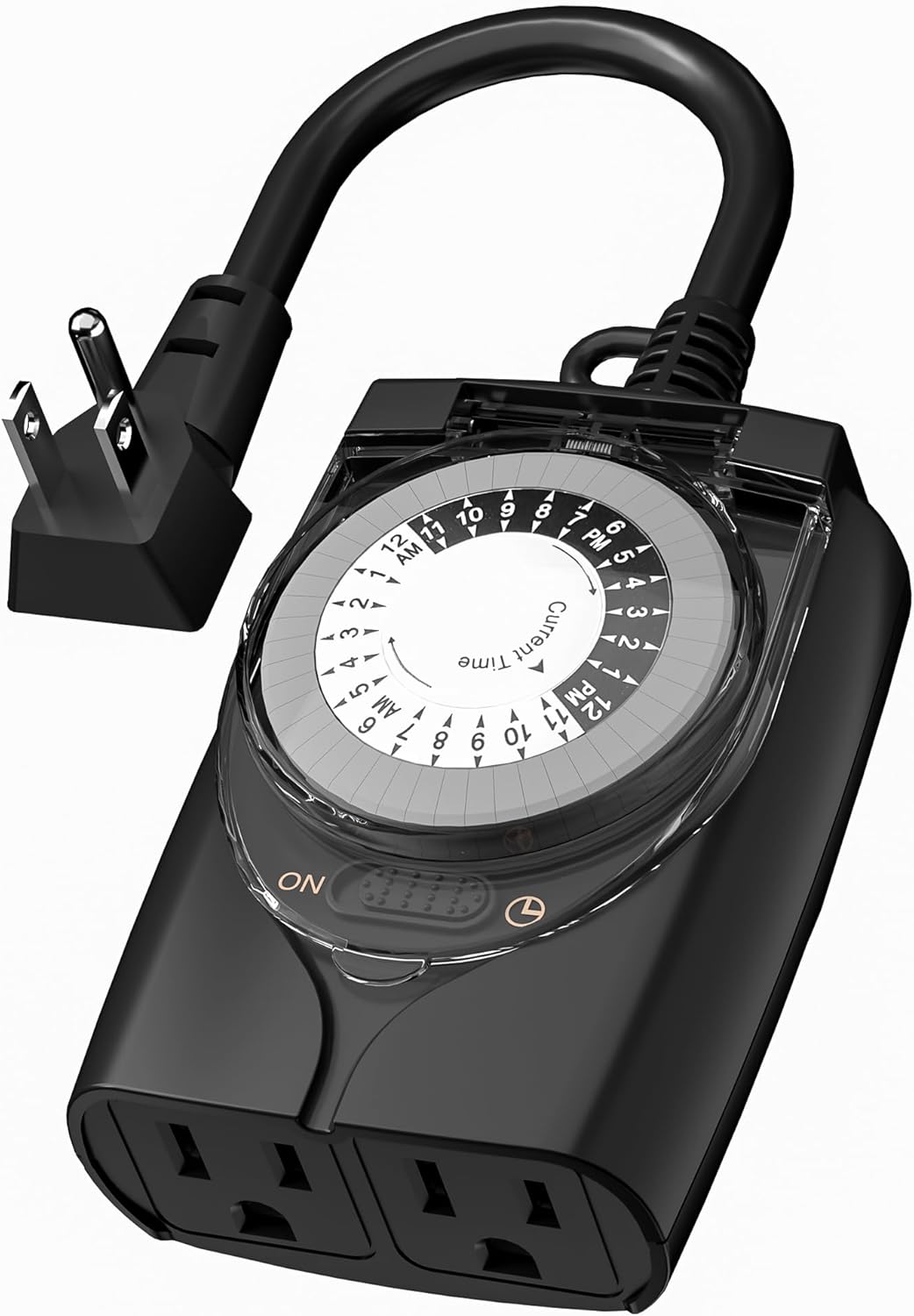
Integrating thoughtful design principles, the HBN HBN Outdoor Timer Outlet Waterproof 24 Hour Mechanical enhances daily routines within Timers areas. Technical integration focuses on functional efficiency, incorporating 【Daily Repeat Outdoor timer】24 ON/OFF options within a 24-hour period; each pin represents a 30-minute interval. Use the mechanical timer to schedule your outdoor devices with daily repetition.. Its balanced engineering incorporates 【Durable & Long-lasting】Heavy duty outdoor outlet timer designed to withstand dust, wear and sunlight, ensuring enduring performance, energy-efficient and money-saving. to streamline day-to-day interactions. Measurements of 6.3"D x 1.9"W x 3"H provide clear dimensional boundaries for precise space planning.
Evaluating build quality and structural execution reveals strong manufacturing standards across components. The physical build incorporates 【Waterproof & Visible】The outlet timer outdoor is built to withstand adverse weather conditions. It features a transparent waterproof cover for easy visualization of timed tasks. For optimal waterproofing, please mount it vertically at least 2ft above the ground., providing essential protection against surface wear. High tolerance assembly prevents unexpected mechanical looseness during daily operation. Constructed using quality Plastic, outer surfaces withstand routine contact without losing visual appeal. Dependable hardware performance ensures consistent operational output throughout the year. Precision engineering delivers a stable foundation tailored for active household demands.
Long-term operational satisfaction is supported by adhering to standard installation and cleaning practices. Thanks to 【For Outdoor Use】Rated at 125 Volts, 60Hz, 15A, 1875W Resistive, 1/2HP; ideal for outdoor lights, Christmas lights, yard lights, pool pump, holiday decorations, home and garden., spatial alignment and initial setup progress smoothly for homeowners. Simple preventative care maintains mechanical responsiveness and aesthetic value over extended use. Dependable hardware performance ensures consistent operational output throughout the year. Precision engineering delivers a stable foundation tailored for active household demands. Carefully selected components ensure minimal maintenance overhead over long service life. Attention to manufacturing details ensures reliable utility for your Timers.

Pros
- 30-minute programming intervals give up to 48 on/off settings across a 24-hour daily cycle
- Dual 3-prong grounded outlets let two devices run on independent or synced schedules
- Clear weatherproof cover shields the internals from dust and moisture while keeping the display visible
- Handles up to 1875W (15A, 1/2HP), enough for pool pumps or strings of holiday lights
- Slide switch flips instantly between programmed timer mode and an always-on override
Cons
- 6-inch cord length is short, so devices set back from the outlet may need an extension
- Weatherproof performance depends on mounting the unit vertically at least 2 ft above ground, not just anywhere outdoors
- Only 2 outlets total, so larger multi-device outdoor lighting setups need more than one unit
This timer works in 30-minute intervals, giving up to 48 setting options across a repeating 24-hour cycle, enough resolution to schedule dusk-to-dawn lighting or set watering windows for a pool pump. A slide switch toggles between timer mode and an always-on override for whenever automatic scheduling isn't needed.
- Programming is done in 3 steps by pushing down or pulling up pins on the dial
- Same daily schedule repeats automatically until pins are reset
- Simple interface avoids the need for an app or button-based digital menu
Straightforward enough for anyone comfortable setting a basic mechanical timer, without digital programming steps.
A clear crystal cover shields the internal components from dust, debris, and moisture, while still letting the timer dial and settings stay visible through the cover. The manufacturer recommends mounting the unit vertically, at least 2 ft above ground, to get the intended weatherproof performance in outdoor conditions.
- Designed to handle typical outdoor exposure, including rain and temperature swings
- Comes with a 6-inch UL-approved PVC cable connecting the timer to the wall outlet
- ETL Listed for safety compliance in outdoor electrical use
Mounting orientation and height matter here, since a flat or ground-level placement won't achieve the same weatherproof result.
The timer includes two grounded 3-prong outlets and handles up to 1875W (15A, 1/2HP), enough capacity for pool pumps, holiday lighting strings, fountains, or security lighting run on the same schedule. Both outlets share the same programmed schedule set on the dial.
- Suited to garden irrigation systems, engine block heaters, and other seasonal outdoor equipment
- Only 2 outlets total, so larger setups with several separate devices need additional timers
- Cable length is 6 inches, short enough that an outdoor-rated extension may be needed for devices set farther from the outlet
A solid fit for one or two outdoor devices on a shared schedule rather than a whole yard of separately timed equipment.

Pros
- [CONTROL YOUR OUTDOOR LIGHTS] Avoid the inconvenience of plugging
- [EASY TO USE] Outlet timer indoor no complicated programming
- [ 24-HOUR CONTROL] No matter the time of day, time of year, or
- [ & RUGGED] The outdoor light timer can handle the worst
- Dimensions of 1.2"D x 3.54"W x 3.54"H engineered for optimal spatial fitting
Cons
- Requires verifying placement clearance for 1.2"D x 3.54"W x 3.54"H prior to installation
- Requires gentle maintenance routines to preserve the Acrylic, Plastic finish
The G-Homa G-Homa Outdoor Timers Mechanical 24 Hour Timer Outlet is engineered to address the operational demands of Timers environments. Practical hands-on evaluation highlights core functional attributes including [CONTROL YOUR OUTDOOR LIGHTS] Avoid the inconvenience of plugging and unplugging your outdoor lights and decorations and let the 24-hr outdoor light timer do the work for you. The timer's 3/4hp capacity allows the timer to be used to control heavy duty devices like pool pumps, aerators, fountains, engine block heaters and more. quality feature: 125V 60Hz, 15A, 1875W resistance or general purpose, 10A tungsten lamp, 3/4HP.. Furthermore, features like [EASY TO USE] Outlet timer indoor no complicated programming required, just pull the pins up for OFF time, and push down the pins for ON time, The timer allows you to set on and off times at 30 minute intervals for a total of 48 on/off options that will cycle daily without having to reset. ensure seamless.
High standards of material craftsmanship ensure the framework manages daily physical loads easily. Materials engineering centers on [ 24-HOUR CONTROL] No matter the time of day, time of year, or season, the light timer is customizable to whatever needs you have. The DARK part of dial will designate night time, while the WHITE part of the dial will designate day time., preserving visual appeal and physical integrity over time. Thoughtful material placement preserves functional responsiveness throughout continuous service. Constructed using quality Acrylic, Plastic, outer surfaces withstand routine contact without losing visual appeal. This balanced configuration fits smoothly into existing interior designs while maximizing efficiency.
To optimize operational lifespan and maintain visual quality, proper setup and care routines are recommended. With user-friendly details such as [ & RUGGED] The outdoor light timer can handle the worst weather.Built with a rainproof and rugged transparent lid and casing, the timer will operate during rain, wind or snow. Please use our timer vertically at least 2ft above the ground., setting up the equipment requires minimal effort. Routine visual checks ensure that mounting hardware and structural screws stay properly tightened. This balanced configuration fits smoothly into existing interior designs while maximizing efficiency. Quality craftsmanship supports long term satisfaction for residential and professional settings.
Why You Need a Light Timer
A light timer is one of the most affordable smart-home upgrades you can make, often costing less than a takeout dinner. The benefits go well beyond convenience:
- Home security: Automated lighting makes an empty house look lived-in, discouraging break-ins while you travel.
- Energy savings: Timers ensure lights are never left burning all night, trimming your electricity bill month after month.
- Convenience: Set your outdoor lights to greet you when you arrive home after dark, without lifting a finger.
- Longer bulb life: Running lights only when needed reduces wear and extends the lifespan of bulbs and fixtures.
From seasonal holiday displays to everyday lamp control, the right timer quietly works in the background so you never have to think about it.
Types of Light Timers
Before comparing features, it helps to understand the main categories. Each type suits a different situation, and picking the wrong one is the most common mistake shoppers make.
Mechanical Timers
Mechanical timers use a rotating dial with pins or tabs you push down to set on and off periods. They are simple, inexpensive, and forgiving for beginners. Because they rely on a physical dial, there is no programming menu to learn. Models like the GE 24-Hour Mechanical Timer and the two-pack GE Mechanical Timer are popular indoor choices for lamps and Christmas trees. For outdoor use, the HBN Outdoor Timer and the G-ELEK Outdoor Timer bring the same easy dial control to weatherproof housings.
The trade-off is precision. Mechanical timers usually work in 15- or 30-minute increments and can drift by a few minutes over time. For most household lighting, that margin of error is perfectly acceptable.
Digital Timers
Digital timers add an LCD screen and buttons, letting you program multiple on/off cycles with minute-level accuracy. They are ideal if you want different schedules for weekdays and weekends or several switching events per day. The myTouchSmart In-Wall Digital Timer replaces a standard wall switch and offers programmable buttons for precise control, while the BN-LINK Indoor Countdown Timer adds a handy repeat function for chargers, fans, and security lighting.
Digital models typically include a battery backup so your program survives a power outage. The learning curve is slightly steeper, but the flexibility is worth it for anyone who wants set-and-forget scheduling.
Outdoor and Weatherproof Timers
Outdoor timers are sealed against rain, snow, and dust, usually carrying a UL or ETL rating for wet locations. If you are powering string lights, inflatable decorations, or landscape lighting, this is the category you want. The DEWENWILS Outdoor Timer Outlet even includes a 100-foot remote so you can override the schedule from indoors, and the DEWENWILS Weatherproof Light Timer adds dusk-to-dawn sensing. For heavy-duty jobs like a pool pump or engine block heater, the G-Homa Outdoor Timer offers a protective cover and a longer cord.
Countdown and In-Wall Timers
Countdown timers switch a load off after a fixed interval, which is perfect for bathroom exhaust fans, closet lights, or garage lighting you tend to forget. The Leviton Countdown Timer Switch installs in place of a standard wall switch, needs no neutral wire, and offers preset intervals from 2 to 15 minutes. In-wall timers give the cleanest look because there is no plug-in module hanging from an outlet.
How to Choose the Best Light Timers
With the categories clear, the next step is matching a timer to your project. Run through these considerations before you buy.
Indoor vs Outdoor Use
This is the single most important decision. Indoor timers are not sealed against moisture and must never be used outside. Outdoor timers are built to survive the elements and often include covers over the outlets. Always confirm the timer is rated for your environment – a bathroom or covered porch may still count as a damp location.
Mechanical or Digital Control
Choose mechanical if you value simplicity and low cost and only need one or two switching events a day. Choose digital if you want precise timing, multiple daily cycles, or separate weekday and weekend programs. Think about who will use the timer; a mechanical dial is easier for guests or older family members to adjust.
Load Capacity and Rating
Every timer lists a maximum amperage and horsepower rating, commonly 15A and 1/2 HP. Lamps and LED string lights draw very little, so almost any timer handles them. Motorized loads like pool pumps or fans need a timer rated for that horsepower. Check the label on your device and stay comfortably under the timer’s limit.
Number of Outlets and Programs
Many outdoor timers include two grounded outlets so you can run multiple light strings from one unit. Indoor plug-in models often offer dual grounded outlets as well. If you have complex lighting scenes, look for digital timers that support several independent on/off programs.
Extra Features Worth Having
- Battery backup: Keeps your program saved through power interruptions.
- Dusk-to-dawn sensor: Automatically turns lights on at sundown and off at sunrise, no clock setting required.
- Remote control: Lets you override the schedule without walking to the outlet.
- Countdown mode: Ideal for fans and lights that should shut off after a set time.
- Weatherproof cover: Protects plugs from rain and keeps connections dry.
Common Uses for Light Timers
Understanding real-world applications makes it easier to pick the right model. Here are the scenarios shoppers most often have in mind:
- Holiday and Christmas lights: A weatherproof outdoor timer runs your display every evening on a set schedule so you never leave it on overnight.
- Home security while traveling: An indoor digital timer varies lamp activity to simulate an occupied home.
- Landscape and string lighting: Dusk-to-dawn outdoor timers keep patios and gardens lit exactly when needed.
- Bathroom and exhaust fans: A countdown switch clears humidity, then shuts off automatically.
- Pool pumps and equipment: Heavy-duty outdoor timers cycle motorized gear on a reliable daily routine.
Comparing Value: What You Get at Each Price Point
Light timers span a wide price range, and understanding what your money buys helps you avoid overspending or under-buying. At the entry level, basic mechanical timers cover simple lamp and decoration duties without any bells and whistles. Mid-range models add weatherproofing, dual outlets, and countdown functions, which is where most shoppers find the best balance of price and capability. At the top of the range, digital and in-wall timers deliver programmable precision, battery backup, and remote control for people who want fuller automation.
The good news is that even premium light timers remain inexpensive compared with most smart-home gadgets. Rather than chasing the cheapest sticker price, focus on the feature set you truly need. A slightly pricier timer with a dusk-to-dawn sensor or weatherproof housing often pays for itself in convenience and durability, especially for outdoor installations exposed to the seasons.
Installation and Safety Tips
Plug-in timers require no tools; you simply insert the timer into the wall outlet and plug your device into the timer. In-wall and switch-style timers involve wiring, so if you are not comfortable working with electrical connections, hire a licensed electrician. Always match the timer to the correct load type, keep outdoor units in their protective covers, and never exceed the rated amperage. For mechanical dials, set the current time first, then push down the pins for your desired on and off periods.
Frequently Asked Questions
Do light timers work with LED bulbs?
Yes. LEDs draw very little current, so virtually every timer on the market handles them without issue. Because LEDs are so efficient, the timer will comfortably stay within its rated capacity.
Can I use one timer for multiple lights?
Absolutely, as long as the combined load stays under the timer’s amperage rating. Many outdoor timers include two outlets specifically so you can control several light strings at once.
What is the difference between a countdown timer and a scheduled timer?
A scheduled timer turns a load on and off at set clock times each day. A countdown timer starts when you activate it and switches off after a chosen interval, which is better for fans and temporary lighting.
Are mechanical timers reliable?
For everyday lighting, yes. They may drift a few minutes over weeks, but that is rarely noticeable for lamps or decorations. If you need exact timing, choose a digital model instead.
Final Thoughts
Choosing the best light timers comes down to three simple questions: indoor or outdoor, mechanical or digital, and what load you plan to run. Answer those and the right model becomes obvious. Whether you want a budget-friendly mechanical dial for holiday lights, a precise digital switch for daily schedules, or a weatherproof outlet for your garden, there is a timer that fits perfectly. Browse the options above, match the features to your project, and enjoy the convenience, security, and savings that automated lighting brings all year round.