 Hannah Lindqvist
 Best Business Security Camera Systems: How to Choose the Right Setup
Protecting a commercial property is very different from securing a single-family home. Storefronts, warehouses, offices, and multi-entry buildings all have blind spots, high-traffic zones, and liability concerns that a couple of doorbell cameras simply can’t cover. If you are researching the best business security camera systems, this guide walks you through the decisions that actually matter – resolution, channel count, wired versus wireless, storage, and detection features – so you can match a system to your space instead of overpaying for hardware you’ll never use.
Rather than ranking products one by one, we’ll focus on how to think about each buying decision, then point you toward proven system types that fit different scenarios. Every business is a little different, so the goal is to help you build a shortlist you can trust.

Pros
- 16 wired 5MP cameras cover a 122° field of view each, wider than many fixed-lens options
- 4TB hard drive handles continuous 24/7 recording, with 2 HDD bays supporting up to 20TB total
- PoE design powers all 16 cameras through their ethernet cables, no separate power run needed
- IP66 housing on each camera suits outdoor placement in rain or direct sun
- AI human and vehicle detection filters out false alarms from wind, shadows or small animals
Cons
- Requires running roughly 1280ft of cable in total across 16 cameras, a significant wiring job for a full install
- Fixed 5MP resolution per camera falls short of the 8MP or 12MP options on some individual channels
- System depends on a wired NVR setup rather than a wireless or app-only camera kit
The kit includes 16 wired cameras, each capturing 5MP resolution across a 122° diagonal field of view, connected to the NVR over PoE so a single ethernet run per camera carries both power and video. Combined cabling across all 16 cameras totals roughly 1280ft, which needs to be planned before installation begins.
- PoE eliminates separate power adapters at each camera location
- IP66 housing on each camera withstands outdoor rain and sun exposure
- 122° field of view per camera reduces blind spots compared with narrower lenses
Running that much cable through walls, attics or conduit is the main installation hurdle; homes or buildings without existing cable runs should set aside real time for pulling and terminating 16 separate cable lengths.
The NVR ships with a 4TB hard drive for continuous local recording and has 2 HDD bays supporting up to 20TB combined for extended history. AI-based human and vehicle detection filters routine motion, such as blowing leaves or passing shadows, cutting down on false alerts.
- 4TB drive included, expandable with a second drive to 20TB total
- Human and vehicle AI detection reduces false-motion alerts
- Cameras and NVR both capture audio alongside video
Recording stays local to the NVR rather than a cloud subscription, so footage is tied to that physical hard drive; anyone wanting off-site backup will need to add their own separate NAS or cloud export process.
Beyond the 16 cameras and NVR, a monitor or PC display is needed to view live and recorded footage, since the system does not include one. An ethernet switch or the NVR's own PoE ports handle camera connections, and the roughly 1280ft of included cable covers standard installation runs.
- A separate monitor or PC is required for local viewing of the 16-channel feed
- 16-channel synchronous playback works on an HD monitor or connected computer
- Technical support is available through Amazon messages or phone for setup questions
For anyone without a spare monitor already earmarked for security footage, that becomes an added item to source before the system can be viewed on-site rather than only through a mobile app.

Pros
- 16 cameras each capture 8MP resolution with a 134-degree diagonal field of view
- IP66-rated metal housing on every camera for full outdoor weatherproofing
- NVR ships with a built-in 4TB hard drive and supports expansion up to 20TB total storage
- PoE wiring delivers power and video over a single ethernet run per camera, with about 1280 ft of cable included across the kit
- Cameras record synchronized audio alongside video, and the NVR plays back all 16 channels at once
Cons
- Full 16-camera system ships with over 1280 ft of cable and a large NVR footprint, so it suits a planned commercial install rather than a quick DIY setup
- Facial recognition and AcuSearch analytics depend on the NVR's own processing power, so very large properties need to plan storage and bandwidth carefully
- Support is handled through Amazon messages or phone rather than live chat, so response time can lag during urgent troubleshooting
Each of the 16 bullet cameras records at 8MP with a 134-degree diagonal field of view, feeding a 16-channel NVR that supports up to 12MP per channel across its inputs. Housings are rated IP66, built from metal rather than plastic, for continuous outdoor exposure in commercial settings such as parking areas or loading docks.
- Face recognition and AcuSearch analytics run on the NVR to help narrow down recorded footage by person rather than scrubbing raw timelines
- Smart AI human and vehicle detection filters out irrelevant motion such as blowing leaves or shadows
- Two-way audio is not listed as a feature on this bundle, though the cameras do record ambient sound
The 16-channel synchronized playback lets all cameras be reviewed at once on a connected monitor rather than one feed at a time.
Power and data travel together over PoE ethernet cabling, with the kit including roughly 1280 ft of cable total across all 16 cameras, enough to reach spread-out coverage points on a commercial site without separate power runs to each camera. The NVR ships with a 4TB hard drive already installed and supports expansion up to 20TB total across its bays.
- 16-channel synchronized playback works from the NVR directly or through remote access software
- Drawing tools let installers mark motion zones and privacy masks per camera after mounting
- Setup is plug-and-play once cameras are wired to the PoE NVR, without a separate power injector per camera
Because the full kit spans 16 cameras and a large NVR enclosure, this is sized for warehouses, retail floors or multi-building sites rather than a single residential entry point.
This system targets commercial-grade deployments - retail stores, warehouses, offices or multi-camera perimeter coverage - rather than a single front-door camera setup. Sixteen channels of coverage, metal IP66 housings and a 4TB-to-20TB storage range are built around continuous recording across many entry points rather than one doorbell-style camera.
- Technical support runs through Amazon messages or phone, with a stated response window of half an hour to two hours
- Face recognition reduces false alerts by distinguishing known individuals from strangers, useful for staffed properties tracking repeat visitors
- AcuSearch is built for reviewing footage after an incident, letting an operator search by appearance rather than scrubbing every timestamp
Smaller households wanting one or two cameras will find the 16-channel kit oversized; it is built for properties that need full-perimeter, multi-building coverage from a single NVR.
Pros
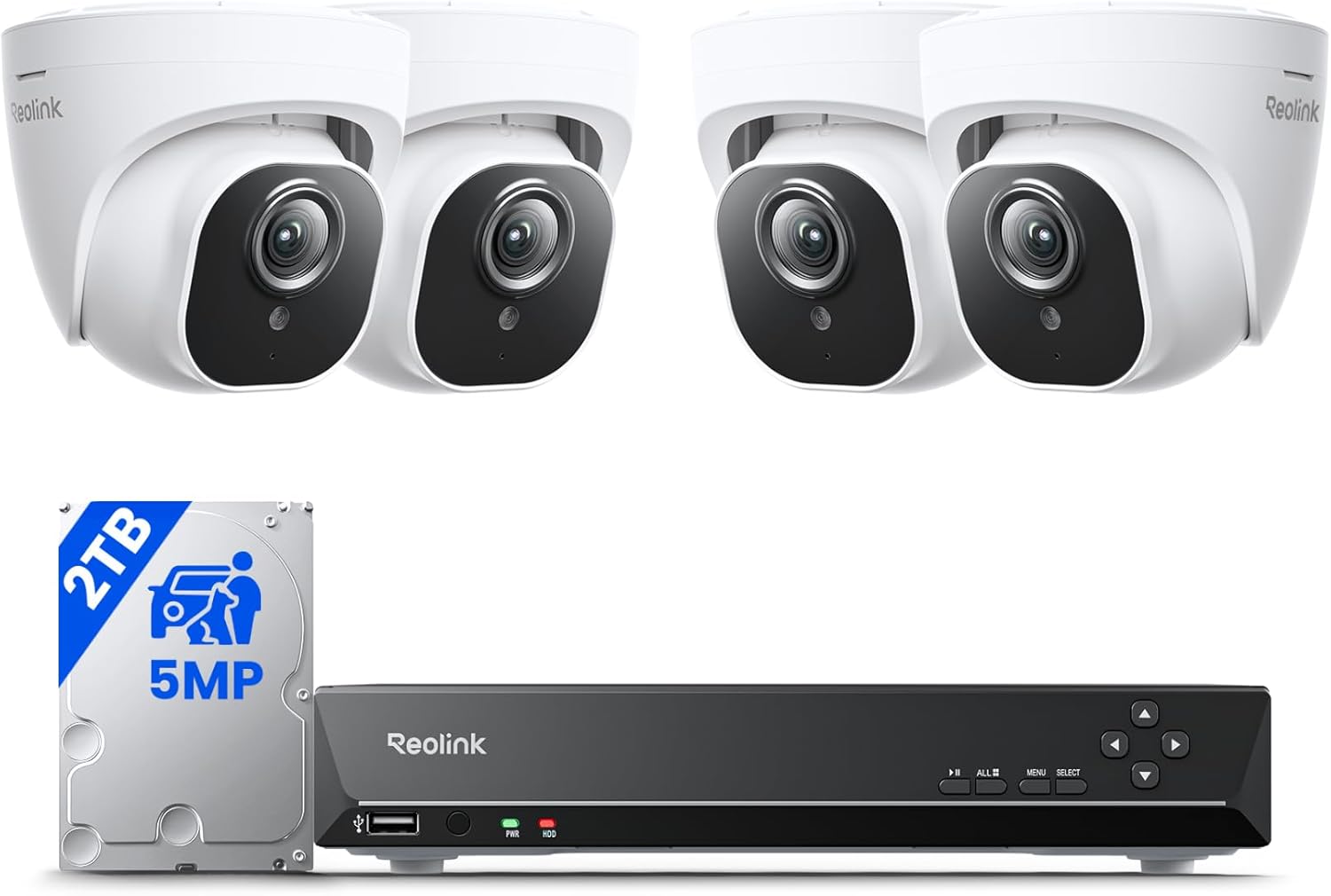
- Includes 4 wired 5MP PoE cameras plus an 8-channel NVR with a pre-installed 2TB HDD
- Infrared night vision reaches up to 100ft in the dark for outdoor coverage
- Person, animal, and vehicle detection filters out false alerts from bugs or leaves
- Built-in microphones on the cameras capture audio alongside video for fuller context
- NVR's e-SATA port supports adding an external 8TB HDD for extended storage
Cons
- Pre-installed 2TB HDD stores roughly ten days of continuous recording before older footage overwrites, unless expanded
- All four cameras are wired PoE units, so cable runs to each camera location are required — there's no wireless option in this kit
- Smart detection accuracy depends on keeping camera firmware updated to the latest version
This 8-channel kit pairs four 5MP PoE cameras with an NVR built for continuous home or property monitoring.
- 5MP HD resolution across all four included cameras
- Infrared night vision effective up to 100ft in darkness
- Smart detection separates people, animals, and vehicles from irrelevant motion like bugs or leaves
- Built-in microphones record audio alongside video footage
General motion detection remains available as a fallback alongside the smart classification. Because detection accuracy depends partly on firmware, keeping all four cameras updated to the latest version helps maintain the lower false-alert rate the system is built around.
Setup is designed around a plug-and-play PoE connection between each camera and the central NVR.
- Each of the 4 cameras connects to the NVR over a single PoE Ethernet cable, carrying both power and video
- No separate power adapters needed at each camera location thanks to PoE
- NVR handles recording centrally rather than requiring per-camera storage
Because every camera is wired, planning Ethernet cable runs to each mounting location ahead of installation is necessary — there is no wireless camera option within this particular kit. Once cabled, connecting each camera to the NVR is meant to be straightforward without additional network configuration.
Recording storage is handled centrally through the included hard drive, with room to expand.
- Pre-installed 2TB HDD stores about ten days of recording before older footage overwrites
- An additional external 8TB HDD can be added via the NVR's e-SATA port for longer retention
- Free Reolink app enables remote playback and live viewing from a smart device
Households wanting more than ten days of rolling footage should plan on the external HDD expansion from the start, since the internal drive capacity is fixed at 2TB. Remote access through the app does not require an ongoing subscription for basic playback and live viewing.

Pros
- 1 TB surveillance-grade drive pre-installed, with the bay accepting a single disk up to 10 TB
- H.265+ compression stretches recording time on the same drive and lowers bandwidth against H.264
- IP67 cameras see 100 ft in infrared black and white and 66 ft in full colour using the white light mode
- Eight channels supplied with four cameras, leaving four inputs free for later additions
- Recorder accepts TVI, AHD, CVI, CVBS and IP cameras, so mixed hardware can share one box
Cons
- Wired cameras throughout, so every run needs cable back to the recorder rather than a wireless link
- The supplied cameras are 1080p; the 3K/5MP capability of the recorder needs cameras bought separately
- A single drive bay means expanding storage replaces the 1 TB disk rather than adding to it
This is a wired system, which is what makes it dependable and also what makes installation the biggest job. Each camera runs cable back to the recorder for both video and power, so mapping the routes before drilling anything is time well spent.
- Plan cable paths through soffits, lofts or conduit, and keep runs away from mains cable to avoid interference
- Mount cameras high enough to be out of easy reach but angled to capture faces rather than the tops of heads
- The recorder ships in a carton around 14.6 by 11.8 by 7.6 inches, so allow shelf space with airflow around the unit
A monitor is needed for the first configuration. After that, day-to-day viewing moves to phones, tablets or computers through the app.
Footage lands on the pre-installed 1 TB surveillance-grade drive, and the single bay accepts a replacement up to 10 TB when you want longer retention. H.265+ encoding does quiet work here, packing more days onto the same disk than older compression manages.
- Continuous 24/7 recording is supported, as is motion-triggered capture when disk space matters more than completeness
- Up to four privacy masks can be applied per view, so a neighbour window or a shared path is never recorded at all
- Recording continues with no internet connection; the network is only needed for remote viewing and playback
There are no subscription requirements to store or play back footage, since everything lives on the drive inside the recorder rather than on a remote server.
Four cameras arrive in the box against eight available channels, so half the system is deliberately left for you to fill. That flexibility is real, since the recorder speaks TVI, AHD, CVI, CVBS and IP, meaning added cameras do not have to match the originals.
- Extra cable, connectors and mounting hardware for any run longer than the supplied leads
- A monitor with an HDMI or VGA input for the initial configuration
- Higher resolution cameras if you want the recorder 3K capability, since the bundled units capture 1080p
AI human and vehicle detection filters alerts so a swaying branch does not trigger a notification, and the same filter narrows the search when scrubbing back through recorded footage.

Pros
- AI Motion Detection 2.0 – Driving AI to the next level,
- Tried-and-True Safe Guard – This one-stop security solution can
- Reliable 24/7 Continuous Recording – With a pre-installed 1TB
- Smart Dual-Light Effectively Guard Your Home – This newly upgraded
- Dimensions of 17.32 x 13.39 x 7.09 inches engineered for optimal spatial fitting
Cons
- Requires verifying placement clearance for 17.32 x 13.39 x 7.09 inches prior to installation
- Best placed in well ventilated indoor spaces away from excess moisture
The ANNKE ANNKE 3K Lite Wired Security Camera System Outdoor with AI offers a refined combination of structural durability and user convenience for Surveillance DVR Kits setups. Key physical design elements prioritize user comfort through AI Motion Detection 2.0 – Driving AI to the next level, human&vehicle detection and flexible detection area are more accurate than before. For quicker locating in crucial moments, human&vehicle smart searching in recordings offers you great help.. Equipped with Tried-and-True Safe Guard – This one-stop security solution can work with TVI, AHD, CVI, CVBS & IP cameras, the kit includes 1080P cams. The 8CH 3K lite DVR can hook up with 1080P@30fps or 3K/5MP@20fps cams. Therefore, you can also DIY it with other cameras in your home., the hardware delivers reliable structural support under regular demands. Measurements of 17.32 x 13.39 x 7.09 inches provide clear dimensional boundaries for precise space planning.
Component assessment indicates careful selection of durable materials tailored for active usage. Key structural features including Reliable 24/7 Continuous Recording – With a pre-installed 1TB HDD(Support up to 10TB HDD), providing 24/7 surveillance recording for you. Upgraded H.265+ saves more storage space and uses less bandwidth, recording videos longer and smoother viewing. support overall longevity during regular operational cycles. Careful manufacturing ensures that frame connections retain rigidity over long term use. User centered design choices streamline routine interactions and enhance practical convenience. Robust physical construction provides verified peace of mind during heavy daily usage. Thoughtful spatial layout allows versatile placement across modern living environments.
Preserving structural integrity over extended service life is achieved through consistent daily care. Attributes like Smart Dual-Light Effectively Guard Your Home – This newly upgraded security system offers you a crisp full color night vision, IR mode and color night vision switch flexibly. Once detect intruders, immediate pushes pop up on your phone, securing your peace of mind day&night. allow hassle-free integration into existing room configurations. Preventing prolonged exposure to harsh environmental factors helps preserve original finish quality. User centered design choices streamline routine interactions and enhance practical convenience. Robust physical construction provides verified peace of mind during heavy daily usage.

Pros
- 8-channel DVR ships with a 1TB drive fitted and accepts a replacement up to 10TB
- Eight IP67 cameras with infrared reach to 100 ft and full-colour night vision to 66 ft
- H.265+ encoding stretches 24/7 continuous recording much further on the same drive
- AI human and vehicle filtering with drawable detection zones cuts alerts from trees and pets
- Recorder accepts TVI, AHD, CVI, CVBS and IP inputs, so higher-resolution heads can be added later
Cons
- Bundled cameras are 1080p, so 3K and 5MP live view needs separate cameras bought later
- Fully wired, so every camera needs a video and power run back to the recorder
- Privacy masking is limited to four areas per camera, and there is no cloud copy if the recorder is stolen
This is a wired system, which is its main strength and its main cost in labour. Each of the eight cameras needs a run back to the recorder carrying both video and power, so plan cable routes, drill points and the recorder location before mounting anything at all.
The cameras are rated IP67, so rain, dust and a wide temperature swing are all within scope for exterior mounting under an eave or on a wall. Mount them at a height that keeps faces in frame rather than the tops of heads, typically 8 to 10 ft, and angle them away from direct sunrise and sunset lines to avoid blown-out footage twice a day.
Useful reach is up to 100 ft, so aim at driveways, gates and approach paths rather than trying to cover a whole field with one head.
A 1TB hard drive comes pre-installed and the recorder accepts up to 10TB, so retention can be extended later without replacing the whole unit. H.265+ encoding is what makes 24/7 continuous recording across eight channels practical, since it cuts file sizes substantially against plain H.264 and lowers bandwidth for remote viewing at the same time.
Everything is stored locally on that drive, with no cloud account in the loop. The recorder keeps working with the internet down; a connection is only needed for remote viewing, phone playback and push alerts.
For privacy, up to four masked areas per camera can be blanked so the system never records them, which is how you keep a neighbour's window or a shared path out of your footage. Access can be shared with family through the app for simultaneous live views.
The bundled cameras are 1080p. The recorder itself supports 3K and 5MP at 20fps and works with TVI, AHD, CVI, CVBS and IP cameras, so higher-resolution heads can be swapped in later, but they are not in this box. Plan for that if you want plate-level detail at a gate.
You will also want, at minimum: a monitor or TV with HDMI for the initial setup, cable clips and weatherproof junction boxes for the outdoor runs, and a spare router port for the recorder if remote access matters to you. A UPS is worth considering as well, since a wired recorder captures nothing during a power cut unless it is backed up.
Full-colour night vision reaches about 66 ft against 100 ft in infrared, so distant night scenes will be monochrome.

Pros
- Ships with a pre-installed 1TB hard drive, expandable up to 10TB for longer recording history
- Four 1920TVL 2MP cameras rated IP67 for outdoor exposure to rain and dust
- 8-channel DVR accepts TVI, AHD, CVI, CVBS and IP cameras for mixed-camera setups
- Color night vision plus IR mode switches automatically, with B&W range to 100 feet
- H.265+ compression extends recording time on the same drive versus older H.264 systems
Cons
- DVR supports up to 3K/5MP at 20fps, but the included cameras are 1080P, so the higher resolution tier requires separate camera purchases
- System weighs in at a sizable 14.57 x 11.81 x 7.56 inch DVR footprint, needing a shelf or cabinet rather than a small desk spot
- Remote access, live viewing and playback require an internet connection; only local recording works if the internet is down
This is a wired system: four cameras connect to the 8-channel DVR by cable, and the DVR itself connects to a monitor or network for viewing.
- 4 x 1920TVL 2MP cameras rated IP67 for outdoor weatherproofing
- DVR accepts TVI, AHD, CVI, CVBS and IP camera types on the same unit
- Pre-installed 1TB hard drive, expandable to 10TB
- DVR footprint measures 14.57 x 11.81 x 7.56 inches
Because the cameras are wired rather than wireless, installation involves running cable from each camera position back to the DVR, which suits a garage, attic or crawlspace run more than a fully finished home without existing conduit. Mounting hardware ships with the cameras for wall or eave installation.
The system records continuously to the built-in 1TB drive and overwrites the oldest footage once storage fills, so there is no subscription fee for local recording.
- H.265+ compression reduces file size versus H.264 for longer retention on the same drive
- AI human and vehicle detection reduces false alerts from branches or animals
- Privacy masking blocks up to 4 areas from being recorded
- Remote access via the ANNKE Vision app when internet is available
Because recording and playback are stored locally on the hard drive rather than in the cloud, there is no monthly fee tied to storage. The tradeoff is that remote viewing depends on the home's internet connection; the DVR keeps recording locally even if that connection drops.
The kit includes four 1080P cameras, cabling and the 8CH DVR, but a few extras make setup smoother depending on the install location.
- A monitor or spare TV with HDMI input for local viewing during setup
- Additional cable length if camera runs exceed what's included, since distances vary by installation
- A UPS or surge protector for the DVR, since it runs continuously
Anyone planning to mix in the higher-resolution 3K/5MP cameras the DVR supports will need to buy those separately, as the bundled units are 1080P. For a straightforward four-camera perimeter setup with a year or more of local storage, the included hardware is enough to start recording the same day it's mounted.

Pros
- Eight 12MP cameras capture detail sharp enough to identify faces or license plates at typical yard distances
- Person, vehicle, and pet detection cuts down false alerts from moving branches or passing shadows
- Spotlight-equipped cameras deliver full-color night vision instead of grainy black-and-white infrared footage
- Two-way talk lets you speak through the camera speaker directly from the Reolink app
- 4TB HDD included, storing recorded footage without an immediate separate hard drive purchase
Cons
- Cameras in this kit only work with the included Reolink PoE NVR, not as standalone Wi-Fi cameras or with generic smart home hubs like Alexa
- 16 PoE ports on the NVR require running Ethernet cable to each camera location, more involved than a wire-free Wi-Fi camera install
- 4TB storage fills faster at 12MP resolution across eight cameras than it would with lower-resolution footage, so long-term archiving may need the external HDD port
Each of the eight cameras records at 12MP (4512x2512) using H.265 compression, with a field of view around 97° horizontal, and includes onboard person, vehicle, and pet detection to filter out irrelevant motion alerts.
- Camera resolution: 12MP, H.265 compression
- Detection types: person, vehicle, pet
- Night vision range: 100ft/30 meters, infrared and full-color modes
The full-color night vision mode relies on the built-in spotlight rather than infrared alone, which produces clearer color footage after dark but draws more power than IR-only night recording.
The system ships with a 4TB internal HDD already installed in the NVR, with capacity to expand up to 16TB total across one internal and one external HDD port, and stores footage using encrypted data protocols.
- Included storage: 4TB HDD (expandable to 16TB across two ports)
- Recording format: H.265 for efficient storage use
- Data protected with encrypted storage and customizable passwords
At 12MP across eight cameras, footage accumulates faster than lower-resolution systems, so households wanting months of continuous archived footage rather than a rolling few weeks should plan for the external HDD expansion.
The 16-channel PoE NVR (expandable to 24 channels with newer firmware) sends both power and data to each camera over a single Ethernet cable, and cameras are rated IP67 waterproof for outdoor mounting in varying weather.
- 16.93 x 14.57 x 13.98 inch NVR unit with 16 PoE ports
- Cameras rated IP67 for outdoor exposure and temperature swings from -10°C to 45°C
- Remote viewing via iOS/Android phone or Windows/Mac PC
Because the cameras in this kit are built to pair only with the Reolink PoE NVR, they can't be repurposed as standalone Wi-Fi cameras or connected to third-party smart home platforms.
Pros
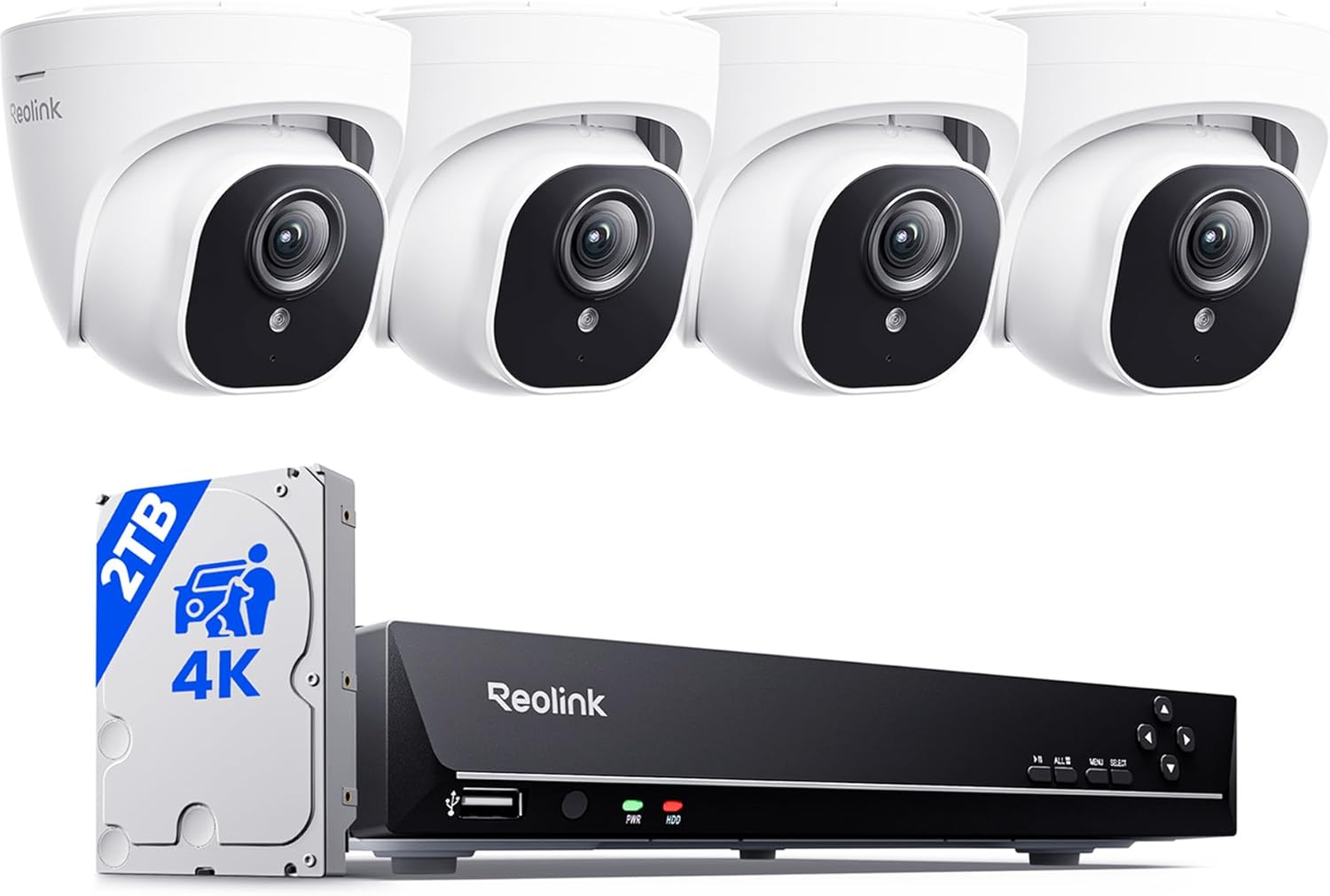
- 4K Ultra HD – Reolink 4K Ultra HD (8MP) PoE camera delivers almost
- Person/Vehicle/Animal Detection – Smart PoE IP cameras can identify
- Plug and Play PoE System – A simple PoE connection makes it easier
- Continuous 24/7 Recording – With a pre-installed 2TB HDD, users are
- Dimensions of 11 x 12.7 x 14.8 inches engineered for optimal spatial fitting
Cons
- Requires verifying placement clearance for 11 x 12.7 x 14.8 inches prior to installation
- Periodic visual inspection recommended to ensure component tightness
Designed with precision, the REOLINK 8CH 4K 8MP Home Security Camera System with 2TB delivers versatile performance for modern Surveillance DVR Kits spaces. Operational testing demonstrates clear performance benefits driven by 4K Ultra HD – Reolink 4K Ultra HD (8MP) PoE camera delivers almost 4 times the clarity of 1080p. Our complete camera system provides users vivid resolution, even when you digitally zoom in. Any flaw or distortion you’ve encountered before has been eliminated, ensuring you the highest quality view of your surroundings.. In active use, the presence of Person/Vehicle/Animal Detection – Smart PoE IP cameras can identify people and vehicles in terms of their shapes, minimizing unwanted alerts such as animals or shadows. Cameras can also be configured to specify the type of detection when sending alerts to you. Know what happened simply by glancing at the lock screen. eliminates common operational friction for homeowners. Measurements of 11 x 12.7 x 14.8 inches provide clear dimensional boundaries for precise space planning.
Engineering integrity remains a central attribute, with robust joints and reinforced surfaces. Hardware stability is reinforced through Plug and Play PoE System – A simple PoE connection makes it easier to install your home security camera system. With a single network cable, stretching up to 330ft, users can enjoy smooth security coverage of their entire house. Please complete the initial system configuration, network connection, and Reolink App setup to make the most of features such as remote access., ensuring dependable daily performance. Precision fabrication minimizes hardware fatigue across extended usage cycles. Carefully selected components ensure minimal maintenance overhead over long service life.
Maximizing hardware utility relies on appropriate room placement and straightforward maintenance procedures. Incorporating Continuous 24/7 Recording – With a pre-installed 2TB HDD, users are provided reliable 24/7 recording. You can also install an external hard drive (up to 8TB) for backup storage. Expandable to 16TB totally., routine adjustments can be performed efficiently without specialized hardware. Keeping the positioning area clear of excess clutter optimizes operational space and user comfort. Carefully selected components ensure minimal maintenance overhead over long service life. Attention to manufacturing details ensures reliable utility for your Surveillance DVR Kits. Using proper installation techniques maintains physical stability across daily activities.
Pros
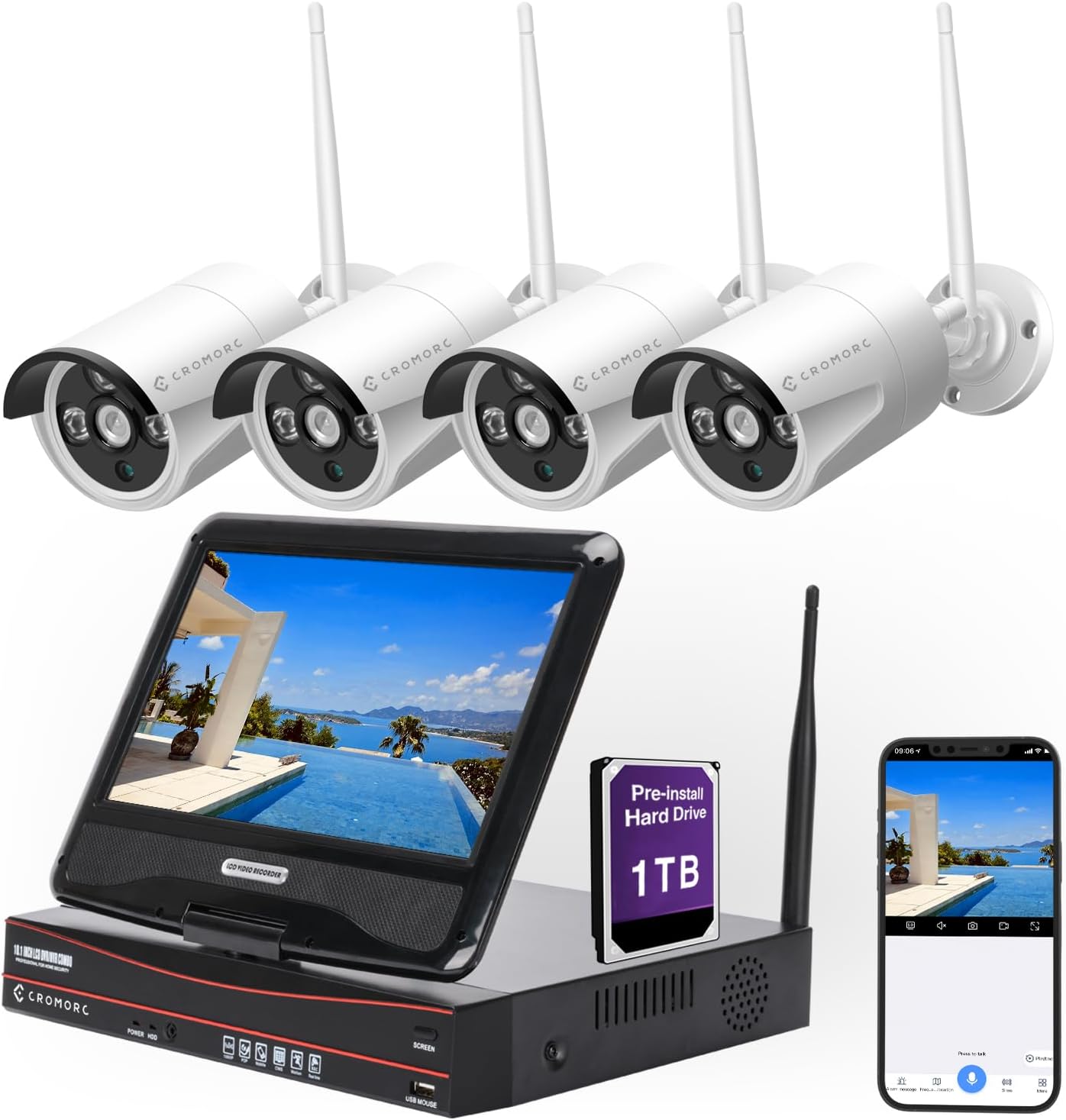
- 10-channel NVR + 1TB HDD included—no separate recorder purchase needed
- 5MP bullet cameras with 65-foot night vision and IP66 weatherproofing for 24/7 outdoor duty
- AI human detection filters 90% false alerts from animals/light changes
- Expandable to 16 cameras; supports 2-way audio via compatible dome camera add-ons
Cons
- 10.1-inch monitor small for detailed license plate review; requires 24-inch display for readability
- Wireless 2.4/5GHz coverage limited to 100 feet in open space; obstacles reduce range
10-channel 8MP NVR with pre-installed 1TB professional-grade hard drive for continuous 7-day storage. 5MP (2560x1920) bullet camera resolution captures facial features and license plates at up to 20-foot distance for security investigations. 65-foot infrared night vision with illuminators maintains visibility and color recognition in complete darkness. IP66 weatherproofing rated for rain, snow, salt spray, and extreme temperature fluctuations. 10.1-inch foldable touchscreen monitor included for on-site review without external display purchases. Supports simultaneous recording from all 10 channels at 30fps.
5th-generation AI chipset enables human detection algorithms to trigger recording only when people enter monitored frame—reduces storage bloat by 80% versus continuous recording. Advanced algorithms distinguish humans from pets, shadows, and vehicle movement. One-way audio capability from recorder to cameras for verbal deterrence messages. Plug-and-play wireless setup requires DC power for each camera but eliminates tedious video cable runs. Auto-repeater function boosts WiFi signal range up to 150 feet without extension antennas. Eseecloud mobile app enables remote viewing and playback management.
DIY installation without technician assistance—no special skills required. Download Eseecloud app for remote viewing, playback, and backup via 2.4/5GHz WiFi or direct Ethernet connection. Local recording continues offline if internet disconnects; manual access to NVR required for playback without network. Auto-repeater function boosts WiFi range without extension antennas cluttering aesthetics. Scalable system reserves 6 channels for future camera expansion as property security needs grow. Activity log tracks all access, deletions, and modification timestamps.
Why Business Cameras Are Different From Home Cameras
Consumer cameras are built for convenience: quick setup, cloud subscriptions, and coverage of a front door or living room. Business environments demand more. You typically need continuous 24/7 recording, coverage of multiple entrances and parking areas, footage that holds up as evidence, and a system that keeps working even if the internet drops. That is why most serious commercial setups rely on a dedicated recorder – either an NVR (network video recorder) or a DVR – paired with several fixed cameras rather than standalone Wi-Fi units.
Purpose-built commercial kits such as the ONWOTE 16 Channel PoE System and the face-recognition-ready ONWOTE 16CH 4K System are designed around this reality, bundling a high-capacity recorder with a full set of matched cameras so you are not stitching together mismatched parts.
Continuous Recording and Reliability
For a business, spot recording triggered only by motion is rarely enough. A shrink event, a slip-and-fall claim, or an after-hours dispute often needs footage from a specific timestamp you didn’t know would matter. Systems with a built-in hard drive record around the clock, so the footage is already there when you need to pull it.
Wired PoE vs. Wireless: Which Fits Your Property?
The first big fork in the road is connection type. Each approach has clear strengths depending on your building and how permanent your installation needs to be.
Wired PoE Systems
Power over Ethernet (PoE) runs both data and power through a single cable to each camera. This is the gold standard for commercial installs because it is stable, hard to jam, and supports long cable runs across large properties. PoE kits like the REOLINK 5MP 8CH System and the higher-resolution REOLINK 8CH 4K System are ideal when you own the building or can run cable through walls and ceilings. The trade-off is a more involved installation.
Wireless Systems
Wireless kits reduce cabling and are easier to reposition, which suits leased spaces or properties where drilling is limited. An expandable wireless option such as the 10CH Wireless System with Monitor even includes a built-in display, so you can monitor live feeds without a separate computer. Keep in mind that wireless still needs power at each camera and can be more sensitive to interference and range, so plan placement carefully.
DVR Systems as a Budget Bridge
DVR systems use coaxial cabling and analog-style cameras, offering strong value for smaller businesses. Kits like the ANNKE 8CH 2MP System and the ANNKE 8CH 3K Lite System deliver reliable wired recording at an accessible price, making them a practical starting point for shops and small offices.
Resolution: How Much Detail Do You Actually Need?
Resolution determines whether you can read a license plate, identify a face, or just see that “someone” was there. For businesses, detail can be the difference between usable evidence and a blurry shape.
- 2MP (1080p): Adequate for general coverage of small areas, aisles, and entryways where cameras sit close to the action.
- 3K / 5MP: A strong middle ground that sharpens faces and plates at moderate distances – well suited to most retail and office settings.
- 4K / 8MP and 12MP: Best for large parking lots, loading docks, and wide storefronts where you want to zoom into recorded footage and still keep clarity.
If your property has long sightlines, lean toward higher-resolution kits such as the REOLINK 16CH 12MP System. For compact spaces, a sharp 3K option like the ANNKE 3K Lite 8-Camera System often provides plenty of detail at a lower cost.
Channel Count: Sizing the System to Your Space
The channel count is the maximum number of cameras the recorder supports. Undersize it and you’ll be shopping again within a year; oversize it needlessly and you pay for capacity you never use. A useful approach is to walk your property and list every zone that needs eyes on it: each public entrance, the register or reception, stockrooms, rear exits, and parking.
Most small businesses land comfortably in the 8-channel range, which is why 8CH kits like the ANNKE 3K Lite 8CH DVR System are so common. Larger operations with multiple buildings or extensive exteriors benefit from 16-channel recorders such as the ONWOTE 16CH Commercial NVR, which leaves room to expand coverage over time.
Plan for Growth
If you expect to add locations, a bay, or exterior coverage later, buy a recorder with a few spare channels now. Adding cameras to an existing NVR is far cheaper and simpler than replacing the whole system.
Storage: Keeping Footage Long Enough to Matter
Storage capacity dictates how many days of continuous footage you can keep before older clips are overwritten. Higher resolution and more cameras eat storage faster, so the two decisions are linked. Many commercial-grade kits ship with a pre-installed hard drive – 1TB, 2TB, or 4TB – sized to their camera count.
Systems bundled with larger drives, like the 4TB ONWOTE 4K NVR Kit or the 2TB REOLINK RLK8 System, are built to retain weeks of continuous recording across many channels. As a rough rule, aim for at least two to four weeks of retention so you can review incidents that surface days after they happen.
Smart Detection and Night Performance
Modern business systems have moved well beyond basic motion alerts. AI-powered detection can distinguish people and vehicles from waving branches or passing shadows, dramatically cutting false alarms and the notification fatigue that leads owners to ignore their own alerts.
Look for person, vehicle, and pet detection when you want targeted alerts. Kits such as the ANNKE 8CH AI Detection System and the REOLINK 4K Turret Kit include these smarter filters. For high-security needs, advanced options add face recognition, as seen in the ONWOTE Face Recognition System.
Color Night Vision and Two-Way Audio
Crime doesn’t wait for daylight, so night performance is essential. Many current cameras offer color night vision using smart spotlights instead of grainy black-and-white infrared – a feature highlighted across the ANNKE Dual Light cameras. Two-way audio, available on kits like the REOLINK 12MP System, lets you speak to visitors or deter loiterers remotely, adding an active layer to passive recording.
Weatherproofing and Placement
Outdoor cameras must survive rain, heat, and cold, so check for an IP66 or IP67 rating on any unit facing the elements. Beyond durability, placement is what makes or breaks coverage. Mount cameras high enough to avoid tampering but angled to capture faces rather than the tops of heads. Cover every entrance, the point of sale, and any cash-handling area, and overlap fields of view so there are no gaps a person could slip through.
- Point at least one camera at each public entrance and exit.
- Position a camera to capture faces at the register or reception desk.
- Cover parking areas and loading zones where vehicles and inventory move.
- Avoid aiming directly into bright light, which can wash out footage.
Matching a System to Your Business Type
Pulling it together, the right choice depends on scale and setting. Small shops and offices are usually well served by an 8-channel wired kit with 3K or higher resolution and a 1-2TB drive. Mid-size retailers with parking lots benefit from higher-resolution PoE systems and AI detection to keep alerts meaningful. Large facilities, warehouses, and multi-entrance buildings should look at 16-channel NVR systems with 4TB storage and 4K or 12MP cameras for maximum coverage and future expansion.
For leased spaces where cabling is restricted, a wireless kit with an included monitor keeps installation simple. And for owners who want the highest tier of identification, systems with face recognition and 4K clarity provide the strongest evidentiary quality.
Final Thoughts on Choosing the Best Business Security Camera Systems
The best business security camera systems aren’t the ones with the longest spec sheet – they’re the ones matched to your building, your risks, and your budget. Start by mapping the zones you need to cover, decide between wired PoE, DVR, or wireless based on your property, then choose a resolution and storage capacity that keep footage clear and available long enough to be useful. Add AI detection and color night vision to reduce noise and protect after hours.
Use the product list above to compare recorder capacity, camera count, and included storage side by side, and pick the setup that fits how your business actually operates. Investing a little time in the right decision now means reliable, evidence-ready coverage for years to come.