 Ryan Delgado
 Choosing the best cctv cameras for home protection can feel overwhelming when every product page promises crystal-clear video, smart alerts, and around-the-clock peace of mind. The truth is that no single camera is right for every household. The ideal setup depends on the size of your property, whether you need indoor or outdoor coverage, how you want footage stored, and how much you are willing to spend. This guide walks you through everything that matters so you can shop with confidence instead of guessing.
Rather than ranking individual models, we focus on how to choose the right system for your needs. Below you will find a curated shortlist of popular options, followed by a practical framework for narrowing down your decision.

Pros
- Motorised head covers 360 degrees horizontally and 130 degrees vertically, so one unit watches a driveway, side path and front door in turn
- Infrared night vision reaches up to 98 ft, enough for a typical driveway or back garden in total darkness
- Person detection and high-speed motion tracking keep a moving subject in frame and cut alerts from swaying branches
- Physical privacy mode rotates the lens behind the housing, blocking it mechanically rather than in software
- Records to a microSD card of up to 512 GB, with an optional cloud service as an alternative
Cons
- Mains wired with no battery, so the install is limited to spots you can run power to
- 2.4 GHz Wi-Fi only, so signal strength at the mounting point needs checking before drilling
- 1080p resolution softens quickly under digital zoom, so faces beyond about 15 ft are hard to identify
This is a wired outdoor camera, so the install starts with the power run rather than the view. It draws from a mains adapter, which means an outdoor socket, a hole drilled through a wall to an indoor socket, or a soffit fitting near an existing supply.
- The body measures 4.88 x 4.84 x 3.54 in and fixes to a wall or ceiling with the supplied bracket
- Under an eave is the usual spot. It shelters the housing and puts the lens above head height, out of easy reach
- Wi-Fi is 2.4 GHz only, which is actually the right band outdoors since it carries through brick better than 5 GHz. Test signal strength at the mounting point before you drill
Mount the bracket, seal the cable entry, then aim the head from the app rather than by hand.
Onboard AI performs person detection with no extra step, which cuts the constant alerts a plain motion trigger throws every time a branch moves. When it sees movement, the head rotates to follow the subject and keeps it in frame.
- Footage records to a microSD card of up to 512 GB fitted inside the housing and supplied separately, with an optional cloud service as an alternative
- Two-way audio runs through the app, and you can record your own message to play as an alarm instead of the stock siren
- Physical privacy mode rotates the lens so the housing blocks it. That is genuinely covered rather than merely software-disabled, which matters on a camera pointed anywhere near a neighbouring garden
The head sweeps 360 degrees horizontally and 130 degrees vertically, so one unit mounted on a corner can watch a driveway, a side path and a front door in turn instead of covering a single fixed cone.
Resolution is 1080p. That reads a plate or a face close to the camera, but softens quickly under digital zoom, so mount it where people pass within roughly 15 ft rather than watching the far end of a long garden.
- Infrared night vision reaches up to 98 ft, producing a monochrome image across a typical driveway
- Alexa and Google Assistant can pull the feed to a display, though Google streaming is limited to Chromecast and Nest devices
- Motion tracking rotates at high speed, so a subject crossing the frame quickly stays in view
Pros
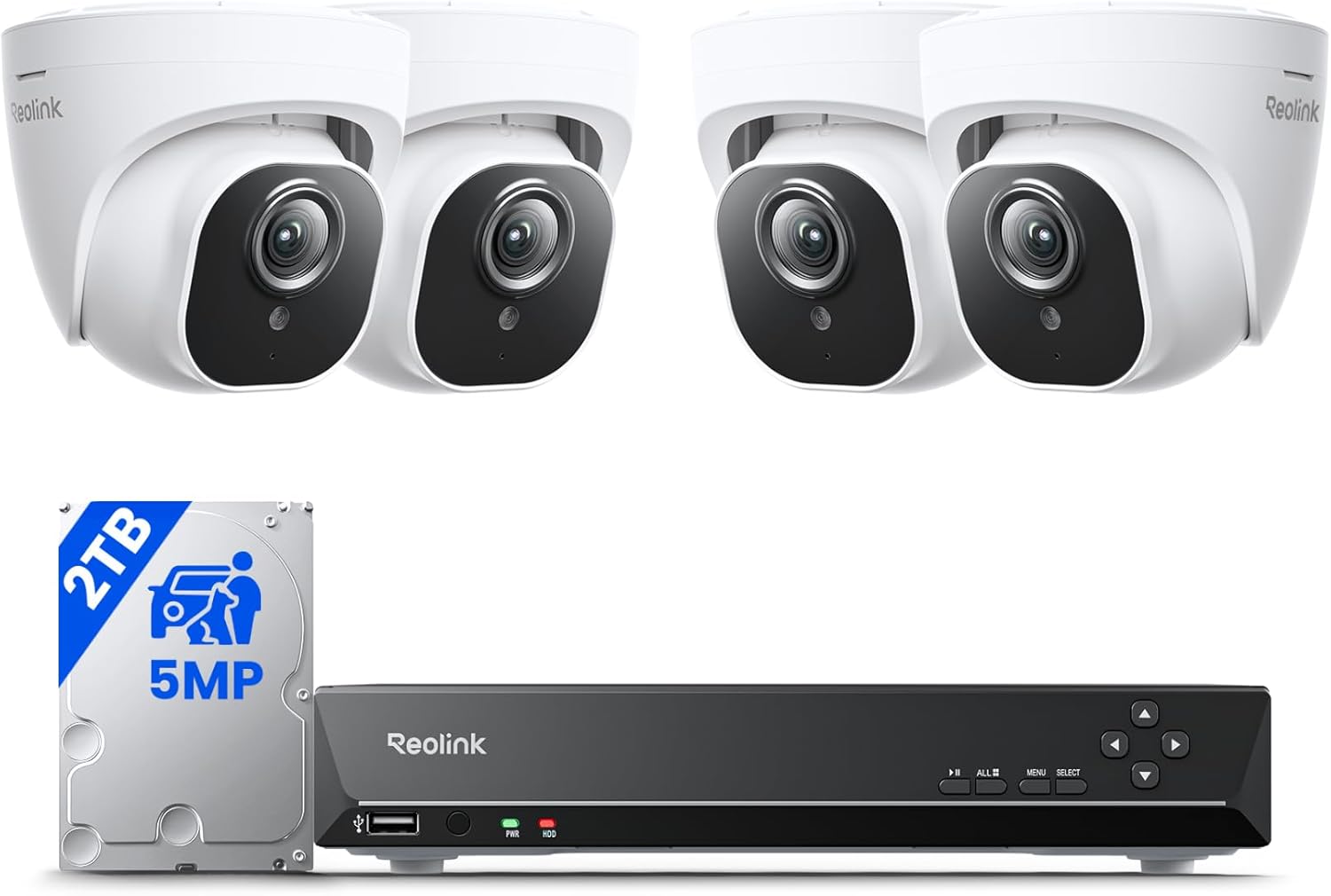
- Includes 4 wired 5MP PoE cameras plus an 8-channel NVR with a pre-installed 2TB HDD
- Infrared night vision reaches up to 100ft in the dark for outdoor coverage
- Person, animal, and vehicle detection filters out false alerts from bugs or leaves
- Built-in microphones on the cameras capture audio alongside video for fuller context
- NVR's e-SATA port supports adding an external 8TB HDD for extended storage
Cons
- Pre-installed 2TB HDD stores roughly ten days of continuous recording before older footage overwrites, unless expanded
- All four cameras are wired PoE units, so cable runs to each camera location are required — there's no wireless option in this kit
- Smart detection accuracy depends on keeping camera firmware updated to the latest version
This 8-channel kit pairs four 5MP PoE cameras with an NVR built for continuous home or property monitoring.
- 5MP HD resolution across all four included cameras
- Infrared night vision effective up to 100ft in darkness
- Smart detection separates people, animals, and vehicles from irrelevant motion like bugs or leaves
- Built-in microphones record audio alongside video footage
General motion detection remains available as a fallback alongside the smart classification. Because detection accuracy depends partly on firmware, keeping all four cameras updated to the latest version helps maintain the lower false-alert rate the system is built around.
Setup is designed around a plug-and-play PoE connection between each camera and the central NVR.
- Each of the 4 cameras connects to the NVR over a single PoE Ethernet cable, carrying both power and video
- No separate power adapters needed at each camera location thanks to PoE
- NVR handles recording centrally rather than requiring per-camera storage
Because every camera is wired, planning Ethernet cable runs to each mounting location ahead of installation is necessary — there is no wireless camera option within this particular kit. Once cabled, connecting each camera to the NVR is meant to be straightforward without additional network configuration.
Recording storage is handled centrally through the included hard drive, with room to expand.
- Pre-installed 2TB HDD stores about ten days of recording before older footage overwrites
- An additional external 8TB HDD can be added via the NVR's e-SATA port for longer retention
- Free Reolink app enables remote playback and live viewing from a smart device
Households wanting more than ten days of rolling footage should plan on the external HDD expansion from the start, since the internal drive capacity is fixed at 2TB. Remote access through the app does not require an ongoing subscription for basic playback and live viewing.

Pros
- 8 cameras rated IP67 for outdoor exposure, each recording at 5MP resolution
- 355-degree pan plus 90-degree tilt per camera for coverage without fixed blind spots
- Pre-installed 1TB hard drive stores 24/7 footage for 15+ days before overwriting
- Color night vision activates via 6 onboard LEDs when human motion is detected, up to 4 cameras
- Functions on a local monitor without an internet connection or monthly subscription fee
Cons
- AI person/vehicle detection and color night-vision spotlight activation are limited to 4 of the 8 cameras
- Pan/tilt is controlled manually through the app or DVR; there is no automatic tracking or patrol cruise mode
- Wired system requires running BNC cable to each camera, unlike a battery or Wi-Fi kit
Each of the 8 cameras covers 355-degree pan and 90-degree tilt, adjustable from the DVR remote or the mobile app, giving broad coverage without a fixed blind spot. Night vision runs in two modes: an infrared black-and-white mode reaching 100 ft in darkness, and a color mode that triggers 6 onboard LEDs when human motion is detected on up to 4 of the cameras.
- 5MP resolution per camera, sharper than 1080p
- AI human/vehicle filtering reduces false alerts from animals or leaves
- Push notifications sent to the app with no monthly fee
The system does not include automatic tracking or a cruise patrol mode; pan and tilt adjustments are manual, made through the app or DVR interface rather than the camera moving on its own.
The DVR ships with a pre-installed 1TB hard drive, storing continuous or motion-triggered footage for 15 or more days before older recordings are overwritten. Playback supports 256x fast-forward to skip through long recordings quickly, along with an event filter that searches by person or vehicle tags on the 4 AI-enabled cameras.
- 24/7 or motion-only recording modes
- Local monitor viewing without an internet connection
- 256x playback speed for scanning footage
Because storage is local to the included 1TB drive rather than cloud-based, there is no recurring subscription fee, but footage retention depends on how much of the drive gets used by continuous versus motion-only recording settings.
Cameras mount to a wall or ceiling using 4 screws each, then connect to the DVR through BNC cable rather than Wi-Fi. All 8 cameras and the DVR are sealed to IP67, built to run across -40C to 60C (-40F to 140F) for outdoor use in most climates.
- Wired BNC connection to the DVR, not wireless
- IP67 sealing on all included cameras
- One-way audio lets you speak through the camera
Because the system is fully wired, installation involves running cable from each camera position back to the DVR, which takes more planning than a battery or Wi-Fi camera kit but avoids the range and interference issues wireless systems can have.

Pros
- Four identical 1080p units in one pack cover a nursery, a back door, a hallway and a garage together
- Infrared night vision reaches roughly 40 ft in a fully dark room
- microSD slot accepts cards up to 512 GB, so recording works without any cloud plan
- RTSP and ONVIF support lets each camera feed an existing NVR or a home automation server
- Built-in siren pairs with two-way audio through the onboard microphone and speaker
Cons
- Fixed lens with no pan or tilt, so each camera only ever watches the angle it was mounted at
- 2.4 GHz Wi-Fi only and mains powered through the DC adapter, so every unit needs a socket within reach
- microSD cards are not included, and person or baby-cry history beyond live alerts sits behind the Tapo Care tier
The pack contains four identical units, each measuring 2.66 x 2.15 x 3.89 in, so several rooms can be covered in one setup session.
- Each camera joins a 2.4 GHz Wi-Fi network, as 5 GHz is not supported
- Every unit runs from its supplied DC adapter and must stay plugged in, since there is no battery
- The lens is fixed with no pan or tilt, so the mounting angle is the coverage you get
That makes placement the most important decision of the install. Corners at ceiling height give the widest useful view, and pointing along a hallway rather than across it keeps a face in frame for longer. Four units spread around a house each want a socket within cable reach, which is worth checking before anything gets drilled.
Recording is local first, with a cloud tier available as an option rather than a requirement.
- A microSD card up to 512 GB slots into each camera for continuous or event recording, and no card is supplied
- The Tapo Care tier adds 30 days of video history along with motion tracking and baby-crying detection
- Push alerts distinguish general motion, a person and a baby crying
Check the manufacturer compatibility list before buying cards, since not every 512 GB card is accepted. For anyone who prefers footage never to leave the house, cards alone work fully, and the RTSP and ONVIF support means the streams can also be pulled into a local NVR or a home automation server. Cameras inside a home should be disclosed to everyone living there.
Out of the box the pack covers the cameras and their adapters, and a working installation usually needs a little more.
- Four microSD cards, or one shared cloud plan, since nothing is retained without storage
- Four mains sockets, or a multi-way strip near each mounting point
- A 2.4 GHz network name separated from 5 GHz during pairing
Optional additions matter more than they first appear. A screen-equipped smart speaker lets any of the four feeds be called up by voice. A machine running NVR or home automation software turns the RTSP streams into a single searchable archive. Night vision reaches about 40 ft indoors, so a very large room may still want a lamp left on at the far end.

Pros
- Rechargeable battery runs up to 60 days under a 100-trigger-per-day test load, with lighter use theoretically stretching further
- IP66 sealing withstands direct rain and temperature swings for permanent outdoor mounting
- Supports both 2.4GHz and 5GHz WiFi bands plus local SD storage up to 256GB alongside cloud backup
- Built-in spotlight and siren activate together with AI-based person motion detection
- 2-way talk lets you speak through the camera to visitors without a separate intercom
Cons
- Free cloud plan only stores SD-quality footage, HD clips require a paid subscription tier
- SD card is not included in the box despite being supported up to 256GB
- Battery life estimate of up to 6 months assumes a low, unspecified trigger frequency rather than daily active use
Set up connects the camera to a 2.4GHz or 5GHz WiFi network through the companion app, with no cables required since the unit runs on a rechargeable, high-capacity battery rather than mains power. That wire-free design means it can be mounted on a wall, eave, or post without running conduit to the location.
- Dual-band WiFi support gives more flexibility fitting into an existing home network
- Battery-powered design avoids the need for outdoor electrical wiring during install
- IP66 sealing means the housing is protected against dust and heavy rain for permanent outdoor placement
- Mounting hardware is included for wall or eave installation, with the camera measuring 2.25 x 2.25 x 3.32 inches
Footage can be saved through free cloud storage or a local SD card supporting up to 256GB, giving a backup option if WiFi drops or a cloud plan is not preferred. The free cloud tier is limited to SD-quality video, with HD storage requiring a paid plan upgrade.
- Local SD storage keeps footage on-site rather than depending solely on a cloud connection
- Free cloud plan avoids a mandatory subscription but caps stored footage at SD quality
- 256GB SD card support gives substantial local storage headroom, though a card must be purchased separately
- Continuous recording mode is available for monitoring beyond motion-triggered clips alone
Getting full functionality out of this camera means planning for a few extras beyond the box: a microSD card for local storage, a stable 2.4GHz or 5GHz WiFi signal at the mount point, and a decision on whether the free cloud tier's SD-quality limit is acceptable or whether a paid plan is needed for HD clips.
- No SD card ships in the box, so local storage requires a separate purchase
- A stable outdoor WiFi signal is necessary since the camera has no wired network fallback
- Alexa compatibility adds voice-based viewing but requires a compatible smart speaker or display separately
- Battery charging cable is included, but a periodic recharge schedule should be planned around actual usage patterns

Pros
- IP65-rated weatherproofing and an operating range of -4°F to 109°F for year-round outdoor use
- 4MP 2K HD resolution captures fine detail like faces and objects even when footage is zoomed in
- Dual-integrated spotlights extend color night vision out to 98 ft instead of switching to black-and-white IR
- AI-powered person detection sends targeted alerts instead of notifying on every motion event
- Subscription-free local storage is available as an alternative to optional cloud storage plans
Cons
- Corded electric power only, so it needs a nearby outlet or in-wall wiring rather than running on battery
- Wi-Fi only connectivity means placement is limited to areas with a strong signal from the router
- 2-way audio and siren both route through the Kasa app, so a phone or tablet is required to trigger them remotely
Rated IP65, this camera is built to handle direct exposure to rain and dust, with an operating temperature range spanning -4°F to 109°F for climates with real seasonal swings. Because it is corded electric rather than battery powered, installation means running a power cable to the mounting spot, whether that is under an eave, beside a garage door, or along a fence line.
Wi-Fi is the only connectivity option, so a strong signal from the home router at the mounting location matters for reliable streaming and alerts.
- IP65-rated protection against rain and dust exposure
- Corded power requires an available outlet or wiring run
A starlight sensor keeps low-light footage crisp and detailed rather than grainy, and dual-integrated spotlights extend full-color night vision out to 98 ft instead of dropping to black-and-white infrared once it gets dark. This makes it easier to tell an animal from a person at a distance overnight.
AI-powered detection is tuned to flag people and motion specifically, and custom activity zones can be set around doors, windows, or a driveway so alerts focus on the areas that matter most instead of every passing car or tree branch.
- Color night vision to 98 ft via dual spotlights
- Custom activity zones reduce alerts from irrelevant motion
Recording works two ways: subscription-free local storage or an optional cloud plan, giving a choice between paying nothing for on-device storage or paying for offsite backup and extended history. Two-way audio with a built-in siren lets an owner speak through the camera or trigger a warning tone directly from the Kasa app.
Beyond the camera itself, a stable Wi-Fi connection and either a local storage card or a cloud subscription are needed to actually retain footage, since the camera does not include a card in the box.
- Choice between free local storage and optional cloud plans
- Built-in siren and 2-way audio controlled through the Kasa app

Pros
- AI Motion Detection 2.0 – Driving AI to the next level,
- Tried-and-True Safe Guard – This one-stop security solution can
- Reliable 24/7 Continuous Recording – With a pre-installed 1TB
- Smart Dual-Light Effectively Guard Your Home – This newly upgraded
- Dimensions of 17.32 x 13.39 x 7.09 inches engineered for optimal spatial fitting
Cons
- Requires verifying placement clearance for 17.32 x 13.39 x 7.09 inches prior to installation
- Best placed in well ventilated indoor spaces away from excess moisture
The ANNKE ANNKE 3K Lite Wired Security Camera System Outdoor with AI offers a refined combination of structural durability and user convenience for Surveillance DVR Kits setups. Key physical design elements prioritize user comfort through AI Motion Detection 2.0 – Driving AI to the next level, human&vehicle detection and flexible detection area are more accurate than before. For quicker locating in crucial moments, human&vehicle smart searching in recordings offers you great help.. Equipped with Tried-and-True Safe Guard – This one-stop security solution can work with TVI, AHD, CVI, CVBS & IP cameras, the kit includes 1080P cams. The 8CH 3K lite DVR can hook up with 1080P@30fps or 3K/5MP@20fps cams. Therefore, you can also DIY it with other cameras in your home., the hardware delivers reliable structural support under regular demands. Measurements of 17.32 x 13.39 x 7.09 inches provide clear dimensional boundaries for precise space planning.
Component assessment indicates careful selection of durable materials tailored for active usage. Key structural features including Reliable 24/7 Continuous Recording – With a pre-installed 1TB HDD(Support up to 10TB HDD), providing 24/7 surveillance recording for you. Upgraded H.265+ saves more storage space and uses less bandwidth, recording videos longer and smoother viewing. support overall longevity during regular operational cycles. Careful manufacturing ensures that frame connections retain rigidity over long term use. User centered design choices streamline routine interactions and enhance practical convenience. Robust physical construction provides verified peace of mind during heavy daily usage. Thoughtful spatial layout allows versatile placement across modern living environments.
Preserving structural integrity over extended service life is achieved through consistent daily care. Attributes like Smart Dual-Light Effectively Guard Your Home – This newly upgraded security system offers you a crisp full color night vision, IR mode and color night vision switch flexibly. Once detect intruders, immediate pushes pop up on your phone, securing your peace of mind day&night. allow hassle-free integration into existing room configurations. Preventing prolonged exposure to harsh environmental factors helps preserve original finish quality. User centered design choices streamline routine interactions and enhance practical convenience. Robust physical construction provides verified peace of mind during heavy daily usage.

Pros
- 8-channel DVR ships with a 1TB drive fitted and accepts a replacement up to 10TB
- Eight IP67 cameras with infrared reach to 100 ft and full-colour night vision to 66 ft
- H.265+ encoding stretches 24/7 continuous recording much further on the same drive
- AI human and vehicle filtering with drawable detection zones cuts alerts from trees and pets
- Recorder accepts TVI, AHD, CVI, CVBS and IP inputs, so higher-resolution heads can be added later
Cons
- Bundled cameras are 1080p, so 3K and 5MP live view needs separate cameras bought later
- Fully wired, so every camera needs a video and power run back to the recorder
- Privacy masking is limited to four areas per camera, and there is no cloud copy if the recorder is stolen
This is a wired system, which is its main strength and its main cost in labour. Each of the eight cameras needs a run back to the recorder carrying both video and power, so plan cable routes, drill points and the recorder location before mounting anything at all.
The cameras are rated IP67, so rain, dust and a wide temperature swing are all within scope for exterior mounting under an eave or on a wall. Mount them at a height that keeps faces in frame rather than the tops of heads, typically 8 to 10 ft, and angle them away from direct sunrise and sunset lines to avoid blown-out footage twice a day.
Useful reach is up to 100 ft, so aim at driveways, gates and approach paths rather than trying to cover a whole field with one head.
A 1TB hard drive comes pre-installed and the recorder accepts up to 10TB, so retention can be extended later without replacing the whole unit. H.265+ encoding is what makes 24/7 continuous recording across eight channels practical, since it cuts file sizes substantially against plain H.264 and lowers bandwidth for remote viewing at the same time.
Everything is stored locally on that drive, with no cloud account in the loop. The recorder keeps working with the internet down; a connection is only needed for remote viewing, phone playback and push alerts.
For privacy, up to four masked areas per camera can be blanked so the system never records them, which is how you keep a neighbour's window or a shared path out of your footage. Access can be shared with family through the app for simultaneous live views.
The bundled cameras are 1080p. The recorder itself supports 3K and 5MP at 20fps and works with TVI, AHD, CVI, CVBS and IP cameras, so higher-resolution heads can be swapped in later, but they are not in this box. Plan for that if you want plate-level detail at a gate.
You will also want, at minimum: a monitor or TV with HDMI for the initial setup, cable clips and weatherproof junction boxes for the outdoor runs, and a spare router port for the recorder if remote access matters to you. A UPS is worth considering as well, since a wired recorder captures nothing during a power cut unless it is backed up.
Full-colour night vision reaches about 66 ft against 100 ft in infrared, so distant night scenes will be monochrome.

Pros
- 355 deg horizontal and 90 deg vertical rotation from a 2.95 in. square footprint
- Four units in one box cover a nursery, hallway, main room and back door
- USB-C mains lead supports continuous 24/7 recording rather than event clips only
- Two-way audio plus sharing with up to 3 additional household accounts
- 2K sensor with infrared night vision for unlit rooms
Cons
- 2.4 GHz Wi-Fi only, so a merged dual-band network often needs splitting during pairing
- Mains powered with no battery, so every camera needs an outlet within cable reach
- No SD cards are supplied with the four-pack
Each of the four cameras joins a 2.4 GHz network through the companion app. There is no 5 GHz support, so a combined dual-band SSID sometimes needs splitting, or the 5 GHz band paused briefly, before the camera will accept credentials.
- 2.4 GHz Wi-Fi only, with no Ethernet port
- USB-C power lead on every unit
- One main account plus 3 shared viewers
- Instant motion push alerts per camera
Pair each camera beside the router first, then move it to its final spot and confirm the stream holds. Four units on a single access point add up, so a mesh node at the far end of the house keeps the picture stable during simultaneous viewing.
At 2.95 in. square and 5.87 in. tall, these sit on a shelf, a bookcase edge or a small wall bracket without dominating a room. A four-pack typically spreads across a nursery, a hallway, a main living space and a back door.
- 355 deg horizontal and 90 deg vertical travel
- 2K sensor with infrared night vision
- Indoor use only, with no weather sealing
- Corner placement covers a whole room in one sweep
Keep each unit within cable reach of an outlet, since there is no battery to fall back on. Point them away from windows at night, because infrared light bounces off glass and washes out the frame with a bright haze.
Recording runs either to a microSD card in each camera or to cloud storage through the app, and neither a card nor a subscription ships with the four-pack. A card gives round-the-clock local recording with no ongoing account; cloud keeps clips safe if a unit is removed.
- microSD card supplied separately
- Cloud subscription optional, not required
- Two-way audio through built-in mic and speaker
- Up to 3 extra people share the main account
Pick high-endurance cards, since continuous writing wears standard media quickly. Sharing caps at three additional viewers, which covers a couple plus a grandparent but not a large household where everyone wants their own login.

Pros
- Ships with a pre-installed 1TB hard drive, expandable up to 10TB for longer recording history
- Four 1920TVL 2MP cameras rated IP67 for outdoor exposure to rain and dust
- 8-channel DVR accepts TVI, AHD, CVI, CVBS and IP cameras for mixed-camera setups
- Color night vision plus IR mode switches automatically, with B&W range to 100 feet
- H.265+ compression extends recording time on the same drive versus older H.264 systems
Cons
- DVR supports up to 3K/5MP at 20fps, but the included cameras are 1080P, so the higher resolution tier requires separate camera purchases
- System weighs in at a sizable 14.57 x 11.81 x 7.56 inch DVR footprint, needing a shelf or cabinet rather than a small desk spot
- Remote access, live viewing and playback require an internet connection; only local recording works if the internet is down
This is a wired system: four cameras connect to the 8-channel DVR by cable, and the DVR itself connects to a monitor or network for viewing.
- 4 x 1920TVL 2MP cameras rated IP67 for outdoor weatherproofing
- DVR accepts TVI, AHD, CVI, CVBS and IP camera types on the same unit
- Pre-installed 1TB hard drive, expandable to 10TB
- DVR footprint measures 14.57 x 11.81 x 7.56 inches
Because the cameras are wired rather than wireless, installation involves running cable from each camera position back to the DVR, which suits a garage, attic or crawlspace run more than a fully finished home without existing conduit. Mounting hardware ships with the cameras for wall or eave installation.
The system records continuously to the built-in 1TB drive and overwrites the oldest footage once storage fills, so there is no subscription fee for local recording.
- H.265+ compression reduces file size versus H.264 for longer retention on the same drive
- AI human and vehicle detection reduces false alerts from branches or animals
- Privacy masking blocks up to 4 areas from being recorded
- Remote access via the ANNKE Vision app when internet is available
Because recording and playback are stored locally on the hard drive rather than in the cloud, there is no monthly fee tied to storage. The tradeoff is that remote viewing depends on the home's internet connection; the DVR keeps recording locally even if that connection drops.
The kit includes four 1080P cameras, cabling and the 8CH DVR, but a few extras make setup smoother depending on the install location.
- A monitor or spare TV with HDMI input for local viewing during setup
- Additional cable length if camera runs exceed what's included, since distances vary by installation
- A UPS or surge protector for the DVR, since it runs continuously
Anyone planning to mix in the higher-resolution 3K/5MP cameras the DVR supports will need to buy those separately, as the bundled units are 1080P. For a straightforward four-camera perimeter setup with a year or more of local storage, the included hardware is enough to start recording the same day it's mounted.
Why Home CCTV Cameras Matter More Than Ever
Home security has moved well beyond a simple alarm sticker on the front window. Modern CCTV cameras act as a constant set of eyes, capturing package deliveries, monitoring pets, and deterring would-be intruders before anything happens. When you are searching for the best cctv cameras for home use, you are really investing in visibility, evidence, and reassurance whether you are asleep upstairs or on vacation across the country.
The market has exploded with choices ranging from budget wireless units to full wired systems with dedicated recorders. That variety is good news, but it also means a little planning goes a long way. Understanding the core categories first will save you from buying a camera that does not fit how you actually live.
Wired vs Wireless: Which System Fits Your Home?
The first fork in the road is deciding between wired and wireless cameras. Each approach has clear strengths, and the right pick depends on your priorities around installation, reliability, and continuous recording.
Wired Systems for Reliable 24/7 Coverage
Wired CCTV systems connect cameras to a central recorder, either a DVR or NVR, using cables that also carry power. Because they are not competing for Wi-Fi bandwidth, they excel at nonstop recording and rarely drop connection. If you want true 24/7 footage across several entry points, a wired kit is usually the strongest foundation.
Multi-camera bundles are ideal for larger homes or properties with multiple approaches. Options like the REOLINK PoE System and the Hiseeu PTZ System pair several outdoor cameras with a recorder and a built-in hard drive, so footage is saved locally without ongoing fees. The ANNKE 3K Lite and its sibling the ANNKE 8CH DVR Kit follow the same all-in-one philosophy, giving you eight channels for whole-property coverage.
Wireless Cameras for Fast, Flexible Setup
Wireless cameras trade some of that hardwired reliability for convenience. They mount in minutes, need no cable runs, and can be repositioned whenever your needs change. Battery-powered models take this even further by removing the need for a nearby outlet entirely.
If you rent, or simply want to avoid drilling long cable channels, a wireless option such as the 2K Wireless Outdoor Camera makes sense. It runs on a rechargeable battery, connects over Wi-Fi, and is a friendly entry point for first-time buyers who value simplicity over a complex install.
Indoor vs Outdoor Cameras
Where you plan to mount a camera changes almost everything about which model to buy. Outdoor cameras need weatherproof housings, stronger night vision, and often a wider field of view. Indoor cameras prioritize discreet design, two-way audio, and features useful for watching pets, children, or elderly relatives.
Covering the Perimeter
For driveways, porches, and backyards, look for an IP-rated weather seal and dependable low-light performance. A pan-and-tilt outdoor camera like the Tapo Outdoor Pan/Tilt can sweep across a wide area and follow motion, while the Kasa 2K+ Outdoor focuses on sharp color night vision and continuous local recording for a fixed viewpoint.
Watching the Inside
Indoor coverage is about awareness and communication. Two-way audio lets you check in on a pet or tell a delivery person where to leave a box. Multi-packs are efficient here because you can place a camera in several rooms at once. The Tapo Indoor 4-Pack and the GNCC 2K Indoor Set both bundle several units, making them convenient for covering a living room, nursery, and hallway together.
Key Features to Compare Before Buying
Once you know where and how you want to record, a handful of specifications separate a good purchase from a frustrating one. Weigh these factors against your own routine rather than chasing the highest number on every line.
Video Resolution
Resolution determines how much detail you can recover from a clip. 1080p is perfectly usable for general monitoring, while 2K, 3K, and higher resolutions let you read a license plate or recognize a face at a distance. Higher resolution files take up more storage, so balance clarity against how long you want to keep footage.
Night Vision
Most incidents around a home happen after dark, which makes night vision one of the most important features to check. Traditional infrared produces clear black-and-white images, while newer starlight and dual-light systems can capture full color at night. If a camera watches a critical entrance, prioritize its low-light capability.
Storage: Local vs Cloud
You have three broad options for keeping recordings: a microSD card in the camera, a hard drive inside a DVR or NVR, and cloud storage. Local storage avoids subscription fees and keeps data in your hands, while cloud storage protects footage even if a camera is stolen. Many buyers choose a system with local storage as the base and add cloud only for their most important cameras.
Smart Detection and Alerts
Basic motion detection triggers on everything from a passing car to a swaying branch, which quickly leads to alert fatigue. Look for AI-powered detection that can tell the difference between people, vehicles, and pets so your phone only buzzes when it matters. Several systems in the shortlist above include person and vehicle detection built in.
Smart Home Compatibility
If you already use Alexa or Google Home, a compatible camera lets you pull up a live feed on a smart display with a simple voice command. This is a genuine convenience rather than a gimmick, especially for checking the front door without reaching for your phone.
How to Match a System to Your Home Size
The right number of cameras depends on your layout. Thinking in terms of coverage zones keeps you from overbuying or leaving blind spots.
- Apartments and small homes: One or two cameras often suffice, typically a single outdoor unit at the entrance and one indoor camera for shared spaces.
- Mid-size houses: Three to four cameras cover the front door, back door, driveway, and a main interior room, which multi-packs handle economically.
- Large properties: A wired eight-channel system gives you room to monitor every approach, the garage, and secondary buildings from one recorder.
Setting a Realistic Budget
Price ranges widely across the category, and spending more does not automatically mean better protection for your situation. An affordable wireless camera can be exactly right for a renter, while a homeowner protecting a large lot benefits from investing in a complete wired kit with a recorder and hard drive.
Remember to factor in ongoing costs. A camera with free local storage may cost more upfront but saves money over years compared with a cheaper unit that pushes a monthly cloud subscription. When you tally the true cost of ownership, the ANNKE 4-Camera Kit and similar subscription-free bundles often deliver strong long-term value.
Installation Tips for Better Results
Even the best hardware underperforms if it is poorly placed. A few simple habits dramatically improve the footage you capture.
- Mount cameras about eight to ten feet high to stay out of easy reach while keeping faces in frame.
- Angle outdoor cameras to avoid pointing directly at the sun, which can wash out morning or evening footage.
- Cover entry points first, since doors and windows are where most activity that matters occurs.
- Test your night view before relying on it, and add a spotlight or dual-light model where extra visibility is needed.
- Keep firmware updated so your cameras stay secure against new vulnerabilities.
Common Mistakes to Avoid
Shoppers often stumble on the same few issues. Buying purely on resolution while ignoring storage leads to great images you cannot keep long enough. Choosing a wireless system for a spot with weak Wi-Fi results in dropped clips at the worst moments. Overlooking the field of view can leave gaps between cameras that a smart placement would have closed. Thinking through these details now prevents disappointment later.
Frequently Asked Questions
Do home CCTV cameras need a monthly subscription?
Not necessarily. Many of the systems above record to a local hard drive or microSD card with no recurring fee. Subscriptions are optional and mainly add convenient cloud backup and extended history.
Can I mix wired and wireless cameras?
Yes. Plenty of households run a wired system for permanent perimeter coverage and add a wireless or battery camera for flexible spots like a shed or temporary vantage point.
How much storage do I really need?
It depends on resolution and how many cameras record continuously. A 1TB or 2TB drive comfortably holds weeks of footage for a typical multi-camera setup, and higher resolutions simply fill that space faster.
Final Thoughts
Finding the best cctv cameras for home security is less about chasing a single top-rated product and more about matching features to your property, habits, and budget. Start by deciding between wired and wireless, map out your coverage zones, then prioritize resolution, night vision, storage, and smart detection in the order that fits your life. With that framework in hand, any of the options highlighted above can become the cornerstone of a system that keeps your household safer, one clear frame at a time.