
 Priya Raghavan
 Best Routers for 200Mbps: How to Choose the Right One
If your home internet plan tops out around 200Mbps, buying the most expensive router on the shelf is usually a waste of money. What you actually need is a router that can consistently deliver your full 200Mbps to every device, in every room, without dropouts or slowdowns during peak hours. The good news is that plenty of affordable, reliable routers handle a 200Mbps connection with ease – and many of them leave headroom for a future speed upgrade.
This guide walks you through what really matters when shopping for the best routers for 200Mbps, how to match a router to your home size and device count, and which features are worth paying for versus which ones are just marketing. Instead of rating each model one by one, we focus on helping you choose confidently. To make browsing easier, here is a curated shortlist of solid options you can compare at a glance:

Pros
- Dual-band Wi-Fi 5 Wave 2 rated at up to 600 Mbps on 2.4GHz and 1300 Mbps on 5GHz
- Four Gigabit LAN ports plus one Gigabit WAN for consoles, a smart TV and a desktop
- Three external antennas with beamforming cover up to roughly 1,200 sq ft
- MU-MIMO across three spatial streams serves several clients at once instead of one at a time
- OneMesh pairing with a compatible extender creates one roaming network name
Cons
- No USB port at all, so there is no shared network drive and no printer sharing
- No VPN server or client function, a capability the Archer A9 carries but this model does not
- Wi-Fi 5 only, with no 6GHz band and no OFDMA, and a separate modem is still required
The radios are dual-band Wi-Fi 5 Wave 2, rated at 600 Mbps on 2.4GHz and 1300 Mbps on 5GHz for the 1.9 Gbps combined headline. Those are theoretical link speeds shared across every connected client, not throughput any single device will see in isolation.
Coverage is quoted at up to 1,200 sq ft, with three external antennas and beamforming focusing signal toward devices rather than radiating evenly in all directions. In a single-storey flat or a small two-bed house that is realistic; in a three-storey house with solid internal walls it is not, and OneMesh support exists for exactly that case.
MU-MIMO across three spatial streams lets the unit talk to several clients simultaneously rather than servicing them in turn, which shows up most when several screens stream at once.
Setup runs through TP-Link's Tether app rather than a browser page, walking through connection type, network name and password in a few minutes. The same app handles firmware updates afterwards, which is the maintenance step most people skip and the one that matters most for security.
Physically the sequence is fixed: modem into the Gigabit WAN port, then wired devices into the four Gigabit LAN ports. Place the unit high and central rather than in a cupboard or behind a TV, and angle the three antennas so they are not all pointing the same way.
Two features are worth switching on during setup. Smart Connect steers each device onto the better band automatically, and parental controls block content categories and set daily time limits per device rather than for the whole household.
It works with any internet provider that hands off an Ethernet connection, including AT&T, Verizon, Xfinity, Spectrum, RCN, Cox, CenturyLink and Frontier. Note the word router though: this is not a modem, so most cable and DSL services still need their own modem or an existing gateway sitting in front of it.
There is no USB port, which rules out attaching a shared drive or a printer to the network through the unit itself. There is also no VPN server or client function, a capability the Archer A9 carries but this one does not, so a VPN has to run on each device or on a separate box.
On the radio side it is Wi-Fi 5 only. Wi-Fi 6 and 6E clients connect happily, but at Wi-Fi 5 rates and without OFDMA or access to the 6GHz band.

Pros
- 1300 Mbps on the 5 GHz band alongside 600 Mbps on 2.4 GHz
- Three spatial streams pair fully with 3x3 client devices instead of dropping them to two
- Beamforming aims signal energy toward connected devices rather than broadcasting evenly in all directions
- Gigabit WAN plus four gigabit LAN ports for a desktop, console, television and network drive
- Four high-gain antennas handle physical coverage without an external amplifier
Cons
- Wi-Fi 5 (802.11ac) only, so there is no OFDMA, no Target Wake Time and no WPA3
- No USB port, which rules out shared network drives and printer serving
- Listed as the EU version, so the supplied plug type and regional channel set may not match a US installation
This is an AC1900-class dual-band router: up to 1300 Mbps on the 5 GHz band and 600 Mbps on 2.4 GHz, combined across three spatial streams.
- 3x3 transmit and receive pairs fully with three-stream laptops instead of dropping to two
- MU-MIMO serves several clients at once rather than strictly in sequence
- Beamforming aims signal energy toward connected devices instead of radiating evenly
- Four high-gain antennas handle the physical coverage
In a typical two-storey home, the 5 GHz band serves the floor it sits on well while 2.4 GHz reaches further at lower speed. Solid walls, foil-backed insulation and stairwells all cut range, so central placement at mid-height matters far more than antenna count.
Wired connectivity follows the standard layout: a gigabit WAN port for the modem and four gigabit LAN ports for desktops, consoles, a network drive or a downstream access point.
- Setup runs through the Tether app or the browser interface
- Guest network, parental controls and traffic prioritisation are configured in the same place
- No USB port, so shared drives and print serving are unavailable
For most households the wired ports are the reason to keep the unit within reach of the television and desk rather than hiding it in a cupboard. If a network drive or a wired console is part of the plan, work out cable routes before mounting. Positioning above floor level and clear of metal cabinets does more for coverage than any configuration setting.
This is a Wi-Fi 5 router built on 802.11ac rather than the newer 802.11ax generation.
- No OFDMA, so many small simultaneous transmissions are handled less efficiently
- No Target Wake Time, so battery devices cannot schedule sleep windows the way they can on Wi-Fi 6
- Security tops out at WPA2 rather than WPA3
None of that prevents it serving a household of phones, laptops and a television well. It matters in dense environments with many simultaneous clients, which is precisely the case Wi-Fi 6 was designed around. The listing also describes an EU version, so confirm the supplied plug type and regional channel set against where it will actually be installed before ordering.

Pros
- Up to 1200 Mbps on 5 GHz plus 574 Mbps on 2.4 GHz for 1.8 Gbps of combined bandwidth
- Four high-gain external antennas with beamforming to focus signal toward distant devices
- OFDMA scheduling keeps dozens of smart-home devices from congesting the available airtime
- Joins an EasyMesh network, so a compatible extender shares one network name across a house
- Built-in OpenVPN and PPTP server plus a 2-year warranty on the hardware
Cons
- Dual-band only - there is no 6 GHz radio, so Wi-Fi 6E and 7 clients gain nothing extra
- WAN and LAN ports top out at gigabit, which bottlenecks any internet plan faster than 1 Gbps
- A separate modem is still required for most internet services, since none is built in
Bandwidth splits into up to 1200 Mbps on 5 GHz and up to 574 Mbps on 2.4 GHz, which is where the AX1800 label comes from. Those are link speeds shared across connected devices, not a guaranteed per-device figure.
- 5 GHz carries the fast traffic - 4K streaming, gaming, large downloads - over shorter distances.
- 2.4 GHz travels further through walls and is where most smart plugs, cameras and sensors live.
- Four high-gain antennas plus beamforming aim signal at devices rather than radiating evenly.
OFDMA lets the router talk to several devices within the same transmission slot, which is the practical Wi-Fi 6 gain in a busy household: fewer stalls when a dozen devices all want airtime at once.
Initial setup runs through a phone app that walks through connection type, network name and password, so no browser configuration page is needed to get online.
- Parental controls allow per-profile time limits and content filtering.
- Guest networks can be raised on both bands to keep visitors off the main network.
- Quality-of-service settings prioritise a chosen device, useful when one machine handles video calls.
The router can also act as an OpenVPN or PPTP server, letting a laptop away from home reach the home network. It joins an EasyMesh setup with compatible units, so coverage can be extended later without replacing it. Note that the more advanced security and parental control features move to a paid tier once the included trial ends.
Wiring is conventional: a gigabit WAN port for the modem and four gigabit LAN ports for wired devices such as a desktop, console, NAS or television.
- Every port is gigabit, so a plan above 1 Gbps cannot be delivered in full through this router.
- Plans up to about 940 Mbps are matched comfortably.
- A modem or ONT from the internet service is still needed - this is a router, not a combined unit.
It works with the major cable, fibre and DSL services in the same way any standalone router does, since the connection type is set in software during setup. If the existing service supplies a combined modem-router, that unit usually has to be switched to bridge mode before this one takes over routing.
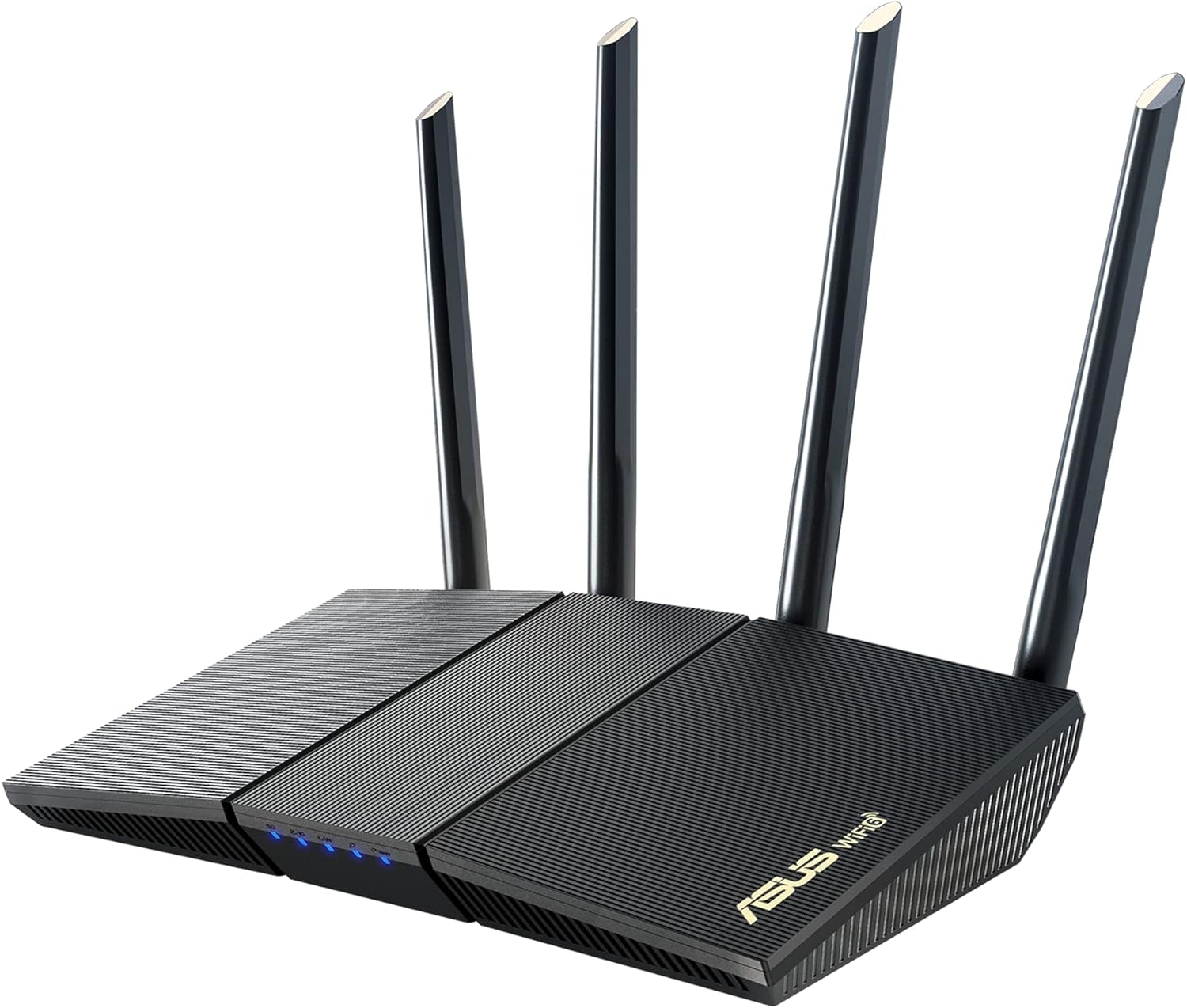
Pros
- Five gigabit ports, one WAN and four LAN, instead of the 100 Mbps ports common on entry Wi-Fi 6 units
- Trend Micro powered network protection runs with no ongoing subscription attached
- Four external antennas on a 2x2 dual-band radio using 1024-QAM and 80 MHz channels
- AiMesh support, so a second compatible unit extends one network name rather than adding a second SSID
- Instant Guard opens a one-click encrypted tunnel home from a laptop on public Wi-Fi
Cons
- 2x2 radios cap the 5 GHz band near 1201 Mbps, so a multi-gig line cannot be fully used
- No USB port, so a shared drive or printer cannot be attached to the router itself
- Dual-core processor and no 160 MHz channel support, which limits top single-client speed
This is a 2x2 dual-band 802.11ax unit: roughly 1201 Mbps on 5 GHz and 574 Mbps on 2.4 GHz, radiated from four external antennas.
- 1024-QAM packs more data into each transmission than 256-QAM Wi-Fi 5 gear
- OFDMA splits one channel between several small transmissions instead of queueing them
- MU-MIMO serves two streams at once to capable clients
- Target Wake Time lets phones and sensors sleep between check-ins
The practical gain over an older AC1750 unit is not headline speed to a single laptop, it is behaviour when fifteen devices are awake. OFDMA cuts the airtime each small packet consumes, so a video call holds steady while a console downloads. Coverage depends heavily on wall construction: plasterboard and timber are kind, dense masonry is not.
The router app walks through the first boot: plug the WAN port into your modem, scan the label, name the network and set an admin password.
- Trend Micro powered filtering blocks known malicious sites with no ongoing fee
- Parental controls schedule access per device
- Built-in VPN server covering WireGuard and OpenVPN protocols
- Instant Guard builds an encrypted tunnel home from a laptop abroad
Change two settings straight away. Turn on automatic firmware updates, since router security depends on them, and give the 2.4 GHz and 5 GHz bands the same network name so devices roam between them without manual selection. If you later add a second compatible unit, AiMesh pairing is handled from the same app in a few taps.
The unit is a router, not a modem, so it connects to whatever your provider supplies.
- Works behind cable, fibre ONT, DSL and satellite terminals with an Ethernet handoff
- One gigabit WAN plus four gigabit LAN ports
- Power input 110 to 240 V, output 12 V at 1.5 A maximum
- PPPoE, dynamic and static WAN modes all supported
If your provider supplies a combined modem-router, put that box into bridge or modem mode first, because leaving two routers in series creates double NAT and breaks console networking and port forwarding. There is no USB socket, so shared storage needs its own network connection. For lines up to about 900 Mbps the gigabit WAN is the correct match; anything faster wants multi-gig hardware.

Pros
- AX3000 splits as 2402 Mbps on 5 GHz with HE160 channel width and 574 Mbps on 2.4 GHz
- One unit is specified to cover about 2,500 sq ft, with more units addable to the same mesh
- Three Gigabit Ethernet ports per unit, and any of them can serve as the WAN input
- Wired Ethernet backhaul is supported, so a Cat 5e run frees the radios entirely for clients
- Two-year warranty with 24/7 technical support, a year longer than many networking brands offer
Cons
- Ethernet ports are Gigabit only, so an internet plan above 1 Gbps will be capped by the wired interface
- No USB port, so shared drives and printers must hang off a computer instead
- This is a 1-pack and replaces the router only — most connections still need the provider modem in front of it
A single unit is specified to cover roughly 2,500 sq ft, which in practice means a typical two-storey home with the unit placed centrally and high rather than in a ground-floor corner.
- AX3000 breaks down as 2402 Mbps on 5 GHz (2x2 with HE160 channel width) and 574 Mbps on 2.4 GHz.
- Wi-Fi 6 brings OFDMA and MU-MIMO, which matter most when many devices are awake at once — support is quoted for over 150 connections.
- Real throughput to any one client sits below the radio figures, and HE160 needs a client that supports 160 MHz channels to approach the headline number.
- Adding a second unit extends coverage under one network name, with devices handed between units as you move.
Thick masonry walls, a converted loft or a detached garage all argue for two units rather than expecting one to reach.
Setup runs through the Deco app rather than a browser page. You connect the unit to the modem with Ethernet, power it up and follow the guided steps on a phone.
- The app handles naming the network, setting the password and checking the internet link, and takes about ten minutes for a first unit.
- Three Gigabit Ethernet ports sit on each unit and any one can act as the WAN input, so you are not tied to a fixed socket.
- Wired Ethernet backhaul is supported: run Cat 5e or better between units and the mesh link stops consuming wireless airtime.
- HomeShield adds network security features and parental controls from inside the same app.
Keep the app installed afterwards. Firmware updates, device lists and guest network toggles all live there rather than on a local web page.
This replaces your router, not your modem. Most connections still need the provider modem or ONT in front of it, with the Deco taking an Ethernet feed from that box.
- If your provider supplied a combined modem-router, switch it to bridge or modem mode before adding this unit, or you end up with two layers of network address translation.
- Ports are Gigabit, so a plan faster than 1 Gbps is limited by the wired interface no matter what the radios can do.
- It joins the same mesh as other Deco models, so an existing X20 or similar can stay in service alongside it.
- The manufacturer lists a two-year warranty and 24/7 technical support for most home products.
There is no USB socket, so network storage or a shared printer needs a computer or a separate NAS.

Pros
- Combined throughput up to 2882 Mbps on 5GHz plus 688 Mbps on 2.4GHz across dual bands using Wi-Fi 7's Multi-Link Operation
- Two 2.5 Gbps ports (one WAN/LAN switchable) plus three 1 Gbps LAN ports break past the single-gigabit bottleneck of older routers
- 2.0GHz quad-core processor and 4 internal antennas with beamforming target coverage up to 2,000 sq. ft. for up to 60 connected devices
- EasyMesh compatibility lets it pair with additional routers or extenders to expand coverage without replacing the whole system
- USB 3.0 port adds local network storage or printer sharing that many entry routers skip entirely
Cons
- Dual-band only, so it does not include the 6GHz band found on tri-band Wi-Fi 7 routers, reducing available spectrum in congested networks
- 2,000 sq. ft. coverage figure is on the smaller end for whole-home Wi-Fi 7 systems, so larger homes may need an EasyMesh extender
- HomeShield's advanced security and parental control features typically require an ongoing subscription beyond the basic free tier
The Archer BE230 is a dual-band BE3600-class Wi-Fi 7 router with combined speeds up to 2882 Mbps on 5GHz and 688 Mbps on 2.4GHz, using 4-stream Multi-Link Operation to keep connections stable as devices roam between bands. Four internal antennas with beamforming push signal toward hard-to-reach corners, with coverage figures up to 2,000 sq. ft. and support for up to 60 connected devices at once.
- Combined throughput up to 2882 Mbps (5GHz) and 688 Mbps (2.4GHz)
- 4-stream Multi-Link Operation for Wi-Fi 7 devices
- Coverage figures up to 2,000 sq. ft. for up to 60 devices
- 4K-QAM modulation for added data capacity per stream
Because this is a dual-band model, it skips the 6GHz band found on tri-band Wi-Fi 7 routers, which matters most in dense apartment buildings with heavy 5GHz interference from neighboring networks.
Physical connectivity runs through one 2.5G WAN/LAN switchable port, a second dedicated 2.5 Gbps LAN port, and three additional 1 Gbps LAN ports, so multi-gig internet plans and wired devices are not bottlenecked by a single gigabit port the way many entry-tier routers are. A USB 3.0 port adds local file sharing or printer connectivity without extra hardware.
- One 2.5G WAN/LAN switchable port plus a second 2.5 Gbps LAN port
- Three additional 1 Gbps LAN ports
- USB 3.0 port for shared storage or printers
- EasyMesh support to add extenders or additional routers later
The 2.0GHz quad-core processor is built to manage this port and antenna load without introducing lag, and EasyMesh compatibility means the network can grow into a mesh system later instead of requiring a full router swap.
The Archer BE230 works with any cable or fiber internet service since it is a standalone router rather than a modem-router combo, so it slots in behind whatever modem your provider supplies. It includes built-in VPN client and server support alongside HomeShield network security tools and Private IoT network separation for keeping smart home devices off the main network.
- Works with any standard cable or fiber modem, ISP-agnostic
- Built-in VPN client and server functionality
- Private IoT network separates smart home devices from primary devices
Advanced HomeShield features such as extended parental controls and deeper security scanning commonly sit behind an ongoing subscription, so check which protections are included at no extra cost versus which require a paid tier before relying on them.

Pros
- Total bandwidth of 6.5 Gbps across 2.4GHz and 5GHz bands with 6 spatial streams
- Two 2.5 Gbps ports (WAN/LAN and LAN) plus three 1 Gbps LAN ports
- Rated coverage up to 2,400 sq ft and 90 simultaneously connected devices
- USB 3.0 port for network-attached storage or printer sharing
- WPA3 encryption plus a separate managed network for IoT devices
Cons
- Dual-band design only, with no dedicated 6GHz band despite the Wi-Fi 7 label
- Full 5764 Mbps and 6.5 Gbps figures are only reached with Wi-Fi 7 client devices; older phones and laptops connect at lower legacy speeds
- Deeper security scanning and remote management run through the cloud-connected Tether app rather than working fully offline
This dual-band Wi-Fi 7 router combines a 5764 Mbps 5GHz band with a 688 Mbps 2.4GHz band for 6.5 Gbps of combined bandwidth across 6 spatial streams.
- Rated coverage of up to 2,400 sq ft with 6 external antennas and beamforming
- Supports up to 90 simultaneously connected devices
- Multi-Link Operation combines both bands for lower latency on supported clients
Because this is a dual-band design rather than tri-band, there is no dedicated 6GHz lane; devices without Wi-Fi 7 support fall back to standard 5GHz or 2.4GHz speeds rather than the peak combined figure. For a typical single-floor or small two-floor home, the antenna layout and beamforming keep signal consistent across rooms, though a very large multi-floor house may still benefit from a mesh add-on at the edges of the stated coverage area.
Setup runs through the Tether app, which walks through connecting the WAN port to a modem and configuring the wireless network name and password in a few steps.
- 1x 2.5 Gbps WAN/LAN port, 1x 2.5 Gbps LAN port, and 3x 1 Gbps LAN ports
- 1x USB 3.0 port for a shared drive or printer
- Powered by an included 12V 2.5A adapter
The unit measures 10.6 x 6 x 1.9 inches and stands vertically, so placement needs a bit of clearance around the antennas rather than lying flat under other equipment. Guest networks, port forwarding, and a separate IoT network are all configurable from the same app, and firmware updates are pushed automatically once cloud services are enabled during setup.
The 2.5 Gbps WAN port supports multi-gig internet plans when paired with a compatible modem, while standard gigabit or slower ISP connections still work through the same port without any adapter needed.
- Supports IPv4 and IPv6, PPPoE, and dynamic or static IP connection types common across ISPs
- WPA3 encryption plus a separate network for IoT devices through HomeShield
- Compatible with Alexa and Google Assistant for voice-based network commands
Because the 2.5 Gbps WAN port only reaches its full speed with a matching multi-gig plan, anyone on a standard gigabit or lower connection will see their own connection's ceiling rather than the port's ceiling. HomeShield's deeper security scanning and parental controls are managed through the cloud-connected Tether app rather than a fully local dashboard.

Pros
- Tri-band radios at 2402 Mbps on 6GHz, 2402 Mbps on 5GHz and 574 Mbps on 2.4GHz
- 2.5 Gbps port usable as either WAN or LAN, for multi-gig service or a wired NAS
- 1.0 GHz dual-core CPU with 512 MB of memory and six high-gain antennas with beamforming
- 160MHz channels on the 6GHz band, clear of legacy device traffic and neighbouring overlap
- Runs OpenVPN, PPTP and L2TP as both server and client, with WPA3 and a 2-year warranty
Cons
- Only Wi-Fi 6E clients can use the 6GHz band, and 6GHz signal attenuates faster through walls than 5GHz
- A separate modem is still required for most cable and DSL services
- Just one 2.5 Gbps port, so a second multi-gig wired device drops back to Gigabit
Three radios rather than two: 2402 Mbps on 6GHz, 2402 Mbps on 5GHz and 574 Mbps on 2.4GHz, making up the 5400 Mbps combined headline. The 6GHz band is the reason to buy a 6E unit at all, because it carries no legacy traffic from older devices and has room for 160MHz channels without overlapping the neighbours.
Six high-gain antennas with beamforming shape signal toward connected devices, and OFDMA plus true tri-band working raises capacity roughly fourfold against a comparable dual-band unit when many devices are active at the same time.
Behind the radios sit a 1.0 GHz dual-core CPU and 512 MB of memory, which is what stops throughput collapsing when dozens of clients, QoS rules and a VPN tunnel are all live at once. The housing is shaped for heat dissipation rather than stacking.
The standout wired feature is the 2.5 Gbps port, which can face either direction. Used as WAN it lets a multi-gig cable or fibre service exceed the old Gigabit ceiling; used as LAN it gives one machine, typically a NAS or a workstation, a 2.5 Gbps link to the rest of the network.
Setup runs through the Tether app, which handles connection type, network naming and firmware. Do the firmware update first, before anything else gets configured.
VPN support is unusually complete for a home unit. It runs as both a server and a client, covering OpenVPN, PPTP and L2TP, so you can either reach your home network from outside or push household traffic out through a provider. Security is WPA3, and the unit carries a 2-year warranty.
It works with any provider that hands off an Ethernet connection, including AT&T, Verizon, Xfinity, Spectrum, RCN, Cox, CenturyLink and Frontier. As with any standalone router, a separate modem is still needed for most cable and DSL services, so this replaces the router half of an existing gateway rather than the whole box.
On the client side, only Wi-Fi 6E devices can use the 6GHz band. Recent flagship phones, current laptops and newer 6E adapters qualify; anything older sits on 5GHz or 2.4GHz and sees no benefit from the third radio at all. Worth knowing too: 6GHz attenuates faster through walls than 5GHz, so the fastest band is also the shortest ranged.
OneMesh support lets a compatible extender join as a single roaming network name rather than appearing as a second SSID.

Pros
- Dual-band throughput quoted at 867 Mbps on 5 GHz and 300 Mbps on 2.4 GHz
- Four fixed external antennas with beamforming, covering roughly 1,000 sq ft
- WPA3 encryption alongside guest networking and keyword-based parental controls in the companion app
- EasyMesh support lets it pair with any EasyMesh router or extender to form one roaming network
- Router, access point and range extender modes, plus IPv6 and IPTV handling through IGMP and tagged VLANs
Cons
- The WAN and LAN ports are 10/100 Mbps, so wired devices cannot exceed about 100 Mbps whatever your line delivers
- Wi-Fi 5 hardware with no Wi-Fi 6 support and no 6 GHz band
- No USB port, so network storage and printer sharing are off the table, and a separate modem is still required
This is a dual-band AC1200 router: up to 867 Mbps on 5 GHz and 300 Mbps on 2.4 GHz, quoted as 1,200 Mbps combined because the two bands are simply added together.
- Four fixed external antennas with beamforming aim signal at connected devices rather than radiating evenly in all directions
- Coverage is quoted at around 1,000 sq ft, which suits an apartment or a compact single-floor home
- MU-MIMO with two spatial streams lets it serve several devices at once instead of in turn
- 5 GHz handles streaming and gaming, while 2.4 GHz reaches further through walls for doorbells and sensors
For a larger home or thick internal walls, pair it with an EasyMesh extender to form one roaming network rather than a second, separate network name.
Setup runs through the maker's mobile app on Android or iOS, or through a browser page if you prefer a keyboard.
- Connect the WAN port to your existing modem, power up, and follow the prompts
- Set the wireless names and passwords, then let the app check for a firmware update - keeping firmware current is the main ongoing security task
- Guest Wi-Fi is a single toggle and keeps visitors off the main network
- Parental controls block sites by keyword and limit access times per device
- Access Point mode turns it into a wireless bridge behind an existing router, while range extender mode rebroadcasts a network you already have
The unit accepts 100-240 V input, so it travels internationally with nothing more than a plug adapter.
This is a router, not a modem. Cable, DSL and fibre lines each need their own modem or ONT in front of it, which most providers supply as part of the service.
- It speaks standard DHCP, PPPoE and static IP connection types, covering the major providers
- IPv6 is supported, which several providers now hand out by default
- IPTV set-top boxes are handled through IGMP Proxy and Snooping, bridge mode and tagged VLANs where the provider requires them
- WPA3 is available for devices that support it, with WPA2 fallback for older equipment
The limitation to plan around is the wired side: every Ethernet port is 10/100 Mbps. If your line delivers more than roughly 100 Mbps, wired devices will never see it.

Pros
- Superfast Wi-Fi 300 Mbps (2.4 GHz) and 867 Mbps (5 GHz) speeds are
- Versatile connectivity - with DSL, EWAN, and USB port, the Archer
- High range: Three high gain antennas provide stable wireless
- Beamforming technology - concentrates signal strength in the
Cons
- Best placed in well ventilated indoor spaces away from excess moisture
- Requires proper surface alignment during initial installation
Integrating thoughtful design principles, the TP-Link TP-LINK Archer VR400 Dual-band Gigabit Ethernet Black 3G enhances daily routines within Routers areas. From an operational perspective, this model emphasizes key capabilities such as Superfast Wi-Fi 300 Mbps (2.4 GHz) and 867 Mbps (5 GHz) speeds are ideal for online gaming, HD streaming, and large file downloads.Tether App – TP-LINK Tether provides the easiest way to access and manage the router on your iOS and Android devices. Additionally, the integration of Versatile connectivity - with DSL, EWAN, and USB port, the Archer VR400 is fully compatible with the VDSL2/ADSL2+/ADSL2/ADSL standards as well as fibre, cable and 3G/4G Internet services enhances overall usability during continuous activity.
Structural analysis confirms an emphasis on long-term mechanical resilience and component stability. Designed for lasting service, the structure leverages High range: Three high gain antennas provide stable wireless connections and high coverage,Supports 802.11ac standard - the next generation of Wi-Fi to minimize mechanical stress. Advanced joint reinforcement guards against structural sagging or premature joint wear. Robust physical construction provides verified peace of mind during heavy daily usage. Thoughtful spatial layout allows versatile placement across modern living environments. Dependable hardware performance ensures consistent operational output throughout the year. Precision engineering delivers a stable foundation tailored for active household demands.
Following practical maintenance guidelines ensures the unit retains its performance properties. Highlighting Beamforming technology - concentrates signal strength in the direction of your devices, delivering stable and highly efficient connections, initial assembly and positioning remain straightforward using basic tools. Gentle surface cleaning with non-abrasive tools keeps outer materials looking clean and pristine. Robust physical construction provides verified peace of mind during heavy daily usage. Thoughtful spatial layout allows versatile placement across modern living environments. Dependable hardware performance ensures consistent operational output throughout the year. Precision engineering delivers a stable foundation tailored for active household demands.
Do You Really Need a Fast Router for 200Mbps?
A 200Mbps plan is comfortably in the mid-range of home internet speeds. It is fast enough for 4K streaming on several screens, video calls, online gaming, and large downloads – but it is not so fast that it demands premium hardware. This is an important distinction, because router marketing loves to advertise headline numbers like AX5400 or BE6500. Those figures describe the router’s theoretical maximum wireless throughput, not the speed your internet plan provides.
In practice, almost any modern dual-band router can carry 200Mbps. The real question is whether it can deliver that speed reliably and everywhere. Walls, distance, interference from neighbors, and the number of connected devices all chip away at real-world performance. A cheap router might hit 200Mbps standing next to it, then drop to 60Mbps two rooms away. That is why choosing the right router is less about raw speed ratings and more about coverage, consistency, and how well the hardware handles a busy household.
What “Mbps” Means for Your Router
Your internet speed is measured in megabits per second (Mbps), and your router’s job is to distribute that speed across your Wi-Fi and wired connections. A 200Mbps plan means the total pipe coming into your home is 200Mbps, shared by everyone. A capable router makes sure a single device streaming Netflix does not starve another device that is downloading a game. Good traffic management, not just top-line speed, is what keeps a 200Mbps connection feeling fast.
Key Features to Look for in a 200Mbps Router
When you strip away the marketing, only a handful of specifications genuinely affect how well a router serves a 200Mbps connection. Here is what to prioritize.
Wi-Fi Standard: Wi-Fi 5, Wi-Fi 6, or Wi-Fi 7
Wi-Fi 5 (AC) routers are perfectly capable of handling 200Mbps and remain the most budget-friendly choice. Options like the TP-Link Archer A8 and the TP-Link Archer C80 deliver stable dual-band performance that easily covers a 200Mbps plan for a small to medium home.
Wi-Fi 6 (AX) is the current sweet spot. It handles crowded networks far better, improves battery life on connected devices, and future-proofs you for faster plans. The TP-Link Archer AX21 and the ASUS RT-AX1800S are popular Wi-Fi 6 choices that offer noticeably smoother performance when many devices are online at once.
Wi-Fi 7 (BE) is the newest standard and is genuine overkill for 200Mbps today – but if you plan to upgrade your internet within a couple of years, a router like the TP-Link Archer BE230 or the TP-Link BE400 buys you long-term headroom.
Gigabit Ports Matter
Check that the router has Gigabit Ethernet ports rather than older 10/100 (Fast Ethernet) ports. A 10/100 port caps wired speeds at 100Mbps, which would throttle your 200Mbps plan on any wired device. Most modern routers include Gigabit WAN and LAN ports, and some newer models even add 2.5Gbps ports for extra headroom. If you connect a gaming console, desktop, or smart TV by cable, Gigabit ports are non-negotiable.
Dual-Band vs Tri-Band
For a 200Mbps plan, a dual-band router (2.4GHz + 5GHz) is entirely sufficient. Tri-band models add a second 5GHz or a 6GHz band, which helps in homes with dozens of devices but adds cost you likely do not need at this speed tier. If you have a very device-heavy household, a tri-band option like the TP-Link Archer AXE75 gives extra breathing room, but most people are well served by dual-band.
Coverage and Home Size
This is where many buyers go wrong. A single router that tests fast up close can still leave dead zones in a larger home. For apartments and small houses, a standalone router handles coverage fine. For larger or multi-story homes, a mesh system such as the TP-Link Deco X55 spreads coverage more evenly than a single unit, keeping your full 200Mbps available in far corners and upstairs bedrooms.
Match the Router to Your Household
The best router for 200Mbps depends less on the plan itself and more on how you live. Use these scenarios to narrow your choice.
Small Apartment or Studio
If you live in a compact space with a handful of devices, you do not need to overspend. A reliable, affordable dual-band router like the TP-Link Archer A54 or the TP-Link Archer A8 will saturate your 200Mbps connection without fuss. Prioritize easy setup and stable range over fancy features.
Medium Home with Many Devices
Families juggling phones, laptops, smart speakers, security cameras, and streaming sticks benefit from Wi-Fi 6. The extra efficiency of the TP-Link Archer AX21 or the ASUS RT-AX1800S keeps everything responsive even when 20 or more devices are connected, which is common in modern homes.
Large or Multi-Story Home
When coverage is the main challenge, a mesh setup wins. The TP-Link Deco X55 can blanket a large footprint and be expanded with additional units, so your 200Mbps reaches the basement office and the top-floor bedroom equally.
Future-Proofers and Power Users
If you expect to upgrade to a gigabit plan soon, or you simply want the latest technology, lean toward Wi-Fi 6E or Wi-Fi 7. The TP-Link BE400, TP-Link Archer BE230, or the 6GHz-equipped TP-Link Archer AXE75 give you speed headroom and multi-gig ports you can grow into.
Features Worth Paying Extra For
Beyond raw speed, a few extras genuinely improve daily life on a 200Mbps connection.
- Parental controls and network security: Built-in protection filters malware and manages screen time. The ASUS RT-AX1800S includes subscription-free security, while TP-Link’s HomeShield adds similar tools.
- Easy mesh support: Routers with EasyMesh or OneMesh let you add nodes later, so you can start with one unit and expand coverage without replacing everything.
- USB ports: A USB 3.0 port lets you share a printer or a network drive across the home – handy on models like the TP-Link Archer BE230.
- VPN and guest networks: Built-in VPN keeps traffic private, and a separate guest network protects your main devices from visitors.
- Smart-home compatibility: Alexa support and app-based control make setup and management simpler for less technical users.
Features You Can Skip at 200Mbps
Just as important as knowing what to buy is knowing what to ignore. At 200Mbps, you do not need the fastest tri-band gaming router with 8 antennas and a multi-gig backbone. Headline throughput ratings above AX1800 provide little real benefit for your plan. Similarly, ultra-premium models like the TP-Link Archer VR400 target specific use cases such as DSL or 3G/4G backup rather than pure speed, so match the product to your connection type rather than chasing the biggest number. Save the money and put it toward better coverage or Wi-Fi 6 efficiency instead.
Setting Up Your Router for Peak 200Mbps Performance
Even the best router underperforms if it is poorly placed. A few simple steps ensure you get the full 200Mbps you are paying for.
- Central placement: Position the router in a central, elevated, open spot – not tucked inside a cabinet or behind a TV.
- Update the firmware: Manufacturers regularly patch performance and security. Run updates right after setup.
- Use the 5GHz band for speed: Connect nearby devices to 5GHz for maximum throughput, and reserve 2.4GHz for range and older gadgets.
- Wire what you can: Plug demanding devices into Gigabit ports to guarantee they get the full 200Mbps.
- Test your speed: Run a speed test near and far from the router to confirm consistent coverage, then reposition if needed.
Final Thoughts: Picking the Best Router for 200Mbps
Choosing the best router for 200Mbps comes down to matching the hardware to your home rather than chasing the flashiest specifications. For a small space on a budget, an affordable Wi-Fi 5 or entry Wi-Fi 6 router delivers your full speed with money to spare. For a busy family, a Wi-Fi 6 model handles the device load smoothly. For a large home, a mesh system eliminates dead zones. And if you plan to upgrade your internet down the road, a Wi-Fi 6E or Wi-Fi 7 router gives you room to grow.
Focus on Gigabit ports, dependable coverage, and the right Wi-Fi standard for your needs, and you will enjoy a fast, stable connection everywhere in your home. Compare the shortlisted options above, pick the one that fits your space and budget, and you will get every megabit of your 200Mbps plan working for you.


