 Owen Bradley
That distinctive plastic smell when you unwrap a new shower curtain is not just an unpleasant first impression — it is the sound of volatile organic compounds leaving the material and entering the smallest, most enclosed, least-ventilated room in your house. Combine that with hot water and steam, which accelerate off-gassing, and the bathroom becomes the one place where curtain material genuinely matters to indoor air quality. The good news is that safe alternatives have become mainstream, affordable, and just as waterproof as the products they replace. This guide explains what to avoid, what the labels actually mean, and how to choose a non-toxic shower curtain in 2026 that performs well without turning your bathroom into a chemistry experiment.
Why PVC Is the Material to Avoid
Polyvinyl chloride, or PVC, is the material behind most cheap vinyl shower curtains and the source of that new-plastic odor. PVC is rigid on its own, so manufacturers add plasticizers — typically phthalates — to make it flexible enough to drape. Those plasticizers are not chemically bonded to the plastic, which means they migrate out over the life of the product, escaping as vapor and settling as dust.
The concern is compounded by the bathroom environment specifically. It is a small volume, it is usually the least-ventilated room in the house, humidity and heat both increase off-gassing rates, and people spend concentrated time there in close proximity to the curtain. A material that would off-gas negligibly in a large airy living room behaves quite differently draped a foot from your face in a steamy enclosure.
PVC also has a poor environmental story at both ends of its life — chlorine-based production and problematic disposal — which is why many manufacturers have moved away from it even where regulations do not require them to.
Reading the Labels: What Each Term Means
Bathroom textile marketing is full of reassuring words with wildly different meanings. Here is what they actually indicate.
- PVC-free — the single most meaningful claim. It rules out the phthalate-plasticizer issue entirely.
- PEVA — polyethylene vinyl acetate. A chlorine-free plastic, waterproof, much lower odor than PVC. A solid liner material and the most common upgrade.
- EVA — ethylene vinyl acetate. Similar to PEVA, slightly softer, also chlorine-free.
- Phthalate-free — good, but check whether the product is still PVC using a different plasticizer.
- OEKO-TEX Standard 100 — an independent certification testing finished textiles for a long list of harmful substances. The most trustworthy label for fabric curtains.
- GOTS certified — Global Organic Textile Standard, covering organic fiber content plus processing and dye restrictions. The strictest mainstream certification.
- Greenguard Gold — certifies low chemical emissions, originally developed for sensitive environments like schools and healthcare.
- “Eco-friendly” or “natural” — unregulated marketing language with no defined meaning. Ignore it unless backed by a specific certification.
The Safest Material Options
Once you rule out PVC, several genuinely good options remain, each with its own trade-offs.
Cotton — breathable, beautiful, and completely free of plastic. Organic cotton with a GOTS certification is the gold standard. The catch is that cotton absorbs water, so it needs a separate liner and regular washing to prevent mildew. Best in a bathroom with a working exhaust fan.
Linen and hemp — naturally more mold-resistant than cotton thanks to their fiber structure, with a beautiful relaxed drape. They cost more and wrinkle happily, which some people love and others do not.
Polyester — synthetic but inert. Polyester does not use plasticizers, off-gasses minimally, dries quickly, and resists mildew well. It is the pragmatic choice for most households and can be used with or without a liner. Look for OEKO-TEX certified versions to cover dye and finish chemistry.
PEVA and EVA — the practical liner answer. Fully waterproof, chlorine-free, and inexpensive. Air a new one out for a day or two before hanging.
Nylon — light, quick-drying, and durable, though less common as a standalone curtain.
Roundups of the best fabric shower curtains are a good place to compare cotton, linen, and polyester constructions side by side.
The Hidden Chemistry: Finishes and Dyes
A curtain can be made from a perfectly safe base material and still carry chemistry you would rather avoid, because finishes are applied afterward.
Watch for antimicrobial treatments, which sometimes use compounds like triclosan or silver nanoparticles whose long-term effects in household use are debated. Water-repellent finishes have historically relied on per- and polyfluoroalkyl substances (PFAS), the persistent “forever chemicals” now being phased out by many manufacturers — look for explicitly PFAS-free labeling. Flame retardants are unnecessary on a bathroom textile and worth avoiding. Azo dyes, restricted in many markets, can release aromatic amines, which is precisely what OEKO-TEX testing screens for.
This is why certification matters more than material claims alone: OEKO-TEX and GOTS test the finished product including its dyes and finishes, not just the raw fiber. Products in the best quality shower curtains category increasingly carry these certifications as standard.
The Fabric Curtain Plus Liner Strategy
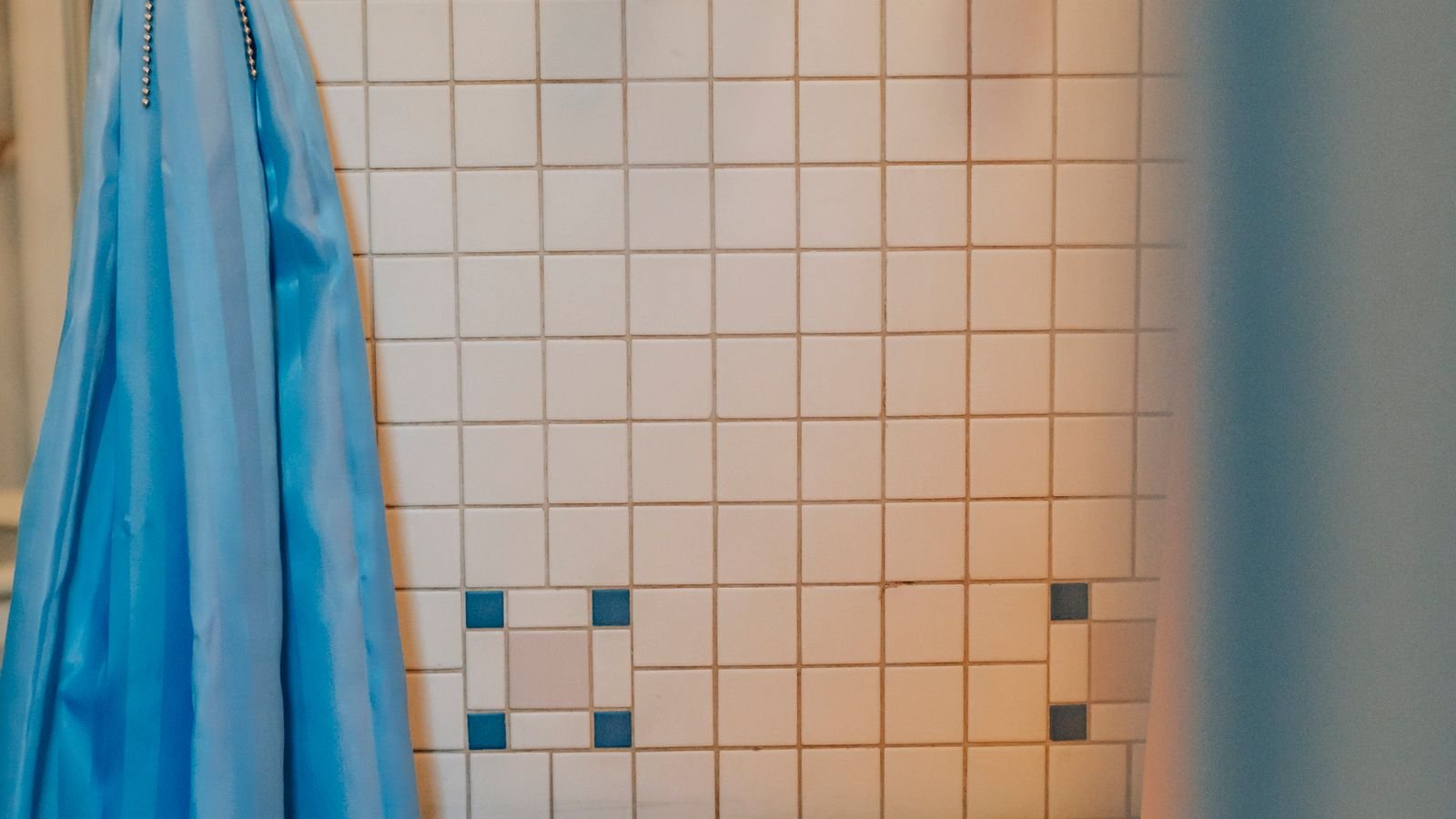
The approach that satisfies both safety and practicality is a two-layer setup: a decorative fabric curtain hanging outside the tub and a waterproof liner hanging inside it.
This works because it separates the two jobs. The liner handles water containment and can be an inexpensive PEVA panel that gets replaced every year or so. The outer curtain never gets soaked, so it can be cotton, linen, or a heavier polyester weave that would be impractical on its own, and it stays clean and dry enough to wash only occasionally.
It also solves the safety question neatly. Even a modest PEVA liner off-gasses far less than PVC, and because the outer fabric is the layer nearest your breathing space for most of the day, the overall exposure is lower still. A well-chosen shower curtain liner is the cheapest component of the whole system and the one that does the most work.
Airing Out a New Curtain
Whatever you buy, the first days matter most — off-gassing rates are highest when a product is new and decline sharply thereafter.
- Unwrap the curtain outdoors or in a garage rather than in the bathroom.
- Hang it in a well-ventilated space, ideally outside in shade, for 24 to 48 hours.
- If it is fabric, wash it before first use to remove manufacturing residues and sizing.
- Once hung, run the bathroom fan or open a window for the first several showers.
- If a strong plastic smell persists after a week of airing, the material is likely PVC regardless of what the listing claimed — return it.
Care That Extends Life and Reduces Waste
The most sustainable curtain is the one you do not replace every year, and non-toxic materials generally reward good care.
Wash fabric curtains monthly on a cold gentle cycle with mild detergent; adding a half cup of baking soda helps with soap scum, and a cup of white vinegar in the rinse addresses early mildew. Skip fabric softener, which leaves a residue that traps moisture and encourages mold. Hang the curtain back on the rod to air dry rather than using high heat, which can damage waterproof coatings and shrink natural fibers.
PEVA liners can usually be wiped down or washed on a delicate cycle with towels for gentle agitation. Most importantly, pull the curtain fully closed after every shower — a curtain bunched at one end stays damp in its folds for hours and is where mildew always starts.
Budget Guidance
- $10–$20 — PEVA or EVA liners and basic PVC-free polyester curtains. A meaningful safety upgrade over vinyl at essentially no extra cost.
- $25–$50 — OEKO-TEX certified polyester, heavier weaves, waffle textures, weighted hems. The value sweet spot for most bathrooms.
- $60–$120 — organic cotton, linen, and hemp curtains with GOTS certification and natural dyes. Worth it if you want the look and have the ventilation to support natural fibers.
Note that the price gap between a vinyl curtain and a PVC-free one is often only a few dollars, which makes this one of the cheapest indoor air quality improvements available anywhere in a home.
Special Considerations for Sensitive Households
If anyone in your home has asthma, chemical sensitivity, or eczema, or if you have young children who spend bath time enclosed in that space, tighten your criteria. Choose GOTS organic cotton or OEKO-TEX certified polyester, avoid antimicrobial and water-repellent finishes entirely, skip printed designs in favor of solid colors or woven texture since large print areas mean more dye and binder, and air new items out for a full week rather than a couple of days.
Ventilation deserves equal attention. An exhaust fan rated for your bathroom’s size, run for 15 to 20 minutes after every shower, does more for air quality than any material choice — and it also keeps whatever curtain you buy from developing mildew in the first place.
Mistakes to Avoid
- Trusting words like “eco” or “natural” without a certification behind them.
- Buying phthalate-free vinyl and assuming the PVC issue is solved.
- Hanging a new plastic curtain straight out of the package in a closed bathroom.
- Choosing an antimicrobial-treated curtain instead of simply washing it regularly.
- Using cotton with no liner in a bathroom that has no fan.
- Machine-drying a waterproof liner on high heat and destroying the coating.
- Leaving the curtain bunched to one side after showering.
Frequently Asked Questions
Is PEVA actually safe?
PEVA is a substantial improvement over PVC: it contains no chlorine and requires no phthalate plasticizers, so it off-gasses far less and has minimal odor. It is still a plastic, so if you want to avoid plastics entirely, choose an organic cotton or linen curtain paired with a nylon or polyester liner instead.
How do I know if my current curtain contains PVC?
The smell is the strongest indicator — that sharp new-plastic odor is characteristic and does not fade quickly. Check the packaging or product listing for “PVC” or “vinyl”; if a curtain is PVC-free the manufacturer almost always says so, because it is a selling point.
Do I need a liner with a polyester curtain?
Not necessarily. Tightly woven polyester with a water-repellent construction can work alone in many bathrooms. A liner still helps by keeping water off the decorative curtain, reducing how often you wash it and extending its life considerably.
How often should I replace a non-toxic shower curtain?
A quality fabric curtain washed regularly can last several years. Liners are consumables — plan on replacing a PEVA liner every 12 to 18 months, or sooner once mildew works into the seams where washing cannot reach.
Final Thoughts
Choosing a safer shower curtain is one of the easier wins in a home. Rule out PVC first, then look for a real certification such as OEKO-TEX or GOTS rather than vague eco language, avoid unnecessary antimicrobial and stain-repellent finishes, and pair a good-looking fabric outer curtain with an inexpensive PEVA or polyester liner that takes the water. Air out anything new before it goes into the bathroom, run the fan, wash on a schedule, and pull the curtain closed to dry after each use. To narrow the field quickly, compare the best non-toxic shower curtains against your ventilation situation and your preferred material, and you will have a bathroom that smells like nothing at all — which is exactly how it should smell in 2026.