 Owen Bradley
Throw pillows are the cheapest way to change how a sofa looks and the easiest thing in the room to get wrong. Buy five identical cushions in the same size and the sofa looks like a display model; buy a random assortment and it looks like a jumble sale. The arrangements that look professionally done follow a handful of repeatable rules about counts, sizes, pattern mixing and — the detail almost everyone misses — insert sizing. Learning to style throw pillows on sofa seating properly takes an afternoon and no tools at all, and the result outlasts almost any other decorating change you can make for the money.
What You Need
- Covers in a mix of sizes, ideally 22, 20 and 18 inch squares plus one lumbar.
- Inserts sized 2 inches larger than each cover.
- Tape measure to check your sofa’s seat depth and back height.
- Optional: a steamer or iron to release creases from new covers.
Start With the Sofa, Not the Pillows
How many pillows a sofa can carry depends on its dimensions, so measure before you shop. A standard three-seat sofa around 84 to 90 inches wide takes five pillows comfortably. A loveseat or apartment-scale sofa under 72 inches takes three. A sectional needs seven or more, distributed unevenly rather than mirrored on both arms.
Seat depth matters as much as width. Deep-seated sofas swallow small pillows, so if your seat depth exceeds 24 inches, start your largest size at 22 inches rather than 20. Frame style plays in too: a low-back mid-century sofa looks overwhelmed by tall stacked cushions, while a high-back traditional frame can take substantial ones. Those proportions vary widely across the best sofas, so it is worth noting your own back height and depth before ordering covers.
Step-by-Step: Building the Arrangement
- Strip the sofa. Remove everything and start from bare upholstery so you are composing rather than adding.
- Choose an odd number. Three for a loveseat, five for a standard sofa, seven or nine for a large sectional. Odd numbers avoid the rigid symmetry that makes a sofa look untouched.
- Place the largest pair first. Set your two biggest pillows, usually 22 inch squares, into the outer corners against the arms. These are the foundation and they are almost always a matched pair.
- Add the middle layer. Set two 20 or 18 inch pillows in front of and slightly inboard of the large ones. This is where pattern usually goes, because it sits in the most visible position.
- Break the symmetry. Place the odd fifth pillow — typically a lumbar or a smaller square — off-centre rather than dead middle. Roughly one-third along the sofa looks far more natural than the exact centre.
- Karate chop or leave flat. A dent in the top edge gives a soft, styled look; leaving them squared reads as more formal and modern. Pick one approach and apply it consistently across the whole sofa.
- Step back and check the silhouette. From across the room, the tops of the pillows should step down from the arms toward the centre rather than forming a flat line.
- Sit down and use it. If a pillow has to be moved every time someone sits, it is one too many. Remove it.
Size Stepping: The Rule That Creates Depth
Layering only works when adjacent pillows differ in size. Step down by 2 inches at each layer: 22 inch squares at the back, 20 inch in front of them, an 18 inch or a 12 x 20 lumbar at the front. Identical sizes stacked together read as one flat mass no matter how good the fabrics are.
Lumbar pillows deserve special mention because they solve two problems at once. They break the grid of squares visually, and they are the only shape that actually supports the lower back, which makes them the pillow people keep rather than push aside. One lumbar per sofa is usually enough.
Mixing Patterns Without Chaos
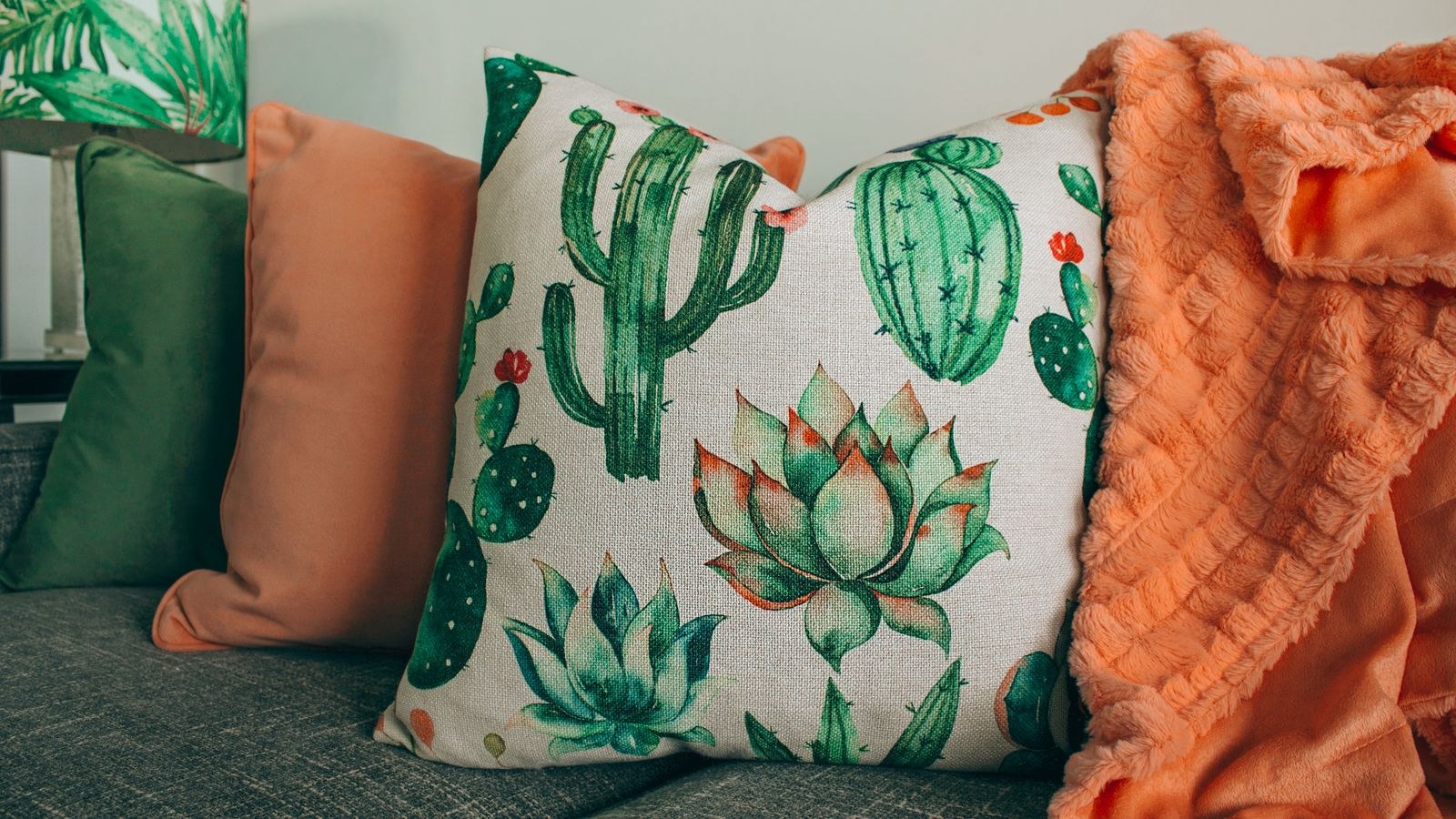
The reliable formula is one large-scale pattern, one small-scale pattern, one texture, and one or two solids. Scale variation is what keeps a mix legible — two medium florals fight each other, while a bold geometric beside a fine stripe reads as intentional.
Hold the whole group together with a shared colour. Every pillow should contain at least one hue that appears in another pillow or in the room’s existing palette. Repeat the accent colour a minimum of three times across the room so it looks like a scheme rather than an accident: a pillow, a throw and something on the wall or shelf.
Texture counts as pattern. A boucle, chunky knit or velvet cushion adds visual interest without a print, and is often the easiest way to make a neutral scheme feel considered. On velvet or heavily textured upholstery, lean harder on texture and lighter on print, since busy patterns fight the sofa itself — a point worth remembering with the plush surfaces found on velvet sofas, where sheen already does much of the work.
Inserts: The Detail Everyone Skips
The most common reason pillows look sad is not the fabric, it is the filling. Buy inserts 2 inches larger than the cover. A 20 inch cover needs a 22 inch insert. This is what produces the plump, full corners you see in showrooms; a same-size insert leaves limp, empty corners within a week.
Feather and down inserts hold a karate chop, feel luxurious and can be fluffed back into shape indefinitely, though they need shaking every few days and are unsuitable for allergy sufferers. Down-alternative polyester inserts cost less and need no maintenance, but they compress permanently over a year or two and never quite take a dent. A practical middle ground is feather inserts on the pillows you display and synthetic on the ones that get leaned on hardest.
Whichever you choose, hidden zip closures look far tidier than envelope backs, and covers you can remove and wash will look better in year three than sewn-shut ones.
Adapting to Different Sofa Types
Sectionals
Avoid mirroring both ends, which makes a large piece look static. Weight the arrangement toward one end with three or four pillows and taper to two at the other, then let the corner seat carry one large pillow on its own. Layouts across the best sectional sofas vary a lot in chaise length, and the chaise usually wants a single lumbar rather than a full stack so the seat stays usable for lying down.
Loveseats and Small Sofas
Three pillows maximum: a matched pair in the corners and one lumbar off to one side. Anything more and the seat disappears.
Chairs Nearby
Give occasional chairs one pillow each at most, in a fabric that appears on the sofa but is not identical to it. That single repetition links the seating group, and the range of living room chairs with lower backs in particular benefit from a small lumbar rather than a square.
Finishing With a Throw
A throw completes the arrangement and softens the hard geometry of squared cushions. Two placements work reliably: folded lengthwise over one arm with the fold facing outward, or draped diagonally across one back corner with a little pooling on the seat. Avoid folding it into a perfect rectangle centred on the sofa, which looks staged rather than lived in.
Choose a texture that contrasts with your pillows — a chunky knit beside smooth linen cushions, or a smooth cotton against boucle. The best throws for sofas come in weights suited to different climates, and picking one in an accent colour already used in the pillows is the simplest way to make the whole grouping look planned.
Common Mistakes
- Too many pillows. If you have to relocate cushions before sitting, the sofa has stopped working. Five is plenty for most.
- All the same size. Without size stepping there is no depth, just a row.
- Inserts that match the cover size. The number one cause of limp, unappealing cushions.
- Perfect symmetry. Mirroring every pillow makes a sofa look like a catalogue photo nobody sits on.
- Matching the upholstery exactly. Pillows in the same fabric as the sofa disappear. Contrast is the point.
- Ignoring the pattern scale. Two patterns of similar scale compete; vary large against small.
Frequently Asked Questions
How many throw pillows should a sofa have?
Five for a standard three-seat sofa, three for a loveseat, and seven or more for a large sectional. Always an odd number, and always fewer than the point where sitting becomes awkward.
Should pillows match each other?
No. Match the outer pair for structure, then vary the rest by size, pattern and texture while keeping one shared colour running through the whole group.
What size insert do I need?
Two inches larger than the cover in each direction. A 22 inch insert in a 20 inch cover gives the full, plump look; a 20 inch insert in the same cover looks deflated within days.
Is the karate chop still in style?
It reads as soft and casual, while flat, squared pillows read as modern and formal. Neither is wrong — the only real rule is to be consistent across the sofa.
Final Thoughts
Styling throw pillows well is a short checklist rather than a talent: odd numbers, sizes stepping down by 2 inches, one large pattern against one small one plus a texture, a single colour repeated throughout, and inserts 2 inches larger than every cover. Break the symmetry with one off-centre lumbar, finish with a throw over an arm, and then actually sit on the sofa to confirm the arrangement survives being used. Get those pieces right and a set of pillows will make a modest sofa look considerably more expensive than it was.