 Owen Bradley
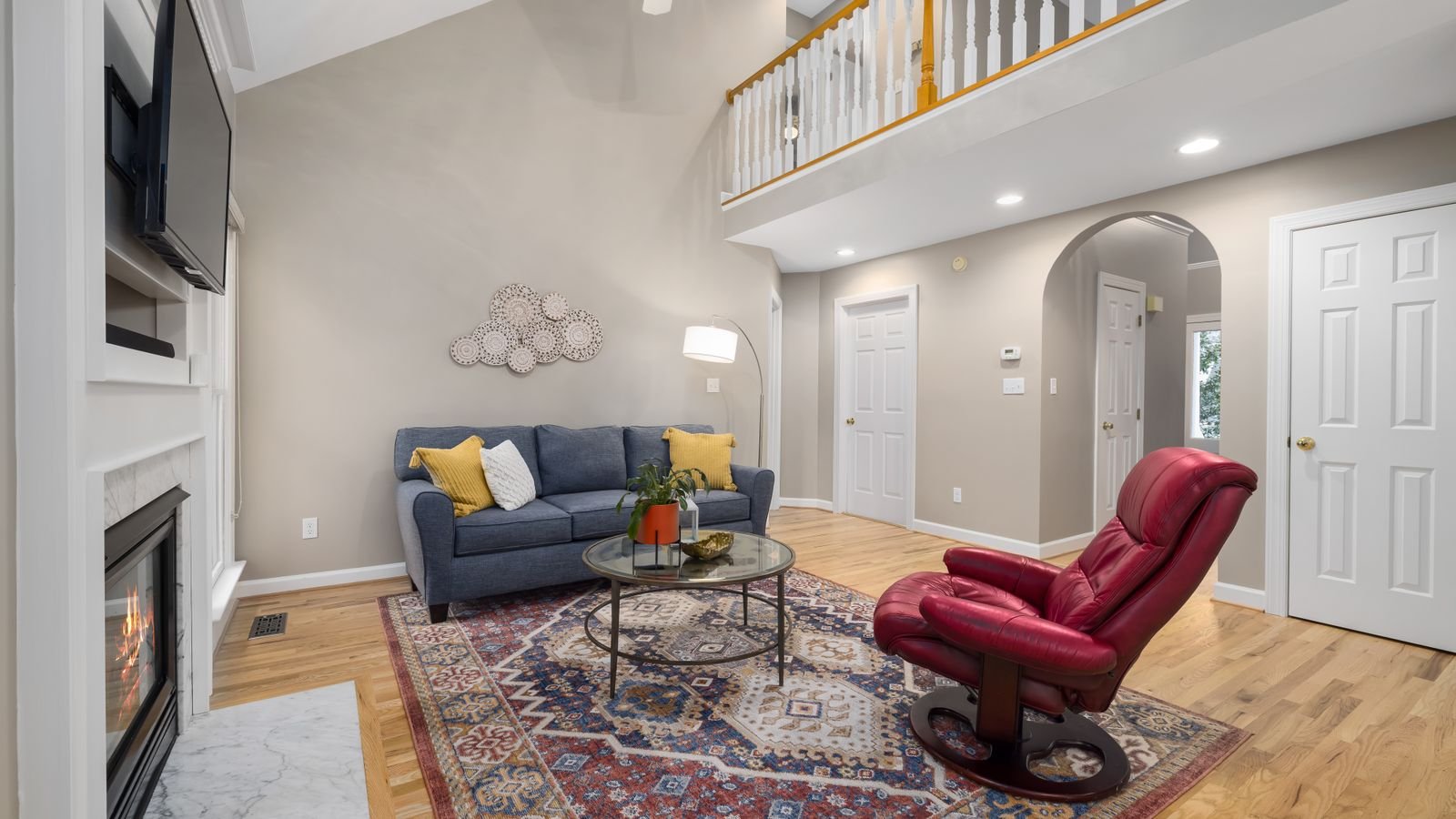
A ceiling fan in a room with a vaulted, cathedral, or two-storey ceiling has to solve two problems that a standard installation never faces: the fan has to hang far enough down to actually move air where people are, and it has to mount to a sloped surface without the motor tilting. Get either wrong and you end up with a beautiful fixture 14 feet overhead that stirs nothing but the ceiling, or a fan that wobbles because the blades are not level. The work itself is well within reach of a competent DIYer, but the planning and the ladder work deserve genuine respect. This guide covers measuring for downrod length, choosing the right mounting hardware for a slope, and installing the fan safely at height.
Safety First: This Is Height Work
Before anything else, be honest about access. Working from a ladder at 12 to 20 feet while holding a 25-pound motor overhead is the riskiest part of this job by a wide margin.
- Switch off the circuit at the breaker and verify with a non-contact voltage tester at the box. A wall switch is not enough.
- Use the right access. For anything above about 12 feet, rent scaffolding or a platform ladder rather than stretching from an extension ladder. Level footing is non-negotiable on sloped or carpeted floors.
- Work with a helper. One person on the ladder, one footing it and passing tools. Do not attempt to carry the motor up alone.
- Confirm the box is fan-rated. A standard plastic lighting box will not hold a fan. You need a metal box marked “Acceptable for Fan Support,” rated for at least 35 lbs, screwed to a joist or fitted with an expanding fan brace.
If the existing box is not fan-rated and the ceiling is inaccessible from above, this becomes a job worth handing to an electrician.
Choose the Right Downrod Length
A downrod is the metal tube between the ceiling mount and the fan motor, and on a vaulted ceiling it is the most important decision you make. It determines whether the fan works at all.
The target is to have the blades sitting 8 to 9 feet above the floor. Lower than 7 feet is a head-height hazard; higher than about 10 feet and airflow at seated level falls off sharply. Do the arithmetic before ordering:
- Measure the floor-to-ceiling height directly beneath the mounting point.
- Subtract your target blade height, usually 9 feet.
- Subtract the fan’s own height from the top of the canopy to the blades — typically 10 to 12 inches, listed in the manual.
- The result is your downrod length.
So for a 14-foot ceiling, targeting 9 feet, with a fan body of about 12 inches: 14 minus 9 is 5 feet, minus 1 foot for the fan body, leaving a 48-inch downrod. Downrods are commonly sold in 12, 18, 24, 36, 48, 60, and 72-inch lengths.
Buy the downrod from the same manufacturer as the fan wherever possible. Diameters and pin-hole positions vary between brands, and a mismatched rod is unsafe.
Check Slope Compatibility
Every fan has a maximum ceiling slope its standard canopy can handle, usually stated as a ratio or in degrees. Many stock canopies manage around 15 to 20 degrees. Cathedral ceilings frequently exceed that.
To measure your slope, hold a level horizontally against the ceiling, measure 12 inches along it, and measure the vertical gap down to the ceiling at that point. A 6-inch drop over 12 inches is a 6/12 pitch, roughly 26.5 degrees.
If your slope exceeds the fan’s rating, you need an angled or sloped ceiling adapter — an accessory canopy that lets the ball joint hang plumb on steeper pitches, often up to 45 degrees or more. Fit this before you start rather than discovering the problem on the ladder.
Choose a Fan Built for the Space
High-ceilinged rooms are usually large rooms, and a fan sized for a bedroom will move air politely and pointlessly. Look at the CFM rating, which measures actual air movement, rather than blade span alone.
- Rooms up to 225 square feet: around 4,000–5,000 CFM.
- Rooms of 225–400 square feet: around 5,500–7,000 CFM.
- Great rooms above 400 square feet: 7,000 CFM or more, or two fans.
Two other features matter more than usual at height. A remote or smart control is essential, because a pull chain 12 feet overhead is unusable. And a DC motor is worth the premium — it is quieter, uses far less power, and typically offers more speed steps, which matters in a tall room where you rarely want full speed. Browsing the best ceiling fans for high ceilings is a practical way to see which models ship with long downrods and slope adapters included rather than as extra purchases.
Install the Fan Step by Step
- Kill the power and verify. Breaker off, tested at the box with a voltage tester.
- Remove the old fixture and inspect the box. Confirm it is fan-rated and firmly attached. Replace it with a fan-rated box or a brace bar if there is any doubt.
- Assemble on the ground. Attach the downrod to the motor housing, feed the wires up through the rod, insert the cross pin, and secure the retaining clip and set screws. Doing this at floor level rather than overhead is the single biggest time-saver.
- Mount the bracket. Fix the ceiling bracket — with the slope adapter if required — to the box using the supplied bolts and lock washers. Tighten firmly.
- Hang the fan on the bracket hook. Almost all brackets have a hook or slot designed to hold the fan while you wire it, freeing both hands. Use it.
- Make the connections. Typically black to black (fan), blue or striped to the light circuit, white to white, and green or bare to ground. If the fan uses a remote receiver, it goes in the canopy between the supply and the fan leads. Follow the fan’s diagram over any general rule.
- Tuck wires and fit the canopy. Fold connections neatly into the box, then raise the canopy and secure it. Check no wire is pinched.
- Attach the blades. Fit each blade bracket to the motor and each blade to its bracket, tightening evenly. Doing this after hanging keeps the assembly manageable on the ladder.
- Fit the light kit if there is one, then install the bulbs.
- Restore power and test. Run every speed, both directions, and the light. Watch for wobble at high speed before you take the ladder down.

Balance and Fine-Tune
Wobble is amplified by a long downrod, so a small imbalance that would be invisible on a short rod becomes obvious at 4 feet down. Work through it methodically:
- Check every blade screw and the downrod set screws are tight. Loose hardware causes most wobble.
- Measure from the ceiling to each blade tip. Any blade more than about an eighth of an inch out of line needs gentle adjustment at the bracket.
- Use the balance kit supplied with the fan: clip the weight to each blade in turn to find which one changes the wobble, then stick the adhesive weight on top of that blade.
- Confirm the ball joint is seated properly in the bracket and the tab is engaged in its slot — a mis-seated ball is a common cause of both wobble and clicking.
Common Mistakes to Avoid
- Using too short a downrod. A fan flush against a 16-foot ceiling produces almost no felt airflow.
- Ignoring the slope rating. A steep pitch without an adapter leaves the motor tilted and stressed.
- Reusing a non-fan-rated box. Vibration will eventually pull it loose, with serious consequences at height.
- Fitting the blades before hanging. The assembly becomes awkward and easy to bend on a ladder.
- Choosing a pull-chain fan. At vaulted height you will never reach it. Buy remote-controlled.
- Undersizing the CFM. Tall rooms have much more air volume; a small fan is inaudible and ineffective.
Frequently Asked Questions
How low should a fan hang from a 20-foot ceiling?
Aim for blades at 8 to 9 feet from the floor, which usually means a downrod of about 10 feet. Very long rods are available, and some installers use two joined rods only where the manufacturer explicitly permits it.
Can I use any downrod with any fan?
No. Diameter, thread, and cross-pin position vary by manufacturer. Use the rod specified for your model.
Do I need a slope adapter for a slight pitch?
Not if the ceiling angle is within the canopy’s rating, commonly around 15 to 20 degrees. Measure the pitch and compare it with the manual rather than guessing.
Will a long downrod make the fan wobble more?
It magnifies any existing imbalance, so careful blade alignment and balancing matter more. A correctly balanced fan on a 6-foot rod runs perfectly steady.
Should the fan direction change with the season?
Yes, and it matters especially in tall rooms. Counter-clockwise in summer pushes air down for a cooling breeze; clockwise on low speed in winter gently returns warm air trapped at the ceiling back down the walls.
Final Thoughts
Installing a ceiling fan on a vaulted ceiling is mostly a measuring exercise wrapped around twenty minutes of wiring. Work out the downrod length before you buy anything, measure the roof pitch and confirm the slope adapter, insist on a fan-rated box, and assemble everything you can at floor level. Then treat the ladder work with the seriousness it deserves and bring a helper. Done properly, the result is a fan that genuinely moves air where people sit rather than an expensive ornament near the ceiling.