 Owen Bradley
Ceiling fan light kits are quietly one of the fussiest sockets in the house. The fixture vibrates constantly, the enclosure traps heat, the base is often a small candelabra size rather than a standard one, and the whole thing may be wired through a remote receiver or a wall dimmer that LED bulbs dislike. Put the wrong bulb in and you get flicker, buzzing, a bulb that dies in three months, or a light that simply will not dim. Put the right one in and you never think about it again. This guide explains how to read your fan’s requirements, what the numbers on the box actually mean, and how to choose a bulb that is bright enough, the right color, and genuinely built to survive a spinning fixture.
Start With the Fixture Label, Not the Bulb Aisle
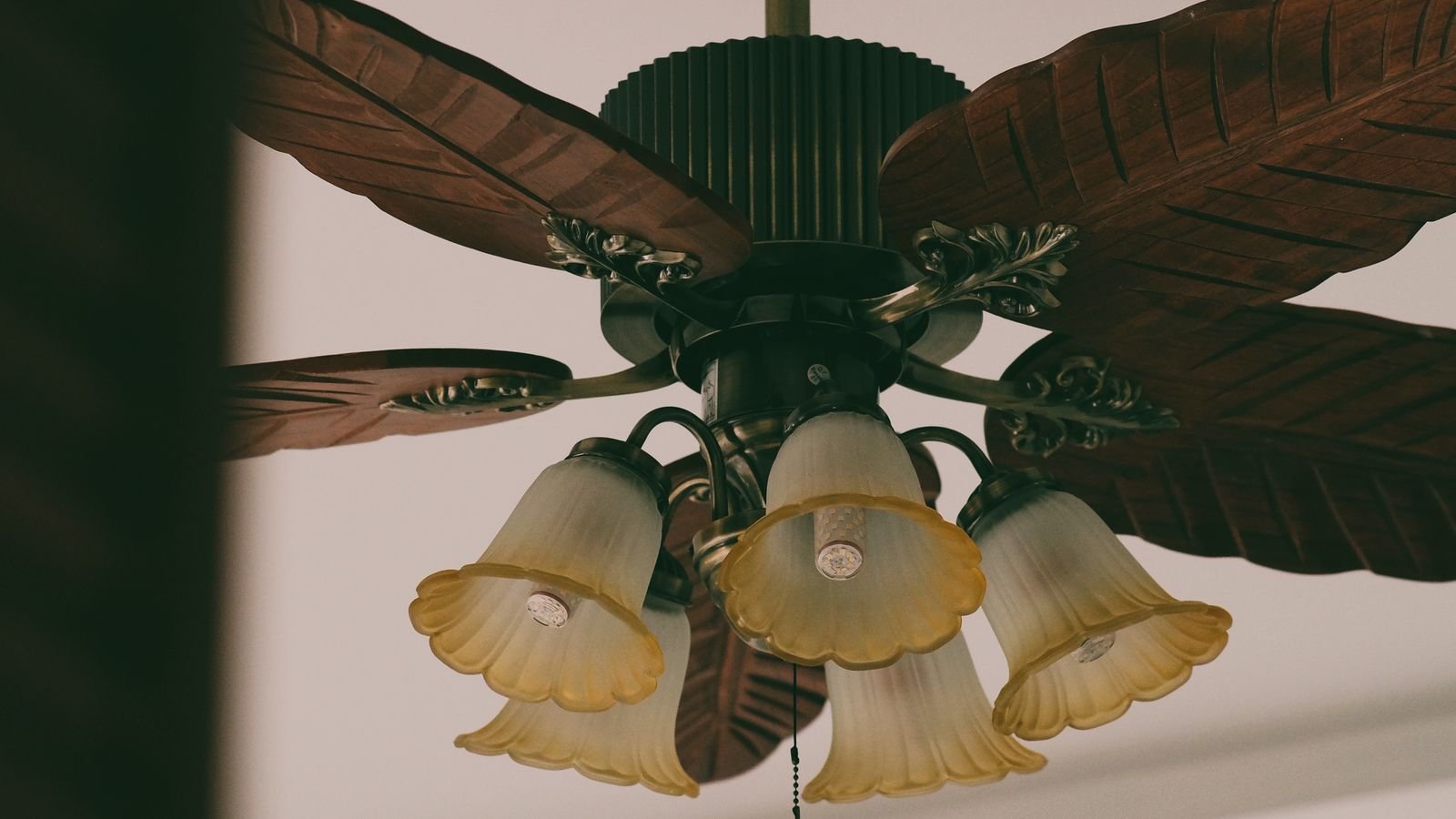
Every ceiling fan light kit carries a label — usually inside the glass shade housing, on the fitter, or on a sticker near the socket. It tells you three things you cannot guess:
- Maximum wattage per socket. Often 40W or 60W. This is a heat and safety limit written for incandescent bulbs.
- Socket base type. E26 medium (standard), E12 candelabra (small), or GU10 / GU24 pin bases on some modern kits.
- Any dimming or fixture restrictions, such as “use with enclosed-rated bulbs only.”
The wattage limit matters far less with LEDs than it did with incandescents, because an LED producing 800 lumens draws about 9 watts rather than 60. You will essentially never exceed a wattage cap with an LED. What you must not do is ignore the base type — a candelabra kit will not accept a standard bulb, and adapters that force the fit put strain on the socket.
Measure the Base Before You Buy
The single most common wasted purchase is the wrong base size. Take the old bulb out and look at the metal screw threads.
- E26 is roughly one inch across — the everyday household bulb.
- E12 is roughly half an inch — the small “candelabra” base used in most decorative fan kits.
- GU10 and GU24 have two pins and twist to lock rather than screwing in.
If you no longer have the old bulb, a US quarter is close to E26 diameter and a dime is close to E12. Take a photo of the socket before heading to the store.
Choose the Right Bulb Shape
Shape decides whether the bulb fits inside the shade and whether the light spreads evenly.
- A19 / A15 — the classic pear shape. A19 is standard; A15 is a slightly shorter version that fits shallow fan kits where an A19 would push against the glass.
- B11 / CA10 candle shapes — slim decorative bulbs for exposed candelabra kits and chandelier-style fans.
- G16.5 / G25 globes — round bulbs used where the bulb is visible under a partial shade.
- BR30 / PAR flood shapes — occasionally used on downlight-style fan kits to focus light beneath the fan.
Measure the clearance inside the shade before buying. A bulb that touches the glass concentrates heat at that point and shortens its own life dramatically. Leave at least a quarter inch of air on every side.
Insist on an Enclosed-Fixture Rating
This is the requirement most people have never heard of, and it explains most premature bulb failures in fan kits. An LED bulb’s electronics — the driver in the base — are heat sensitive. In an open lamp, the base sheds heat into the room. Inside a sealed glass shade, that heat has nowhere to go, and the driver cooks. The LED chips themselves may be fine; the driver fails, and the bulb dies or starts flickering.
Manufacturers test bulbs for this and mark the box “suitable for enclosed fixtures” or “enclosed rated.” A bulb without that marking used in a closed shade often lasts a fraction of its claimed lifespan. Because ceiling fan kits are almost always enclosed, this rating should be treated as mandatory. It is worth checking the specifications listed for the best light bulbs for ceiling fans, since enclosed-rating and vibration tolerance are exactly the details that separate bulbs built for this job from generic replacements.
Pick Brightness by Lumens, Not Watts
Watts measure power draw; lumens measure light output. Since LEDs broke the old relationship between the two, lumens are the number to shop by. A useful reference for fan light kits:
- 450 lumens per bulb — soft accent level, suitable for a four-bulb kit in a bedroom.
- 800 lumens per bulb — the equivalent of an old 60-watt bulb, the standard choice for a two- or three-bulb kit in a living room.
- 1100 lumens per bulb — bright, appropriate where the fan is the room’s only light source.
Multiply by the number of sockets to get total output. A bedroom of about 150 square feet is comfortable with roughly 1600 to 2400 total lumens from the fan; a kitchen wants considerably more, or additional fixtures.
Get the Color Temperature Right
Color temperature, measured in kelvin, changes the whole feel of a room and is the most noticeable mistake when it is wrong.
- 2700K — warm white, the color of a traditional incandescent bulb. The default choice for bedrooms and living rooms.
- 3000K — soft white, slightly crisper. Good for a fan over a dining table or in a den.
- 4000K — neutral white. Appropriate for kitchens, laundry rooms, and workshops.
- 5000K and above — daylight. Rarely flattering in a living space; save it for a garage.
Whatever you choose, keep every bulb in the kit identical and try to match the other fixtures in the room. Mixed color temperatures in a single ceiling fan are immediately, unmistakably visible. Also check the CRI figure — a value of 90 or higher renders skin tones and fabrics far more naturally than the typical 80.
Handle Dimmers and Remotes Correctly
Many ceiling fans control the light through a remote receiver in the canopy, a pull chain, or a wall dimmer. Each has implications.
If the fan has a wall dimmer, you must use bulbs explicitly labelled dimmable, and ideally check the dimmer manufacturer’s compatibility list. Old incandescent-era dimmers frequently cause LED flicker and buzz because their minimum load exceeds what a few LED bulbs draw.
If the fan uses a remote receiver, non-dimmable bulbs are usually fine, but some receivers pass a small standby current that makes certain LEDs glow faintly when off. Switching to a different bulb brand normally cures it.
If the fan uses only a pull chain, any bulb works, and dimmable versions offer no benefit.
Common Mistakes to Avoid
- Buying a non-enclosed-rated LED. The most common cause of bulbs failing within months.
- Mixing color temperatures. Always replace all bulbs in a kit together.
- Choosing a bulb that touches the shade. Check physical clearance, not just base size.
- Over-tightening. Snug is enough; forcing a bulb cracks the base and damages the socket contact.
- Using a dimmable bulb on an incompatible dimmer. Dimmable means the bulb can dim, not that any dimmer will work.
- Ignoring vibration. Fan fixtures shake constantly, so choose bulbs with solid one-piece construction rather than fragile glass-and-filament designs.
Frequently Asked Questions
Can I put a 100-watt-equivalent LED in a fixture labelled 60W max?
Yes. The label refers to actual watts drawn, and a 100W-equivalent LED typically draws around 14 actual watts — well under the limit. Confirm the physical size fits the shade.
Why does my ceiling fan light flicker only when the fan runs?
Usually a loose bulb or a worn socket contact vibrating under the fan’s motion. Turn off power, re-seat the bulbs firmly, and check that the light kit is tightly secured to the fan body.
Are vibration-rated or “rough service” bulbs necessary?
They mattered greatly for incandescent bulbs with fragile filaments. Modern LEDs have no filament and tolerate vibration well, so a standard enclosed-rated LED is fine.
Can I use smart bulbs in a ceiling fan light kit?
Yes, provided they are enclosed-rated and the fan’s light is left switched on at the wall so the bulbs keep power. They will not work reliably if a pull chain or remote regularly cuts their supply.
How many bulbs should I replace at once?
All of them. Bulbs from the same kit age together, and mismatched brightness or color between old and new bulbs is far more noticeable overhead than at eye level.
Final Thoughts
Choosing a bulb for a ceiling fan light kit comes down to five checks: the right base size, a shape that clears the shade, an enclosed-fixture rating, the lumen output the room needs, and a color temperature that matches the rest of your lighting. Get those five right, buy a full matched set at once, and the light kit stops being a recurring chore. Take a photo of the socket and the fixture label before you shop, and you will get the right bulb on the first attempt rather than the third.