 Owen Bradley
Bathroom lighting is the hardest lighting job in the house, and almost nobody treats it that way. A single fixture in the middle of the ceiling has to somehow serve shaving, makeup, cleaning, and a relaxing soak — four tasks with completely different requirements. The result, in most homes, is a room lit from directly overhead that throws every shadow downward onto the face, making the mirror useless for anything precise. Good bathroom lighting is layered: vanity lighting aimed at the face, ambient ceiling or recessed light filling the room, and accent or task light for the shower and tub. This guide walks through each layer, explains the numbers that actually matter, and helps you build a plan that works in a powder room, a full family bath, or a large primary suite in 2026.
The Three Layers of Bathroom Lighting
Every well-lit bathroom uses some combination of three layers. Understanding what each one does keeps you from asking a single fixture to do an impossible job.
Vanity (task) lighting illuminates your face at the mirror. This is the layer that determines whether your bathroom feels professional or frustrating, and it is the layer most commonly done wrong. It should come from the sides or from a broad diffused source above, never from a narrow spot directly overhead.
Ambient lighting fills the room with general light so you can navigate, clean, and see into the shower and closet. Recessed downlights, a flush-mount ceiling fixture, or a small chandelier all serve this role.
Accent and specialty lighting covers everything else: a wet-rated downlight over the shower, a light inside a niche, toe-kick lighting under the vanity for nighttime trips, or a dimmable fixture over the tub. These are optional in a small bathroom and transformative in a large one.
A powder room can survive on two layers. A primary bathroom really wants all three, on separate switches so you can run low ambient light at 2 a.m. without triggering full vanity brightness.
Vanity Lighting: Getting the Mirror Right
The physics here are simple. Light from directly above your head casts shadows into your eye sockets, under your nose, and under your chin — exactly the areas you need to see. Light arriving from the sides at roughly face height fills those shadows and produces even, flattering illumination.
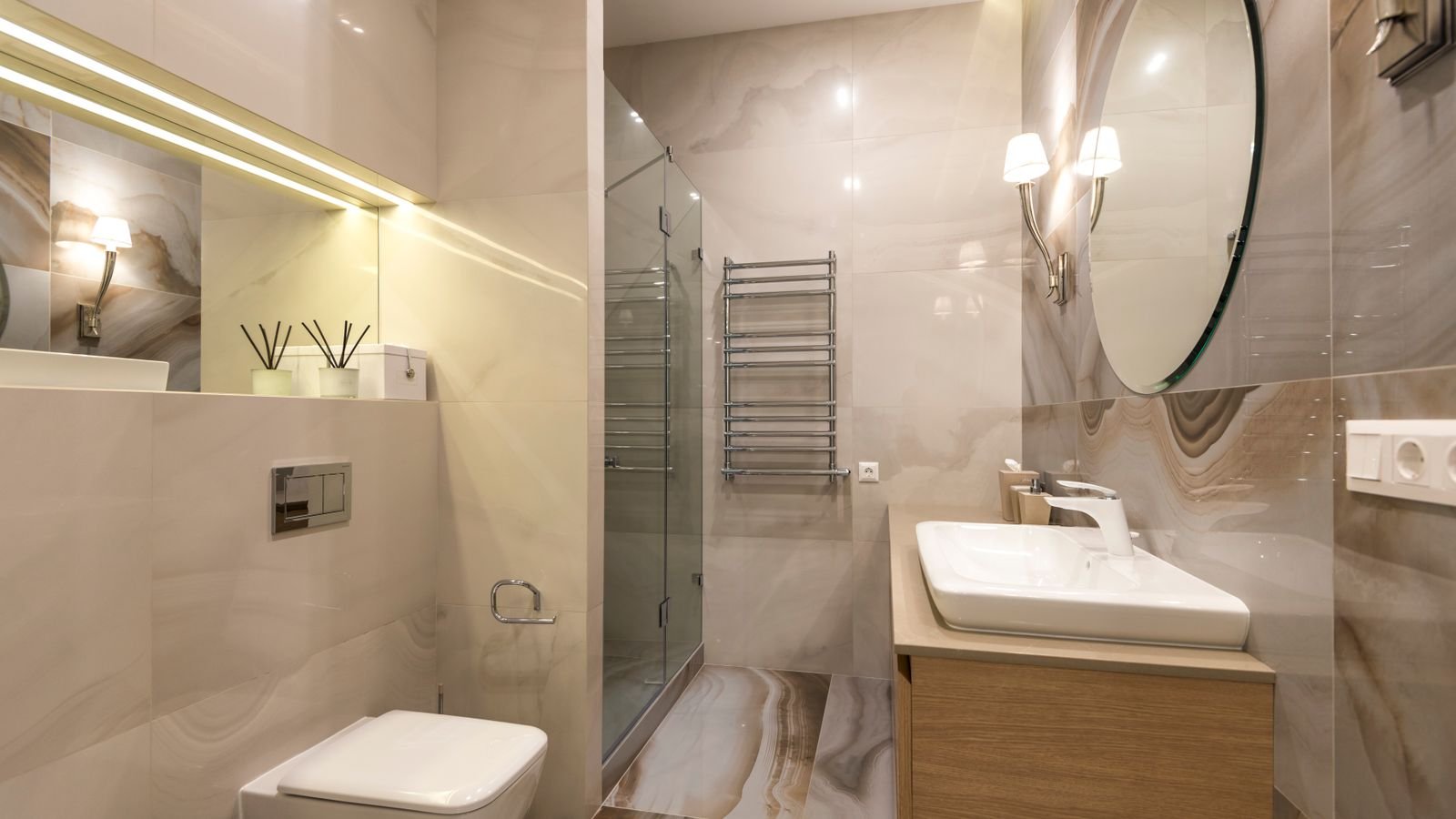
The gold standard is a pair of sconces flanking the mirror, mounted about 36 to 40 inches apart (center to center) at roughly 65 to 70 inches above the floor, which places them near eye level for most adults. Choose fixtures with a diffusing shade — frosted glass, fabric, or opal acrylic — so the source is broad rather than a hard point.
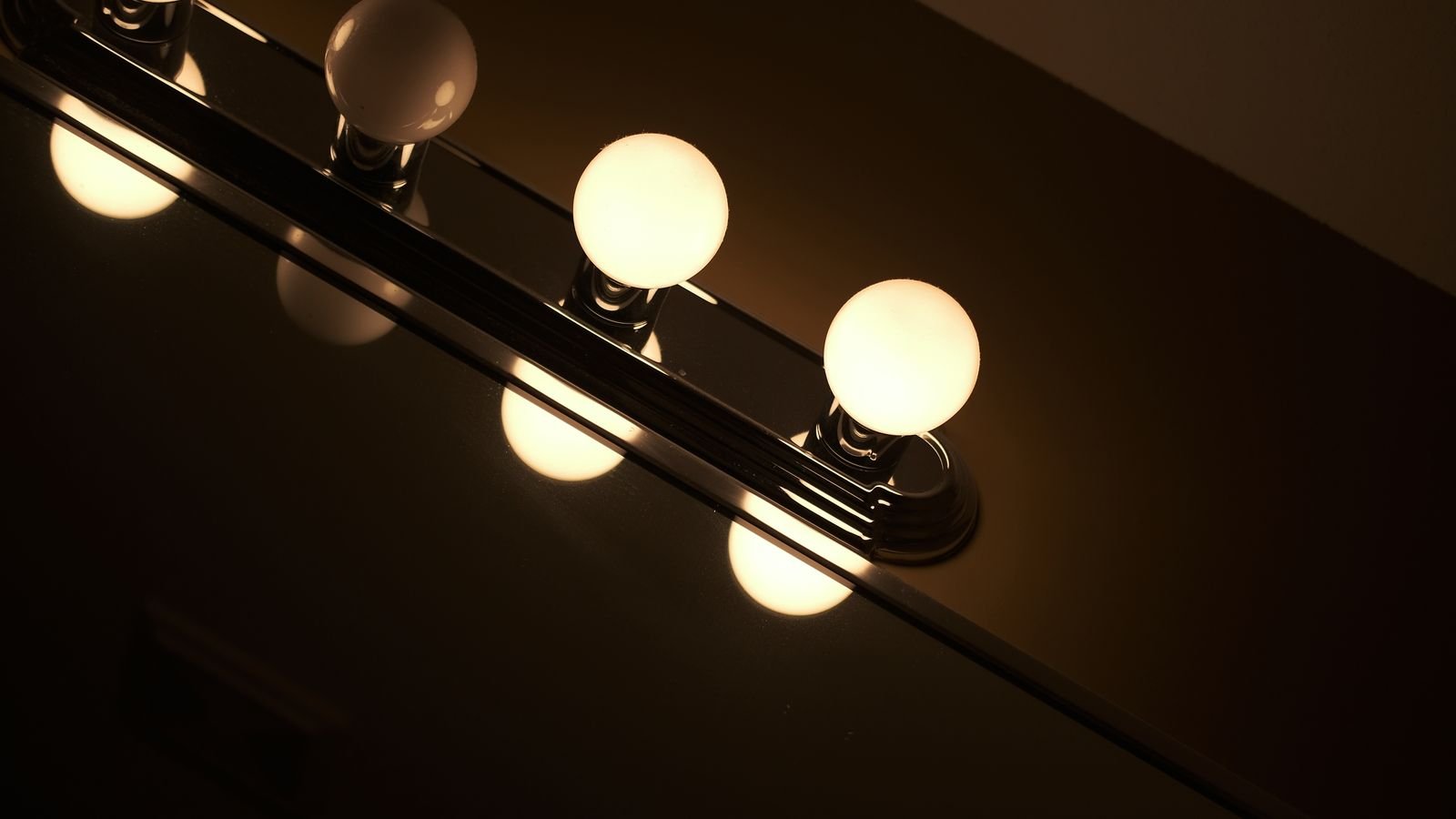
If side sconces are not possible because the mirror spans the wall, use a horizontal vanity bar mounted above the mirror. Choose one that is at least 24 inches wide for a single sink and 36 inches or more for a double vanity, and give strong preference to fixtures with shades pointing down and outward rather than a bare row of exposed globes. Whatever fixture you pick, the bulbs inside do most of the work — see our roundup of the best light bulbs for bathroom vanity fixtures for options with the color rendering you need.
Color Temperature and CRI: The Two Numbers That Matter Most
Color temperature, measured in kelvin, describes whether light looks warm and yellow or cool and blue. For bathrooms, 2700K to 3000K produces a warm, residential, flattering light and pairs well with warm-toned tile and brass or bronze finishes. 3500K to 4000K reads as neutral to slightly cool, keeps white tile looking crisp, and is the preferred range for grooming tasks where you want accuracy over atmosphere.
A practical compromise: use 3000K for ambient ceiling lighting and 3500K or 4000K at the vanity, or install tunable bulbs that let you shift between them. What you should avoid is mixing 2700K and 5000K in the same sightline — the contrast makes the warmer fixture look dingy and yellow.
CRI — color rendering index — measures how accurately a light source reveals colors compared with daylight. This matters enormously in a bathroom. A bulb with a CRI of 80 will make skin tones look flat and can render foundation or hair color inaccurately; you apply makeup that looks correct at the mirror and wrong the moment you step outside. Insist on CRI 90 or higher for vanity bulbs. The premium is a few dollars per bulb and it is the single highest-value upgrade in the room. If makeup accuracy is your priority, our guide to the best light bulbs for makeup covers high-CRI options in detail.
How Much Light Do You Actually Need?
Lumens, not watts, tell you brightness. A rough planning target for bathrooms:
- Ambient lighting: about 50 to 75 lumens per square foot. A 50 sq ft bathroom therefore wants roughly 2,500 to 3,750 lumens total from ceiling sources.
- Vanity lighting: 1,600 to 2,400 lumens across the mirror area — typically two bulbs of 800 to 1,100 lumens each, or a bar fixture in that combined range.
- Shower: a single wet-rated downlight of 600 to 800 lumens is usually plenty for a standard enclosure.
These are starting points, not rules. Dark tile, deep paint colors, and matte finishes absorb light and push you toward the upper end; white subway tile and a large mirror bounce light around and let you go lower. The safest approach is to specify generously and put everything on dimmers, which costs little and gives you the full range afterward.
Recessed Lighting for Bathrooms
Recessed downlights are the workhorse ambient layer in most modern bathrooms. They disappear into the ceiling, distribute light evenly, and free up wall space. Placement matters more than fixture choice: space 4-inch or 6-inch downlights roughly 3 to 4 feet apart, and keep them 18 to 24 inches out from the wall so they wash the wall rather than grazing it and highlighting every drywall imperfection.
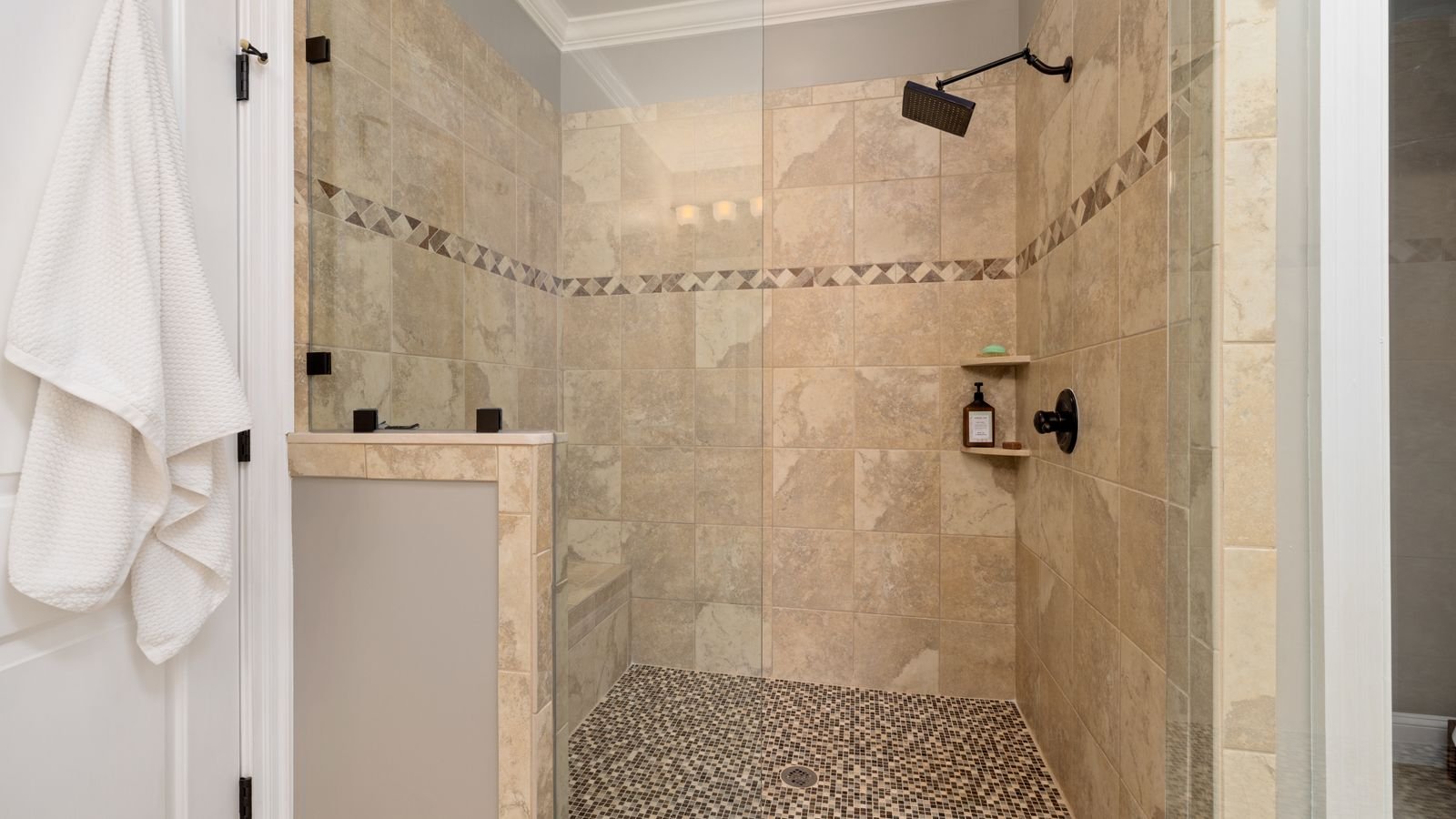
Two ratings are non-negotiable. Any fixture over a tub or inside a shower enclosure must be wet rated; fixtures elsewhere in the bathroom should be at minimum damp rated. Second, if the fixture sits under insulated attic space, it needs to be IC rated so insulation can contact the housing safely. Canless LED downlights have made both easy to satisfy in retrofits, since the thin housing needs only a few inches of ceiling depth.
For a full comparison of trims, beam angles, and wet-rated designs, see our picks for the best recessed lighting for bathrooms, and if you are specifically lighting an enclosure, our guide to recessed lighting for showers covers the wet-rated lens options that keep moisture out.
Ceiling Fixtures, Flush Mounts, and Decorative Options
Not every bathroom wants recessed cans. A single flush-mount or semi-flush fixture is often the right answer in a small bathroom with an 8-foot ceiling — it is one electrical box, one fixture, and a broad diffuse source that fills the room without the ceiling looking like Swiss cheese. Look for models with an opal or frosted diffuser rather than clear glass, which produces glare when you look up from the tub.
In larger bathrooms with 9-foot or higher ceilings, a small chandelier or pendant over the tub adds character that downlights cannot. Building codes generally require any hanging fixture to be at least 8 feet above the tub rim or 3 feet horizontally from the tub edge — check your local requirements, since they vary. And if you are lighting a room with mixed fixture types, our overview of the best light bulbs for bathroom fixtures explains which base types and shapes fit where.
Dimming, Switching, and Controls
The single best control decision is putting the vanity and ambient layers on separate switches, each dimmable. Full brightness serves grooming; 15 percent ambient at night lets you use the bathroom without the jolt of full light. If you can add only one dimmer, make it the ambient layer.
A few practical notes. Not all LED bulbs dim, and those that do vary widely in how low they go and whether they flicker or buzz at the bottom of the range. Match a modern LED-compatible dimmer to your bulbs, and buy one bulb to test before committing to eight. Motion sensor switches are a good fit for guest baths and powder rooms where lights routinely get left on, but avoid them for the main bathroom where a long soak will leave you sitting in the dark.
Budget Tiers: What You Get at Each Level
- Under $150 — bulb and control refresh. Replace existing bulbs with high-CRI 3000K–4000K LEDs, add an LED-compatible dimmer, and swap a clear diffuser for a frosted one. In a bathroom with decent fixture placement this alone fixes most complaints.
- $150–$500 — fixture upgrade. A new vanity bar or a pair of sconces, plus a better ceiling fixture. This is where you correct bad light direction, which bulbs alone cannot do.
- $500–$1,500 — layered rebuild. Add recessed downlights on their own dimmed circuit, a wet-rated shower light, and dedicated vanity fixtures. Usually requires an electrician and some drywall work.
- $1,500 and up — full design. Everything above plus accent lighting in niches, toe-kick lighting, a decorative tub fixture, and smart controls with scenes.
Common Bathroom Lighting Mistakes
- One overhead fixture doing everything. The most common and most fixable error. Overhead light alone guarantees facial shadows at the mirror.
- Ignoring CRI. A cheap 80-CRI bulb undermines an expensive fixture. Skin tones and color matching both suffer.
- Mounting sconces too high. Sconces at 78 inches behave like overhead lights. Aim for eye level, around 65 to 70 inches.
- Mixing color temperatures. Two different kelvin values visible at once always looks like a mistake, because it is.
- Skipping wet and damp ratings. A standard fixture over a shower will corrode, fail, and in the worst case create a safety hazard.
- Buying non-dimmable bulbs to save a few dollars. You lose all flexibility for the life of the fixture.
- Too few lumens in a dark-tiled room. Dark surfaces can absorb half the light you install. Plan for it.
Frequently Asked Questions
What color temperature is best for a bathroom?
3000K is the safest all-round choice for a warm, residential feel. If grooming accuracy matters more than ambience, move the vanity to 3500K or 4000K. Keep every fixture visible from one spot within about 500K of each other.
Can I put recessed lights directly over a shower?
Yes, provided the fixture is wet rated and typically fitted with a sealed shower trim. Damp-rated fixtures are not sufficient inside an enclosure where they receive direct spray and steam.
How many recessed lights does a bathroom need?
A 50 sq ft bathroom is usually well served by three or four 4-inch downlights spaced 3 to 4 feet apart, supplemented by dedicated vanity lighting. Downlights alone will not solve mirror shadows no matter how many you add.
Are LED vanity bulbs bright enough for makeup?
Easily, as long as you choose high-CRI bulbs. Two 800-lumen bulbs at CRI 90 or above, positioned on either side of the mirror, outperform a single much brighter overhead source because the light arrives from the correct direction.
Do bathroom lights need to be on a GFCI circuit?
Requirements vary by jurisdiction and by how close the fixture sits to water. Many modern codes require GFCI protection for bathroom receptacles and for fixtures within certain zones around tubs and showers. Confirm with your local code or a licensed electrician before you wire anything.
Final Thoughts
Bathroom lighting rewards planning far more than spending. The layered approach — task light at the mirror, ambient light in the room, accent light where it adds value — solves the problems that no single fixture can, and it works at every budget. If you make only three decisions, make them these: put light beside the mirror rather than only above it, insist on CRI 90 or higher for anything that lights your face, and dim everything. Get those right and the fixture styling becomes a purely aesthetic choice, which is exactly where it belongs.